
Life, 1917-07-19 · page 10 of 40
Life — July 19, 1917 — page 10: what you’re looking at
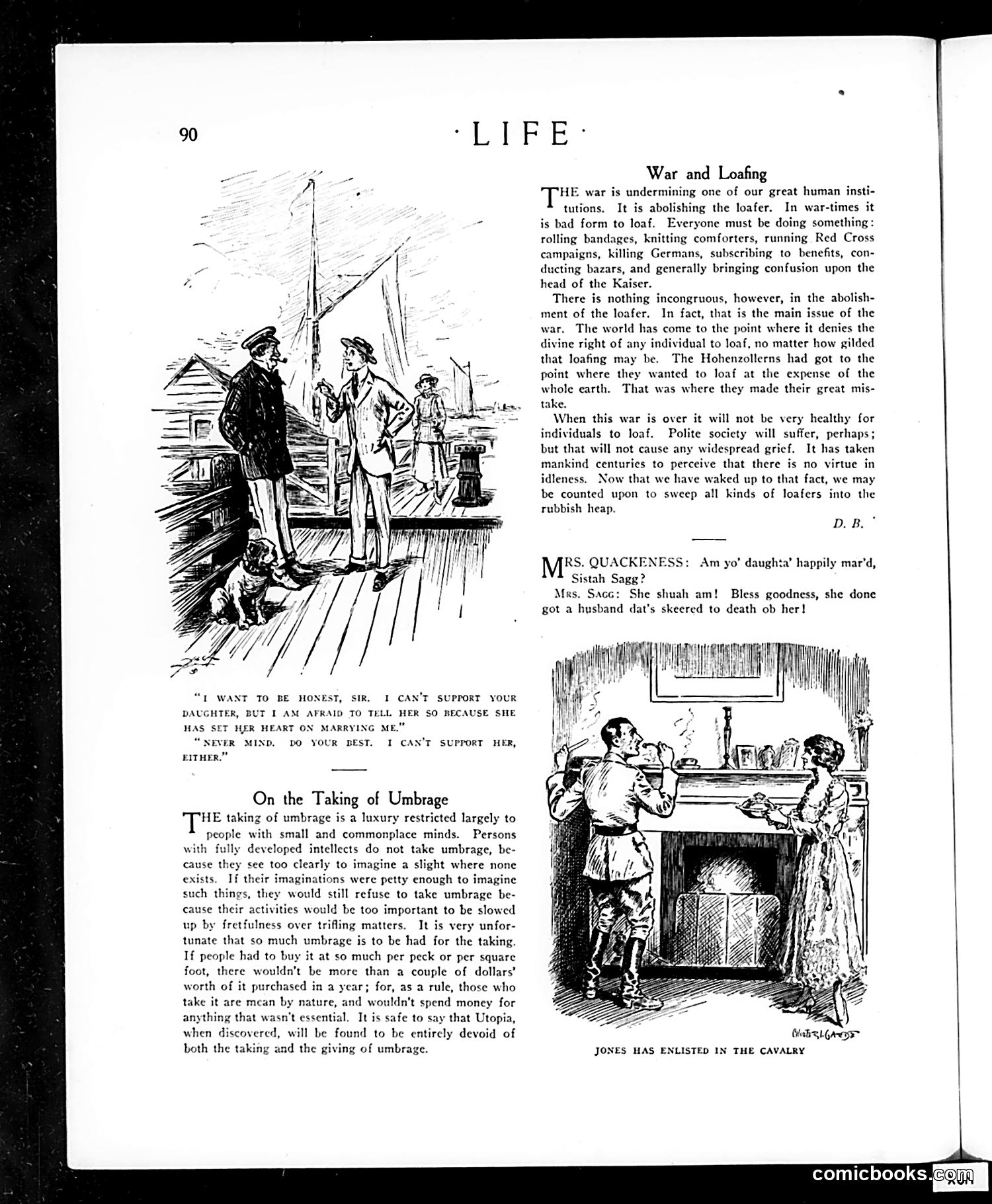
What you’re looking at
This page contains three distinct pieces: 1. **"War and Loafing"** (essay by D.B.): A World War I-era commentary arguing that warfare is eliminating idleness from society. The author contends that loafing—previously considered acceptable among the upper classes—has become socially unacceptable during wartime, when everyone must contribute productively. 2. **"Mrs. Quackeness" dialogue**: A brief humorous exchange where a woman questions whether her daughter is happily married, receiving the reply that the daughter's husband has died in war. 3. **"On the Taking of Umbrage"**: An essay criticizing people who take offense easily, arguing that truly intelligent people avoid such pettiness and that umbrage-taking is economically wasteful. 4. **"Jones Has Enlisted in the Cavalry"**: A domestic illustration showing what appears to be a farewell scene, complementing the wartime themes throughout.
📄 Transcribed text from this page (OCR, searchable)
Machine-transcribed from the original scan — historical spelling and the odd misread are preserved.
‘LL FE * War and Loafing HE war is undermining one of our great human insti- tutions. It is abolishing the loafer. In war-times it is bad form to loaf. Everyone must be doing something : rolling bandages, knitting comforters, running Red Cross campaigns, killing Germans, subscribing to benefits, con- ducting bazars, and generally bringing confusion upon the head of the Kaiser. There is nothing incongruous, however, in the abolish- ment of the loafer, In fact, that is the main issue of the war. The world has come to the point where it denies the divine right of any individual to loaf, no matter how gilded that loafing may be. The Hohenzollerns had got to the point where they wanted to loaf at the expense of the whole earth. That was where they made their great mis- take. When this war is over it will not be very healthy for individuals to loaf. Polite society will suffer, perhaps; but that will not cause any widespread grief. It has taken mankind centuries to perceive that there is no virtue in idleness. Now that we have waked up to that fact, we may be counted upon to sweep all kinds of loafers into the rubbish heap. D.B.* RS. QUACK: Sistah Sagg? Mrs. Sacc: She shuah am! Bless goodness, she done got a husband dat’s skeered to death ob her! Am yo’ daughta’ happily mar’d, “LT WANT TO BE HONEST, SIR. I CAN'T SUPPORT YOUR DAUGHTER, BUT I AM AFRAID TO TELL HER SO BECAUSE SHE HAS SET HER HEART ON MARRYING ME.” ER MIND. DO YOUR BEST. I CAN'T SUPPORT HER, EITHER.” On the Taking of Umbrage THe taking of umbrage is a luxury restricted largely to people with small and commonplace minds. Persons with fully developed intellects do not take umbrage, be- cause they see too clearly to imagine a slight where none exists. If their imaginations were petty enough to imagine such things, they would still refuse to take umbrage be- cause their activities would be too important to be slowed up by fretfulness over trifling matters. It is very unfor- tunate that so much umbrage is to be had for the taking. If people had to buy it at so much per peck or per square foot, there wouldn't be more than a couple of dollars’ worth of it purchased in a year; for, as a rule, those who take it are mean by nature, and wouldn't spend money for anything that wasn’t essential. It is safe to say that Utopia, when discovered, will be found to be entircly devoid of both the taking and the giving of umbrage. JONES HAS ENLISTED IN THE CAVALRY comicbooks.