
Life, 1917-07-19 · page 18 of 40
Life — July 19, 1917 — page 18: what you’re looking at
What you’re looking at
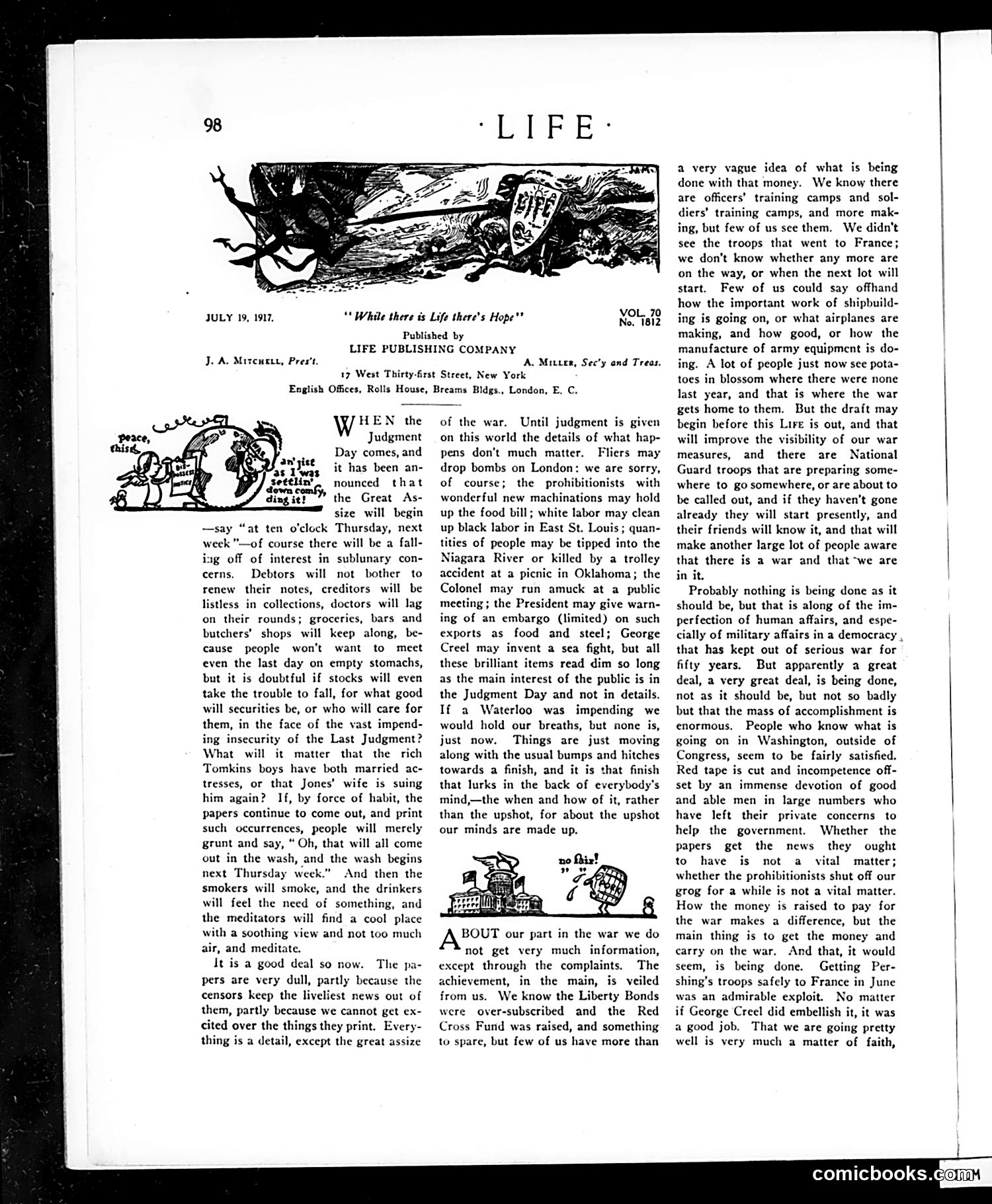
This satirical editorial uses the metaphor of Judgment Day to critique American public apathy toward World War I. The author argues that Americans treat the war as so momentous—a kind of "Last Judgment"—that all mundane concerns (stocks, lawsuits, daily news) seem trivial by comparison. This paralysis of interest renders newspapers dull. The piece then shifts to concrete complaint: the government severely restricts war information through censorship. Americans know Liberty Bonds succeeded and soldiers trained, but remain ignorant about shipbuilding progress, aircraft production, troop deployments to France, and equipment manufacturing. The cartoons (showing a fallen soldier and domestic scenes) reinforce the disconnect between the massive war effort and the information vacuum reaching civilians. The satire suggests this information blackout leaves the public both anxious and disengaged.
📄 Transcribed text from this page (OCR, searchable)
Machine-transcribed from the original scan — historical spelling and the odd misread are preserved.
JULY 19, 1917, “While there és Life there's Hope" VOL. 70 No, 1812 Published by LIFE PUBLISHING COMPANY J. A. Mircurtt, Pres’t. A. Mitre, Sec’y and Treas. 17 West Thirty-first Street, New York English Offices, Rolls House, Breams Bldgs., London, E. C. HEN the Judgment Day comes, and it has been an- settlin’. nounced that down comfy, ding it? the Great As- size will begin —say “at ten o'clock Thursday, next week "—of course there will be a fall- ing off of interest in sublunary con- cerns. Debtors will not bother to renew their notes, creditors will be listless in collections, doctors will lag on their rounds; groceries, bars and butchers’ shops will keep along, be- cause people won't want to meet even the last day on empty stomachs, but it is doubtful if stocks will even take the trouble to fall, for what good will securities be, or who will care for them, in the face of the vast impend- ing insecurity of the Last Judgment? What will it matter that the rich Tomkins boys have both married ac- tresses, or that Jones’ wife is suing him again? If, by force of habit, the papers continue to come out, and print such occurrences, people will merely grunt and say, “Oh, that will all come out in the wash, and the wash begins next Thursday week.” And then the smokers will smoke, and the drinkers will feel the need of something, and the meditators will find a cool place with a soothing view and not too much air, and meditate. It is a good deal so now. The pa- pers are very dull, partly because the censors keep the liveliest news out of them, partly because we cannot get ex- cited over the things they print. Every- thing is a detail, except the great assize of the war. Until judgment is given on this world the details of what hap- pens don’t much matter. Fliers may drop bombs on London: we are sorry, of course; the prohibitionists with wonderful new machinations may hold up the food bill; white labor may clean up black labor in East St. Louis ; quan- tities of people may be tipped into the Niagara River or killed by a trolley accident at a picnic in Oklahoma; the Colonel may run amuck at a public meeting ; the President may give warn- ing of an embargo (limited) on such exports as food and steel; George Creel may invent a sea fight, but all these brilliant items read dim so long as the main interest of the public is in the Judgment Day and not in details. If a Waterloo was impending we would hold our breaths, but none is, just now. Things are just moving along with the usual bumps and hitches towards a finish, and it is that finish that lurks in the back of everybody's mind,—the when and how of it, rather than the upshot, for about the upshot our minds are made up. BOUT our part in the war we do not get very much information, except through the complaints. The achievement, in the main, is veiled from us. We know the Liberty Bonds were over-subscribed and the Red Cross Fund was raised, and something to spare, but few of us have more than a very vague idea of what is being done with that money. We know there are officers’ training camps and sol- diers’ training camps, and more mak- ing, but few of us sce them. We didn't see the troops that went to France; we don’t know whether any more are on the way, or when the next lot will start. Few of us could say offhand how the important work of shipbuild- ing is going on, or what airplanes are making, and how good, or how the manufacture of army equipment is do- ing. A lot of people just now sce pota- toes in blossom where there were none last year, and that is where the war gets home to them. But the draft may begin before this Lire is out, and that will improve the visibility of our war measures, and there are National Guard troops that are preparing some- where to go somewhere, or are about to be called out, and if they haven’t gone already they will start presently, and their friends will know it, and that will make another large lot of people aware that there is a war and that “we are in it. Probably nothing is being done as it should be, but that is along of the im- perfection of human affairs, and espe- cially of military affairs in a democracy , that has kept out of serious war for fifty years. But apparently a great deal, a very great deal, is being done, not as it should be, but not so badly but that the mass of accomplishment is enormous. People who know what is going on in Washington, outside of Congress, seem to be fairly satisfied. Red tape is cut and incompetence off- set by an immense devotion of good and able men in large numbers who have left their private concerns to help the government. Whether the papers get the news they ought to have is not a vital matter; whether the prohibitionists shut off our grog for a while is not a vital matter. How the money is raised to pay for the war makes a difference, but the main thing is to get the money and carry on the war. And that, it would seem, is being done. Getting Per- shing’s troops safely to France in June was an admirable exploit. No matter if George Creel did embellish it, it was a good job. That we are going pretty well is very much a matter of faith, comicbooks.