
A complete issue · 39 pages · 1917
Life — June 28, 1917
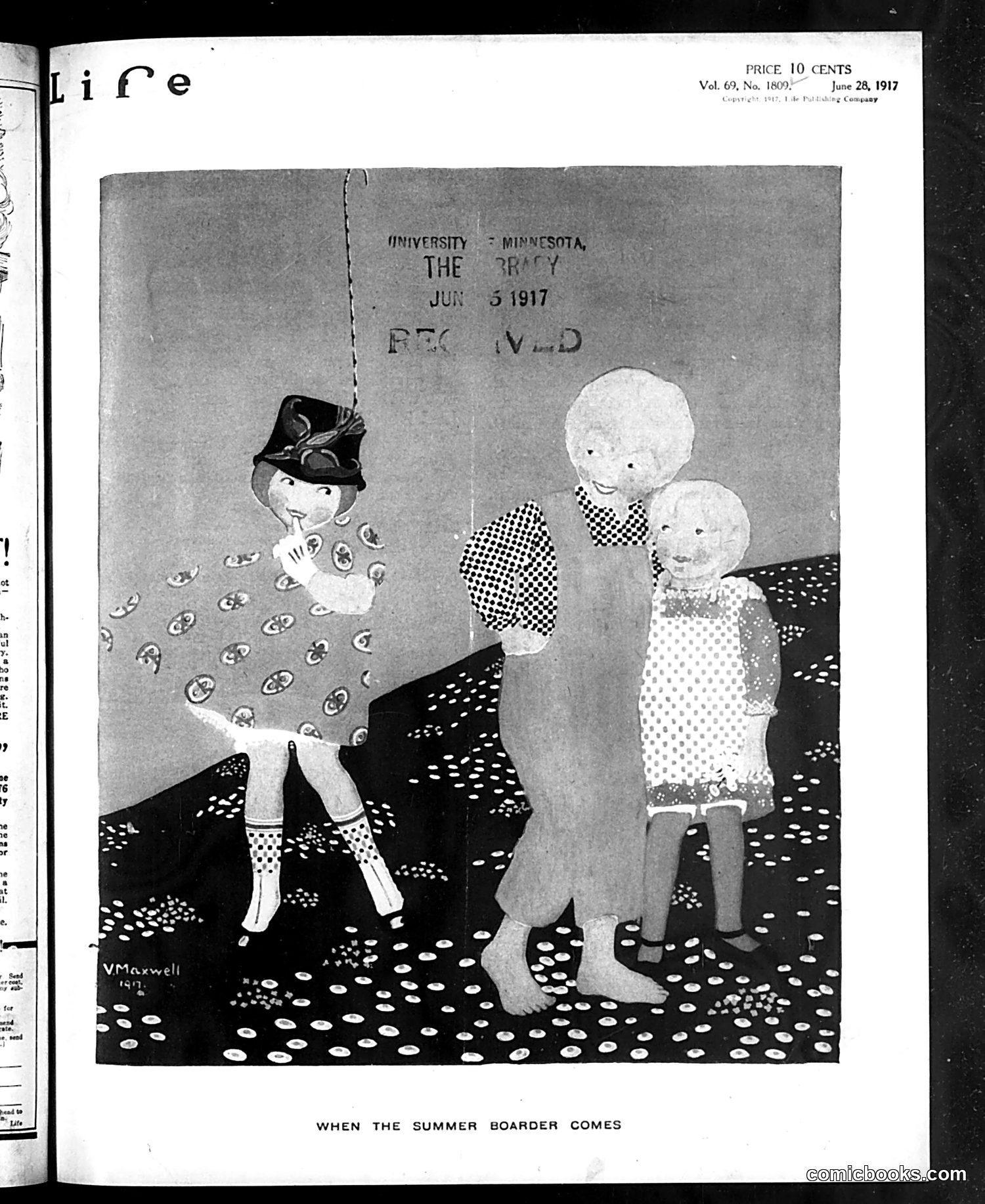
This 1917 *Life* magazine cartoon satirizes the phenomenon of summer boarders—typically wealthy city dwellers who rented rooms in rural homes during summer months. The illustration shows a fashionably dressed woman arriving with luggage, while two local children observe her with wide-eyed curiosity. The joke targets the contrast between urban sophistication and rural simplicity. The boarder's elaborate checkered outfit and hat represent city fashion and wealth, while the plainly-dressed local children embody rural innocence. The scattered coins on the ground suggest the economic benefit—and perhaps the ostentatious spending—such visitors brought to rural communities. The cartoon gently mocks both the pretentiousness of city visitors and the rural residents' fascination with their exotic guests.
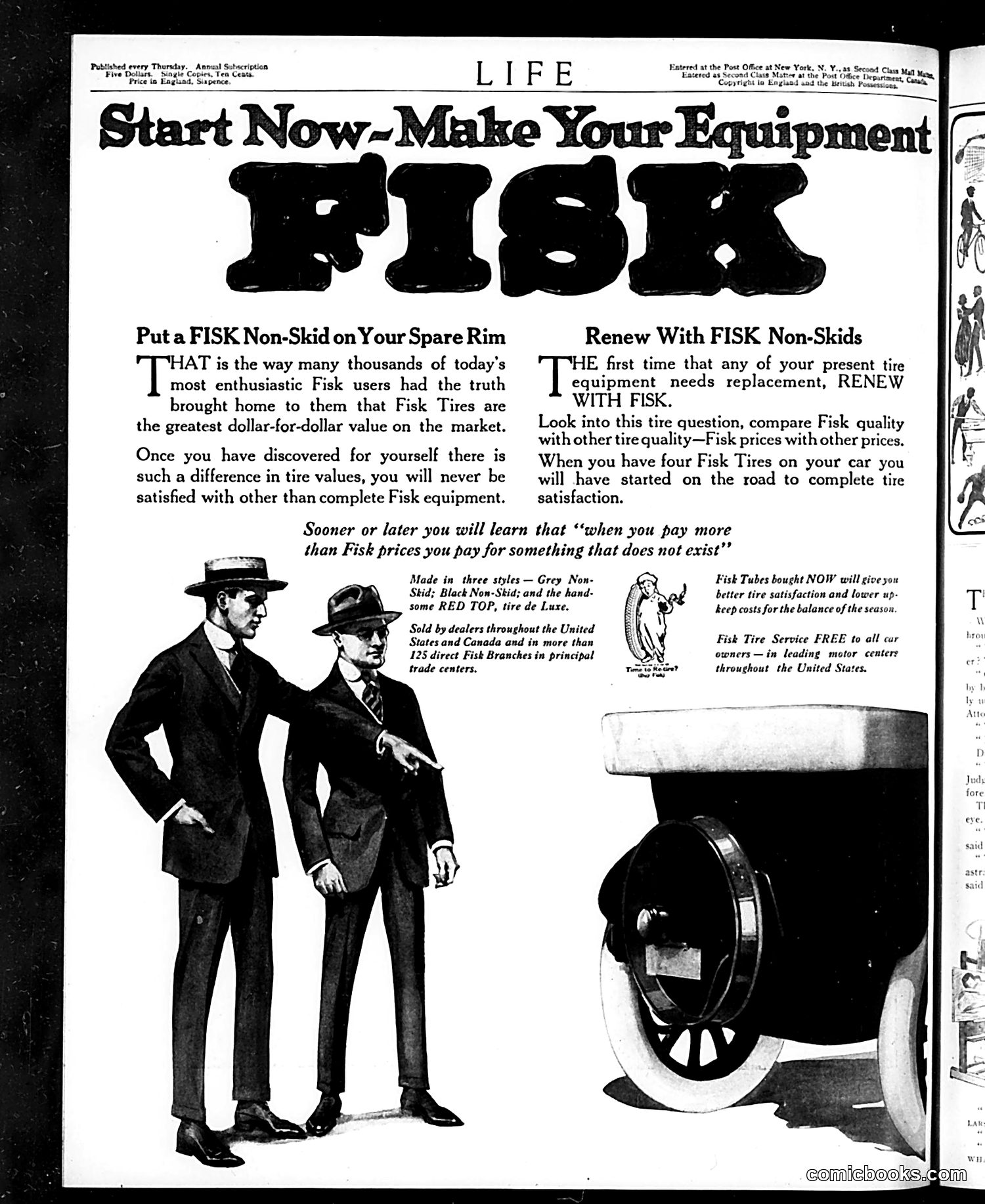
This is primarily a **Fisk Tire advertisement**, not political satire. The page promotes Fisk Non-Skid tires as superior value. The two illustrated figures in business suits appear to be generic "modern businessmen" rather than specific political figures or caricatures. They're positioned as representatives of the target consumer—professionals who should upgrade their vehicle equipment to Fisk tires. The advertisement's central claim—"when you pay more with Fisk prices you pay for something that does not exist"—uses paradoxical language meant as a compliment, suggesting Fisk's superior quality justifies its price premium. The tire image demonstrates the product itself. This is straightforward commercial messaging typical of early 20th-century magazine advertising, not political commentary or satire requiring historical context to interpret.
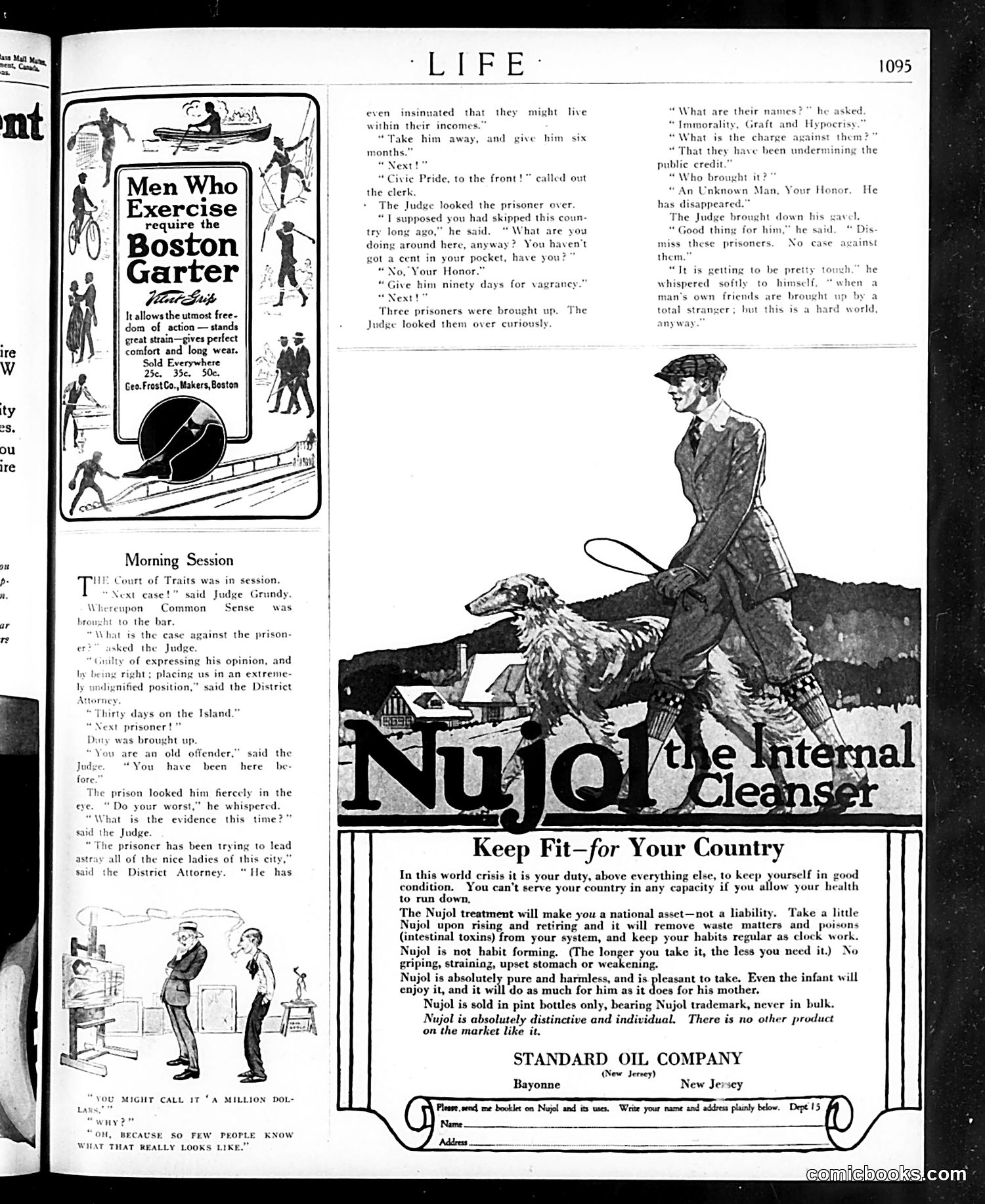
This page contains two distinct elements: **Left side:** A Boston Garter advertisement featuring illustrations of men exercising, promoting the product as providing "comfort and long wear" at various price points. **Right side:** A large advertisement for Nujol, a laxative product by Standard Oil Company. The ad features an illustration of a man with a tennis racket and dog, positioned above text reading "Nujol the Internal Cleanser" with the patriotic slogan "Keep Fit—for Your Country." The advertisement frames bowel regularity as a civic duty during wartime, claiming Nujol treatment makes one "a national asset—not a liability." This represents typical early-20th-century marketing that connected personal health products to patriotic obligation, particularly relevant during World War I. The page is primarily advertising-driven rather than satirical content.
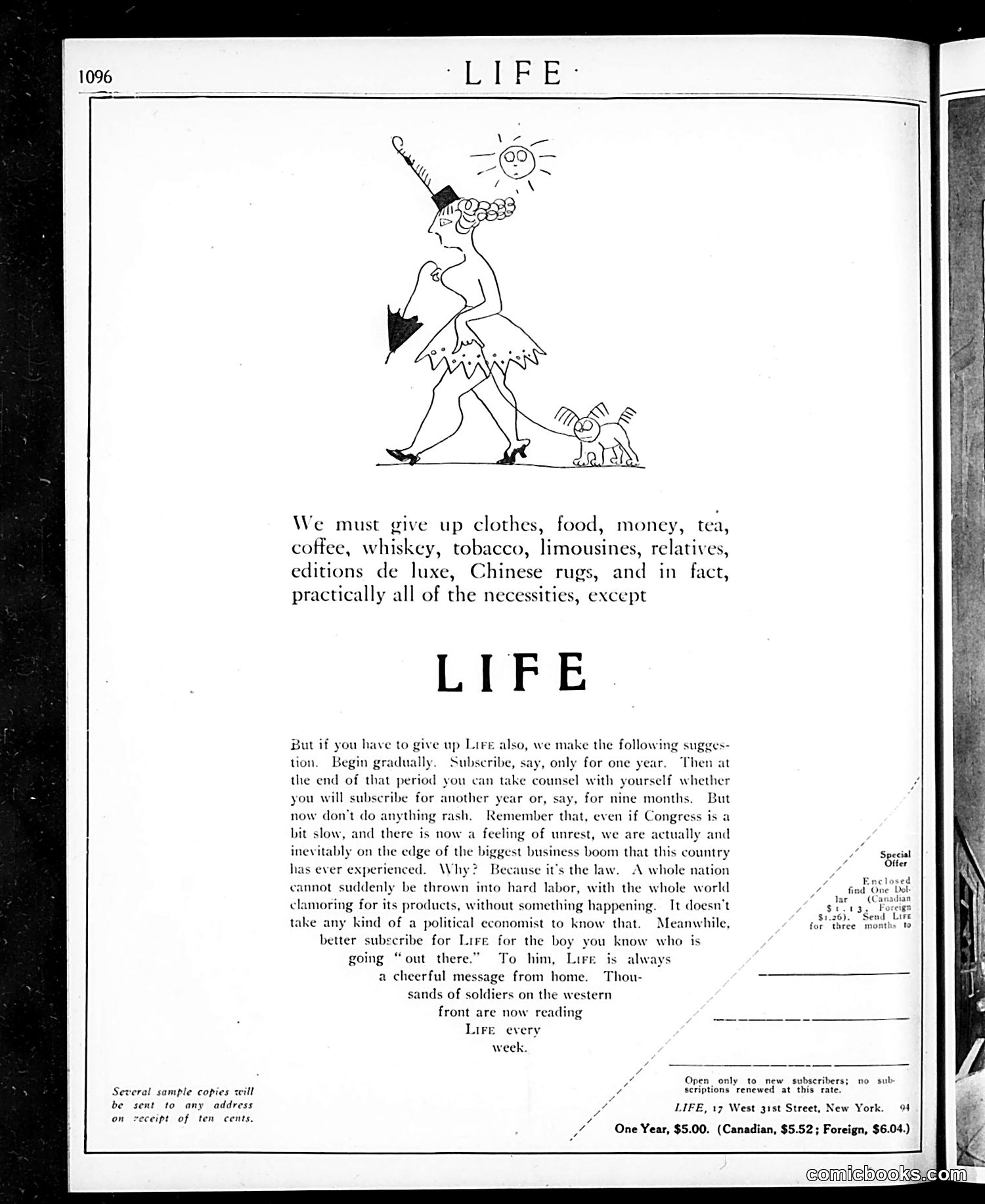
This is primarily a **subscription advertisement** for Life magazine, using satire to promote readership. The cartoon depicts a fashionable woman juggling life's luxuries—clothes, food, money, tea, coffee, whiskey, tobacco, limousines, relatives, and expensive goods. The visual joke plays on the word "LIFE": the ad argues readers must sacrifice nearly everything *except* LIFE itself (the magazine). The accompanying text suggests subscribing to Life during uncertain times (references to "Congress" and "unrest" suggest post-WWI economic anxiety). It appeals particularly to soldiers on the front who need "a cheerful message from home." The satire mocks conspicuous consumption and social anxieties of the era while paradoxically promoting the magazine as an essential, not a luxury.
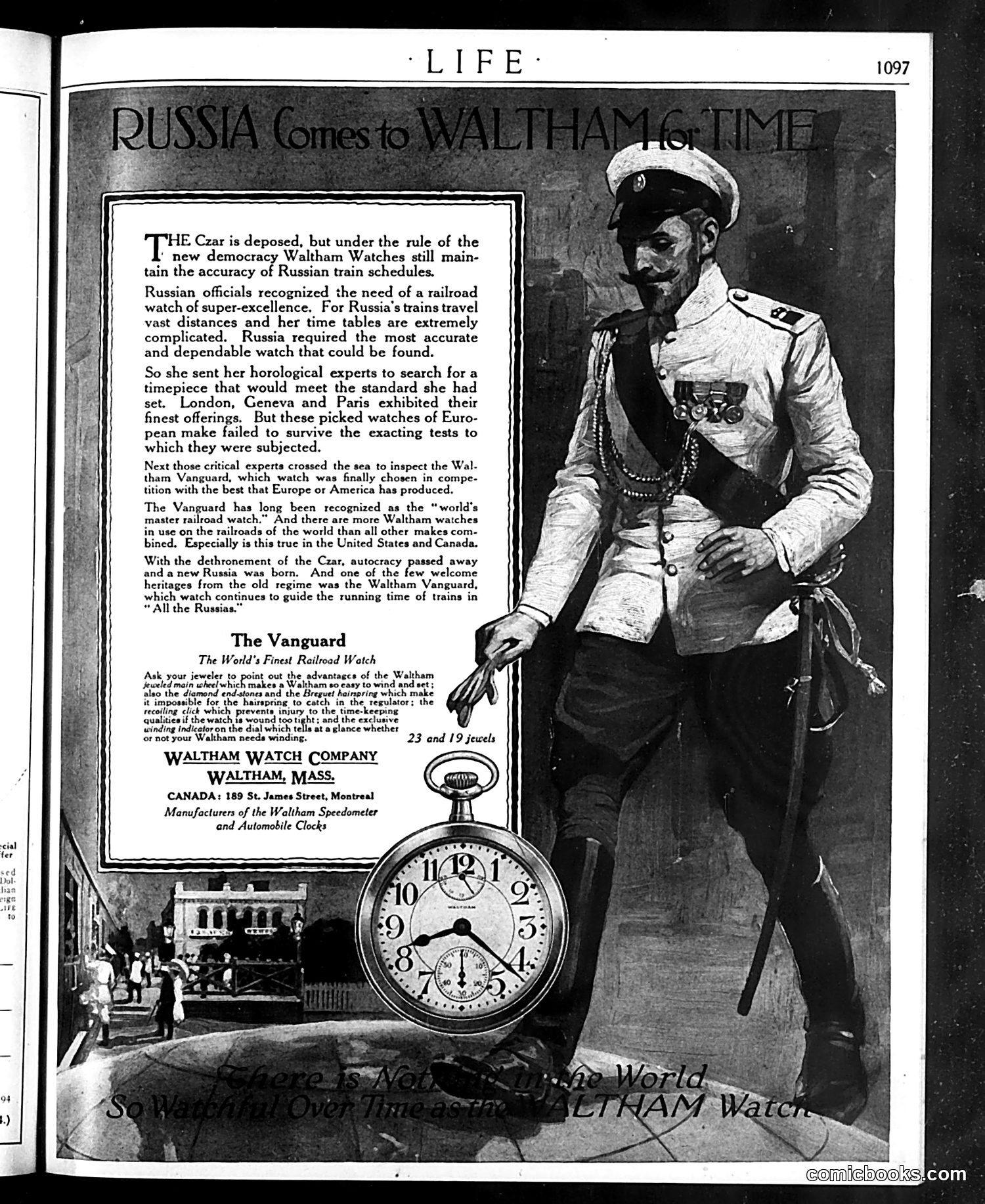
This is primarily a **Waltham Watch Company advertisement** disguised as editorial content, a common early 20th-century advertising practice. The headline "RUSSIA Comes to WALTHAM for TIME" references Russia's post-Czarist transition to democracy (the text mentions "the Czar is deposed"). The ad claims Russian railroad officials needed ultra-precise watches and selected Waltham's "Vanguard" model after testing European competitors' offerings. The illustration shows a Russian official (identifiable by his military uniform and cap) holding the advertised pocket watch. The accompanying text emphasizes the Vanguard's reliability for railroad scheduling across Russia's vast distances. **This is straightforward product advertising**, leveraging Russia's political upheaval and modernization needs to promote American watchmaking superiority.
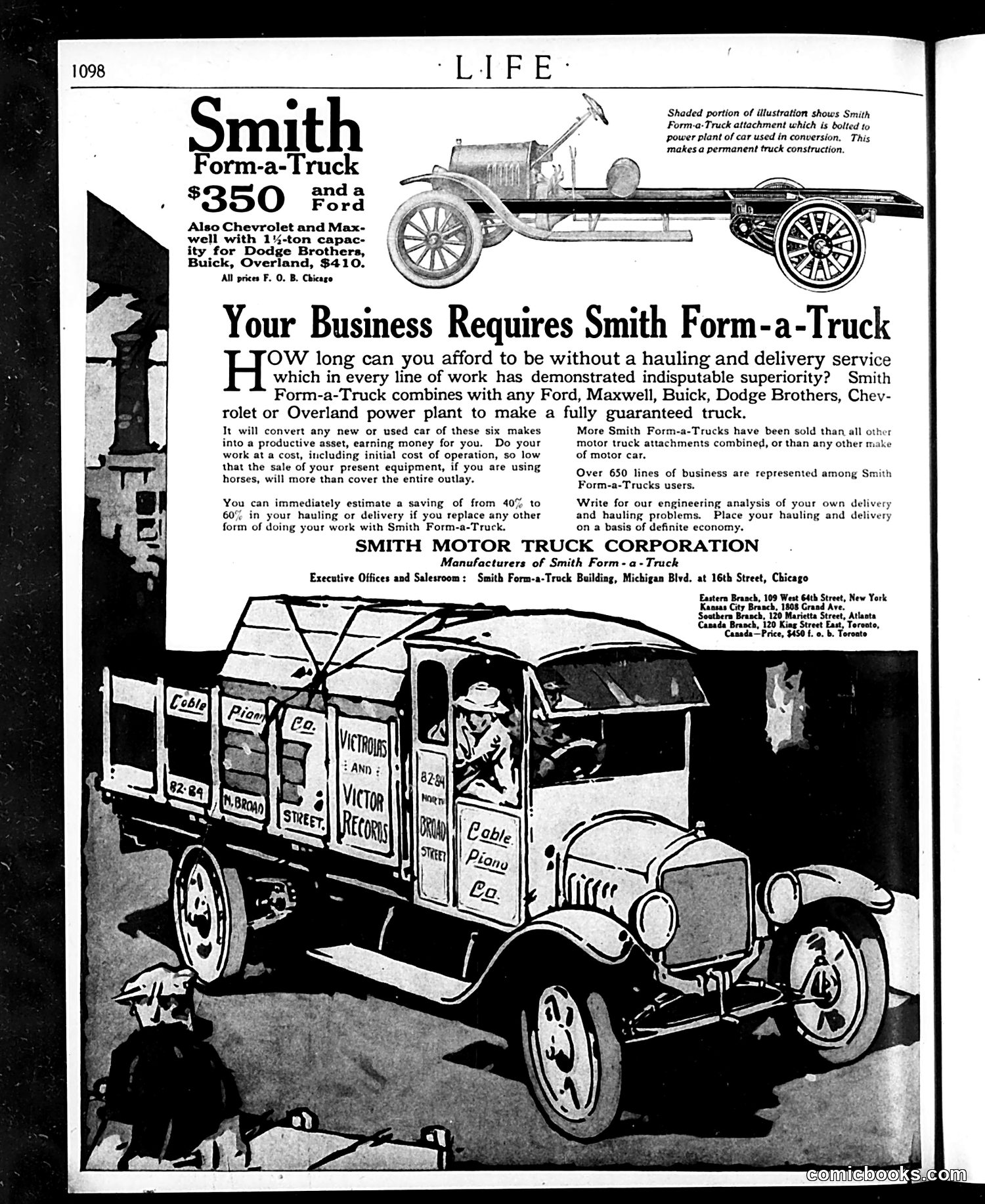
This page is **primarily advertising, not satire or political commentary**. It contains two advertisements for Smith Form-a-Truck, a modular truck bed system that could be attached to various car chassis (Ford, Chevrolet, Maxwell, Buick, Dodge Brothers). The top illustration shows the truck attachment mechanism. The bottom photograph depicts an actual Form-a-Truck converted vehicle used by "Loble Piano Co." for delivery service in what appears to be the 1920s. The advertising copy emphasizes practical business benefits: cost efficiency, versatility across multiple vehicle makes, and superior hauling capacity compared to horse-drawn equipment. This reflects early automotive commerce when businesses were rapidly transitioning from horses to motorized delivery. There is no political satire or social commentary evident on this page.
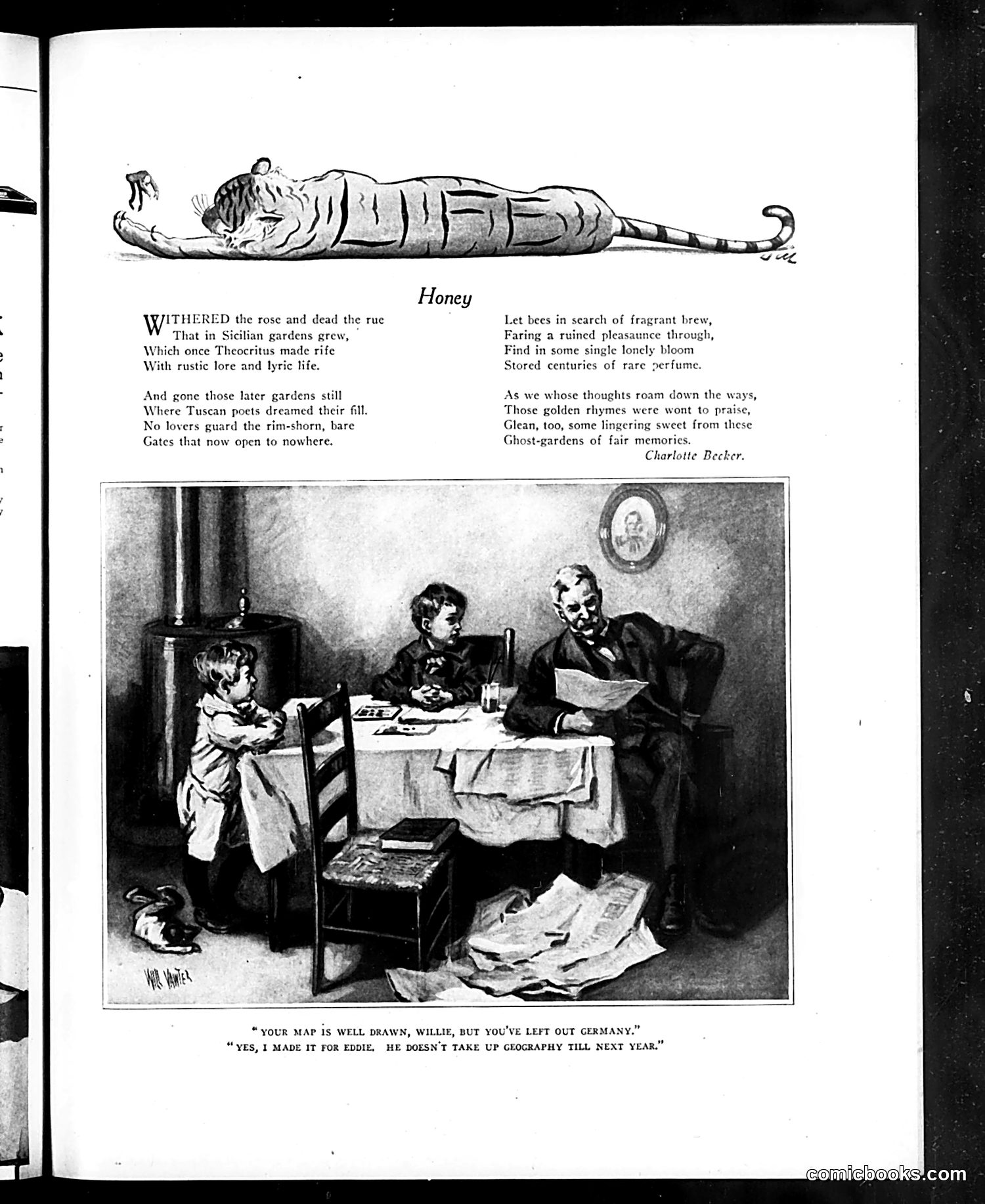
This page contains a poem titled "Honey" by Charlotte Becker, followed by a cartoon about geography homework. **The Cartoon:** A young boy named Willie shows his map to two adult men (likely his father and teacher). The adults praise the map's quality, but one notes: "Your map is well drawn, Willie, but you've left out Germany." Willie responds he made it for his friend Eddie, who "doesn't take up geography till next year." **The Satire:** This is a mild joke about a child's deliberate incompleteness—Willie intentionally omitted Germany from his map to simplify it for a younger student. The humor relies on the boy's practical logic versus adult expectations of thoroughness. There's no apparent political commentary, just gentle satire about childhood reasoning.
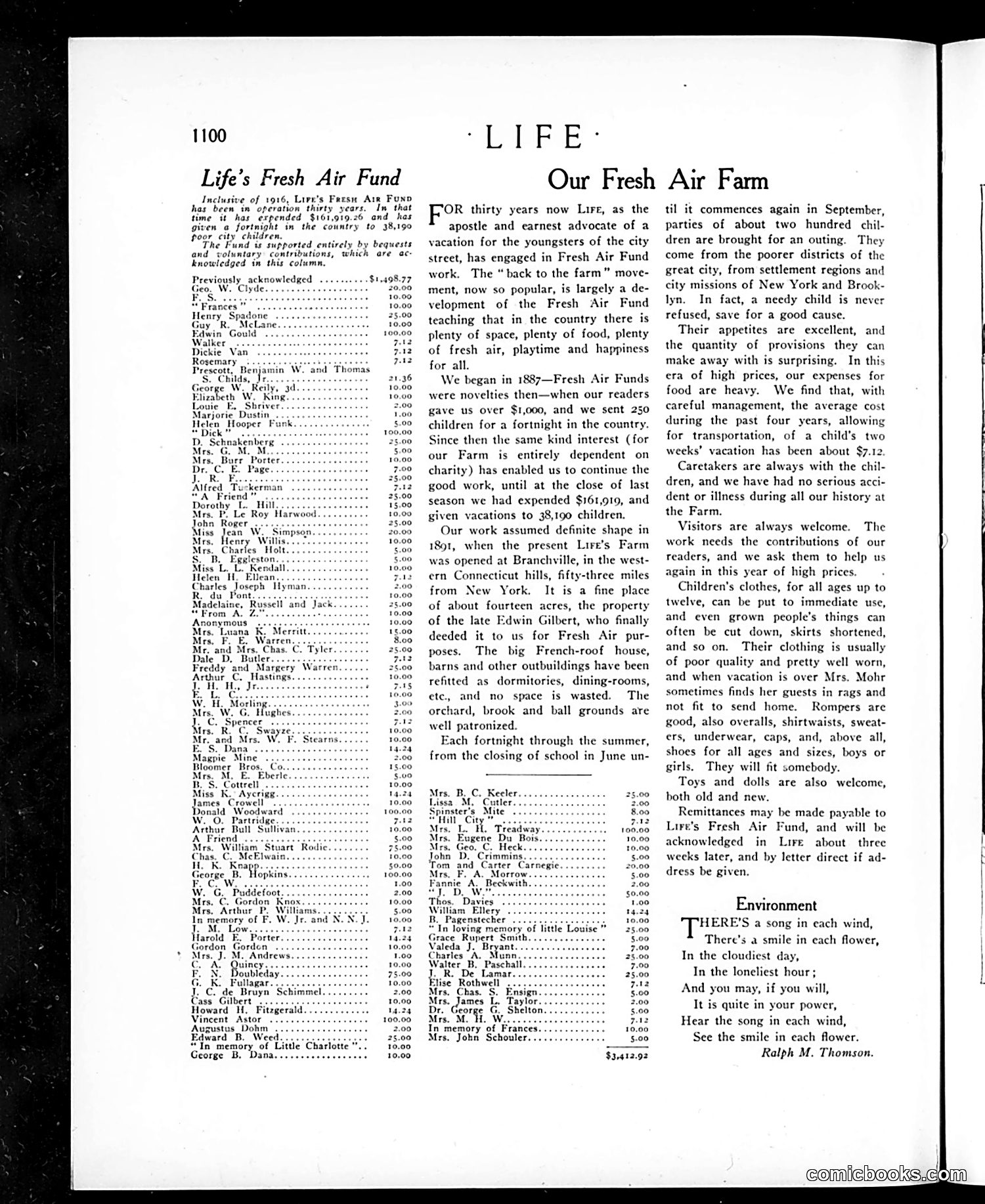
This page is primarily **not a cartoon but fundraising content** for Life magazine's Fresh Air Fund. The left column lists donors and contribution amounts to support the charity, which has operated since 1882, sending underprivileged children from New York City to a farm in Connecticut for summer vacations. The right side describes "Our Fresh Air Farm"—a 14-acre property in Branchville where about 200 children from poor city districts spend two weeks annually at minimal cost ($7.12 per child in this year of "high prices"). The farm provides clothing donations, recreation, and rural respite for urban youth. At bottom, a poem titled "Environment" by Ralph M. Thomson appears, celebrating nature's restorative power—thematically aligned with the charity's mission.
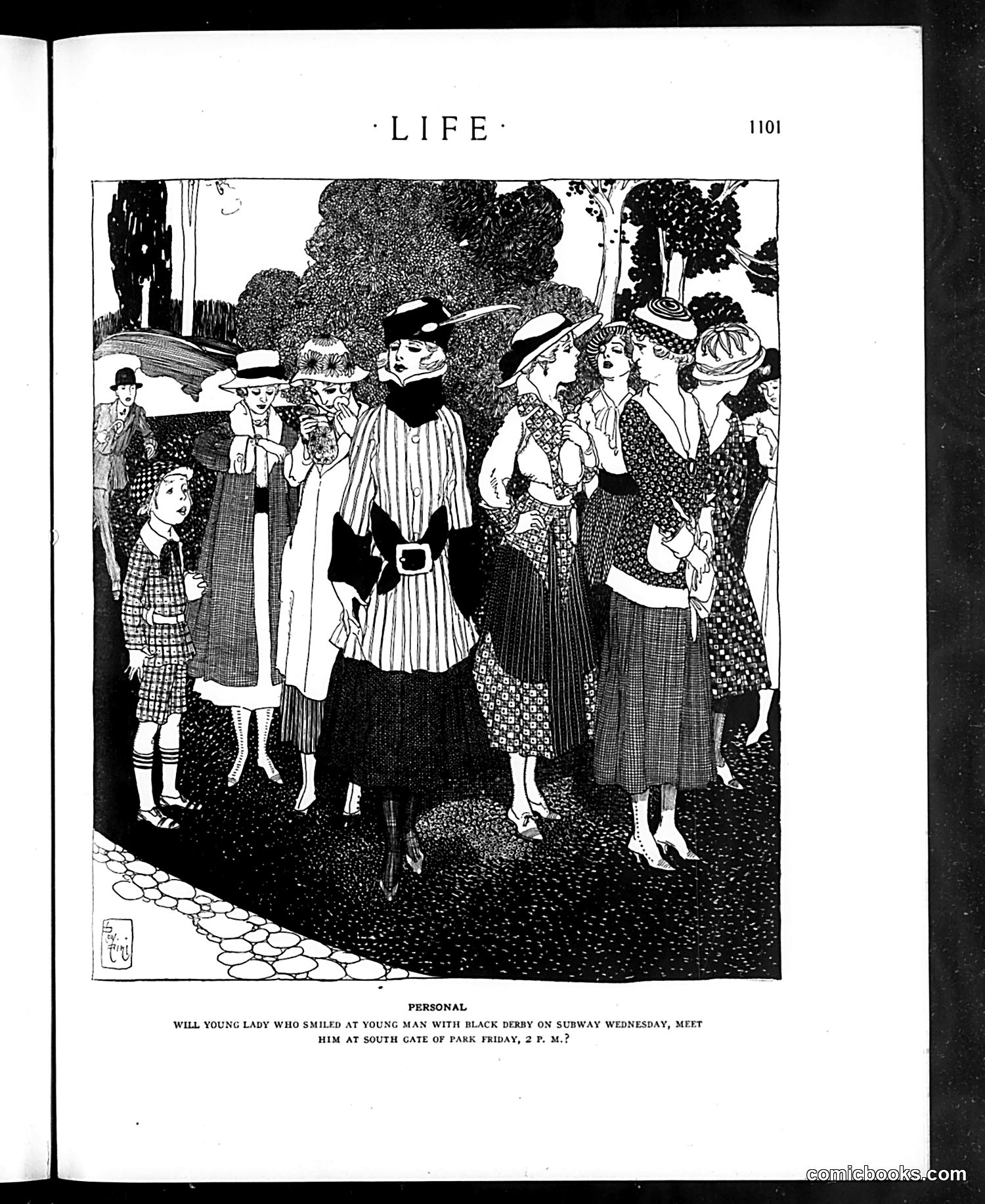
This is a "Personal" advertisement section from Life magazine. The illustration depicts a fashionable group of people in 1920s attire gathered in what appears to be a park setting. The text reads: "WILL YOUNG LADY WHO SMILED AT YOUNG MAN WITH BLACK DERBY ON SUBWAY WEDNESDAY, MEET HIM AT SOUTH GATE OF PARK FRIDAY, 2 P.M.?" This is a "missed connection" advertisement—a common feature in magazines and newspapers where someone seeks to reconnect with a stranger they encountered briefly. The romantic scenario reflects 1920s courtship customs, where a chance smile on public transit could spark interest. The specific details (black derby hat, subway, park location, time) are meant to help the woman identify the sender. This section satirizes the earnestness of such hopeful personal ads.
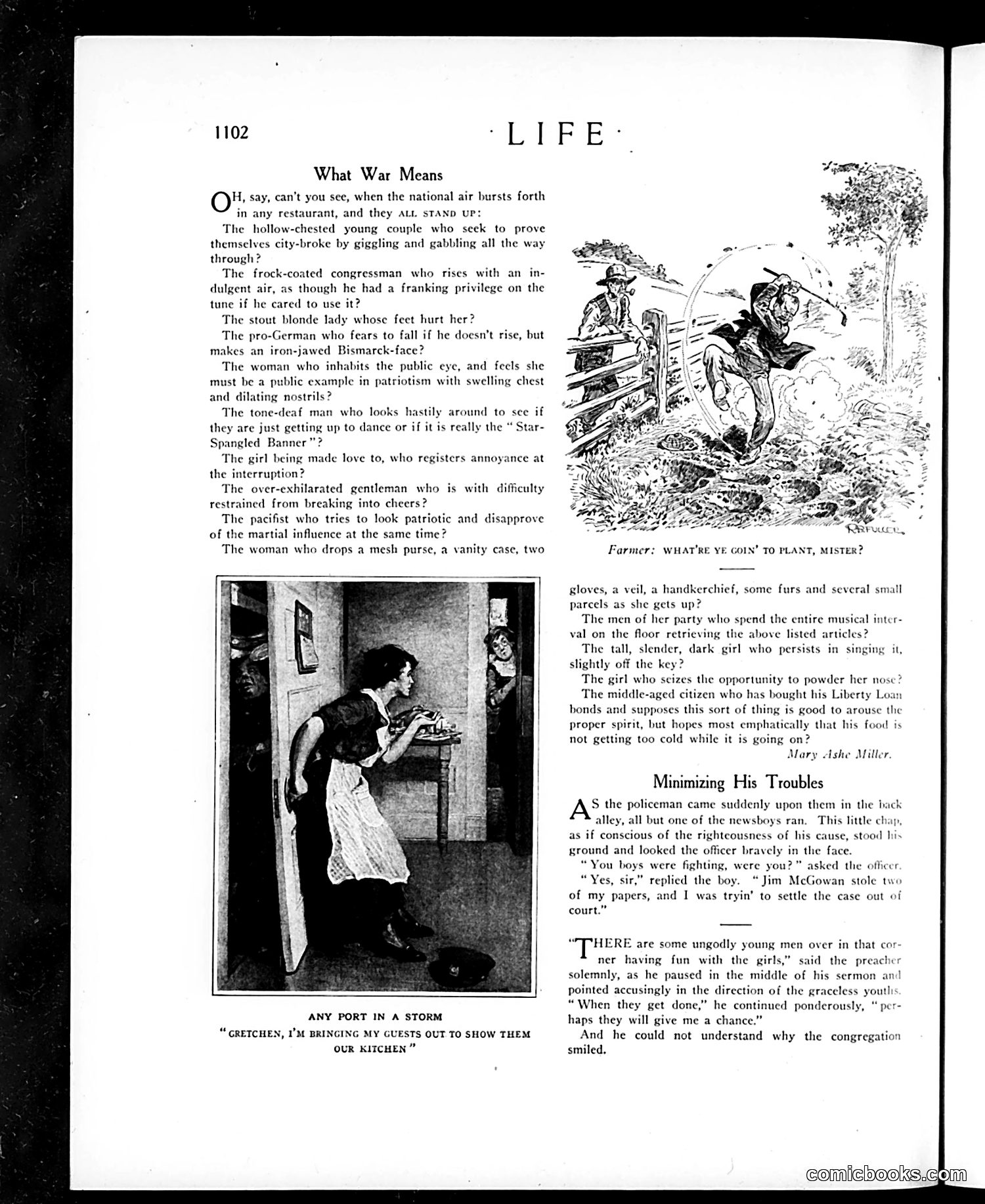
This satirical article by Mary Ashe Miller catalogs the social disruptions caused by World War I on American home life. The piece lists absurd and petty complaints about how war affects civilian behavior—people being loud in restaurants, young couples showing off, congressmen acting superior, women staring rudely—suggesting that Americans are treating wartime as an excuse for bad manners rather than recognizing genuine hardship. The photograph shows a woman (captioned "Gretchen, I'm bringing my guests out to show them our kitchen") displaying domestic life, likely mocking the trivial concerns of the wealthy during wartime. The second article, "Minimizing His Troubles," describes a newsboy caught between warring factions, suggesting even children navigate conflict with practical concern for consequences rather than ideology.
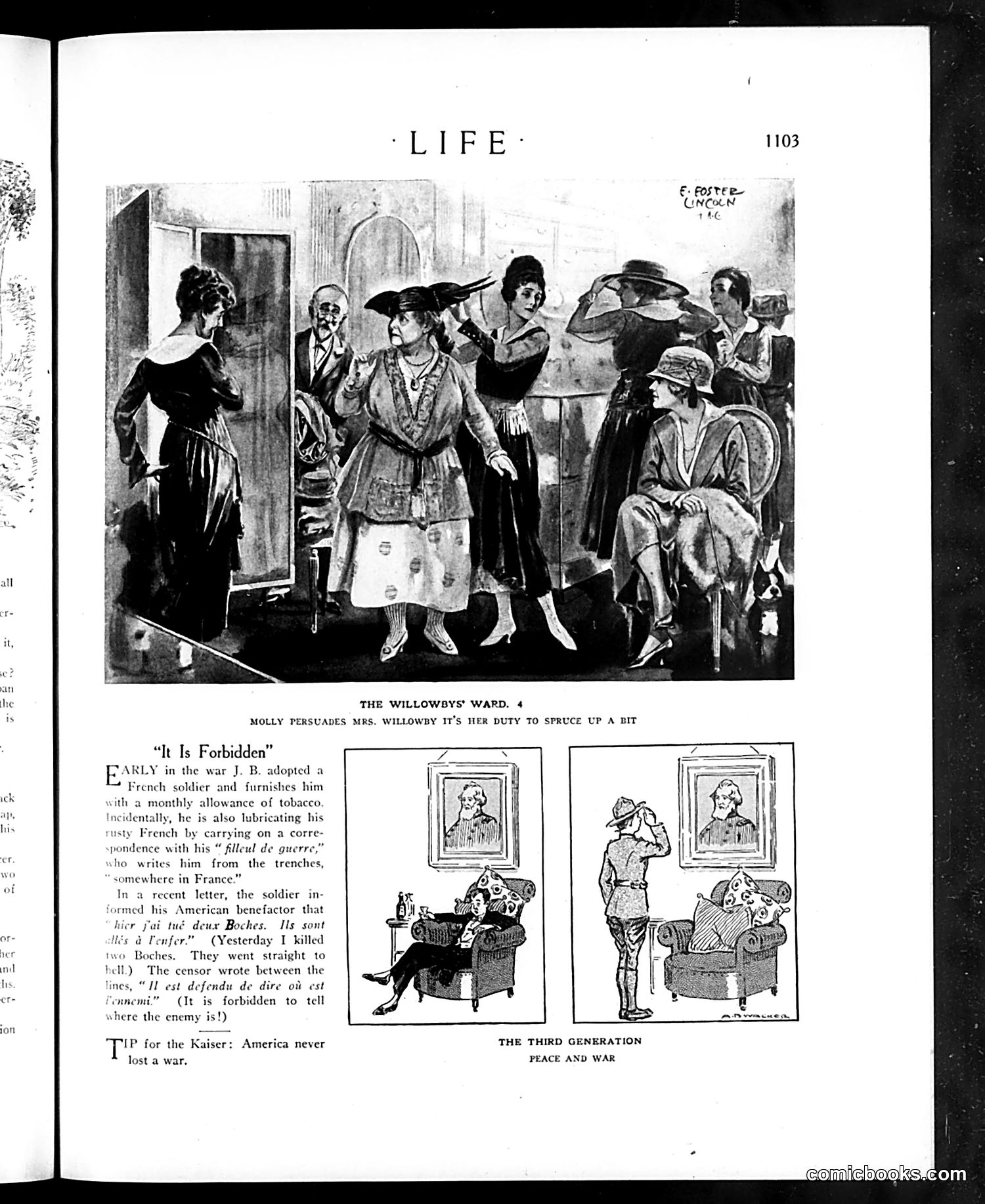
**Top Illustration:** "The Willowbys' Ward" depicts a domestic scene where Mrs. Willowby apparently must "spruce up" her ward—a young woman being presented to what appears to be military or aristocratic visitors. The scene satirizes social propriety and the performance of respectability. **Text Section "It Is Forbidden":** References WWI, describing a French soldier who lubricates his rifle with tobacco allowance and corresponds using "Bleu de guerre" (war dispatches). The anecdote humorously illustrates how soldiers circumvent military regulations about communication—the phrase "Il est defendu de dire où est l'ennemi" (forbidden to say where the enemy is) jokes about censorship and wartime secrecy. **Bottom Cartoons:** "The Third Generation: Peace and War" appears to show contrasting attitudes across generations regarding conflict.
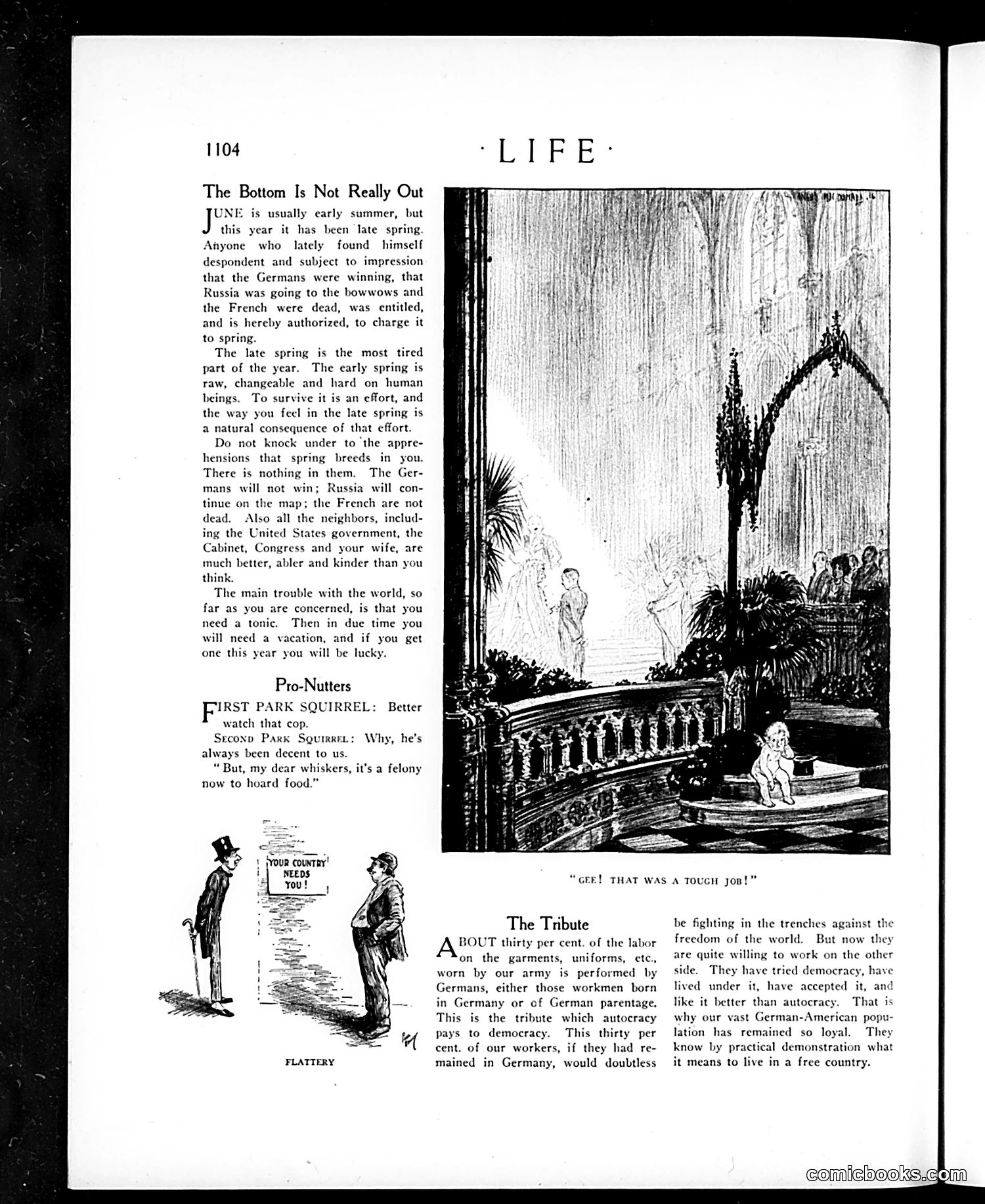
This page contains wartime morale-boosting content from WWI era. The main article "The Bottom Is Not Really Out" encourages Americans not to be discouraged by war news, asserting that Germany won't win, Russia won't collapse entirely, and France isn't defeated. The "Pro-Nutters" section features two park squirrels debating hoarding food—an allegory for wartime rationing and resource management concerns. "Flattery," a small cartoon below, shows two figures discussing patriotic duty, likely encouraging civilian support for the war effort. "The Tribute" article discusses how 30% of garment workers are German or German-American, framing this as democracy's strength—these workers contribute to the war effort despite ethnic background. This addresses anxiety about German-American loyalty during WWI.
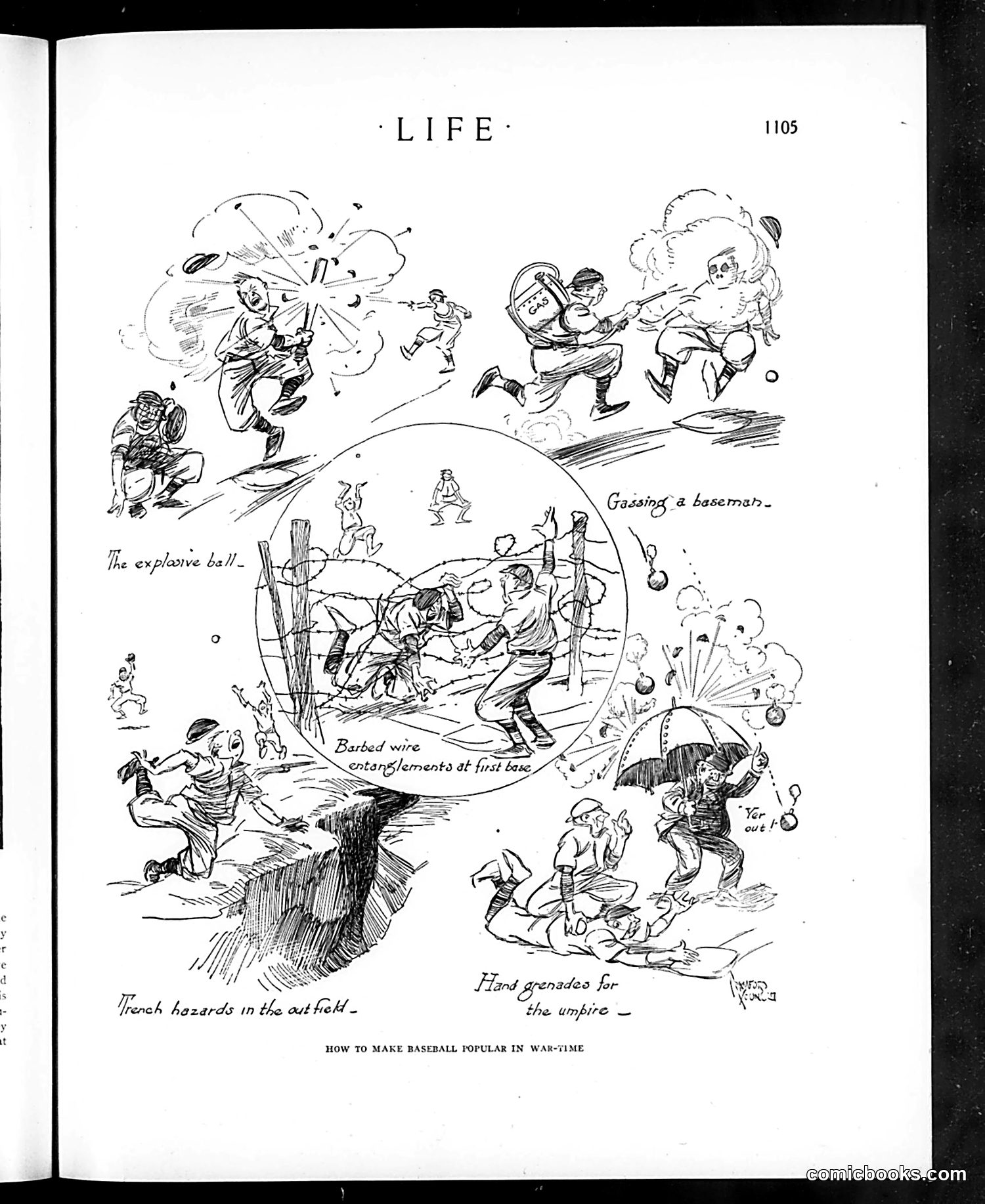
This is a satirical cartoon from Life magazine depicting baseball played under World War I combat conditions. The central circle shows soldiers playing baseball while surrounded by active warfare hazards: "barbed wire entanglements at first base," "the explosive ball," and "gassing a baseman." The surrounding vignettes illustrate additional wartime dangers: "French hazards in the outfield," "trench hazards in the outfield," "hand grenades for the umpire," and soldiers taking cover with an umbrella from incoming fire labeled "too hot." The satire contrasts baseball's peaceful American civilian sport with the brutal reality of trench warfare, suggesting that making baseball "popular" during wartime requires adapting it to actual combat conditions—an absurdist commentary on promoting normalcy during global conflict.
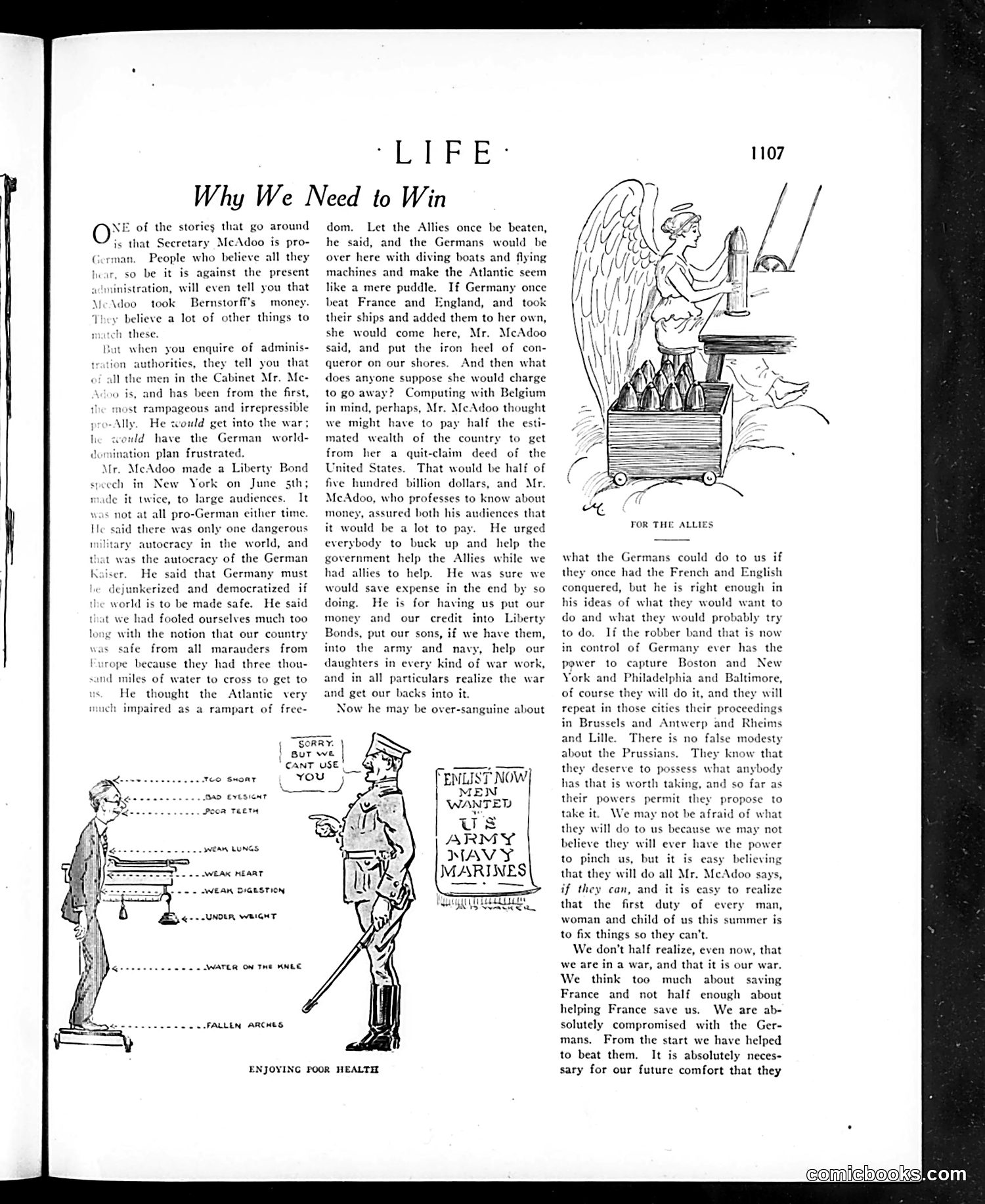
This page contains two satirical cartoons about American military recruitment and preparedness during World War I. **Left cartoon** ("Enjoying Poor Health"): Shows a skeletal, sickly man labeled with ailments (weak heart, fallen arches, etc.). A recruiting sergeant holds a sign reading "Enlist Now Men Wanted U.S. Army Navy Marines," implying the military's desperation to recruit anyone, even the physically unfit. **Right cartoon** ("For the Allies"): Features an angel or allegorical figure, accompanying the article's argument that Americans must support the Allies financially and militarily. The text advocates paying war bonds and enlisting to prevent German conquest of Europe and invasion of America. Both cartoons mock America's unpreparedness and make the case for immediate military mobilization—likely from 1917-1918.
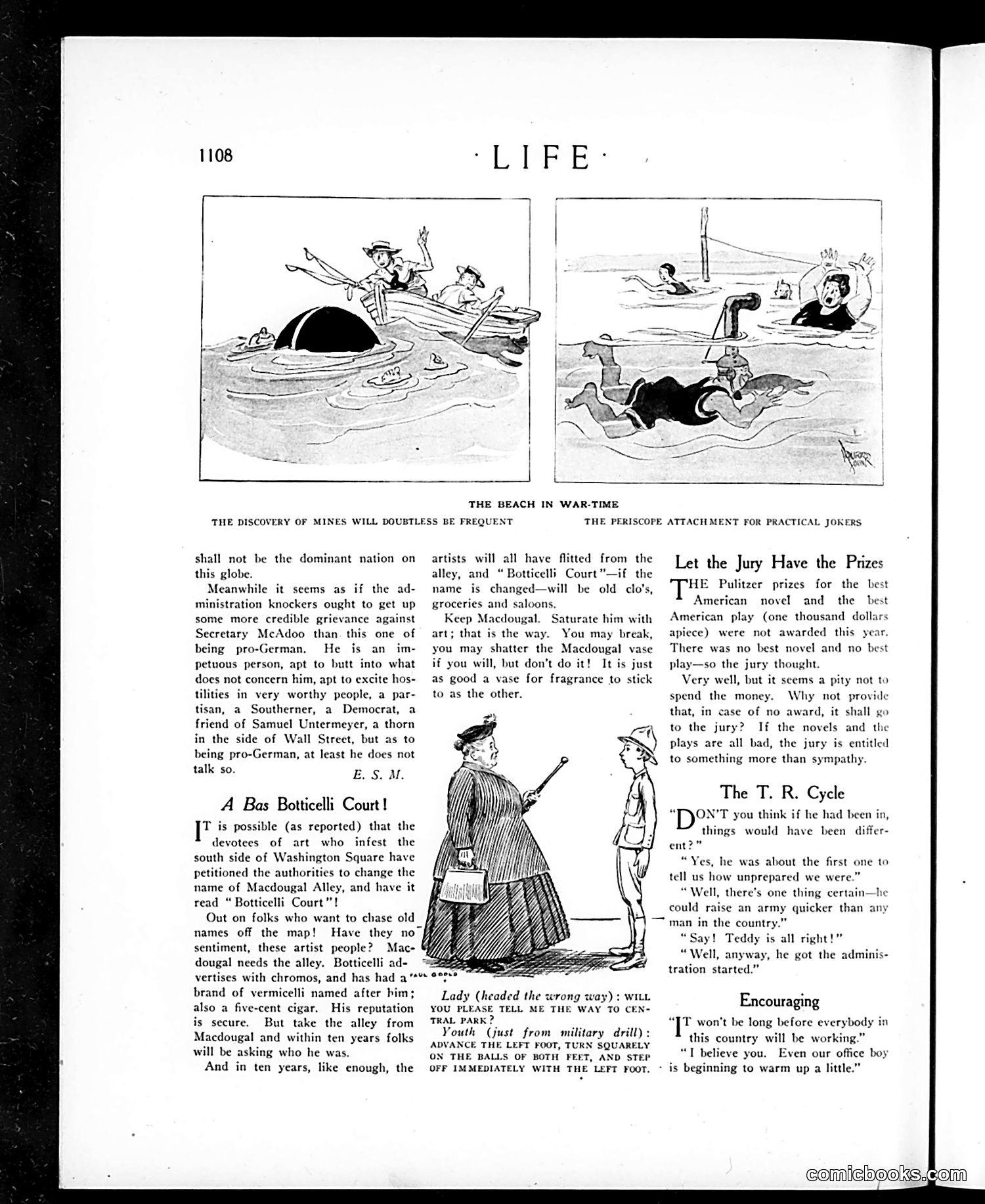
This WWI-era satirical page contains three distinct commentaries: **Top cartoons ("The Beach in War-Time"):** Mock civilian beach-goers oblivious to wartime dangers—mines and periscopes. The humor lies in their continued leisure activities despite military threats. **"A Bas Botticelli Court!"** attacks Greenwich Village artists petitioning to rename Macdougal Alley after Renaissance painter Botticelli. The satire criticizes artistic pretension and erasure of local history. It defends the working-class namesake Macdougal against elite cultural erasure. **Secretary McAdoo critique:** Defends Treasury Secretary William McAdoo (Wilson administration) against accusations of being "pro-German," listing legitimate grievances instead (partisan, Southern Democrat, friend to Wall Street enemies). **"Periscope Attachment" cartoon:** A soldier's overly-military response to a lost woman's simple direction-request—absurdist humor about military drilling. **Pulitzer Prizes & T.R. Cycle sections:** Joke about withholding prizes due to poor submissions, and cyclical nostalgia for Theodore Roosevelt's preparedness warnings.
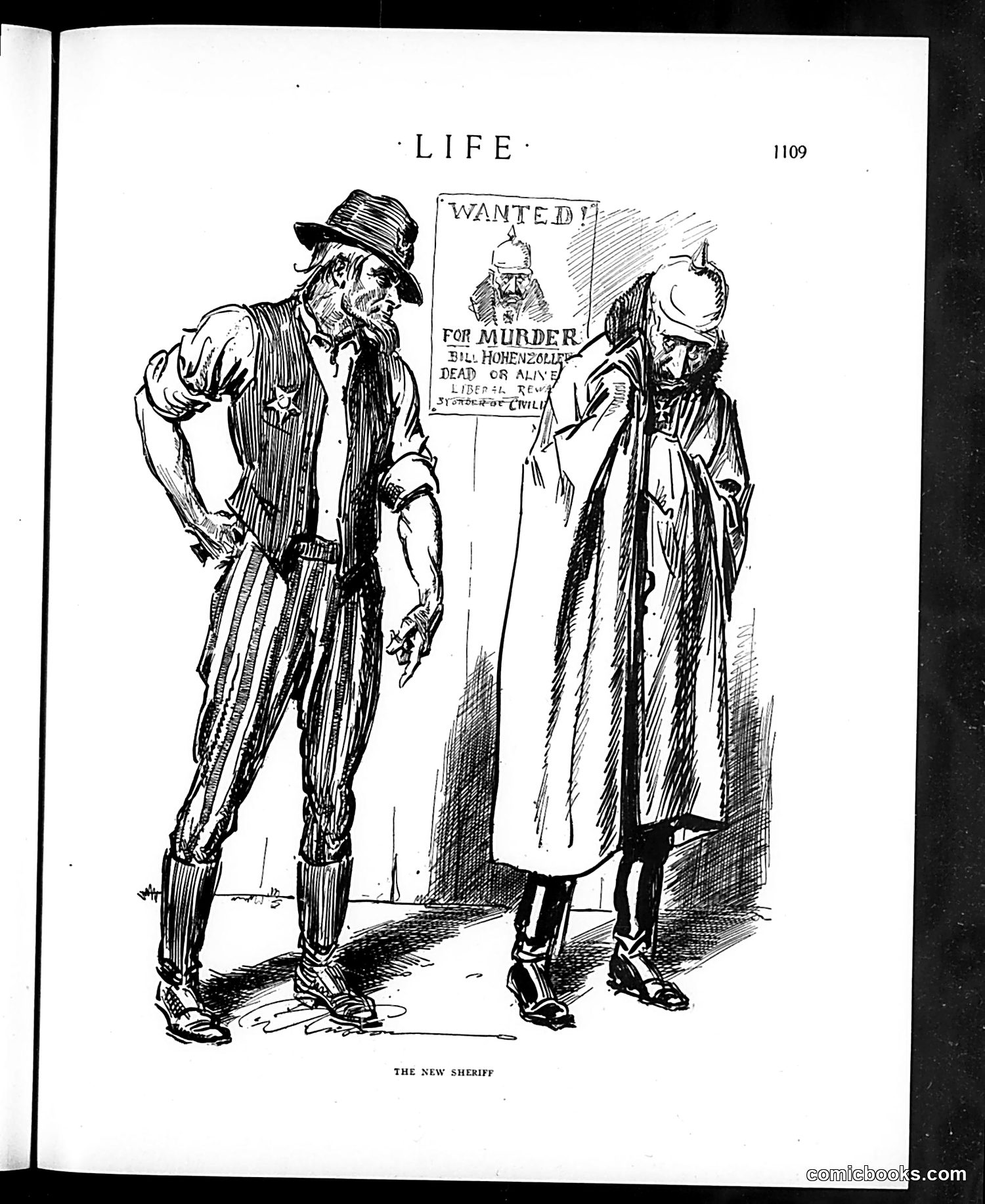
This satirical cartoon from *Life* magazine depicts two figures examining a wanted poster for "Bill Honeycutt," sought "For Murder" with a reward of "$5,000 Dead or Alive." The figure on the left, dressed as a cowboy/frontier character with a beard and hat, appears to be the "new sheriff" referenced in the caption. The satire likely critiques a newly appointed law enforcement official or political figure tasked with pursuing a dangerous criminal or corrupt target. The wanted poster's specificity suggests a real historical figure or well-known outlaw. The cartoon's humor derives from the contrast between the rough frontier setting and what appears to be commentary on contemporary law enforcement challenges or political accountability during the early 20th century.
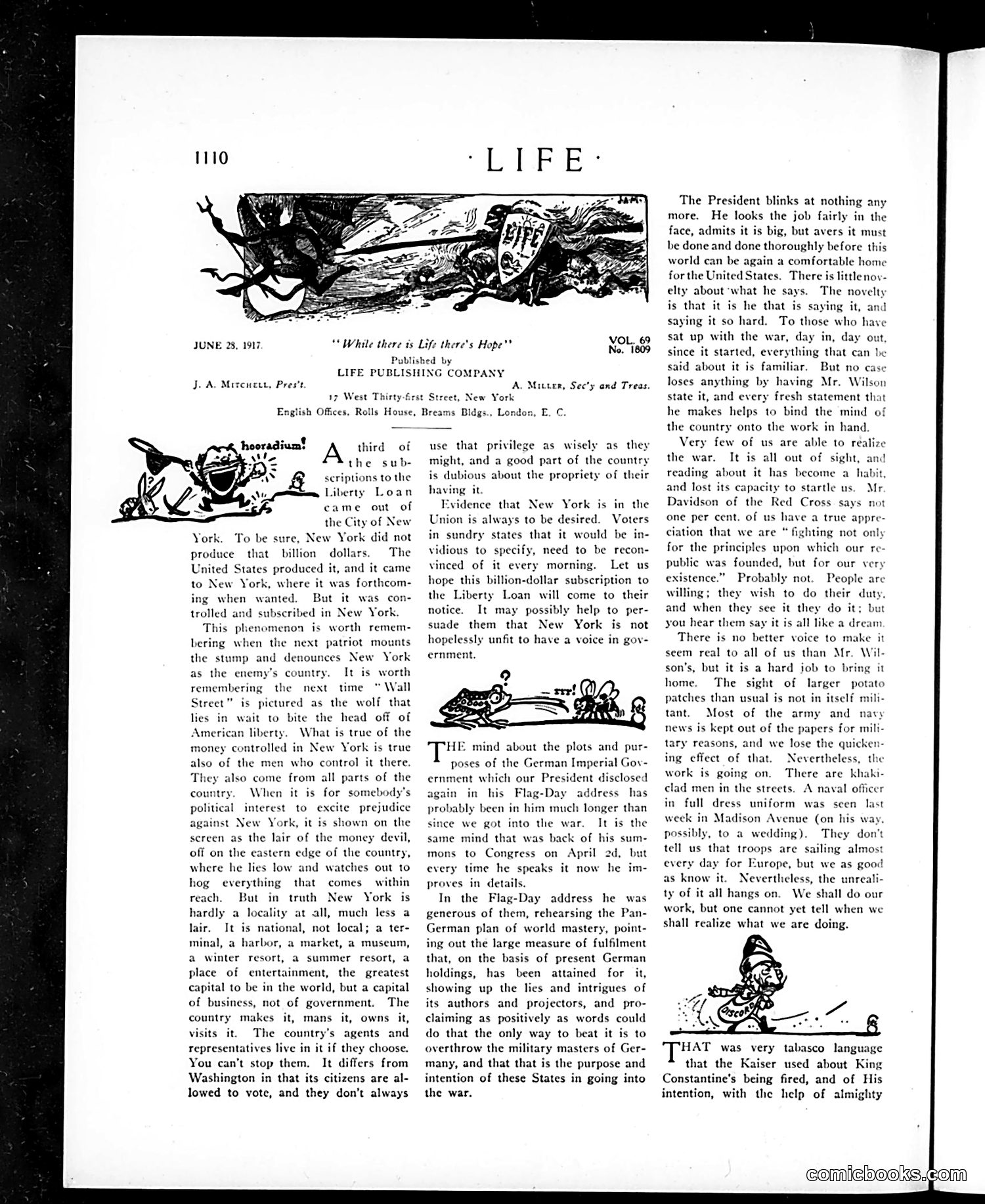
This page defends New York City against anti-Wall Street prejudice, particularly the stereotype of "Wall Street" as an enemy to American liberty. The article argues that New York is not a locality controlled by a money-hungry elite, but rather a national hub—a "terminal, a harbor"—where Americans from all parts of the country work and conduct business. The timing is significant: this is June 1917, just two months after America entered World War I. The piece celebrates New York's subscription to the Liberty Loan (war bonds), arguing this patriotic contribution should counter anti-New York sentiment. The second article praises President Wilson's Flag-Day address, which outlined German imperial ambitions and America's commitment to defeating German militarism. The author notes Wilson's rhetoric has become more direct and forceful about the war's necessity. The cartoons (specific figures unclear from image quality) appear to reinforce these pro-war, pro-New York themes typical of Life's 1917 editorial stance.
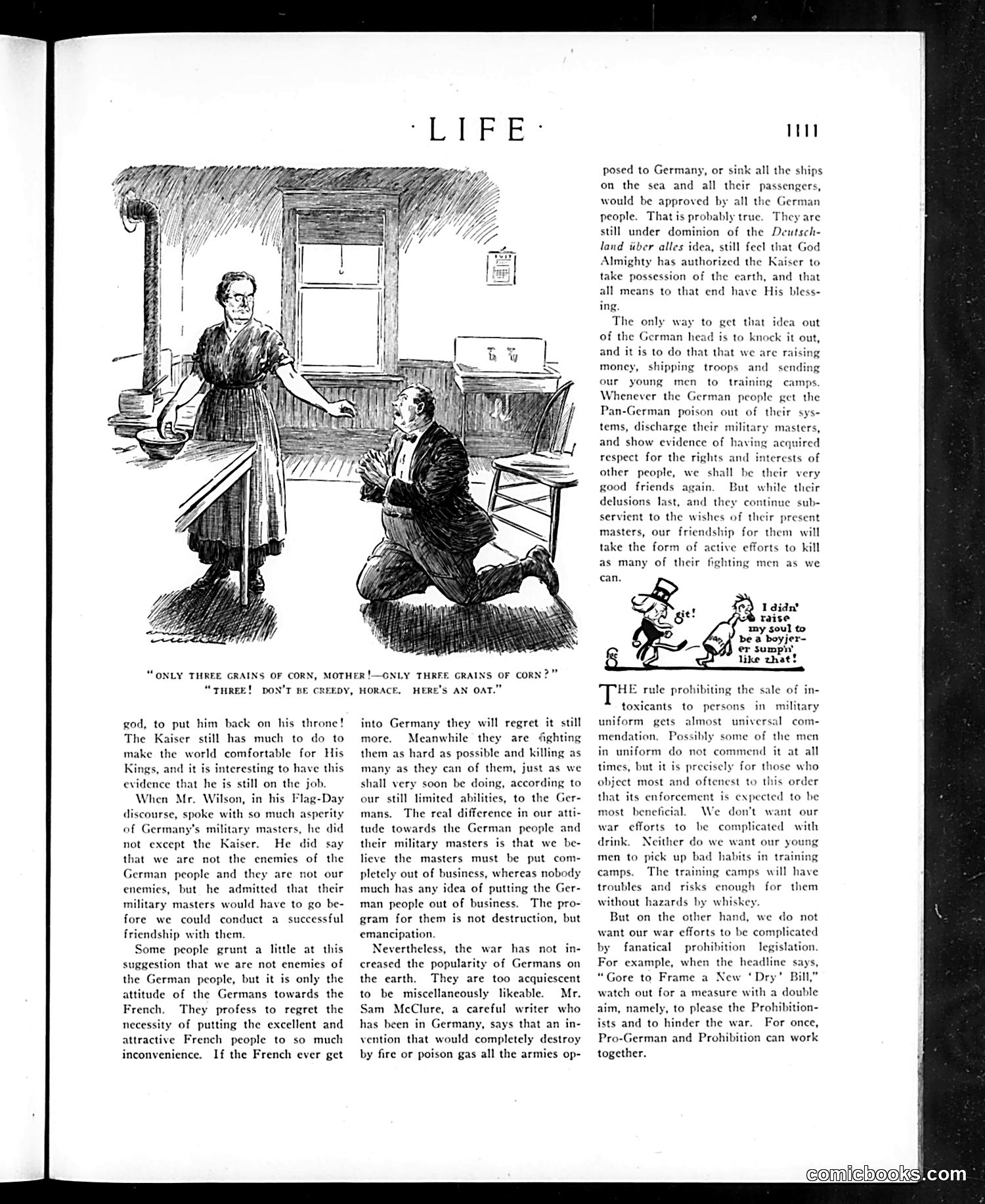
This Life magazine page from World War I contains two distinct cartoons satirizing German attitudes and American war policy. **The main cartoon** (top) depicts a starving German mother and child with the caption "Only three grains of corn, mother!" The accompanying text sarcastically praises Germany's leadership, suggesting ordinary Germans would approve any atrocity—even poison gas or sinking ships—to win the war. The satire's point: German civilians have been so thoroughly indoctrinated by "Deutschland über alles" ideology and the Kaiser's authority that they've lost moral reasoning. **The smaller cartoon** (bottom right) shows a child refusing an oat, captioning "I didn't raise my boy to be a bumper like that!"—mocking overly sentimental peace advocates while America mobilizes for war. The text advocates distinguishing between German *people* (whom Americans should eventually befriend after military defeat) and German *military masters* (who must be destroyed). The satire's target: German militarism and blind obedience, not the German population itself.
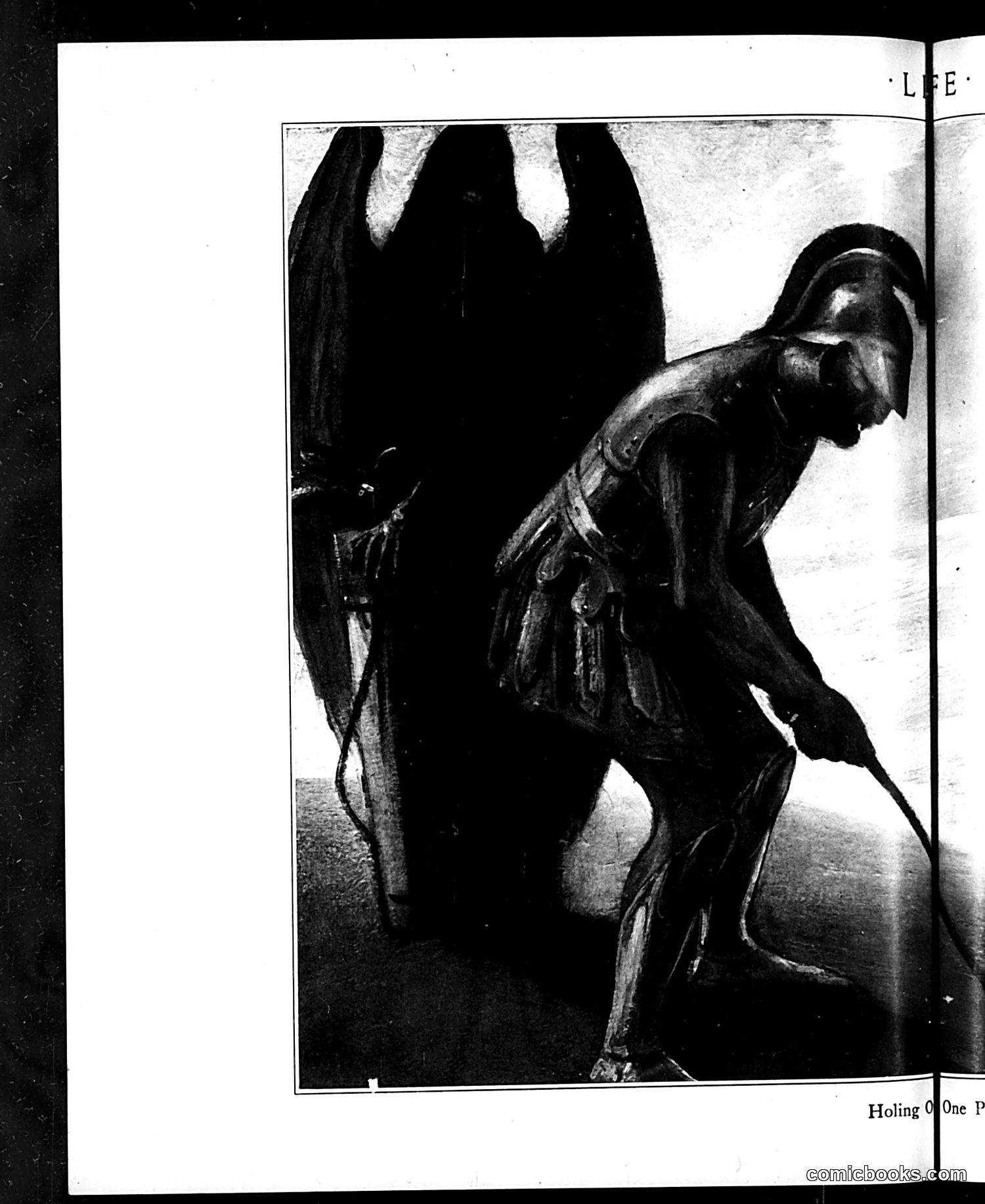
This appears to be a satirical illustration from *Life* magazine depicting a figure in classical or theatrical dress (possibly representing Death, a demon, or an allegorical character based on the dark robes and skeletal appearance) looming over a smaller, crouched human figure who appears to be cowering or in distress. The heavy use of shadow and the ominous posture suggests this is political or social commentary about threat, doom, or subjugation—common *Life* magazine themes addressing contemporary anxieties. However, **without a visible title, caption, or complete text context**, I cannot definitively identify which specific political figure, event, or social condition this targets. The artistic style and printing quality suggest early-to-mid 20th century. More text or contextual information would be needed for accurate interpretation.
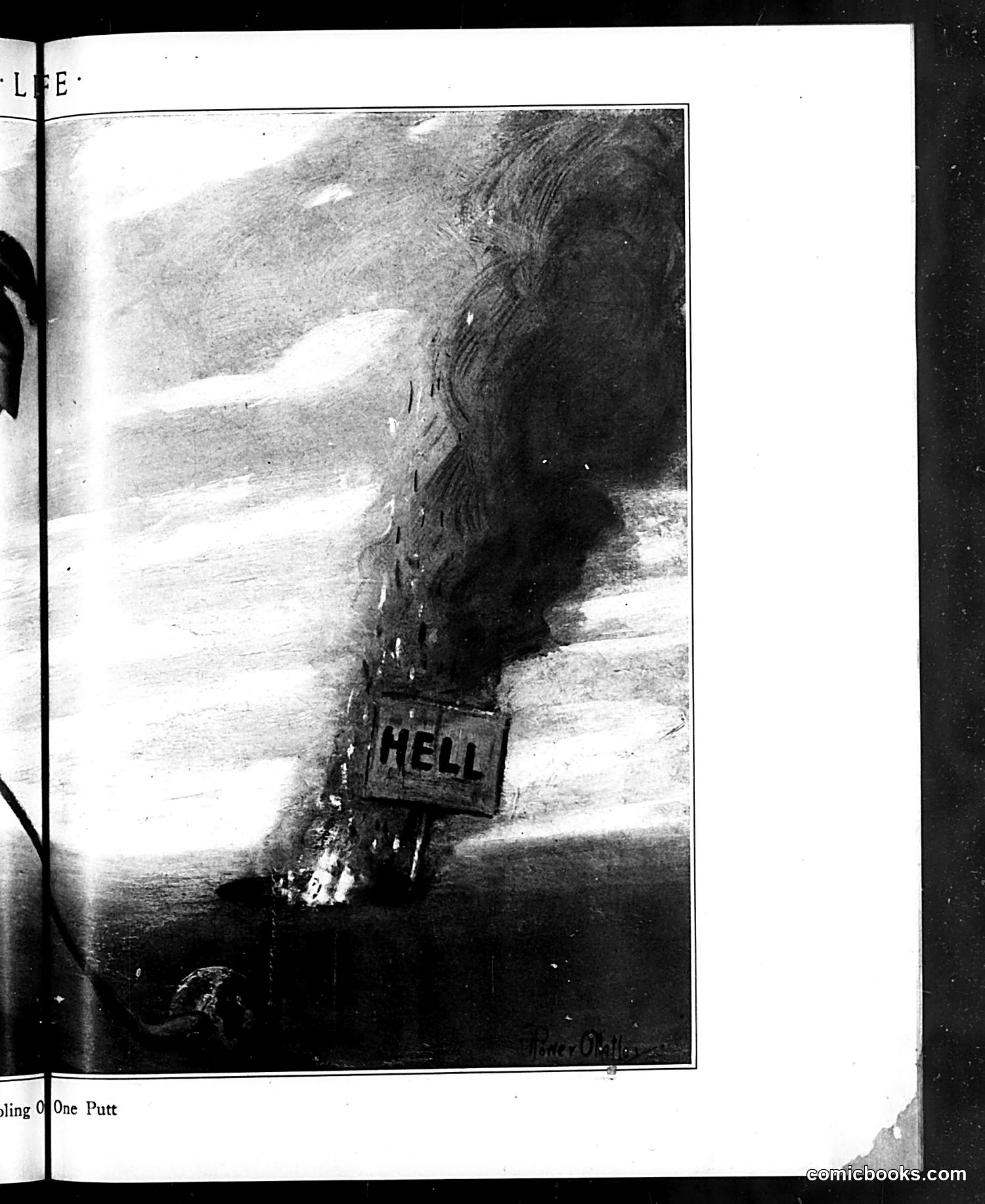
This appears to be a page from *Life* magazine featuring a golf-themed cartoon or illustration. The image shows a tree trunk with a sign reading "HELL" attached to it, positioned on what appears to be a golf course with rolling terrain in the background. The caption reads "Golfing O One Putt" (though the OCR may be imperfect). The joke appears to satirize golf difficulty: the sign marking "HELL" suggests an extremely challenging or impossible putting situation—so difficult that achieving "one putt" from this location would be nearly miraculous. This reflects *Life's* satirical commentary on the frustrations of golf, a leisure activity popular among American middle and upper classes. The humor targets golfers' exasperation with the sport's inherent challenges.
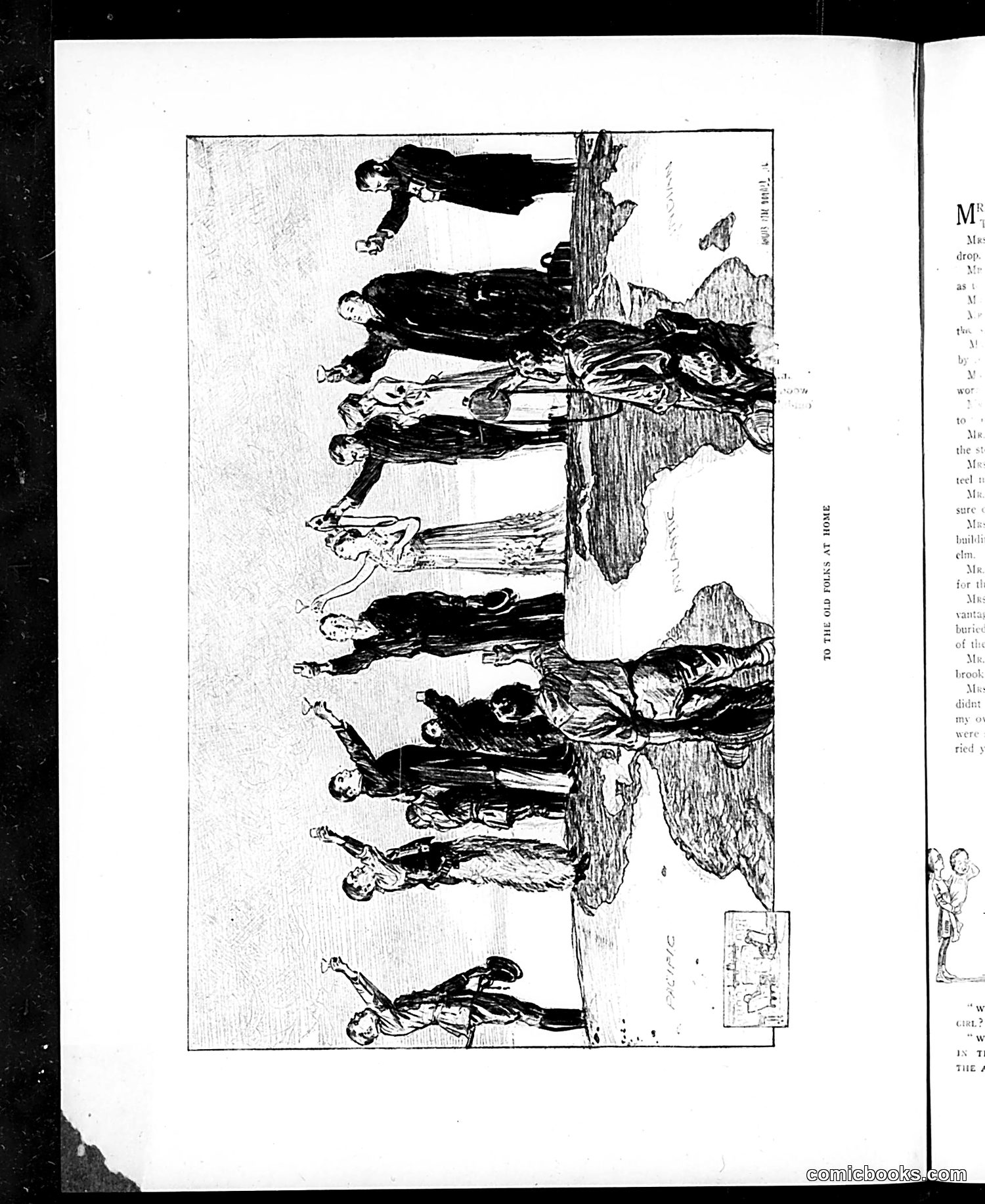
I can see this page contains an illustration that appears to be oriented sideways, showing multiple figures in what looks like a satirical scene. However, the OCR text provided is largely illegible—consisting mainly of random letters and symbols that don't form coherent words. Without clear text to contextualize the image, I cannot reliably identify the specific figures, political references, or satirical point being made. The illustration appears to be a multi-figure composition typical of Life magazine's satirical style, but determining its exact subject and meaning would require either clearer OCR text or additional context about the publication date and issue. I cannot responsibly guess at the identities or references involved.
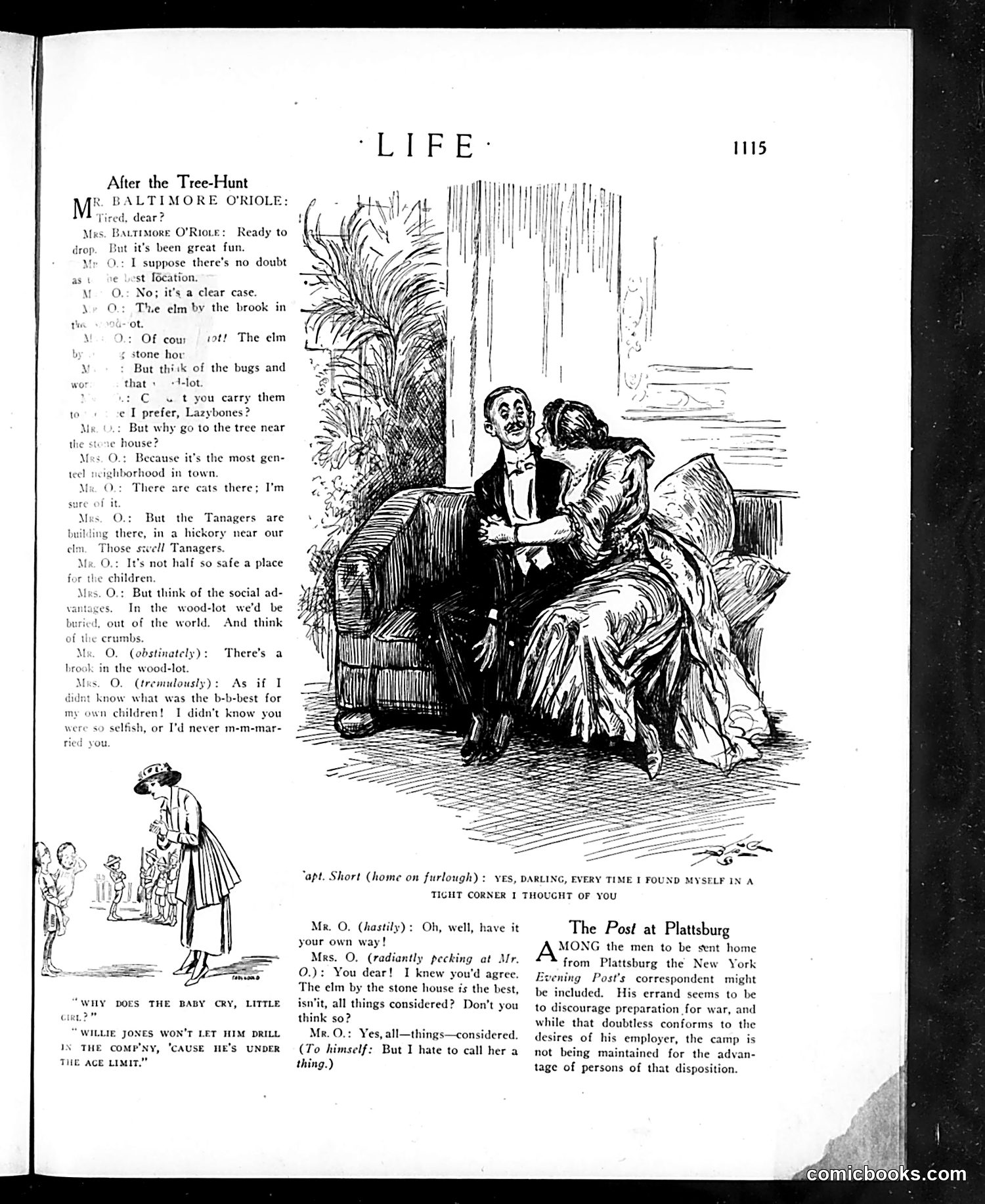
The left cartoon satirizes marital dynamics through a couple debating where to picnic. Mr. Baltimore O'Riole, tired from a "tree-hunt," defers to his wife's preferences despite his own objections—ultimately accepting her choice while privately resenting being called "a thing." The humor lies in his forced submission to domestic authority. The right section, "The Post at Plattsburg," criticizes a *New York Evening Post* correspondent embedded at the military training camp. The satire targets his alleged pacifist editorializing, suggesting he discourages war preparation to serve his employer's anti-war agenda rather than the camp's patriotic purpose. This reflects WWI-era tensions between isolationist publications and military preparedness advocates. The piece implies such correspondents undermine national defense readiness.
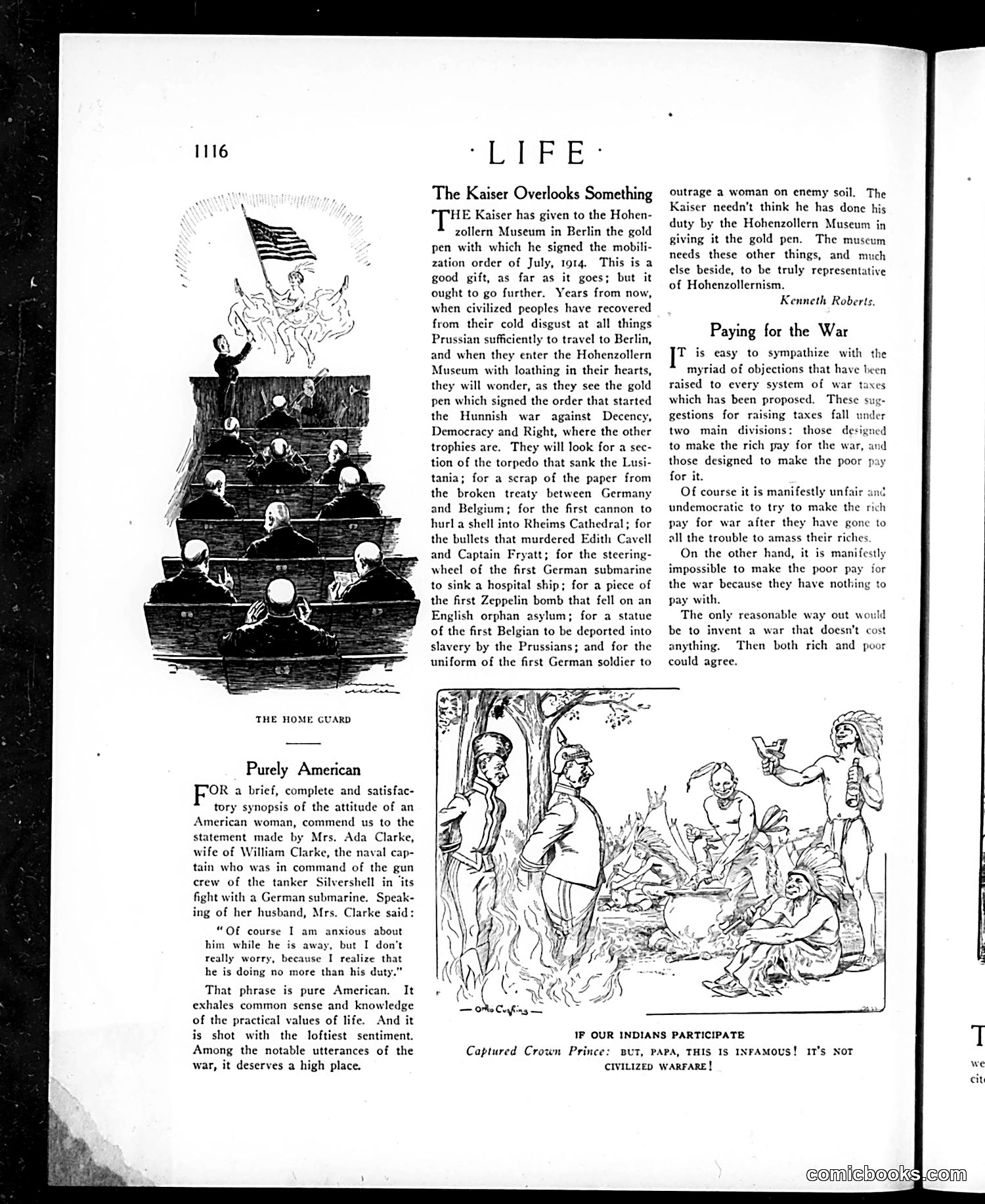
This WWI-era page contains three satirical pieces attacking Germany and defending American interests: **"The Home Guard"** praises Mrs. Ada Clarke, wife of a naval captain, for stoically accepting her husband's wartime service—presenting her pragmatism as quintessentially American virtue. **"The Kaiser Overlooks Something"** mocks Kaiser Wilhelm II for donating only a gold pen (used to sign the 1914 mobilization order) to Berlin's Hohenzollern Museum. The author sarcastically suggests the museum should also display artifacts of German atrocities: the Lusitania torpedo, violated Belgian treaty, Rheims Cathedral bombardment, Edith Cavell's bullets, sunk hospital ships, Zeppelin bombs on orphanages, and evidence of sexual violence against Belgian women—implying these represent Prussian "civilization." **"If Our Indians Participate"** (bottom cartoon) shows a captured German Crown Prince horrified that Native Americans fight "uncivilized" warfare, ironically inverting Germany's own brutal conduct—a jab at German hypocrisy about warfare rules. All three pieces present American/Allied righteousness against German barbarism.
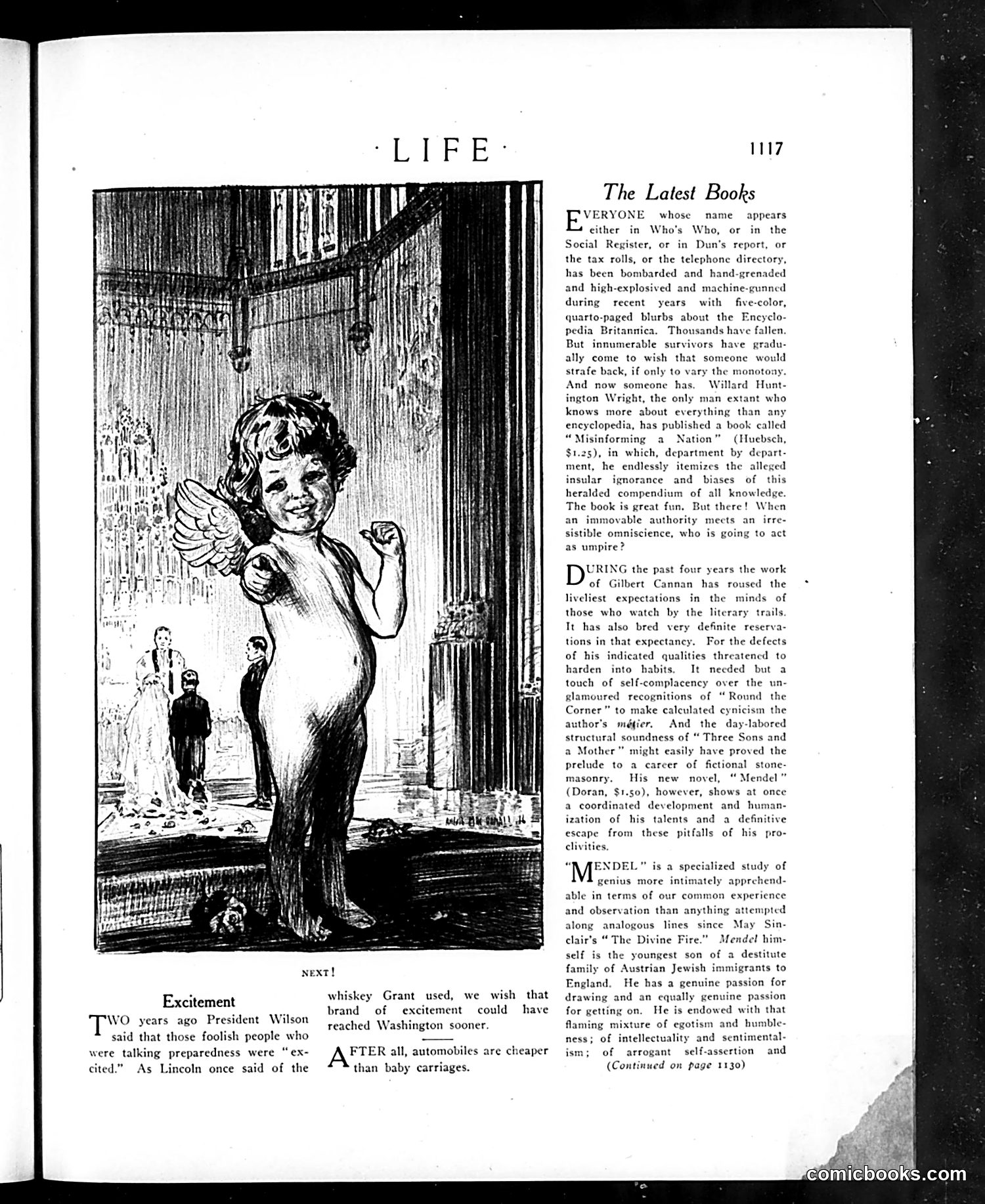
This page contains a brief political cartoon and book reviews. The cartoon section, titled "Excitement," satirizes President Wilson's 1914 dismissal of military preparedness advocates as "excited" people. Life's editors sarcastically wish that Wilson had shown more of that same "excitement"—implying his reluctance to prepare for war was foolish, especially given America's eventual entry into World War I (the page references "the past four years," suggesting this is circa 1918-1919). The quip comparing automobiles to baby carriages appears to mock those opposing military spending on cost grounds. The bulk of the page reviews new books, including Willard Huntington Wright's critique of the Encyclopedia Britannica's alleged bias and Gilbert Cannan's novel "Mendel" about a young Austrian Jewish immigrant artist in England. The reviews are literary commentary unrelated to the political cartoon above.
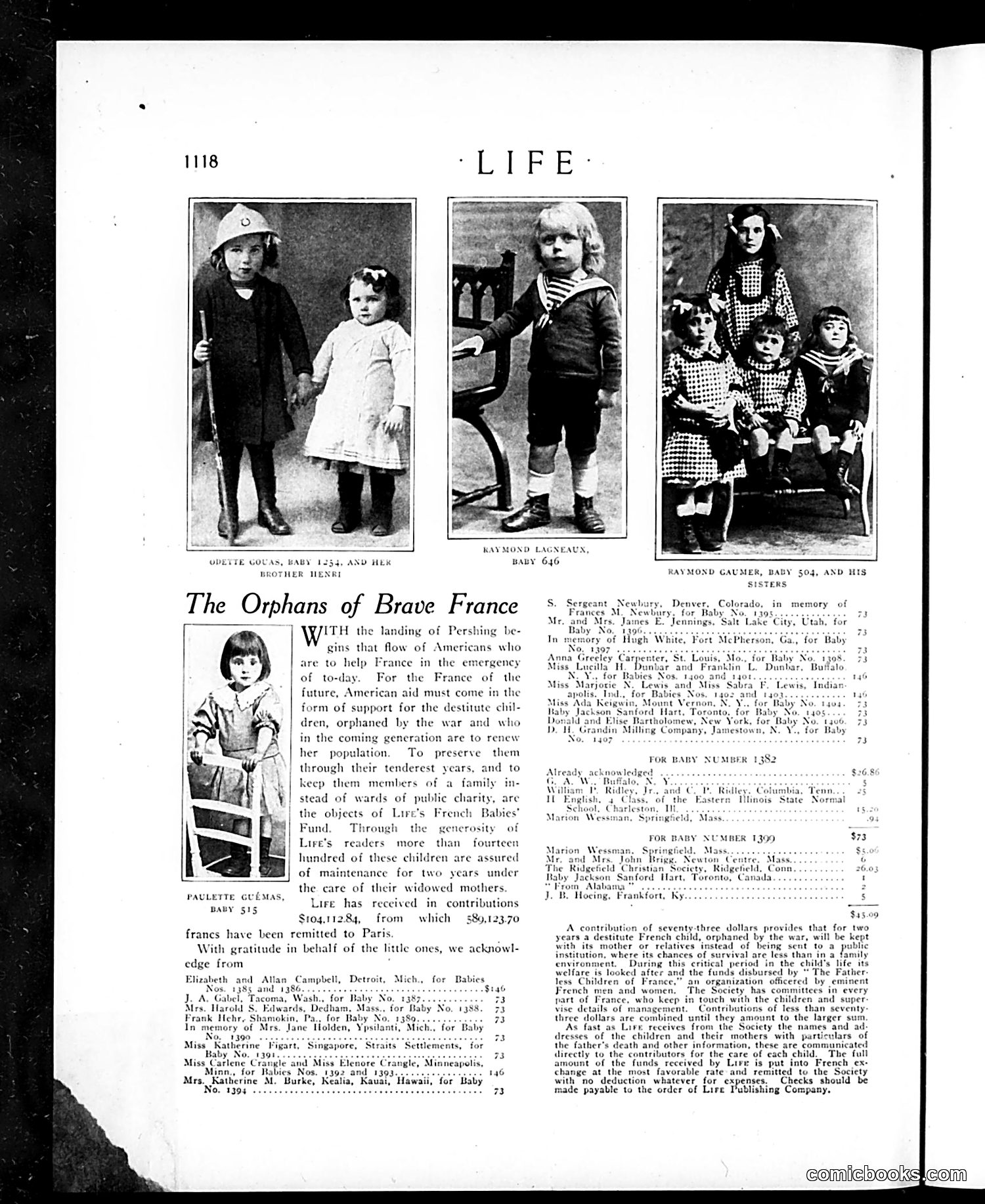
This is not satire but earnest charitable fundraising. Life magazine solicited donations to support French children orphaned by World War I after American troops under Pershing arrived in 1917. The page features photographs of actual French orphans (named, numbered as "babies") alongside names of American donors who sponsored their care. For $73, donors could support a child for two years, keeping them with widowed mothers rather than in institutions. The text explains that Life had raised over $104,000, with $89,000 remitted to Paris through the "Destitute Children of France" organization. Donors received direct communication about their assigned child's welfare. This represents American charitable response to European war casualties—a patriotic duty aligned with supporting America's French allies during the Great War.
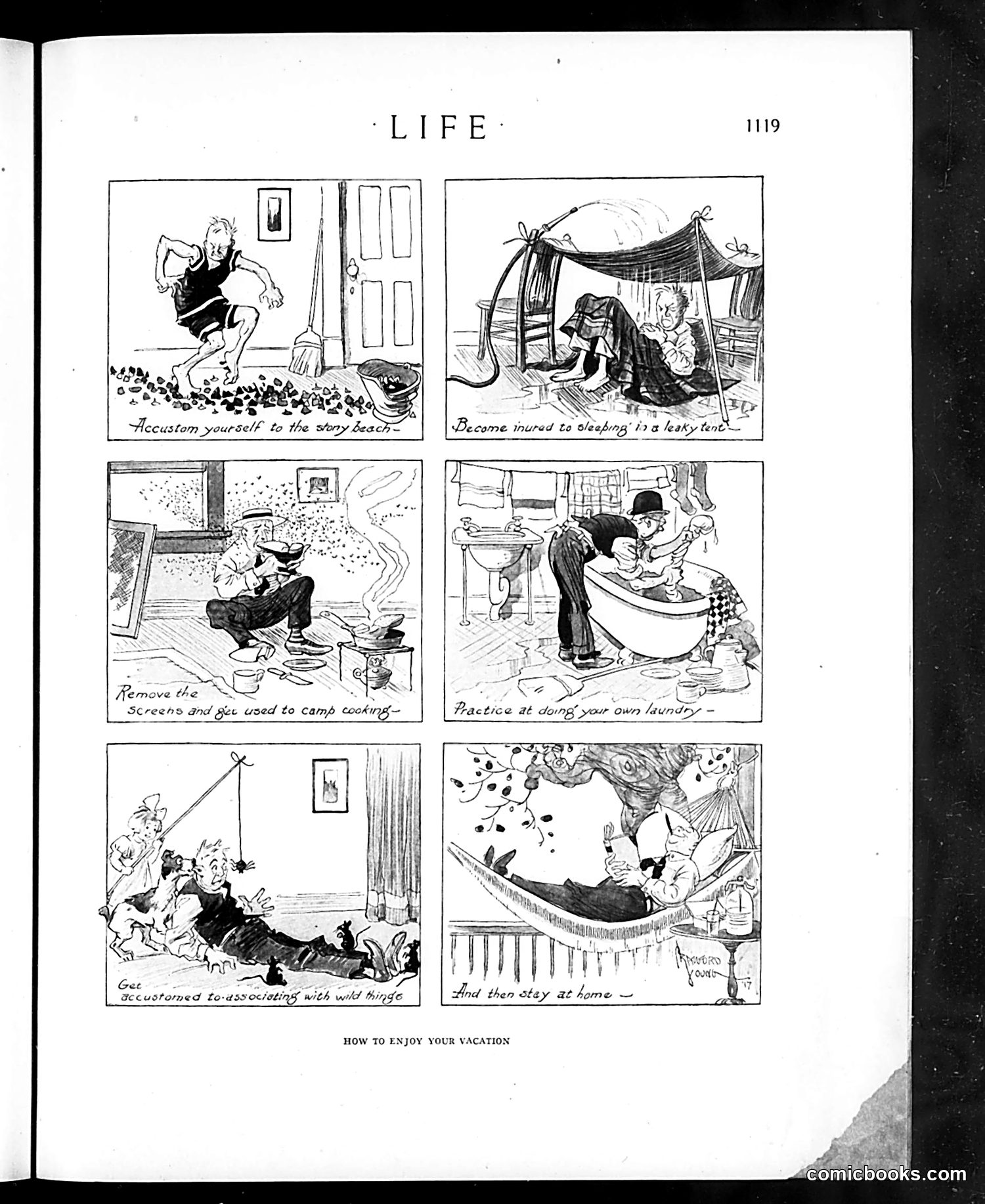
This is a six-panel comic strip offering satirical advice for vacation enjoyment. Each panel depicts humorous (often uncomfortable) scenarios: 1. **Stony beach**: Man struggles with painful pebbles 2. **Leaky tent**: Couple deals with water damage while camping 3. **Camp cooking**: Man removes screens used for cooking, suggesting poor hygiene 4. **Laundry**: Man attempts unfamiliar domestic chores 5. **Wild hiking**: Man encounters aggressive animals/insects 6. **Home relaxation**: Man finally rests comfortably at home The joke's irony is clear: after enduring various camping and vacation hardships—beaches, tents, cooking, manual labor, and wildlife—the final panel's punchline suggests the only real enjoyment comes from staying home. This satirizes the romanticized vacation ideal versus the messy reality of outdoor recreation and domestic responsibilities.
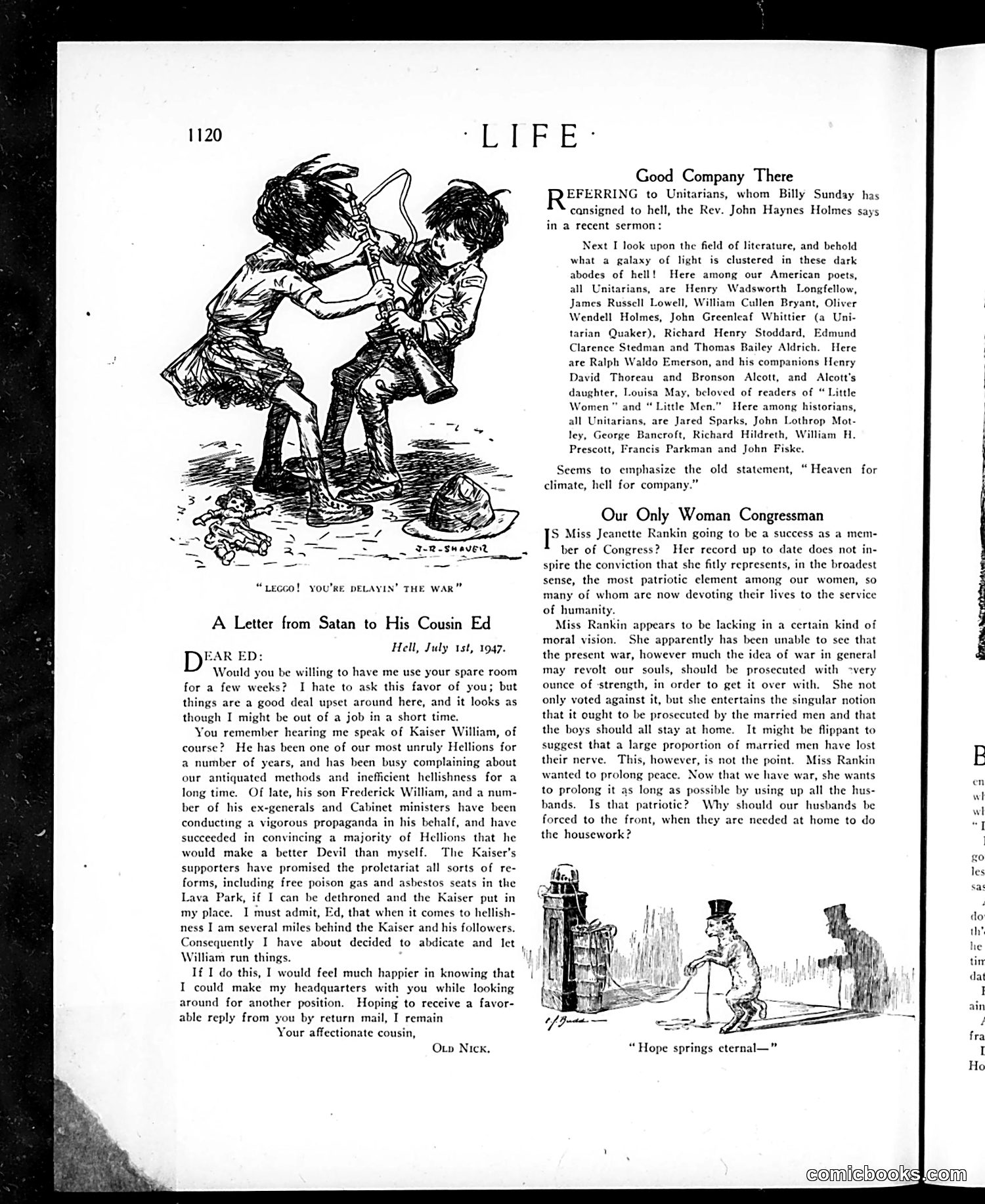
This 1917 *Life* magazine page contains wartime satire during World War I. **"A Letter from Satan to His Cousin Ed"** mocks German leadership. Satan writes that Kaiser William (Wilhelm II) and his son Frederick are threatening his position in Hell through propaganda promising reforms. Satan plans to abdicate, suggesting the Kaiser is *more evil* than the Devil himself—sharp political mockery of German militarism. **"Good Company There"** satirizes evangelist Billy Sunday's claim that Unitarians go to Hell. Reverend Holmes counters that Hell would actually contain America's greatest literary and historical figures—Emerson, Thoreau, Longfellow, etc.—all Unitarians. The joke: "Heaven for climate, hell for company" (good people make Hell preferable). **"Our Only Woman Congressman"** criticizes Representative Jeanette Rankin for voting against U.S. entry into WWI and suggesting married men stay home. The author attacks her pacifism as unpatriotic, viewing war support as a patriotic duty. All three pieces use humor to promote pro-war sentiment and mock dissenters.
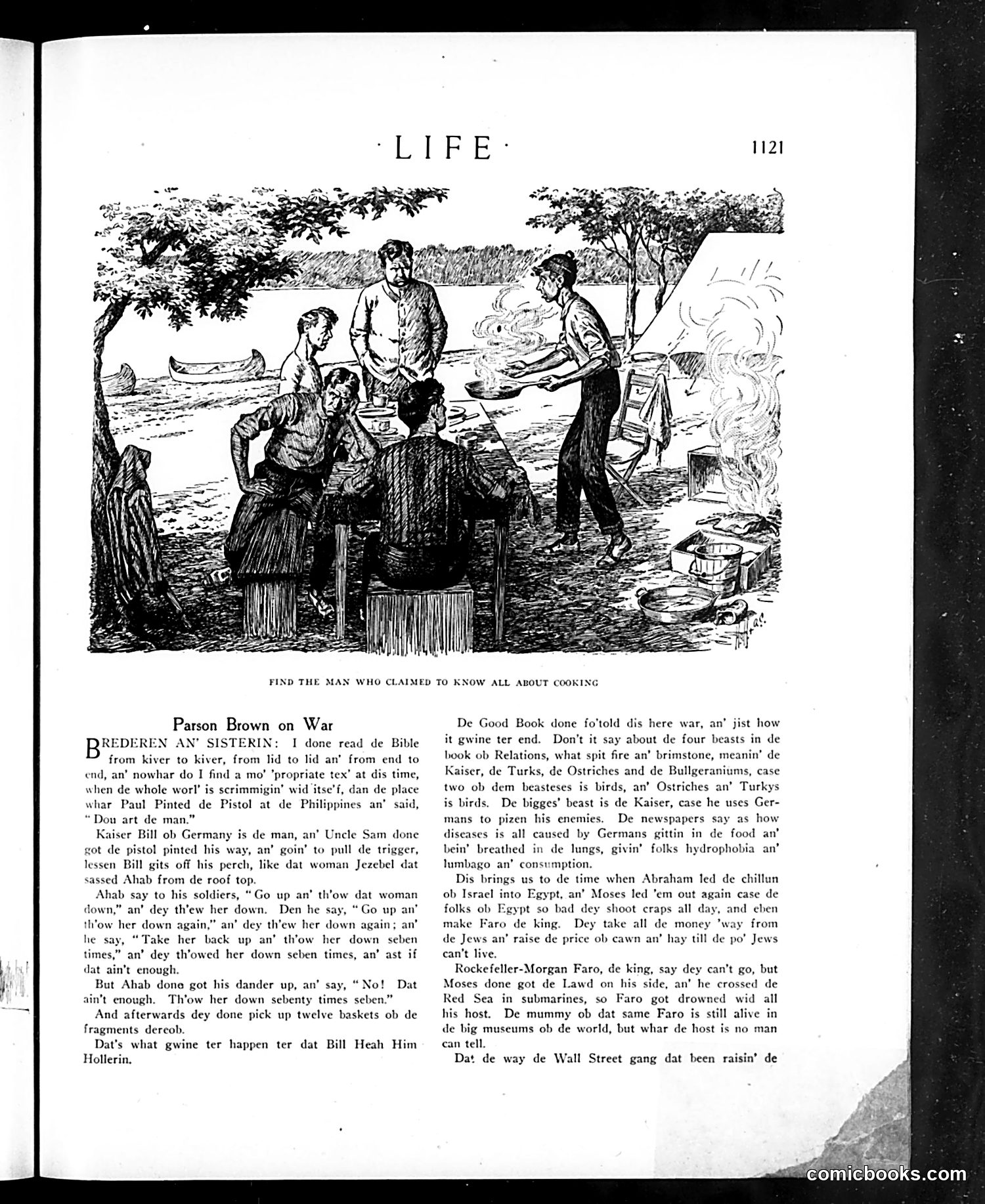
This page contains a satirical sermon by "Parson Brown" commentary on World War I, using dialect humor to critique American attitudes toward the conflict. **The Cartoon:** The top illustration shows a camping scene with the caption "FIND THE MAN WHO CLAIMED TO KNOW ALL ABOUT COOKING"—a visual joke about someone's culinary incompetence amid outdoor activities. **The Satire:** Parson Brown uses twisted Biblical references to discuss the war. He compares Kaiser Wilhelm II (German leader) to various Biblical villains, saying America must defeat him. He mocks German propaganda about disease and stereotypes about Jewish financial power (referencing Rockefeller-Morgan banking). **The Point:** The dialect humor satirizes both rural American speech and jingoistic war rhetoric. Brown conflates historical and Biblical events absurdly—mixing Pharaohs, submarines, and Wall Street—to mock how Americans justify military action through pseudo-religious and economic arguments, particularly targeting Jewish bankers as war profiteers. This reflects early WWI-era American skepticism about elite motivations for war involvement.
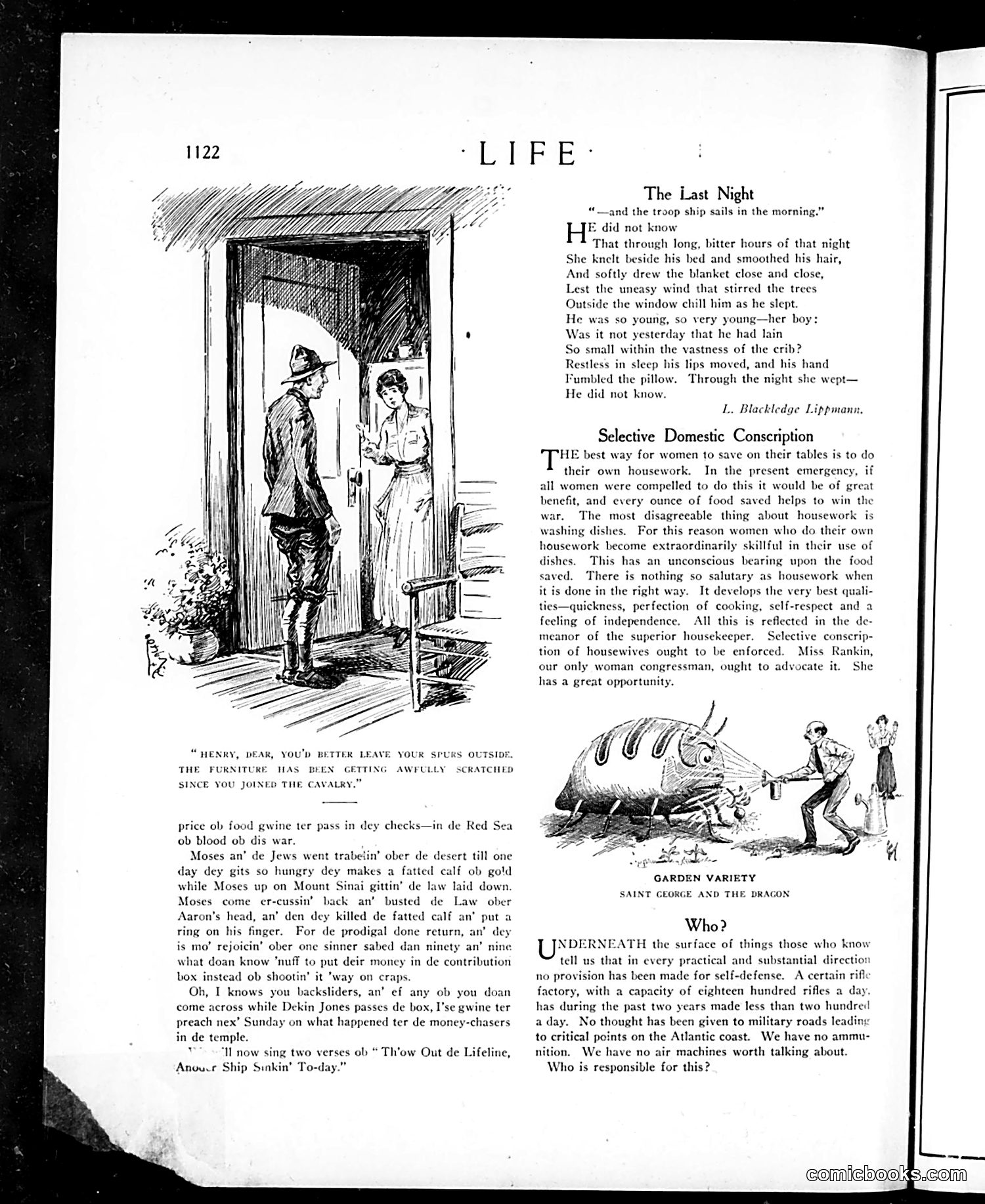
This page contains **WWI-era social commentary** addressed to a modern American audience unprepared for war. **"The Last Night" poem** depicts a mother's vigil beside her young son, a soldier departing on a troop ship. The pathos emphasizes the human cost of military conscription—the emotional toll on families. **"Selective Domestic Conscription"** argues women should be mandated to do their own housework to conserve food for the war effort. It praises housework as character-building and advocates Miss Rankin (the only female congressman) to enforce this policy. This reflects WWI-era attempts to mobilize civilian resources. **"Who?" column** exposes military unpreparedness: inadequate rifle production, no defensive infrastructure on the Atlantic coast, insufficient ammunition and aircraft. The rhetorical question "Who is responsible?" assigns blame for America's lack of military readiness—likely directed at government leadership. The cartoons and dialect piece appear to address economic/social aspects of war mobilization, though their specific references are unclear without additional historical context.
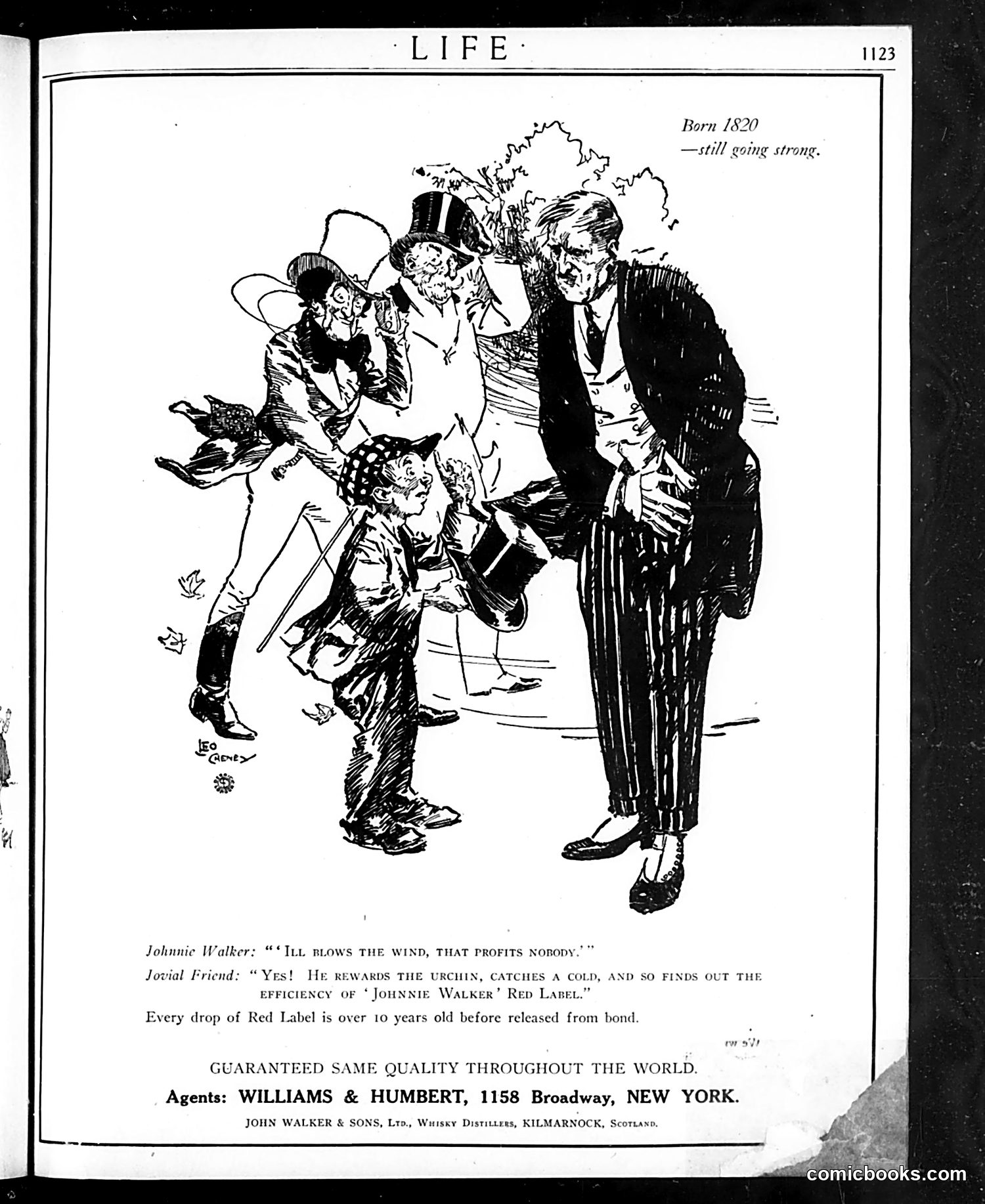
This is a **Johnnie Walker whisky advertisement** disguised as satirical commentary. The cartoon depicts an anthropomorphized Johnnie Walker (the brand's mascot—a striding gentleman in top hat) interacting with street urchins and a well-dressed man. The "joke" plays on the proverb "It's an ill wind that blows nobody good": Walker causes a child to catch cold by blowing wind, but this "efficiency" somehow demonstrates the whisky's quality. The humor is dark and nonsensical—clearly the advertisement's real purpose is simply to showcase the product's longevity ("Born 1820—still going strong") and guaranteed quality. The text emphasizes the whisky ages over 10 years before release, positioning it as premium and reliable worldwide. This is essentially propaganda wrapped in crude cartoon satire, typical of early 20th-century advertising that used humor to create brand familiarity rather than logical persuasion.
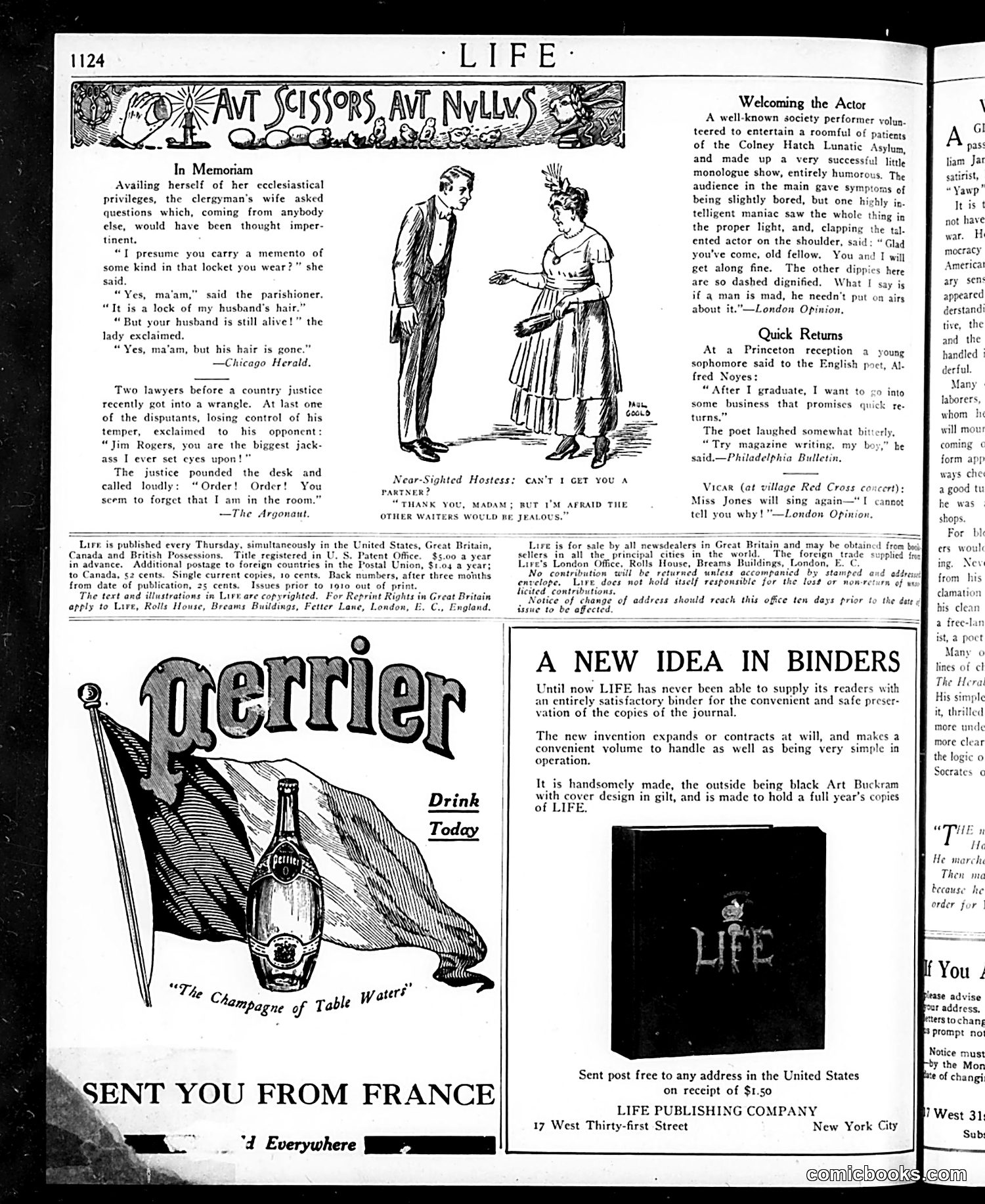
This page contains three humorous anecdotes typical of Life's satirical humor: 1. **"In Memoriam"**: A joke about a clergyman's wife asking a parishioner about a locket. The punchline plays on the woman's assumption—the parishioner carries hair from her dead husband, but reveals he's still alive; she's just kept a lock from before he lost his hair. 2. **"Two Lawyers"**: A courtroom joke where a lawyer insults another as a "jackass," and the judge must restore order by reminding both lawyers who's in charge—absurdist humor mocking legal pomposity. 3. **"Near-Sighted Hostess"**: A brief cartoon caption joke about a server apparently being complimented by a nearsighted hostess, who worries other waiters will become jealous. The page also advertises a new LIFE magazine binder ($1.50) and Perrier water ("The Champagne of Table Water"). These represent Life's characteristic early-20th-century domestic humor—gentle satire of bourgeois society, marital situations, and professional pretension, rather than political commentary.
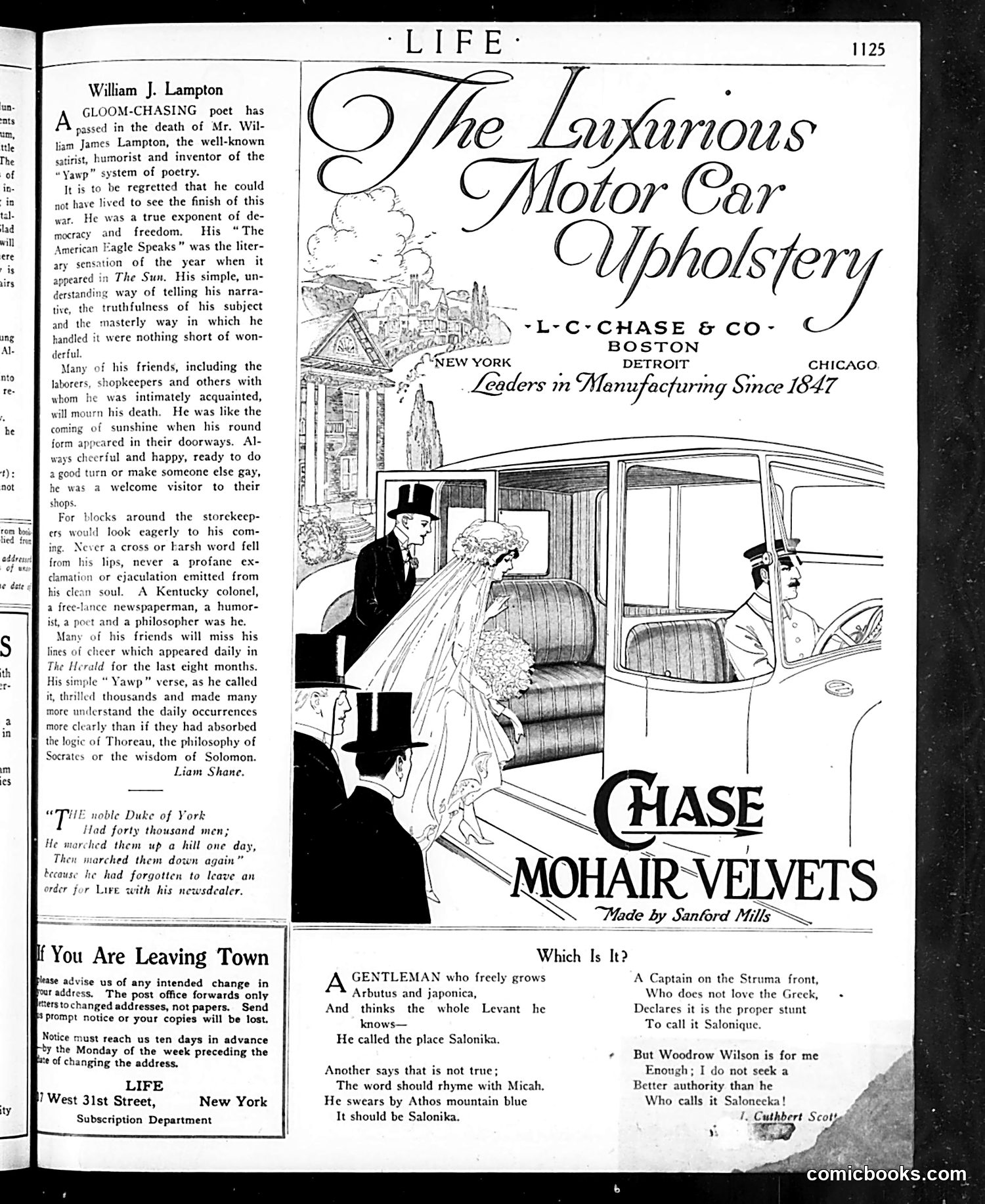
This page contains three distinct elements: **Main Content:** An obituary for William J. Lampton, a poet and humorist known for his "Yawp" system of poetry and cheerful newspaper verses. The piece praises his democratic spirit and kindly character, noting he was beloved by working-class people in his community. **Primary Advertisement:** L.C. Chase & Co.'s luxurious motor car upholstery, featuring an illustration of well-dressed passengers in an elegant automobile. **Satirical Poem:** "Which Is It?" mocks disagreement over the correct pronunciation/spelling of Salonika (a Balkan city). The poem presents competing claims—one man calls it "Salonika," another insists it rhyme with "Micah," and a third supports "Salonecka"—before humorously declaring that whatever President Woodrow Wilson says must be correct. This satirizes both nationalist linguistic pedantry and wartime deference to Wilson's authority during World War I.
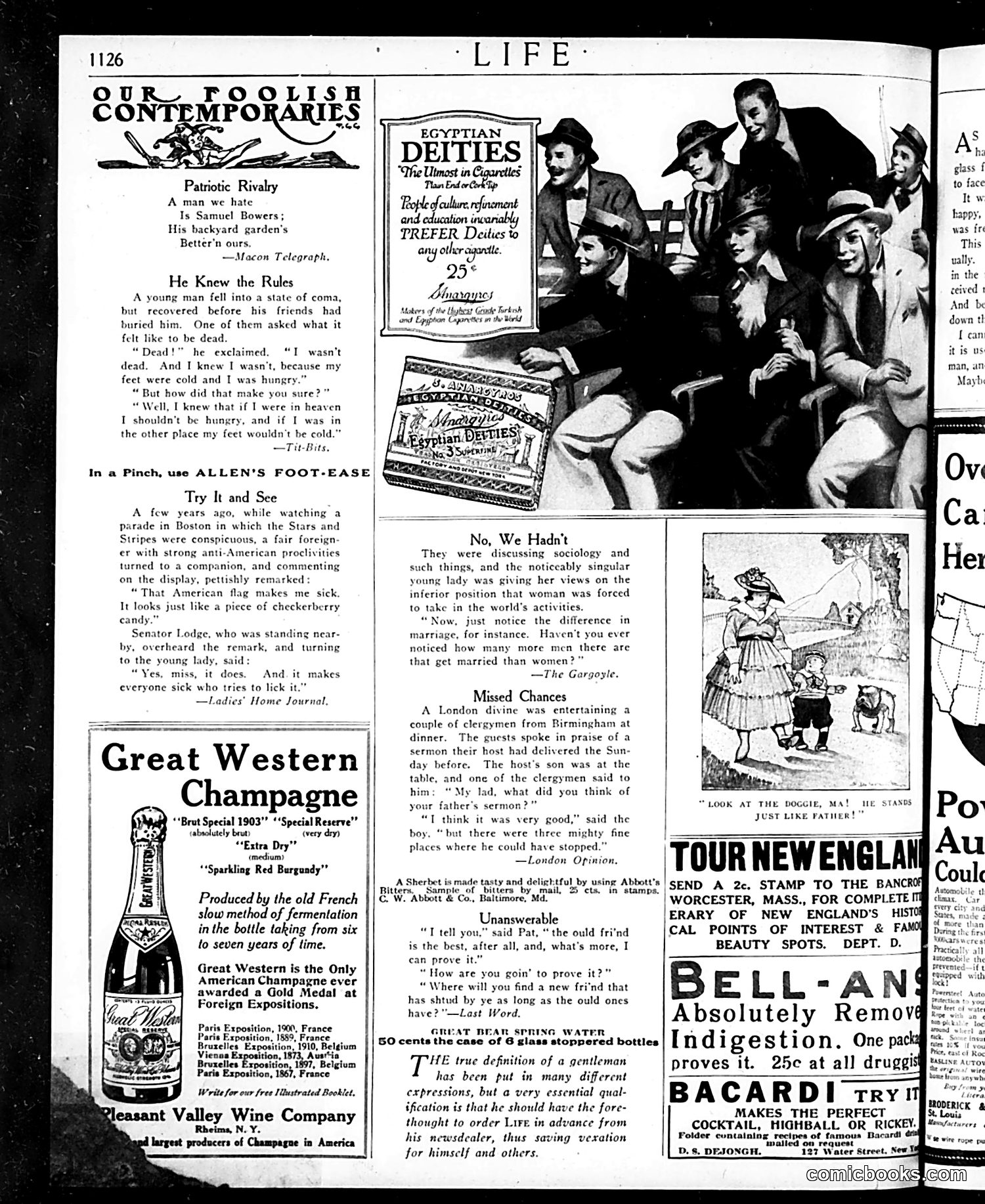
This page collects humorous anecdotes and jokes mocking contemporary social attitudes. Key satirical pieces include: **"Patriotic Rivalry"**: Mocks petty small-town competition—neighbors jealous of each other's gardens. **"He Knew the Rules"**: A joke about a man who distinguishes the afterlife by physical sensations (cold feet = hell, hunger = not heaven), satirizing simplistic religious thinking. **"Try It and See"**: Senator Lodge (a real historical figure) retorts to a foreign woman's anti-American sentiment by suggesting the flag makes people sick *when they try to lick it*—a cutting patriotic putdown. **"No, We Hadn't"** and **"Missed Chances"**: Gentle satire of contemporary sociology and clergy. The page is primarily **advertising-driven**, featuring champagne, cigarettes, and patent medicines alongside the humor—typical Life magazine format mixing editorial content with commercial pitches to readers.
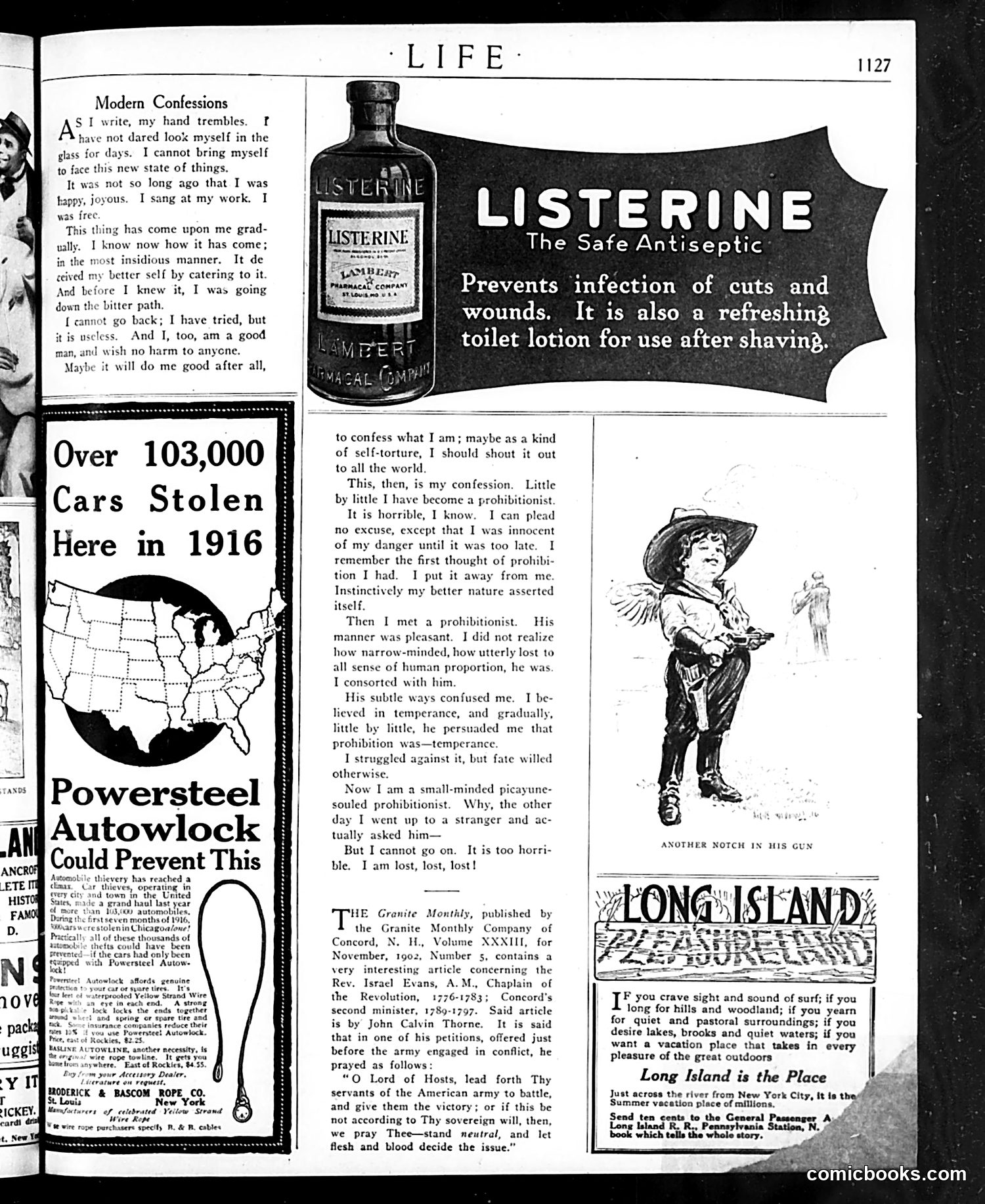
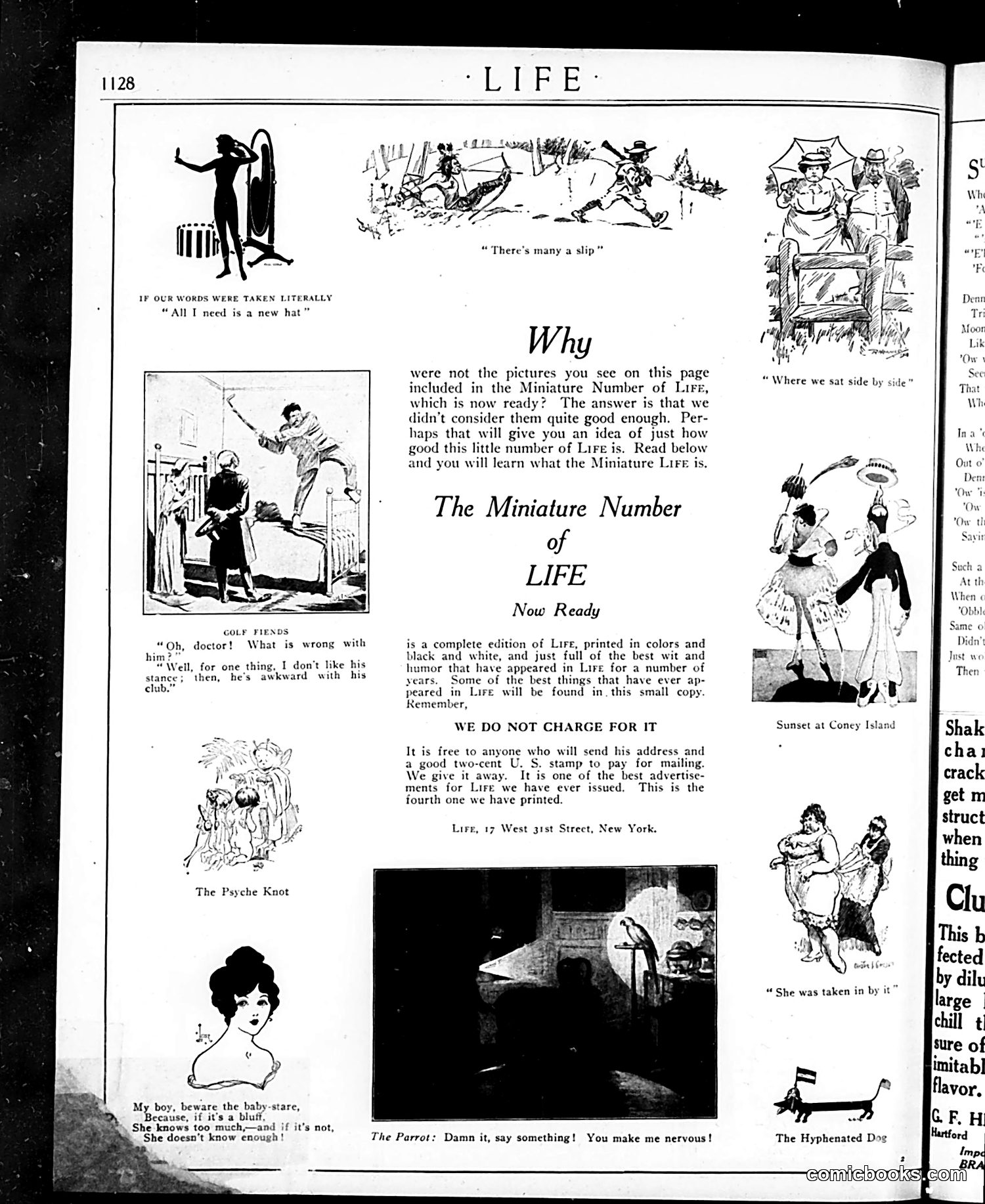
This page from *Life* magazine showcases the publication's satirical humor through several cartoon vignettes. The main content advertises *Life's* "Miniature Number"—a free pocket-sized edition sent to readers who provide their address and a two-cent stamp. The cartoons illustrate everyday absurdities through literal interpretations of common phrases. "All I need is a new hat" shows a man literally wearing only a hat. "Golf Fiends" mocks doctors diagnosing golf players' problems. "The Psyche Knot" comments on women's inscrutability. Other sketches play on double meanings and social situations—a parrot demanded to speak, romantic entanglements, and a dog described as "hyphenated," likely a mixed breed. The humor relies on visual wordplay and observational comedy about modern social life, typical of early 20th-century American satire magazines. The cartoons rejected as "not quite good enough" for the main edition are presented here to demonstrate the magazine's quality standards.
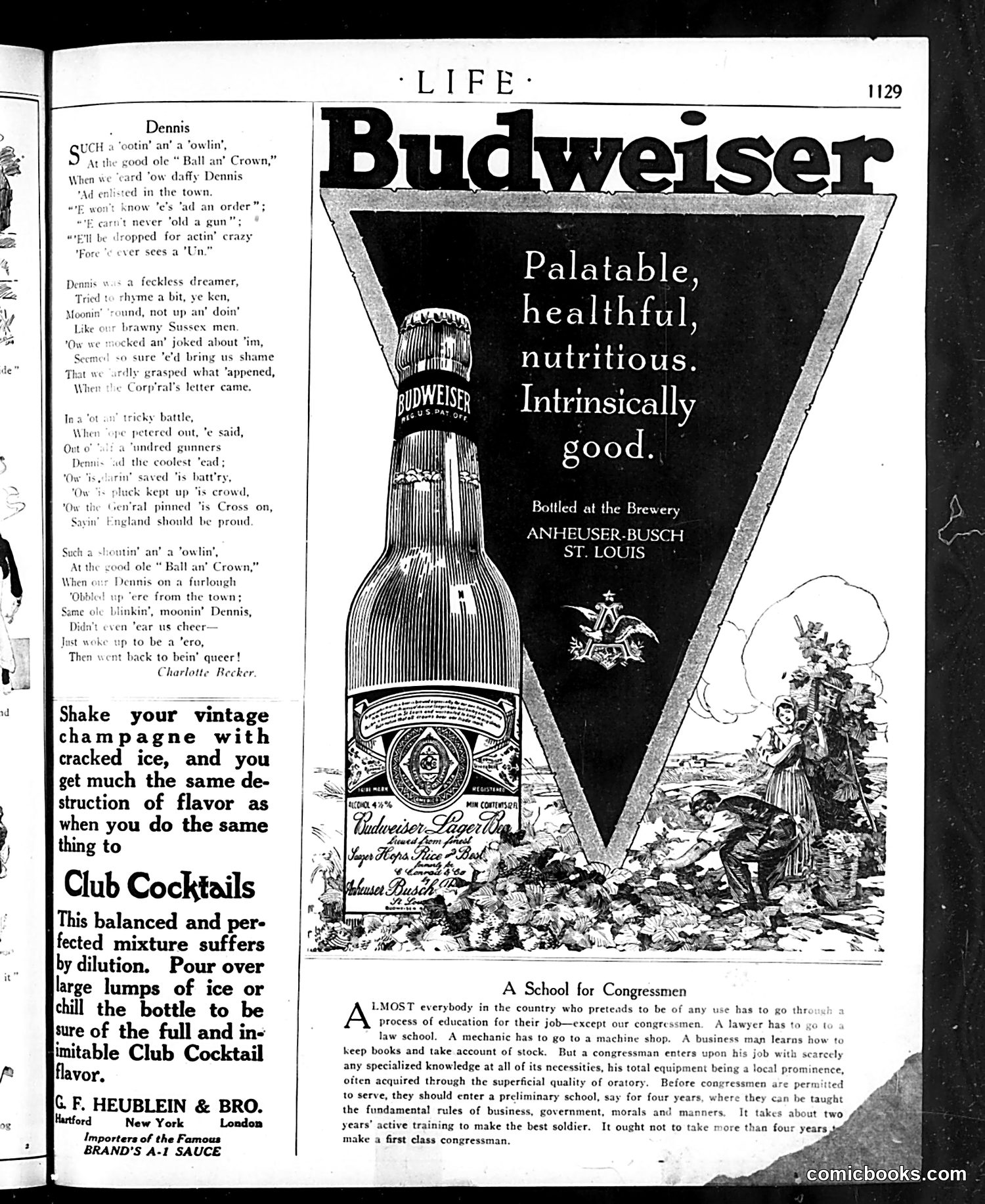
This page combines three distinct elements: a poem, advertisements, and social commentary. **"Dennis" Poem (by Charlotte Becker):** A narrative about a seemingly worthless dreamer from Sussex who enlists despite appearing unfit for military service. The townspeople mock him—he can't follow orders, hold a gun, or act normally. However, during combat, Dennis unexpectedly becomes a hero, saving his battery and earning a military decoration. Upon returning home on furlough, he reverts to his old eccentric self. The satire mocks both the initial prejudgment of character and the bizarre transformation war produces—suggesting that ordinary, seemingly incapable people can rise to extraordinary circumstances, yet may remain fundamentally unchanged. **"A School for Congressmen":** An editorial advocating formal training for newly elected representatives, arguing that congressmen enter office with only local prominence and oratory skills but no actual education in governance, business, or policy—unlike lawyers, mechanics, or soldiers. It proposes a mandatory four-year preliminary school teaching fundamental rules of business and governance. The Budweiser and Club Cocktails advertisements fill remaining space.
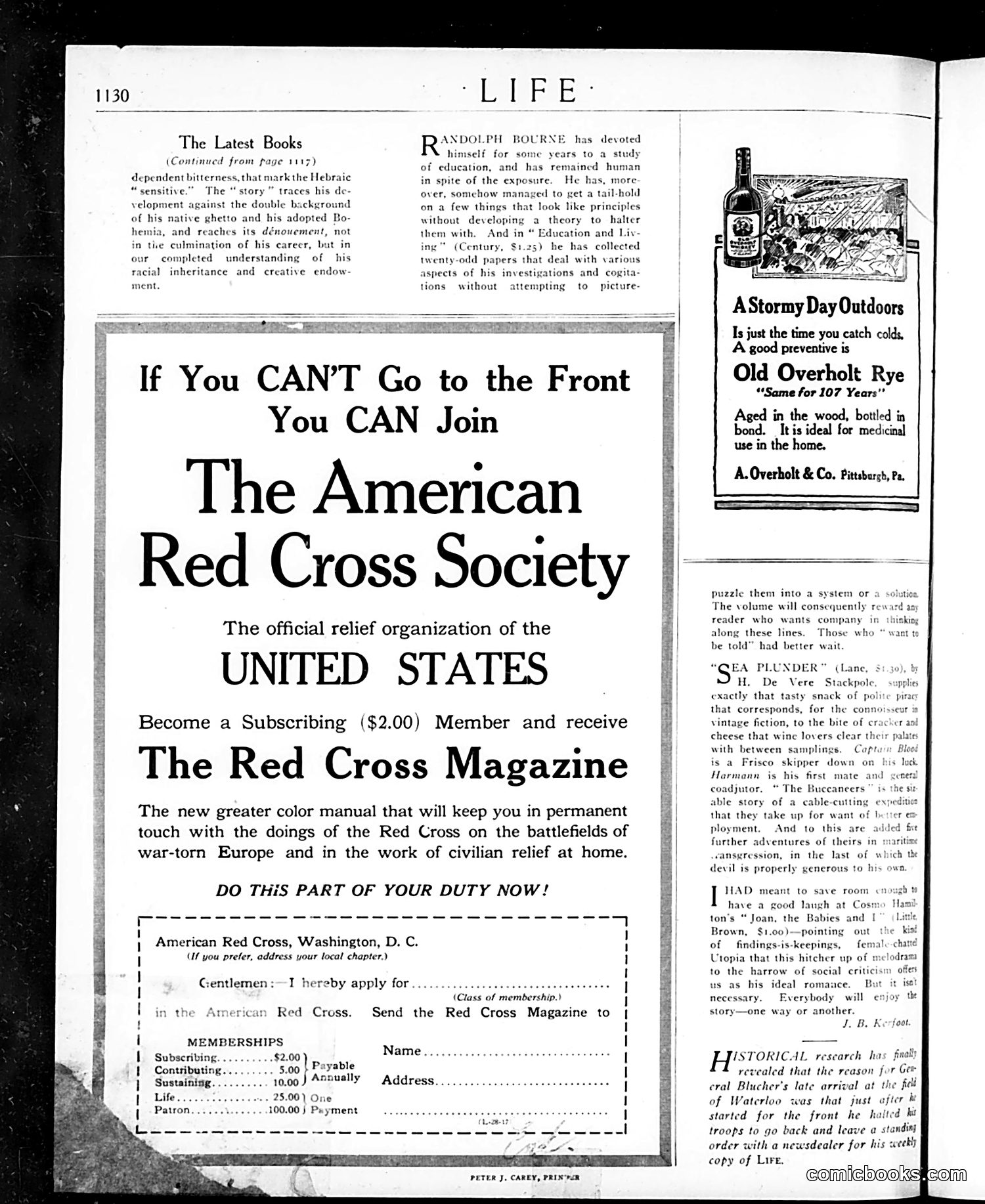
This page is primarily **advertising and recruitment content**, not satire. The dominant feature is a large Red Cross recruitment advertisement urging Americans unable to serve in combat to join the American Red Cross Society as subscribing members ($2.00) and receive *The Red Cross Magazine*. The context is **World War I**—references to "war-torn Europe" and "the battlefields" establish the timeframe. The ad frames Red Cross membership as a patriotic duty: "DO THIS PART OF YOUR DUTY NOW!" This reflects how American civilian organizations mobilized public support during the war. The page also includes book reviews and advertisements for **Old Overholt Rye whiskey**, marketed as medicinal—a common advertising claim during Prohibition's approach. At the bottom, there's a brief humorous note about General Blücher's delayed arrival at Waterloo being caused by his need to order his weekly *Life* magazine—a self-promotional joke by the magazine itself. The overall page reflects early-1900s wartime American print culture and mobilization messaging.
I can see this is a page from *Life* magazine, but the image shows primarily a blank white page with only fragmentary text visible along the left margin. The OCR'd text provided ("is weekly") is too incomplete to identify specific cartoons, political figures, or satirical content. The left margin contains partial text fragments that are largely illegible in this reproduction, making it impossible to accurately identify what cartoon or article this page contained, what figures were caricatured, or what social/political commentary was intended. To properly analyze this page's meaning for a modern reader, a clearer image or complete text would be necessary.