
Life, 1917-06-28 · page 18 of 39
Life — June 28, 1917 — page 18: what you’re looking at
What you’re looking at
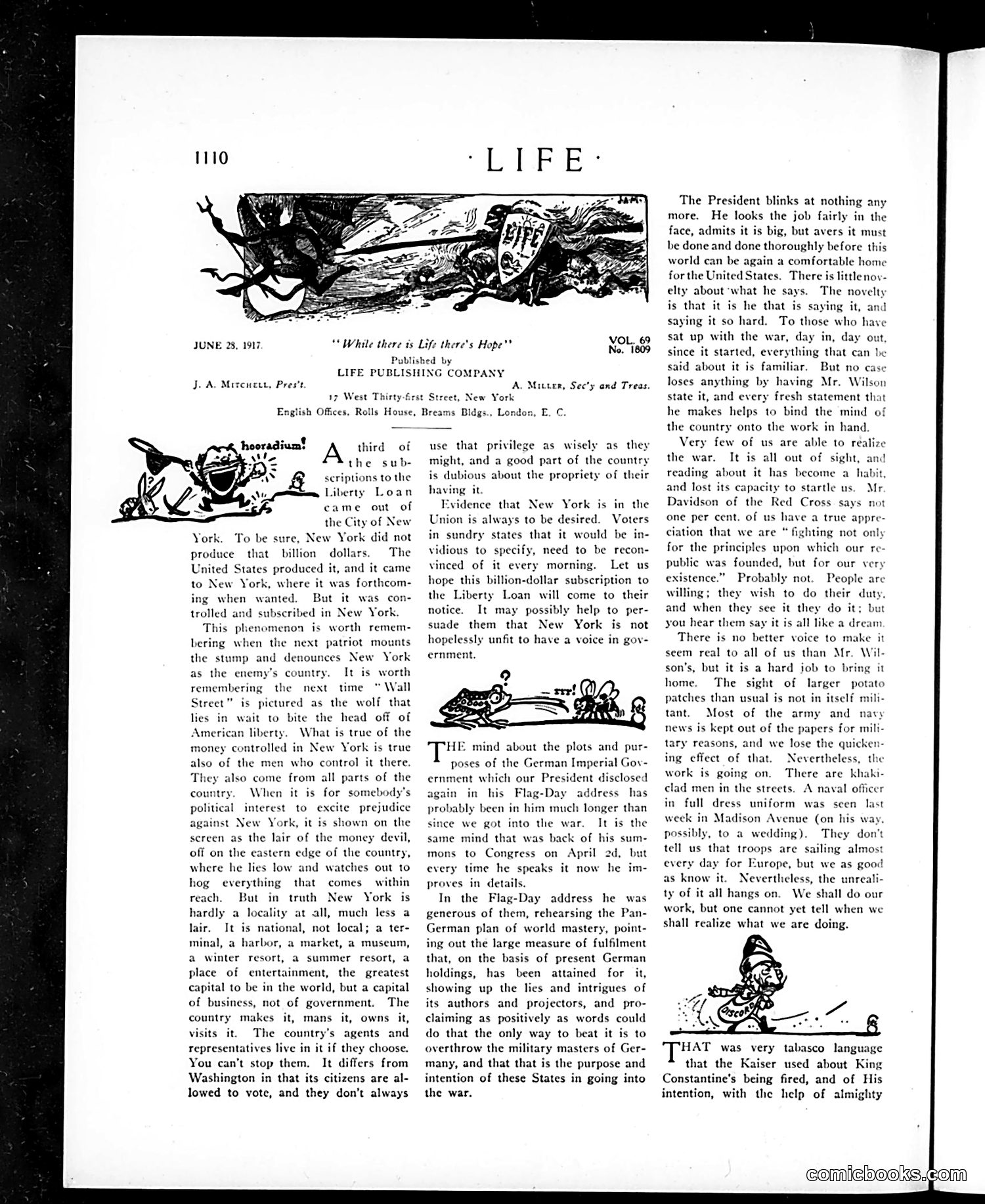
This page defends New York City against anti-Wall Street prejudice, particularly the stereotype of "Wall Street" as an enemy to American liberty. The article argues that New York is not a locality controlled by a money-hungry elite, but rather a national hub—a "terminal, a harbor"—where Americans from all parts of the country work and conduct business. The timing is significant: this is June 1917, just two months after America entered World War I. The piece celebrates New York's subscription to the Liberty Loan (war bonds), arguing this patriotic contribution should counter anti-New York sentiment. The second article praises President Wilson's Flag-Day address, which outlined German imperial ambitions and America's commitment to defeating German militarism. The author notes Wilson's rhetoric has become more direct and forceful about the war's necessity. The cartoons (specific figures unclear from image quality) appear to reinforce these pro-war, pro-New York themes typical of Life's 1917 editorial stance.
📄 Transcribed text from this page (OCR, searchable)
Machine-transcribed from the original scan — historical spelling and the odd misread are preserved.
JUNE 28, 1917 ‘While there is Life there's Hope’* Published by LIFE PUBLISHING J. A. Mitcucet, Pres't. 17 West Thirty-firs English Offices, Rolls H third of Aune scriptions to the Liberty Loan came out of the City of New York. To be sure, New York did not produce that billion dollars. The United States produced it, and it came to New York, where it was forthcom- ing when wanted. But it was cor trolled and subscribed in New York. This phenomenon is worth remem- bering when the next patriot mounts the stump and denounces New York as the enemy’s country. It is worth remembering the next “Wall Street” is pictured as the wolf that lies in wait to bite the head off of American liberty. What is true of the money controlled in New York is true also of the men who control it ther They also come from all parts of the country. When it is for somebody’ political interest to excite prejudice against New York, it is shown on the screen as the lair of the money devil, off on the eastern edge of the country, where he lies low and watches out to hog everything that comes within reach. But in truth New York is hardly a locality at all, much less a lair. It is national, not local; a ter- minal, a harbor, a mar! museum, a winter resort, a summer resort, a place of entertainment, the greatest capital to be in the world, but a capital of business, not of government. The country makes it, mans it, owns it, visits it. The country’s agents and representatives live in it if they choose. You can’t stop them. It differs from Washington in that its citizens are al- lowed to vote, and they don’t always hooradium! whe aS & ———— sub- time COMPANY A. Mitten, Sec’y and Treas. t Street, New York Breams Bldgs., London, E. C. use that privilege as wisely as they might, and a good part of the country is dubious about the propriety of their having it Evidence that New Union is always to be desired. in sundry states that it would be in- vidious to specify, need to be recon- vinced of it every morning. Let us hope this billion-dollar subscription to the Liberty Loan will come to their notice. It may possibly help to per- suade them that New York is not hopelessly unfit to have a voice in gov- ernment. York is in the Voters HE mind about the plots and pur- poses of the German Imperial Gov- ernment which our President disclos again in his Flag-Day address has probably been in him much longer than since we got into the war. It is the same mind that was back of his sum- mons to Congress on April 2d, but every time he speaks it now he im- proves in details. In the Flag-Day address he was generous of them, rehearsing the Pan- German plan of world mastery, point- ing out the large measure of fulfilment that, on the basis of present German holdings, has been attained for it, showing up the lies and intrigues of its authors and projectors, and pro- claiming as positively as words could do that the only way to beat it is to overthrow the military masters of Ger- many, and that that is the purpose and intention of these States in going into the war. The President blinks at nothing any more. He looks the job fairly in the face, admits it is big, but avers it must be done and done thoroughly before this world can be again a comfortable home forthe United States. There is littlenov- elty about ‘what he says. he novelty is that it is he that is saying it, and saying it so hard. To those who have sat up with the war, day in, day out, since it started, everything that can be said about it is familiar. But no cas loses anything by having Mr. Wilson state it, and every fresh statement that he makes helps to bind the mind of the country onto the work in hand. Very few of us are able to realize the war. It is all out of sight, and reading about it has become a habit, and lost its capacity to startle us. Mr Davidson of the Red Cross says not one per cent. of us have a true appre- ciation that we are “fighting not only for the principles upon which our re public was founded, but for our very existence.” Probably not. People are willing; they wish to do their duty. and when the it they do it; t you hear them say it is all like a dream There is no better voice to make it seem real to all of us than Mr. Wil- son's, but it is a hard job to bring it home. The sight of larger patches than usual is not in itself mili- tant. Most of the army and navy news is kept out of the papers for mili- potato, tary reasons, and we lose the quicken- ing effect of that. Nevertheless, the work is going on. There are khaki- clad men in the streets. A naval officer in full dress uniform was last week in Madison Avenue (on his way, possibly, to a wedding). They don’t tell us that troops are sailing almost every day for Europe, but we as good as know it. Nevertheless, the unreali- ty of it all hangs on. We shall do our work, but one cannot yet tell when we shall realize what we are doing. seen Be [ear was very tabasco langu that the Kaiser used about King Constantine's being fired, and of His intention, with the help of almighty comichooks.