
Life, 1917-06-28 · page 25 of 39
Life — June 28, 1917 — page 25: what you’re looking at
What you’re looking at
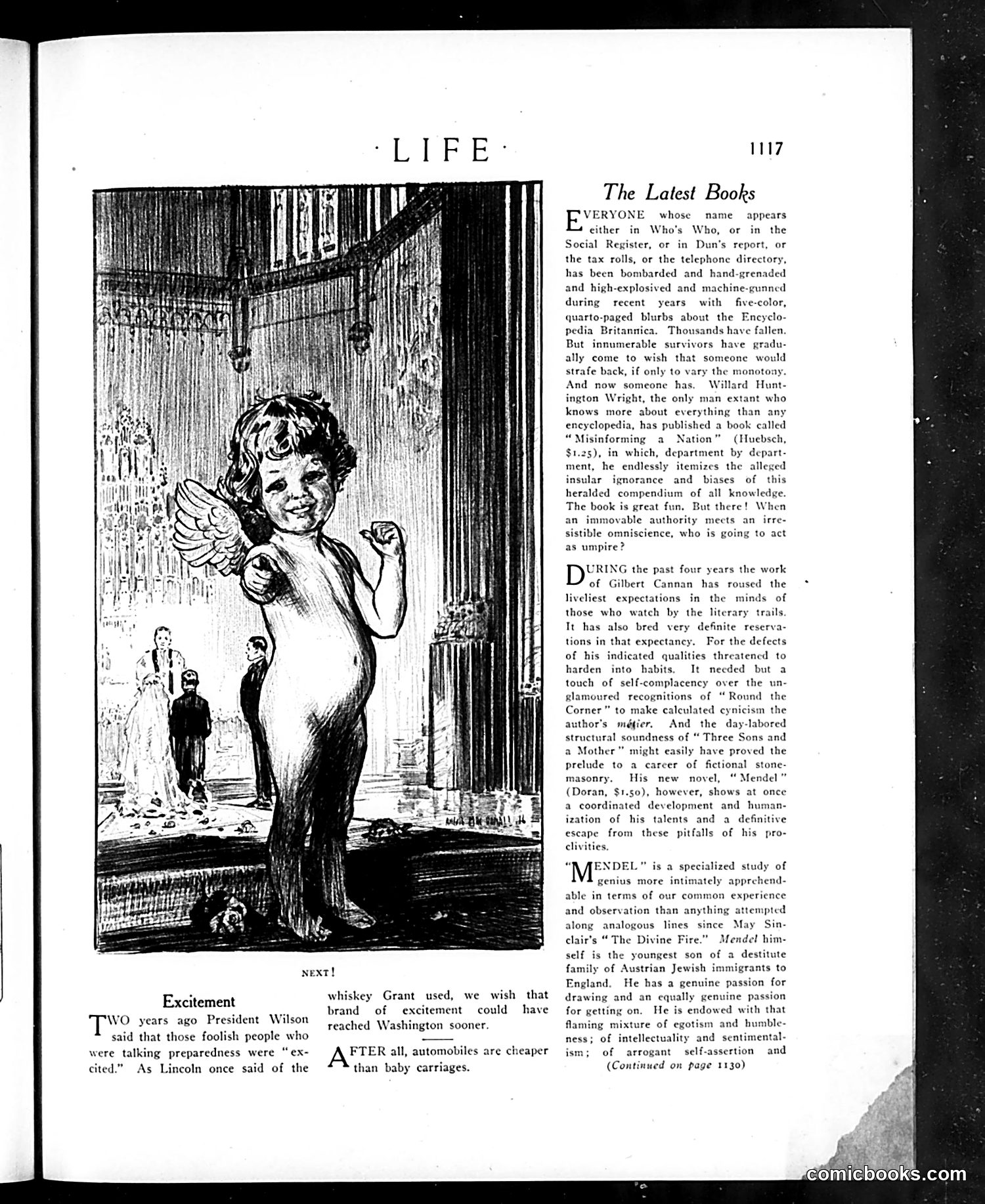
This page contains a brief political cartoon and book reviews. The cartoon section, titled "Excitement," satirizes President Wilson's 1914 dismissal of military preparedness advocates as "excited" people. Life's editors sarcastically wish that Wilson had shown more of that same "excitement"—implying his reluctance to prepare for war was foolish, especially given America's eventual entry into World War I (the page references "the past four years," suggesting this is circa 1918-1919). The quip comparing automobiles to baby carriages appears to mock those opposing military spending on cost grounds. The bulk of the page reviews new books, including Willard Huntington Wright's critique of the Encyclopedia Britannica's alleged bias and Gilbert Cannan's novel "Mendel" about a young Austrian Jewish immigrant artist in England. The reviews are literary commentary unrelated to the political cartoon above.
📄 Transcribed text from this page (OCR, searchable)
Machine-transcribed from the original scan — historical spelling and the odd misread are preserved.
ip ny ial HT vis Excitement WO years ago President Wilson said that those foolish people who were talking preparedness were “ex- cited.” As Lincoln once said of the that have whiskey Grant used, we wish brand of excitement could reached Washington sooner. FTER all, automobiles are cheaper than baby carriages. W117 The Latest Books E RYONE whose name appears cither in Who's Who, or in the Social Register, or in Dun’s report, or the tax rolls, or the telephone directory, has been bombarded and hand-grenaded and high-explosived and machine-guaned during years with quarto-paged blurbs about the Encyclo- pedia Britannica, Thousands have fallen. But innumerable survivors have gradu- ally come to wish that someone would strafe back, if only to vary the monotony. And now someone has. Willard Hunt- ington Wright, the only man extant who knows more about everything than any encyclopedia, has published a book called “Misinforming a Nation” (Huebsch, .25), in which, department by depart- ment, he endlessly itemizes the alleged insular ignorance and biases of th heralded compendium of all knowledge. The book is great fun, But there! When an immovable authority meets an irre- sistible omniscience, who is going to act as umpire? recent five-color, URING the past four years the work of Gilbert Cannan has roused the liveliest expectations in the those who watch by the literary trails. Tt has also bred very definite reserva- For the defects minds of tions in that expectancy. of his indicated qualities threatened to harden into habits. It needed but a touch of self-complacency over the un- glamoured recognitions of “Round the Corner” to make calculated cynicism the author's méfier, And the day-labored structural soundness of “ Three Sons and a Mother” might easily have proved the prelude to a carcer of fictional stone- masonry. His new “ Mendel” (Doran, $1.50), however, shows at once a coordinated development and human- ization of his talents and a definitive escape from these pitfalls of his pro- clivities. novel, "M DEL” is a specialized study of genius more intimately apprehend- able in terms of our comm: and observation than anything analogous lines since May S The Divine Fire.” Mendel him- self is the youngest son of a destitute family of Austrian Jewish immigrants to England. He has a genuine passion for drawing and an equally genuine passion for getting on. He is endowed with that flaming mixture of egotism and humble- ness; of intellectuality and sentimental- ism; of arrogant self-assertion and (Continued on page 1130) nm experience along clair's