
Life, 1917-06-28 · page 19 of 39
Life — June 28, 1917 — page 19: what you’re looking at
What you’re looking at
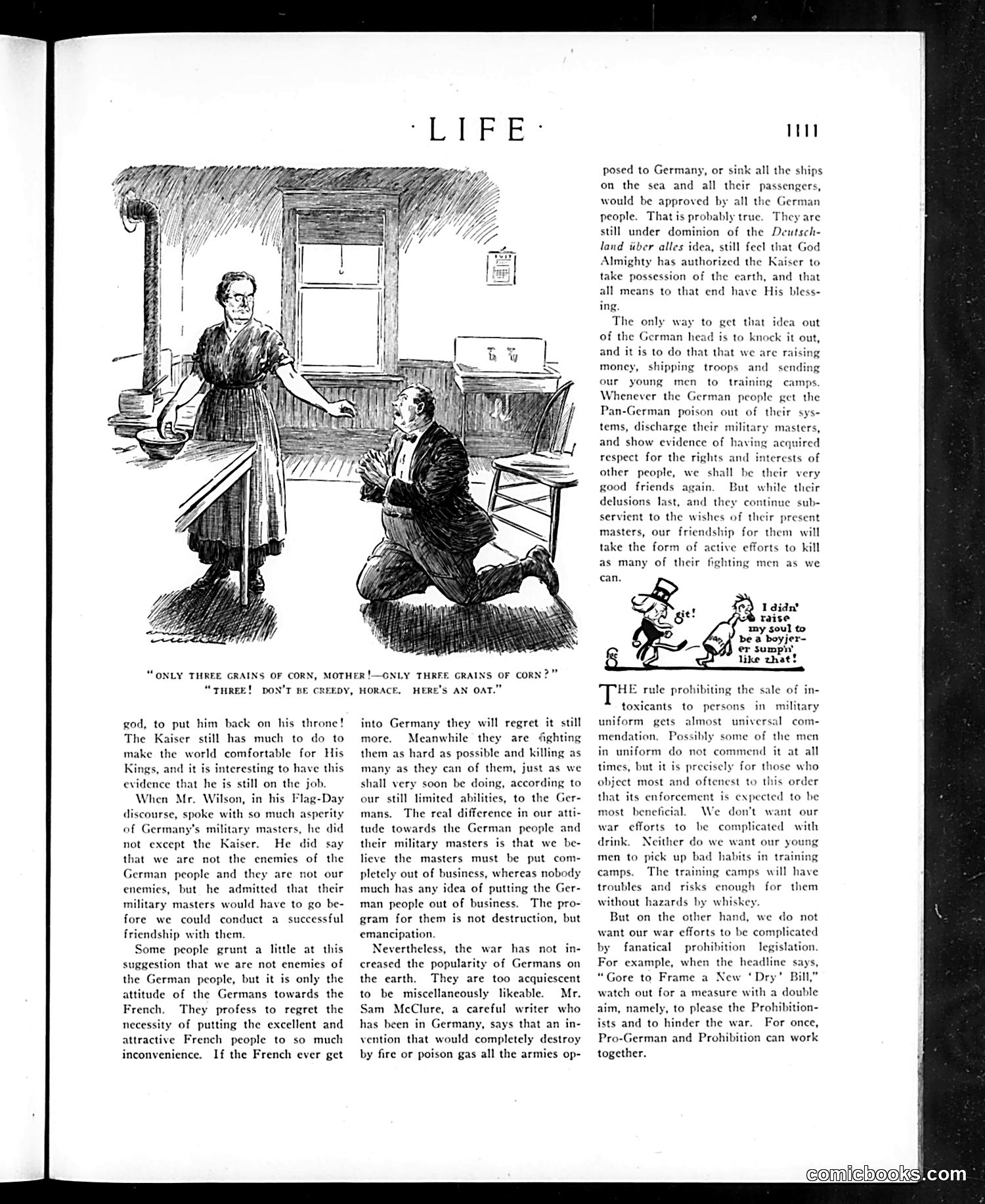
This Life magazine page from World War I contains two distinct cartoons satirizing German attitudes and American war policy. **The main cartoon** (top) depicts a starving German mother and child with the caption "Only three grains of corn, mother!" The accompanying text sarcastically praises Germany's leadership, suggesting ordinary Germans would approve any atrocity—even poison gas or sinking ships—to win the war. The satire's point: German civilians have been so thoroughly indoctrinated by "Deutschland über alles" ideology and the Kaiser's authority that they've lost moral reasoning. **The smaller cartoon** (bottom right) shows a child refusing an oat, captioning "I didn't raise my boy to be a bumper like that!"—mocking overly sentimental peace advocates while America mobilizes for war. The text advocates distinguishing between German *people* (whom Americans should eventually befriend after military defeat) and German *military masters* (who must be destroyed). The satire's target: German militarism and blind obedience, not the German population itself.
📄 Transcribed text from this page (OCR, searchable)
Machine-transcribed from the original scan — historical spelling and the odd misread are preserved.
“ONLY THREE GRAINS OF CORN, MOTHER!—GNLY THREE GRAINS OF CORN?” “THREE! god, to put him back on his throne! The Kaiser still has much to do to make the world comfortable for His Kings, and it is interesting to have this evidence that he is still on the job. When Mr. Wilson, in his Flag-Day discourse, spoke with so much asperity of Germany's military masters, he did not except the Kaiser. He did say that we are not the enemies of the German people and they are not our enemies, but he admitted that their military masters would have to go be- fore we could conduct a successful friendship with them. Some people grunt a little at this suggestion that we are not enemies of the German people, but it is only the attitude of the Germans towards the French. They profess to regret the necessity of putting the excellent and attractive French people to so much inconvenience. If the French ever get DON’T BE CREEDY, HORACE. HERE'S AN OAT.” into Germany they will regret it still more. Meanwhile they are Aghting them as hard as possible and killing as many as they can of them, just as we shall very soon be doing, according to our still limited abilities, to the Ger- mans. The real difference in our atti- tude towards the German people and their military masters is that we be- lieve the masters must be put com- pletely out of business, whereas nobody much has any idea of putting the Ger- man people out of business. The pro- gram for them is not destruction, but emancipation. Nevertheless, the war has not in- creased the popularity of Germans on the earth. They are too acquiescent to be miscellancously likeable. Mr. Sam McClure, a careful writer who has been in Germany, says that an in- vention that would completely destroy by fire or poison gas all the armies op- Wi posed to Germany, or sink all the ships on the sea and all their passengers, would be approved by all the German people. That is probably true. They are still under dominion of the Deutsch- land iiber alles idea, still feel that God Almighty has authorized the Kaiser to take possession of the earth, and that all means to that end have His bless- ing. The only way to get that idea out of the German head is to knock it out, and it is to do that that we are raising money, shipping troops and sending our young men to training camps. Whenever the German people get the Pan-German poison out of their sys- tems, discharge their military and show evidence of having acquired respect for the rights and interests of other people, we shall be their very good friends again. But while their delusions last, and they continue sub- servient to the wishes of their present masters, our friendship for them will take the form of active efforts to kill as many of their fighting men as we masters, my soul to be a boyjer- er Sump’ like that! HE rule prohibiting the sale of in- toxicants to military uniform gets almost universal com- mendation, Possibly some of the men in uniform do not commend it at all persons in times, but it is precisely for those who object most and oftenest to this order that its enforcement is expected to be most beneficial. We war efforts to be complicated with drink. ther do we want our young men to pick up bad habits in training camps. The training camps will have troubles for them without hazards by whiskey. But on the other hand, we do not want our war efforts to be complicated by fanatical prohibition legislation. For example, when the headline “Gore to Frame a New ‘Dry’ watch out for a measure with a aim, namely, to please the Prohil ists and to hinder the war. For once, Pro-German and Prohibition can work together. don't want our nd risks enough