
Life, 1917-06-28 · page 24 of 39
Life — June 28, 1917 — page 24: what you’re looking at
What you’re looking at
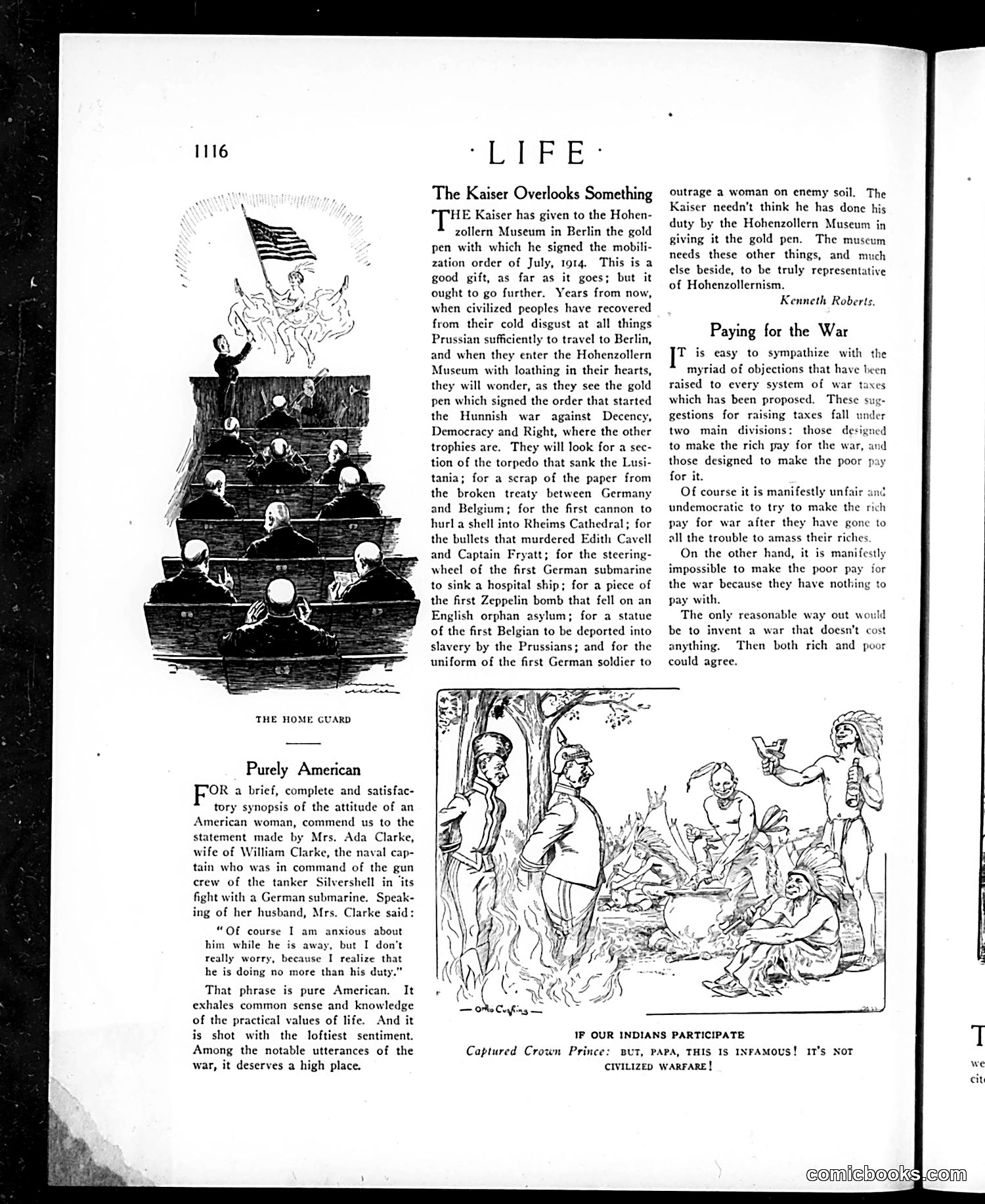
This WWI-era page contains three satirical pieces attacking Germany and defending American interests: **"The Home Guard"** praises Mrs. Ada Clarke, wife of a naval captain, for stoically accepting her husband's wartime service—presenting her pragmatism as quintessentially American virtue. **"The Kaiser Overlooks Something"** mocks Kaiser Wilhelm II for donating only a gold pen (used to sign the 1914 mobilization order) to Berlin's Hohenzollern Museum. The author sarcastically suggests the museum should also display artifacts of German atrocities: the Lusitania torpedo, violated Belgian treaty, Rheims Cathedral bombardment, Edith Cavell's bullets, sunk hospital ships, Zeppelin bombs on orphanages, and evidence of sexual violence against Belgian women—implying these represent Prussian "civilization." **"If Our Indians Participate"** (bottom cartoon) shows a captured German Crown Prince horrified that Native Americans fight "uncivilized" warfare, ironically inverting Germany's own brutal conduct—a jab at German hypocrisy about warfare rules. All three pieces present American/Allied righteousness against German barbarism.
📄 Transcribed text from this page (OCR, searchable)
Machine-transcribed from the original scan — historical spelling and the odd misread are preserved.
THE HOME GUARD Purely American For a brief, complete and satisfac- tory synopsis of the attitude of an American woman, commend us to the statement made by Mrs, Ada Clarke, wife of William Clarke, the naval cap- tain who was in command of the gun crew of the tanker Silvershell in ‘its fight with a German submarine. Speak- ing of her husband, Mrs. Clarke said: “Of course I am anxious about him while he is away, but I don’t really worry, because I realize that he is doing no more than his duty.” That phrase is pure American. It exhales common sense and knowledge of the practical values of life. And it is shot with the loftiest sentiment. Among the notable utterances of the war, it deserves a high place. “LEE ~ The Kaiser Overlooks Something 'HE Kaiser has given to the Hohen- zollern Museum in Berlin the gold pen with which he signed the mobili- zation order of July, 1914. This is a good gift, as far as it goes; but it ought to go further. Years from now, when civilized peoples have recovered from their cold disgust at all things Prussian sufficiently to travel to Berlin, and when they enter the Hohenzollern Museum with loathing in their hearts, they will wonder, as they see the gold pen which signed the order that started the Hunnish war against Decency, Democracy and Right, where the other trophies are. They will look for a sec- tion of the torpedo that sank the Lusi- tania; for a scrap of the paper from the broken treaty between Germany and Belgium; for the first cannon to hurl a shell into Rheims Cathedral; for the bullets that murdered Edith Cavell and Captain Fryatt; for the steering- wheel of the first German submarine to sink a hospital ship; for a piece of the first Zeppelin bomb that fell on an English orphan asylum; for a statue of the first Belgian to be deported into slavery by the Prussians; and for the uniform of the first German soldier to outrage a woman on enemy soil. The Kaiser needn't think he has done his duty by the Hohenzollern Museum in giving it the gold pen. The museum needs these other things, and much else beside, to be truly representative of Hohenzollernism. Kenneth Roberts, Paying for the War T is easy to sympathize with the myriad of objections that have been raised to every system of war taxes which has been proposed. These sug- gestions for raising taxes fall und two main divisions: those to make the rich pay for the war, and those designed to make the poor pay for it. Of course it is manifestly unfair anc undemocratic to try to make the rich pay for war after they have gone to all the trouble to amass their riches On the other hand, it is manifestly impossible to make the poor pay for the war because they have nothing to pay with, The only reasonable way out would be to invent a war that doesn’t cost anything. Then both rich and poor could agree. IF OUR INDIANS PARTICIPATE Captured Crown Prince: But, PAPA, THIS 1S INFAMOUS! IT's NOT CIVILIZED WARFARE! comichoo! we cit