
Life, 1917-06-28 · page 30 of 39
Life — June 28, 1917 — page 30: what you’re looking at
What you’re looking at
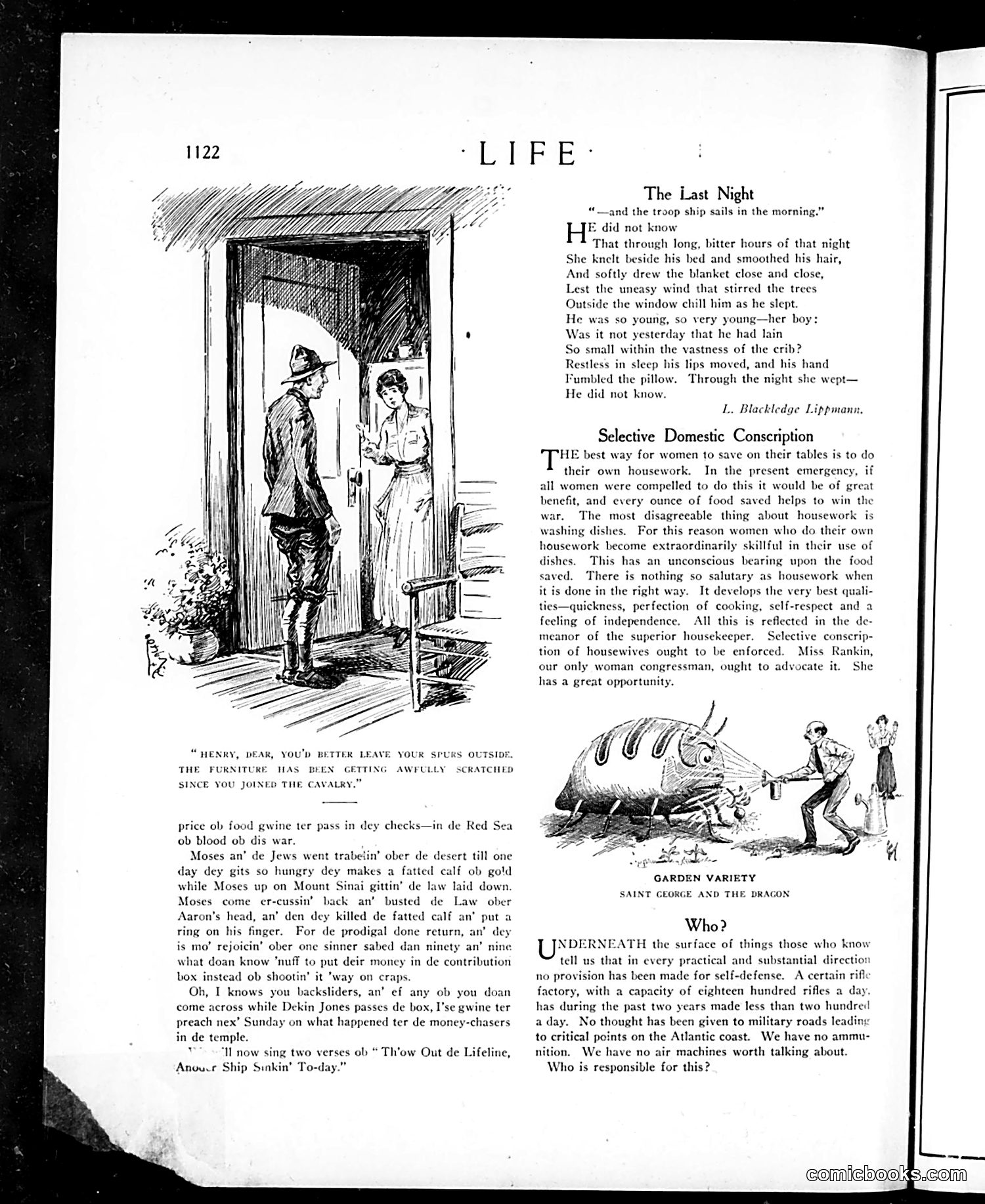
This page contains **WWI-era social commentary** addressed to a modern American audience unprepared for war. **"The Last Night" poem** depicts a mother's vigil beside her young son, a soldier departing on a troop ship. The pathos emphasizes the human cost of military conscription—the emotional toll on families. **"Selective Domestic Conscription"** argues women should be mandated to do their own housework to conserve food for the war effort. It praises housework as character-building and advocates Miss Rankin (the only female congressman) to enforce this policy. This reflects WWI-era attempts to mobilize civilian resources. **"Who?" column** exposes military unpreparedness: inadequate rifle production, no defensive infrastructure on the Atlantic coast, insufficient ammunition and aircraft. The rhetorical question "Who is responsible?" assigns blame for America's lack of military readiness—likely directed at government leadership. The cartoons and dialect piece appear to address economic/social aspects of war mobilization, though their specific references are unclear without additional historical context.
📄 Transcribed text from this page (OCR, searchable)
Machine-transcribed from the original scan — historical spelling and the odd misread are preserved.
YOUR SPURS OUTSIDE. SCRATCHED “HENRY, DEAR, YOU'D BETTER LEAV THE FURNITURE HAS BEEN GETTING AWFULLY SINCE YOU JOINED THE CAVALRY.” price ob food gwine ter pass in dey checks—in de Red Sea ob blood ob dis war. Moses an’ de Jews went trabelin’ ober de desert till one day dey gits so hungry dey makes a fatted calf ob gold while Moses up on Mount Sinai gittin’ de law laid down. Moses come er-cussin’ back an’ busted de Law ober Aaron's head, an’ den dey killed de fatted calf an’ put a ring on his finger. For de prodigal done return, an’ dey is mo! rejoicin’ ober one sinner sabed dan ninety an’ nine what doan know ‘nuff to put deir money in de contribution box instead ob shootin’ it way on craps. Oh, I knows you backsliders, an’ ef any ob you doan come across while Dekin Jones passes de box, I’se gwine ter preach nex’ Sunday on what happened ter de money-chasers in de temple. YIP now sing two verses ob “ Th'ow Out de Lifeline, Anoucr Ship Sinkin’ To-da The Last Night and the troop ship sails in the morning.” E did not know That through long, bitter hours of that night She knelt beside his bed and smoothed his hair, And softly drew the blanket close and close, Lest the uneasy wind that stirred the trees Outside the window chill him as he slept. He was so young, so very young—her boy: Was it not yesterday that he had la So small within the vastness of the crib? Restless in sleep his lips moved, and his hand Fumbled the pillow. Through the night she wept— He did not know. L. Blackledge Lippmann, Selective Domestic Conscription HE best way for women to save on their tables is to do their own housework. In the present emergenc all women were compelled to do this it would be of great benefit, and every ounce of food saved helps to win the war. The most disagreeable thing about housework is For this reason women who do their own xtraordinarily skillful in their use of an unconscious bearing upon the food washing dishes. housework become dishes. This ha saved, There is nothing so salutary as housework when it is done in the right way. It develops the very best quali- ties—quickness, perfection of cooking, self-respect and a All this is reflected in the de- meanor of the superior housekeeper. Selective conscrip- tion of housewives ought to be enforced. Miss Rankin, our only woman congressman, ought to advocate it. She has a great opportunity. feeling of independence. GARDEN VARIETY SAINT GEORGE AND THE DRAGON Who? NDERNEATH the surf. tell us that in every practical and substantial directior no provision has been made for self-defense. A certain rifle factory, with a capacity of eighteen hundred rifles a day. has during the past two years made less than two hundred a day. No thought has been given to military roads leading to critical points on the Atlantic coast. We have no ammu- nition. We have no air machines worth talking about. Who is responsible for this? of things those who know