
Life, 1917-06-28 · page 28 of 39
Life — June 28, 1917 — page 28: what you’re looking at
What you’re looking at
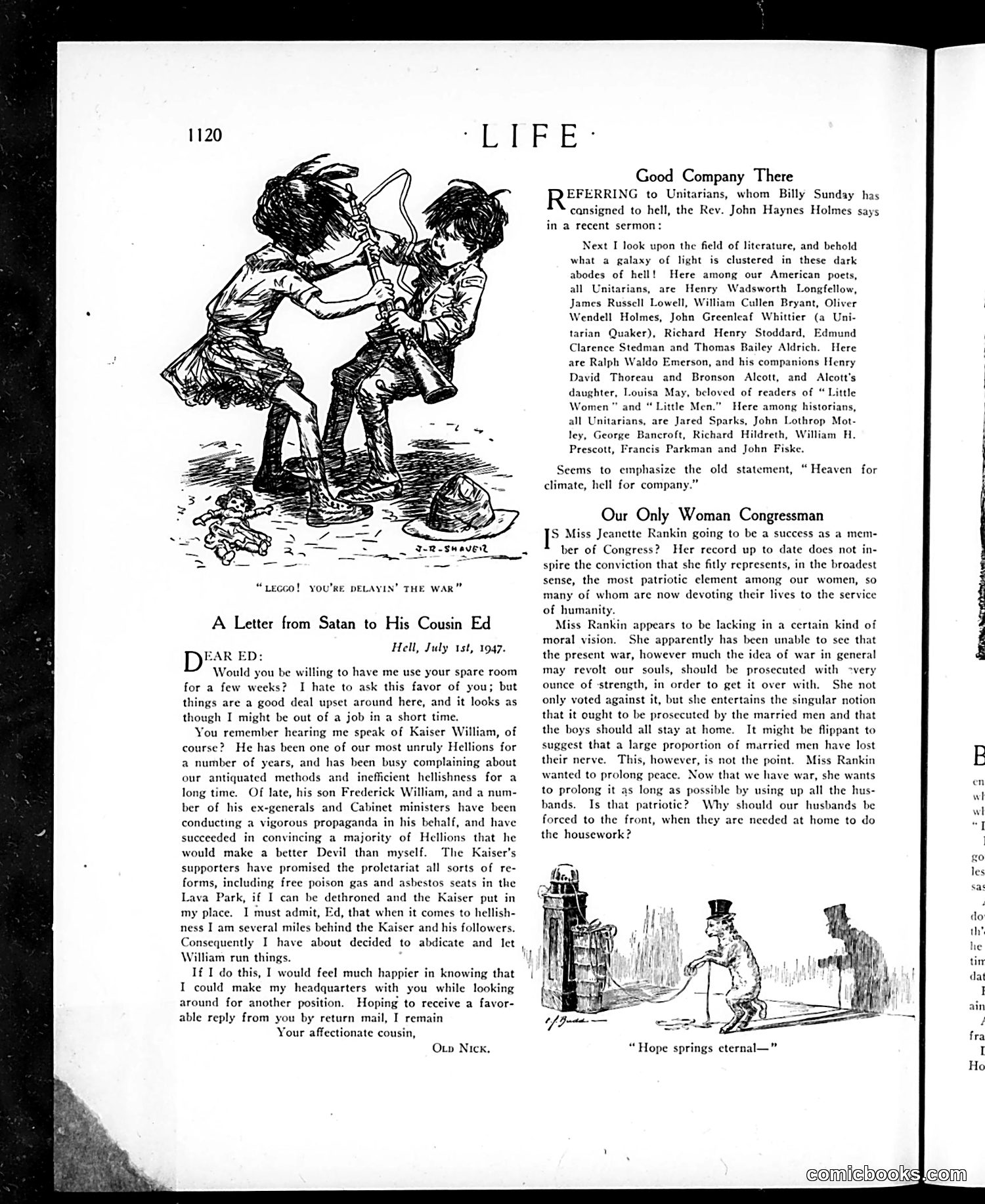
This 1917 *Life* magazine page contains wartime satire during World War I. **"A Letter from Satan to His Cousin Ed"** mocks German leadership. Satan writes that Kaiser William (Wilhelm II) and his son Frederick are threatening his position in Hell through propaganda promising reforms. Satan plans to abdicate, suggesting the Kaiser is *more evil* than the Devil himself—sharp political mockery of German militarism. **"Good Company There"** satirizes evangelist Billy Sunday's claim that Unitarians go to Hell. Reverend Holmes counters that Hell would actually contain America's greatest literary and historical figures—Emerson, Thoreau, Longfellow, etc.—all Unitarians. The joke: "Heaven for climate, hell for company" (good people make Hell preferable). **"Our Only Woman Congressman"** criticizes Representative Jeanette Rankin for voting against U.S. entry into WWI and suggesting married men stay home. The author attacks her pacifism as unpatriotic, viewing war support as a patriotic duty. All three pieces use humor to promote pro-war sentiment and mock dissenters.
📄 Transcribed text from this page (OCR, searchable)
Machine-transcribed from the original scan — historical spelling and the odd misread are preserved.
“LTFE* I-R-ShavErr Be ——— “Lecco! You'Re DELAYIN’ THE WAR” A Letter from Satan to His Cousin Ed EAR ED: Hell, July 1st, 1947. Would you be willing to have me use your spare room for a few weeks? I hate to ask this favor of you; but things are a good deal upset around here, and it looks as though I might be out of a job in a short time. You remember hearing me speak of Kaiser William, of course? He has been one of our most unruly Hellions for a number of years, and has been busy complaining about our antiquated methods and inefficient hellishness for a long time. Of late, his son Frederick William, and a num- ber of his ex-generals and Cabinet ministers have been conducting a vigorous propaganda in his behalf, and have succeeded in convincing a majority of Hellions that he would make a better Devil than myself. The Kaiser's supporters have promised the proletariat all sorts of re- forms, including free poison gas and asbestos seats in the Lava Park, if I can be dethroned and the Kaiser put in my place. I must admit, Ed, that when it comes to hellish- ness I am several miles behind the Kaiser and his followers. Consequently I have about decided to abdicate and let William run things. If I do this, I would feel much happier in knowing that I could make my headquarters with you while looking around for another position. Hoping to receive a favor- able reply from you by return mail, I remain Your affectionate cousin, Otp Nick, Good Company There EFERRING to Unitarians, whom Billy Sunday has cansigned to hell, the Rev. John Haynes Holmes says in a recent sermon: Next I look upon the field of literature, and behold what a galaxy of light is clustered in these dark abodes of hell! Here among our American poets, all Unitarians, are Henry Wadsworth Longfellow, James Russell Lowell, William Cullen Bryant, Oliver Wendell Holmes, John Greenleaf Whittier (a Uni- tarian Quaker), Richard Henry Stoddard, Edmund Clarence Stedman and Thomas Bailey Aldrich. Here are Ralph Waldo Emerson, and his companions Henry David Thoreau and Bronson Alcott, and Alcott's daughter, Louisa May, beloved of readers of “Little Women” and “Little Men.” Here among historians, all Unitarians, are Jared Sparks, John Lothrop Mot- ley, George Bancroft, Richard Hildreth, William H. Prescott, Francis Parkman and John Fiske. Seems to emphasize the old statement, “Heaven for climate, hell for company.” Our Only Woman Congressman S Miss Jeanette Rankin going to be a success as a mem- ber of Congress? Her record up to date does not in- spire the conviction that she fitly represents, in the broadest sense, the most patriotic element among our women, so many of whom are now devoting their lives to the service of humanity. Miss Rankin ap 's to be lacking in a certain kind of moral vision. She apparently has been unable to see that the present war, however much the idea of war in general may revolt our souls, should be prosecuted with -very ounce of ‘strength, in order to get it over with. She not only voted against it, but she entertains the singular notion that it ought to be prosecuted by the married men and that the boys should all stay at home. It might be flippant to suggest that a large proportion of married men have lost their nerve. This, however, is not the point. Miss Rankin wanted to prolong peace. Now that we have war, she wants to prolong it as long as possible by using up all the hus- bands. Is that patriotic? Why should our husbands be forced to the front, when they are needed at home to do the housework? “Hope springs cternal—” comichooks, wh