
A complete issue · 38 pages · 1917
Life — January 4, 1917
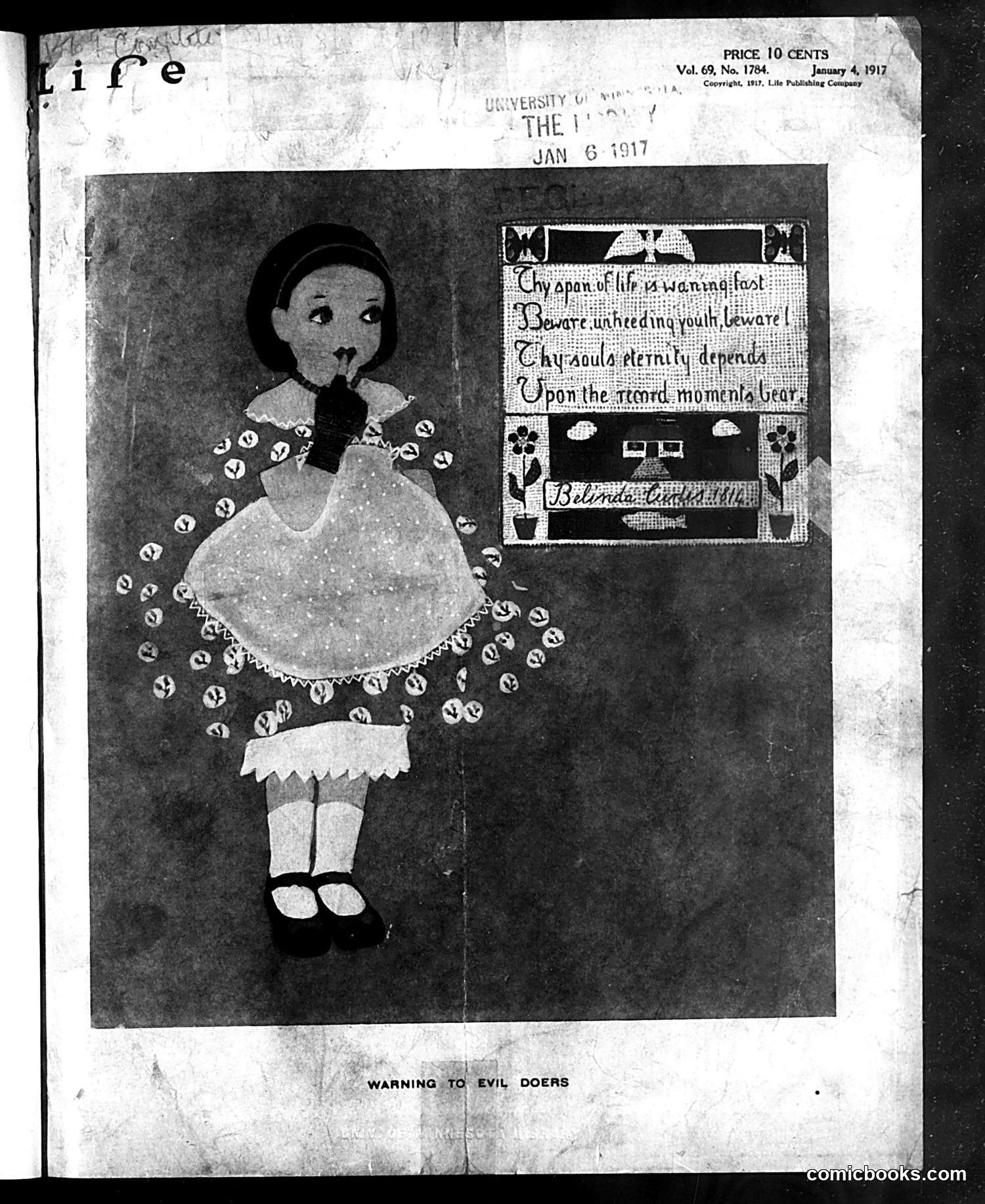
This page presents a cautionary illustration titled "Warning to Evil Doers," depicting a young girl surrounded by baseball-themed objects (baseballs arranged in a halo-like pattern around her dress). The accompanying text panel uses archaic language ("Chy upon of life's waning fast / Beware unheeding youth, beware!") suggesting moral instruction typical of early 20th-century children's literature. The satire likely mocks the era's tendency toward melodramatic, preachy warnings to youth about morality and "evil." The juxtaposition of innocent girlhood imagery with ominous textual warnings creates ironic commentary on overwrought moral panic. The baseball imagery remains unclear—possibly referencing youth culture or Americana. The overall piece appears to satirize contemporary anxieties about corrupting influences on American youth.
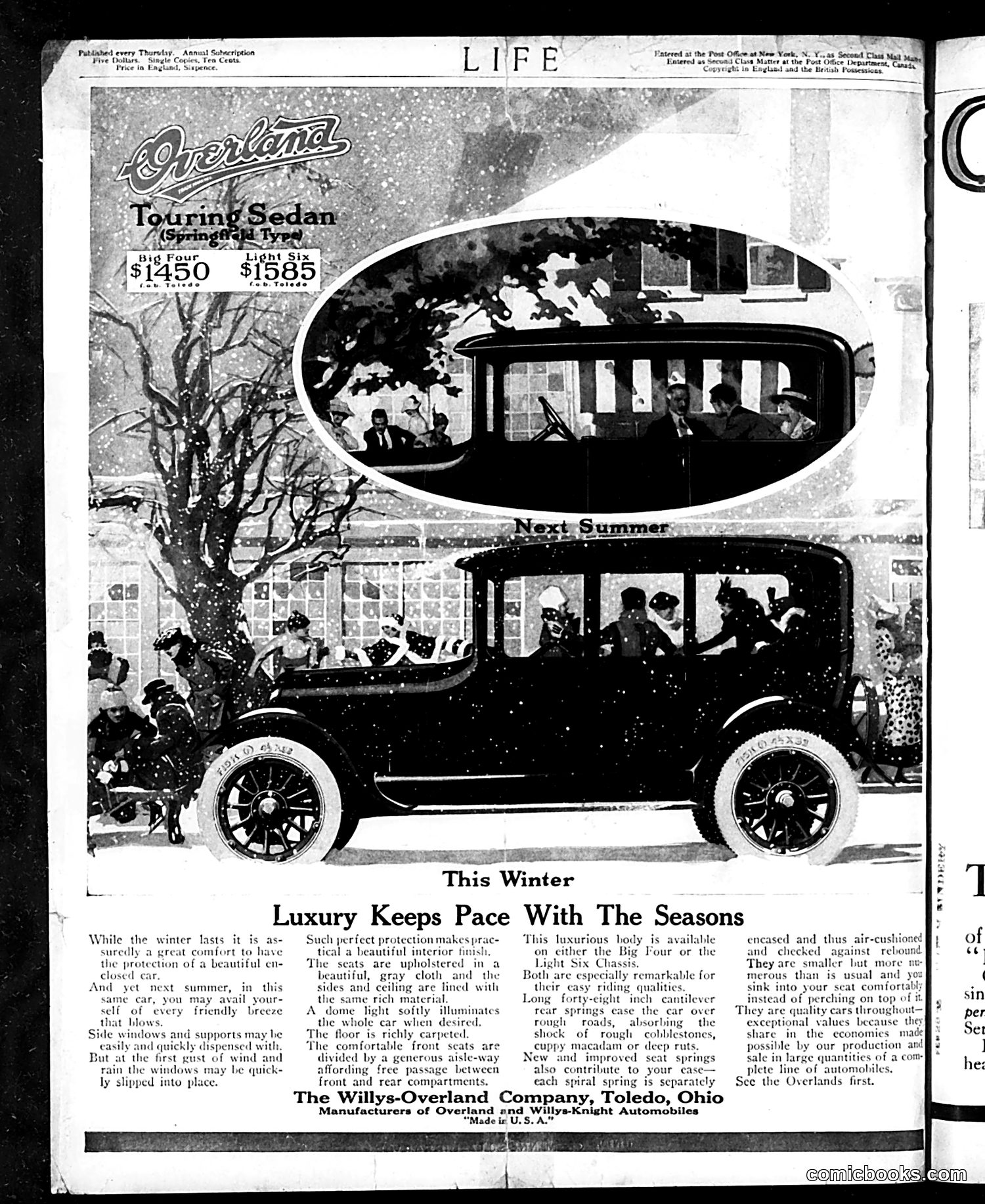
This page is primarily **advertising, not satire or political commentary**. It features a full-page advertisement for the Overland Touring Sedan automobile, manufactured by Willys-Overland Company in Toledo, Ohio. The ad shows two images of the vehicle and promotes its comfort and durability through winter and summer seasons. The headline "Luxury Keeps Pace With The Seasons" emphasizes year-round usability. Text highlights features like protective interior design, spring suspension, and comfortable seating. The only potentially humorous element is the phrase "Next Summer" appearing between the two vehicle images, suggesting the car's reliability will last until the following season—a gentle joke about durability rather than political satire. This is a straightforward commercial advertisement typical of 1920s magazine marketing.
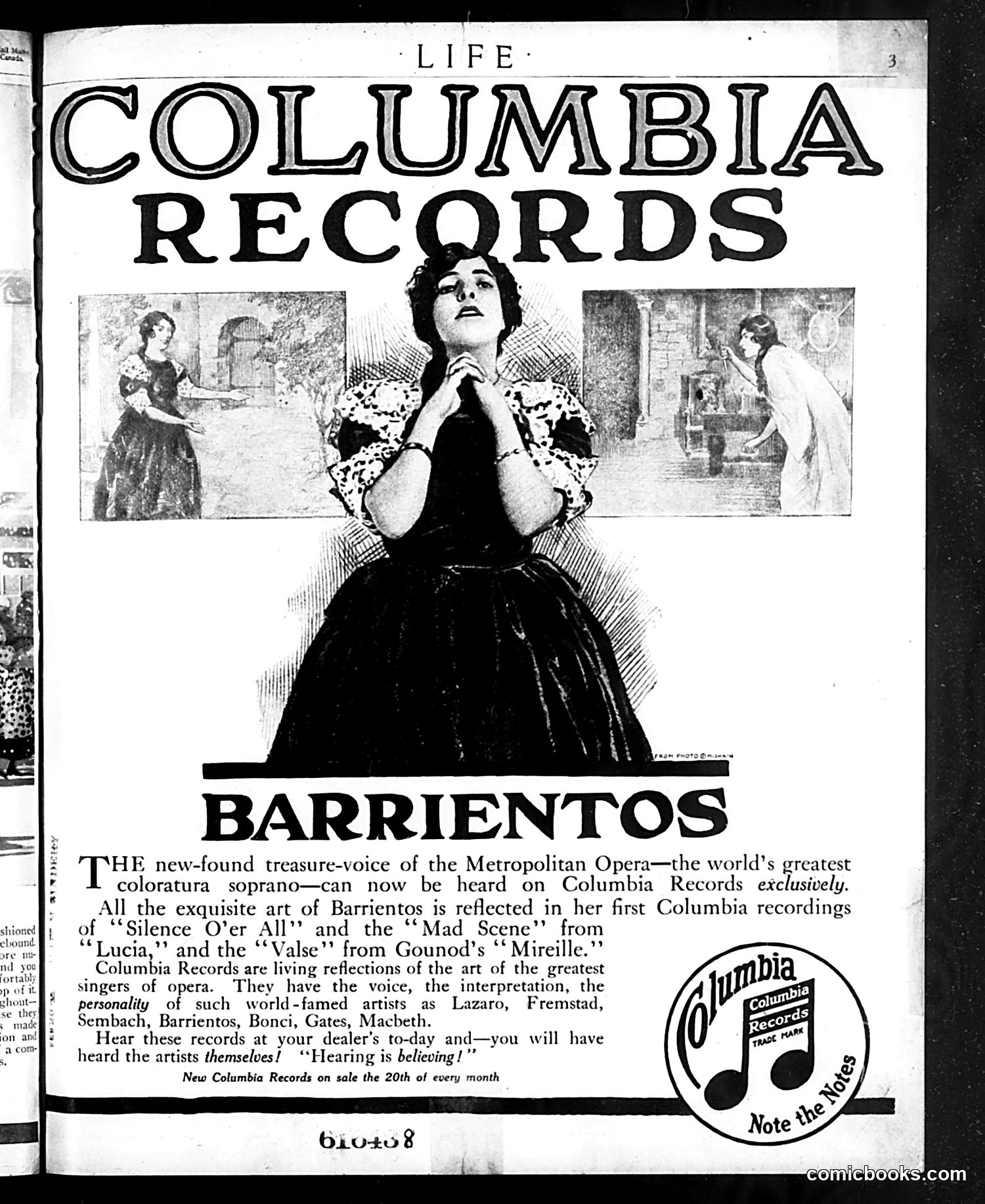
This is primarily a **Columbia Records advertisement**, not political satire. It promotes opera singer Maria Barrientos, described as the "new-found treasure-voice of the Metropolitan Opera" and "the world's greatest coloratura soprano." The ad emphasizes her first Columbia Records recordings of opera excerpts ("Silence O'er All," "Mad Scene" from *Lucia*, and "Valse" from *Mireille*). It positions Columbia Records as repositories of great singers' performances, comparing Barrientos to other renowned artists like Lazaro and Fremstad. The central image shows a woman in operatic costume (elaborate dress with spotted shawl) in an expressive pose. This is straightforward celebrity endorsement advertising typical of the era, designed to drive record sales by associating the label with prestigious Metropolitan Opera talent.
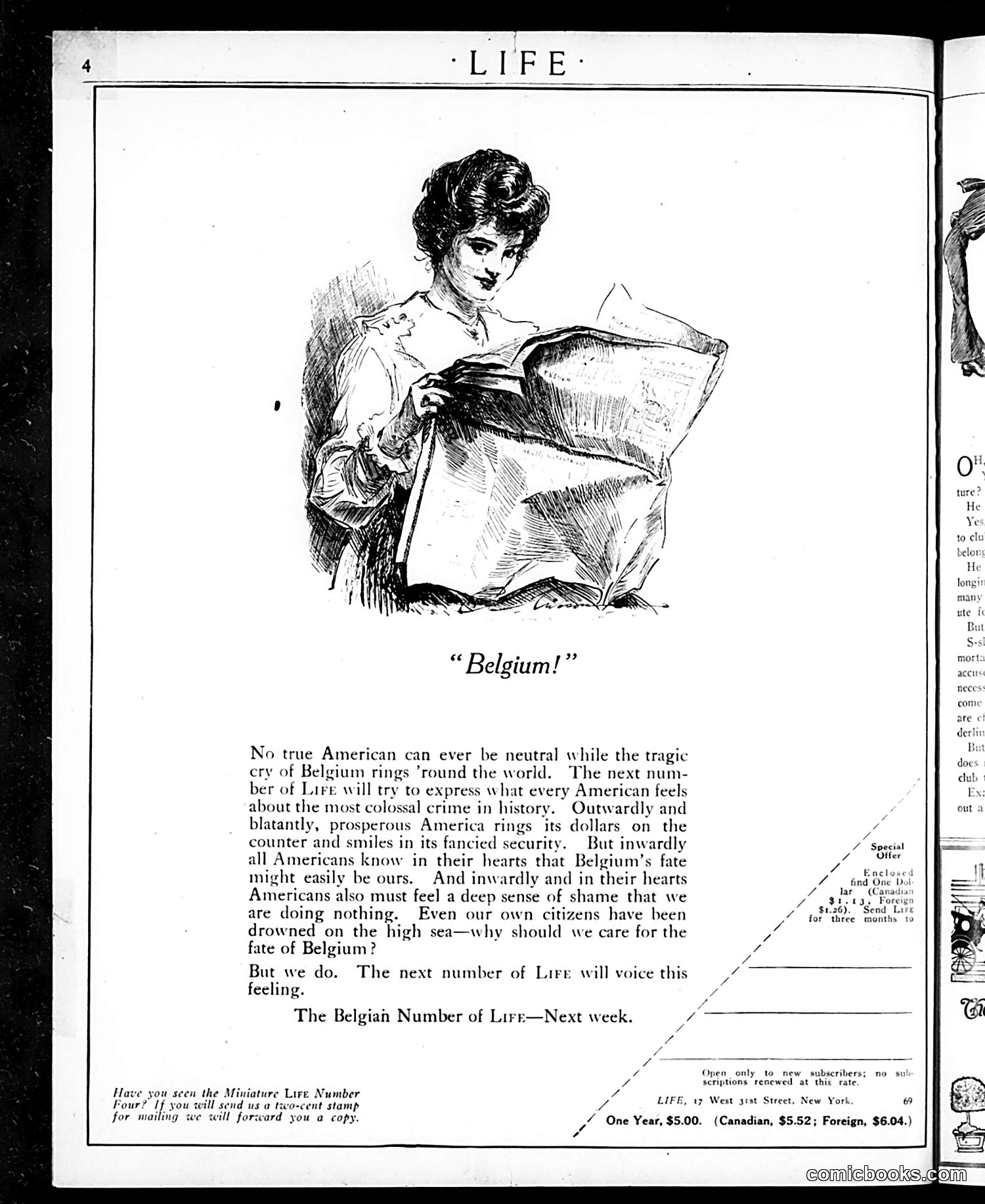
This page announces an upcoming special "Belgian Number" of *Life* magazine focused on Belgium's plight during World War I. The illustration shows a fashionable woman reading a newspaper with the exclamation "Belgium!" The accompanying text appeals to American neutrality sentiment by arguing that no American can remain truly neutral given Belgium's tragedy. It acknowledges that Americans outwardly maintain neutrality and financial security, but inwardly feel shame about doing nothing while Belgian citizens drown. The passage uses emotional language to pressure readers toward concern for Belgium's fate. The advertisement promotes the next issue as an vehicle to "voice this feeling," attempting to convert readers' guilty emotions into magazine subscriptions. This reflects early WWI-era American sympathy for Belgium before U.S. entry into the war in 1917.
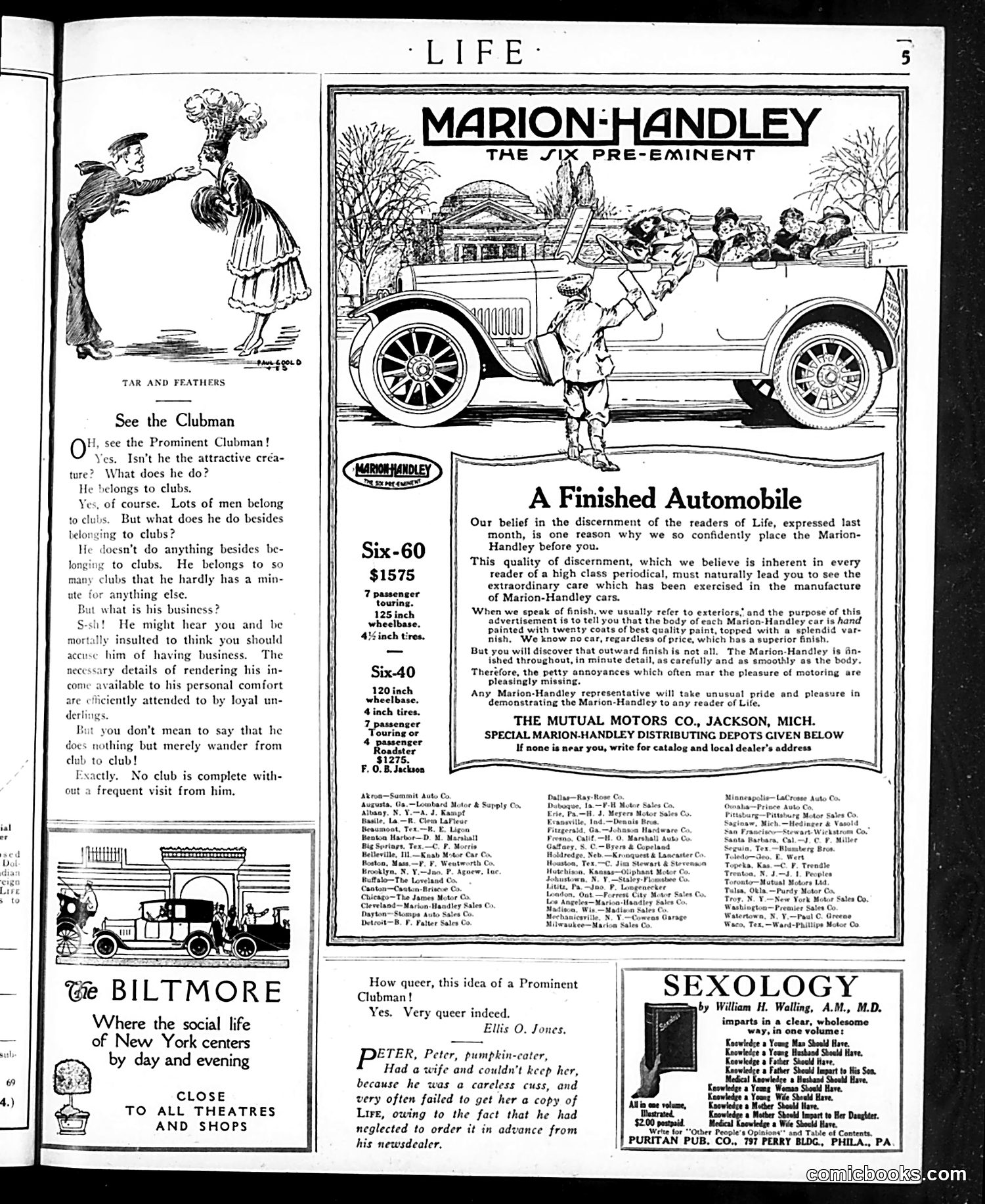
This page is primarily **advertising and social commentary rather than political satire**. The top cartoon titled "Tar and Feathers" depicts a man presenting flowers to a woman, with dialogue about "clubmen" and club membership—apparently satirizing the pretensions of social club culture in this era. The main content features a Marion-Handley automobile advertisement, promoting the "Six-60" model as "A Finished Automobile" with emphasis on quality craftsmanship. The ad includes dealer listings across America. Lower sections advertise the Biltmore hotel (positioning New York's social life) and a book on "Sexology." The humor targets social climbing and consumerism rather than political figures. The "prominent clubman" dialogue jokes about superficial social status-seeking among the affluent.
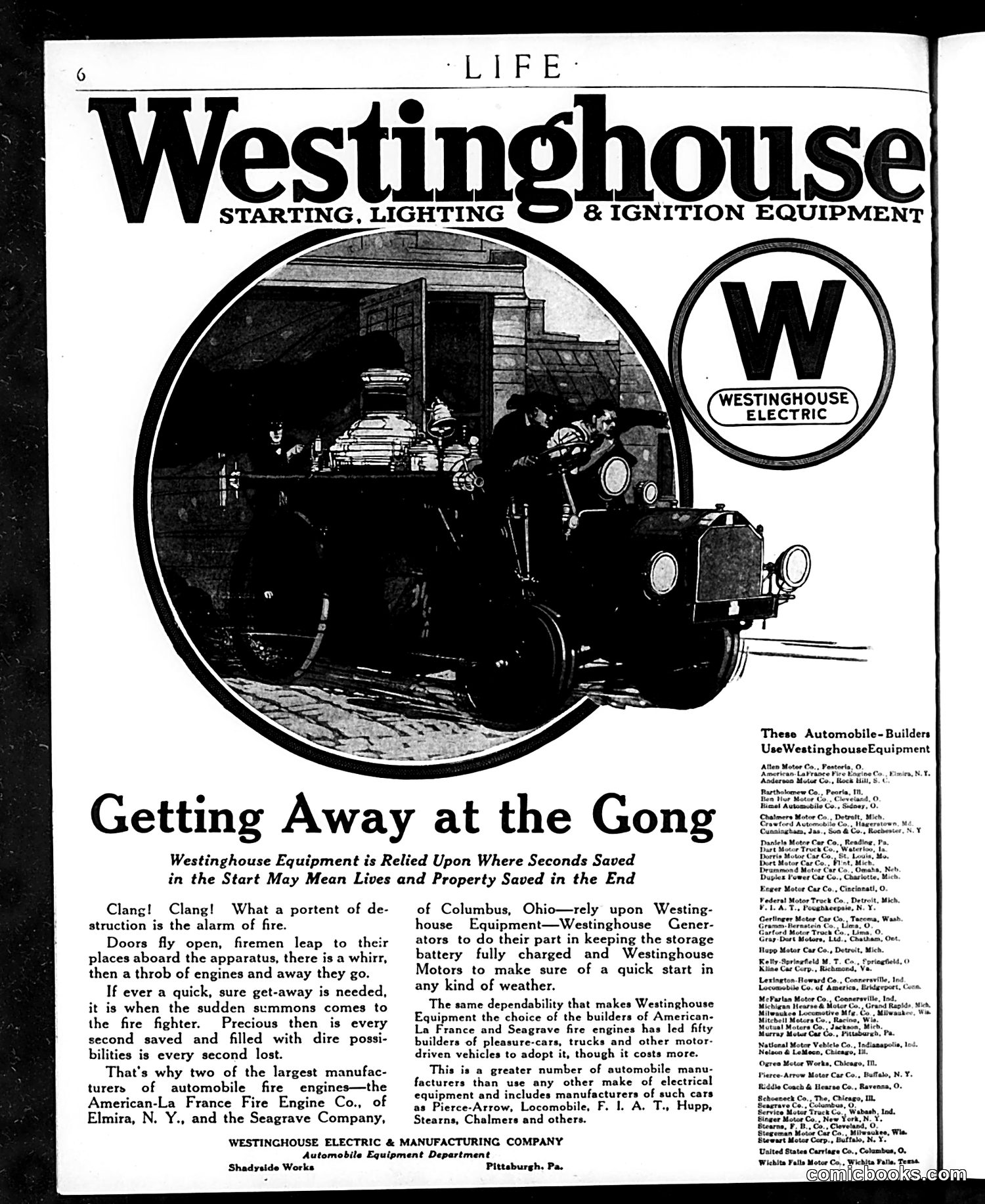
This is primarily **advertising, not satire or editorial cartoon**. The page promotes Westinghouse Electric's starting, lighting, and ignition equipment for automobiles. The headline "Getting Away at the Gong" uses a fire-alarm metaphor to emphasize speed and reliability. The circular inset shows an early automobile with prominent headlights, illustrating the equipment in use. The accompanying text argues that Westinghouse equipment is "relied upon" by major automobile manufacturers, claiming that quick, dependable starts could save "lives and property" in emergency situations. The right column lists numerous automobile companies using Westinghouse Equipment, serving as endorsement. This is a straightforward corporate advertisement leveraging safety and reliability claims to market electrical components to consumers and manufacturers during the early automotive era.
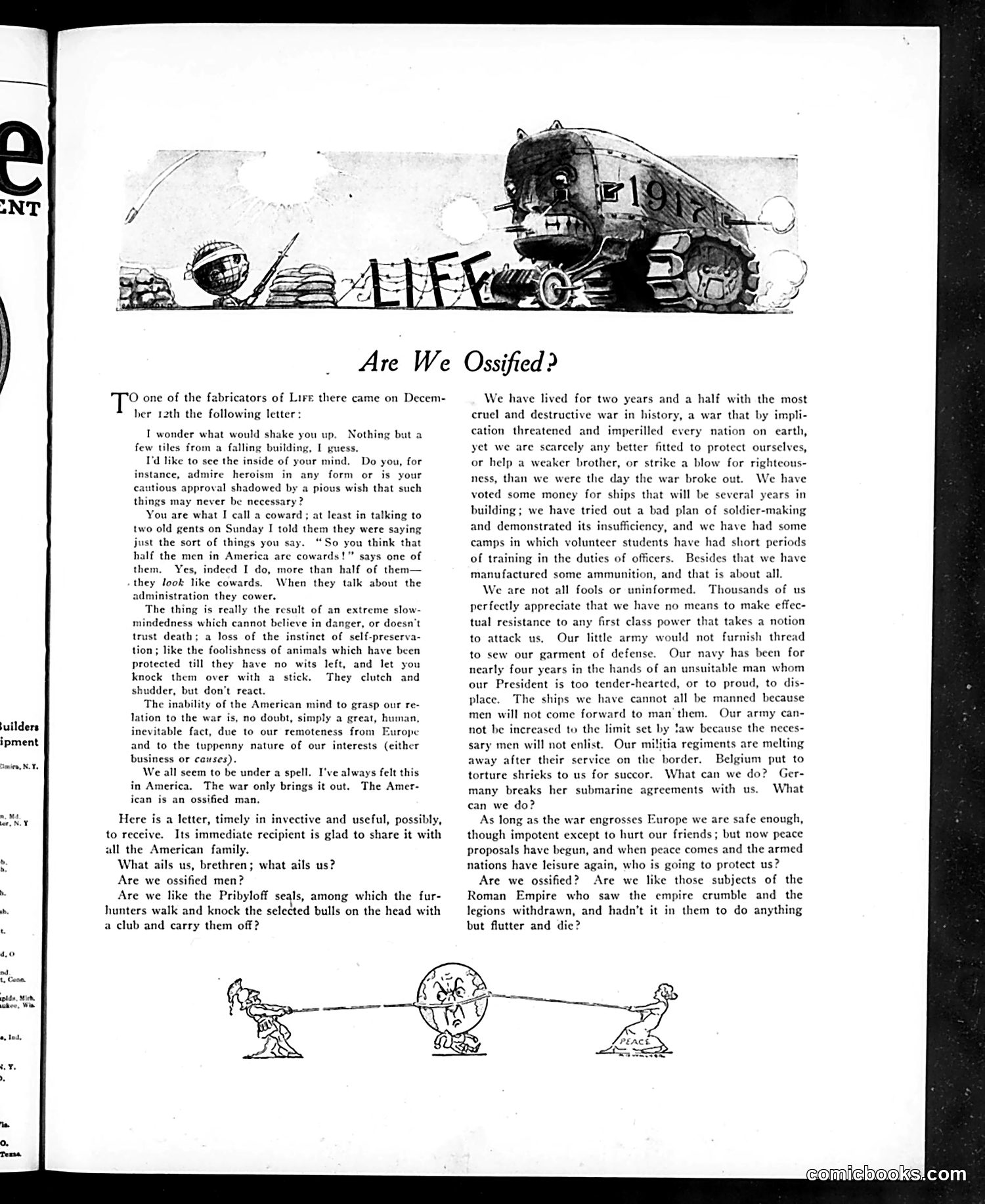
This editorial piece critiques American unpreparedness during World War I. The header illustration depicts a streamlined military train labeled "1917," contrasting modern warfare capability with the text's argument about American inadequacy. The article laments that despite two-and-a-half years of brutal European warfare, America remains unprepared to defend itself. It sarcastically compares Americans to "Pliohoff seals"—protective but passive animals—suggesting the nation has become mentally ossified (hardened/rigid) and unable to grasp real danger. The bottom illustration shows two figures pulling a globe apart, symbolizing global conflict tearing the world asunder, with a central figure labeled "PEACE" being pulled from both sides. The satire attacks American complacency and slow military mobilization in response to the Great War's escalating devastation.
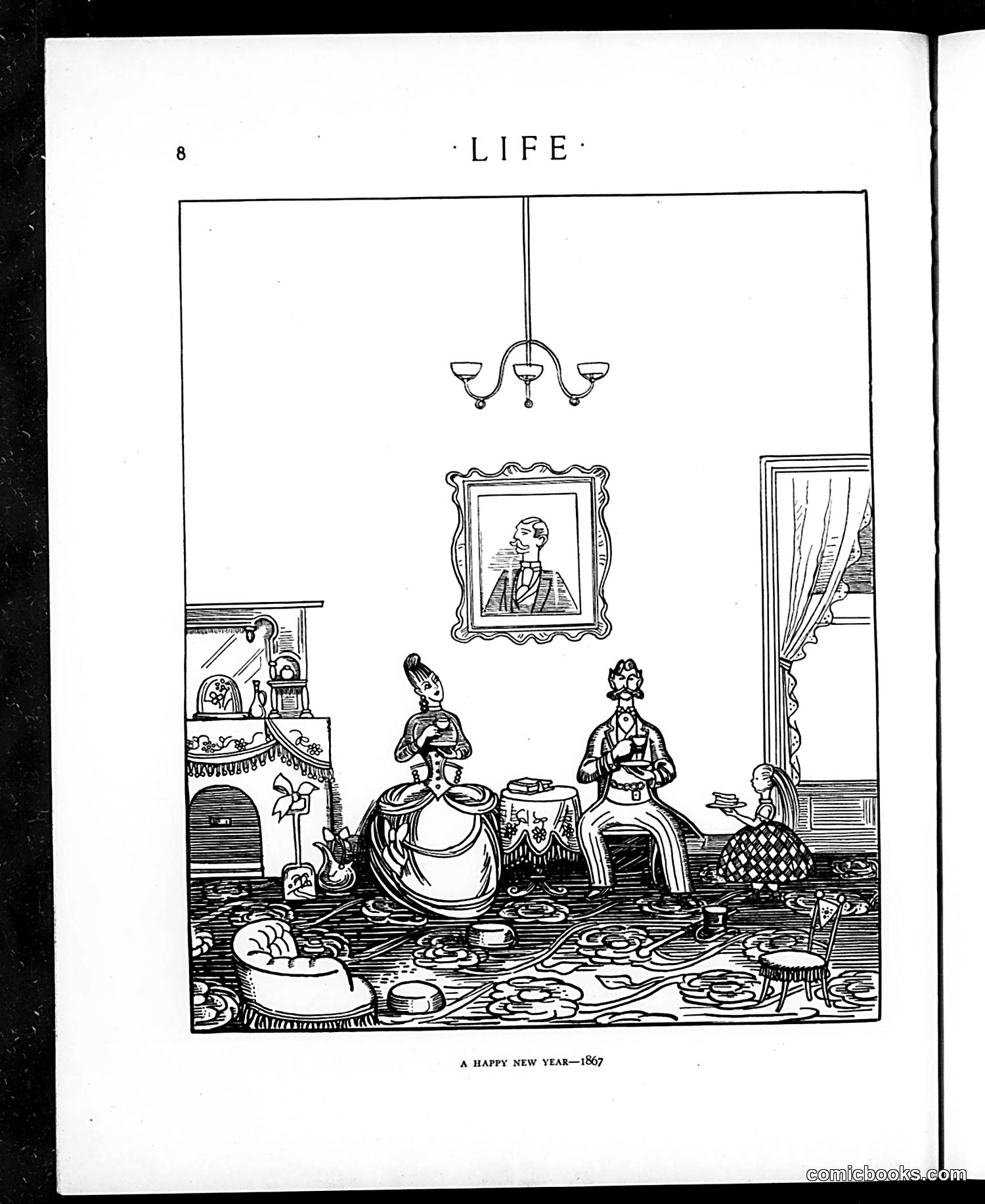
This satirical illustration depicts an elegant Victorian interior with three figures gathered around furniture and decorative objects. The caption dates it to 1867, a significant year following the American Civil War and during Reconstruction. The scene appears to satirize post-war domestic life and possibly wealth inequality or changing social conditions of the era. The ornate furnishings, chandelier, and formal dress suggest affluence, while the composition may be commenting on how certain Americans were thriving or indulging themselves while the nation recovered from conflict. The specific identities of the figures are unclear from the image alone, but the elaborate interior setting and the dated caption suggest this is political commentary on 1867's social or economic conditions. The style is typical of *Life* magazine's satirical woodcut illustrations from this period.
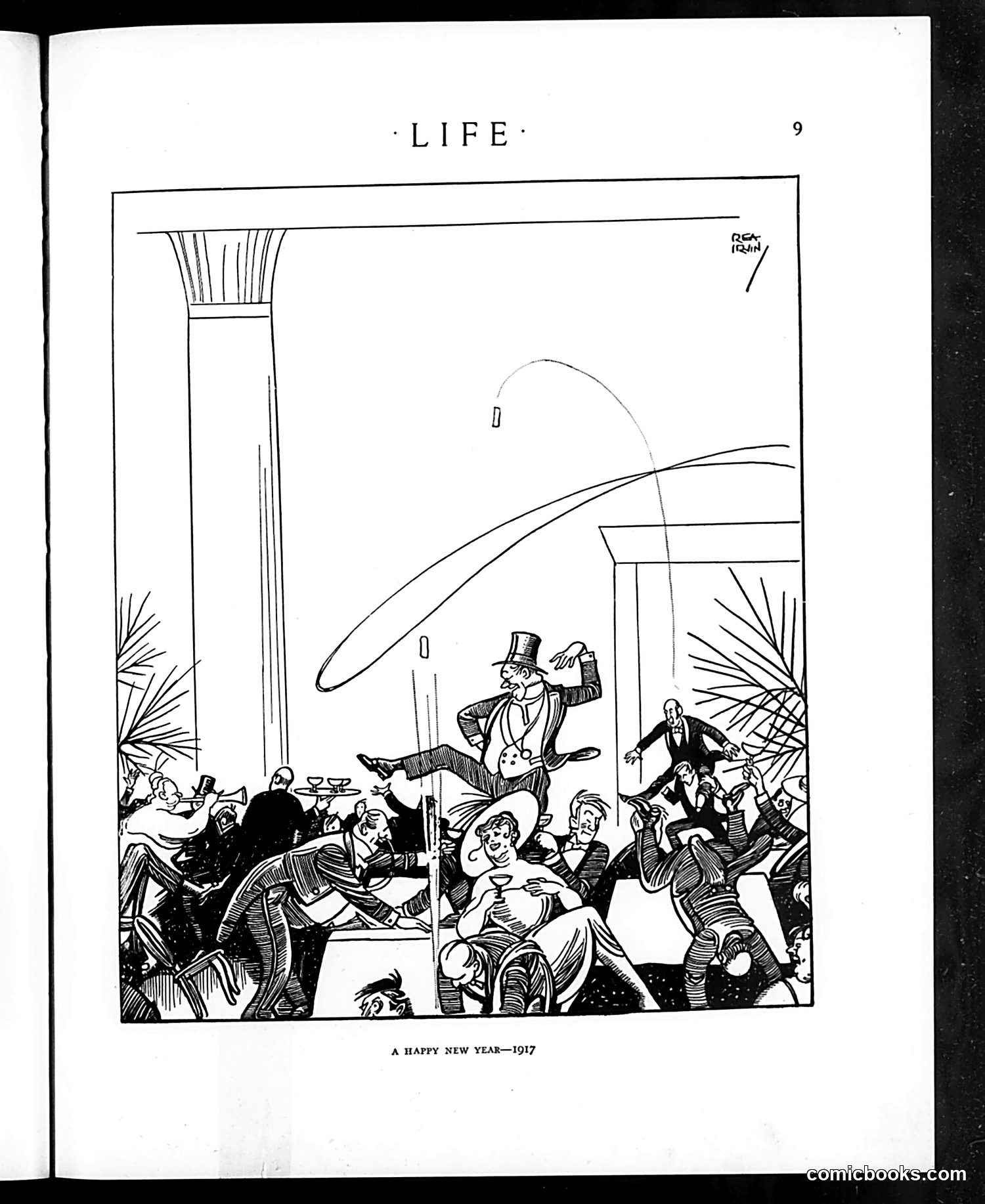
This is a New Year's Eve celebration cartoon from 1917, published in *Life* magazine. The illustration depicts a lavish party scene with well-dressed revelers in what appears to be an elegant venue with ornate columns and potted plants. The satire likely comments on wartime excess and social inequality. In 1917, the U.S. had recently entered World War I, making such opulent celebrations potentially controversial. The contrast between the carefree, festive upper-class partygoers and broader wartime conditions would have struck contemporary readers as tone-deaf or inappropriate. The exaggerated expressions and dynamic poses of the figures emphasize the frivolous nature of the celebration, suggesting the cartoonist's critique of wealth disparity during a period of national sacrifice and military engagement.
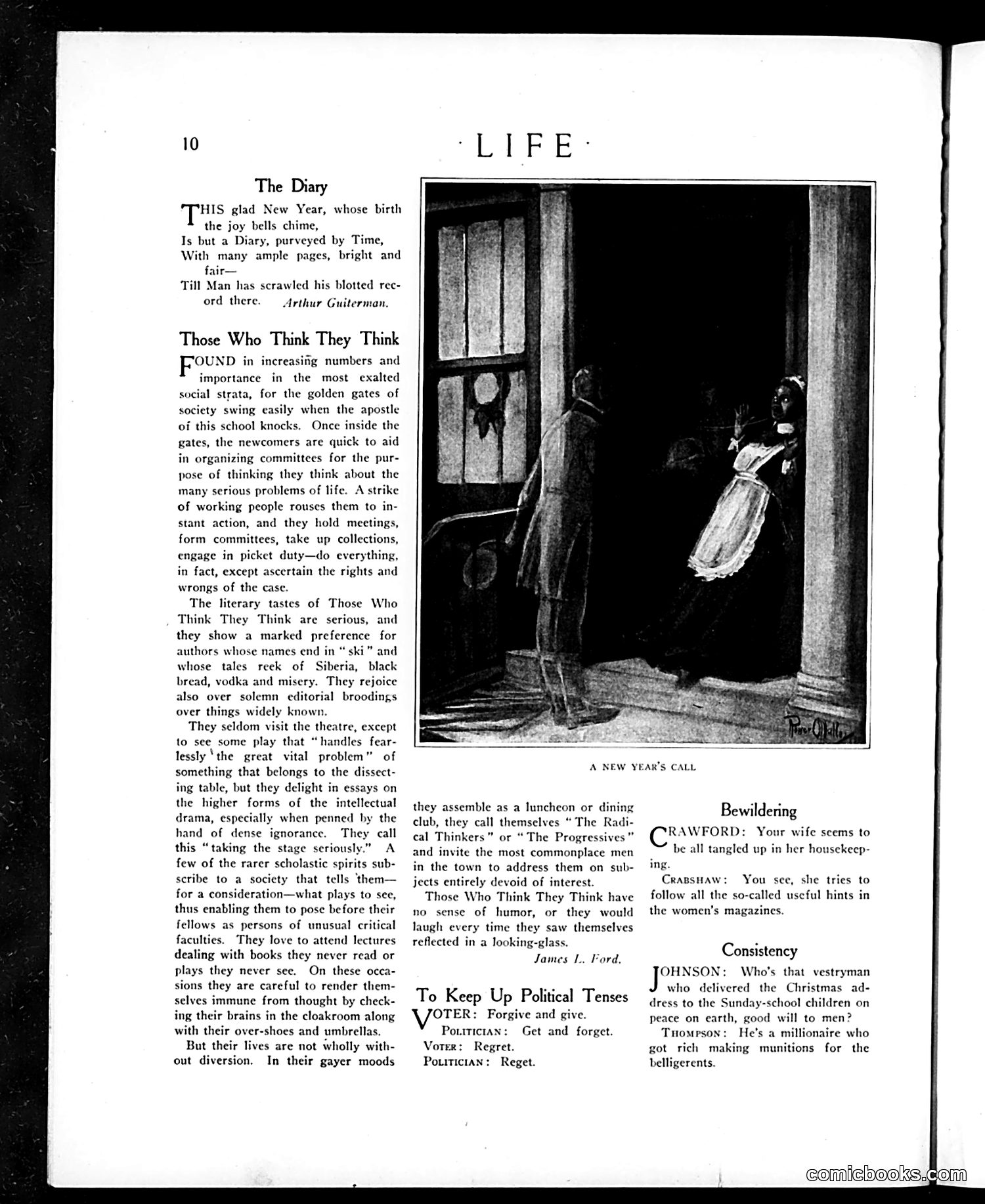
This page contains satirical essays rather than visual cartoons. The main content mocks "Those Who Think They Think"—intellectuals who join committees to discuss serious social problems but accomplish little. The satire targets their pretentious literary tastes (favoring Russian authors), their self-importance, and their ineffectual activism. The photograph titled "A New Year's Call" shows a woman in a doorway, illustrating domestic life rather than political commentary. The small comic exchanges at bottom ("To Keep Up Political Tenses," "Bewildering," "Consistency") are brief joke dialogues poking fun at politicians' contradictions and wealthy industrialists who donate munitions while preaching peace—typical early 20th-century American social satire about hypocrisy among the privileged classes.
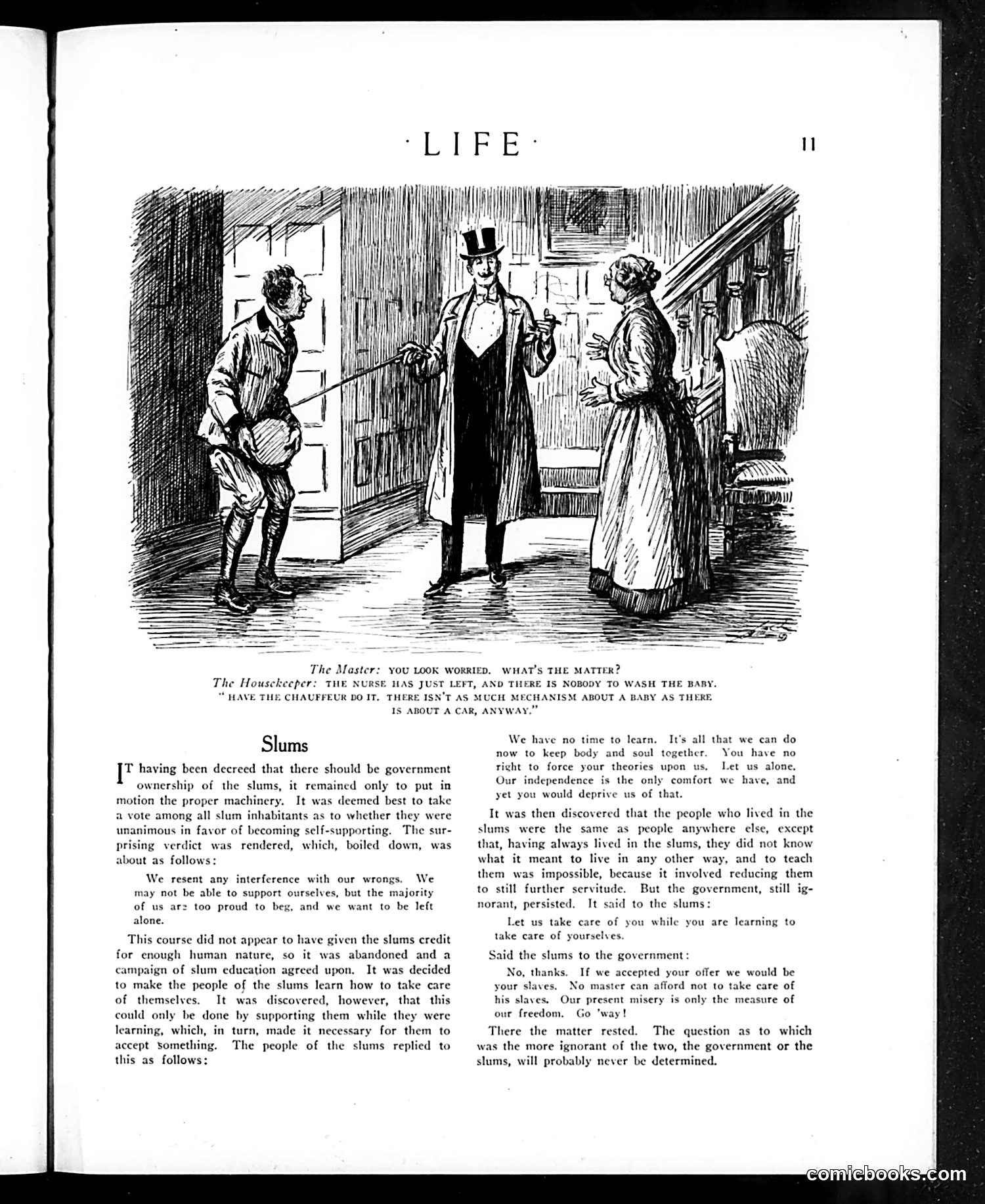
This page from *Life* magazine satirizes a dispute between government authorities and slum residents over who should improve living conditions. The cartoon depicts a well-dressed government official (top hat, formal coat) confronting working-class slum dwellers. The accompanying text describes a debate: the government demanded slum residents learn self-improvement while refusing to provide support. The slum residents replied that they couldn't improve themselves without assistance, and that the government—which claims authority—should bear responsibility for their welfare rather than demanding enslaved-like obedience. The satire criticizes government hypocrisy: authorities impose expectations on the poor while denying them resources, then blame the poor for their own poverty. The piece suggests this represents a fundamental failure of government responsibility to its citizens.
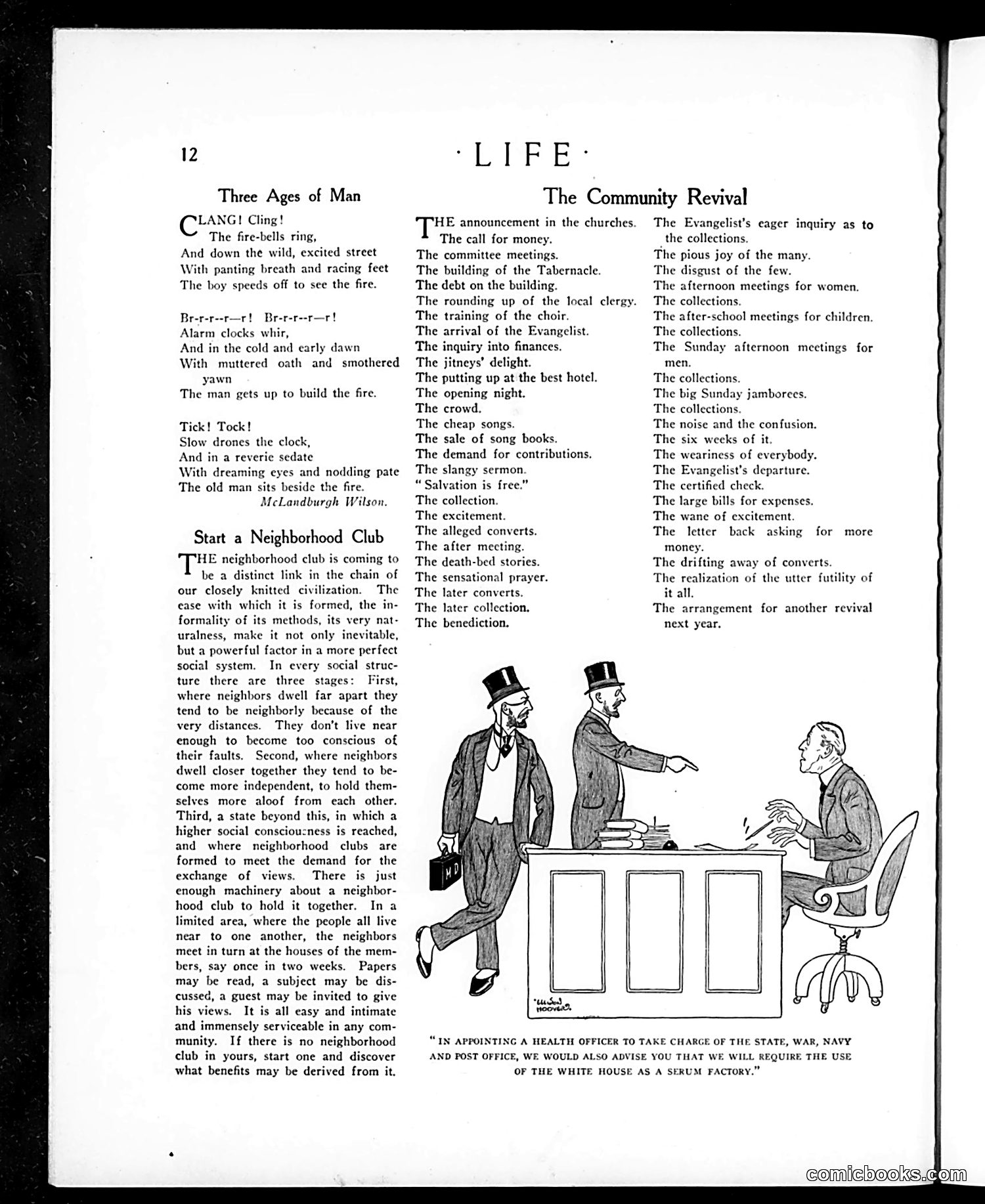
This page from *Life* magazine contains a satirical cartoon about government inefficiency. The caption reads: "IN APPOINTING A HEALTH OFFICER TO TAKE CHARGE OF THIS STATE, WAR, NAVY AND POST OFFICE, WE WOULD ALSO ADVISE YOU THAT WE WILL REQUIRE THE USE OF THE WHITE HOUSE AS A SERUM FACTORY." The cartoon depicts two well-dressed men approaching a seated official, presumably proposing an absurd consolidation of government departments under a single health officer while commandeering the White House itself as a medical facility. The satire mocks governmental overreach and bureaucratic inefficiency—suggesting that consolidating unrelated departments (health, war, navy, postal service) into one person's authority while repurposing the President's residence would be equally ridiculous. The joke critiques poor administrative organization and comically disproportionate government expansion.
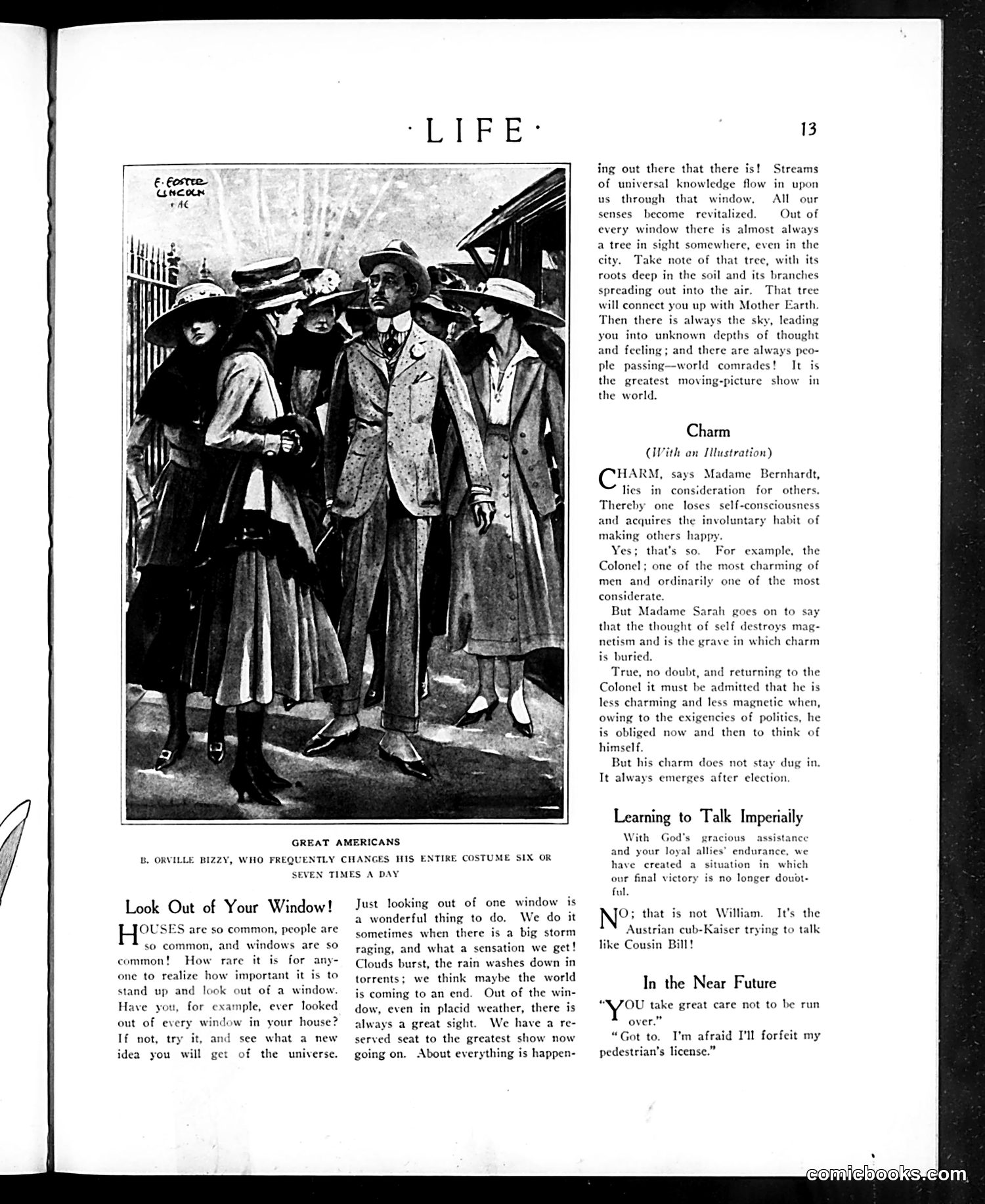
The main illustration depicts "Great Americans" featuring E. B. Orville Bizzy, who "frequently changes his entire costume six or seven times a day." The cartoon satirizes a fashionable gentleman obsessed with clothing changes—a joke about vanity and social pretension common to Gilded Age satire. The text sections include "Look Out of Your Window!" (encouraging appreciation of nature), "Charm" (discussing character and magnetism), "Learning to Talk Imperially" (an unclear political reference, possibly about imperial rhetoric), and "In the Near Future" (a brief comedic dialogue about losing a pedestrian's license). The overall page mixes social commentary on fashion, manners, and character with light humor typical of Life magazine's satirical approach.
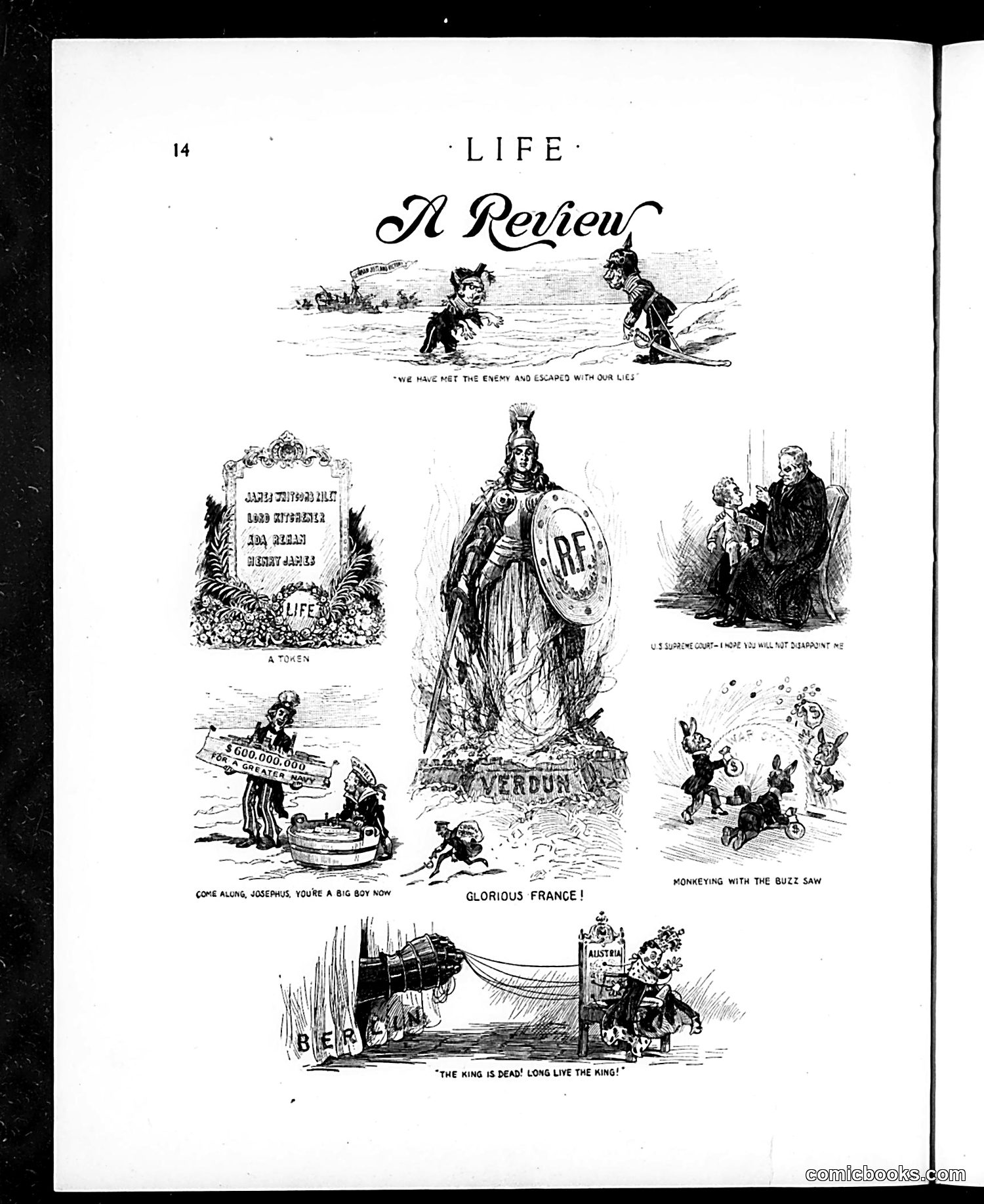
This page presents multiple cartoons commenting on World War I and French affairs. The central figure labeled "GLORIOUS FRANCE!" depicts Britannia (the female warrior symbol of Britain) holding a shield marked "VERDUN," referencing the devastating 1916 battle. Surrounding cartoons mock various wartime situations: one shows financial strain ("COME ALONG JOSEPHUS, YOU'RE A BIG BOY NOW"), another depicts the home front confusion ("MONKEYING WITH THE BUZZ SAW"), and a cemetery monument honors war dead. The bottom cartoon ("THE KING IS DEAD! LONG LIVE THE KING!") appears to reference political succession, with a bear (likely Russia) and an Australian figure present. The overall tone critiques war's costs, Allied struggles, and political complications of the period through darkly humorous satire typical of Life magazine's WWI-era commentary.
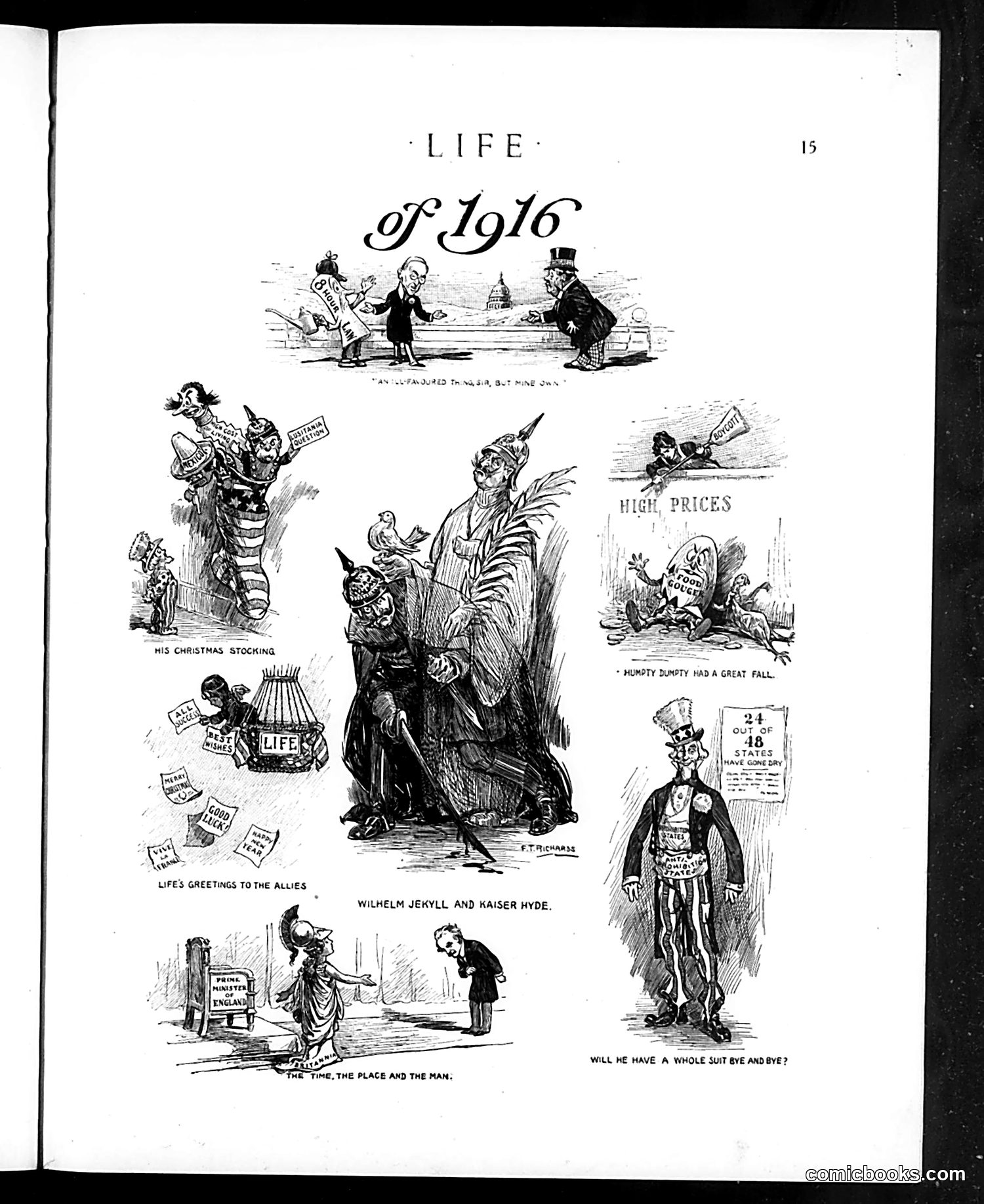
This page presents WWI-era American political satire. The central cartoon, "Wilhelm Jekyll and Kaiser Hyde," depicts Germany's Kaiser Wilhelm II with a Jekyll-and-Hyde duality—showing his public versus brutal military persona. Other cartoons reference 1916 American concerns: "High Prices" mocks inflation; "Humpty Dumpty Had a Great Fall" likely satirizes a political figure's downfall; "Life's Greetings to the Allies" shows support for Britain and France against Germany; "The Time, the Place and the Man" appears to reference political timing or opportunity. The top vignette shows figures (likely representing nations) in discussion. These cartoons collectively express American anxieties about the war, economic impacts, and political leadership during 1916—before the U.S. formally entered WWI in 1917.
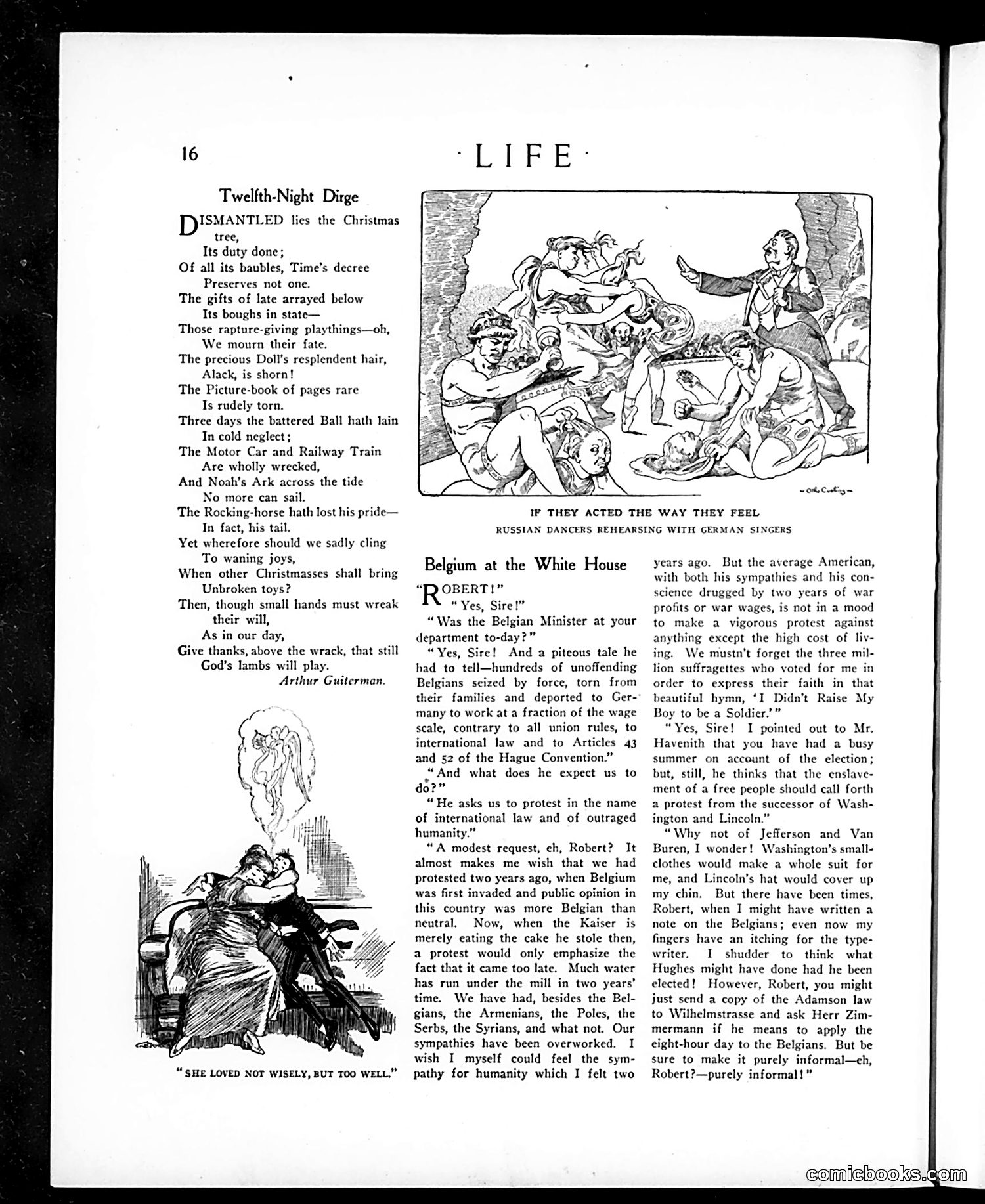
This page contains two satirical pieces critiquing American passivity during World War I. **"Twelfth-Night Dirge"** (top left) is a sentimental poem by Arthur Guiterman lamenting destroyed Christmas toys, ultimately offering spiritual comfort that children will continue playing. **"Belgium at the White House"** (main text) is the page's sharp political satire. It depicts a conversation between a U.S. President (likely Wilson, given references to the 1916 election and Adamson Law) and an aide named Robert. A Belgian Minister requests American protest against German forced deportation of Belgian civilians—violations of international law and the Hague Convention. The President cynically refuses, arguing American sympathies are "overworked" after two years of war profiteering. He dismisses the request as too late and suggests sending a mock gesture instead—asking Germany about applying an eight-hour workday to enslaved Belgians. **The satire's point**: American leadership has grown morally exhausted and commercially complicit, unwilling to protest even flagrant atrocities despite earlier sympathy for Belgium.
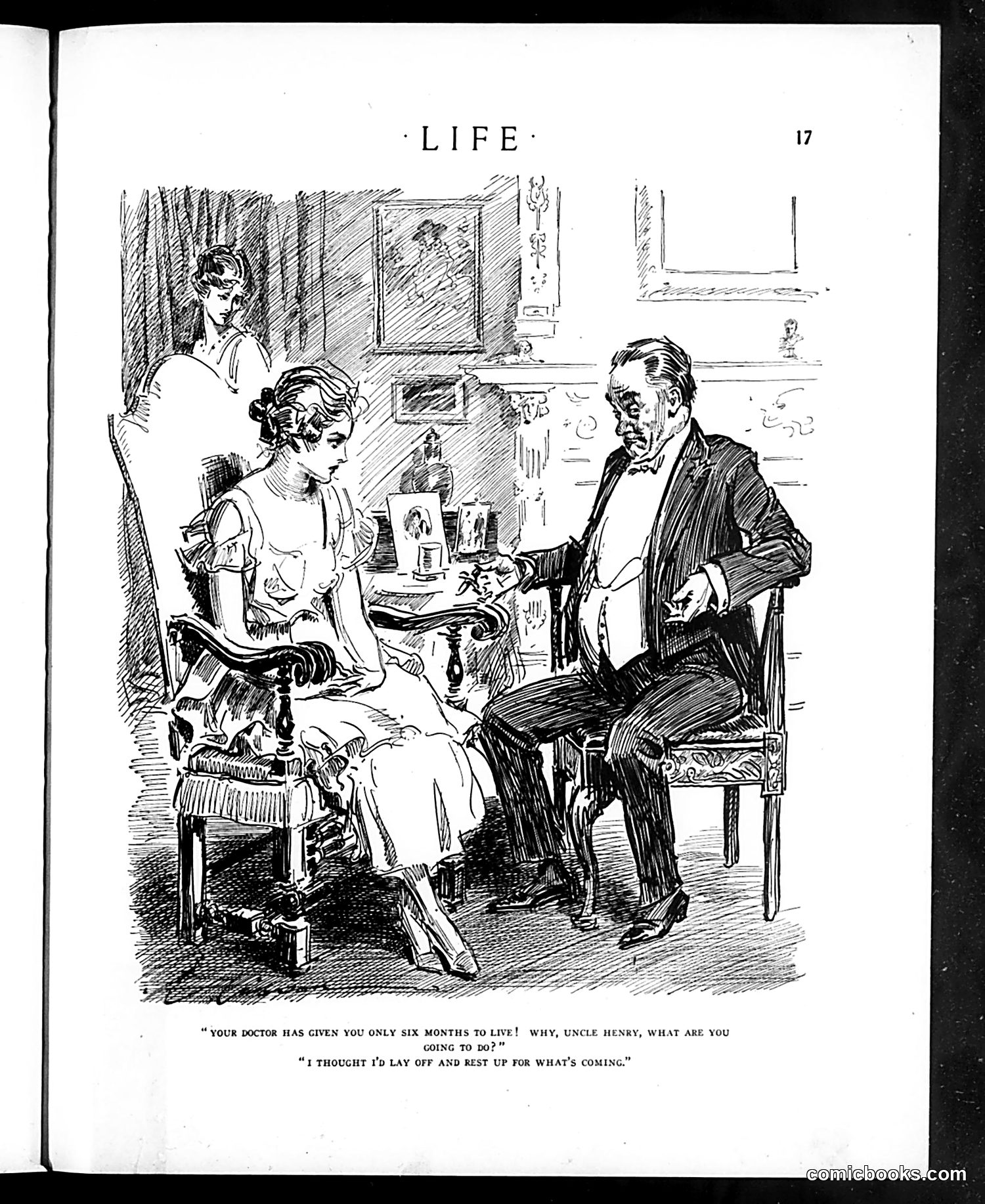
This cartoon depicts a domestic scene where a woman has just received dire medical news—a doctor has given her only six months to live. She expresses shock and asks her Uncle Henry what he plans to do about his own mortality. His response—"I thought I'd lay off and rest up for what's coming"—is the joke's punchline. Rather than making ambitious plans or fighting his fate, Uncle Henry opts for passivity and rest, apparently resigned to inevitable death. The satire appears to mock a particular attitude toward mortality: fatalistic acceptance rather than active response. Whether this references a specific cultural moment or general human tendency toward inaction in the face of bad news is unclear without additional context about *Life* magazine's publication date. The cartoon relies on dark humor about death and suggests commentary on how people respond to terminal diagnoses.
This editorial discusses President Wilson's recent peace proposal to end World War I. The cartoon's opening image (top left) appears to show a figure being struck or affected by forces—likely representing Wilson caught between opposing pressures. The text argues Wilson has been "lucky" because, unusually, he's faced criticism from only one side initially. Germany welcomes his peace overture (wanting the war to end), while the Allies (Britain and France) feel injured or unconvinced. American public opinion splits into two camps: those supporting everything Wilson does versus those opposing him. The editorial uses the metaphor of Wilson as a "lightning-rod of the belligerents"—suggesting he might absorb the conflicting fires of warring nations, channeling them harmlessly to ground. The piece treats this as potentially noble, comparing it to Ajax's mythological burden. Contextually, this reflects pre-U.S. entry tensions (America wouldn't enter until April 1917), when Wilson was positioning himself as peacemaker while facing pressure from German submarines and Allied demands.
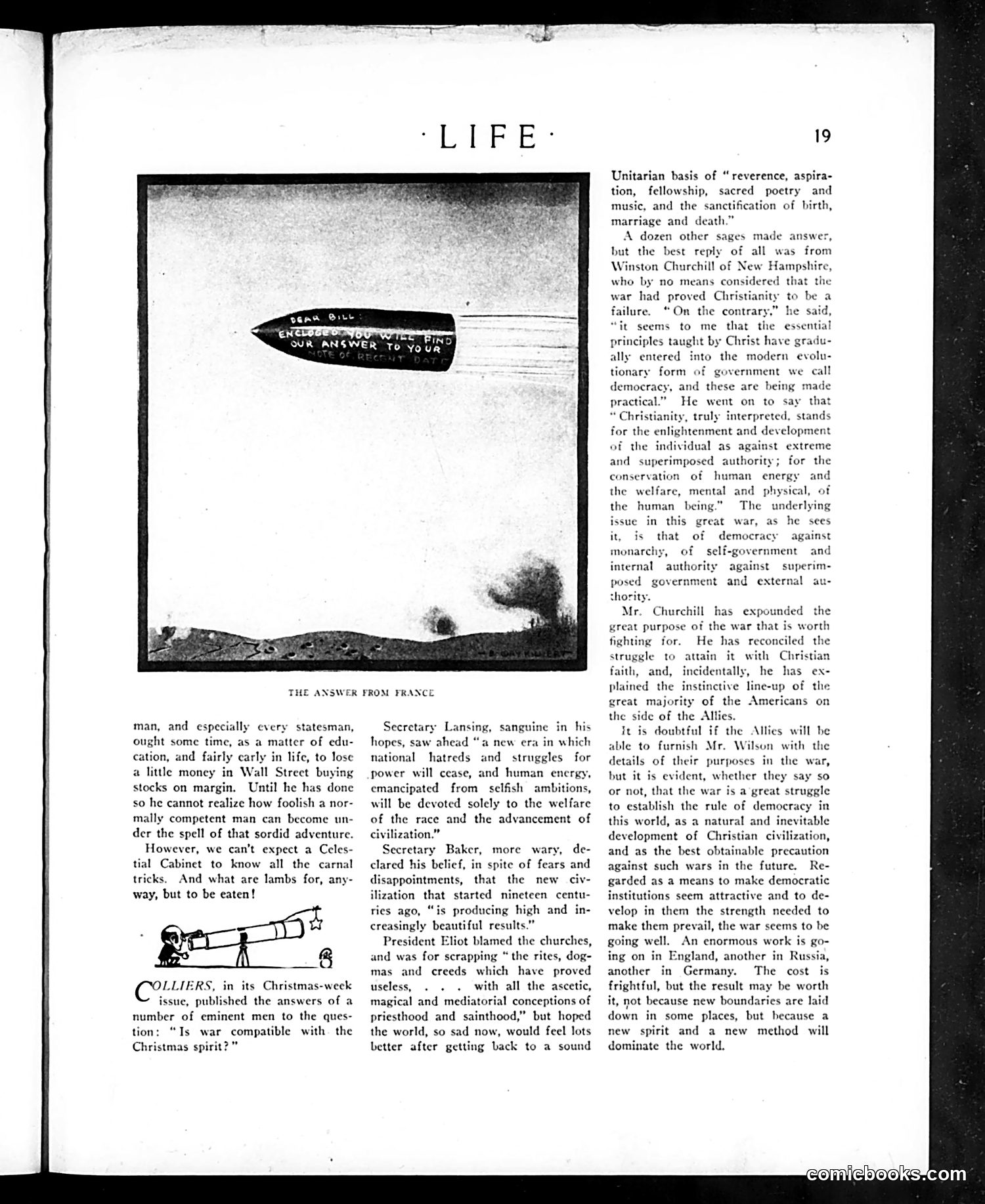
This wartime editorial cartoon depicts a boat labeled "Dear Bill, Enclosed by Our Answer to Your" pointing toward France, with explosions visible on the shore. It accompanies an article debating whether World War I is compatible with Christian values. The cartoon illustrates the article's central point: while various American leaders (Secretary Lansing, Secretary Baker, President Eliot) offered philosophical answers about war and Christianity, **Winston Churchill of New Hampshire provided the most direct, practical response**—essentially, action rather than words. The "answer from France" represents military engagement itself as America's response to the war's moral questions. The cartoon satirizes the gap between abstract ethical debate and battlefield reality, suggesting that the true answer to whether democracy and Christianity can coexist with war is being written through combat rather than rhetoric.
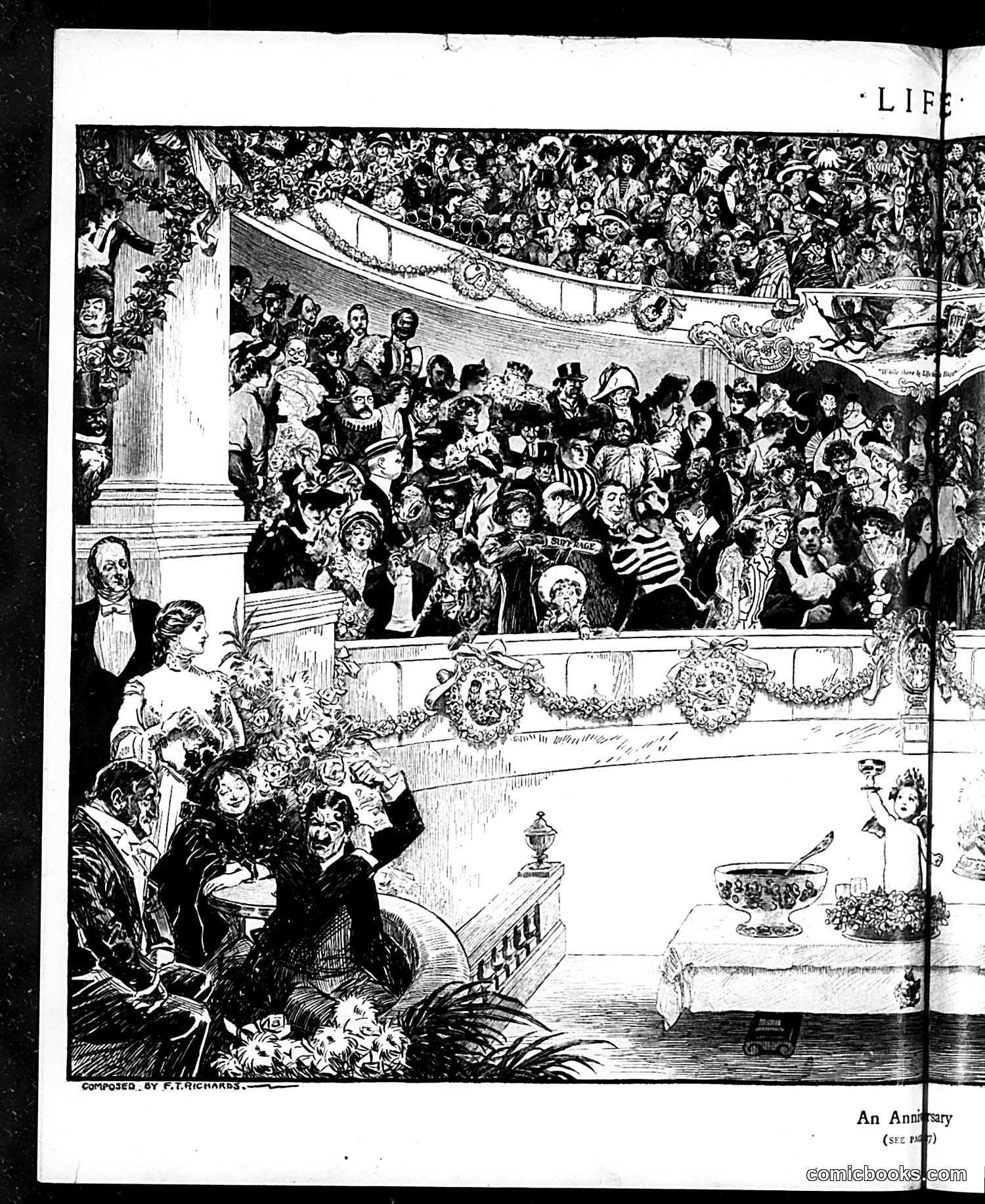
This appears to be a satirical illustration by F. Fitzgerald (credited as "Composed by F. Fitzgerald" at bottom) depicting a grand theatrical or operatic performance or gala event. The drawing shows an ornate venue packed with elegantly dressed spectators in the balconies and boxes, with elaborate floral decorations and garlands. In the foreground, well-dressed figures in the orchestra section are shown enjoying refreshments. The title "An Anniversary" suggests this commemorates a specific event, likely a theatrical production or social institution's milestone. The dense crowd and theatrical setting indicate satire of high society's pretensions or excess. However, without additional context identifying the specific anniversary or figures depicted, the exact target of the satire remains unclear from the image alone.
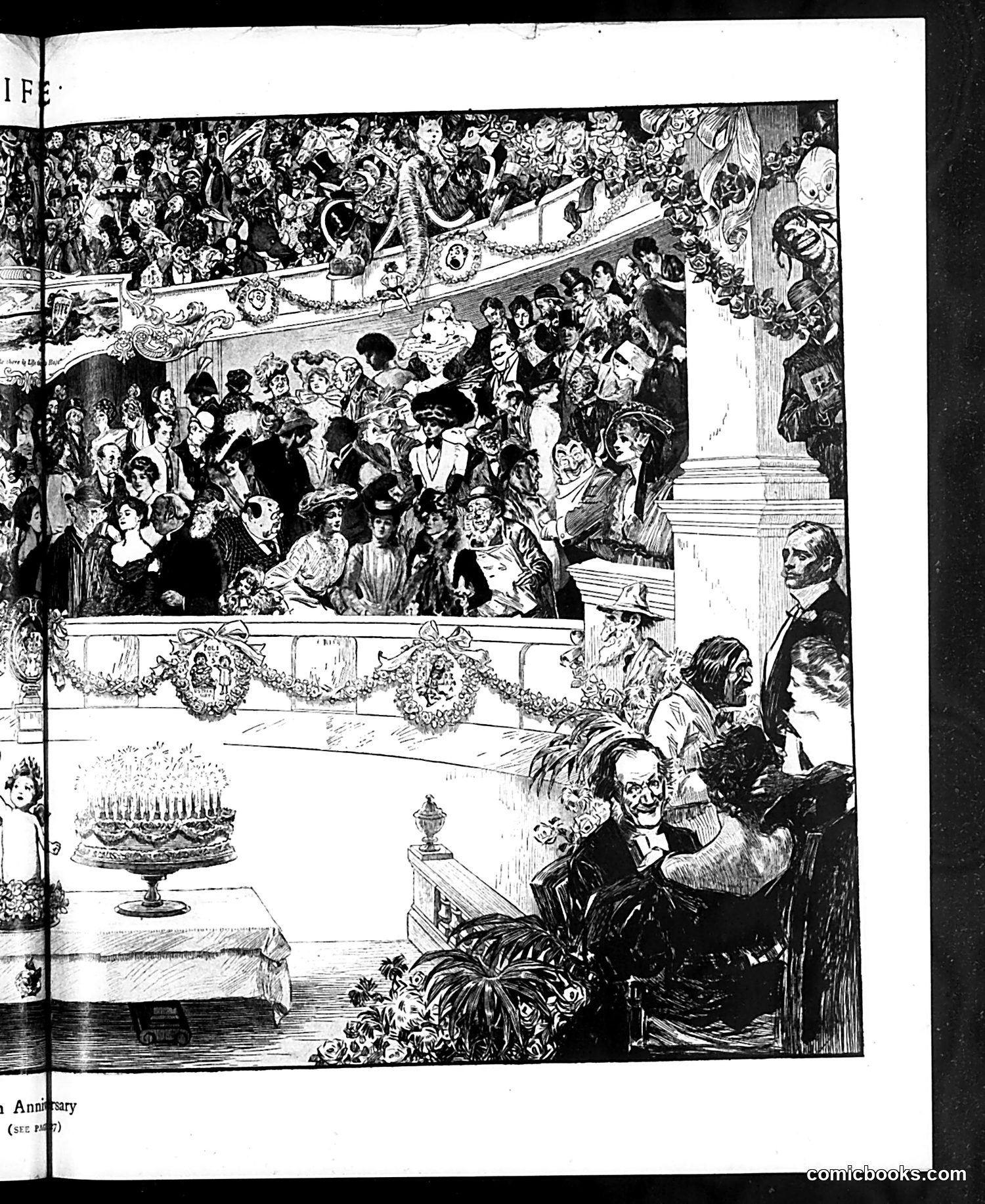
This appears to be a satirical illustration from *Life* magazine depicting an elaborate theatrical or operatic scene. The image shows multiple tiers of audience members in an ornate venue, with elaborate decorative elements and a grand staircase. In the foreground, several caricatured figures observe the proceedings below. The specific identities of the figures and the exact event being satirized are unclear from the visible text ("Bag oS" appears to be OCR error). However, the composition suggests social satire about high society attendance at cultural events, possibly mocking the pretensions or fashionable nature of attending such affairs. Without clearer text or caption visibility, I cannot definitively identify which specific political or social figures are being caricatured or what particular event is being referenced.
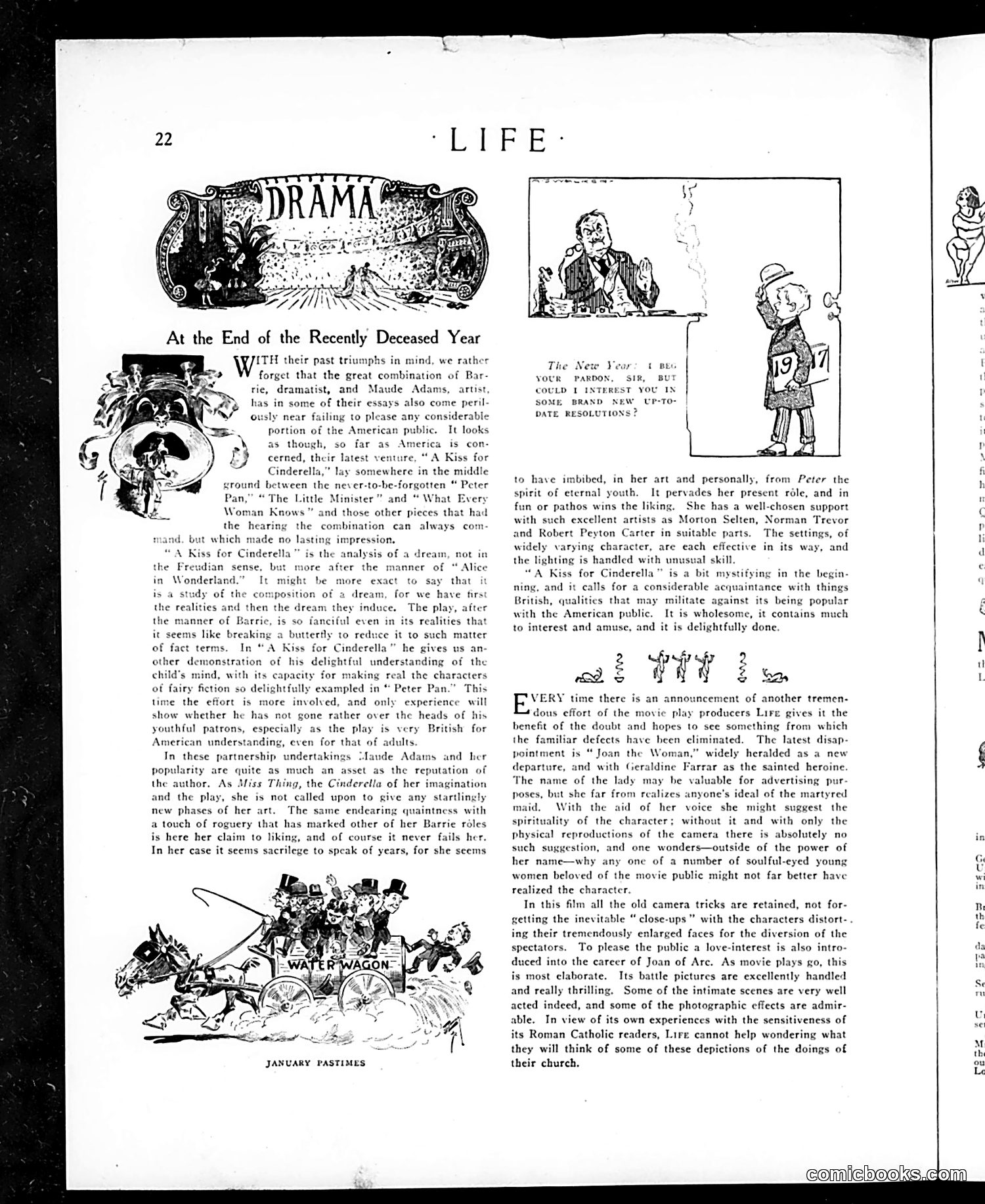
This page reviews theatrical productions from early 20th-century Broadway. The main discussion concerns J.M. Barrie's "A Kiss for Cinderella," starring Maude Adams. The critic praises Adams' performance and her "eternal youth," noting the play successfully adapts Barrie's dream-logic style (similar to "Peter Pan") but warns American audiences may find it too British. The small cartoon at top-right depicts a New Year's resolution salesman—a satirical commentary on the January tradition of making resolutions. The "Water Wagon" illustration below references the common resolution to quit drinking (getting "on the water wagon"). The page also briefly critiques the film "Joan the Woman" with opera singer Geraldine Farrar, suggesting her voice carries the performance, but her physical presence alone cannot convey the character's spiritual depth—a critique of early cinema's limitations with operatic casting.
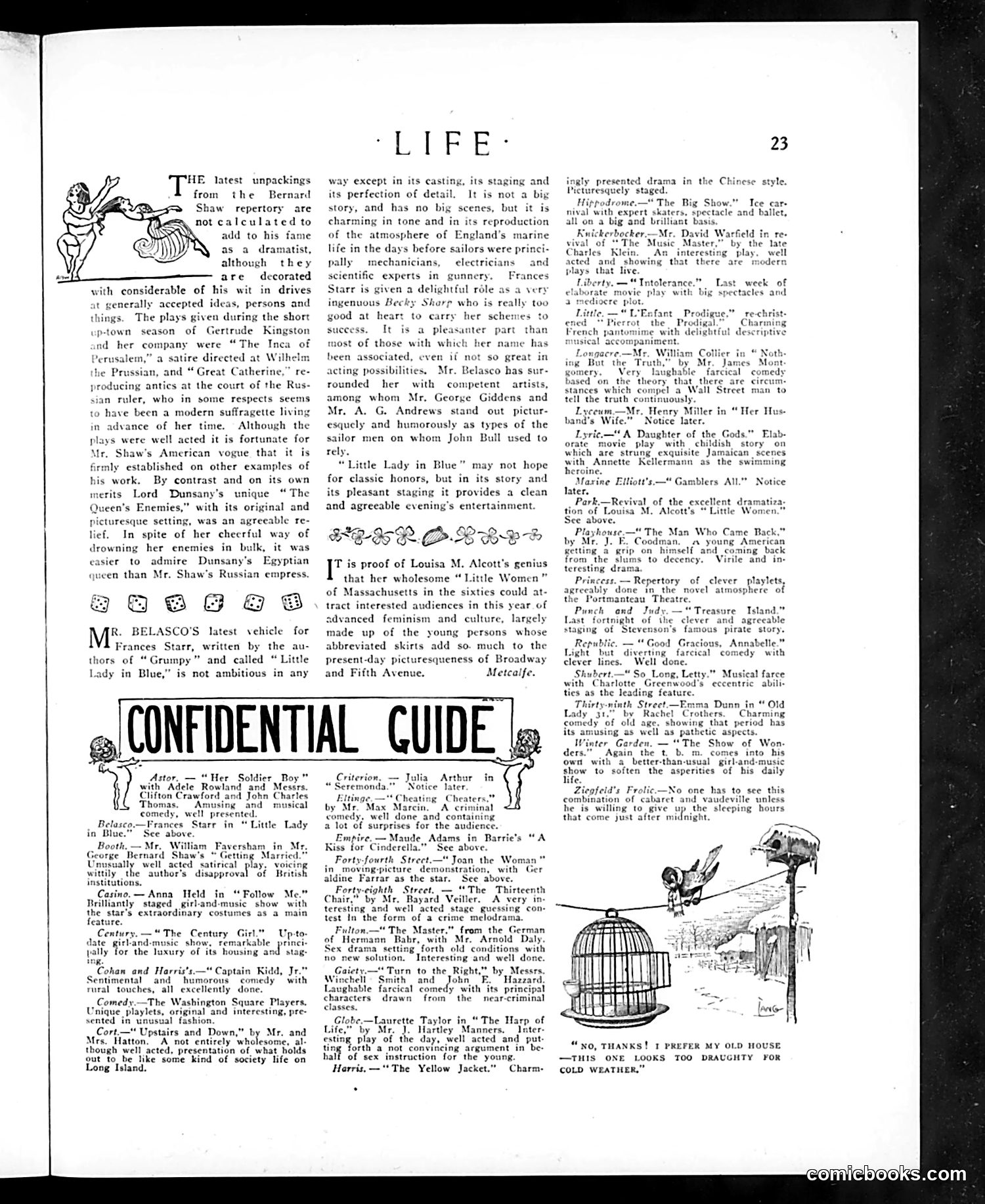
This page reviews Broadway theater productions from the early 1910s. The main satirical content concerns **George Bernard Shaw's plays**, which the critic dismisses as heavy-handed and didactic. The reviewer contrasts Shaw's "The Inca of Perusalem" (attacking Wilhelm II's Prussia) and "Great Catherine" (mocking Russian autocracy) unfavorably with Lord Dunsany's "The Queen's Enemies," praising the latter's aesthetic merit over Shaw's polemical approach. The cartoon at bottom—showing a figure preferring an old house despite "draughty" weather—appears unrelated editorial humor. The second major review celebrates **Louisa May Alcott's "Little Women"** (1860s Massachusetts setting) unexpectedly appealing to 1910s audiences of young women wearing abbreviated skirts—implying modern feminism makes the novel's "wholesome" values seem charmingly old-fashioned rather than dated. The "Confidential Guide" section lists Broadway theaters and current productions with brief critical notices.
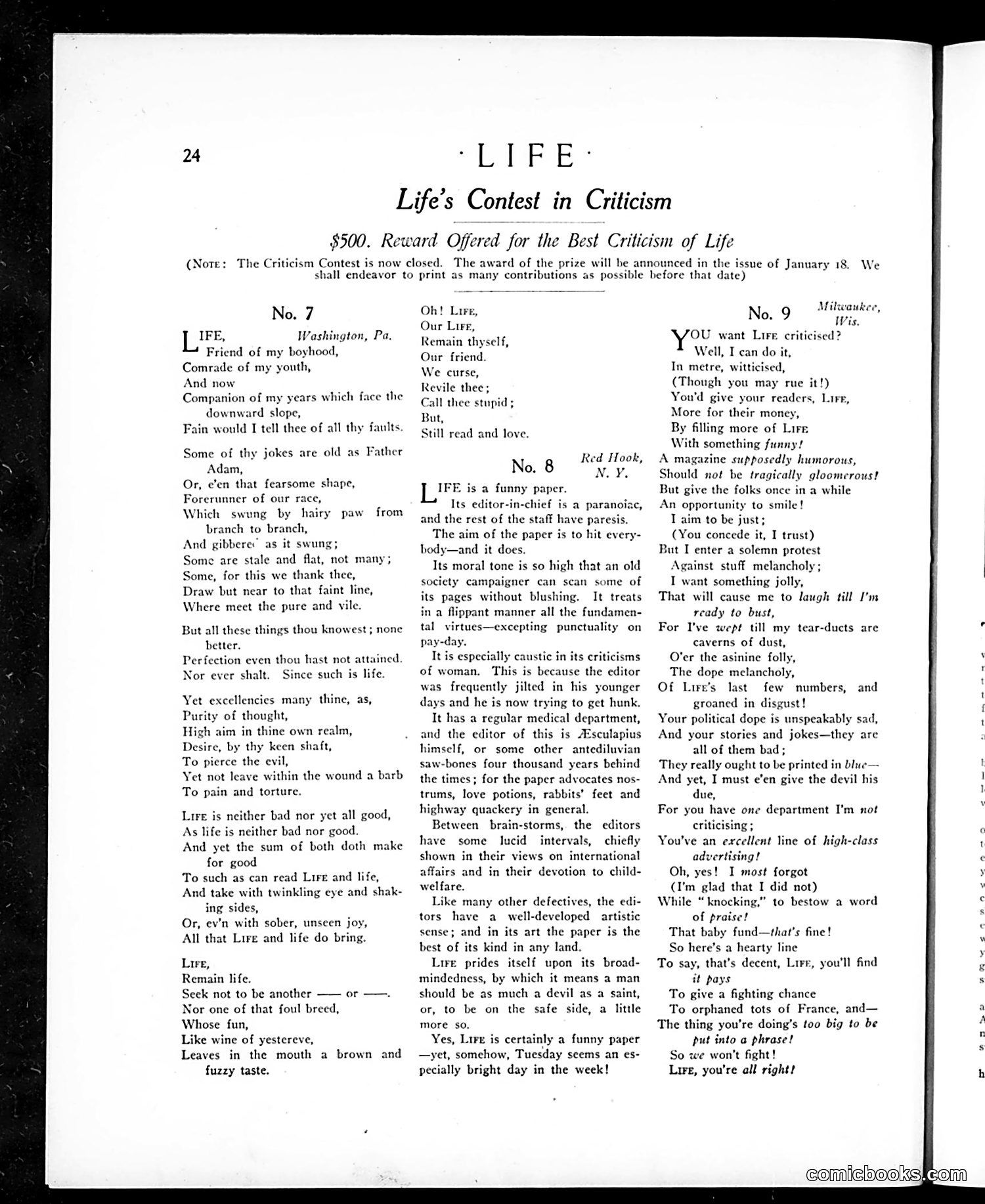
This page presents reader submissions for *Life* magazine's criticism contest (prize: $500). Rather than external commentary, these are letters *about* the magazine itself. **No. 7** (Washington, Pa.): A nostalgic, affectionate critique addressing *Life* as an old friend. The writer acknowledges its faults—some jokes are ancient, some crude—but praises its purity of thought and moral aim. The message: *Life* is imperfect like life itself, yet valuable for those who read it with humor and perspective. **No. 8** (Red Hook, N.Y.): A satirical self-description claiming the editor is paranoid, the staff has "paresis" (neurosyphilis), and the magazine attacks everything indiscriminately. It mocks the medical advice column, notes the editor's bitterness toward women (from jilting), yet credits the publication's artistic quality and occasional lucidity on international affairs. **No. 9** (Milwaukee, Wis.): Demands *Life* be funnier. The writer complains the magazine is "tragically gloomerous" and wants more humor, fewer melancholy pieces—essentially requesting *Life* live up to its satirical mission.
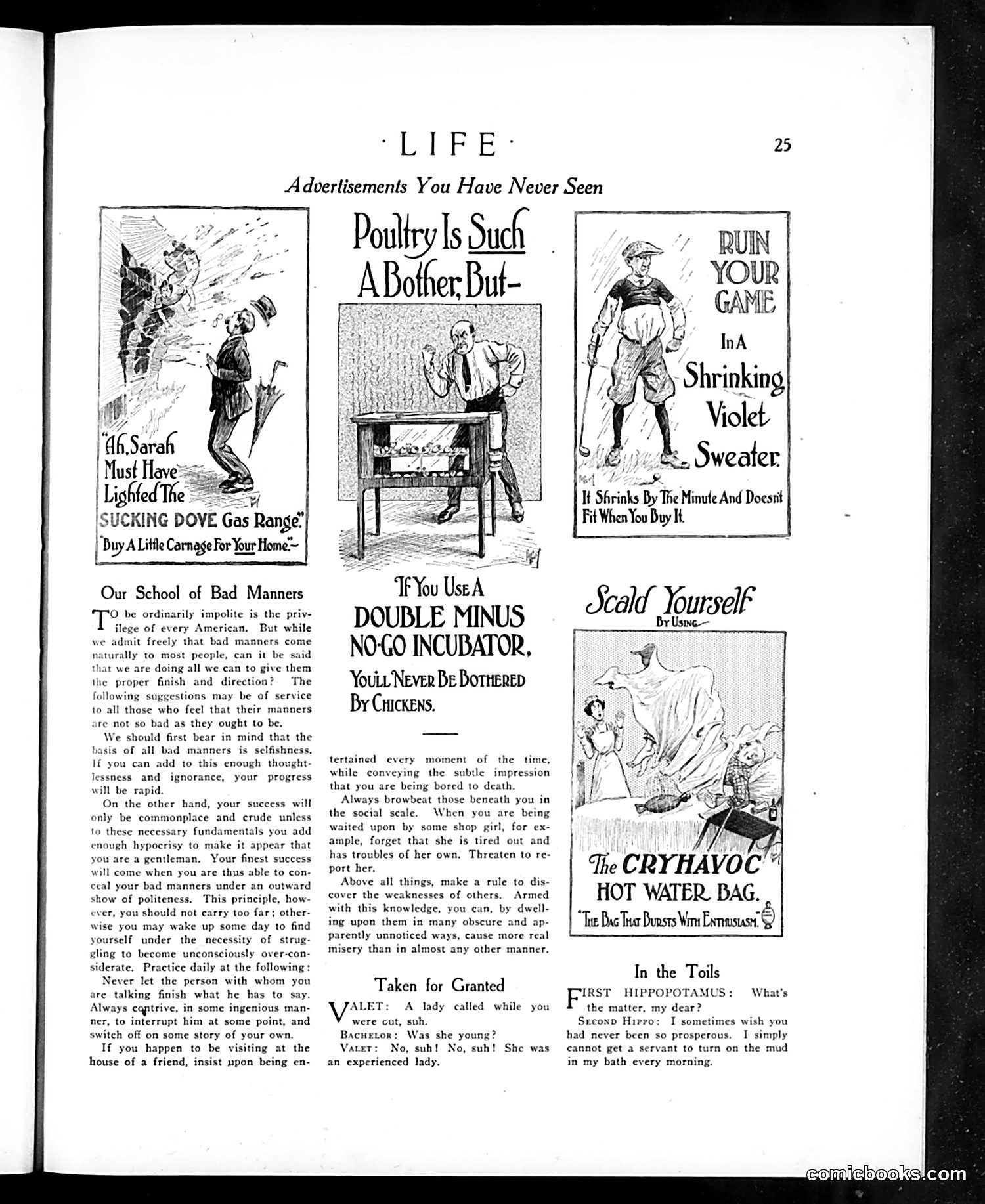
This page satirizes American rudeness through mock-earnest instruction. The central article ironically teaches readers how to be *deliberately* impolite by combining selfishness, thoughtlessness, and hypocrisy—then concealing it under false politeness. The satire targets the contradiction between Americans' claimed gentility and their actual behavior. Key satirical points: interrupting conversations, appearing bored at social visits, bullying service workers (shop girls), and exploiting others' weaknesses. The humor lies in Life *endorsing* bad manners as a refined art form requiring practice. The surrounding fake advertisements extend this mockery—a poultry incubator that causes constant bother, a sweater that shrinks immediately, a hot water bag that explodes. These absurdist ads mirror the article's deadpan tone, suggesting consumer culture itself promotes frustration and failure. The final cartoon about hippopotamuses wanting servants to "turn on the mud" in their bath mocks wealthy people's absurd entitlement and reliance on domestic labor. The satire critiques American rudeness, class snobbery, and consumer culture.
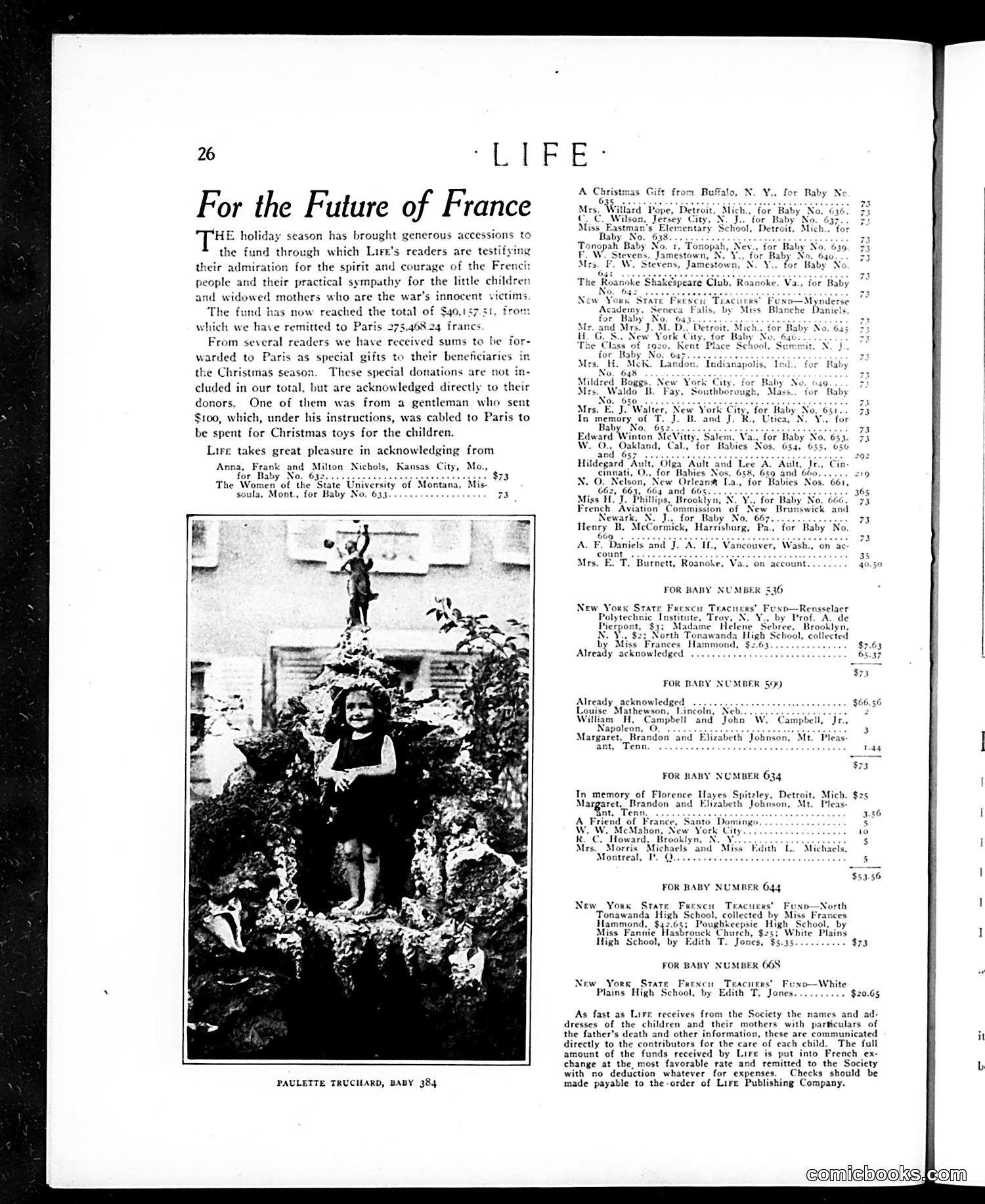
This page documents **Life magazine's charitable fundraising campaign** to support French war orphans and widowed mothers during World War I. The photograph shows **Paulette Truchard, Baby 384**—one of the French children being sponsored. The text explains Life's organized donation system: American readers contribute funds that are converted to French currency and sent directly to a French aid society. Each donor receives the name and details of a specific child they're supporting. The page lists numerous contributors and their designated "baby numbers," showing that by this point the fund had raised over $40,000 (roughly $275,000 in francs remitted to Paris). The campaign emphasizes transparency—funds go directly to beneficiaries with "no deduction whatever for expenses." This reflects Progressive Era attitudes toward charitable accountability while appealing to American sympathy for innocent civilian victims of the war.
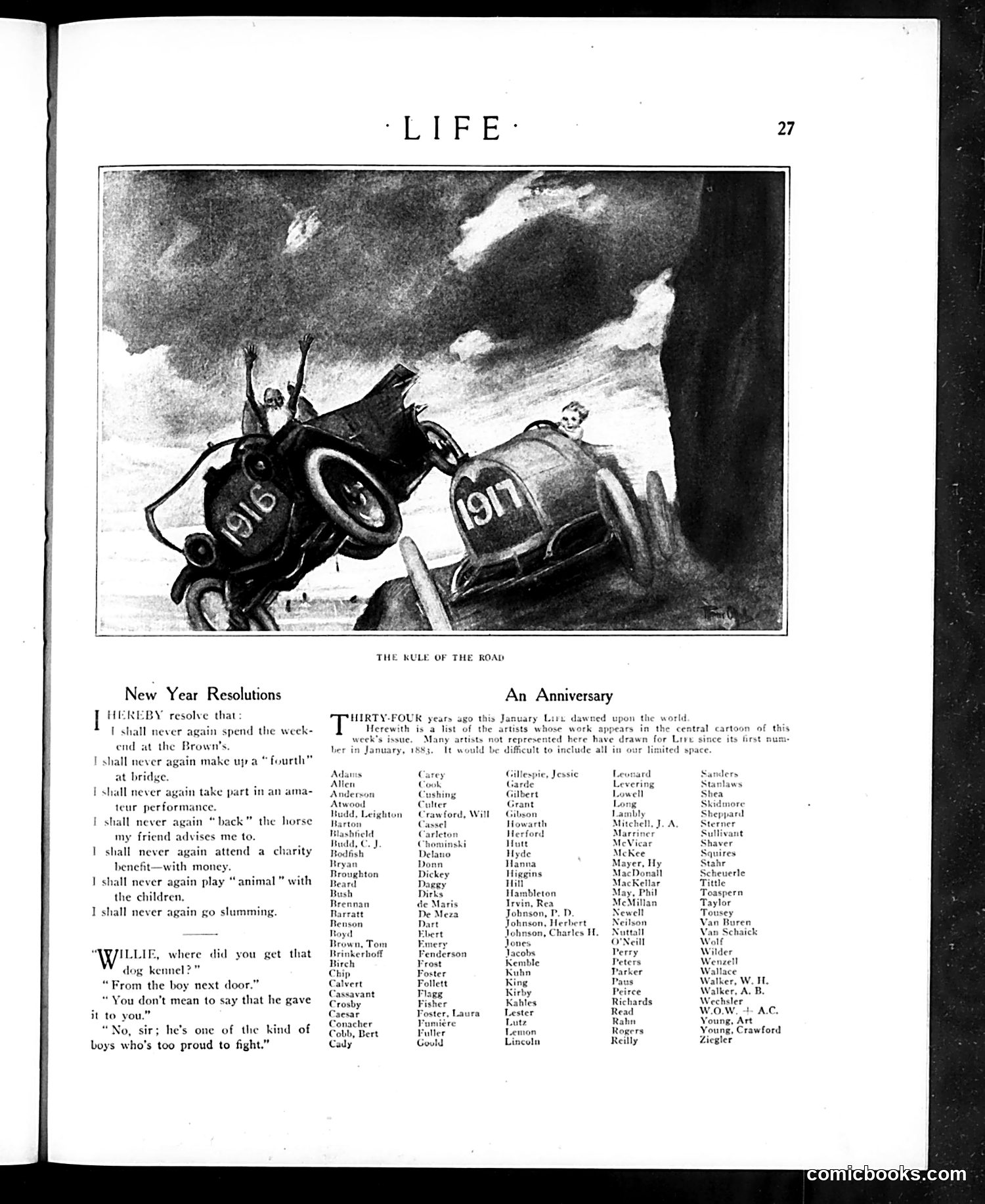
**"The Rule of the Road"** cartoon depicts two racing cars numbered 1916 and 1917, with drivers triumphantly celebrating. This is a New Year's satire about the transition between years—the new year (1917) is overtaking and "winning" against the old year (1916). The dramatic sky and speed convey urgency and competition. The page also features humorous "New Year Resolutions" (self-improvement pledges people make), including social commentary on upper-class leisure activities: attending Brown's parties, playing bridge, amateur performances, and charity benefits. A final joke mocks a boy's pride—he won't give away his dog, being "too proud to fight," likely a contemporary reference to reluctance about military service. The bulk of the page lists artists who contributed to Life magazine over 34 years, celebrating the publication's anniversary. This appears to be a commemorative issue.
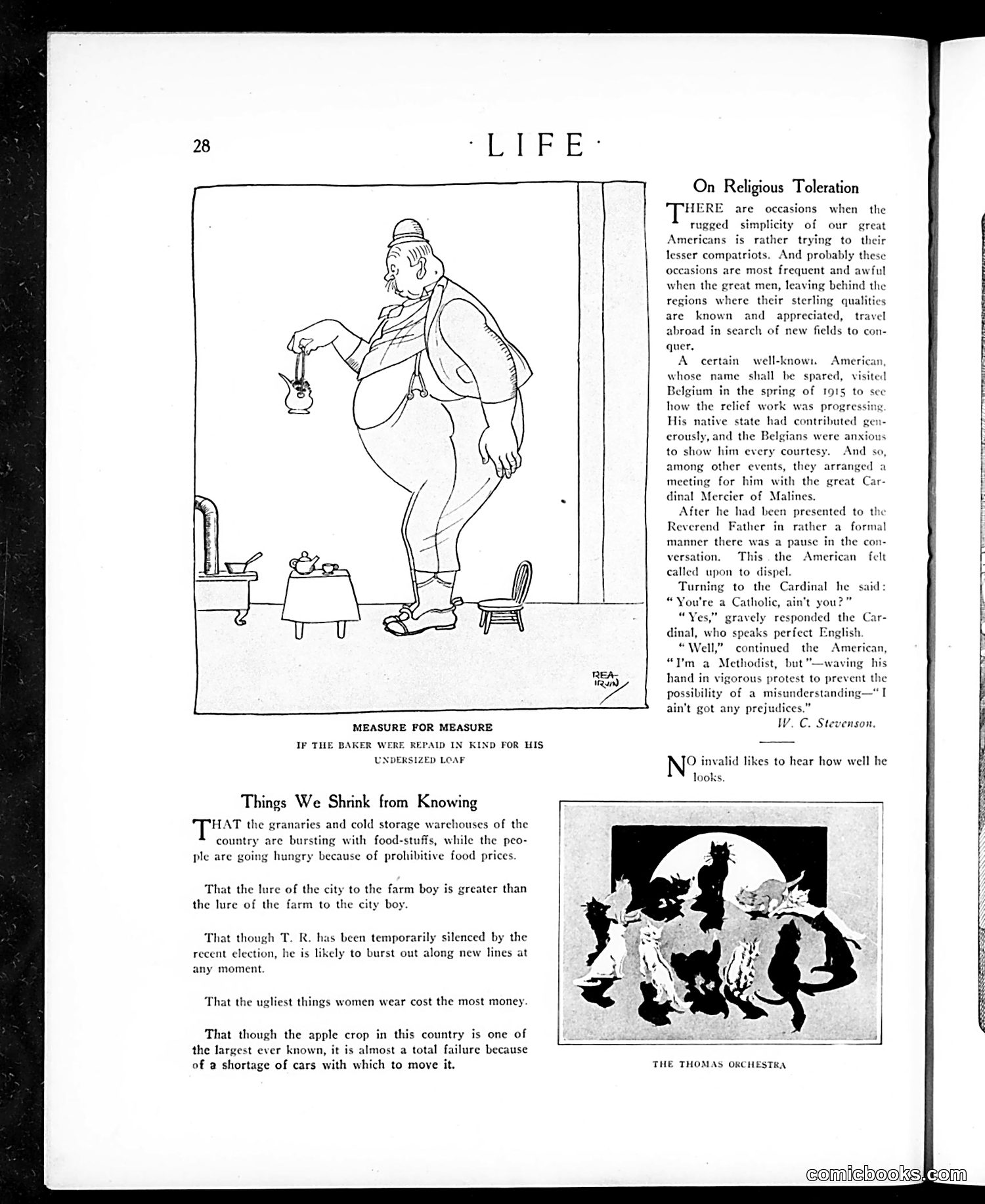
This page contains two distinct satirical pieces from Life magazine (circa 1915): **"Measure for Measure"** cartoon: A portly baker is shown measuring out undersized loaves while standing on a scale. The satire critiques wartime food profiteering—the caption suggests if bakers were "repaid in kind" (cheated as they cheat customers), they'd experience the same shortages affecting the public. It supports the accompanying text listing hypocrisies: food warehouses overflow while people starve due to "prohibitive prices." **"On Religious Toleration"** essay by W.C. Stevenson: An unnamed prominent American visits Belgium in 1915 (likely during WWI relief efforts) and meets Cardinal Mercier. The American clumsily attempts tolerance by announcing he's Methodist with "no prejudices"—the humor lies in his oblivious, blunt provincialism. His reassurance ironically reveals exactly the kind of small-minded prejudice he claims not to have. The satire mocks American arrogance abroad and shallow understanding of genuine tolerance.
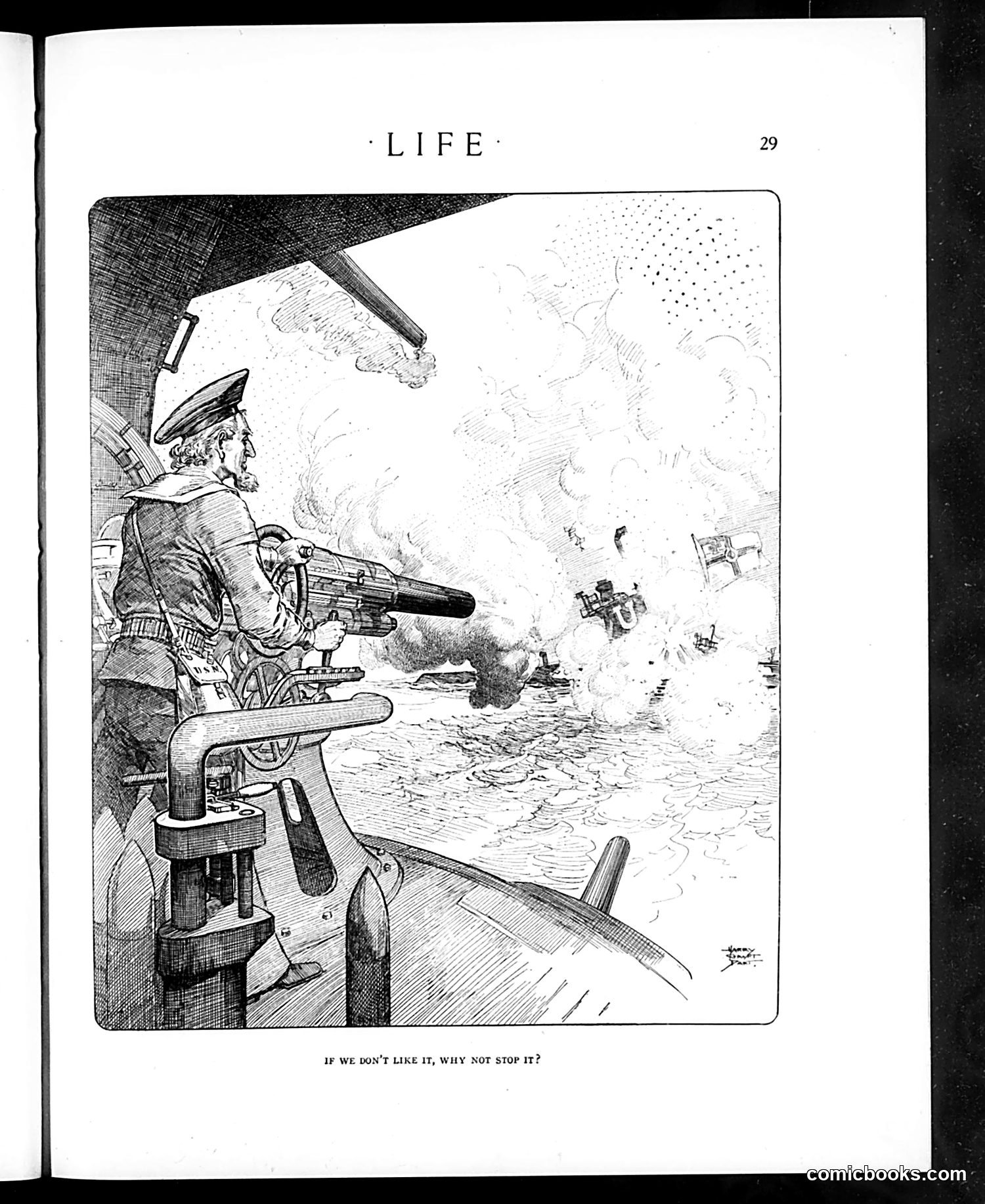
This is a military-themed political cartoon depicting a uniformed officer operating a large gun from what appears to be a naval vessel or fortification. The gun is firing at enemy positions in the distance, where explosions and military vehicles are visible. The caption reads: "IF WE DON'T LIKE IT, WHY NOT STOP IT?" This appears to be World War I-era satire, likely criticizing American military involvement or policy. The cartoon suggests ironic commentary on military action—implying that if those in power disapprove of war or conflict, they should halt it rather than continue operations. The officer's confident demeanor contrasts with the caption's questioning tone, suggesting criticism of military leadership's decisions or the contradiction between stated objections to war and continued military engagement.
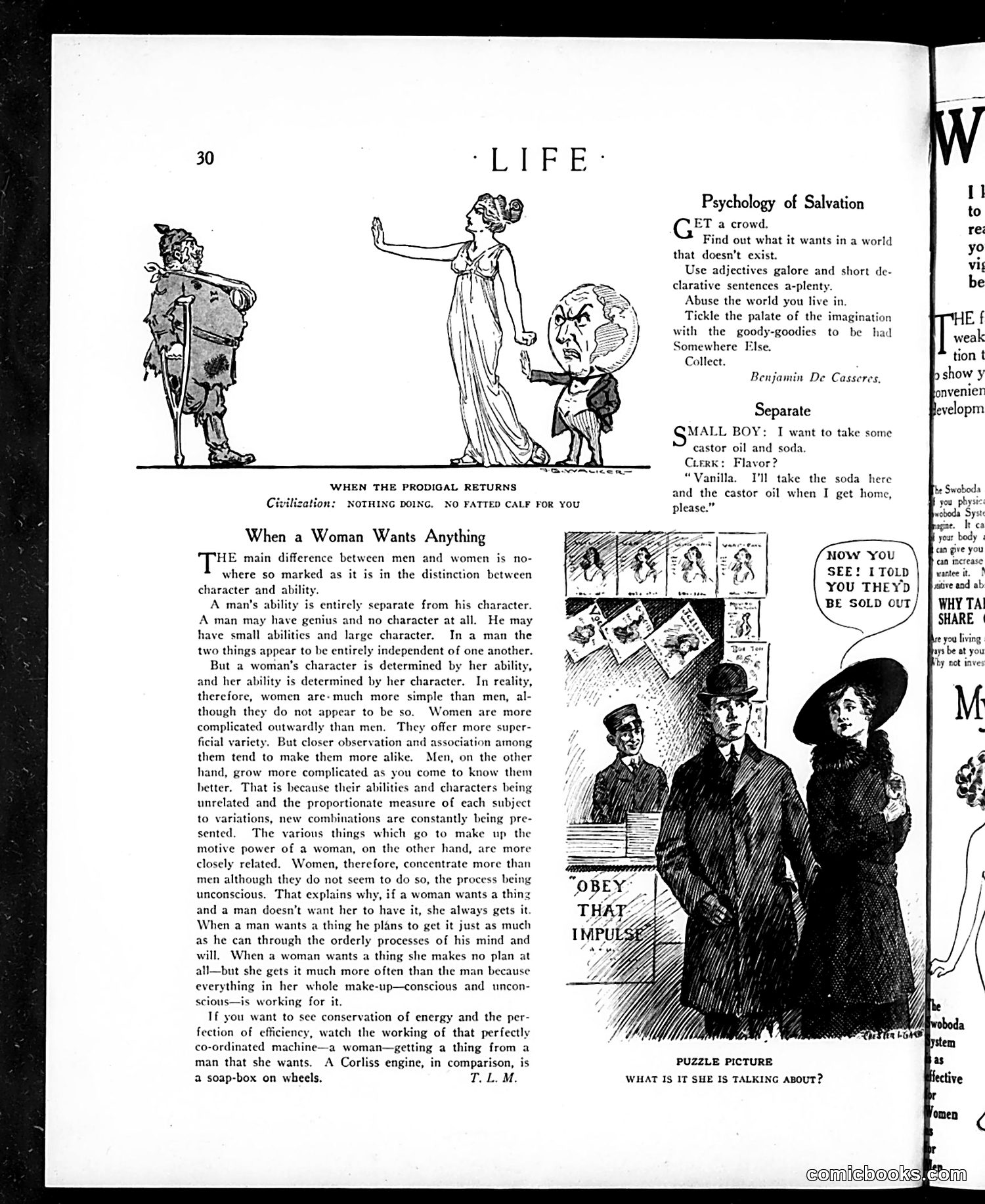
This page from *Life* magazine combines social satire with period humor: **Top Section ("Psychology of Salvation")**: Benjamin De Casseres satirizes religious revival tactics—manipulating crowds by offering false promises of an idealized "Elsewhere" rather than addressing present reality. It critiques evangelical methodology as escapist marketing. **Middle Comic**: A boy asks a pharmacy clerk for castor oil (a common laxative) with soda flavoring. The joke plays on the boy's attempt to make medicine palatable—he'll take the soda now but the unpleasant castor oil later, reflecting period attitudes about delayed gratification and childhood obedience. **Main Article ("When a Woman Wants Anything")**: The text argues women are psychologically "simpler" than men because their character and ability are unified, making them single-mindedly effective at obtaining what they want. Though intended as compliment to female determination, it reflects early-20th-century pseudopsychological gender stereotypes. **Bottom Puzzle**: A cartoon asks readers to identify what a woman is discussing—likely a visual riddle typical of the magazine's entertainment.
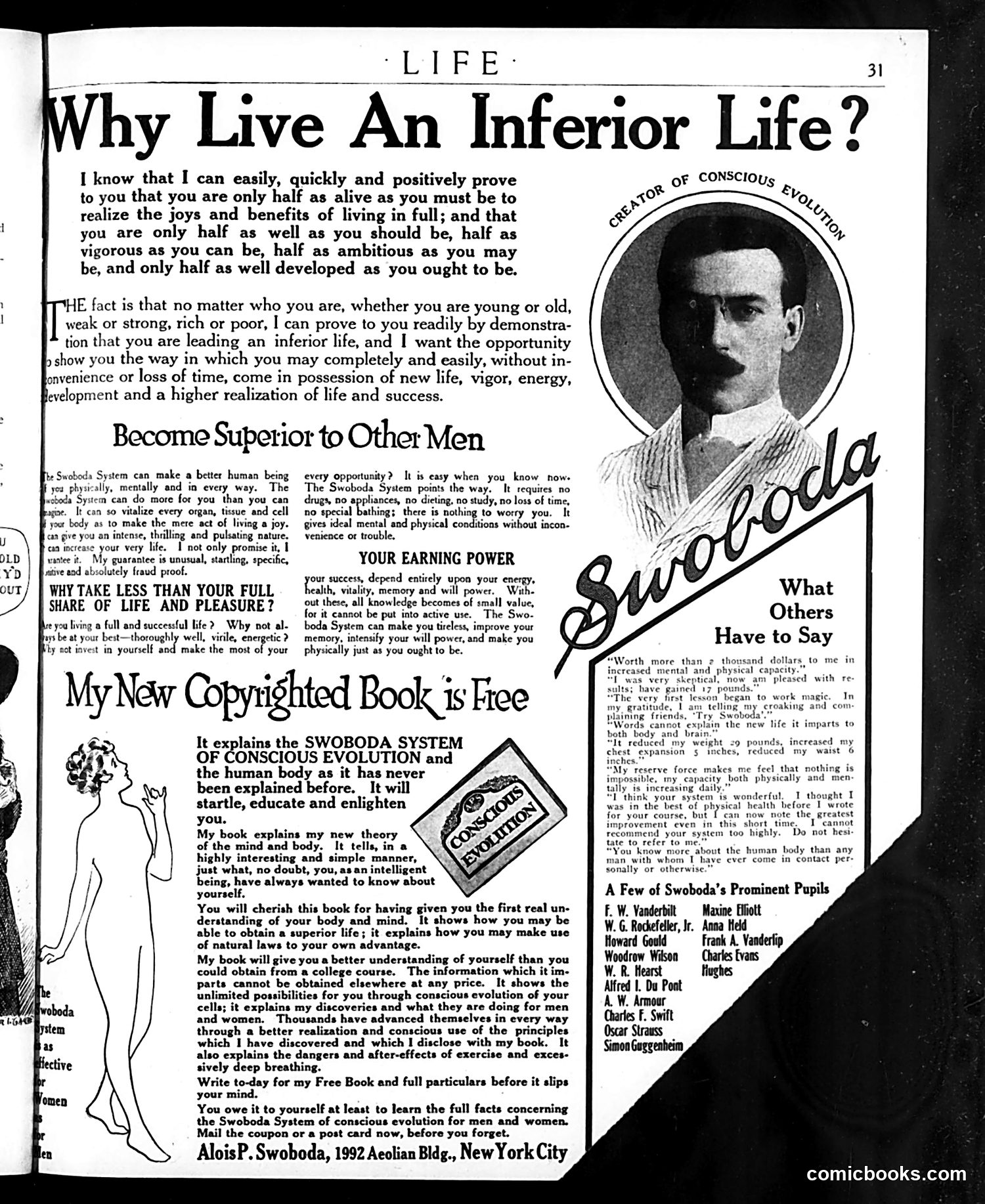
This page is primarily a **commercial advertisement**, not satire. Alois P. Swoboda promotes his "System of Conscious Evolution"—a pseudo-scientific self-help method claiming to maximize human physical and mental potential. The ad uses aggressive persuasion: declaring readers "only half alive" unless they adopt his system. It promises dramatic results (increased vigor, earning power, vitality) through undefined techniques involving "conscious evolution of your cells." The portrait shows Swoboda himself, labeled "Creator of Conscious Evolution." The testimonials from prominent figures (Vanderbilt, Rockefeller, etc.) serve as credibility markers—though we cannot verify their authenticity from the page alone. This reflects early 20th-century **quack medicine and self-help culture**, where vague pseudoscientific claims exploited public anxieties about vitality and success. The page demonstrates how Life magazine monetized advertising space for dubious wellness schemes targeting ambitious, health-conscious readers.
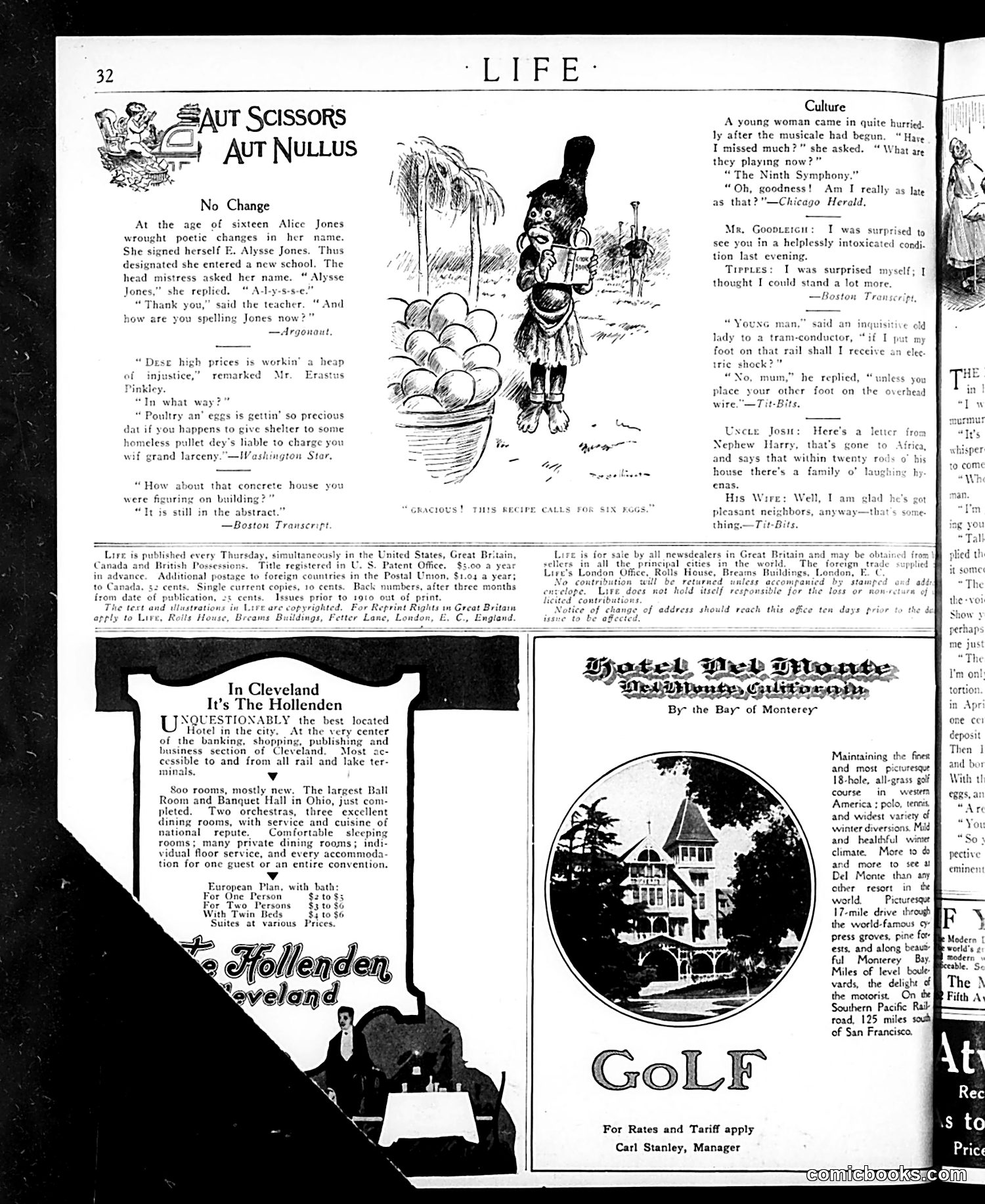
This page contains **humor columns and advertisements** rather than political cartoons. The main content features three brief satirical anecdotes under "Aut Scissors Aut Nullus" ("Either Scissors or Nothing"): 1. **"No Change"**: A girl named Alice Jones changes her name spelling from "Jones" to "Alysse Jones" at age sixteen, then back to "Jones" when entering a new school—mocking pretentious name alterations. 2. **High prices complaint**: A dialogue about expensive poultry and concrete houses, satirizing post-war inflation and building costs. 3. **Urban social comedy**: A tram conductor and passengers exchange witty remarks about overcrowding and etiquette. The page also advertises the **Hollenden Hotel in Cleveland** and **Hotel Del Monte in Monterey, California**—luxury destinations with golf courses and fine dining. The humor targets **social pretension, economic hardship, and urban inconveniences** of the era—typical Life magazine fare mocking middle-class anxieties.
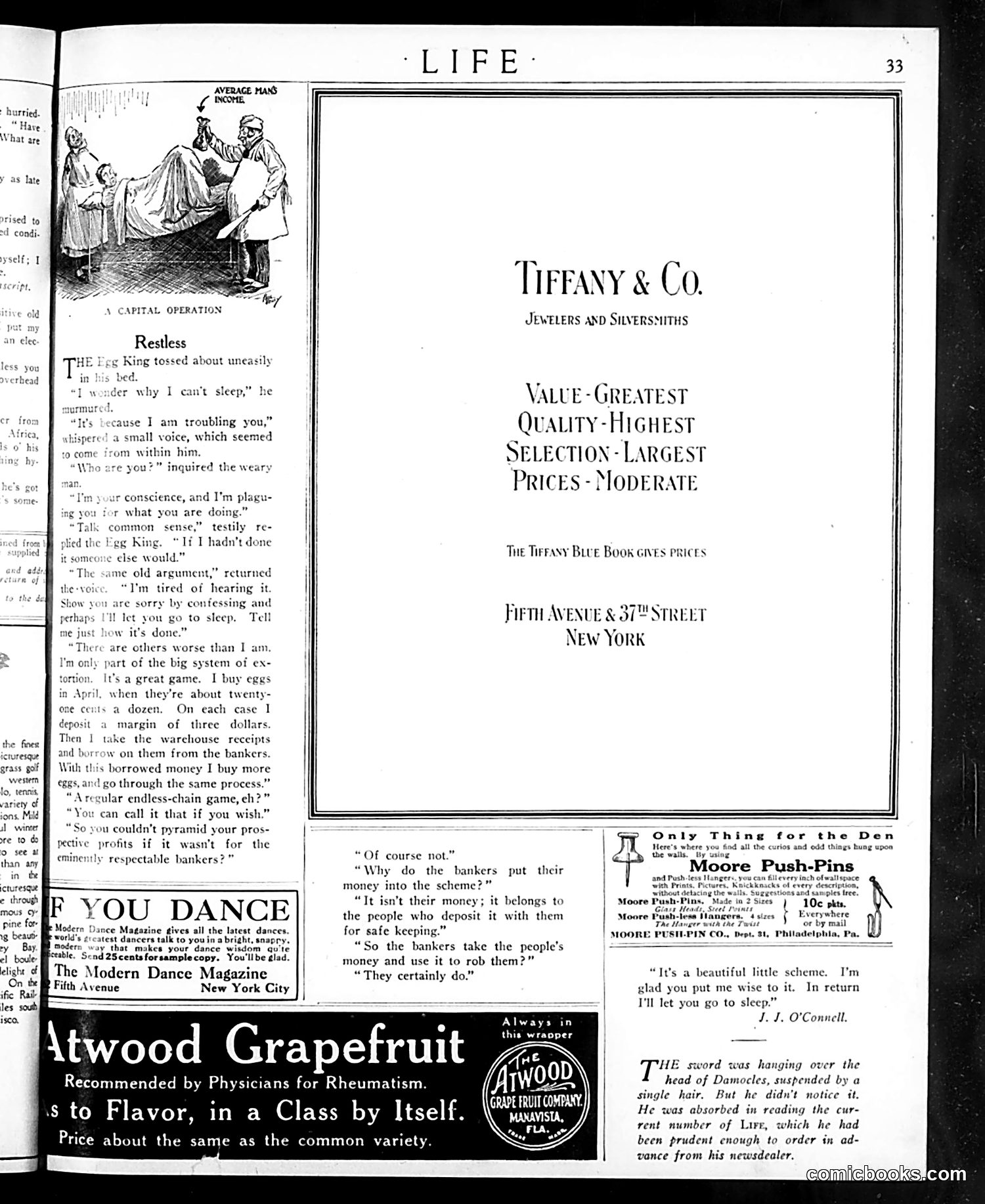
This untitled cartoon satirizes financial manipulation and banking corruption during the early 20th century. The "Egg King" represents a speculator or financier engaging in what appears to be a pyramid scheme: he purchases eggs cheaply, uses warehouse receipts as collateral to borrow from banks, then reinvests borrowed money to repeat the cycle. The satire's point: bankers knowingly finance these speculative schemes using depositors' money, essentially allowing financiers to "rob" ordinary people. When the Egg King claims he "couldn't pyramid" profits without banker cooperation, the dialogue reveals that banks prioritize profits over their fiduciary responsibility to depositors. This reflects Progressive Era criticism of unregulated financial practices and banker complicity in market manipulation—concerns that would intensify toward the 1929 stock market crash.
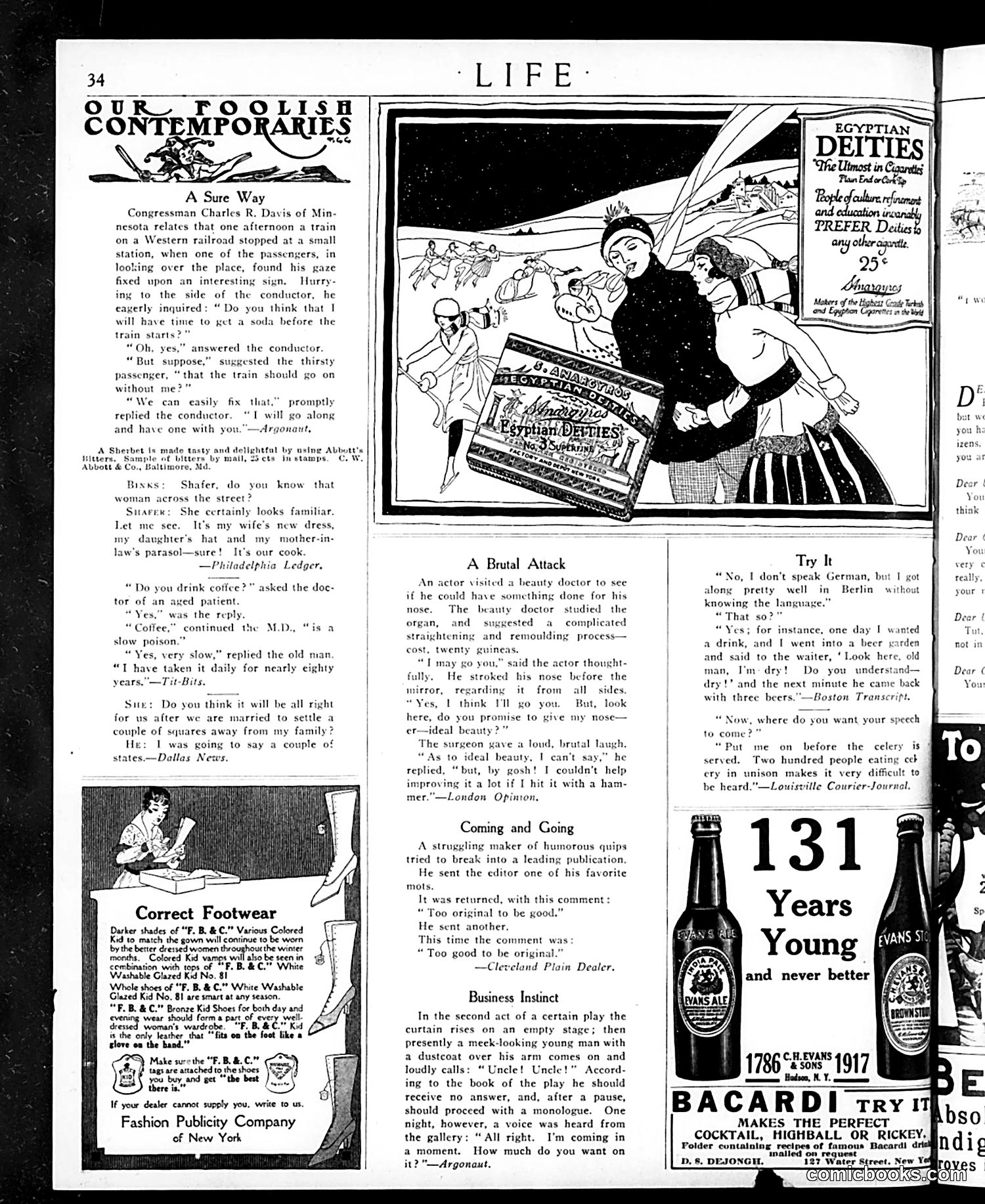
This page presents humorous anecdotes mocking everyday foolishness. The "Sure Way" joke satirizes absurd logic: a conductor agrees to drink soda with a passenger to prevent the train leaving without him—solving nothing. Other jokes mock domestic life (a husband recognizing his wife only by her borrowed clothes and accessories) and romantic naïveté (a couple planning to live "a couple of squares away" from the wife's family; the husband counters they should live "a couple of states" away). The central cartoon depicts someone being attacked with Egyptian Deities cigarettes—visual humor about an aggressive sales pitch or advertisement. Sidebar content includes advice on fashionable footwear and advertisements for beer and cigarettes. The overall tone is light satire on human nature's small absurdities rather than political commentary.
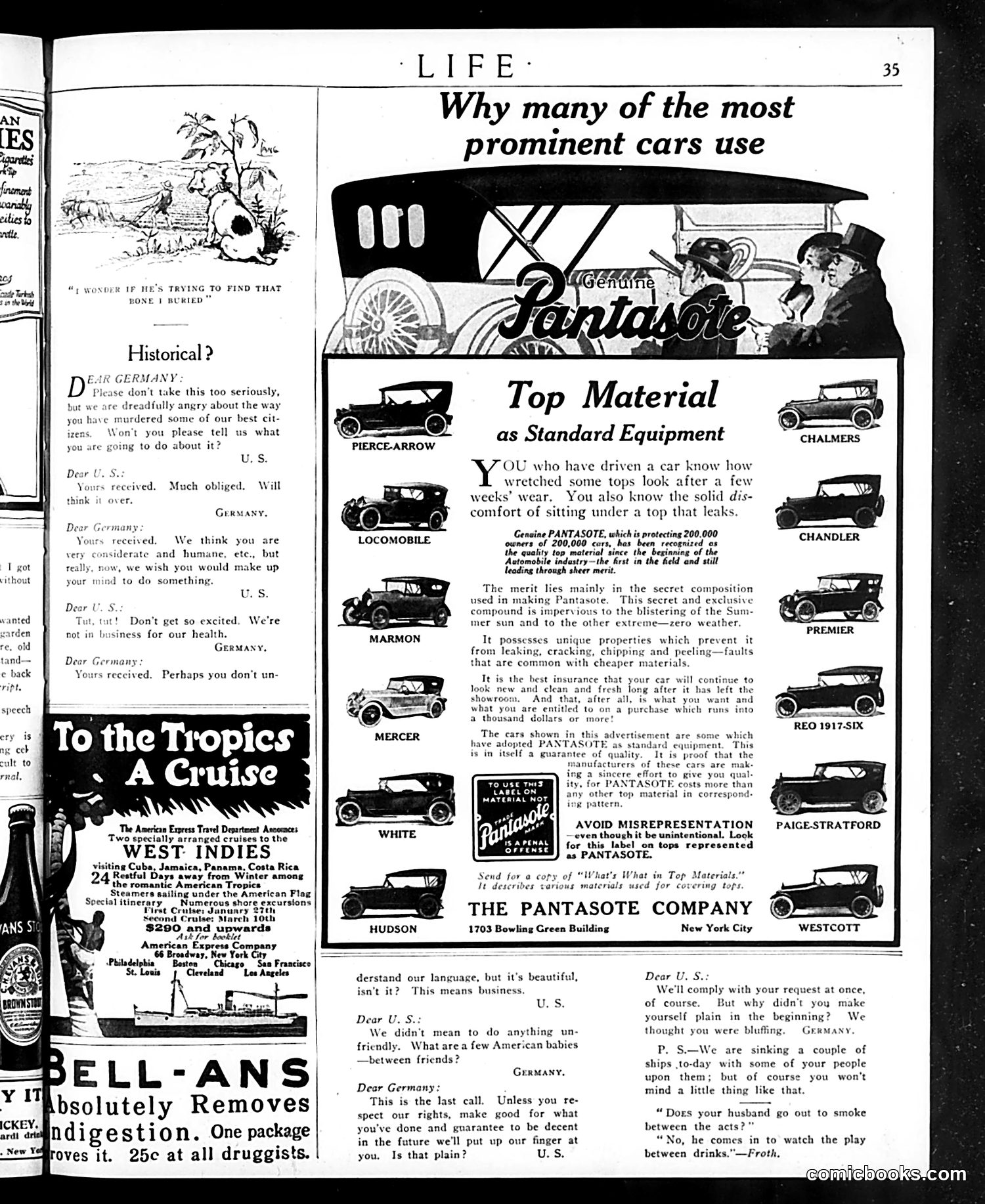
This page primarily consists of **advertisements and a satirical letter exchange**, with minimal actual political cartoon content. The main satire appears in the **"Historical" section**—a fictional correspondence between the United States and Germany. The letters mock post-World War I tensions: Germany complains about harsh treatment, the U.S. responds with exasperation ("We're not in business for our health"), and escalates to threats ("This is the last call"). The final U.S. letter references sinking German ships, suggesting the correspondence reflects **real diplomatic hostility** during the 1920s-1930s period. The page is dominated by **Pantasote automobile top advertisements** featuring various car brands (Pierce-Arrow, Hudson, etc.), a cruise advertisement, and a Bell-Ans indigestion remedy ad. A closing joke about a husband watching theater plays rather than smoking between acts provides light entertainment but carries no political significance. **Historical context**: This appears designed to satirize interwar U.S.-German relations through faux-diplomatic correspondence, though the tone remains relatively lighthearted.
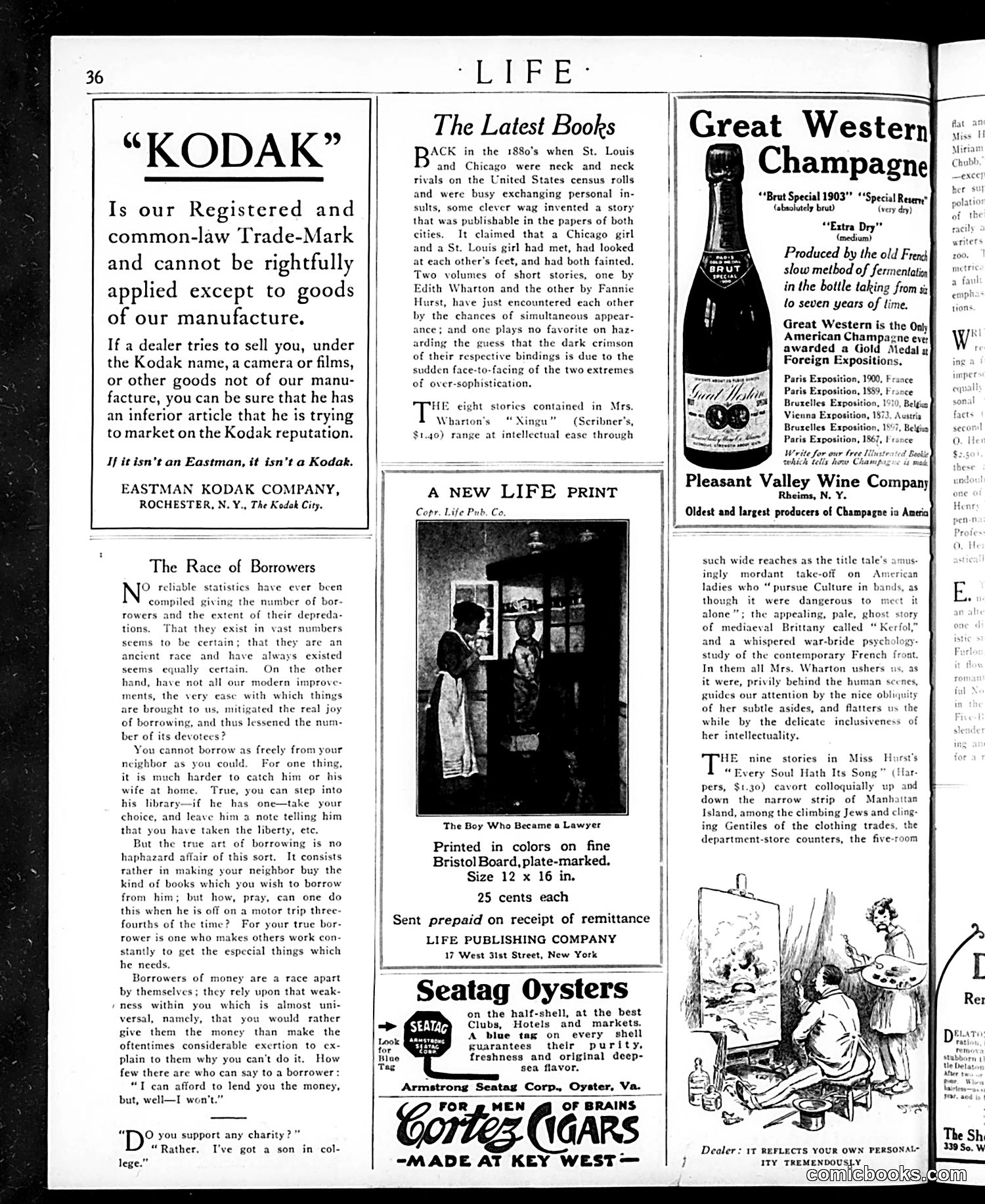
This page is primarily **advertising with one editorial essay**. The main content is "The Race of Borrowers," a humorous essay satirizing people who habitually borrow money and possessions from neighbors. The piece argues that chronic borrowers are a distinct social type who exploit others' reluctance to refuse requests—it's easier to lend than to explain why you won't. The essay concludes with a joke: supporting a son in college *is* charitable giving (via tuition costs). The advertisements include trademark warnings from Kodak (protecting their brand name from counterfeit cameras), book reviews featuring Edith Wharton and Fannie Hurst, a Life Publishing print titled "The Boy Who Became a Lawyer," oysters, cigars, and champagne. **No political cartoons appear on this page.** The "satire" is limited to the gentle, domestic humor of the borrowers essay—observing middle-class social behavior rather than commenting on politics or major events.
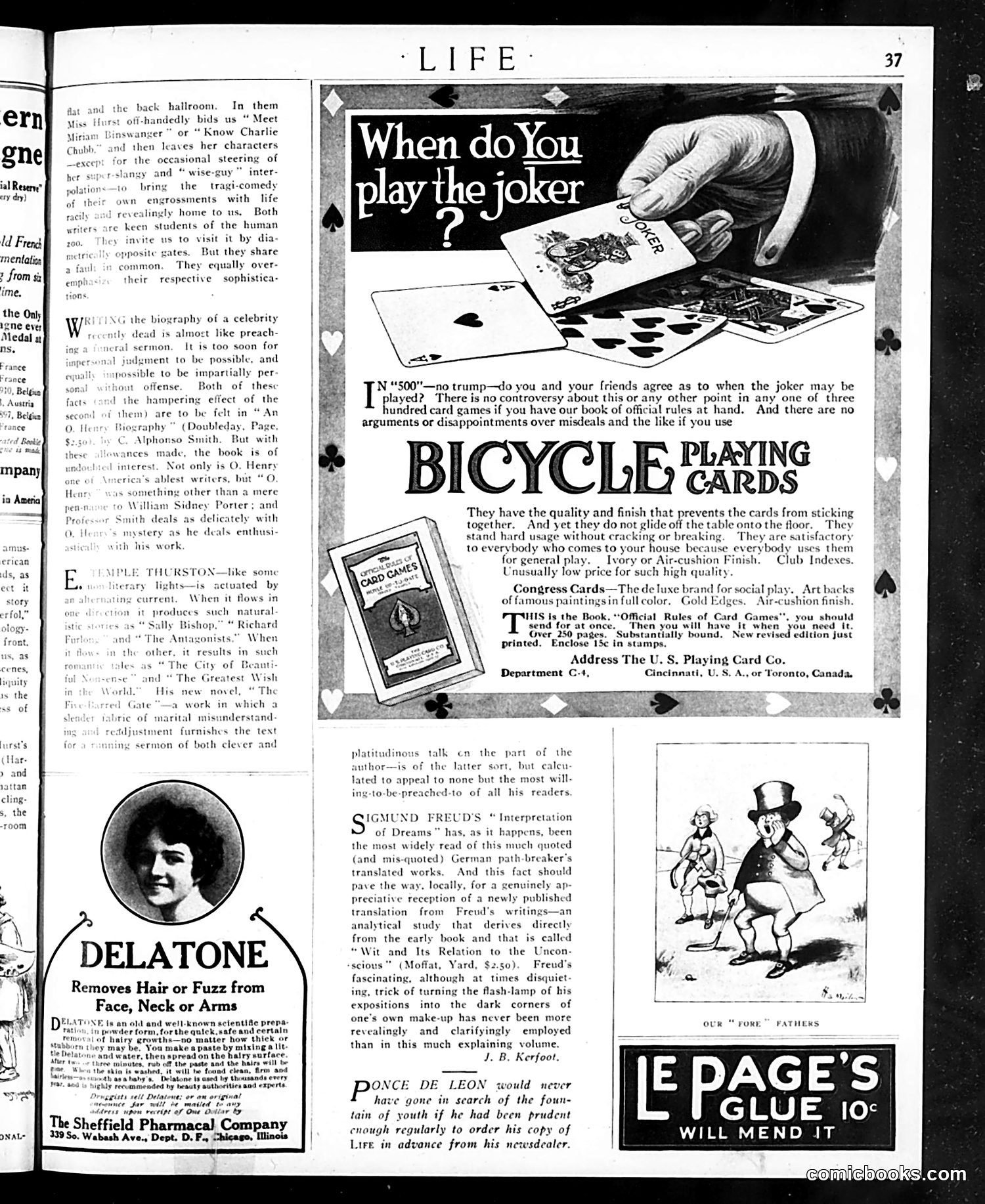
This page is primarily **advertising**, not political satire. The main content features a Bicycle Playing Cards advertisement asking "When do You play the joker?" — promoting their card decks by emphasizing they prevent disputes about game rules. The page includes three **product advertisements**: 1. **Bicycle Playing Cards** — highlighting quality, durability, and the availability of official rule books 2. **Delatone** — a hair removal product for women's facial hair 3. **Le Page's Glue** — a adhesive product The only illustrated content approaching satire is a small cartoon labeled "OUR 'PUNK' FATHERS" showing children playing cards, which appears to make a nostalgic or humorous point about youthful gaming. The left column contains book reviews discussing celebrity biographies and Sigmund Freud's works, but these are editorial content, not satire requiring historical context.
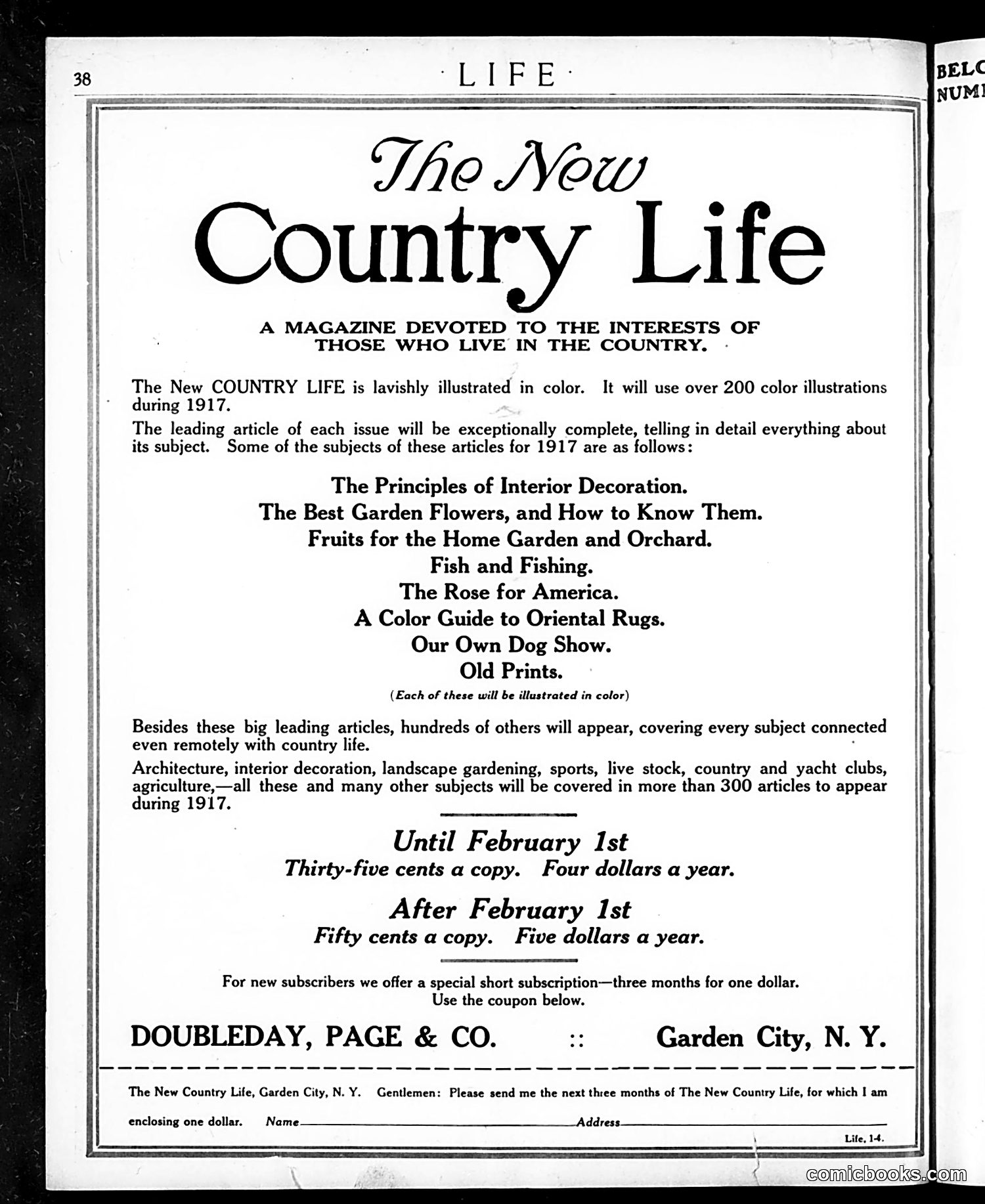
This is a magazine advertisement, not a cartoon. It promotes *The New Country Life*, a lifestyle publication by Doubleday, Page & Co., positioned for affluent rural readers in 1917. The ad emphasizes lavish color illustrations (over 200 promised annually) and comprehensive coverage of genteel country pursuits: interior decoration, gardening, fishing, dog shows, oriental rugs, architecture, and agriculture. The publication targets a leisured class with interests in estates, yacht clubs, and refined hobbies. Notably timed for 1917 (America's entry into World War I), the ad offers introductory pricing until February 1st, then raises rates—a common marketing tactic. There are no satirical cartoons or political commentary visible; this is straightforward commercial messaging appealing to upper-class readers seeking lifestyle guidance.