
Life, 1917-01-04 · page 22 of 38
Life — January 4, 1917 — page 22: what you’re looking at
What you’re looking at
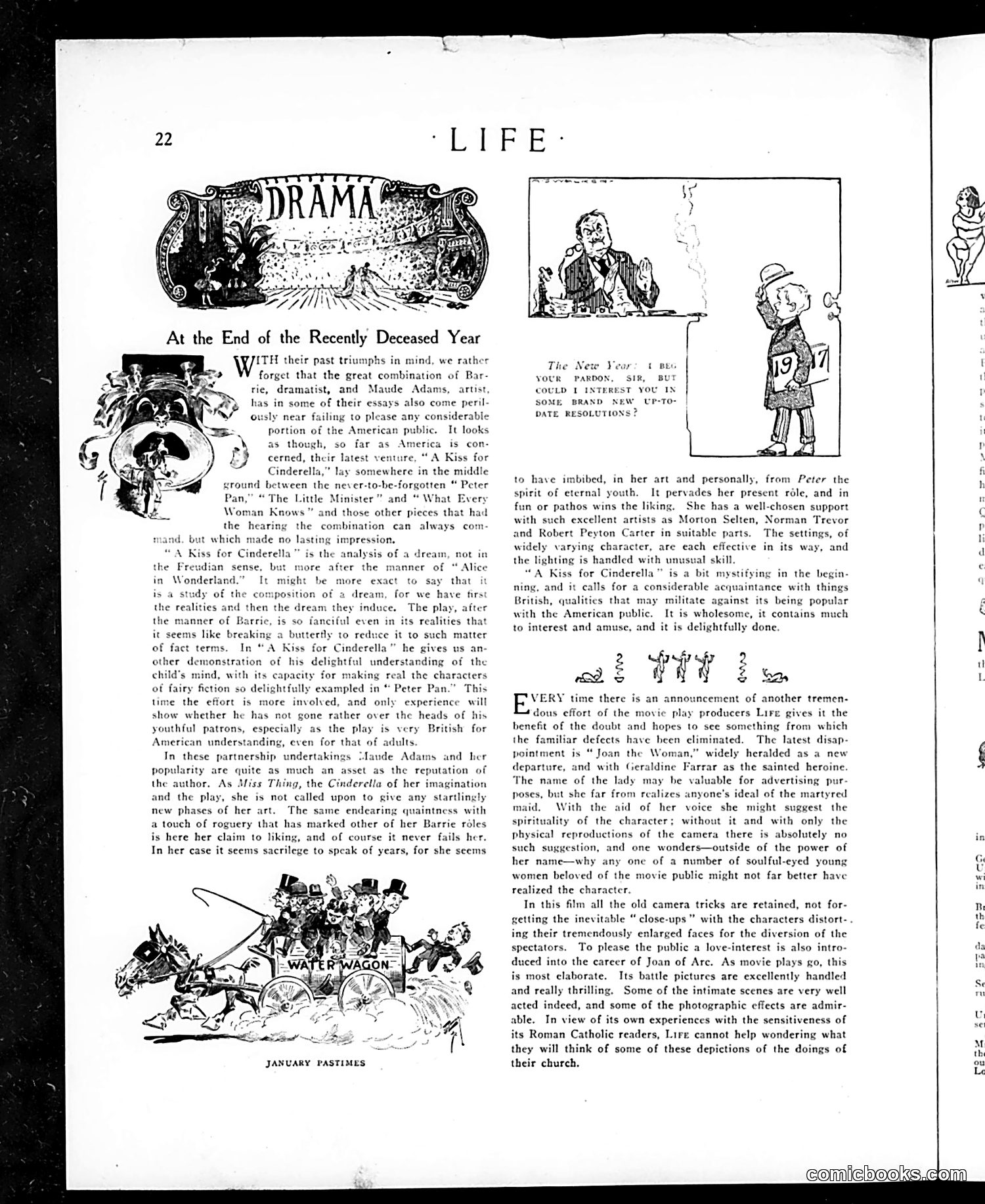
This page reviews theatrical productions from early 20th-century Broadway. The main discussion concerns J.M. Barrie's "A Kiss for Cinderella," starring Maude Adams. The critic praises Adams' performance and her "eternal youth," noting the play successfully adapts Barrie's dream-logic style (similar to "Peter Pan") but warns American audiences may find it too British. The small cartoon at top-right depicts a New Year's resolution salesman—a satirical commentary on the January tradition of making resolutions. The "Water Wagon" illustration below references the common resolution to quit drinking (getting "on the water wagon"). The page also briefly critiques the film "Joan the Woman" with opera singer Geraldine Farrar, suggesting her voice carries the performance, but her physical presence alone cannot convey the character's spiritual depth—a critique of early cinema's limitations with operatic casting.
📄 Transcribed text from this page (OCR, searchable)
Machine-transcribed from the original scan — historical spelling and the odd misread are preserved.
aE = 7711 Se 8 At the End of the Recently Deceased Year ITH their past triumph ind, we rather forget that the great combination of Bar- tie, dramatist, and Maude Adams, artist s in some of their essays also come peril- ling to pl derable portion of the American public. It looks as though, so far as America is con- EJ cerned, their latest venture, “A Kiss for Cinderella,” lay somewhere in the middle ground between the never-to-be-forgotten “ Peter Pan,” “The Little Minister” and “ What Every Woman Knows” and those other pieces that had the hearing the combination can always com nd. but which made no lasting impression. usly near fi se any con: “A Kiss for Cinderella” is the analysis of a dream, not in the Pri sense, but more after the manner of “Ali in Wonderland.” It might be more exact to that it is a study of the composition of a dream, for we have first the realities and then the dream they induce, The play, after the manner of Barrie, is so fanciful even in its realities that it seems like breaking a butterfly to reduce it to such matter of fact terms. In “A Kiss for Cinderella” he gives us other demonstration of his delightful underst child’s mind, with its capacity of fairy fiction so delightfully exampled in Peter Pan.” This lime the effort is more involved, and only experience will show whether he has not gone r. youthful patrons, especially as the play is very British for American understanding, even for that of adults In these partnership undertakings Maude Adams and her popularity are quite as much an asset as the reputation of the author. As Miss Thing, the Cinderella of her imagination and the play, she is not called upon to give new phases of her art. The same endearing quaintness with a touch of roguery that has marked other of her Barrie rales is here her claim to liking, and of course it never fails her. In her case it seems sacrilege to speak of years, for she seems an- nding of the for making real the characters her over the heads of his ny startlingly JANUARY PASTIMES he New YOUR PARDON, SIR, COULD 1 INTEREST YOU IN SOME BRAND NEW UP-TO- DATE RESOLUTIONS ? to have imbibed, in her art and personally, from Peter the spirit of eternal youth. It pervades her present réle, and in fun or pathos wins the liking. She has a well-chosen support with such excellent artists as Morton Selten, Norman Trevor and Robert Peyton Carter in suitable parts. The settings, of widely varying character, are each effective in its way, and the lighting is handled with unusual skill. “A Kiss for Cinderella” is a bit mystifying in the begin- ning, and it calls for a considerable acquaintance with things British, qualities that may militate against its being popular with the American public. It is wholesome, it contains much to interest and amuse, and it is delightfully done. wi OUP ia RY time there is an announcement of another tremen- ous effort of the movie play producers Lire gives it the benefit of the doubt and hopes to see something from which the familiar defects have heen eliminated. The latest disap- pointment is “Joan the Woman,” widely heralded as a new departure, and with Geraldine Farrar as the sainted heroine. The name of the lady may be valuable for advertising pur poses, but she far from realizes anyone's ideal of the martyred maid, With the aid of her voice she might suggest the ity of the character; without it and with only the physical reproductions of the camera there is absolutely no such suggestion, and one wonders—outside of the power of her name—why any one of a number of soulful-eyed young women beloved of the movie public might not far better have realized the character. In this film all the old camera tricks are retained, not for- getting the inevitable “ close-ups” with the characters distort- are spiritu; ing their tremendously enlarged faces for the diversion of the spectators. To please the public a love-interest is also intro- duced into the career of Joan of Arc. As movie plays go, this is most elaborate. Its battle pictures are excellently handled and really thrilling. Some of the intimate scenes are very well deed, and some of the photographic effects are admir- acted able. In view of its own experiences with the sensitiveness of its Roman Catholic readers, Lire cannot help wondering what they will think of some of these depictions of the doings of their church,