
Life, 1917-01-04 · page 19 of 38
Life — January 4, 1917 — page 19: what you’re looking at
What you’re looking at
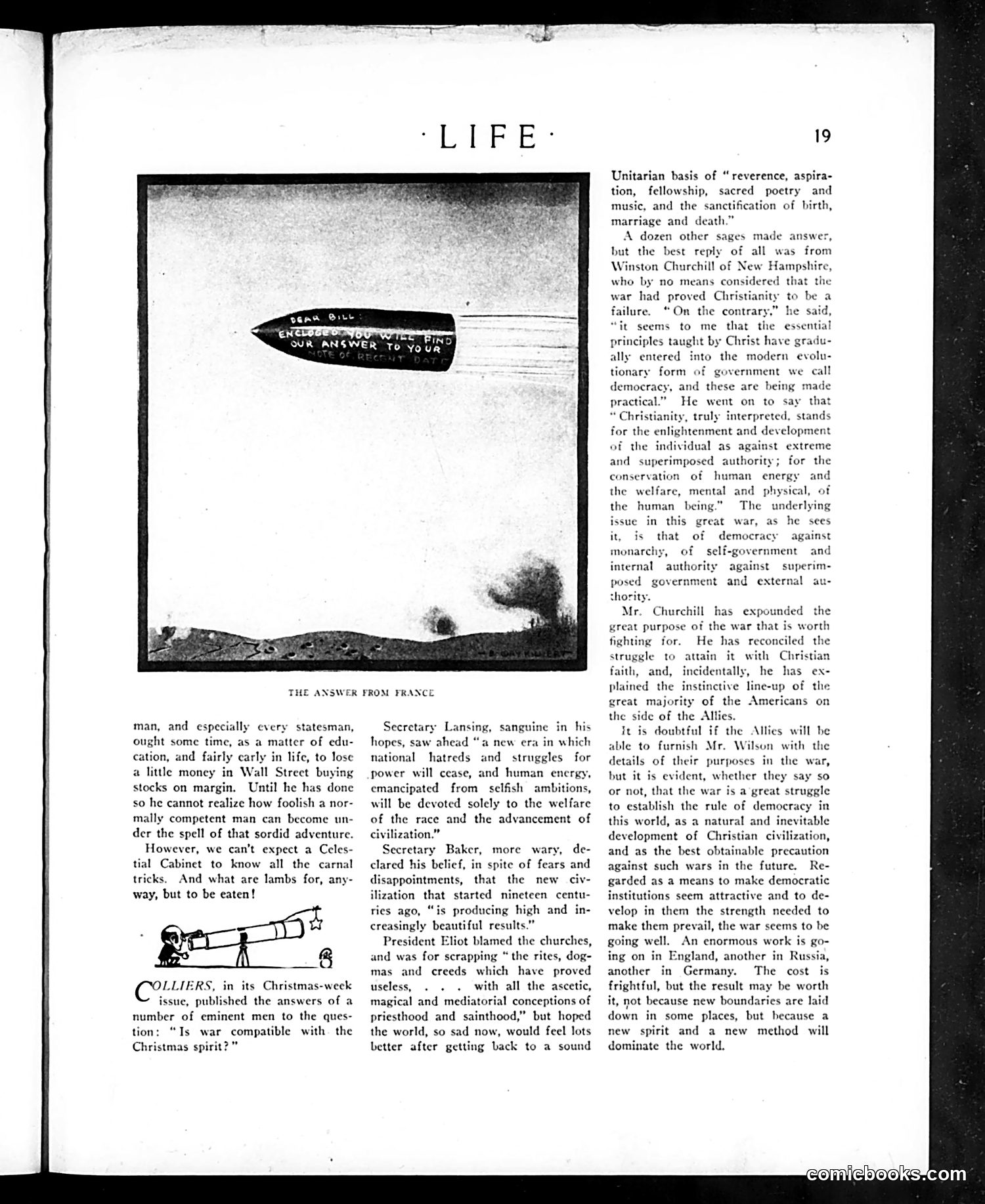
This wartime editorial cartoon depicts a boat labeled "Dear Bill, Enclosed by Our Answer to Your" pointing toward France, with explosions visible on the shore. It accompanies an article debating whether World War I is compatible with Christian values. The cartoon illustrates the article's central point: while various American leaders (Secretary Lansing, Secretary Baker, President Eliot) offered philosophical answers about war and Christianity, **Winston Churchill of New Hampshire provided the most direct, practical response**—essentially, action rather than words. The "answer from France" represents military engagement itself as America's response to the war's moral questions. The cartoon satirizes the gap between abstract ethical debate and battlefield reality, suggesting that the true answer to whether democracy and Christianity can coexist with war is being written through combat rather than rhetoric.
📄 Transcribed text from this page (OCR, searchable)
Machine-transcribed from the original scan — historical spelling and the odd misread are preserved.
DEAR BLE ENCLOTEOIBY OUR ANSWER Tm To Your THE ANSWER FROM FRANCE man, and especially every statesman, ought some time, as a matter of edu- cation, and fairly carly in life, to lose a little money in Wall Street buying stocks on margin, Until he has done so he cannot realize how foolish a nor- mally competent man can become un- der the spell of that sordid adventure. However, we can’t expect a Celes- tial Cabinet to know all the carnal tricks. And what are lambs for, any- way, but to be eaten! LLIERS, in its Christmas-week issue, published the answers of a number of eminent men to the ques- tion: “Is war compatible with the Christmas spirit?" Secretary Lansing, sanguine in his hopes, saw ahead “a new era in which national hatreds and struggles for power will cease, and human energy, emancipated from selfish ambitions, will be devoted solely to the welfare of the race and the advancement of civilization, Secretary Baker, more wary, de- clared his belief, in spite of fears and disappointments, that the new civ- ilization that started nineteen centu- ries ago, “is producing high and in- creasingly beautiful results.” President Eliot blamed the churches, and was for scrapping “ the rites, dog- mas and creeds which have proved useless, . . . with all the ascetic, magical and mediatorial conceptions of priesthood and sainthood,” but hoped the world, so sad now, would feel lots Letter after getting back to a sound 19 Unitarian basis of “reverence, aspira- tion, fellowship, sacred poetry and music, and the sanctification of birth, marriage and death.” A dozen other sages made answer, but the best reply of all from Winston Churchill of New Hampshire, who by no means considered that the war had proved Christianity to be a failure. “On the contrary e said, “it seems to me that the principles taught by Christ have gradu- ally entered into the modern evolu- f we call was essential tionary form of government democracy, and these are being made practical.” He went on to say that “Christianity, truly interpreted, stands for the enlightenment and development of the individual as against extreme and superimposed authority; for the energy and the welfare, mental and physical, of the human being.” The underlying issue in this great war, as he sees it, is that of democracy against monarchy, of self-government internal authority against superim- posed government and external au- thority. Mr. Churchill has expounded the great purpose of the war that is worth fighting for. He has reconciled the struggle attain it with Christian faith, and, incidentally, he has ex- plained the instinctive line-up of the great majority of the Americans on the side of the Allies. It is doubtful if the Allies will be able to furnish Mr. Wilson with the details of their purposes in the war, but it is evident, whether they say so or not, that the war is a great struggle to establish the rule of democracy in this world, as a natural and inevitable development of Christian civilization, and as the best obtainable precaution against such wars in the future. Re- garded as a means to make democratic institutions seem attractive and to de- velop in them the strength needed to make them prevail, the war seems to be going well. An enormous work is go- ing on in England, another in Russia, another in Germany. The cost is frightful, but the result may be worth it, not because new boundaries are laid down in some places, but because a new spirit and a new method will dominate the world. conservation of human and