
Life, 1917-01-04 · page 23 of 38
Life — January 4, 1917 — page 23: what you’re looking at
What you’re looking at
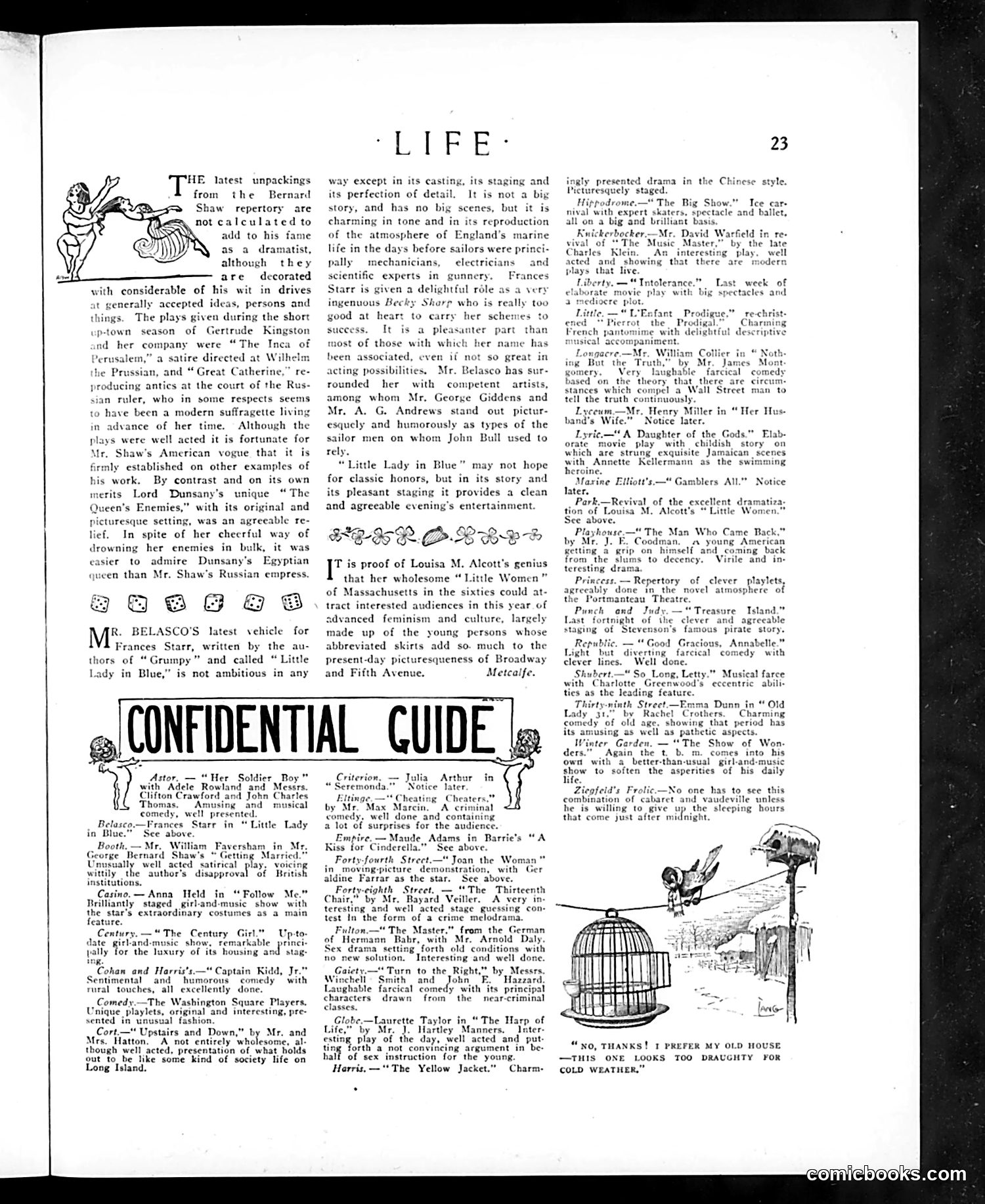
This page reviews Broadway theater productions from the early 1910s. The main satirical content concerns **George Bernard Shaw's plays**, which the critic dismisses as heavy-handed and didactic. The reviewer contrasts Shaw's "The Inca of Perusalem" (attacking Wilhelm II's Prussia) and "Great Catherine" (mocking Russian autocracy) unfavorably with Lord Dunsany's "The Queen's Enemies," praising the latter's aesthetic merit over Shaw's polemical approach. The cartoon at bottom—showing a figure preferring an old house despite "draughty" weather—appears unrelated editorial humor. The second major review celebrates **Louisa May Alcott's "Little Women"** (1860s Massachusetts setting) unexpectedly appealing to 1910s audiences of young women wearing abbreviated skirts—implying modern feminism makes the novel's "wholesome" values seem charmingly old-fashioned rather than dated. The "Confidential Guide" section lists Broadway theaters and current productions with brief critical notices.
📄 Transcribed text from this page (OCR, searchable)
Machine-transcribed from the original scan — historical spelling and the odd misread are preserved.
HE latest unpackings from the Bernard Shaw repertory are not calculated to add to his fame as a dramatist, although they are decorated with considerable of his wit in drives senerally accepted ideas, persons and The plays given during the short up-town season of Gertrude Kingston nd her company “The f Perusalem,” a satire directed at Wilh ¢ Prussian, and “ Great Catherine,” producing antics at the court of the Ru: sian ruler, who in some respects seems to have been a modern suffragette living in advance of her time. Although the plays were well acted it is fortunate for haw’s American vogue that is y established on other examples of his work. By contrast and on its own merits Lord Dunsany’s unique “ The Queen's Enemies,” with its original and picturesque setting, was an agreeable re- lief. In spite of her cheerful way of drowning her enemies in bulk, it was easier to admire Dunsany’s Egyptian queen than Mr. Shaw's Russian empress. M® BELASCO’S latest vehicle for Frances Starr, written by the au- thors of “Grumpy” and called “ Little Lady in Blue,” is not ambitious in any were re- “LIFE: way except in its casting, its staging and its perfection of detail. It is not a big story, and has no big scenes, but it is charming in tone and in its reproduction of the atmosphere of England’s marine life in the days before sailors were princi pally mechanicians, and scientific experts in gunnery. Frances Starr is given a delightful réle as a very electricians ingenuous Becky Shorp who is really too good at heart to carry her schemes to success. It is a pleasanter part than most of those with which her name has been ass iated, even if not so great in Mr. B ng possibilitie asco has sur- rounded her with competent artists, among whom Mr, George Giddens and Mr. A. G. Andrews stand out pictur- esquely and humorously as types of the sailor men on whom John Bull used to rel act Little Lady in Blue” may not hope for classic honors, but in its story and its pleasant staging it provides a clean and agreeable evening's entertainment 225 .9-O AD-~2 .a,-2 FE-IR BS COPD T is proof of Louisa M. Alcott’s genius that her wholesome “ Little Women" of Massachusetts in the sixties could at- tract interested audiences in this year of dvanced feminism and culture, largely made up of the young persons whose abbreviated skirts add so. much to the present-day picturesqueness of Broadway and Fifth Avenue. Metcalfe. Soldier Boy " Adele Rowland and Messr Clifton Crawford and John Charles Tho: J musical dy, well presented. Belasco.—Frances Starr in te Lady in Blue.” See above. Booth. — Mr. William Faversham in Mr, corge Bernard Shaw's * ig Married.” ‘nusually ‘well acted satirical play, voicing wittily the author's disapproval of British institutions. Casino. — Anna Held in “Follow Me.” Brilliantly staged girl-and-music show with he star's extraordinary costumes as a main feature. Century. —“The Century Girl.” date gictand-music show. remarkable. p pally for the luxury of its housing ax ing. Cohan and Harris Captai entimental and humorous ¢ rural touches, all excellently di Comedy.—The Washington Square Players. Unique. playlets, original and interesting, pre- sented in unusual fashion. Cort.—* Upstairs and Down,” by Mr. and Mrs. Hatton. A not entirely wholesome, al- though well acted, presentation of what holds out to be like some kind of society life on Long Island. Criterion. — Julia Arthur in “ Seremonda.” “Notice later. Eltinge, —"* Cheating Cheaters. by Mr. Max Marcin. A criminal comedy, well done and containing a lot of surprises for the audience. _Empire. — Mande, Adams in Barr Kiss for Cinderella.” See above. Forty-fourth Street. Joan the Wo in| moving-picture demonstration, with aldine Farrar as the star. See above. Forty-eighth Street. — “The Thirteenth Chair,” by Mr. Bayard Veiller. A very in- teresting and well acted stage guessing con- test In the form of a crime melodrama. Fulton.—" The Master." from, the German of Hermann Babr, with Mr. Arnold Daly. Sex drama setting forth old conditions with no new solution. Interesting and well done. Gaiety.—* Turn to the Right, Winchell) Smith and John. "F. Laughable farcical comedy with its principal characters. drawn from the near-criminal classes, Globe—Laurette Taylor in.“ The Harp of Life,” by Mr. J. Hartley Manners. Inter- esting play of the day, well acted and put- ting forth a not convincing argument in be- half of sex instruction for the you Harris, —“*The Yellow Jacket.’ aly presented drama in the Ch Picturesquely staged. Hippodrome.—" The Big Show.” nival with expert skaters, spec all on a big and brilliant basis Knickerbocker.—Mr. David W: vival of “The Music Mas Charles Klein. interesting ac and showing at there lays that live. Liberty, — “Intolerance.” Last week of elaborate movie play with big spectacles and a mediocre plot, Little, —“T'Esfant Prodigy ened “Pierrot the Prodigal. French pantomime with delightfu miusical aces Tee care cle and ballet, rfield in re- by the late play, well are modern Longacre.—Mr. “ Noth: ing But the Tr by Mr. James Mont gi Very laughable farcical comedy “on the theory that, there are circum: stances which compel a Wall Street man to tell the truth continuously. Lyceum—Mr. Henry Miller in band’s Wife.” “Notice later. Lyrie.—* A Daughter of the Gods.” Elab- orate movie play with childish story on which are strung exquisite Jamaican scenes Her Hus with Annette Kellermann as the swimming heroine. Marine Eltiott's.—" Gamblers All.” Notice later. Park.—Revival_ of the excellent tion of Louisa M. Alcott’s “Little See above. Playhouse.—" The Man Who Came Back.” by Mr. J. E. Coodman. young American back Virile and in- getting a grip on from the slums to decency. teresting dr. Princess. — Repertory of clever playlets, agreeably done in the novel atmosphere of the Portmanteau Theatre. Punch and Judy. — “Trea Istand.” Last fortnight of the clever agreeable Stevenson's staging of Republic. — “Good Graciou Light but’ diverting farcical clever lines. Well done. Shubert.—"“ So Long, Letty.” with Charlotte Greenwood’s eccentric ties as the leading feature. Thirty-ninth Street—Emma Dunn in “ Old Lady 31." by Rachel Crothers. Charming comedy of old age, showing that period has its amusing as well as pathetic aspects. famous pirate sto Annabelle.” comedy with Musical farce abili- Winter Garden. — “The Show of Won- ders." Again the t. b. m. 3 into his own with better-than-usual girl-and-music flow to soften the asperities of his daily life. afeid’s Frolic.—No one has to see this combination of cabaret and. va unless he is willing to give up ng hours hat come just after midnigl “No, THANKS! T PREFER MY OLD HOUSE THIS ONE LOOKS TOO DRAU COLD WEATHER,” HTY YOR