
Life, 1917-01-04 · page 16 of 38
Life — January 4, 1917 — page 16: what you’re looking at
What you’re looking at
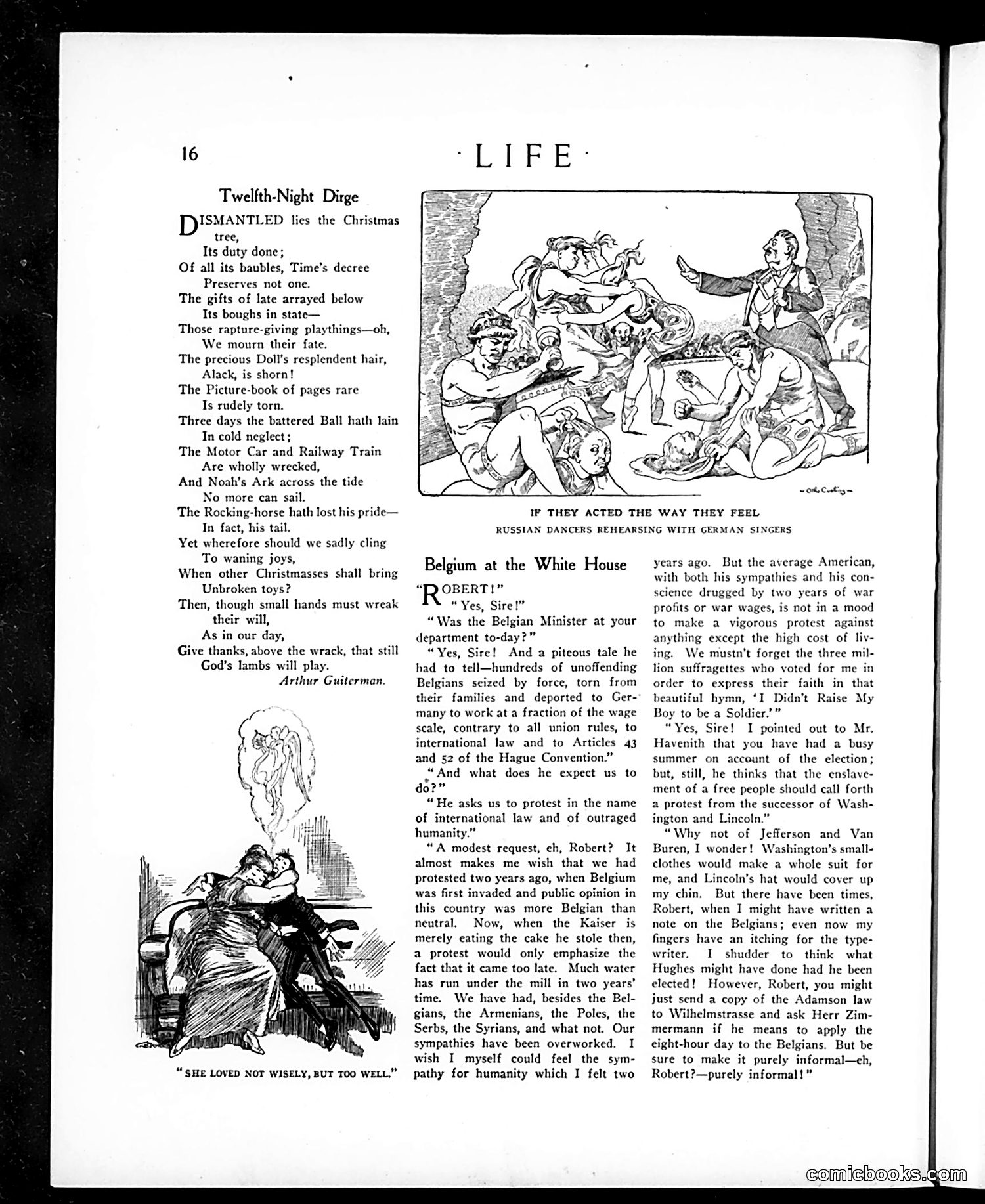
This page contains two satirical pieces critiquing American passivity during World War I. **"Twelfth-Night Dirge"** (top left) is a sentimental poem by Arthur Guiterman lamenting destroyed Christmas toys, ultimately offering spiritual comfort that children will continue playing. **"Belgium at the White House"** (main text) is the page's sharp political satire. It depicts a conversation between a U.S. President (likely Wilson, given references to the 1916 election and Adamson Law) and an aide named Robert. A Belgian Minister requests American protest against German forced deportation of Belgian civilians—violations of international law and the Hague Convention. The President cynically refuses, arguing American sympathies are "overworked" after two years of war profiteering. He dismisses the request as too late and suggests sending a mock gesture instead—asking Germany about applying an eight-hour workday to enslaved Belgians. **The satire's point**: American leadership has grown morally exhausted and commercially complicit, unwilling to protest even flagrant atrocities despite earlier sympathy for Belgium.
📄 Transcribed text from this page (OCR, searchable)
Machine-transcribed from the original scan — historical spelling and the odd misread are preserved.
16 Twelfth-Night Dirge D'SMANTLED lies the Christmas tree, Its duty done; Of all its baubles, Time's decree Preserves not one. The gifts of late arrayed below Its boughs in state— Those rapture-giving playthings—oh, We mourn their fate. The precious Doll's resplendent hair, Alack, is shorn! The Picture-book of pages rare Is rudely torn. Three days the battered Ball hath lain In cold neglect; The Motor Car and Railway Train Are wholly wrecked, And Noah’s Ark across the tide No more can sail. The Rocking-horse hath lost his pride— In fact, his tail. Yet wherefore should we sadly cling To waning joy When other Christmasses shall bring Unbroken toys? Then, though small hands must wreak their will, As in our day, Give thanks, above the wrack, that still God’s lambs will play. Arthur Guiterman. “ SHE LOVED NOT WISELY, BUT TOO WELL.’ IF THEY ACTED THE WAY THEY FEEL. RUSSIAN DANCERS REHEARSING WITH GERMAN SINGERS Belgium at the White House “BR OBERT!” “Yes, Sire!” “Was the Belgian Minister at your department to-day?” “Yes, Sire! And a piteous tale he had to tell—hundreds of unoffending Belgians seized by force, torn from their families and deported to Ger- many to work at a fraction of the wage scale, contrary to all union rules, to international law and to Articles 43 and 52 of the Hague Convention.” {And what does he expect us to do?” “He asks us to protest in the name of international law and of outraged humanity.” “A modest request, ch, Robert? It almost makes me wish that we had protested two years ago, when Belgium was first invaded and public opinion in this country was more Belgian than neutral. Now, when the Kaiser is merely eating the cake he stole then, a protest would only emphasize the fact that it came too late. Much water has run under the mill in two years’ time. We have had, besides the Bel- gians, the Armenians, the Poles, the Serbs, the Syrians, and what not. Our sympathies have been overworked. I wish I myself could feel the sym- pathy for humanity which I felt two years ago. But the average American, with both his sympathies and his con- science drugged by two years of war profits or war wages, is not in a mood to make a vigorous protest against anything except the high cost of liv: ing. We mustn't forget the three mil- lion suffragettes who voted for me in order to express their faith in that beautiful hymn, ‘I Didn’t Raise My Boy to be a Soldier.’” “Yes, Sire! I pointed out to Mr. Havenith that you have had a busy summer on account of the election; but, still, he thinks that the enslave- ment of a free people should call forth a protest from the successor of Wash- ington and Lincoln.” “Why not of Jefferson and Van Buren, I wonder! Washington’s small-+ clothes would make a whole suit for me, and Lincoln's hat would cover up my chin. But there have been times, Robert, when I might have written a note on the Belgians; even now my fingers have an itching for the type- writer, I shudder to think what Hughes might have done had he been elected! However, Robert, you might just send a copy of the Adamson law to Wilhelmstrasse and ask Herr Zim- mermann if he means to apply the eight-hour day to the Belgians. But be sure to make it purely informal—ch, Robert ?—purely informal!” comichooks.com