
Life, 1917-01-04 · page 10 of 38
Life — January 4, 1917 — page 10: what you’re looking at
What you’re looking at
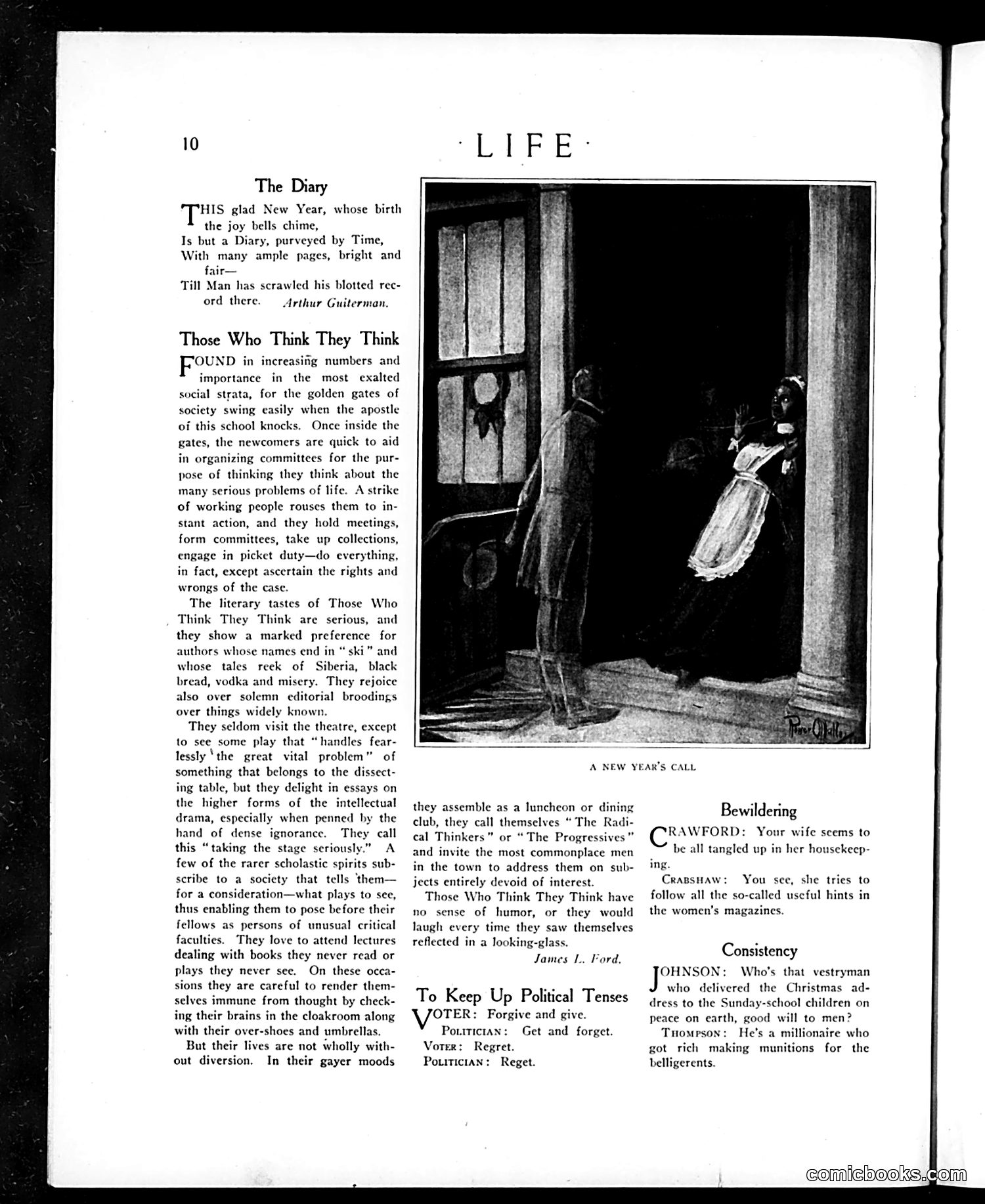
This page contains satirical essays rather than visual cartoons. The main content mocks "Those Who Think They Think"—intellectuals who join committees to discuss serious social problems but accomplish little. The satire targets their pretentious literary tastes (favoring Russian authors), their self-importance, and their ineffectual activism. The photograph titled "A New Year's Call" shows a woman in a doorway, illustrating domestic life rather than political commentary. The small comic exchanges at bottom ("To Keep Up Political Tenses," "Bewildering," "Consistency") are brief joke dialogues poking fun at politicians' contradictions and wealthy industrialists who donate munitions while preaching peace—typical early 20th-century American social satire about hypocrisy among the privileged classes.
📄 Transcribed text from this page (OCR, searchable)
Machine-transcribed from the original scan — historical spelling and the odd misread are preserved.
The Diary HIS glad New Year, whose birth the joy bells chime, Is but a Diary, purveyed by Time, With many ample pages, bright and fair— Till Man has scrawled his blotted ree- ord there. Arthur Guiterman, Those Who Think They Think ‘OUND in increasifg numbers and importance in the most exalted social strata, for the golden gates of ily when the apostle Once inside the society swing eas oi this school knocks. gates, the newcomers are quick to aid in organizing committees for the pur- pose of thinking they think about the many serious problems of life. A strike of working people rouses them to in- stant action, and they hold meetings, form committees, take up collections, engage in picket duty—do everything, in fact, except ascertain the rights and wrongs of the case. The literary tastes of Those Who Think They Think are serious, and they show a marked preference for authors whose names end in “ ski” and whose tales reek of Siberia, black bread, vodka and misery. They rejoice also over solemn editorial broodings over things widely known. They seldom visit the theatre, except to see some play that “handles fear- lessly ‘the great vital problem” of something that belongs to the dissect- ing table, but they delight in essays on the higher forms of the intellectual drama, especially when penned by the hand of dense ignorance. They call this “taking the stage seriously. few of the rarer scholastic spirits sub- scribe to a society that tells ‘them— for a consideration—what plays to see, thus enabling them to pose before their fellows as persons of unusual critical faculties. They love to attend lectures dealing with books they never read or plays they never see. On these occa- sions they are careful to render them- selves immune from thought by check- ing their brains in the cloakroom along with their over-shoes and umbrellas. But their lives are not wholly with- out diversion. In their gayer moods A NEW YEAR'S CALL. they assemble as a luncheon or dining club, they call themselves “ The Radi- cal Thinkers” or “ The Progressives” and invite the most commonplace men in the town to address them on sub- jects entirely devoid of interest. Those Who Think They Think have no sense of humor, or they would laugh every time they saw themselves reflected in a looking-glass. James 1. Ford. To Keep Up Political Tenses OTER: Forgive and give. Ponttician: Get and forget. Voter: Regret. Pouitician: Reget. Bewildering RAWFORD: Your wife seems to be all tangled up in her housekeep- ing. CRABSHAW follow all th the women’s magazines. You sce, she tries to so-called useful hints in Consistency OH ¥: Who's that vestryman who delivered the Christmas ad- dress to the Sunday-school children on peace on earth, good will to men? Tuomrson: He's a millionaire who got rich making munitions for the belligerents. comichooks.com