
Life, 1917-01-04 · page 7 of 38
Life — January 4, 1917 — page 7: what you’re looking at
What you’re looking at
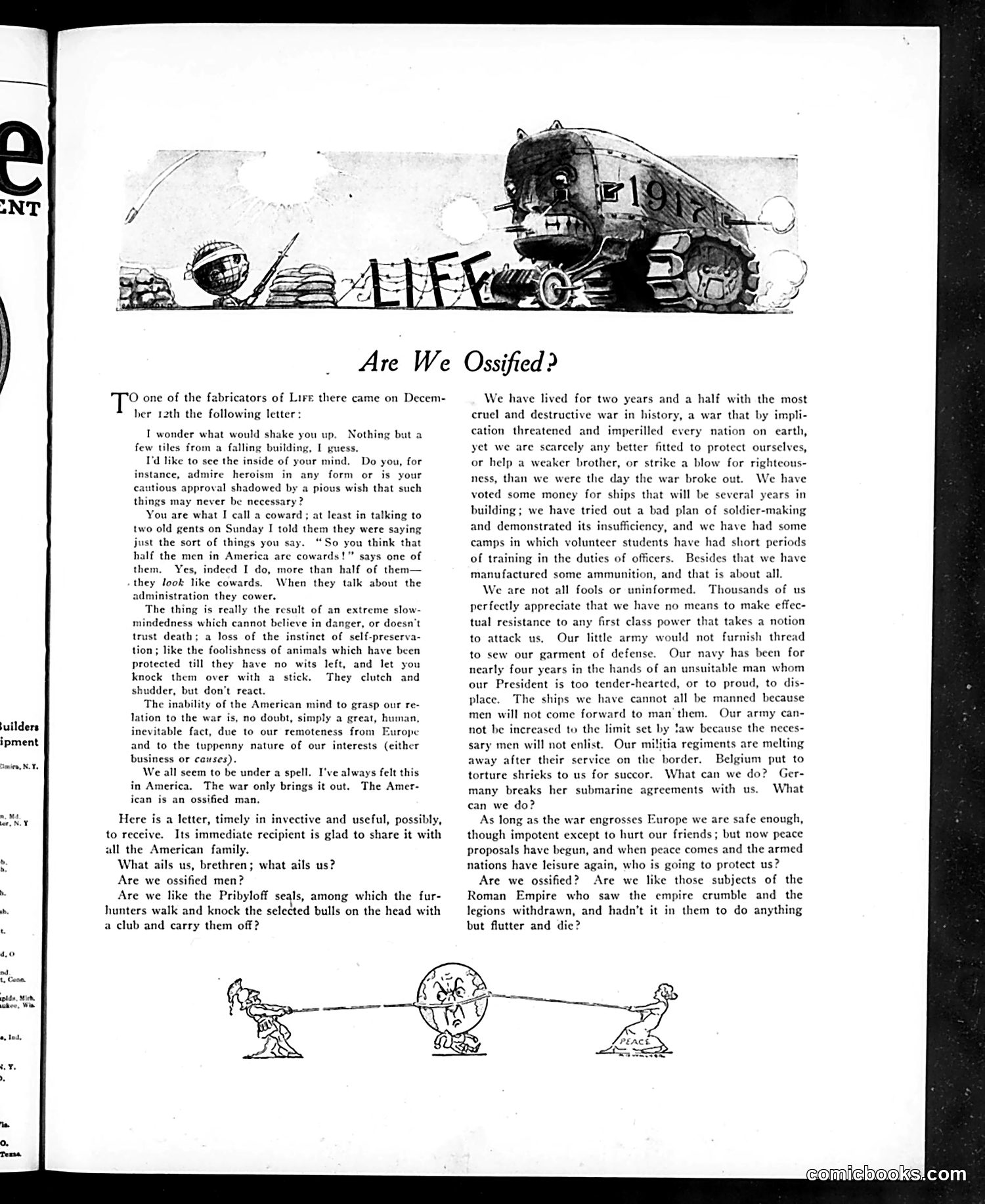
This editorial piece critiques American unpreparedness during World War I. The header illustration depicts a streamlined military train labeled "1917," contrasting modern warfare capability with the text's argument about American inadequacy. The article laments that despite two-and-a-half years of brutal European warfare, America remains unprepared to defend itself. It sarcastically compares Americans to "Pliohoff seals"—protective but passive animals—suggesting the nation has become mentally ossified (hardened/rigid) and unable to grasp real danger. The bottom illustration shows two figures pulling a globe apart, symbolizing global conflict tearing the world asunder, with a central figure labeled "PEACE" being pulled from both sides. The satire attacks American complacency and slow military mobilization in response to the Great War's escalating devastation.
📄 Transcribed text from this page (OCR, searchable)
Machine-transcribed from the original scan — historical spelling and the odd misread are preserved.
Are We Ossified? 'O one of the fabricators of Lire there came on Decem- ber 12th the following letter: I wonder what would shake you up. Nothing bu few tiles from a falling building, 1 guess. I'd like to sce the inside of your mind, Do you, for stance, admire heroism in any form or is your cautious approval shadowed by a pious wish that such things may never be necessary? You are what I call a coward ; at least in talking to two old gents on Sunday I told them they were saying just the sort of things you say. “So you think that half the men in America are cowards!" says one of them. Yes, indeed I do, more than half of them— they look like cowards. When they talk about the administration they cower. The thing is really the result of an extreme slow- mindedness which cannot believe in danger, or doesn't trust death; a loss of the instinct of self-preserva- tion ; like the foolishness of animals which have been protected till they have no wits left, and let you knock them over with a stick, They clutch and shudder, but don’t react. The inability of the American mind to grasp our re- lation to the war is, no doubt, simply a great, human, inevitable fact, due to our remoteness from Europe and to the tuppenny nature of our interests (either business or causes). We all seem to be under a spell. I've always felt this in America. The war only brings it out. The Amer- ican is an ossified man. Here is a letter, timely in invective and useful, possibly, to receive. Its immediate recipient is glad to share it with all the American family. What ails us, brethren; what ails us? Are we ossified men? Are we like the Pribyloff seals, among which the fur- hunters walk and knock the selected bulls on the head with a club and carry them off? and a half with the most a war that by impli- We have lived for two year: cruel and destructive war in history cation threatened and imperilled every nation on earth, yet we are scarcely any better fitted to protect ourselves, or help a weaker brother, or strike a blow for righteous- ness, than we were the day the war broke out. We have voted some money for ships that will be several years in building; we have tried out a bad plan of soldier-making and demonstrated its insufficiency, and we have had some camps in which volunteer students have had short periods of training in the duties of officers. Besides that we have manufactured some ammunition, and that is about all. We are not all fools or uninformed. Thousands of us perfectly appreciate that we have no means to make effec- tual resistance to any first class power that takes a notion to attack us. Our little army would not furnish thread to sew our garment of defense. Our navy has been for nearly four years in the hands of an unsuitable man whom our President is too tender-hearted, or to proud, to dis- place. The ships we have cannot all be manned because men will not come forward to man’ them. Our army can- not be increased to the limit set by taw because the neces- sary men will not enlist. Our militia regiments are melting away after their service on the border. Belgium put to torture shrieks to us for succor. What can we do? Ger- many breaks her submarine agreements with us. What can we do? As long as the war engrosses Europe we are safe enough, though impotent except to hurt our friends; but now peace proposals have begun, and when peace comes and the armed nations have leisure again, who is going to protect us? Are we ossified? Are we like those subjects of the Roman Empire who saw the empire crumble and the legions withdrawn, and hadn't it in them to do anything but flutter and die? we PEACE ae