
Life, 1917-01-04 · page 28 of 38
Life — January 4, 1917 — page 28: what you’re looking at
What you’re looking at
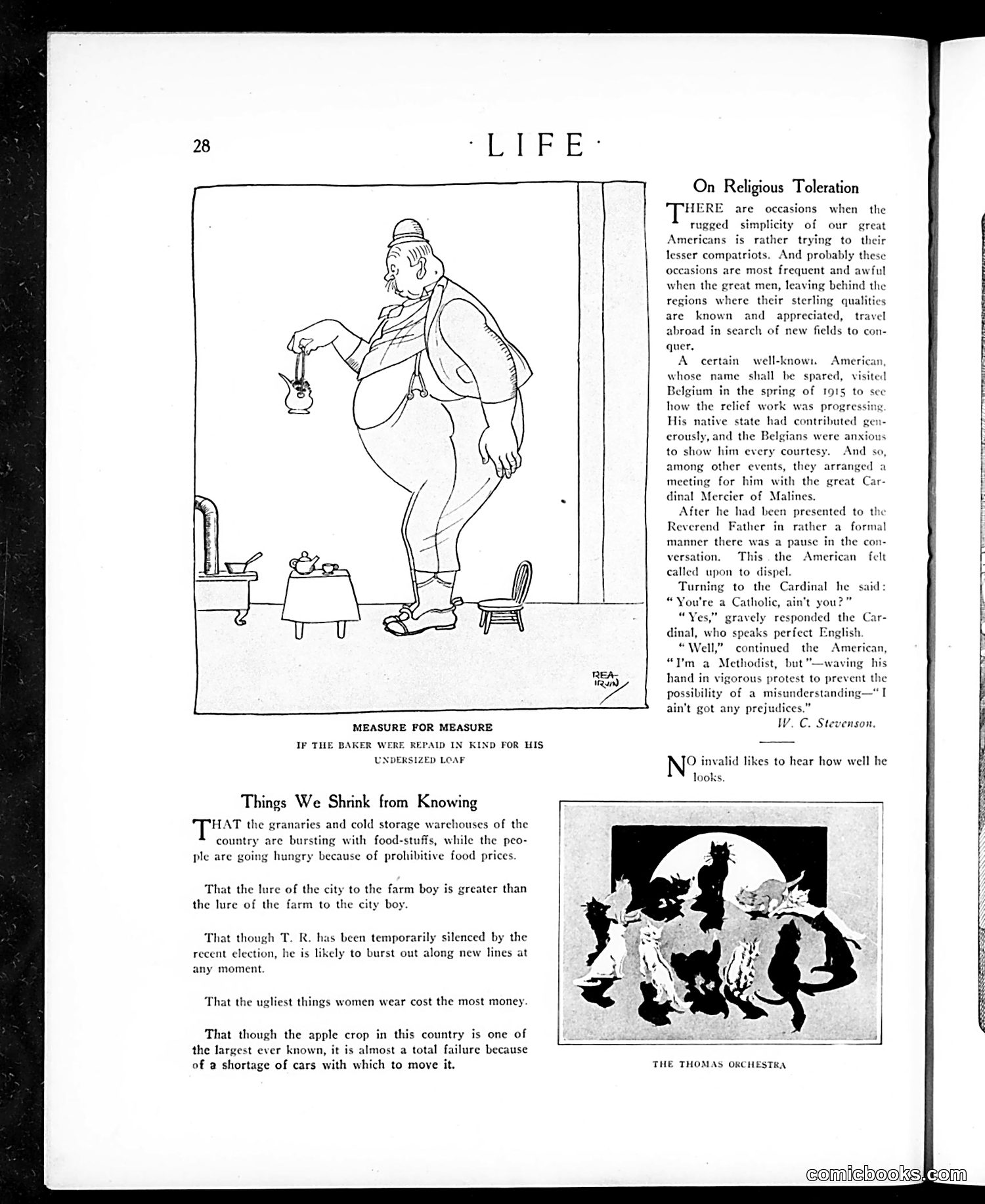
This page contains two distinct satirical pieces from Life magazine (circa 1915): **"Measure for Measure"** cartoon: A portly baker is shown measuring out undersized loaves while standing on a scale. The satire critiques wartime food profiteering—the caption suggests if bakers were "repaid in kind" (cheated as they cheat customers), they'd experience the same shortages affecting the public. It supports the accompanying text listing hypocrisies: food warehouses overflow while people starve due to "prohibitive prices." **"On Religious Toleration"** essay by W.C. Stevenson: An unnamed prominent American visits Belgium in 1915 (likely during WWI relief efforts) and meets Cardinal Mercier. The American clumsily attempts tolerance by announcing he's Methodist with "no prejudices"—the humor lies in his oblivious, blunt provincialism. His reassurance ironically reveals exactly the kind of small-minded prejudice he claims not to have. The satire mocks American arrogance abroad and shallow understanding of genuine tolerance.
📄 Transcribed text from this page (OCR, searchable)
Machine-transcribed from the original scan — historical spelling and the odd misread are preserved.
MEASURE FOR MEASURE IF THE BAKER WERE REPAID IN KIND FOR HIS UNDERSIZED LOAF Things We Shrink from Knowing HAT the granaries and cold storage warchouses of the country are bursting with food-stuffs, while the peo- ple are going hungry because of prohibitive food prices. That the lure of the city to the farm boy is greater than the lure of the farm to the city boy. That though T. R. has been temporarily silenced by the recent election, he is likely to burst out along new lines at any moment. That the ugliest things women wear cost the most money. That though the apple crop in this country is one of the largest ever known, it is almost a total failure because of a shortage of cars with which to move it. On Religious Toleration HERE are occasions when the rugged simplicity of our great Americans is rather trying to their lesser compatriots. And probably these occasions are most frequent and awful when the great men, leaving behind the regions where their sterling qualities are known and appreciated, travel abroad in search of new fields to con- quer. A’ certain well-known American, whose name shall be spared, visited Belgium in the spring of 1915 to see how the relief work was progres His native state had contributed gen- crously, and the Belgians were anxious to show him every courtesy. And so, i among other events, they arranged : j meeting for him with the great Car- ' dinal Mercier of Malines, i After he had been presented to the Reverend Father in rather a formal manner there was a pause in the con- versation. This the American felt called upon to dispe Turning to the Cardinal he said: “You're a Catholic, ain't you? “Yes,” gravely responded the Car- dinal, who speaks perfect English. h “Well,” continued the American, “T’'m a Methodist, but"—waving his hand in vigorous protest to prevent the possibility of a misunderstanding—* I ain't got any prejudices. W.C. 'O invalid likes to hear how well he looks. THE THOMAS ORCHESTRA comichooksxeom