
Life, 1917-01-04 · page 36 of 38
Life — January 4, 1917 — page 36: what you’re looking at
What you’re looking at
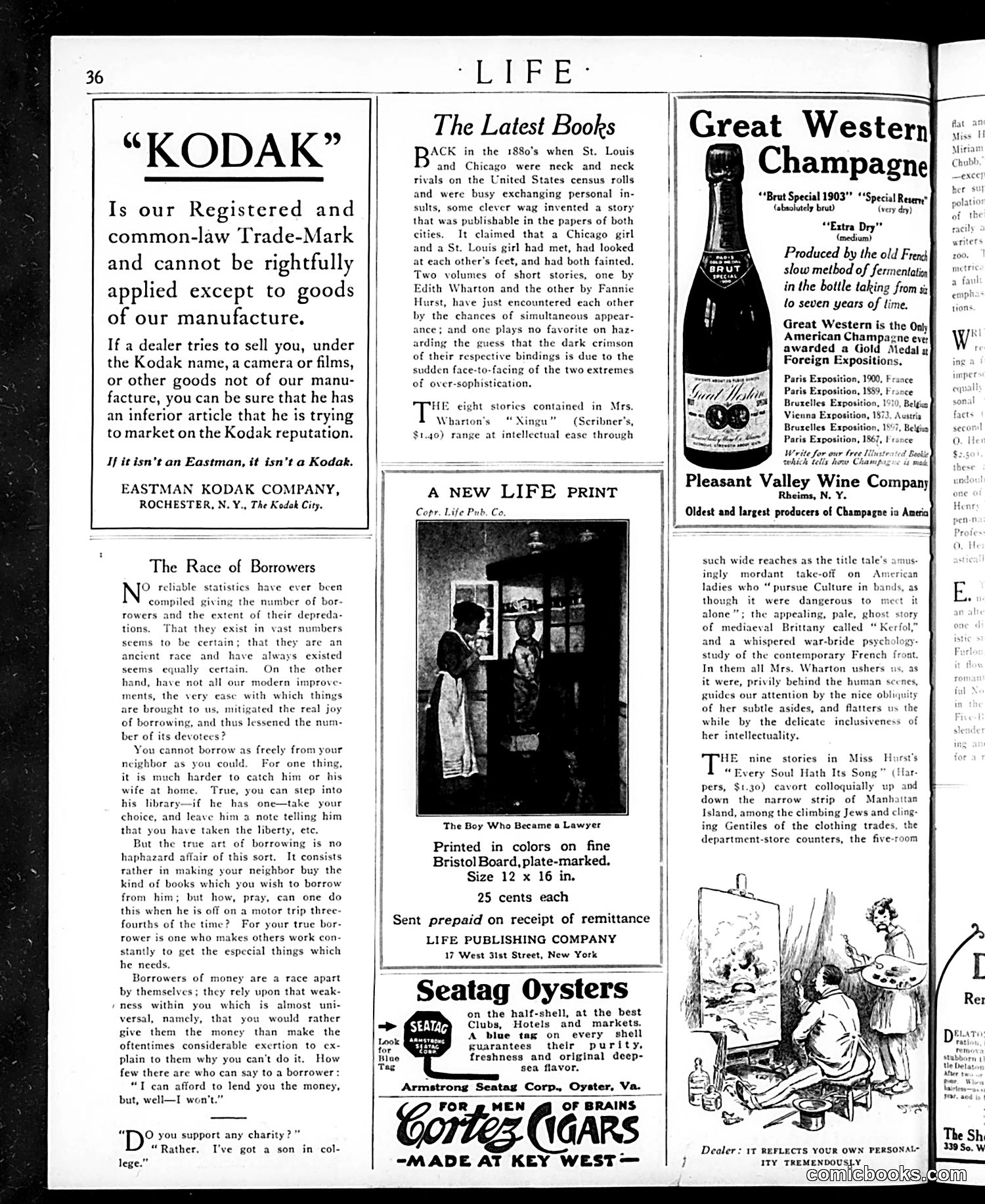
This page is primarily **advertising with one editorial essay**. The main content is "The Race of Borrowers," a humorous essay satirizing people who habitually borrow money and possessions from neighbors. The piece argues that chronic borrowers are a distinct social type who exploit others' reluctance to refuse requests—it's easier to lend than to explain why you won't. The essay concludes with a joke: supporting a son in college *is* charitable giving (via tuition costs). The advertisements include trademark warnings from Kodak (protecting their brand name from counterfeit cameras), book reviews featuring Edith Wharton and Fannie Hurst, a Life Publishing print titled "The Boy Who Became a Lawyer," oysters, cigars, and champagne. **No political cartoons appear on this page.** The "satire" is limited to the gentle, domestic humor of the borrowers essay—observing middle-class social behavior rather than commenting on politics or major events.
📄 Transcribed text from this page (OCR, searchable)
Machine-transcribed from the original scan — historical spelling and the odd misread are preserved.
“LIFE: “KODAK” Is our Registered and common-law Trade-Mark and cannot be rightfully applied except to goods of our manufacture. If a dealer tries to sell you, under the Kodak name, a camera or films, or other goods not of our manu- facture, you can be sure that he has an inferior article that he is trying to market on the Kodak reputation. If it isn’t an Eastman, it isn’t a Kodak. EASTMAN KODAK COMPANY, ROCHESTER, N. Y., The Kodak City. The Race of Borrowers ‘reliable statistics have ever been compiled giving the number of bor- rowers and the extent of their depreda- tions. That they exist in vast numbers s to be certain; that they are an race and have always existed equally certain. On the other of borrowing, and thus lessened the num- ber of its devotees? You cannot borrow as freely from your neighbor as you could. For one thing, h harder to catch him or his True, you can step into his library—if he has one—take your choice, and leave him a note telling him that you have taken the liberty, ete. But the true art of borrowing is no azard affair of this sort. It consists her in making your neighbor buy the kind of books which you wish to borrow from him; but how, pray, can one do this when he is off on a motor trip three- fourths of the time? For your true bor- rower is one who makes others work con- stantly to get the especial things which he needs. Borrowers of money are a race apart by themselves ; they rely upon that weak- yness within you which is almost wi versal, namely, that you would rather give them the money than make the oftentimes considerable exertion to ex- plain to them why you can't do it. How few there are who can say to a borrower: “T can afford to lend you the money, but, well—I won't.” “DT you support any charity?” “Rather. I've got a son in col- lege.” The Latest Books Bis in the 1880's when St. Louis and Chicago were neck and neck rivals on the United States census rolls and were busy exchanging personal in- sults, some clever wag invented a story that was publishable in the papers of both cities It claimed that a Chicago girl and a St. Louis girl had met, had looked at each other's feet, and had both fainted. Two volumes of short stories, one by Edith Wharton and the other by Fannie Hurst, have just encountered each other by the chances of simultaneous appear- ance; and one plays no favorite on haz- arding the guess that the dark crimson of their respective bindings is due to the sudden face-to-facing of the two extremes of over-sophistication, HE eight stories contained in Mrs. Wharton's Xing’ (Scribner's, $1.40) range at intellectual ease through A NEW LIFE PRINT Copr. Life Pub. Co. The Boy Who Became a Lawyer Printed in colors on fine Bristol Board, plate-marked. Size 12 x 16 in. 25 cents each Sent prepaid on receipt of remittance LIFE PUBLISHING COMPANY 17 West 3ist Street, New York Seatag Oysters on the half-shell, at the best Clubs, Hotels and markets. A jue tag on every shell guarantees their purity, freshness and original deep- sea flavor. Corp. Oyster, Va. MEN OF BRAINS 1GARS “MADE AT KEY WEST=— “‘Brut Special 1903" ‘‘Speci: , Sean Speci Ree “Extra Dry” (medium) Produced by the old Freng slow method of fermentatica in the bottle taking from s: to seven years of lime, Great Western is American Champ: Paris Exposition, 1859, Fracce Brurelles Exposi Vienna Exposi 7 Brurelles Exposition, which tells how C Pleasant Valley Wine Company Rheims, N. Y. Oldest and largest producers of Champagne ia Ameria| such wide reaches as the title tale’s amus- ingly mordant take-off on Am an ladies who “pursue Culture in bands, as though it were dangerous to + alone”; the appealing, pale, ghos' of mediaeval Brittany called “ Kerfo and a whispered war-bride psyct dy of the contempor: In them all Mrs. Wharton ushers it were, privily behind the human sc guides our attention by the nice obli of her subtle asides, and flatters us the while by the delicate inclusiveness of her intellectuality. T nine stories in Miss Hurst's Every Soul Hath Its Song” (Har- pers, $1.30) cavort colloquially up and down the narrow strip of Manbattan Island, among the climbing Jews and cling- ing Gentiles of the clothing trades, department-store counters, the five-r Dealer : 11 REFLECTS YOUR OWN PERSONAL” ITY TREMENDOUSLY iclbooks. flat a Miss H Miria Chubb —exce her su]