
A complete issue · 41 pages · 1916
Life — December 28, 1916
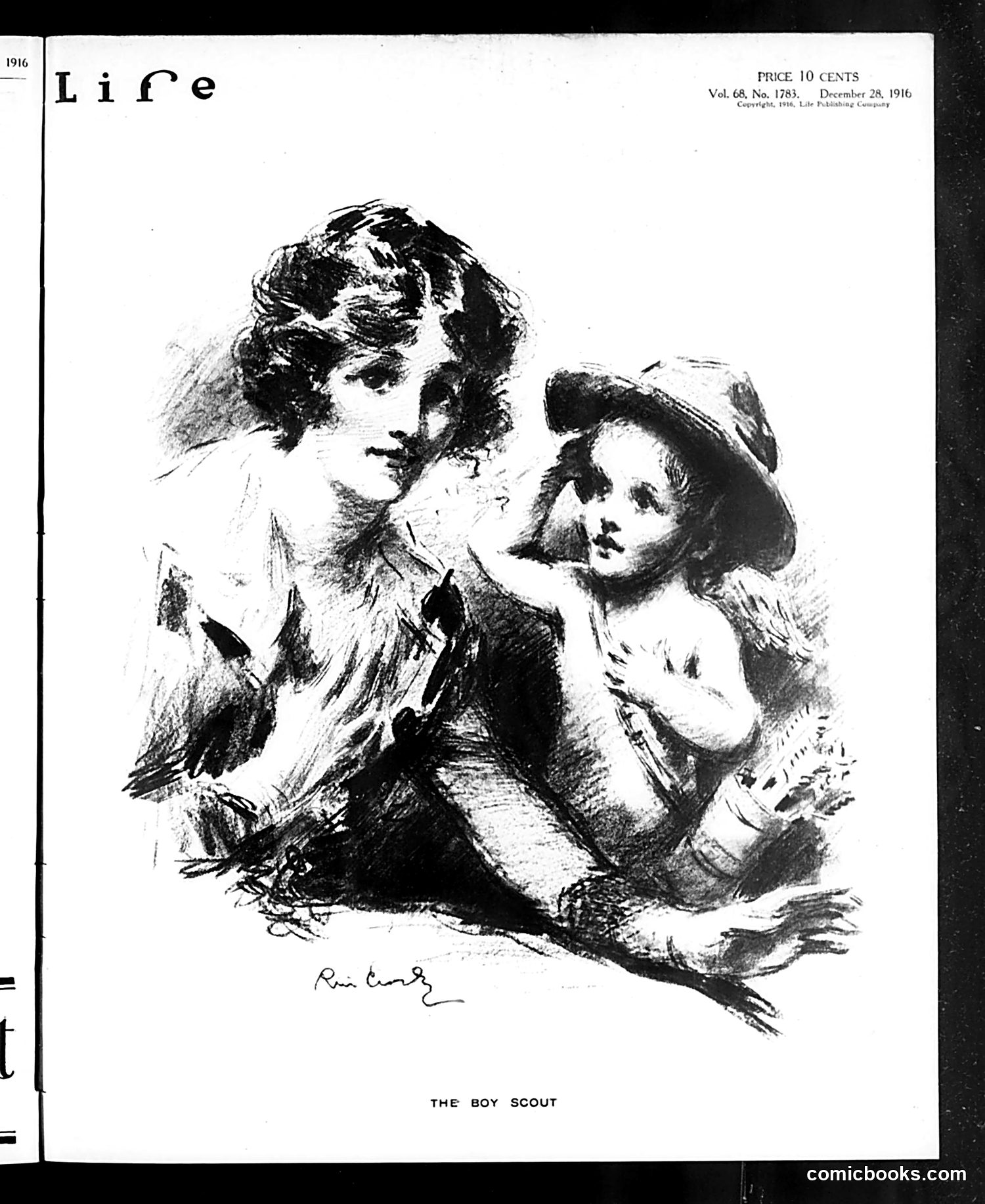
This illustration, signed by the artist (signature appears to read "Reisland"), depicts an adult man with a young boy. The caption "THE BOY SCOUT" suggests commentary on the Boy Scout movement, which was relatively new to America (founded 1910). The satirical point likely critiques either the movement itself or uses it as social commentary. The adult's protective, somewhat paternalistic posture toward the child could be mocking sentimentalized ideals of youth development, or commenting on adult authority over young people. Without additional article text, the specific target of satire is unclear—it may relate to militarization concerns (scouts had quasi-military elements) or contemporary debates about childhood education during World War I. The sketch style is typical of Life's editorial illustrations from this era.
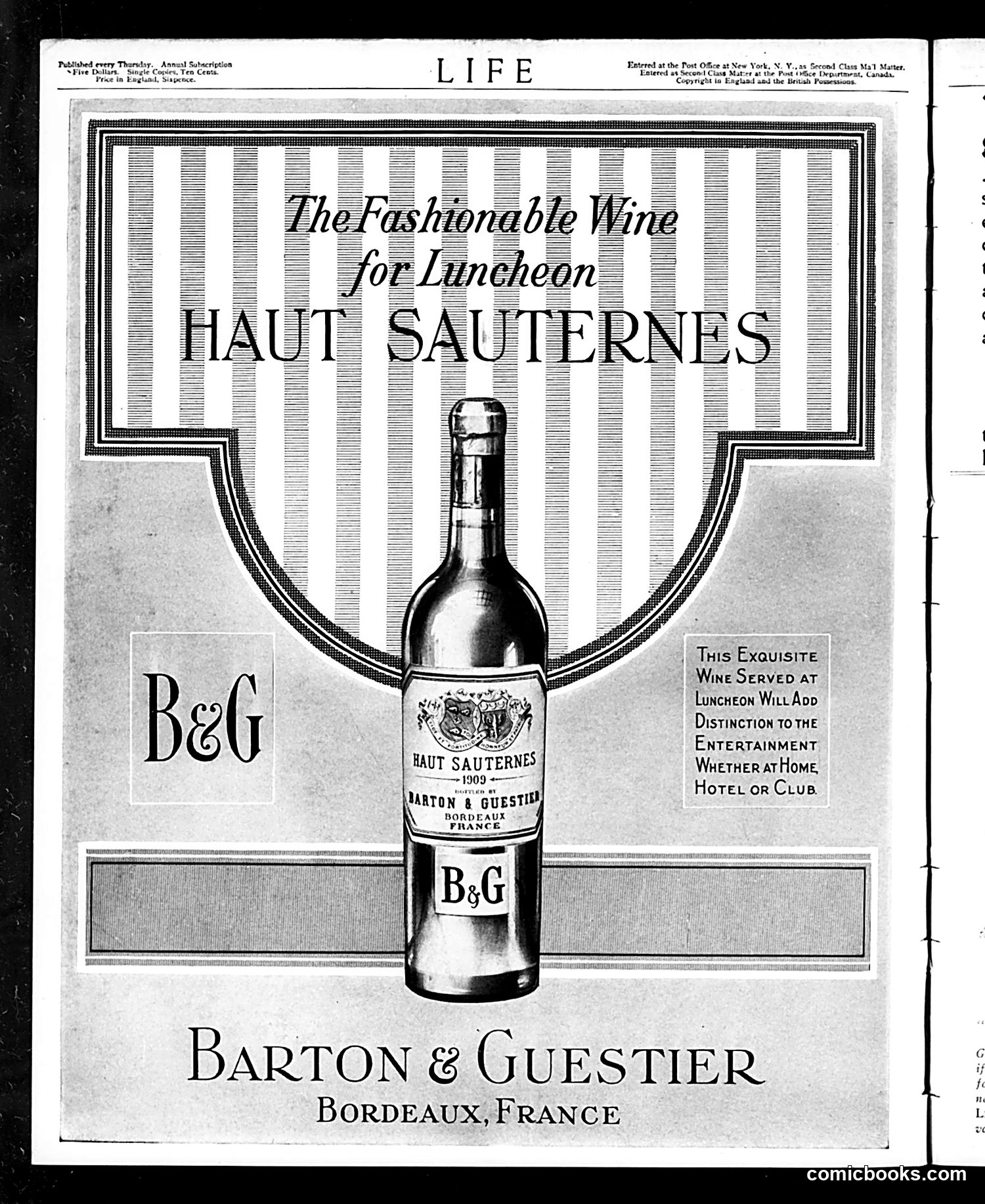
This is **not a cartoon or satire**, but rather a **straightforward advertisement** for Haut Sauternes wine by Barton & Guestier, a French wine merchant from Bordeaux. The ad promotes their 1909 Haut Sauternes as "the fashionable wine for luncheon," emphasizing its suitability for upscale entertaining at home, hotels, or clubs. The elegant bottle design and formal layout reflect early 20th-century luxury marketing conventions. The "B&G" branding appears prominently. The text promises that serving this wine will "add distinction to the entertainment" at social gatherings—a common marketing appeal to aspirational consumers concerned with appearing sophisticated and refined. This represents typical Life magazine advertising from the pre-Prohibition era.
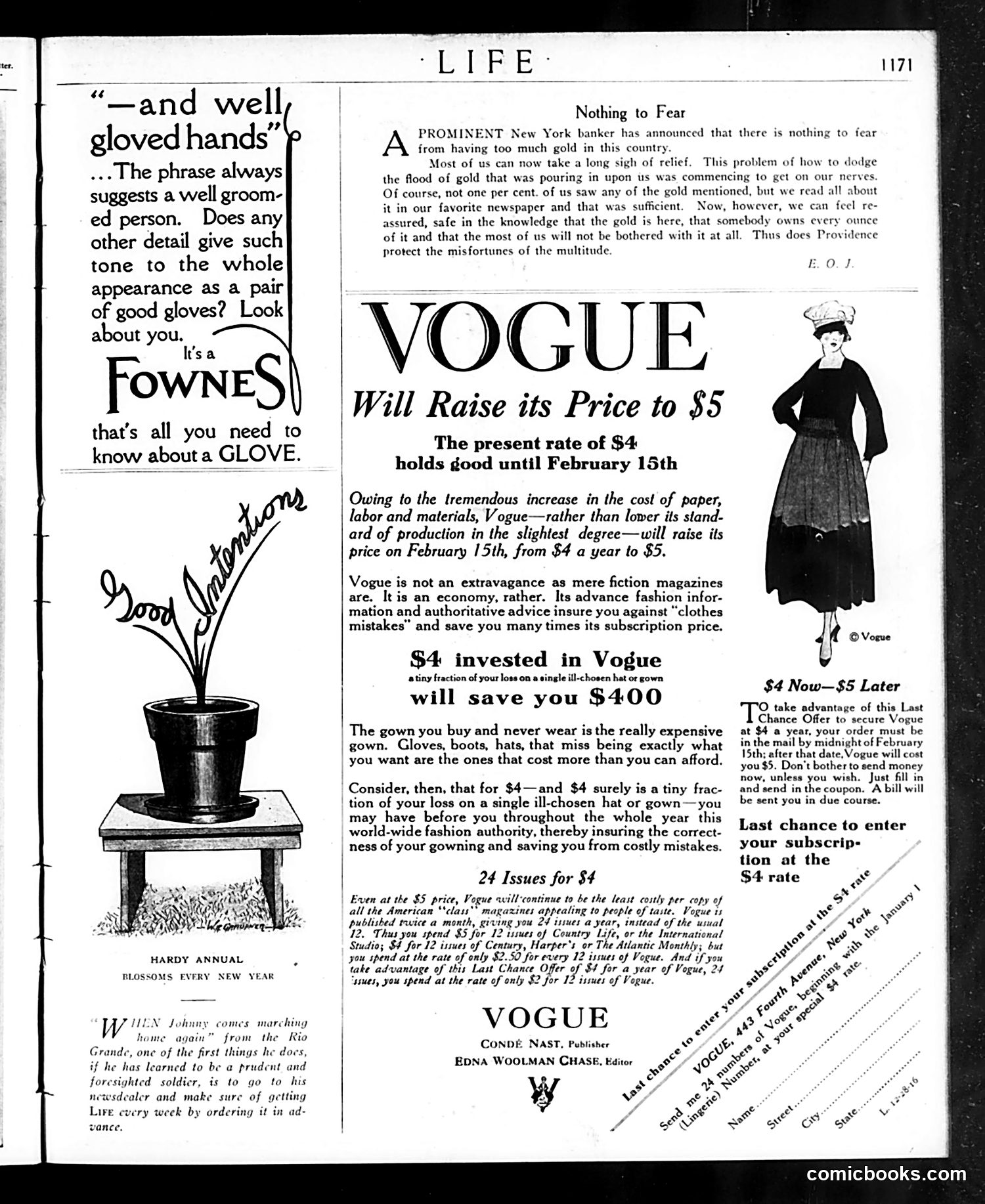
This page contains **primarily advertisements** rather than political cartoons or satire. **Left side:** A Fownes glove advertisement uses the phrase "well gloved hands" to suggest refinement and grooming, with decorative potted plant imagery. **Center/Right:** The dominant content is a Vogue magazine subscription advertisement announcing a price increase from $4 to $5 annually (effective February 15th). The ad justifies the increase by citing rising costs in paper, labor, and materials. It positions Vogue as practical rather than frivolous, claiming a $4 subscription "will save you $400" through fashion advice preventing costly mistakes. **Bottom:** A brief humorous note about Johnny returning from war, suggesting readers subscribe to Life magazine. The page reflects early 20th-century consumer culture and post-WWI economic inflation.
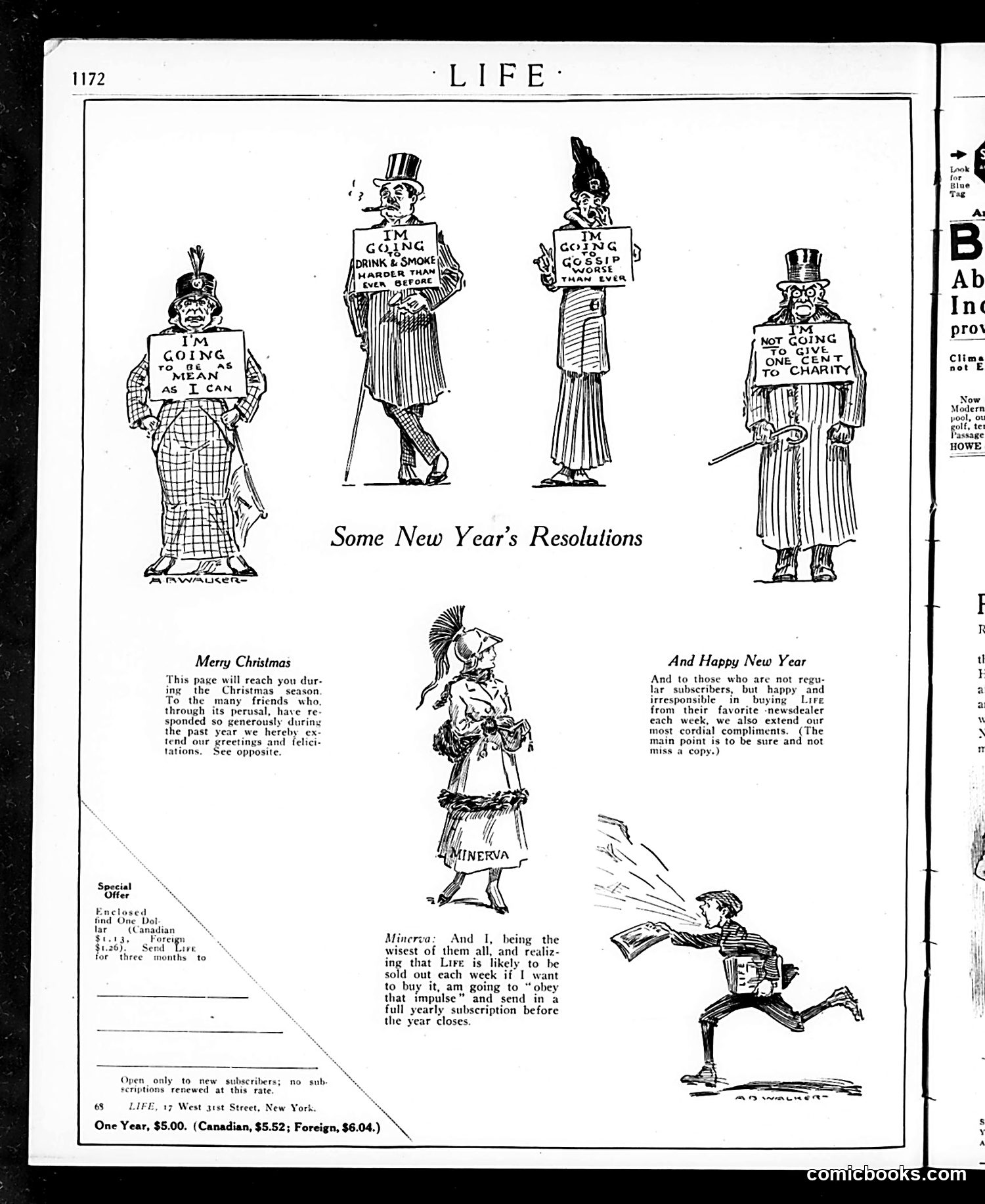
This satirical cartoon presents four caricatured figures making humorous New Year's resolutions that reveal their actual vices rather than genuine self-improvement. Each character holds a sign advertising what they claim to reform, but the exaggerated drawings suggest their resolutions are insincere or impossible. The figures appear to represent stereotypical character types (possibly political or social figures, though specific identities are unclear from the image alone). The joke relies on the contrast between stated intentions and implied reality—the resolutions are transparently false boasts, mocking how people make impossible promises at year's end. The page includes Christmas and New Year greetings, subscription information for Life magazine, and a separate commentary by "Minerva" about the magazine's value. This was typical Life magazine content: satirical commentary on contemporary social behavior.
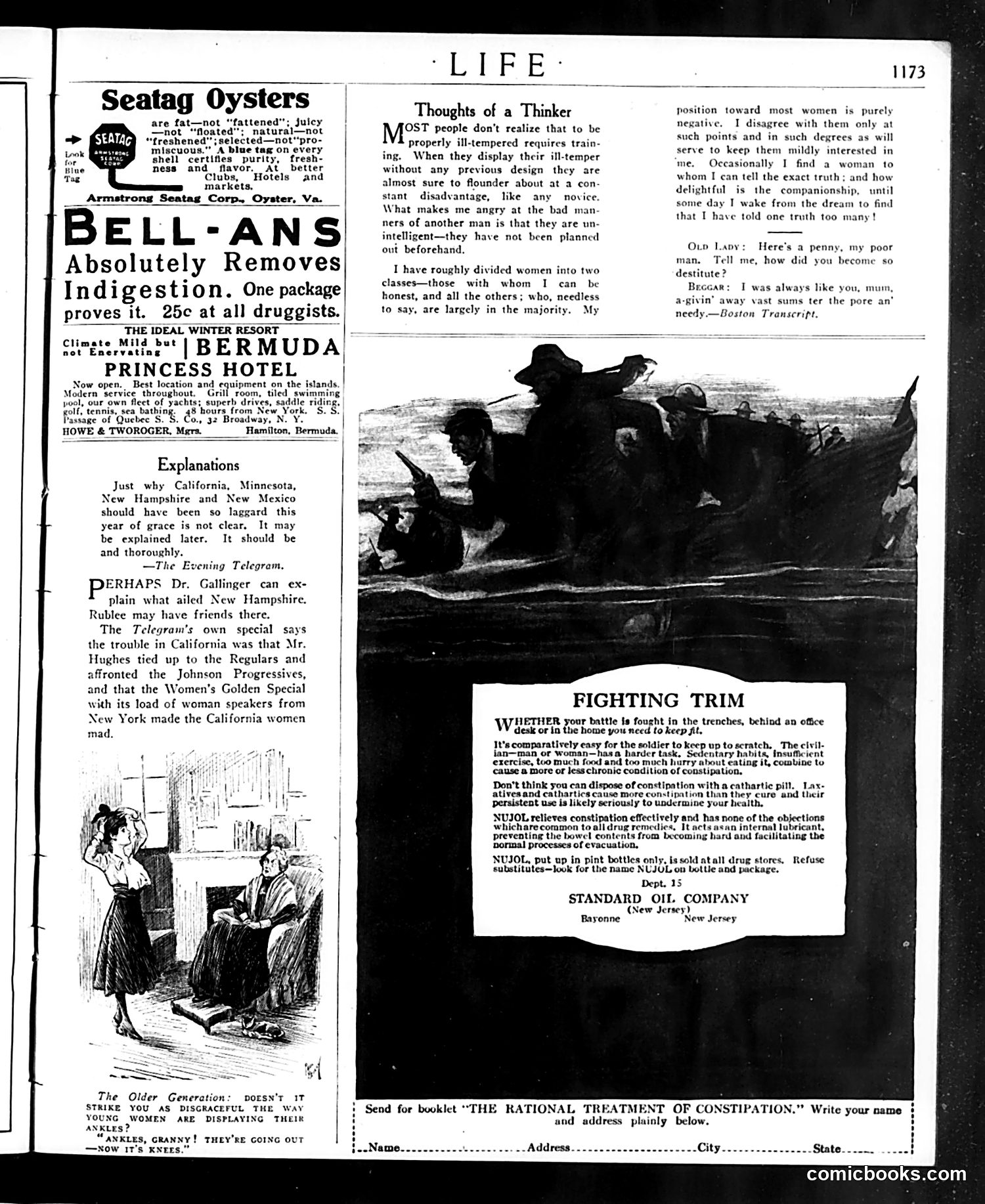
This page is primarily **advertising and filler content** rather than political satire. The main cartoon ("The Older Generation") shows an elderly woman confronting a younger woman about her ankles being visible—a common generational complaint in early 20th-century America about changing fashion standards. The joke plays on modest Victorian dress codes clashing with flapper-era styles. The "Thoughts of a Thinker" column discusses class divisions among women—those deemed "honest" versus those needing "saving"—reflecting period social attitudes about respectability and morality. Other advertisements promote oysters, a constipation remedy (Nujol), a Bermuda hotel, and indigestion relief (Bell-Ans). The "Fighting Trim" section offers health advice about exercise and diet. **Overall: Largely commercial content with light social commentary on generational fashion disputes.**
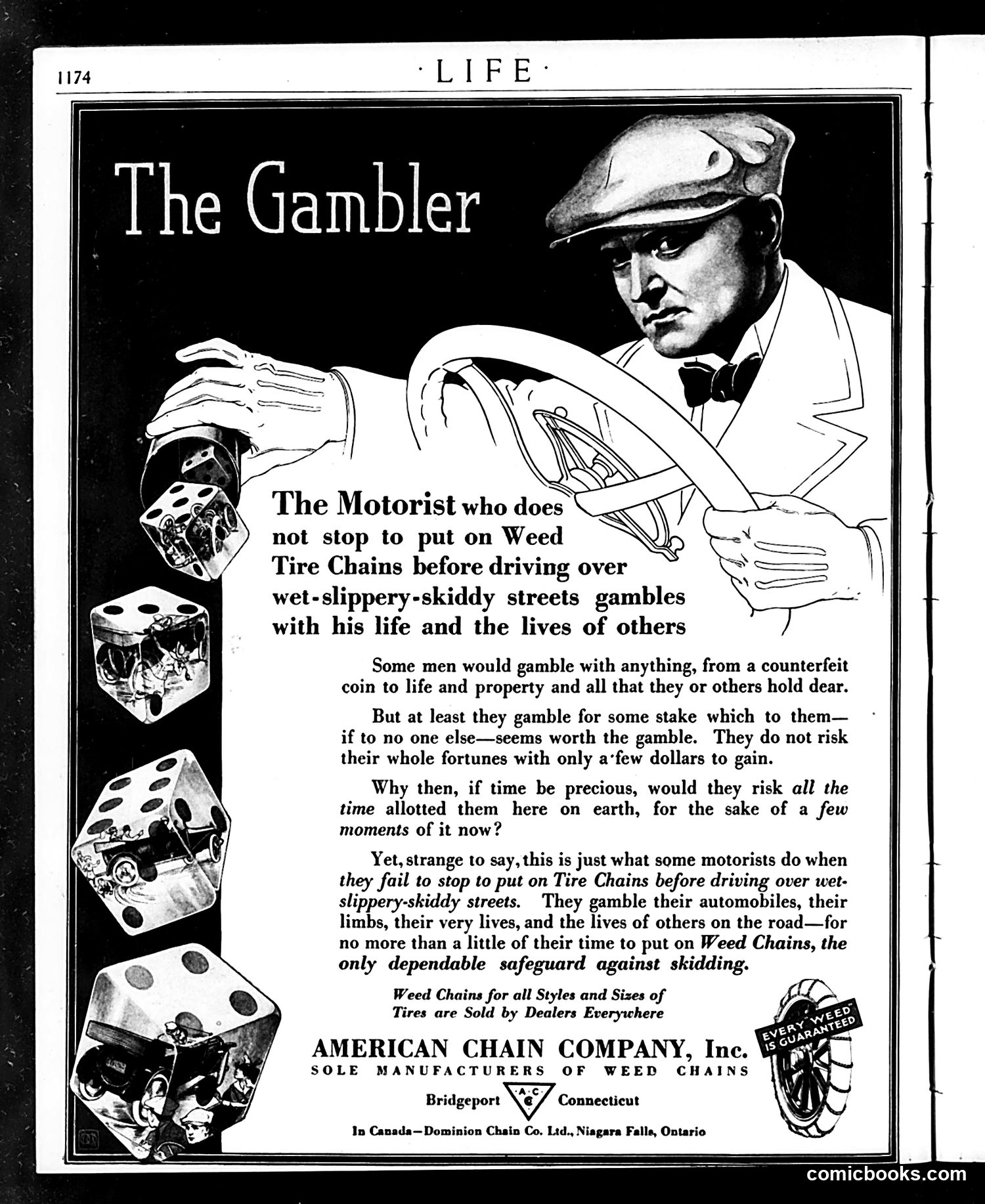
This is primarily a **safety advertisement** for Weed tire chains, disguised as social commentary. The illustrated figure labeled "The Gambler" is a well-dressed man in a cap and bow tie—representing a typical motorist of the era. The ad uses gambling metaphors to criticize drivers who skip installing tire chains on wet roads. The comparison suggests such drivers are recklessly gambling with their own and others' lives for minor time savings, similar to how gamblers risk fortunes for trivial stakes. The dice and playing cards shown emphasize the "gamble" metaphor. The satire's point: installing chains is the only reliable safeguard against skidding. This reflects early automotive safety concerns from an era when tire chains were essential winter equipment, before modern tire technology existed.
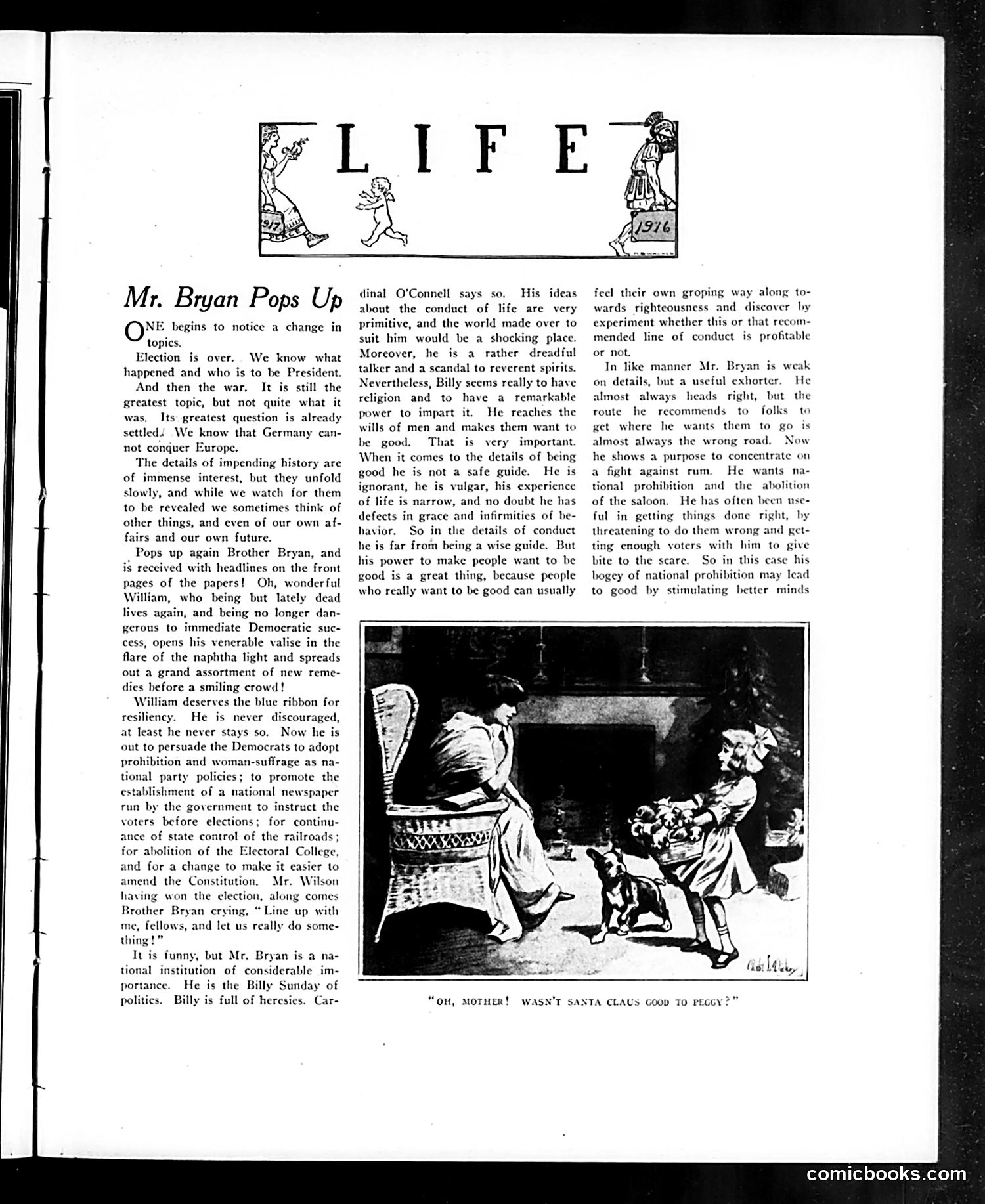
This page contains an article titled "Mr. Bryan Pops Up" discussing William Jennings Bryan's re-emergence in politics following the recent presidential election. The text criticizes Bryan as a political figure—describing him as dreadful, a scandal-spreader, and lacking wisdom in guiding conduct. The accompanying cartoon depicts a domestic scene with the caption "OH, MOTHER! WASN'T SANTA CLAUS GOOD TO PEGGY?" A child appears surprised by Santa's gifts, suggesting Bryan's political proposals (likely prohibition and women's suffrage, mentioned in the text) are presented as absurd or childish ideas being imposed on voters. The satire mocks Bryan's influence on Democratic policy while portraying his supporters' enthusiasm as naive or foolish.
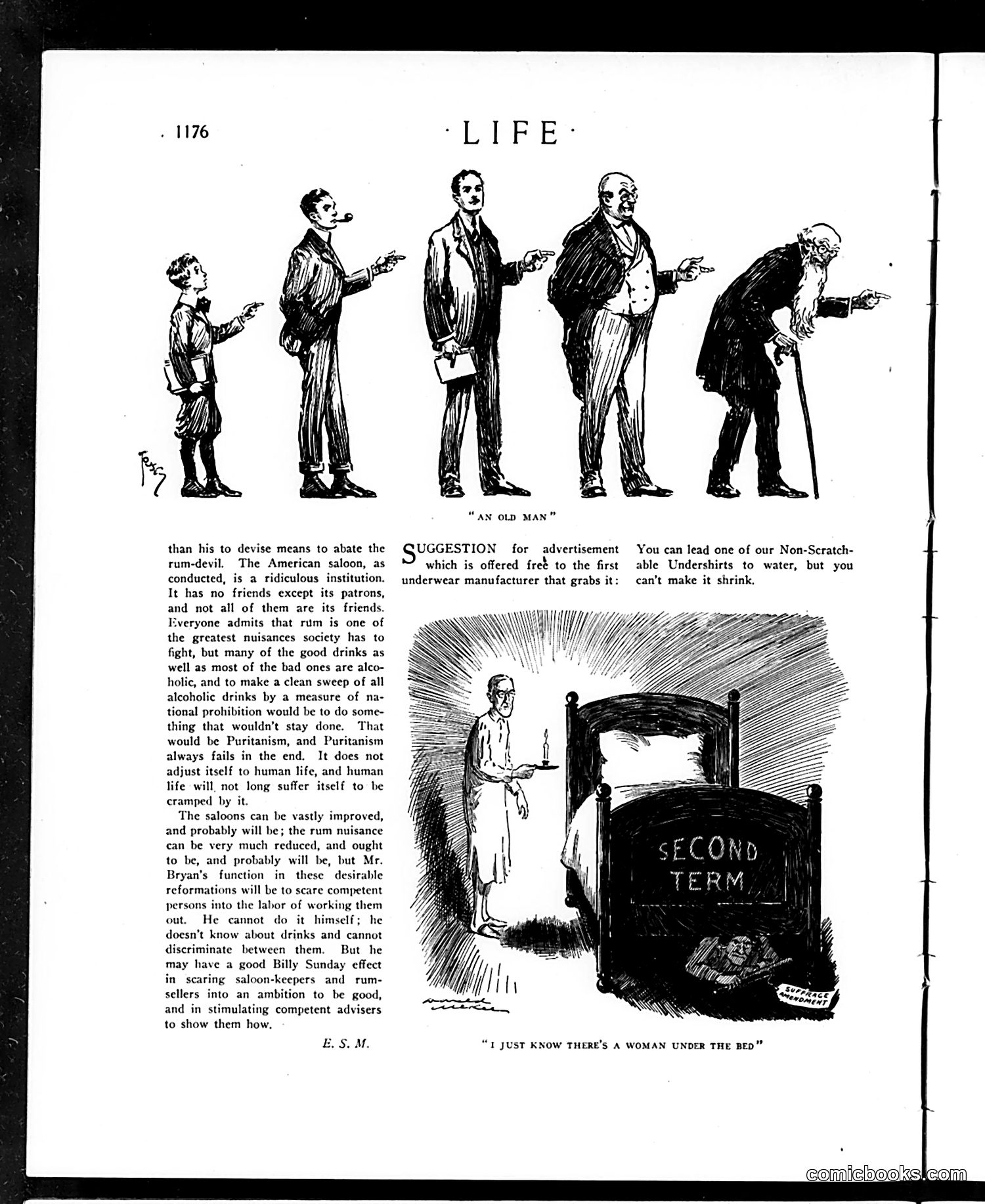
**Top Illustration: "An Old Man"** This sequence shows five male figures progressing from youth to old age, each pointing outward in identical poses. It's a visual metaphor for life's progression and aging. **Main Article Text** Discusses American saloons as social institutions and argues against prohibition. The author contends that banning alcohol won't work because it contradicts human nature. He suggests reforming saloons instead—improving them and training managers to discriminate between drinks and educate patrons about moderation. **Bottom Cartoon: "I Just Know There's a Woman Under the Bed"** A man in nightclothes holds a candle over a bed labeled "Second Term," appearing to search beneath it. This likely satirizes political anxiety about a president's second term, using domestic paranoia as metaphor for political uncertainty.
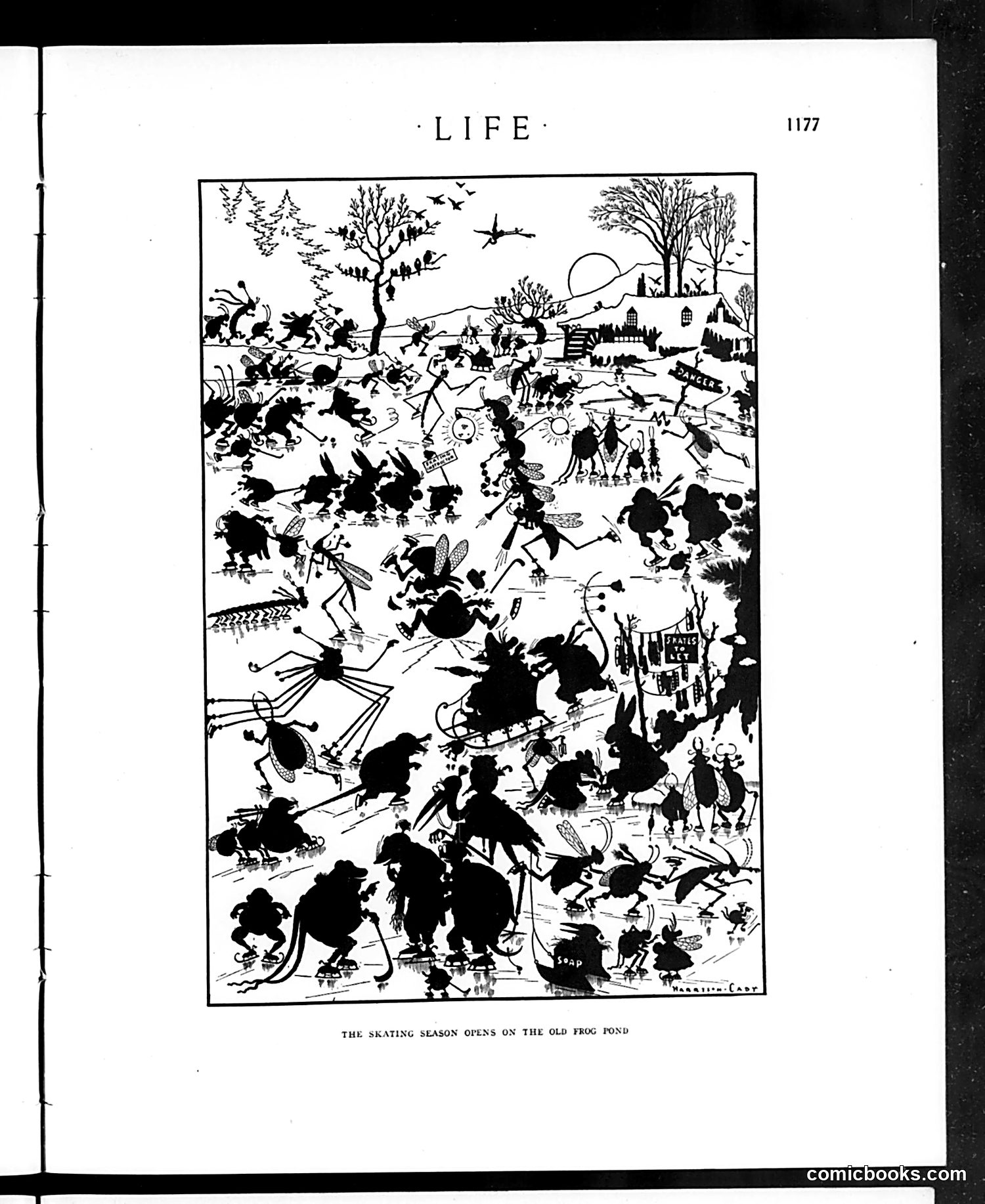
This is a whimsical winter scene illustration rather than political satire. The image depicts anthropomorphic animals and figures skating on a frozen pond, with a village visible in the background. The scene is crowded with dozens of characters engaged in winter activities—skating, playing, and socializing. The humor appears to be gentle and observational rather than satirical: it captures the chaos and joy of a community ice-skating gathering, with various figures in different states of competence and mishap on the ice. The title suggests this is a traditional seasonal activity ("the skating season opens"), presented as a nostalgic or humorous look at winter recreation. The artist signature appears to read "Hamilton Carré" or similar.
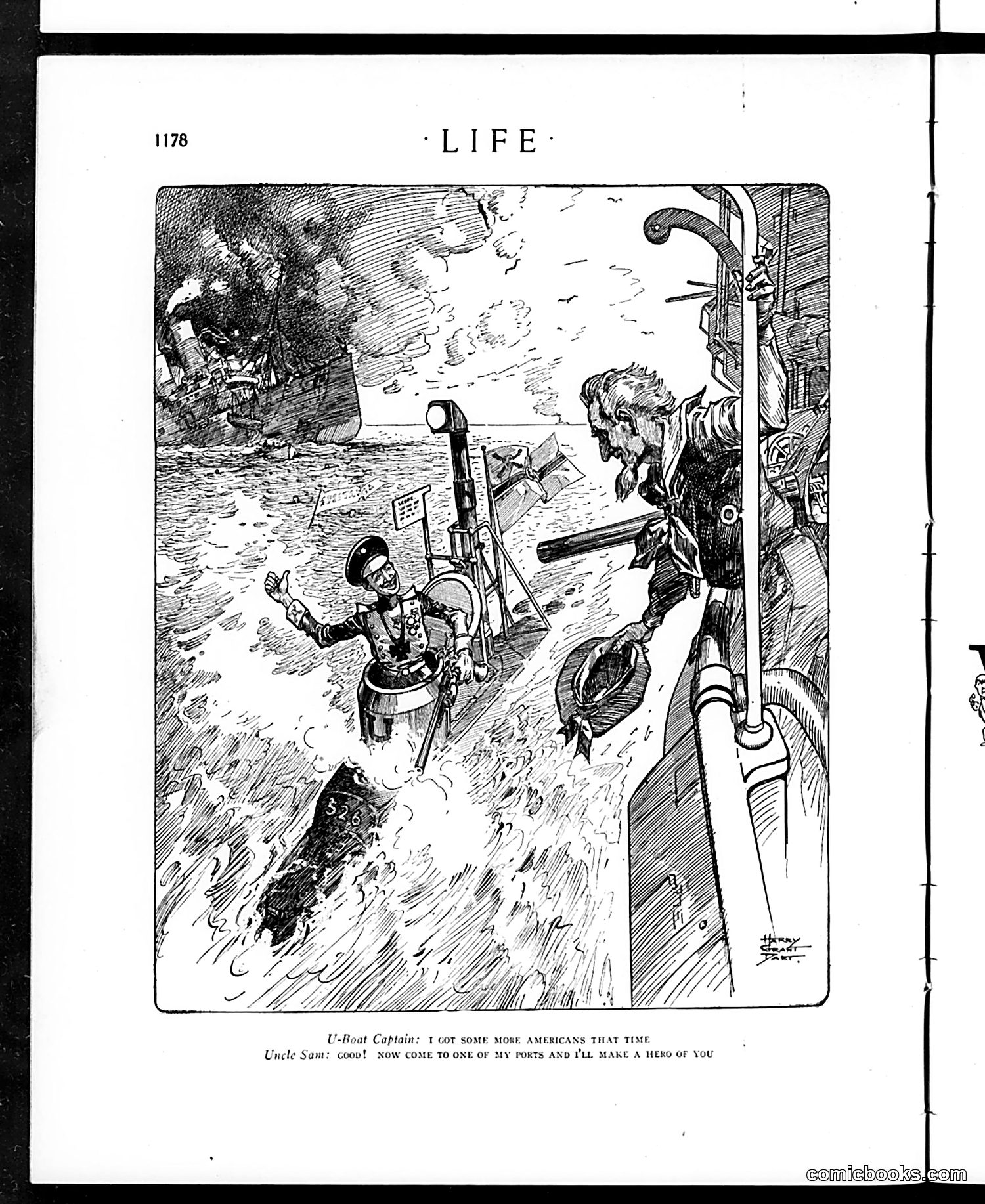
This cartoon depicts a German U-boat (submarine) captain emerging from the water, addressing Uncle Sam with a recruitment pitch: "Good! Now come to one of my ports and I'll make a hero of you." The satire targets American neutrality during World War I. The U-boat captain's offer is sarcastic—he's essentially threatening that if Americans visit German-controlled ports, they'll be attacked and potentially killed, becoming "heroes" through wartime casualties. This reflects historical tensions: German submarines were sinking American merchant vessels and passenger ships (notably the Lusitania in 1915), killing American civilians. The cartoon mocks both German aggression and American reluctance to abandon official neutrality despite these provocations. It's propaganda urging American intervention or at least condemnation of German warfare tactics.
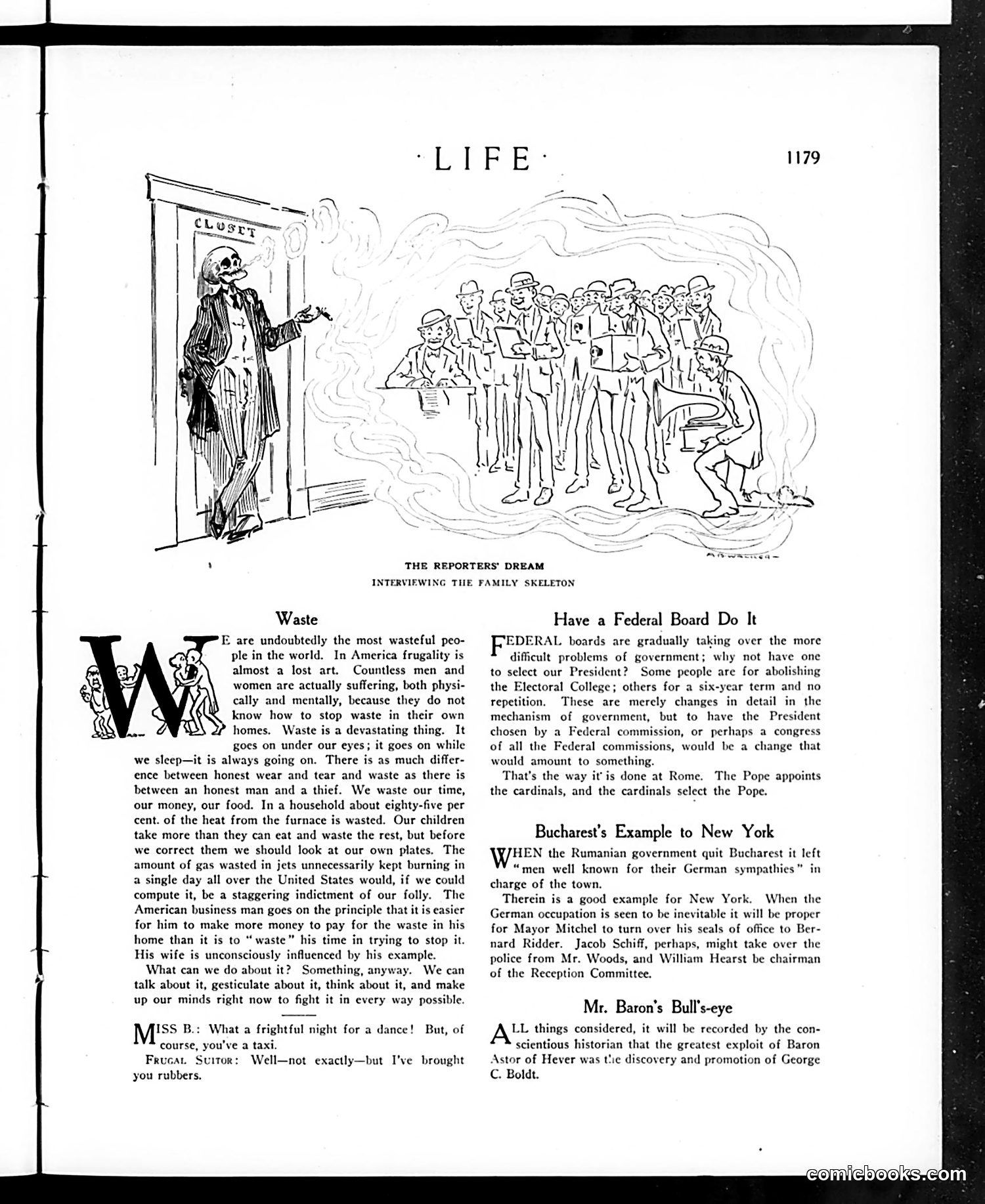
**The Main Cartoon**: "The Reporters' Dream—Interviewing the Family Skeleton" depicts Death (skeletal figure at a closet door) with a group of reporters eagerly approaching. The satire mocks journalists' sensationalism—they're desperate to expose society's hidden scandals ("family skeletons," meaning shameful secrets). **The Articles** discuss: - **"Waste"**: Criticizes American wastefulness in homes, food, and utilities - **"Have a Federal Board Do It"**: Satirizes bureaucratic solutions to governance problems, suggesting Federal boards proliferate without solving issues - **"Bucharest's Example"**: References Romania's government changes (likely post-WWI) - **"Mr. Baron's Bull's-eye"**: Praises historian George C. Boldt's work on Baron von Hexer The page reflects post-WWI American concerns: waste, government efficiency, and international politics.
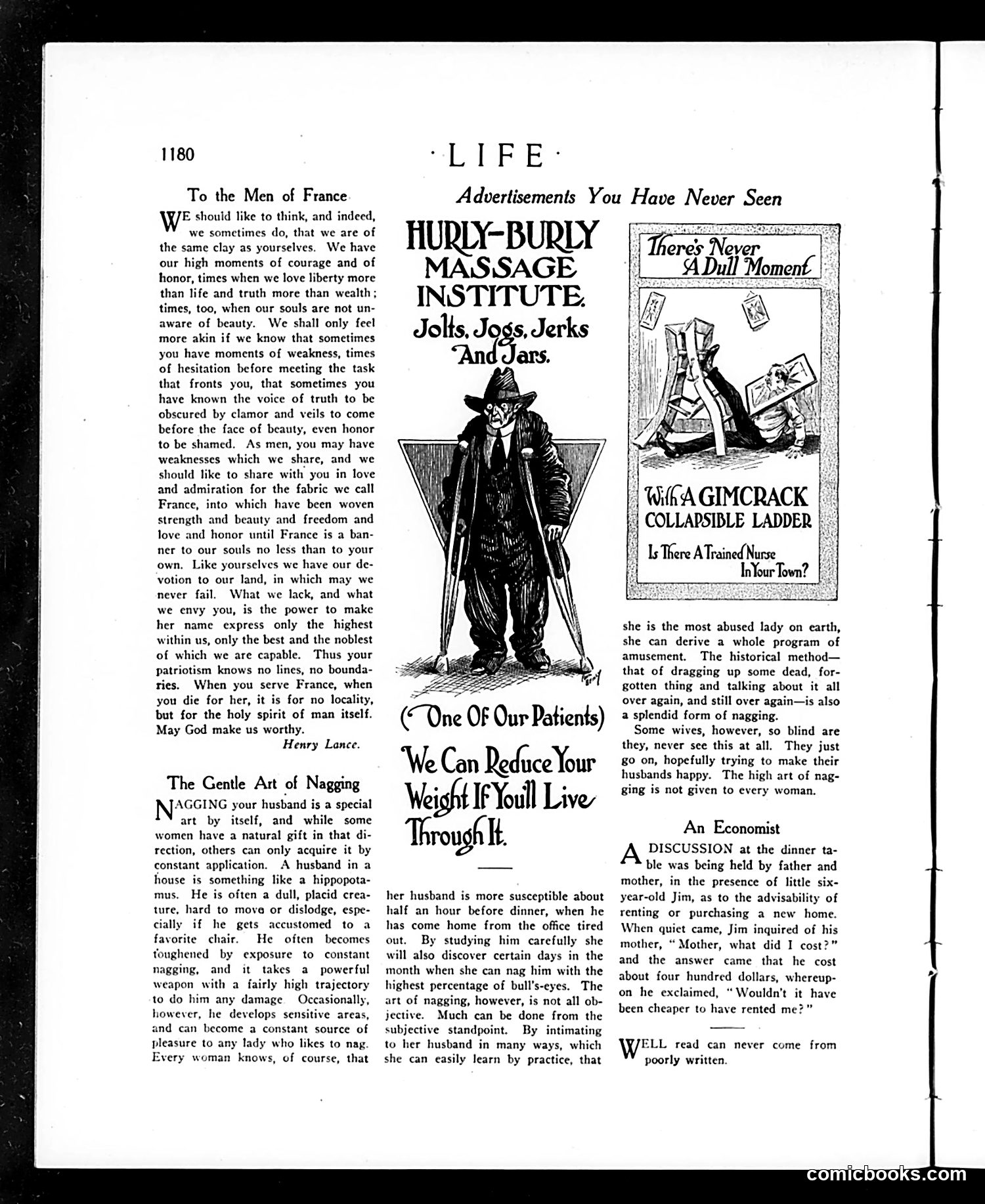
This Life magazine page contains satirical advertisements and articles about gender relations and marriage. The central cartoon depicts a cowboy-like figure labeled "One Of Our Patients" promoting weight loss, likely mocking male authority and domestic control. The main satire targets women's roles: "The Gentle Art of Nagging" argues nagging is a skill wives develop, while "We Can Reduce Your Weight If You'll Live Through It" sarcastically suggests husbands use weight-loss programs to control wives. "An Economist" mocks a father-son conversation about renting versus purchasing a home, with the punchline that renting was cheaper—satirizing male financial pretensions. The fake advertisements (Hurly-Burly Massage Institute, Gimcrack Collapsible Ladder) parody dubious commercial promises. Overall, the page satirizes early 20th-century gender dynamics, marital power struggles, and consumer culture's exploitation of domestic anxieties.
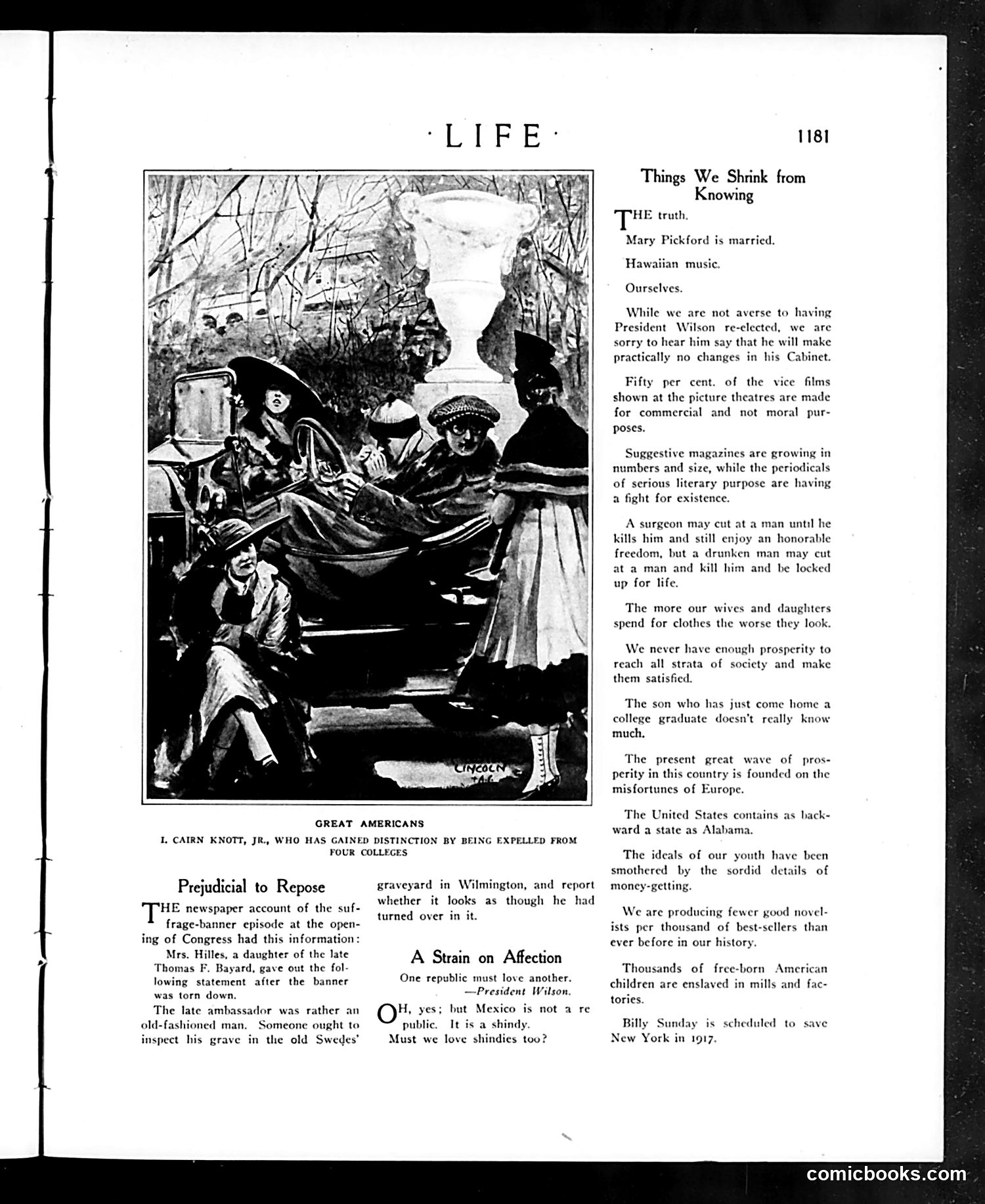
The main illustration depicts a classical scene with figures in period dress gathered around what appears to be a statue or monument. The caption identifies this as referencing **J. Cairn Knott, Jr., who was expelled from four colleges**. The accompanying article "Prejudicial to Repose" discusses a suffrage-banner incident at Congress involving Mrs. Hillis, daughter of Thomas F. Bayard. The late ambassador apparently had his grave disturbed when the banner was torn down—the satire mocking this as overly dramatic concern. The right column contains **"Things We Shrink from Knowing,"** a list of social critiques including references to President Wilson's re-election, vice films, suggestive magazines, and various American social problems like child labor. The overall tone suggests early 20th-century satirical commentary on contemporary social and political issues.
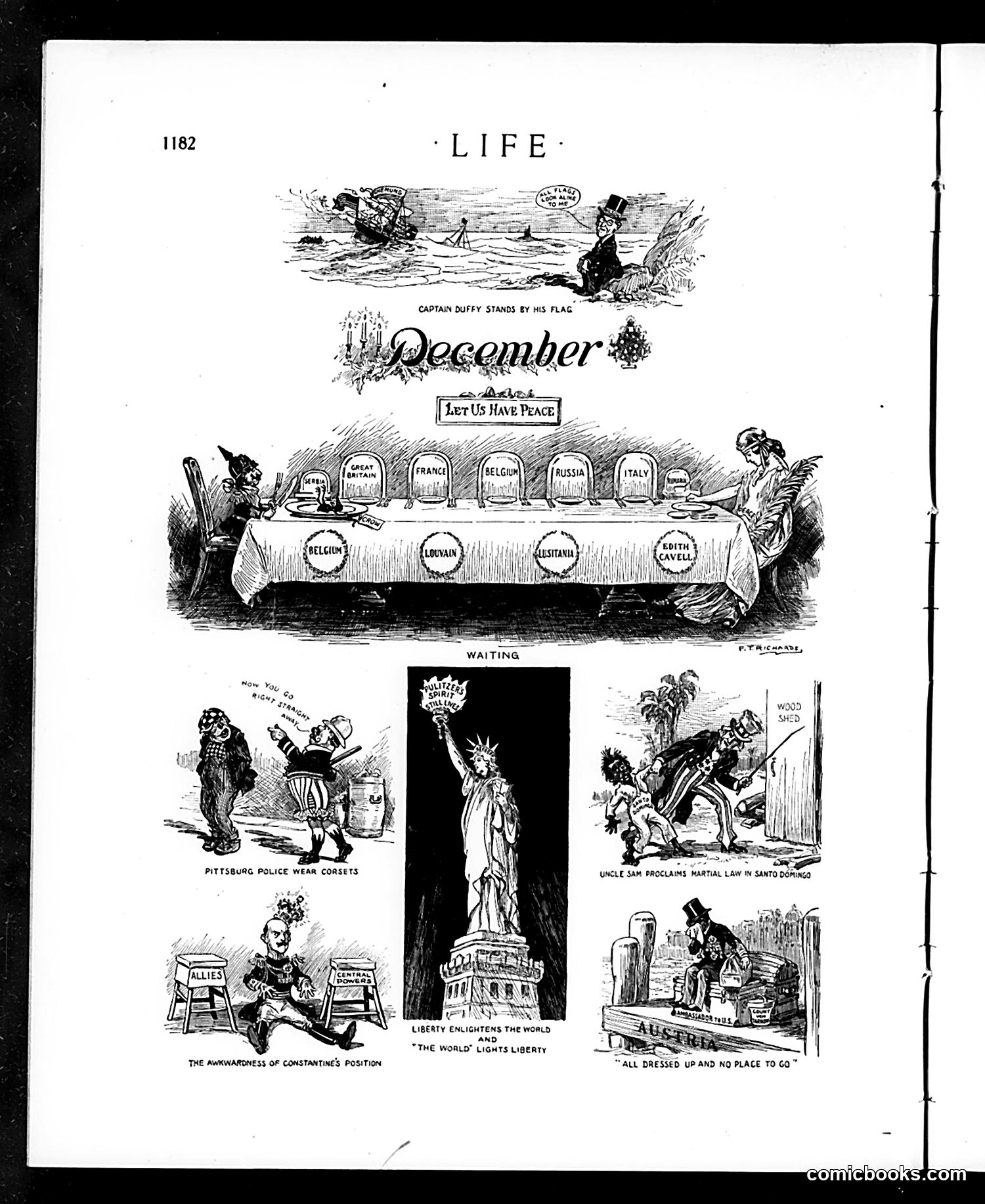
This page satirizes World War I peace efforts through the theme "Let Us Have Peace." The main cartoon depicts a dinner table with place settings labeled for major combatant nations (France, Belgium, Russia, Italy, Britain, Germany, and others), with two figures—likely representing peace negotiators—seated at opposite ends. The surrounding vignettes mock various geopolitical situations: Pittsburgh police corsets (domestic American issues), the Statue of Liberty "enlightens the world," Uncle Sam proclaiming martial law in Santo Domingo (U.S. Caribbean interventionism), and a figure "all dressed up and no place to go" (suggesting military unreadiness or futility). The overall message appears skeptical of peace prospects while commenting on American neutrality and global instability in WWI's early months.
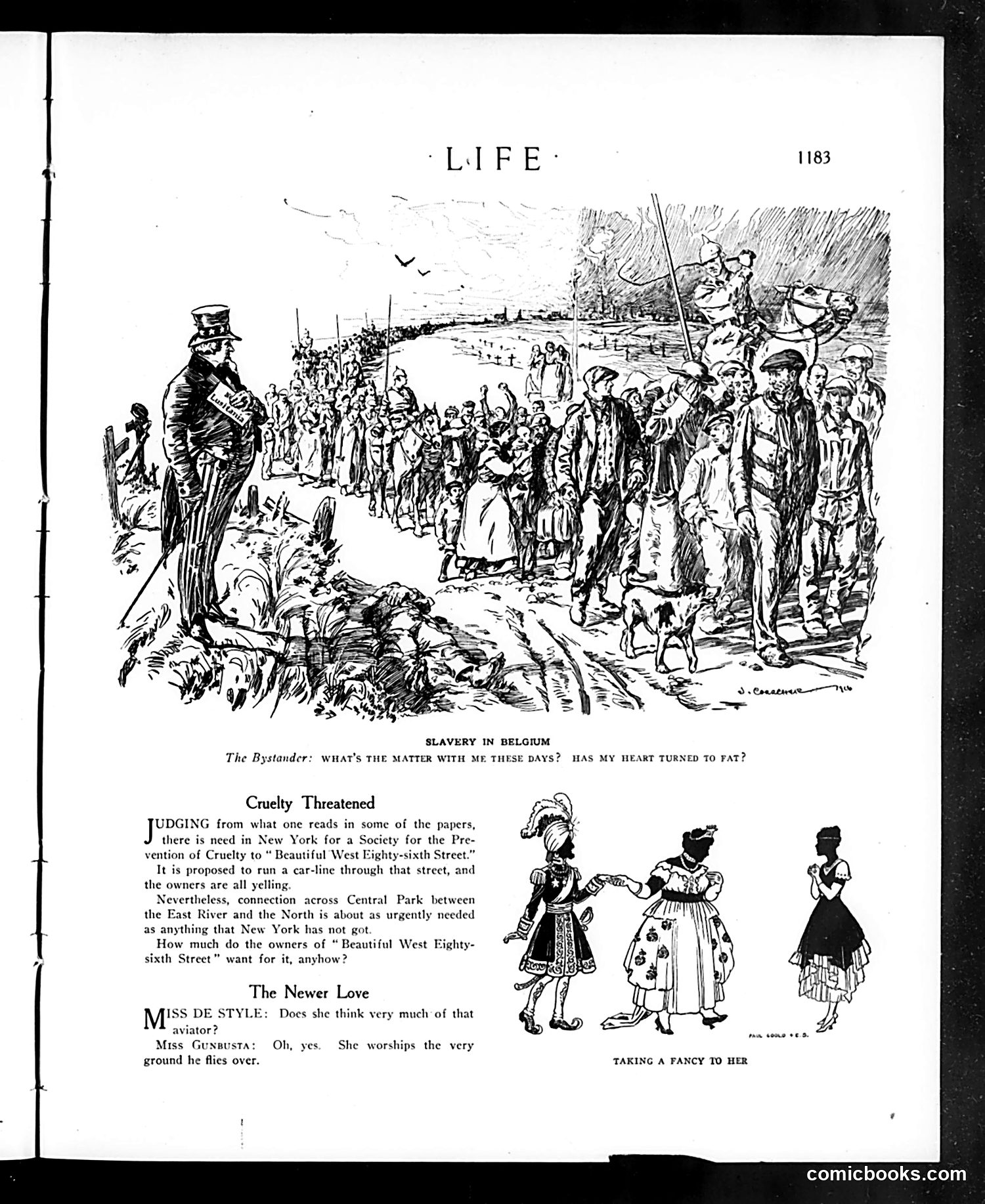
**Top Cartoon - "Slavery in Belgium":** This depicts colonial exploitation during Belgium's control of the Congo. The Bystander character expresses moral outrage ("What's the matter with me these days? Has my heart turned to fat?"), questioning why he's become indifferent to witnessing slavery and abuse. The cartoon critiques public apathy toward atrocities occurring in Belgian colonial territories. **Bottom Section - Social Commentary:** "Cruelty Threatened" satirizes proposed infrastructure in New York City—a car line through "Beautiful West Eighty-sixth Street." The piece questions whether residents truly want this development. "The Newer Love" is a brief comic dialogue mocking romantic affection, where Miss Gunsusta claims to "worship the very ground" her aviator "flies over"—satirizing exaggerated romantic devotion.
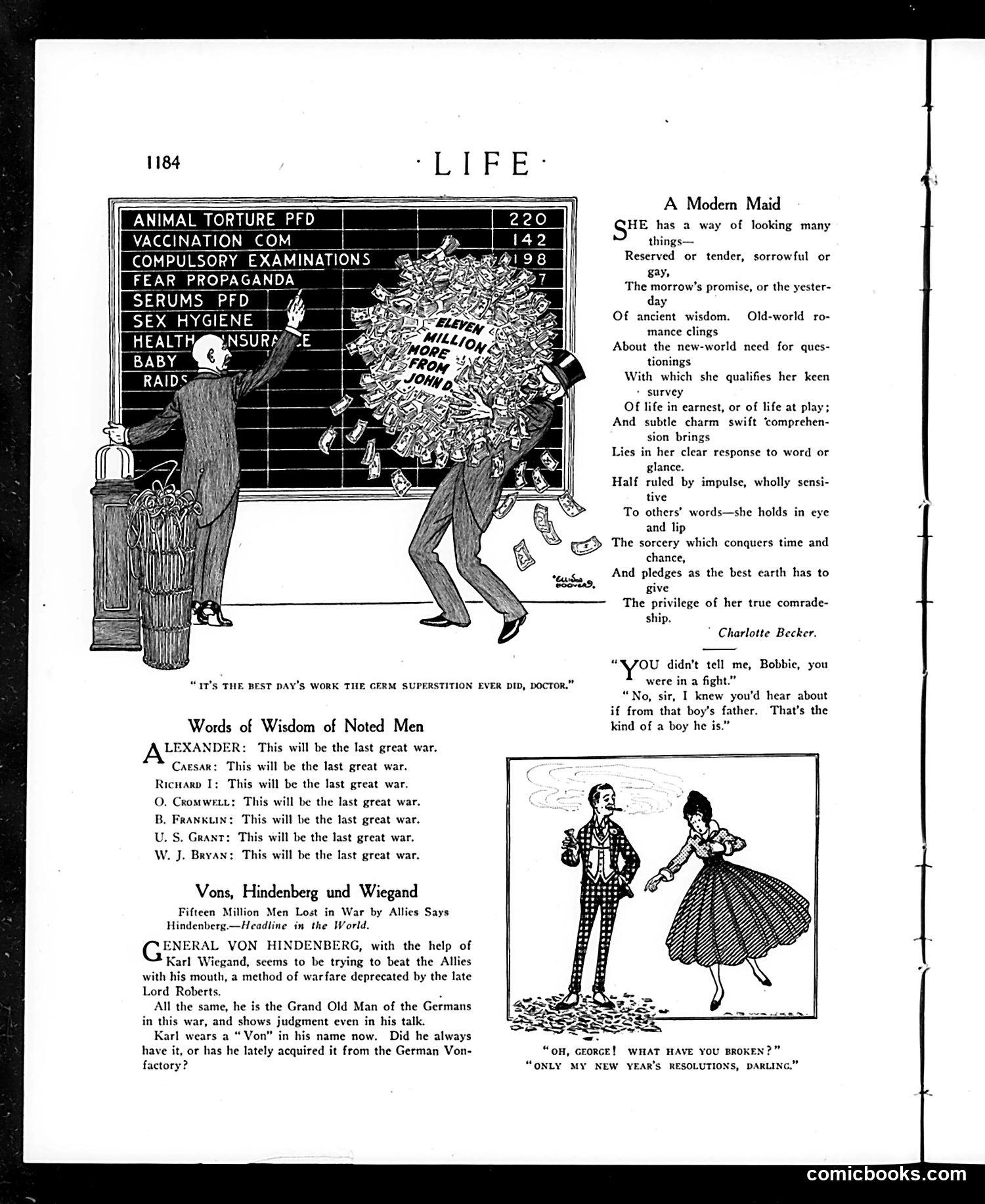
The main cartoon satirizes modern anxieties and pseudo-scientific fads. A figure drowns under cascading papers labeled with contemporary concerns—"Animal Torture," "Vaccination," "Compulsory Examinations," "Fear Propaganda," "Serums," "Sex Hygiene," "Health Insurance," "Baby Raids"—representing the era's proliferation of medical, social, and public health mandates. The caption mocks germ theory as mere "superstition," reflecting period skepticism toward emerging medical science. Below, "Words of Wisdom" lists historical figures (Alexander, Caesar, Richard I, Cromwell, Franklin, Grant, Bryan) all claiming "This will be the last great war"—satirizing humanity's repeated, futile hope that each conflict ends all wars, likely referencing WWI's marketing as "the war to end all wars." A final item mocks General von Hindenburg and journalist Karl Wiegand's war commentary, questioning whether Wiegand recently adopted the prestigious "Von" prefix. The lighter illustrations depict period romance and humor—a woman breaking New Year's resolutions.
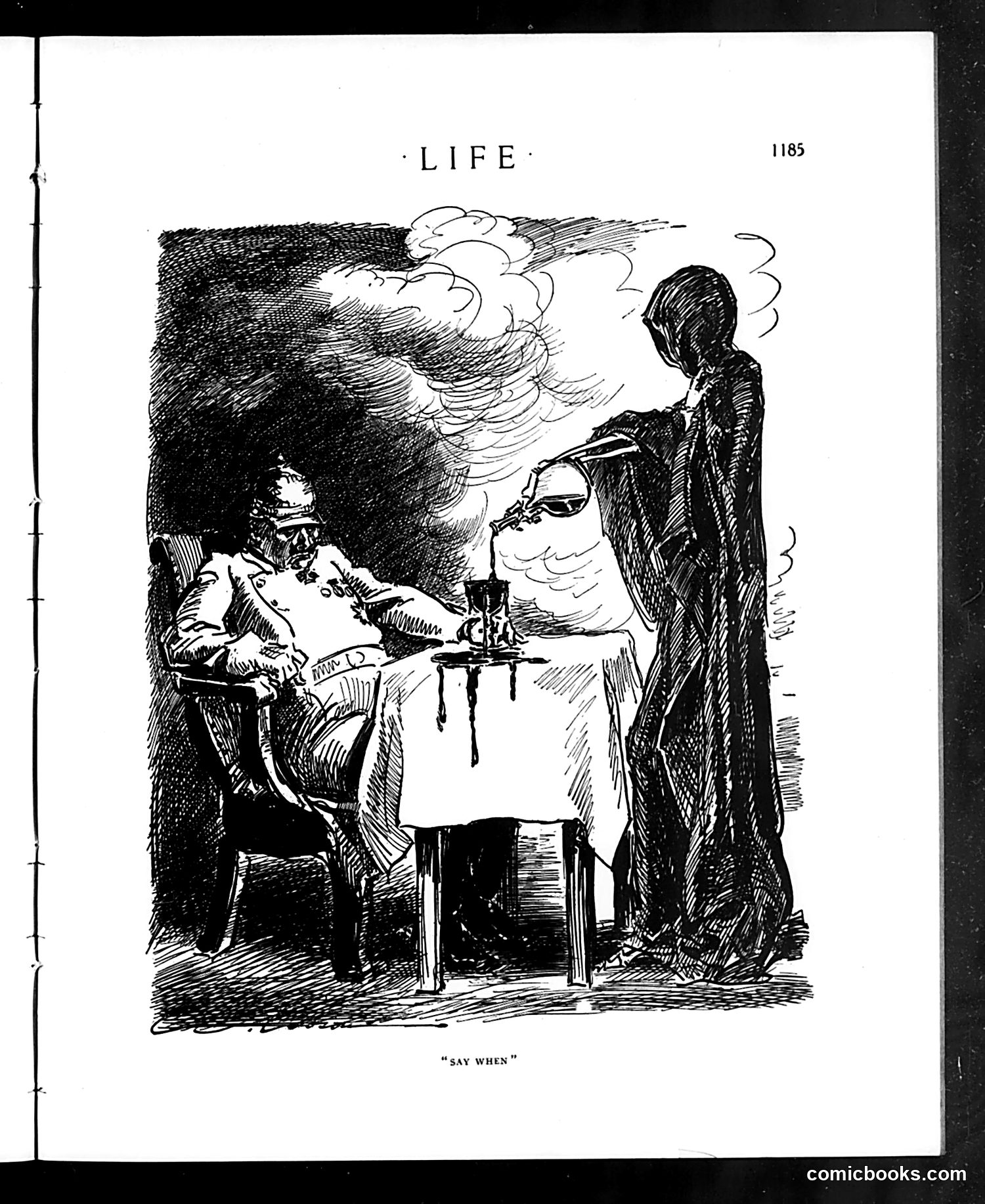
This is a satirical cartoon from *Life* magazine (page 1185) titled "Say When." It depicts two figures in what appears to be a dimly lit, dramatic setting. One seated figure wearing military attire or formal dress smokes while holding a drink; a tall, cloaked figure stands nearby. A small table between them holds what appears to be a bottle or glass. The caption "Say When" suggests a drinking scenario, likely satirizing political or military excess, overindulgence, or dangerous decision-making. The theatrical lighting and dramatic poses suggest commentary on serious affairs—possibly wartime decisions or political compromises. Without additional context about the publication date, the specific historical figures remain unclear, though the military costume and formal setting suggest this concerns high-stakes political or military matters of the era.
This editorial discusses Germany's peace overtures during World War I. The author argues that while the Allies claim confidence in defeating Germany, the war has evolved from preventing German dominance into potentially seeking to overwhelm Germany itself—a costly, likely unprofitable goal. The central satirical point appears in the final section: the ongoing war is like a game played in a "burning house." Players are so invested in winning that they ignore the structure itself is collapsing. The author compares this to a recent U.S. election (likely 1916) where candidates were equally certain of victory—yet one lost narrowly. The difference, crucially: in elections someone must win, but in prolonged war, "everybody is going to lose." The cartoons (small illustrations visible) appear to reinforce themes of conflict and consequence, though specific figures are unclear in reproduction. The piece advocates negotiated peace, suggesting Germany's willingness to discuss terms indicates changed war aims, making continued fighting increasingly irrational.
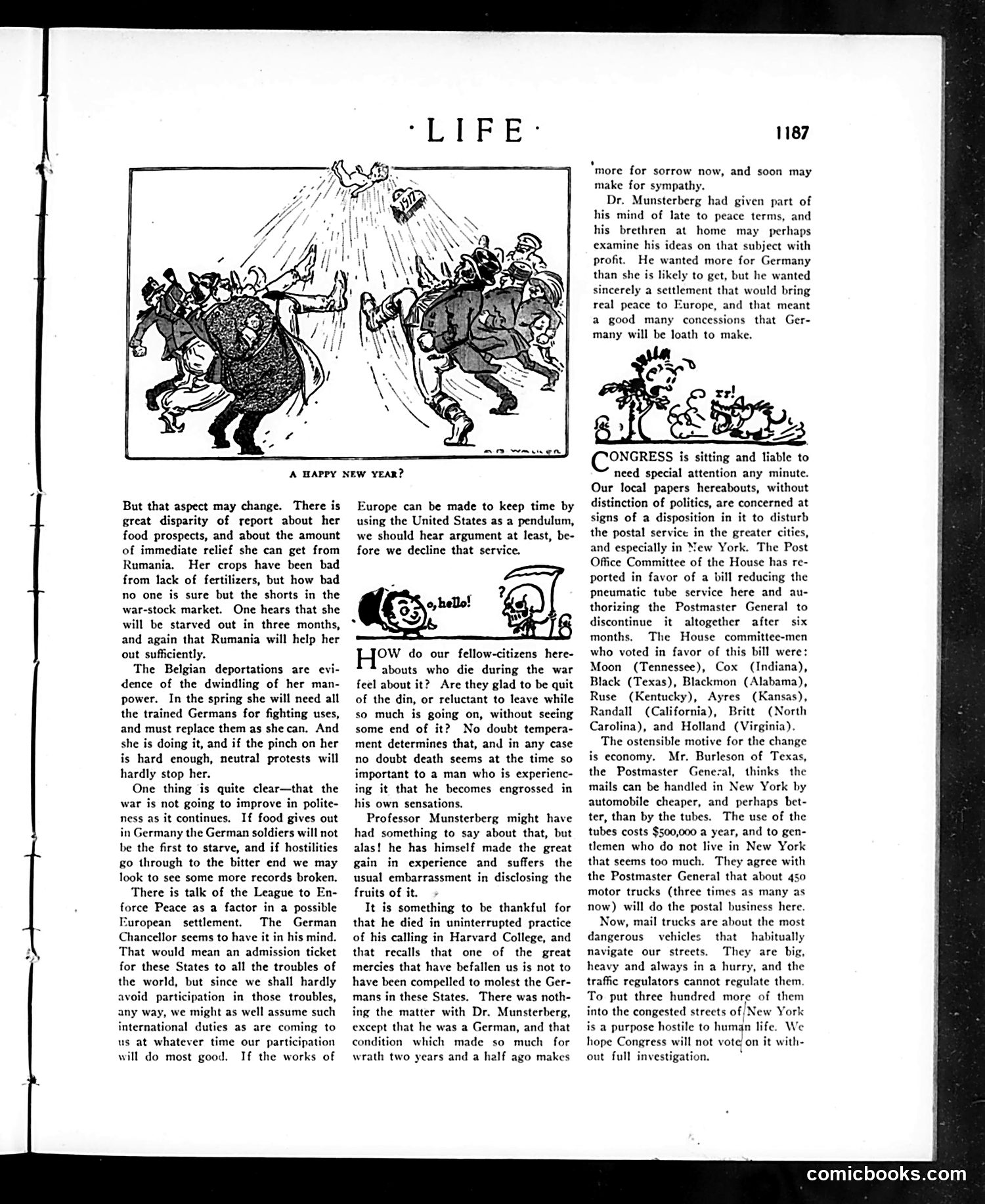
**The Cartoon "A Happy New Year?"** The main illustration satirizes WWI's brutality by depicting figures (likely representing warring nations) being violently shaken by a large hand from above—symbolizing fate or divine judgment. The title's question mark suggests bitter irony: there's nothing "happy" about the coming year given the war's escalating devastation. **Key Context:** The text discusses Germany's deteriorating situation: food shortages, forced Belgian deportations, and dwindling manpower. The article notes the war will become *less* polite and more brutal as desperation increases. The piece also mentions **Professor Munsterberg**, a German-American academic who recently died. Once viewed with suspicion as a German national during wartime, he's now regarded with sympathy. He had advocated for peace terms—though terms favorable to Germany that the Allies wouldn't accept. **The Satire's Point:** Life critiques how wartime transforms attitudes and brutality, suggesting America should engage constructively in peace-making rather than remain neutral, while observing that desperation makes nations increasingly willing to break ethical bounds.
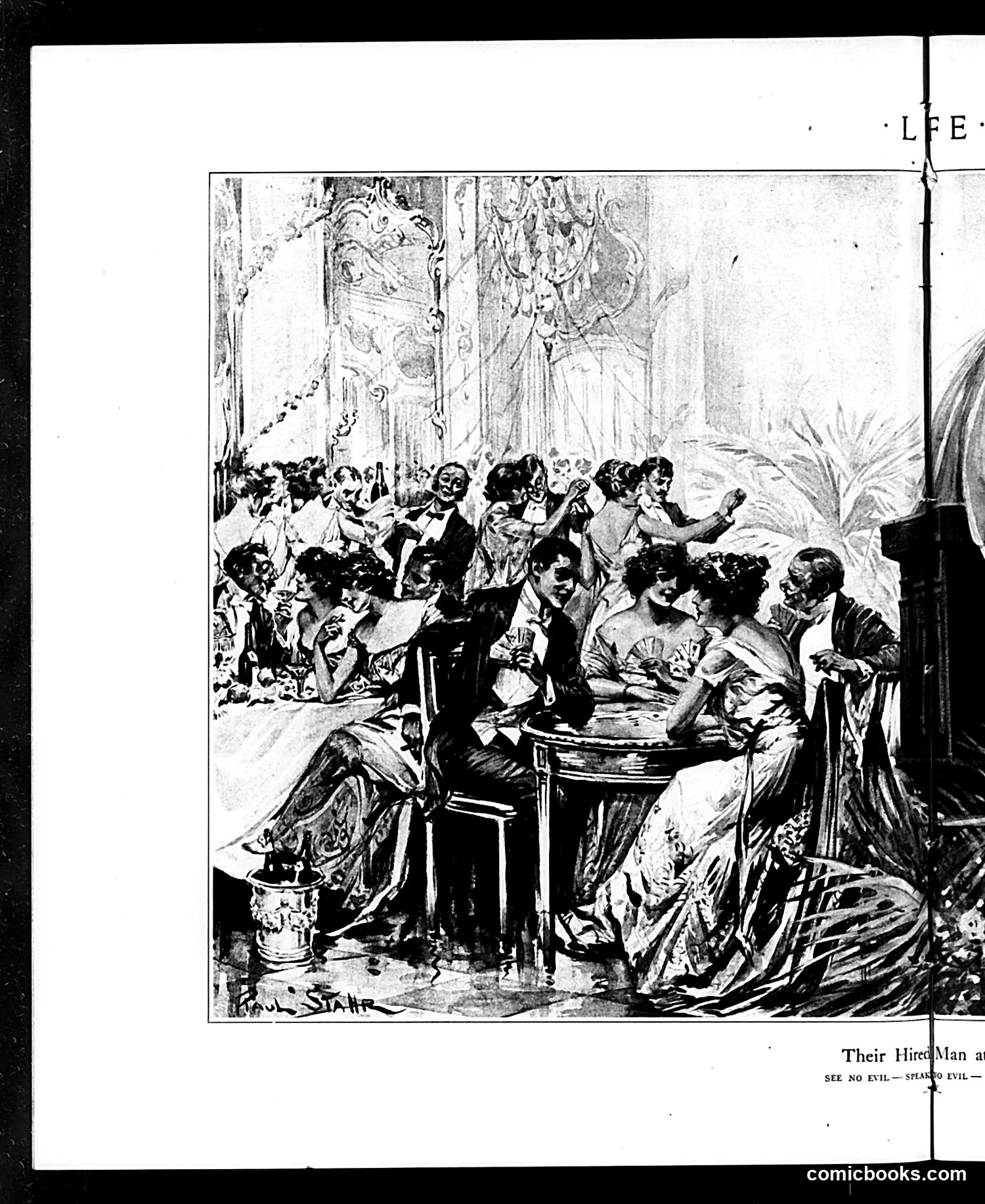
This appears to be a satirical illustration depicting a social gathering of wealthy or upper-class figures in an ornate interior setting. The caption "SEE NO EVIL — SPEAK NO EVIL" suggests the cartoon critiques selective blindness or willful ignorance among the elite regarding social problems. The phrase plays on the "three wise monkeys" proverb. The gathered figures—rendered in formal dress and surrounded by luxury (decorative walls, plants, fine furnishings)—seem to be deliberately ignoring or refusing to acknowledge some issue or wrongdoing, possibly related to labor, inequality, or political corruption. The partially visible title "Their Hired Man at" (text cut off) suggests commentary on class relationships or exploitation. Without the complete caption or publication date, the specific scandal or social issue referenced remains unclear.
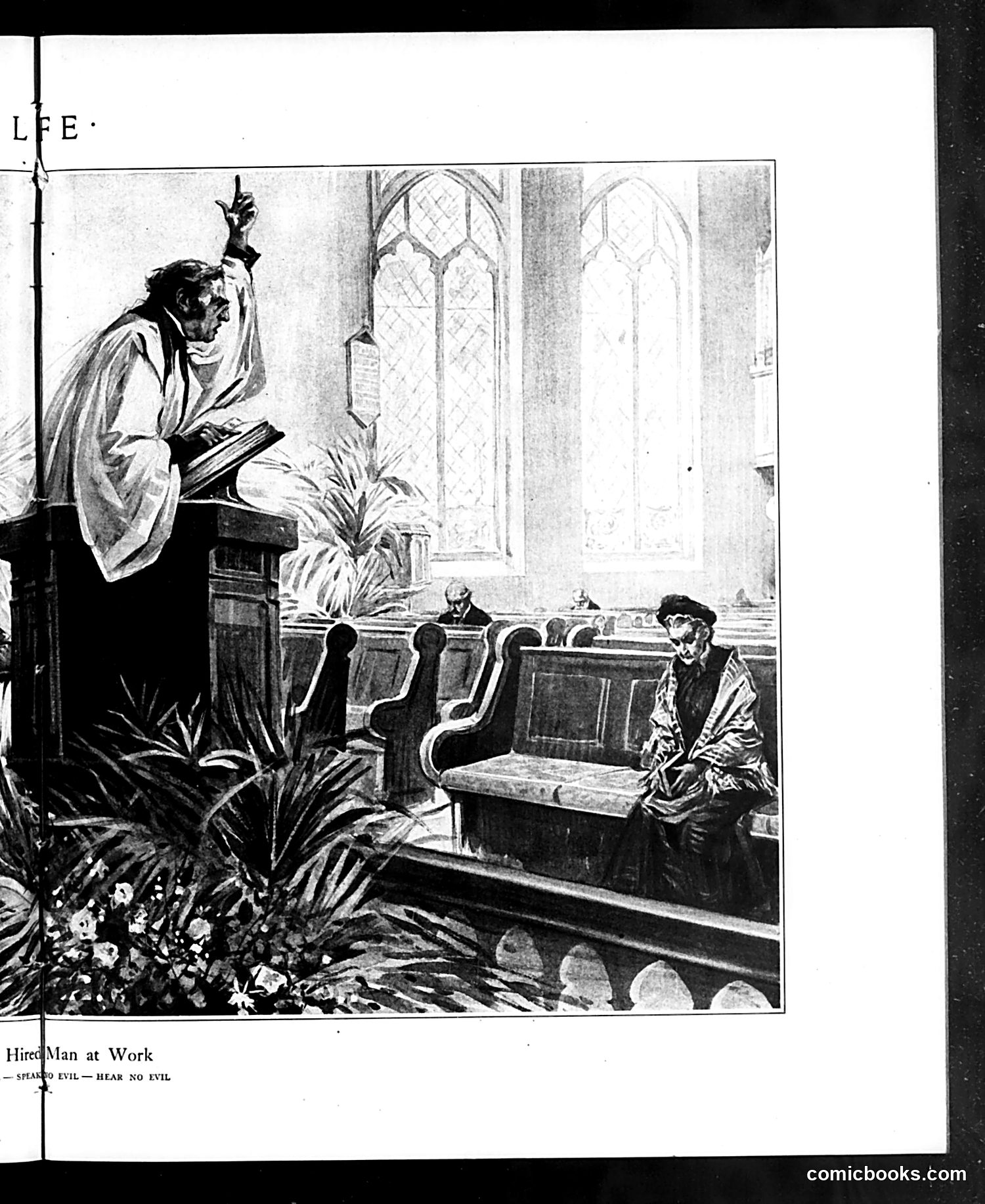
This illustration satirizes hypocrisy in religious institutions. A preacher gestures dramatically from a pulpit, appearing to deliver a moral sermon. Below, in the church pews, seated congregants ignore or turn away from his words — literally embodying the caption's reference to "speak no evil, hear no evil." The satire suggests that clergy preach virtue while their audiences willfully ignore those teachings, or conversely, that preachers themselves fail to practice what they preach. The plants and formal church architecture reinforce the setting as an established, respectable institution, making the disconnect between stated morality and actual behavior the cartoon's pointed critique. This reflects turn-of-the-century skepticism about institutional religion's authenticity.
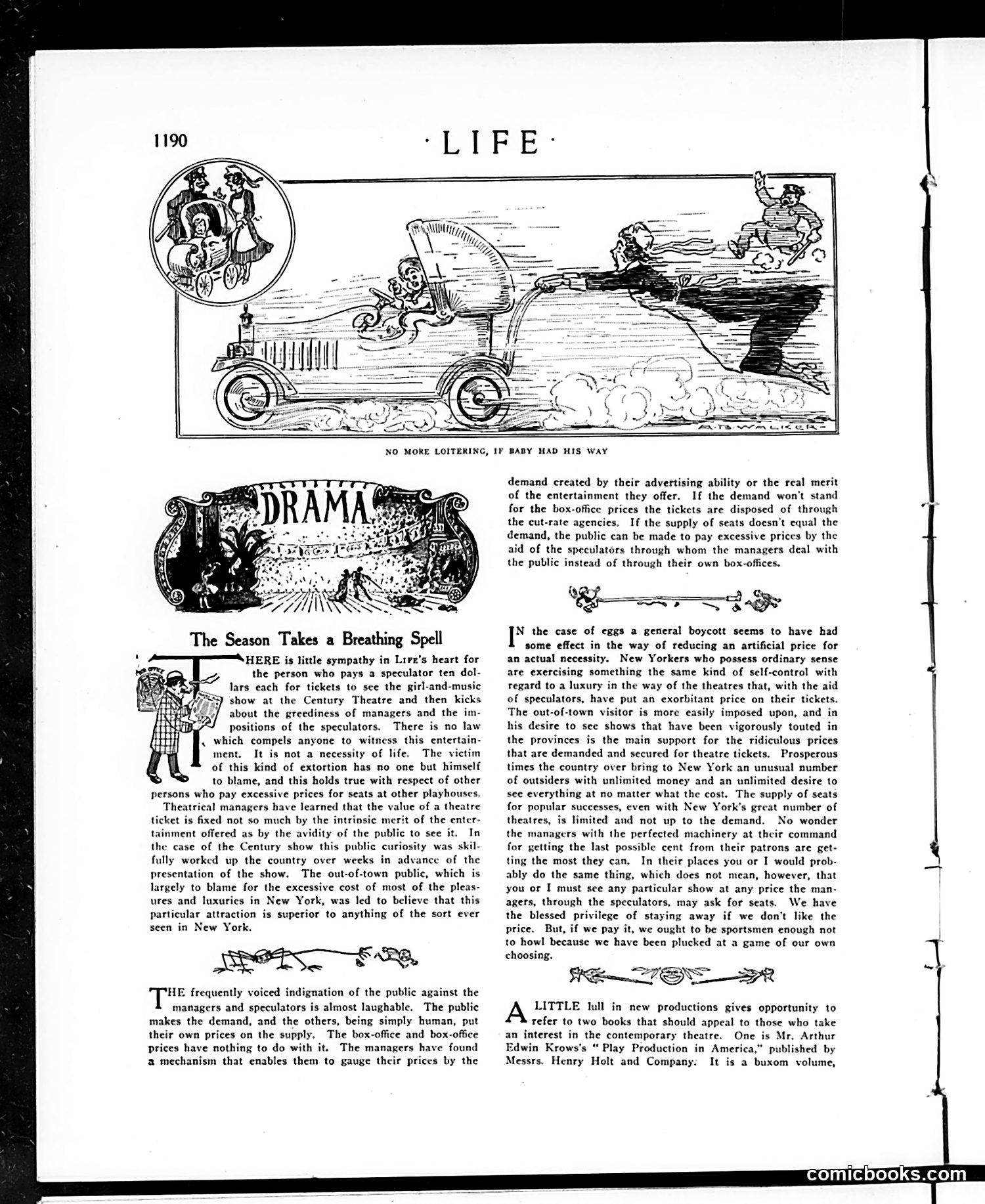
The top cartoon depicts a speeding automobile with a baby at the wheel, driven erratically while an adult passenger holds on desperately. The caption "NO MORE LOITERING, IF BABY HAD HIS WAY" appears to be a humorous commentary on reckless driving or impatient behavior. The accompanying article attacks theatrical ticket speculation, particularly regarding a show at the Century Theatre. The author argues that out-of-town visitors with disposable income artificially inflate ticket prices through their eagerness to see heavily-advertised productions. Rather than blaming speculators and theater managers, the writer criticizes the *public* for creating demand through their own choices and then complaining about high prices. The article draws a parallel to egg boycotts, suggesting consumers could exercise self-control. The satirical point: audiences willing to pay inflated prices have no legitimate grievance—they're "plucked at a game of our own choosing."
This page is primarily **theater and film reviews** rather than political cartoons. The small illustrations at the bottom labeled "Footlight Favorites" are decorative vignettes (candy box, jester, man's face, car, contract) representing entertainment themes—not satirical commentary. The substantive content critiques **early cinema's treatment of audiences**. Critic Metcalfe argues that moving pictures insult viewers by leaving explanatory text on-screen too long between scenes, implying producers assume audiences possess "intelligence away below the ordinary." This reflects early 20th-century anxieties about cinema as a "low" medium compared to theater. The page also reviews several Broadway productions, notably Shaw's "Getting Married" at the Booth Theatre, praised for its social critique. The reviews mention Charles Frohman's biography, referencing his death on the Lusitania (1915), dating this page to approximately 1916.
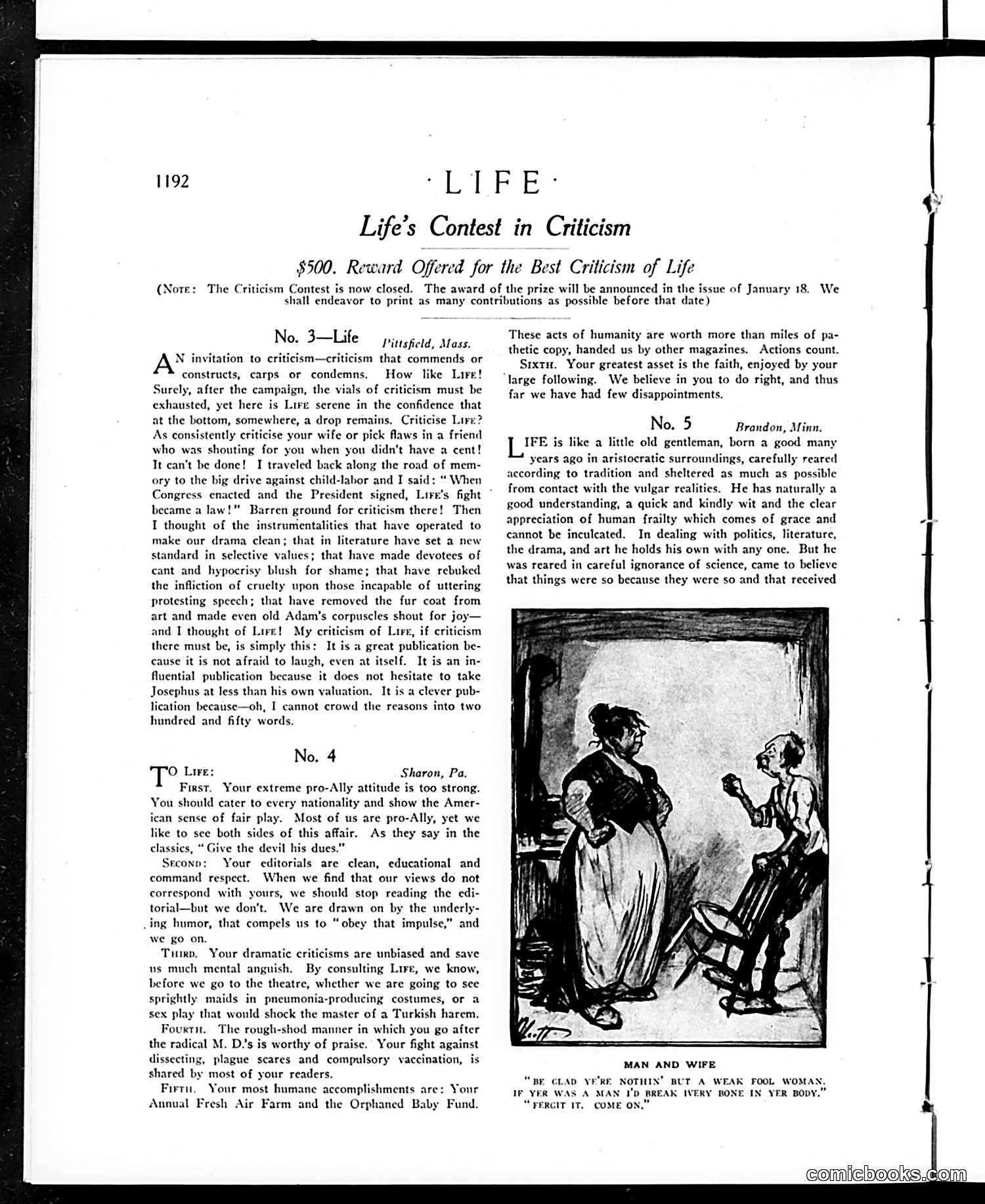
This page showcases **Life magazine's $500 contest inviting readers to critique the publication itself**—a self-reflexive marketing ploy typical of early 20th-century satirical magazines. The accompanying **cartoon depicts a domestic scene** labeled "Man and Wife," showing a couple in what appears to be a tense marital moment. The caption quotes crude period dialect, suggesting working-class domestic conflict. This illustration exemplifies the magazine's satirical commentary on American social life. The printed critiques praise Life for: its child-labor reform advocacy, raising dramatic and literary standards, fighting medical quackery and "compulsory vaccination," and its charitable Fresh Air Farm and orphan programs. One reader criticizes Life's "pro-Ally attitude" during the pre-WWI period, requesting more balanced coverage of all nationalities. The contest itself functions as **self-promotion disguised as democratic engagement**—inviting criticism while implicitly celebrating the magazine's influence and moral authority in shaping American culture and opinion.
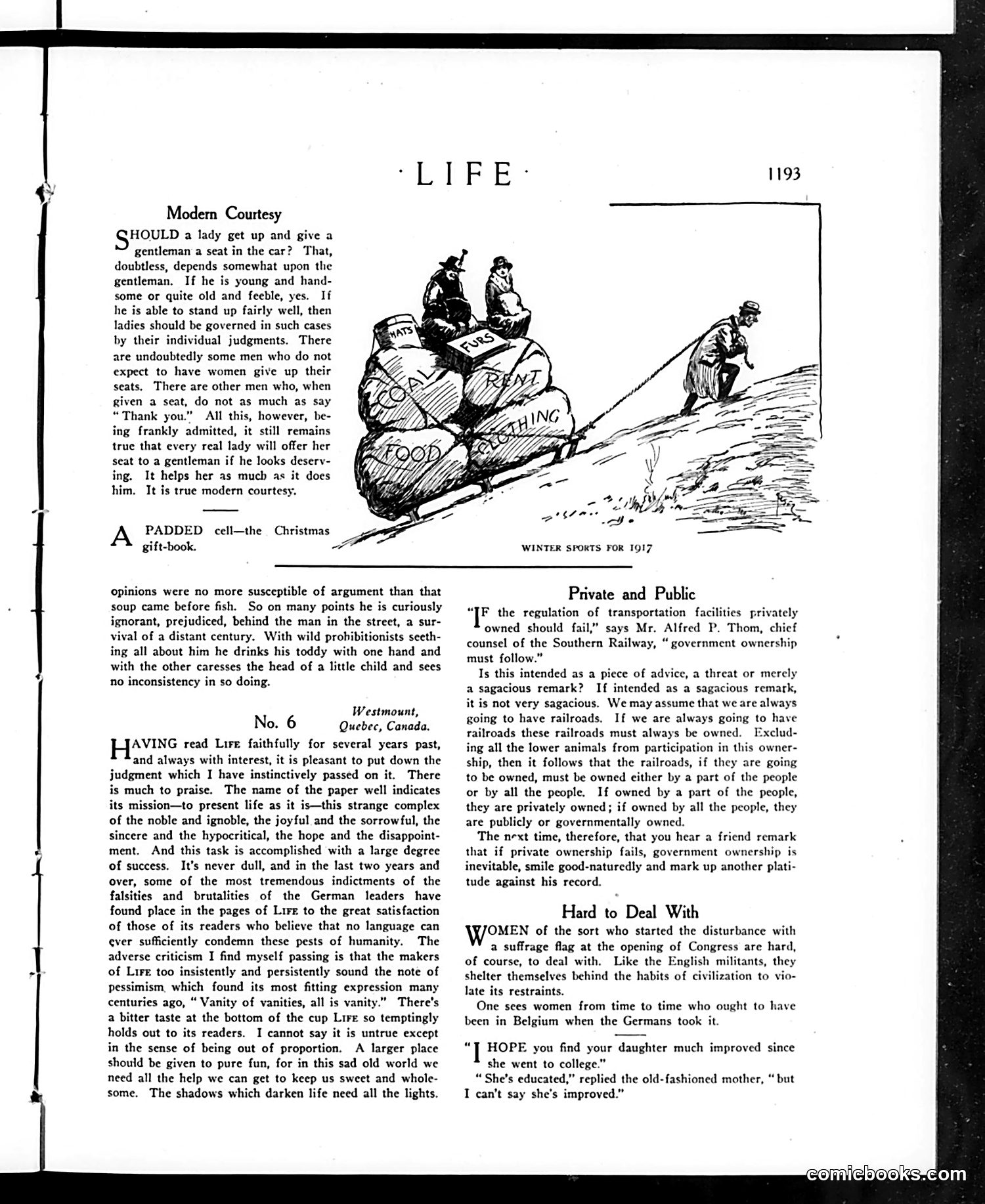
## The Cartoon The sketch titled "Winter Sports for 1917" depicts a figure sledding downhill laden with heavy bundles labeled "FOOD," "RENT," and "CLOTHING." Another figure appears to be struggling ahead on the slope. This satirizes the economic hardships of WWI-era America—civilians burdened by inflation and rising costs of basic necessities during wartime. ## Text Content The page discusses modern courtesy (whether women should yield subway seats based on gentlemen's appearance/ability), includes a book review of *Life* magazine praising its social commentary on German wartime "falsities and brutalities" while criticizing its pessimistic tone, and debates railroad ownership. The railroad discussion questions whether private rail regulation failure inevitably leads to government ownership—essentially mocking a railway executive's veiled threat that unless private companies self-regulate, nationalization becomes unavoidable. **Context**: This reflects 1917 anxieties about wartime resource scarcity, regulatory debates during industrial expansion, and America's ideological tensions regarding private enterprise versus public control.
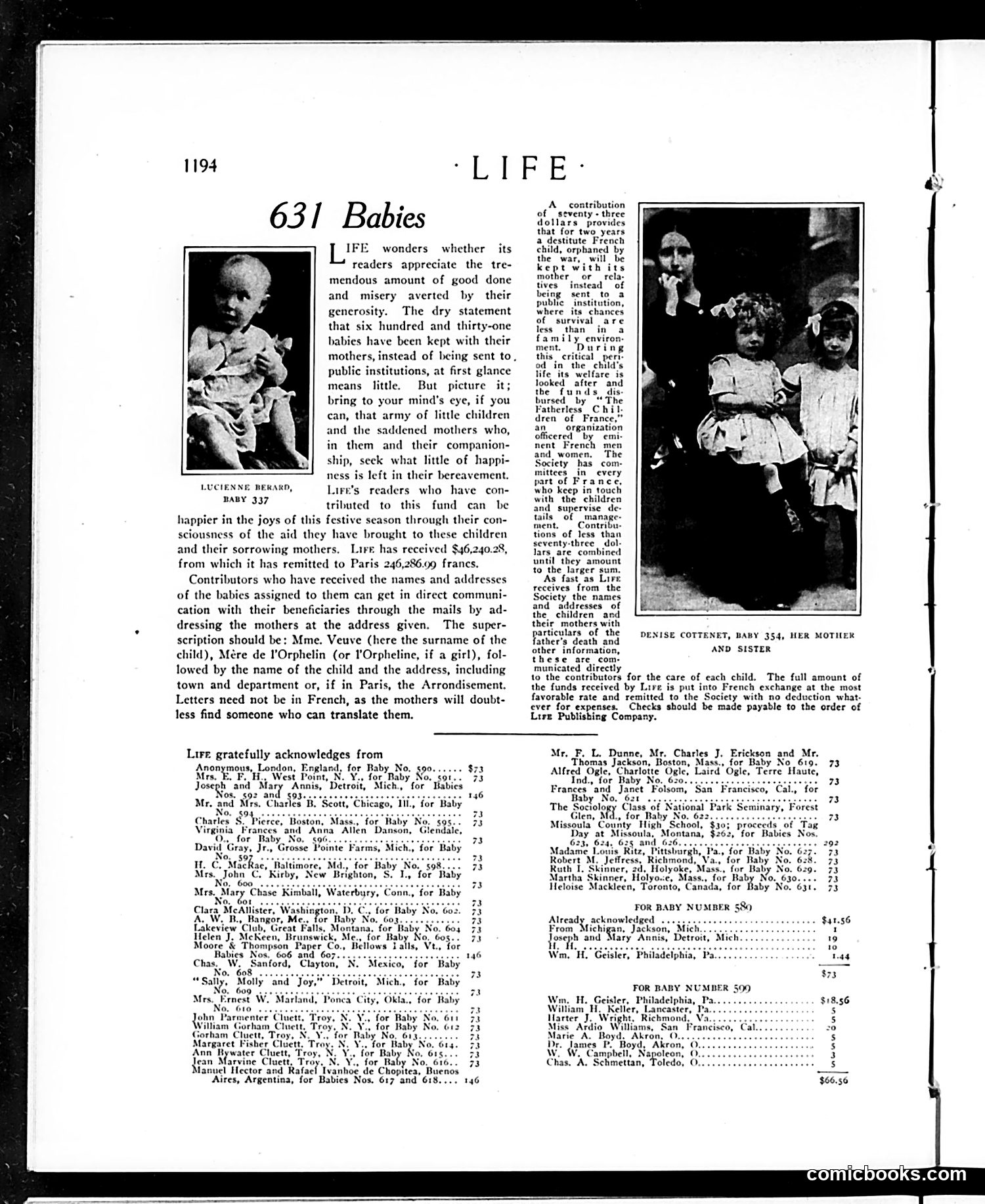
This page documents Life magazine's fundraising campaign to support French orphans and widows after World War I. The two photographs show actual beneficiaries: "Lucienne Berard, Baby 337" and "Denise Cottenet, Baby 354, Her Mother and Sister." The article explains that Life has collected $46,240.28 to support 631 French children kept with their mothers rather than institutionalized—emphasizing the humanitarian value of preserving family bonds during postwar hardship. Readers who contributed could correspond directly with assigned mothers, receiving updates on individual children's welfare. The bulk of the page lists donor names and amounts, a common practice in early 20th-century charity journalism. This served both practical (acknowledging contributors) and promotional purposes (encouraging competition and further donations). The appeal reflects widespread American philanthropic concern for European recovery following World War I's devastation.
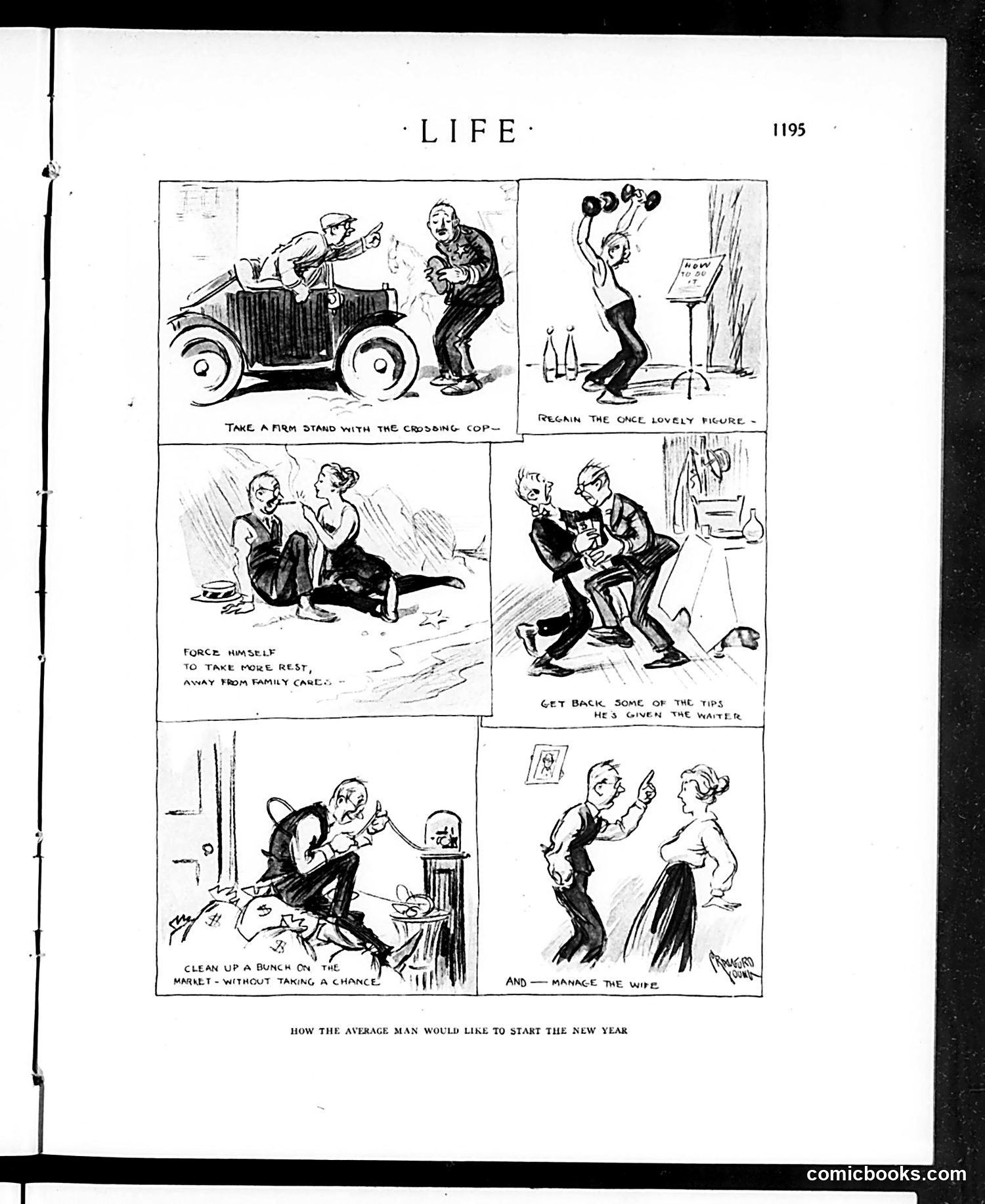
This is a humorous six-panel comic showing a man's fantasies for New Year's resolutions, contrasting his idealized wishes with reality. The panels depict: 1. **Reckless driving** with a police officer 2. **Exercise/fitness** to regain physical shape 3. **Leisure and rest** away from family obligations 4. **Financial gain** ("tips") without effort or risk 5. **Market speculation** ("clean up a bunch on the market—without taking a chance") 6. **Marital control** over his wife The satire targets the "average man" of the early 20th century—his contradictory desires for excitement, wealth, leisure, and dominance, all without consequence or work. The joke is that these fantasy resolutions are impossible: one cannot evade police, gain wealth without risk, or rest while supporting a family. It mocks male daydreaming and the gap between New Year's aspirations and realistic life constraints, particularly regarding work, marriage, and social responsibility.
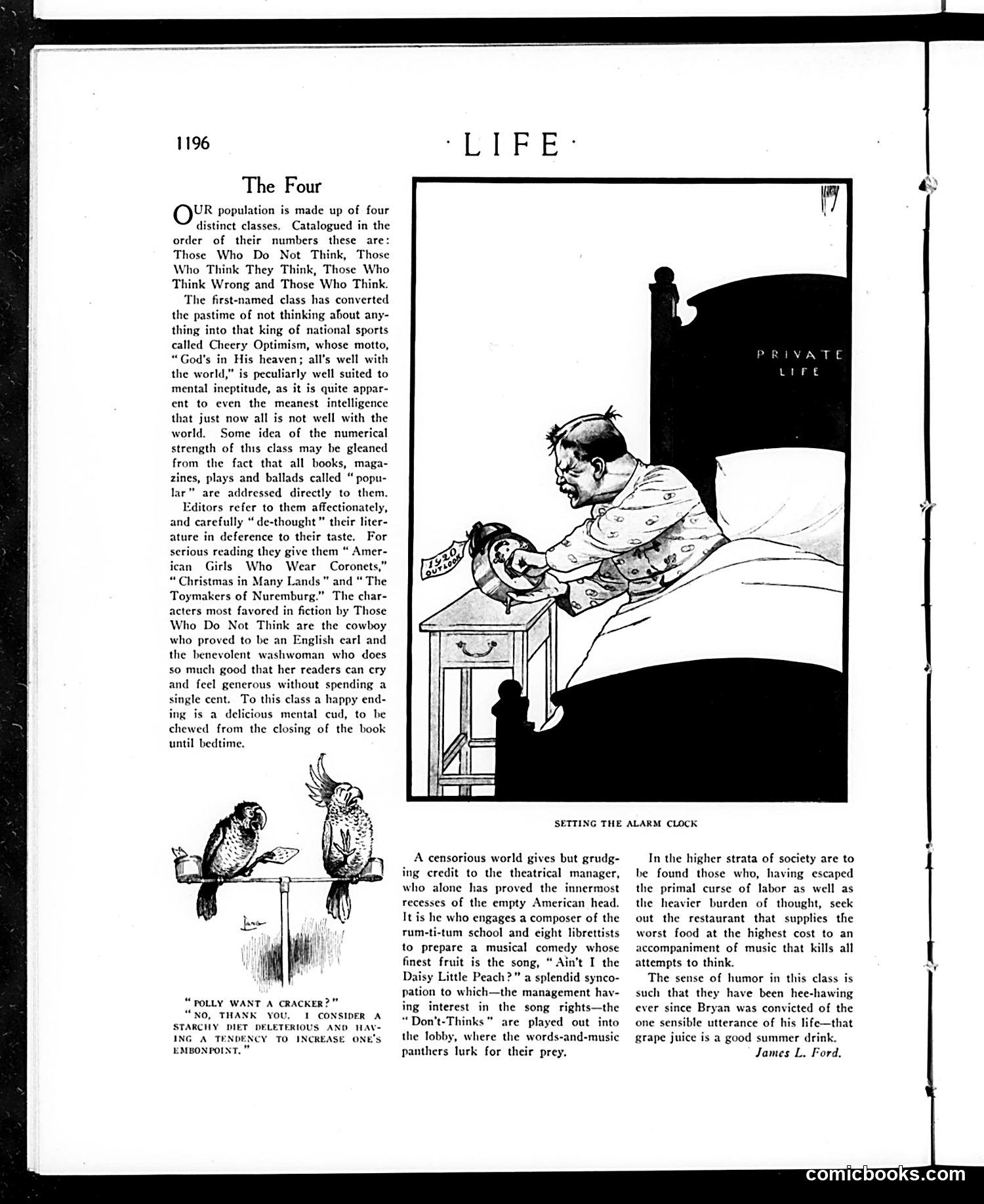
This page satirizes American society by dividing the population into four classes based on intellect. The main illustration, "Setting the Alarm Clock," depicts a man winding a clock while a woman watches—labeled "Private Life." The accompanying text mocks "Those Who Do Not Think," claiming this class has converted non-thinking into "Cheery Optimism" with the motto "God's in His heaven; all's right with the world." The article critiques how popular magazines cater to this demographic through escapist fiction featuring cowboys and benevolent characters requiring no intellectual engagement. The lower cartoon shows two parrots, labeled "Polly Want a Cracker?"—a visual joke equating unthinking people to mere animals repeating phrases without comprehension. The satire targets mass media's role in promoting intellectual passivity among Americans.
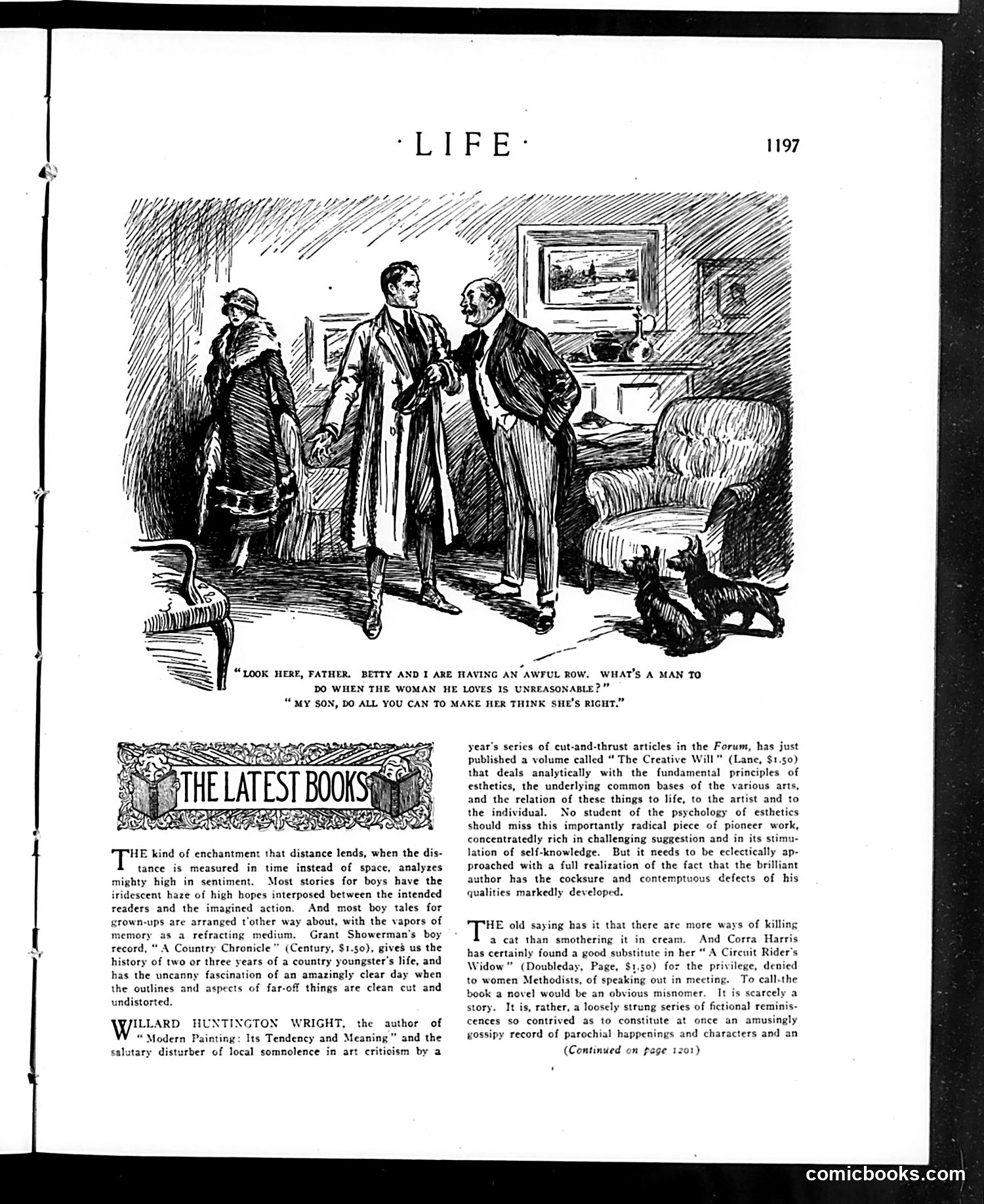
The main cartoon depicts a domestic dispute where a young man seeks his father's advice about his girlfriend Betty being "unreasonable." The father's cynical response—"do all you can to make her think she's right"—satirizes marital compromise and male strategy in relationships. The joke mocks the conventional wisdom that men should appease women by pretending to agree with them, suggesting this is manipulative rather than genuine partnership. The surrounding text reviews recent books, including works on art criticism and rural life. The page reflects early 20th-century attitudes about gender relations, where men's strategic accommodation of women's viewpoints was treated as humorous rather than respectful. The cartoon's humor relies on the audience recognizing this as standard domestic advice—cynical but widely accepted among men of the era.
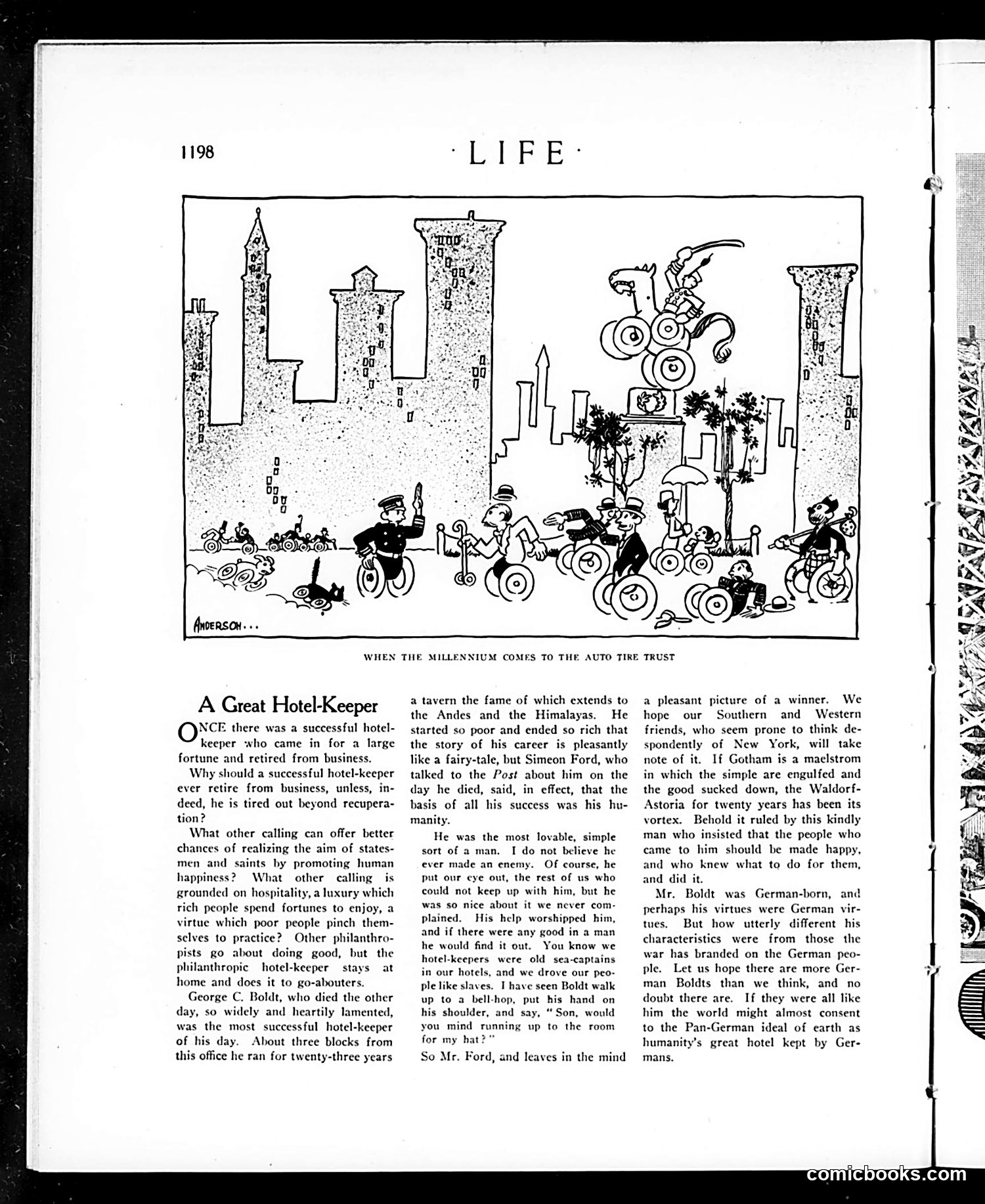
**The Cartoon ("When the Millennium Comes to the Auto Tire Trust"):** The top illustration depicts a fantastical future city where vehicles have been replaced by enormous wheels serving as transportation and recreational devices. Citizens ride on oversized tires; some are stacked as buildings or monuments. This is satirical commentary on the emerging automobile industry's dominance and the "tire trust"—likely referring to consolidation in tire manufacturing around this era. **The Article ("A Great Hotel-Keeper"):** An obituary-style tribute to George C. Boldt, who ran the famous Waldorf-Astoria hotel in New York for 23 years. The piece praises his success as rooted in genuine humanity and kindness toward employees and guests. It positions him as proof that New York, often seen as cutthroat, could nurture such virtue. **The Ironic Ending:** The final paragraph notes Boldt was German-born, then delivers pointed satire: it contrasts his admirable "German virtues" with the cruelty "the war has branded on the German people," hoping there are "more German Boldts than we think." This references WWI-era anti-German sentiment, using Boldt's example to argue Germans aren't inherently militaristic.
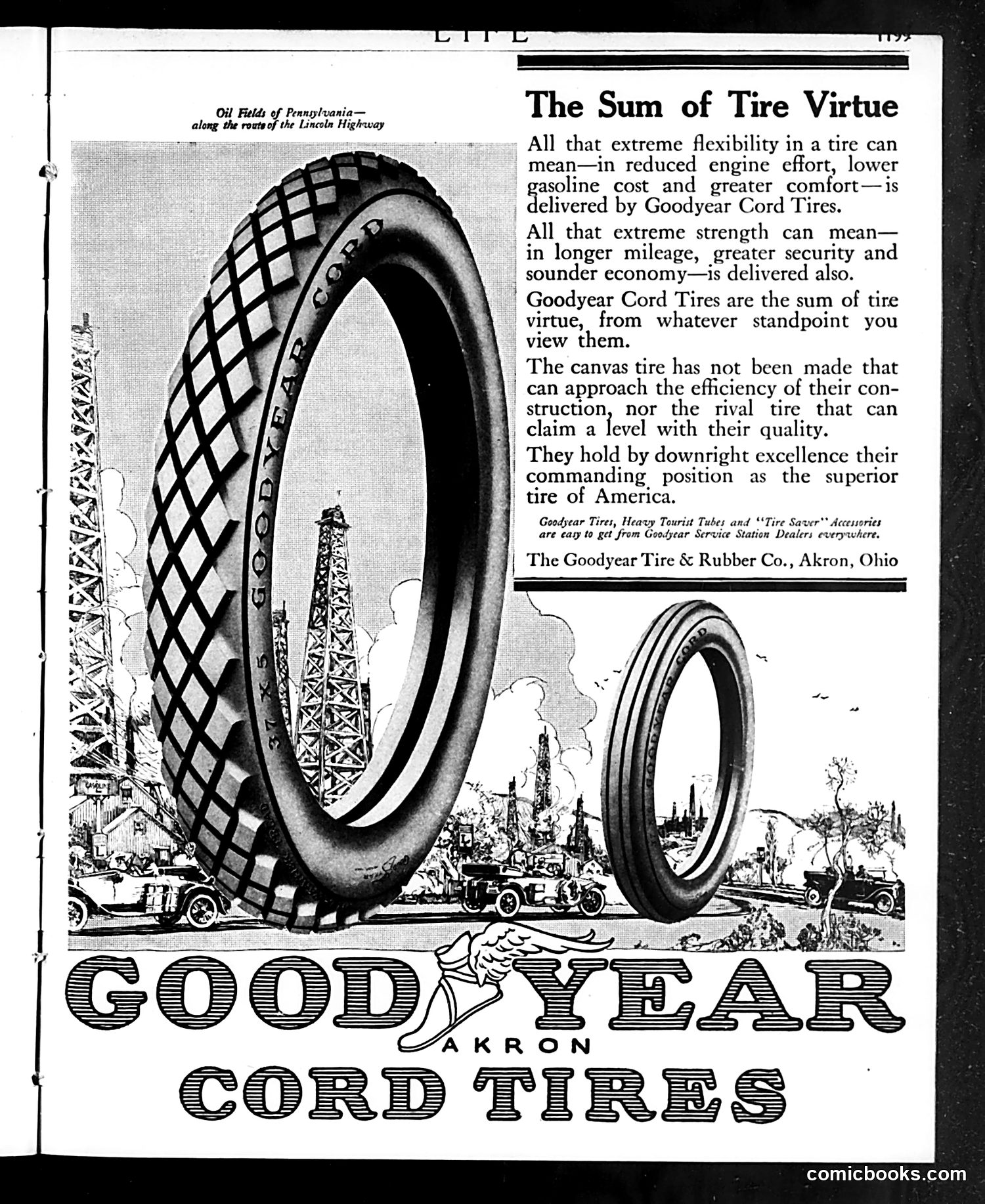
This is primarily **advertising, not satire or political commentary**. It's a Goodyear Cord Tires advertisement from Life magazine. The page features two large tire illustrations set against an oil field landscape (Pennsylvania's fields along the Lincoln Highway). The visual humor is **scale-based**: an enormous tire dwarfs a smaller one beside it, suggesting Goodyear's superior size and dominance in the tire market. The text makes straightforward marketing claims—flexibility, strength, durability, and quality—positioning Goodyear as "the superior tire of America." There's no political satire here. The "sum of tire virtue" phrase is simply advertising copy emphasizing that Goodyear combines all desirable tire qualities. For modern readers: this represents early automotive-era marketing using Life's commercial pages to reach middle-class car owners making purchasing decisions during the motor age's expansion.
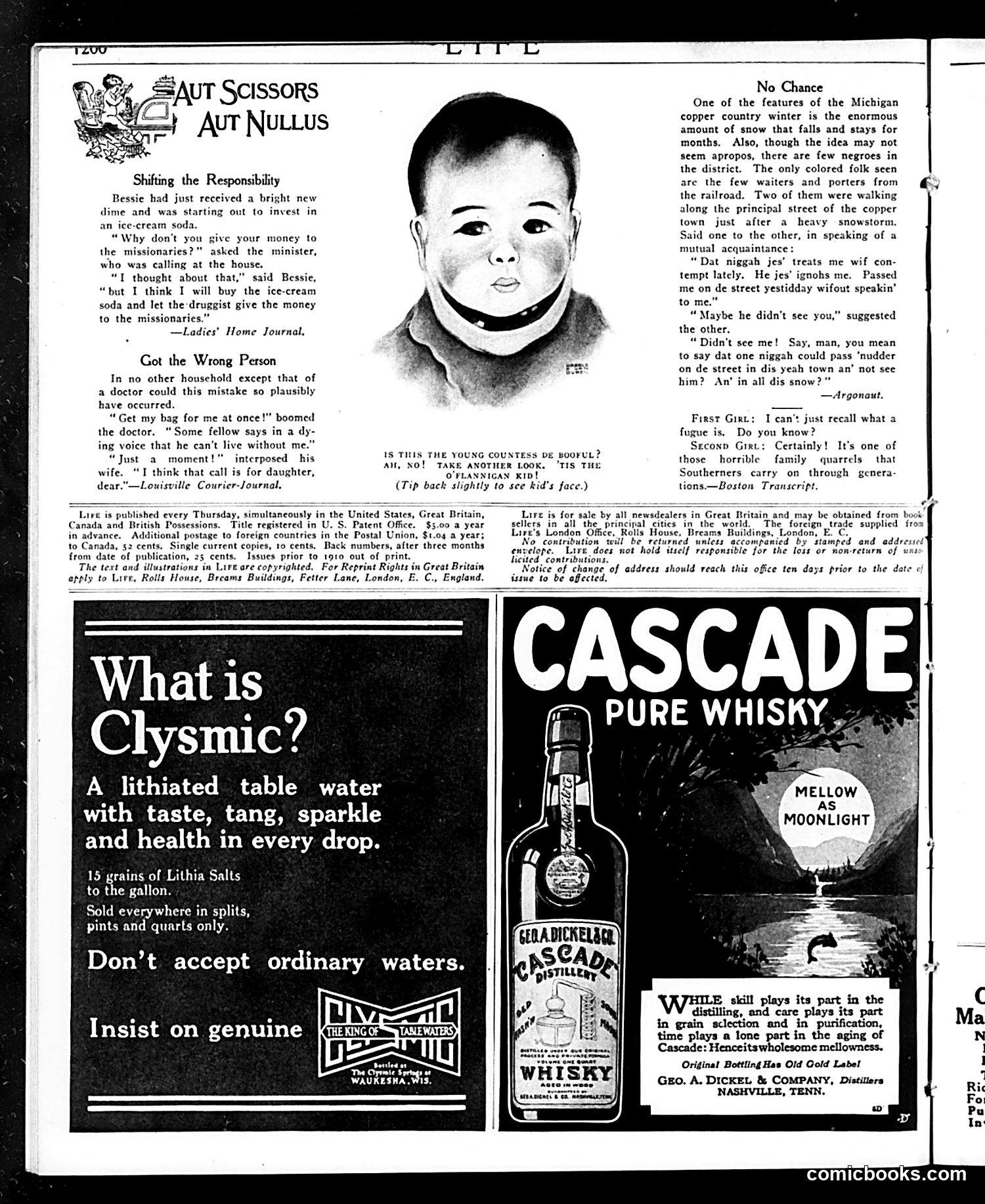
This Life magazine page (circa 1910s) contains several short humorous anecdotes and advertisements typical of the era. **The cartoons/jokes:** - "Shifting the Responsibility": A child's clever deflection—asked to donate her dime to missionaries, Bessie says she'll buy soda instead and *let the druggist* donate to charity. - "Got the Wrong Person": A doctor rushes to answer an urgent call, only to learn his *daughter* is the one being summoned by an admirer. - An untitled visual joke: A countess's portrait that reveals a baby's face when tilted. **The racial anecdote** ("No Chance"): A problematic period piece depicting two Black railroad workers in Michigan discussing a mutual acquaintance. The "joke" relies on racist dialect and stereotypes—the punchline being that in heavy snow, a Black man couldn't possibly pass another Black man unnoticed. **Advertisements**: Clysmic lithiated water and Cascade Pure Whisky occupy the lower half. The content reflects early 20th-century attitudes: gentle middle-class domestic humor mixed with casual racial caricature that was commonplace in mainstream American publications then.
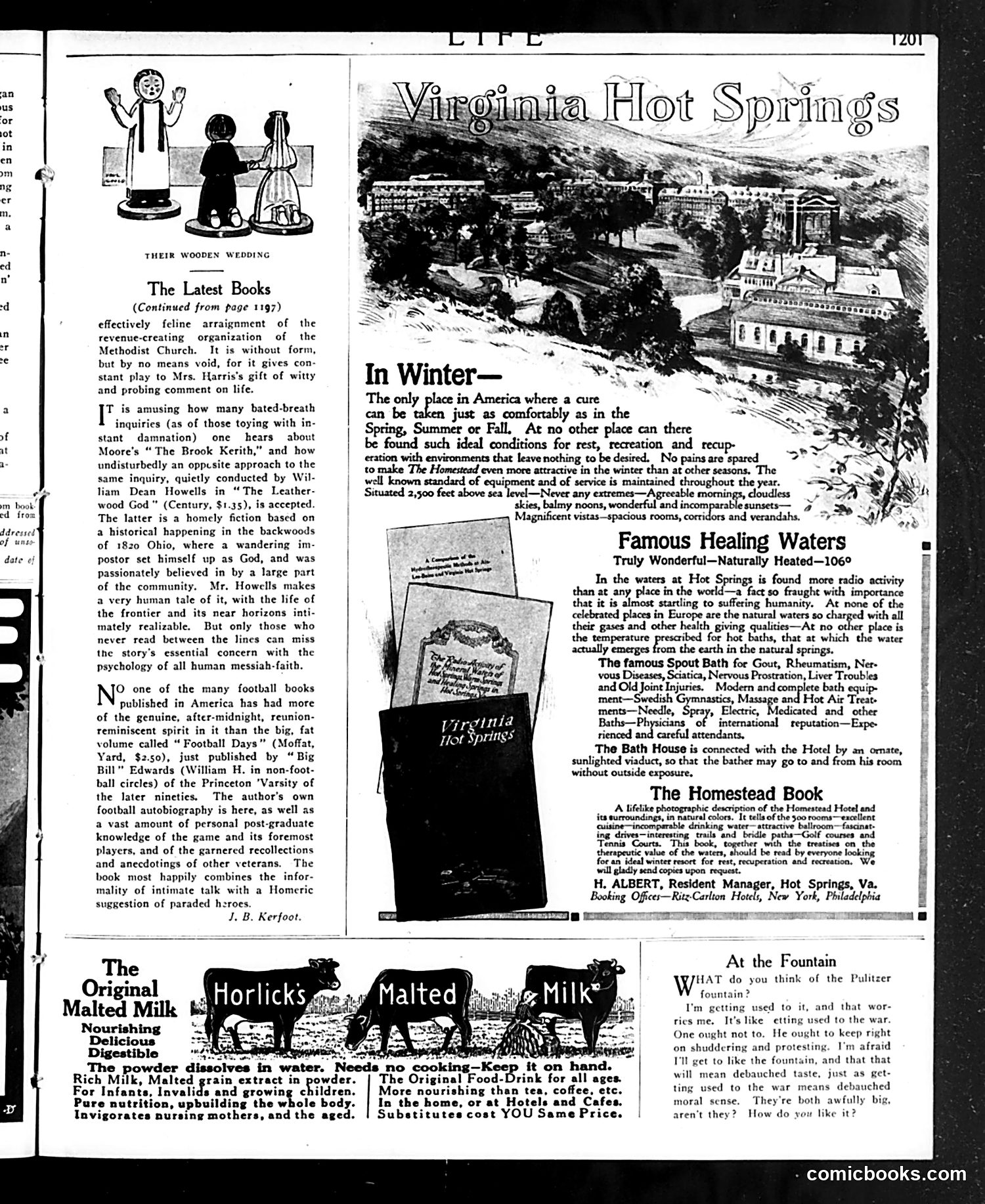
The small cartoon at top left depicts a wooden figure (a doll or puppet) with raised arms, flanked by two smaller figures in formal dress. The caption "Their Wooden Wedding" is a pun referencing the traditional "wooden anniversary" (fifth wedding anniversary). The satire likely mocks either an actual celebrity wedding of the era or — more probably — critiques artificial, emotionless marriages or relationships lacking genuine feeling. The wooden figures suggest lifelessness and inauthenticity. Without identifying the specific individuals caricatured, the joke relies on contemporary readers recognizing who was being ridiculed. The remainder of the page consists primarily of book reviews and advertisements (Virginia Hot Springs resort, Horlick's Malted Milk), with no additional political or satirical content visible.
This page is primarily **advertising with humor sidebars**. The main content consists of liquor and beverage advertisements (Wilson whiskey, Gold Seal Champagne, Old Overholt Rye, Bacardi) alongside brief satirical anecdotes. The "Our Foolish Contemporaries" section presents short, standalone jokes mocking various types of people: a credulous country squire fooled by his horse's behavior, a widow in mourning for a husband nobody liked, and people making absurd observations (like complaining that a football stadium is being used for opera). The satire is **gentle and apolitical**—targeting social pretension and human folly rather than specific events or figures. The anecdotes mock overly earnest modernists, sentimental theater-goers, and those lacking common sense. The page reflects **1910s-era values**: celebration of self-control and moderation (ironically, while advertising alcohol), skepticism toward contemporary trends, and amusement at human inconsistency. It's primarily a vehicle for luxury goods advertising dressed in satirical clothing.
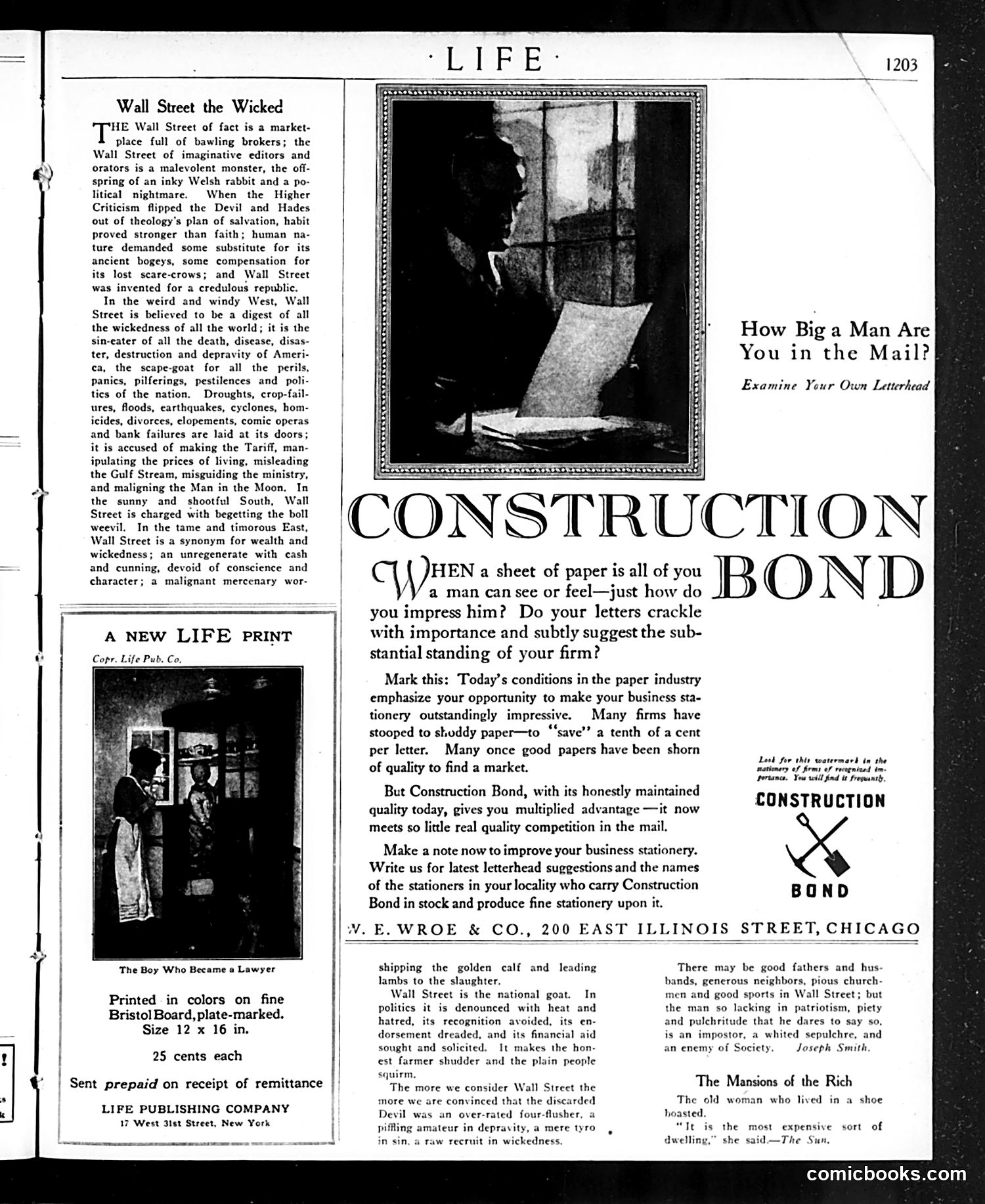
This page contains a satirical essay titled "Wall Street the Wicked" that mocks American society's tendency to scapegoat Wall Street for all national problems. **The Satire's Point:** The author argues that people across America—from the West to the South to the East—irrationally blame Wall Street for everything: droughts, earthquakes, bank failures, even the boll weevil infestation and the Gulf Stream's behavior. The essay suggests this is absurd scapegoating: Wall Street has replaced the Devil as society's convenient villain now that religious faith has declined. **The Joke:** By cataloging increasingly ridiculous accusations (misguiding the Moon, begetting weevils), the author reveals how irrational and all-encompassing Wall Street blame has become. He concludes that the discarded Devil was "an over-rated four-flusher" compared to Wall Street's newly invented wickedness. **Context:** This reflects early 20th-century tensions between rural/agrarian America (suspicious of financial centers) and Wall Street interests, with populist rhetoric treating finance as inherently corrupt. The page also contains unrelated period advertisements for stationery and prints.
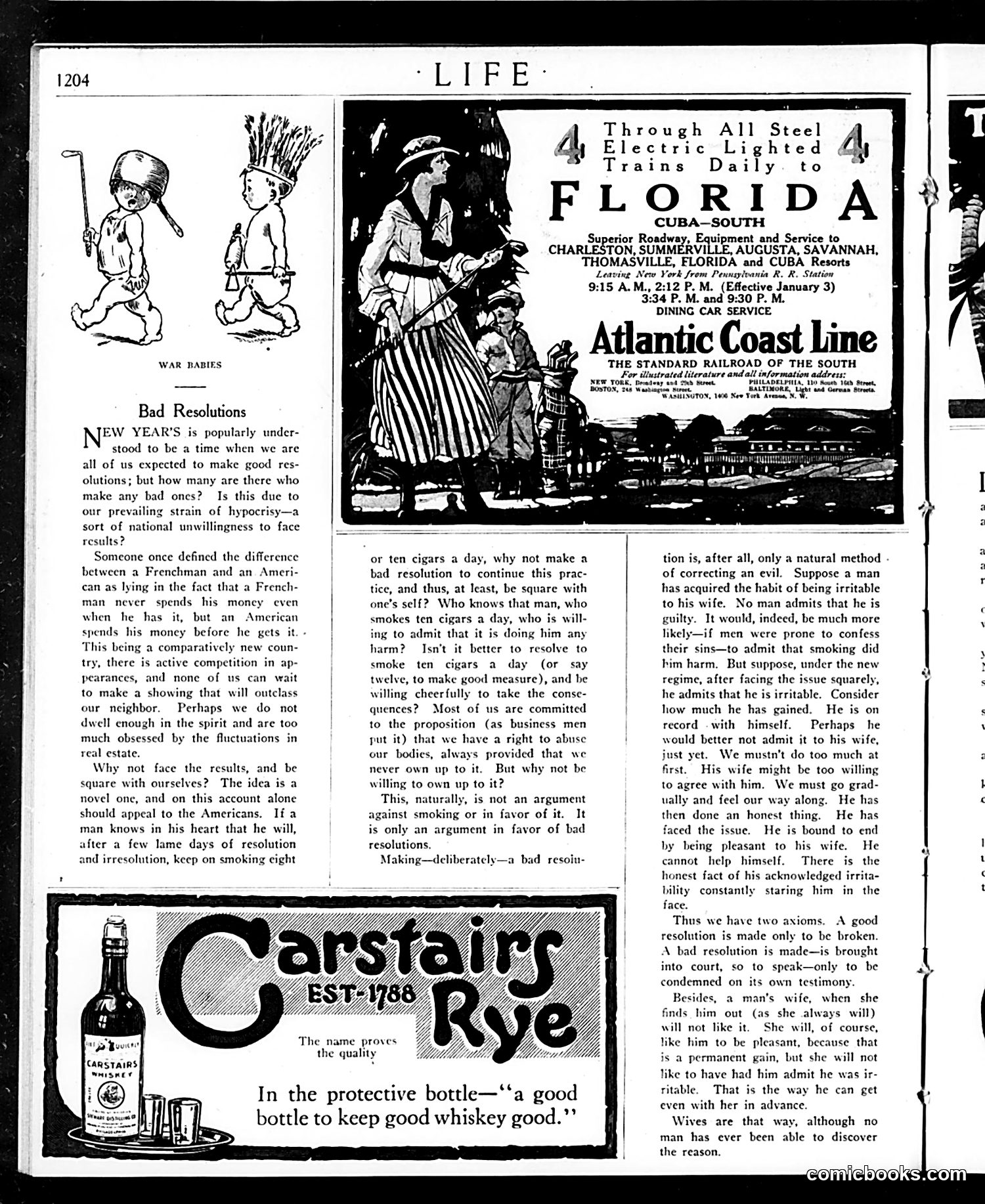
The cartoon labeled "War Babies" depicts two infants in military dress—likely referencing children born during or after World War I, satirizing how society might militarize or politicize the next generation. The accompanying essay "Bad Resolutions" is a New Year's commentary mocking American hypocrisy about self-improvement. It argues that rather than pretend to quit vices (smoking ten cigars daily), men should honestly *resolve to continue* them—at least admitting the truth to themselves. The satire targets masculine pretense: husbands claiming they'll reform but never doing so, then denying harm to their wives. The piece ironically suggests that openly acknowledging one's faults (irritability, smoking) is morally superior to self-deception, even if reform never follows. It reflects early-20th-century American anxieties about commercialism, masculine honor, and the gap between public respectability and private behavior. The Carstairs Rye whiskey advertisement below reinforces the era's acceptance of alcohol consumption (pre-Prohibition context, likely 1920).
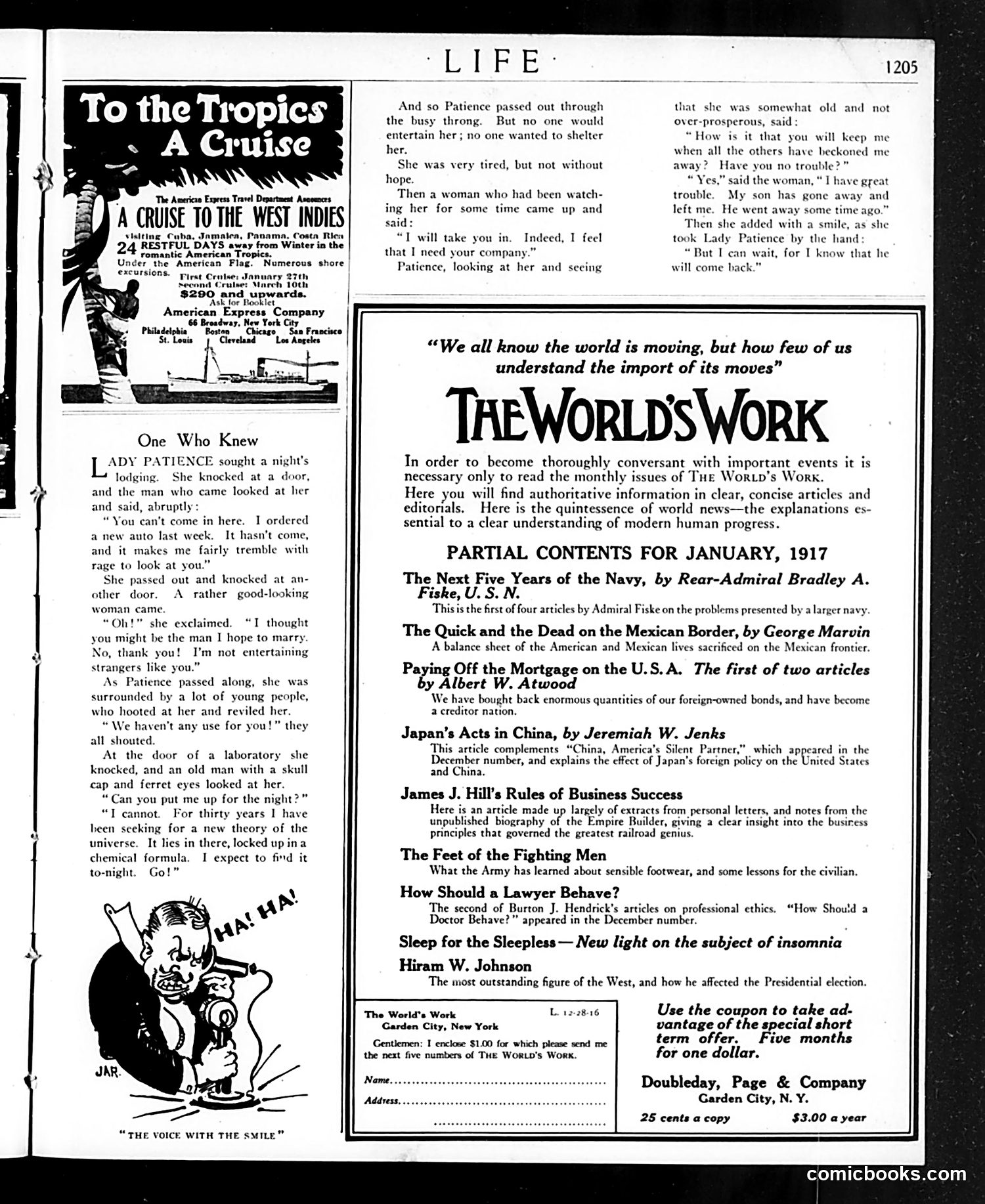
This allegorical story depicts "Lady Patience" seeking shelter but being rejected by various people obsessed with modern concerns. A man refuses her because he's anxious about a delayed automobile purchase; a woman won't help because she's waiting for a suitor; young people mock her; a scientist turns her away, consumed by his research into universal theory. Only an older, poor woman—who has suffered genuine loss (her absent son)—welcomes her with compassion and patience. The satire critiques early 20th-century materialism and shallow priorities: people prioritize consumer goods, romance, youth culture, and abstract ambition over human kindness. The moral is that true virtue comes from those who've endured real hardship and maintain faith despite it. The cartoon's title, "The Voice with the Smile," appears ironic—only the grieving mother smiles genuinely, suggesting authentic humanity emerges through suffering, not prosperity.
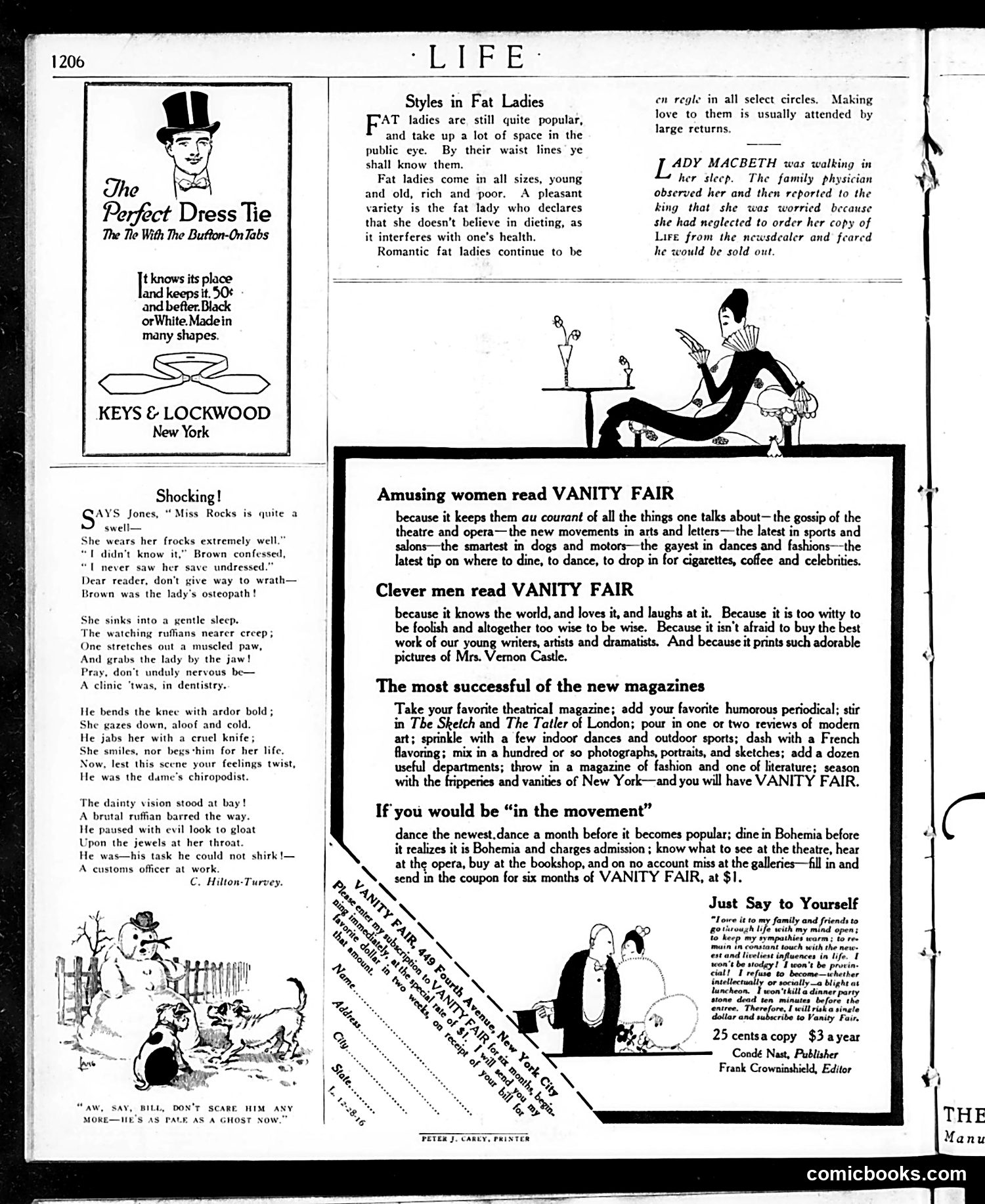
This page combines humor, advertisements, and social commentary typical of early 20th-century Life magazine. **The cartoons** ("Shocking!" by C. Hilton-Turvy) use a running gag: scenes initially appear scandalous—a woman being grabbed, touched with a knife, robbed—but each reveals an innocent professional context (osteopath, dentist, chiropodist, customs officer). The humor relies on readers' assumptions and expectation-subversion, mocking both sensationalism and prudish overreactions. **"Styles in Fat Ladies"** satirizes period attitudes toward women's bodies, noting contradictions: fat ladies are "popular," yet the text implies they're objects of curiosity and financial interest ("large returns" when courting). **The Vanity Fair advertisement** dominates the page, marketing the magazine as essential for staying culturally "in the movement"—knowing theater gossip, fashionable restaurants, and celebrity news. It targets both women (for social awareness) and "clever men" (for wit), positioning the magazine as proof of sophistication and modernity. The overall page reflects 1910s-1920s attitudes about gender, class, and modern consumer culture.
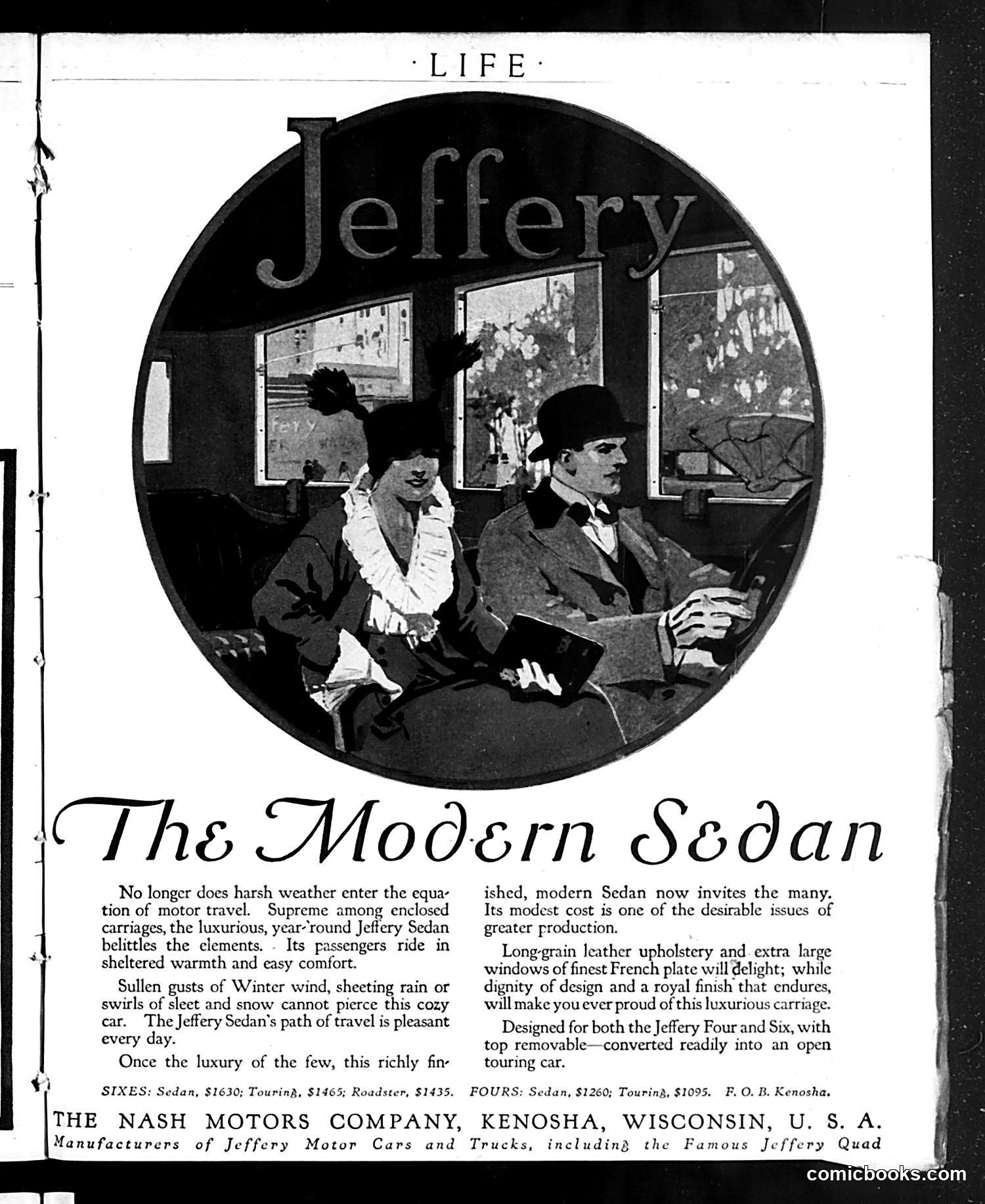
This is a **motor car advertisement**, not satire. The page promotes the Jeffery Sedan, manufactured by Nash Motors Company in Kenosha, Wisconsin. The circular illustration shows two well-dressed passengers (a woman and man) seated comfortably inside an enclosed sedan, visible through windows. The image emphasizes the vehicle's key selling point: **protection from harsh weather** — a major advancement in early automotive design. The advertisement's appeal targets the emerging middle class: it positions the enclosed sedan as formerly "the luxury of the few" but now accessible to "the many" through mass production and "modest cost" pricing ($1,260–$1,630). The text emphasizes comfort features—leather upholstery, large French plate windows, removable top—that would have been genuinely novel and desirable to 1920s consumers transitioning from open carriages and early roadsters. This reflects the historical moment when enclosed cars became standard, transforming automobiles from seasonal luxury into year-round practical transportation.
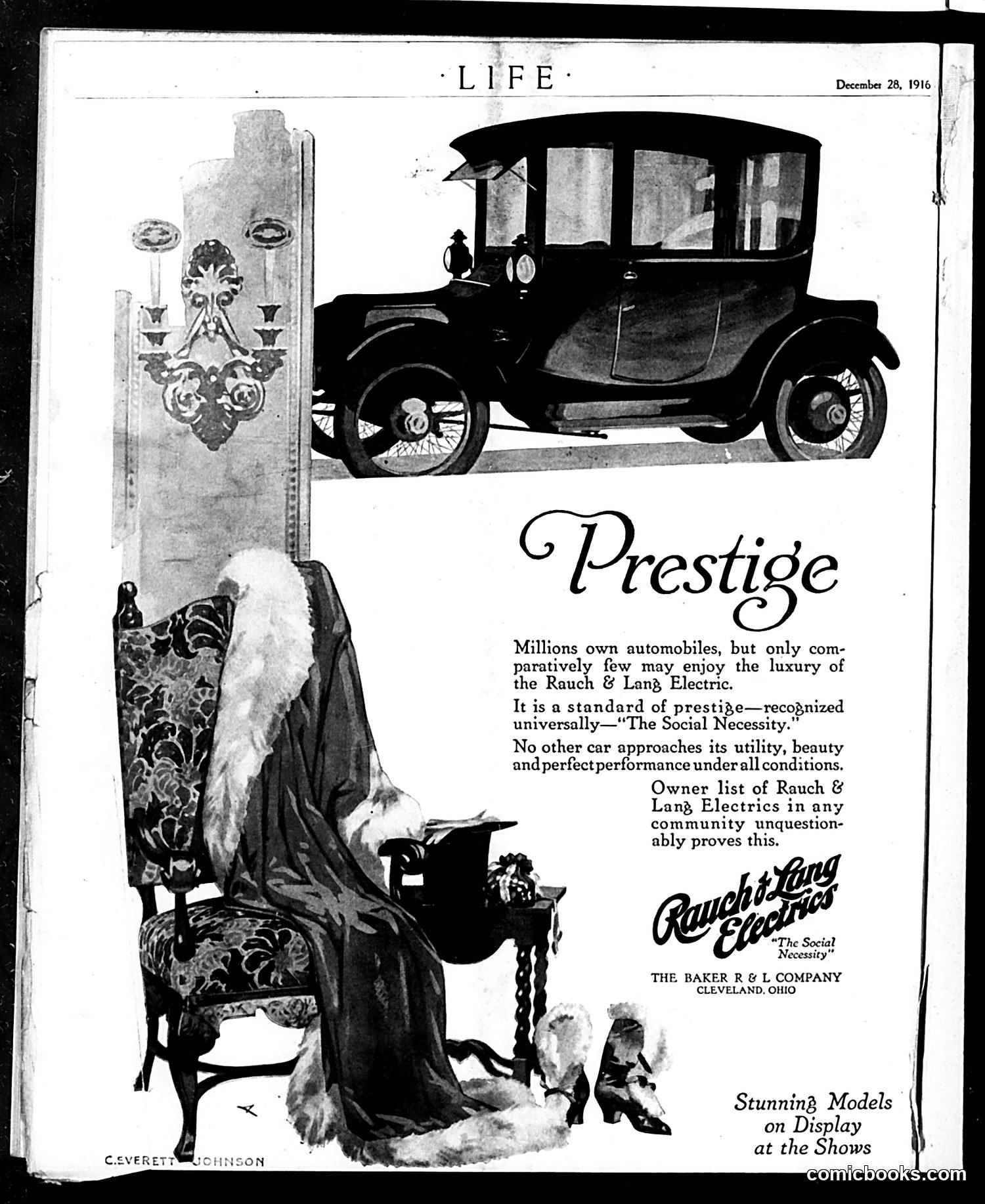
This is a **full-page advertisement** for the Rauch & Lang Electric automobile, not a political cartoon or satire. The page uses social snobbery as its marketing strategy. The left side depicts an elderly wealthy woman in elaborate period dress and fur, seated in ornate furniture—representing old money and established prestige. The right shows a sleek electric car. The ad's argument: owning a Rauch & Lang Electric is "The Social Necessity"—a status symbol that signals membership in high society. The copy claims millions own cars, but only the truly elite enjoy *this* luxury vehicle. The implication is that the car's owner list in any community "unquestionably proves" one's social standing. This reflects early 1900s attitudes where electric cars (quieter, cleaner, requiring no hand-cranking) were marketed as refined alternatives to noisy gasoline vehicles—appealing specifically to wealthy women and the upper class.

I can see this is a page from Life magazine dated 1916 (visible in top left corner), but the image is almost entirely black or severely degraded, making it impossible to discern any cartoons, illustrations, text, or other content with clarity. While there appear to be some faint circular shapes or patterns in the center-right portion, I cannot reliably identify what they depict, what political or social references they might contain, or what satirical point they were intended to make. To provide accurate historical analysis as requested, I would need a clearer or higher-contrast version of this page.