
Life, 1916-12-28 · page 19 of 41
Life — December 28, 1916 — page 19: what you’re looking at
What you’re looking at
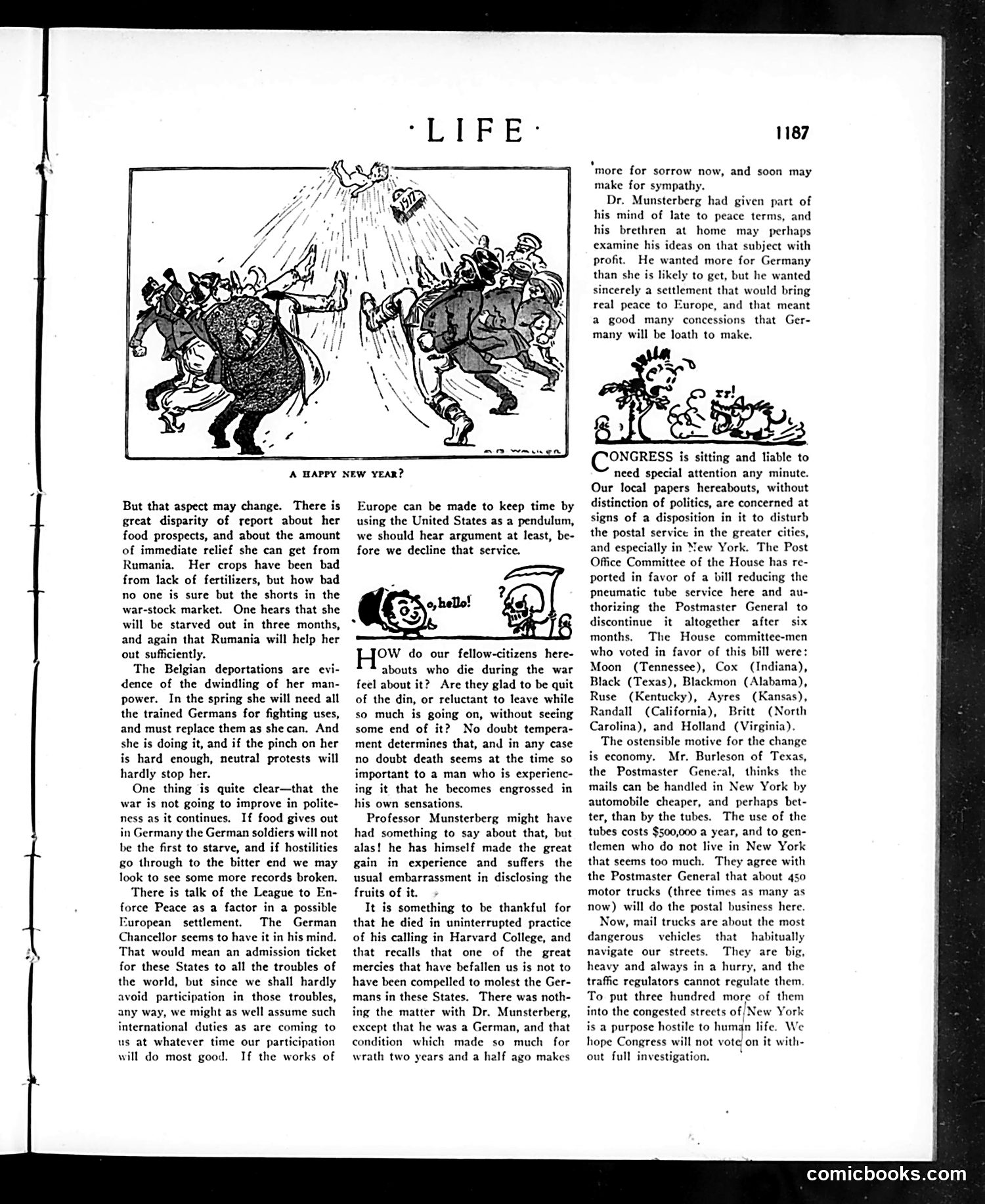
**The Cartoon "A Happy New Year?"** The main illustration satirizes WWI's brutality by depicting figures (likely representing warring nations) being violently shaken by a large hand from above—symbolizing fate or divine judgment. The title's question mark suggests bitter irony: there's nothing "happy" about the coming year given the war's escalating devastation. **Key Context:** The text discusses Germany's deteriorating situation: food shortages, forced Belgian deportations, and dwindling manpower. The article notes the war will become *less* polite and more brutal as desperation increases. The piece also mentions **Professor Munsterberg**, a German-American academic who recently died. Once viewed with suspicion as a German national during wartime, he's now regarded with sympathy. He had advocated for peace terms—though terms favorable to Germany that the Allies wouldn't accept. **The Satire's Point:** Life critiques how wartime transforms attitudes and brutality, suggesting America should engage constructively in peace-making rather than remain neutral, while observing that desperation makes nations increasingly willing to break ethical bounds.
📄 Transcribed text from this page (OCR, searchable)
Machine-transcribed from the original scan — historical spelling and the odd misread are preserved.
But that aspect may change. There is great disparity of report about her food prospects, and about the amount of immediate relief she can get from Rumania. Her crops have been bad from lack of fertilizers, but how bad no one is sure but the shorts in the war-stock market. One hears that she will be starved out in three months, and again that Rumania will help her out sufficiently, The Belgian deportations are evi- dence of the dwindling of her man- power. In the spring she will need all the trained Germans for fighting uses, and must replace them as she can. And she is doing it, and if the pinch on her is hard enough, neutral protests will hardly stop her. One thing is quite clear—that the war is not going to improve in polite- ness as it continues. If food gives out in Germany the German soldiers will not be the first to starve, and if hostilities go through to the bitter end we may look to see some more records broken. There is talk of the League to En- force Peace as a factor in a possible European settlement. The German Chancellor seems to have it in his mind. That would mean an admission ticket for these States to all the troubles of the world, but since we shall hardly avoid participation in those troubles, any way, we might as well assume such international duties as are coming to us at whatever time our participation will do most good. If the works of ‘A HAPPY NEW YEAR? Europe can be made to keep time by using the United States as a pendulum, we should hear argument at least, be- fore we decline that service. OW do our fellow-citizens here- abouts who die during the war feel about it? Are they glad to be quit of the din, or reluctant to leave while so much is going on, without seeing some end of it? No doubt tempera- ment determines that, and in any case no doubt death seems at the time so important to a man who is experienc- ing it that he becomes engrossed in his own sensations, Professor Munsterberg might have had something to say about that, but alas! he has himself made the great gain in experience and suffers the usual embarrassment in disclosing the fruits of it. It is something to be thankful for that he died in uninterrupted practice of his calling in Harvard College, and that recalls that one of the great mercies that have befallen us is not to have been compelled to molest the Ger- mans in these States. There was noth- ing the matter with Dr. Munsterberg, except that he was a German, and that condition which made so much for wrath two years and a half ago makes 1187 “more for sorrow now, and soon may make for sympathy. Dr. Munsterberg had given part of his mind of late to peace terms, and his brethren at home may perhaps examine his ideas on that subject with profit. He wanted more for Germany than she is likely to get, but he wanted sincerely a settlement that would bring real peace to Europe, and that meant a good many concessions that Ger- many will be loath to make. (CONGRESS is sitting and liable to need special attention any minute. Our local papers hereabouts, without distinction of politics, are concerned at signs of a disposition in it to disturb the postal service in the greater cities, and especially in New York. The Post Office Committee of the House has re- ported in favor of a bill reducing the pneumatic tube service here and au- thorizing the Postmaster General to discontinue it altogether after six months, The House committee-men who voted in favor of this bill were: Moon (Tennessee), Cox (Indiana), Black (Texas), Blackmon (Alabama), Ruse (Kentucky), Ayres (Kansas), Randall (California), Britt North Carolina), and Holland (Virginia). The ostensible motive for the change is economy. Mr. Burleson of Texas, the Postmaster Genezal, thinks the mails can be handled in New York by automobile cheaper, and perhaps bet- ter, than by the tubes. The use of the tubes costs $500,000 a year, and to gen- tlemen who do not live in New York that seems too much. They agree with the Postmaster General that about 450 motor trucks (three times as many as now) will do the postal business here. Now, mail trucks are about the most dangerous vehicles that habitually navigate our streets. They are big, heavy and always in a hurry, and the traffic regulators cannot regulate them To put three hundred more of them into the congested streets of New York is a purpose hostile to human life. We hope Congress will not vote on it with- out full investigation, comicbooks.com