
Life, 1916-12-28 · page 29 of 41
Life — December 28, 1916 — page 29: what you’re looking at
What you’re looking at
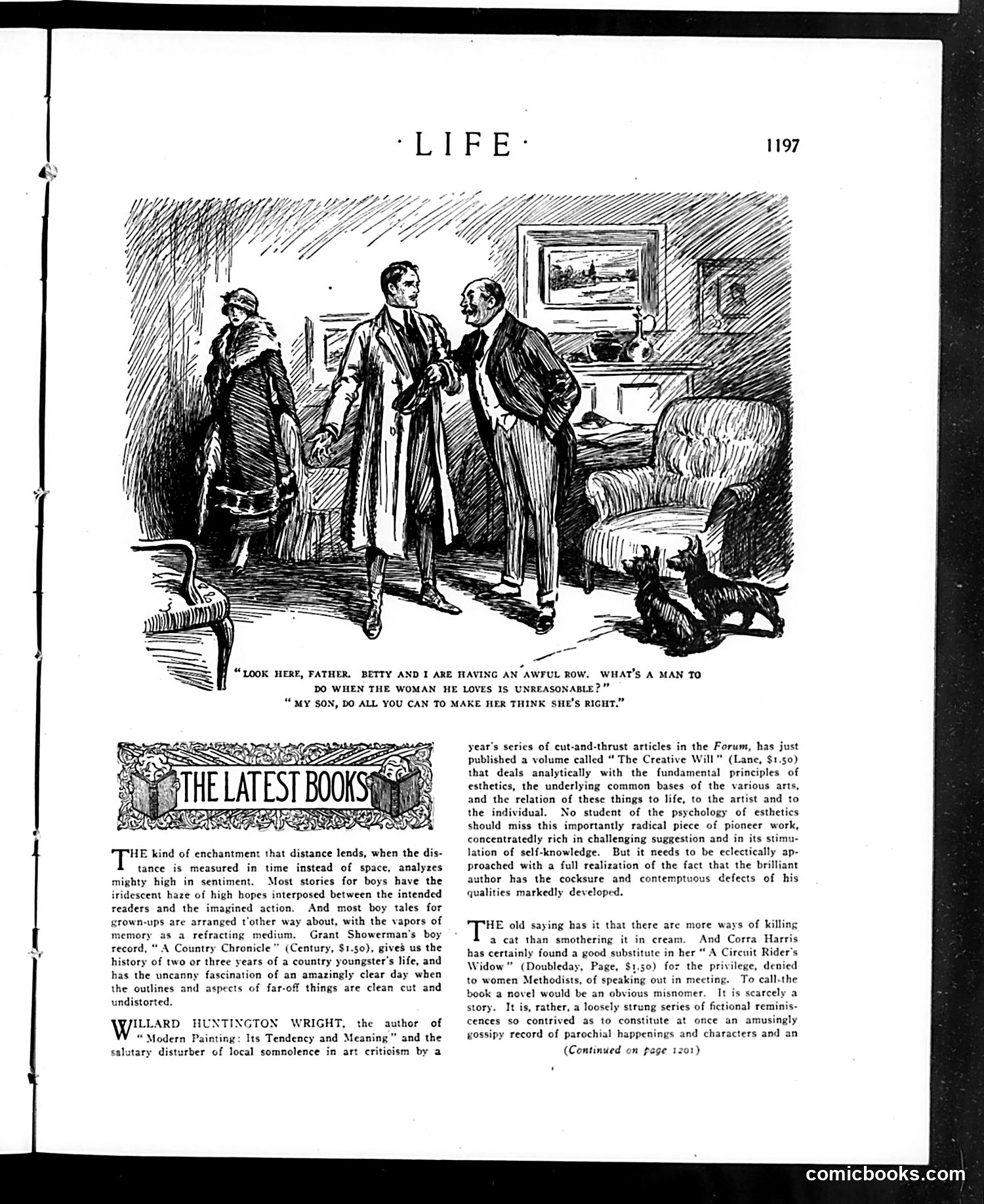
The main cartoon depicts a domestic dispute where a young man seeks his father's advice about his girlfriend Betty being "unreasonable." The father's cynical response—"do all you can to make her think she's right"—satirizes marital compromise and male strategy in relationships. The joke mocks the conventional wisdom that men should appease women by pretending to agree with them, suggesting this is manipulative rather than genuine partnership. The surrounding text reviews recent books, including works on art criticism and rural life. The page reflects early 20th-century attitudes about gender relations, where men's strategic accommodation of women's viewpoints was treated as humorous rather than respectful. The cartoon's humor relies on the audience recognizing this as standard domestic advice—cynical but widely accepted among men of the era.
📄 Transcribed text from this page (OCR, searchable)
Machine-transcribed from the original scan — historical spelling and the odd misread are preserved.
“LOOK HERE, FATHER. BETTY AND I ARE HAVING AN AWFUL ROW. WHAT'S A MAN TO DO WHEN THE WOMAN HE LOVES IS UNREASONABLE?" “MY SON, DO ALL YOU CAN TO MAKE HER THINK SHE'S RIGHT.” HE kind of enchantment that distance lends, when the dis- tance is measured in time instead of space, analyzes mighty high in sentiment. Most stories for boys have the iridescent haze of high hopes interposed between the intended readers and the imagined action. And most boy tales for grown-ups are arranged t‘other way about, with the vapors of memory as a refracting medium. Grant Showerman’s boy record, “A Country Chronicle” (Century, $1.50), gives us the history of two or three years of a country youngster's life, and has the uncanny fascination of an amazingly clear day when the outlines and aspects of far-off things are clean cut and undistorted. ILLARD HUNTINGTON WRIGHT, the author of Modern Painting: Its Tendency and Meaning” and the salutary disturber of local somnolence in art criticism by a year’s series of cut-and-thrust articles in the Forum, has just published a volume called “ The Creative Will” (Lane, $1.50) that deals analytically with the fundamental principles of esthetics, the underlying common bases of the various arts, and the relation of these things to life, to the artist and to the individual. No student of the psychology of esthetics should miss this importantly radical piece of pioneer work, concentratedly rich in challenging suggestion and in its stim! lation of self-knowledge. But it needs to be eclectically ap- proached with a full realization of the fact that the brilliant author has the cocksure and contemptuous defects of his qualities markedly developed. HE old saying has it that there are more ways of killing a cat than smothering it in cream. And Corra Harris has certainly found a good substitute in her “A Circuit Rider's Widow” (Doubleday, Page, $1.50) for the privilege, denied to women Methodists, of speaking out in meeting. To call-the book a novel would be an obvious misnomer. It is scarcely a story. It is, rather, a loosely strung series of fictional reminis- cences so contrived as to constitute at once an amusingly kossipy record of parochial happenings and characters and an (Continued on page 1201) comicbooks.com