
Life, 1916-12-28 · page 25 of 41
Life — December 28, 1916 — page 25: what you’re looking at
What you’re looking at
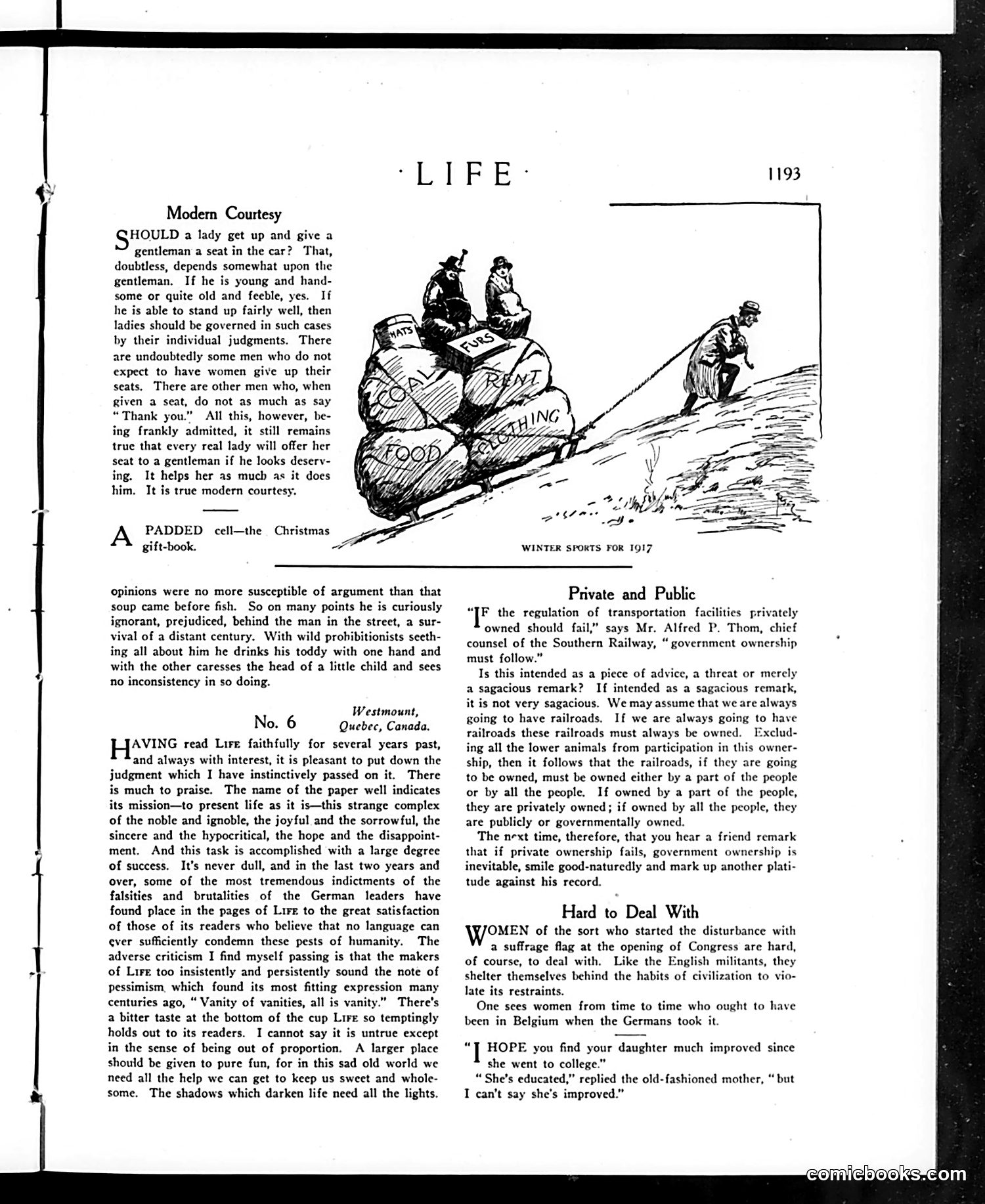
## The Cartoon The sketch titled "Winter Sports for 1917" depicts a figure sledding downhill laden with heavy bundles labeled "FOOD," "RENT," and "CLOTHING." Another figure appears to be struggling ahead on the slope. This satirizes the economic hardships of WWI-era America—civilians burdened by inflation and rising costs of basic necessities during wartime. ## Text Content The page discusses modern courtesy (whether women should yield subway seats based on gentlemen's appearance/ability), includes a book review of *Life* magazine praising its social commentary on German wartime "falsities and brutalities" while criticizing its pessimistic tone, and debates railroad ownership. The railroad discussion questions whether private rail regulation failure inevitably leads to government ownership—essentially mocking a railway executive's veiled threat that unless private companies self-regulate, nationalization becomes unavoidable. **Context**: This reflects 1917 anxieties about wartime resource scarcity, regulatory debates during industrial expansion, and America's ideological tensions regarding private enterprise versus public control.
📄 Transcribed text from this page (OCR, searchable)
Machine-transcribed from the original scan — historical spelling and the odd misread are preserved.
es “LIFE: 1193 Modern Courtesy SHOULD a lady get up and give a gentleman a seat in the car? That, doubtless, depends somewhat upon the gentleman. If he is young and hand- some or quite old and feeble, yes. If he is able to stand up fairly well, then ladies should be governed in such cases by their individual judgments. There are undoubtedly some men who do not expect to have women give up their seats, There are other men who, when given a seat, do not as much as say “Thank you.” All this, however, be- ing frankly admitted, it still remains true that every real lady will offer her seat to a gentleman if he looks deserv- ing. It helps her as much as it does him. It is true modern courtesy. PADDED cell—the Christmas gift-book. a7 WINTER SPORTS FOR 1917 opinions were no more susceptible of argument than that soup came before fish. So on many points he is curiously ignorant, prejudiced, behind the man in the street, a sur- vival of a distant century. With wild prohibitionists seeth- ing all about him he drinks his toddy with one hand and with the other caresses the head of a little child and sees no inconsistency in so doing. Westmount, No. 6 Quebec, Canada. Havine read Lire faithfully for several years past, and always with interest, it is pleasant to put down the judgment which I have instinctively passed on it. There is much to praise. The name of the paper well indicates its mission—to present life as it is—this strange complex of the noble and ignoble, the joyful and the sorrowful, the sincere and the hypocritical, the hope and the disappoint- ment. And this task is accomplished with a large degree of success. It’s never dull, and in the last two years and over, some of the most tremendous indictments of the falsities and brutalities of the German leaders have found place in the pages of Lire to the great satisfaction of those of its readers who believe that no language can ever sufficiently condemn these pests of humanity. The adverse criticism I find myself passing is that the makers of Lire too insistently and persistently sound the note of pessimism, which found its most fitting expression many centuries ago, “ Vanity of vanities, all is vanity.” There's a bitter taste at the bottom of the cup Lire so temptingly holds out to its readers. I cannot say it is untrue except in the sense of being out of proportion. A larger place should be given to pure fun, for in this sad old world we need all the help we can get to keep us sweet and whole- some. The shadows which darken life need all the lights. Private and Public “[F the regulation of transportation facilities privately owned should fail,” says Mr. Alfred P. Thom, chief counsel of the Southern Railway, “ government ownership must follow.” Is this intended as a piece of advice, a threat or merely a sagacious remark? If intended as a sagacious remark, it is not very sagacious. We may assume that we are always going to have railroads. If we are always going to have railroads these railroads must always be owned. Exclud- ing all the lower animals from participation in this owner- ship, then it follows that the railroads, if they are going to be owned, must be owned either by a part of the people or by all the people. If owned by a part of the people, they are privately owned; if owned by all the people, they are publicly or governmentally owned. The next time, therefore, that you hear a friend remark that if private ownership fails, government ownership is inevitable, smile good-naturedly and mark up another plati- tude against his record. Hard to Deal With (OMEN of the sort who started the disturbance with a suffrage flag at the opening of Congress are hard, of course, to deal with. Like the English militants, they shelter themselves behind the habits of civilization to vio- late its restraints. One sees women from time to time who ought to have been in Belgium when the Germans took it. | HOPE you find your daughter much improved since she went to college.” “She's educated,” replied the old-fashioned mother, “ but I can’t say she's improved.”