
Life, 1916-12-28 · page 11 of 41
Life — December 28, 1916 — page 11: what you’re looking at
What you’re looking at
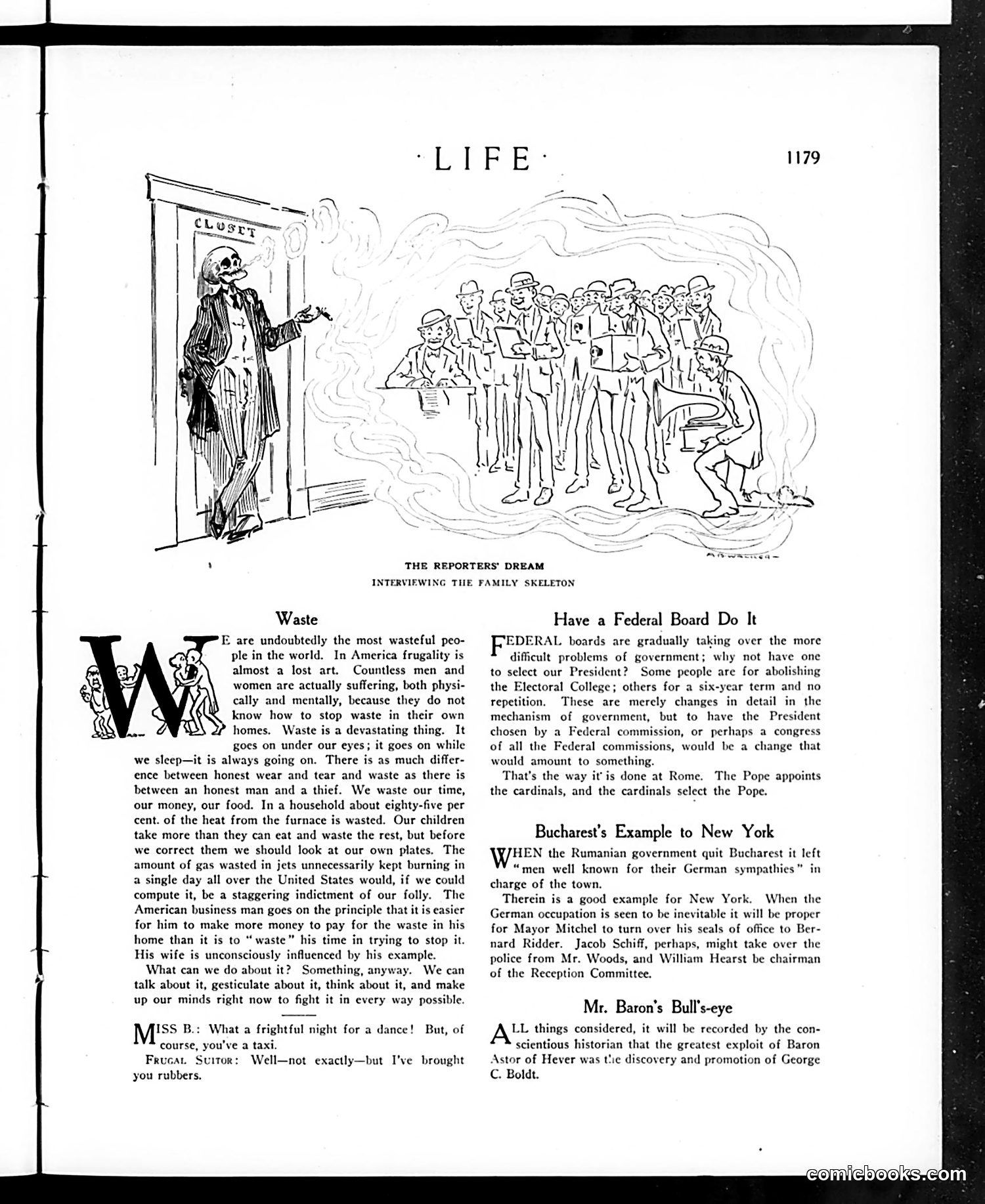
**The Main Cartoon**: "The Reporters' Dream—Interviewing the Family Skeleton" depicts Death (skeletal figure at a closet door) with a group of reporters eagerly approaching. The satire mocks journalists' sensationalism—they're desperate to expose society's hidden scandals ("family skeletons," meaning shameful secrets). **The Articles** discuss: - **"Waste"**: Criticizes American wastefulness in homes, food, and utilities - **"Have a Federal Board Do It"**: Satirizes bureaucratic solutions to governance problems, suggesting Federal boards proliferate without solving issues - **"Bucharest's Example"**: References Romania's government changes (likely post-WWI) - **"Mr. Baron's Bull's-eye"**: Praises historian George C. Boldt's work on Baron von Hexer The page reflects post-WWI American concerns: waste, government efficiency, and international politics.
📄 Transcribed text from this page (OCR, searchable)
Machine-transcribed from the original scan — historical spelling and the odd misread are preserved.
THE REPORTERS’ DREAM INTERVIEWING THE FAMILY SKELETON Waste E are undoubtedly the most wasteful peo- ple in the world. In America frugality is almost a lost art. Countless men and women are actually suffering, both physi- cally and mentally, because they do not know how to stop waste in their own homes. Waste is a devastating thing. It goes on under our eyes; it goes on while we sleep—it is always going on. There is as much differ- ence between honest wear and tear and waste as there is between an honest man and a thief. We waste our time, our money, our food. In a household about eighty-five per cent. of the heat from the furnace is wasted. Our children take more than they can eat and waste the rest, but before we correct them we should look at our own plates, The amount of gas wasted in jets unnecessarily kept burning in a single day all over the United States would, if we could compute it, be a staggering indictment of our folly. The American business man goes on the principle that it is easier for him to make more money to pay for the waste in his home than it is to “waste” his time in trying to stop it. His wife is unconsciously influenced by his example. What can we do about it? Something, anyway. We can talk about it, gesticulate about it, think about it, and make up our minds right now to fight it in every way possible. ISS B.: What a frightful night for a dance! But, of course, you've a taxi. Frucat. Suitor: Well—not exactly—but I've brought you rubbers. Have a Federal Board Do It DERAL boards are gradually taking over the more difficult problems of government; why not have one to select our President? Some people are for abolishing the Electoral College; others for a six-year term and no repetition. These are merely changes in detail in the mechanism of government, but to have the President chosen by a Federal commission, or perhaps a congress of all the Federal commissions, would be a change that would amount to something. That’s the way it is done at Rome. The Pope appoints the cardinals, and the cardinals select the Pope. Bucharest’s Example to New York HEN the Rumanian government quit Bucharest it left “men well known for their German sympathies” in charge of the town. Therein is a good example for New York. When the German occupation is seen to be inevitable it will be proper for Mayor Mitchel to turn over his seals of office to Ber- nard Ridder. Jacob Schiff, perhaps, might take over the police from Mr. Woods, and William Hearst be chairman of the Reception Committee. Mr. Baron's Bull's-eye LL things considered, it will be recorded by the con- scientious historian that the greatest exploit of Baron Astor of Hever was tlic discovery and promotion of George C. Boldt.