
Life, 1916-12-28 · page 18 of 41
Life — December 28, 1916 — page 18: what you’re looking at
What you’re looking at
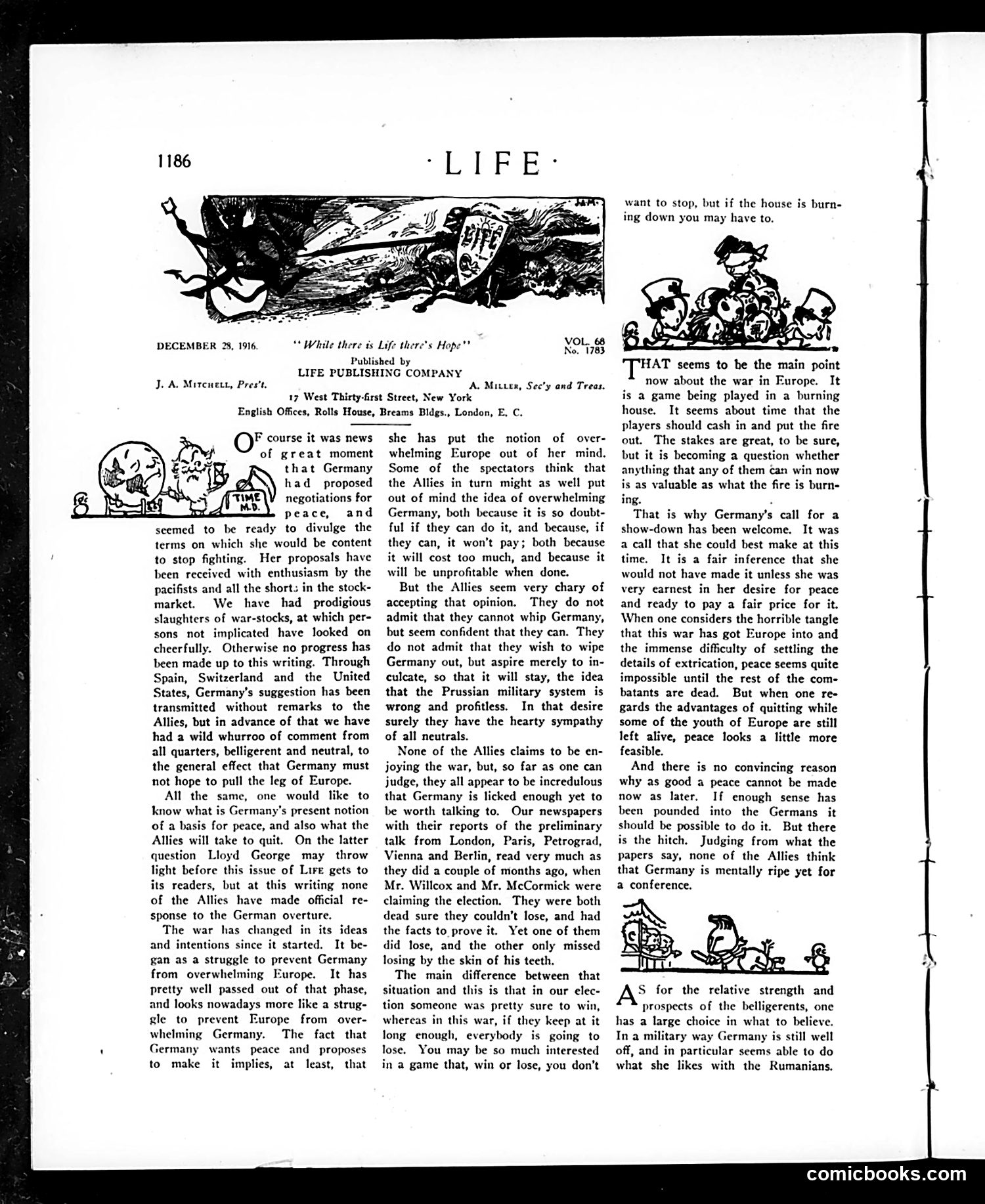
This editorial discusses Germany's peace overtures during World War I. The author argues that while the Allies claim confidence in defeating Germany, the war has evolved from preventing German dominance into potentially seeking to overwhelm Germany itself—a costly, likely unprofitable goal. The central satirical point appears in the final section: the ongoing war is like a game played in a "burning house." Players are so invested in winning that they ignore the structure itself is collapsing. The author compares this to a recent U.S. election (likely 1916) where candidates were equally certain of victory—yet one lost narrowly. The difference, crucially: in elections someone must win, but in prolonged war, "everybody is going to lose." The cartoons (small illustrations visible) appear to reinforce themes of conflict and consequence, though specific figures are unclear in reproduction. The piece advocates negotiated peace, suggesting Germany's willingness to discuss terms indicates changed war aims, making continued fighting increasingly irrational.
📄 Transcribed text from this page (OCR, searchable)
Machine-transcribed from the original scan — historical spelling and the odd misread are preserved.
DECEMBER 28, 1916. “While there ts Life there's ie OL. lope No. 1783 Published by LIFE PUBLISHING COMPANY J. A. Mitcnett, Pres’t. F course it was news of great moment that Germany had_ proposed negotiations for peace, and seemed to be ready to divulge the terms on which she would be content to stop fighting. Her proposals have been received with enthusiasm by the pacifists and all the short. in the stock- market. We have had prodigious slaughters of war-stocks, at which per- sons not implicated have looked on cheerfully. Otherwise no progress has been made up to this writing. Through Spain, Switzerland and the United States, Germany's suggestion has been transmitted without remarks to the Allies, but in advance of that we have had a wild whurroo of comment from all quarters, belligerent and neutral, to the general effect that Germany must not hope to pull the leg of Europe. All the same, one would like to know what is Germany’s present notion of a basis for peace, and also what the Allies will take to quit. On the latter question Lloyd George may throw light before this issue of Lire gets to its readers, but at this writing none of the Allies have made official re- sponse to the German overture. The war has changed in its ide: and intentions since it started. It be- gan as a struggle to prevent Germany from overwhelming Europe. It has pretty well passed out of that phase, and looks nowadays more like a strug- gle to prevent Europe from over- whelming Germany. The fact that Germany wants peace and proposes to make it implies, at least, that A. Mitts, Sec’y and Treas. 17 West Thirty-first Street, New York English Offices, Rolls House, Breams Bldgs., London, E, C. she has put the notion of over- whelming Europe out of her mind. Some of the spectators think that the Allies in turn might as well put out of mind the idea of overwhelming Germany, both because it is so doubt- ful if they can do it, and because, if they can, it won't pay; both because it will cost too much, and because it will be unprofitable when done. But the Allies seem very chary of accepting that opinion. They do not admit that they cannot whip Germany, but seem confident that they can. They do not admit that they wish to wipe Germany out, but aspire merely to in- culcate, so that it will stay, the idea that the Prussian military system is wrong and profitless. In that desire surely they have the hearty sympathy of all neutrals. None of the Allies claims to be en- joying the war, but, so far as one can judge, they all appear to be incredulous that Germany is licked enough yet to be worth talking to. Our newspapers with their reports of the preliminary talk from London, Paris, Petrograd, Vienna and Berlin, read very much as they did a couple of months ago, when Mr. Willcox and Mr. McCormick were claiming the election. They were both dead sure they couldn’t lose, and had the facts to prove it. Yet one of them did lose, and the other only missed losing by the skin of his teeth. The main difference between that situation and this is that in our elec- tion someone was pretty sure to win, whereas in this war, if they keep at it long enough, everybody is going to lose. You may be so much interested in a game that, win or lose, you don’t want to stop, but if the house is burn- ing down you may have to. AT seems to he the main point now about the war in Europe. It is a game being played in a burning house. It seems about time that the players should cash in and put the fire out. The stakes are great, to be sure, but it is becoming a question whether anything that any of them can win now is as valuable as what the fire is burn ing. * That is why Germany's call for a show-down has been welcome. It was a call that she could best make at this time. It is a fair inference that she would not have made it unless she was very earnest in her desire for peace and ready to pay a fair price for it. When one considers the horrible tangle that this war has got Europe into and the immense difficulty of settling the details of extrication, peace seems quite impossible until the rest of the com- batants are dead. But when one re- gards the advantages of quitting while some of the youth of Europe are still left alive, peace looks a little more feasible. And there is no convincing reason why as good a peace cannot be made now as later. If enough sense has been pounded into the Germans it should be possible to do it. But there is the hitch. Judging from what the Papers say, none of the Allies think that Germany is mentally ripe yet for a conference. S for the relative strength and prospects of the belligerents, one has a large choice in what to believe. In a military way Germany is still well off, and in particular seems able to do what she likes with the Rumanians. comicbooks.com