
Life, 1916-12-28 · page 36 of 41
Life — December 28, 1916 — page 36: what you’re looking at
What you’re looking at
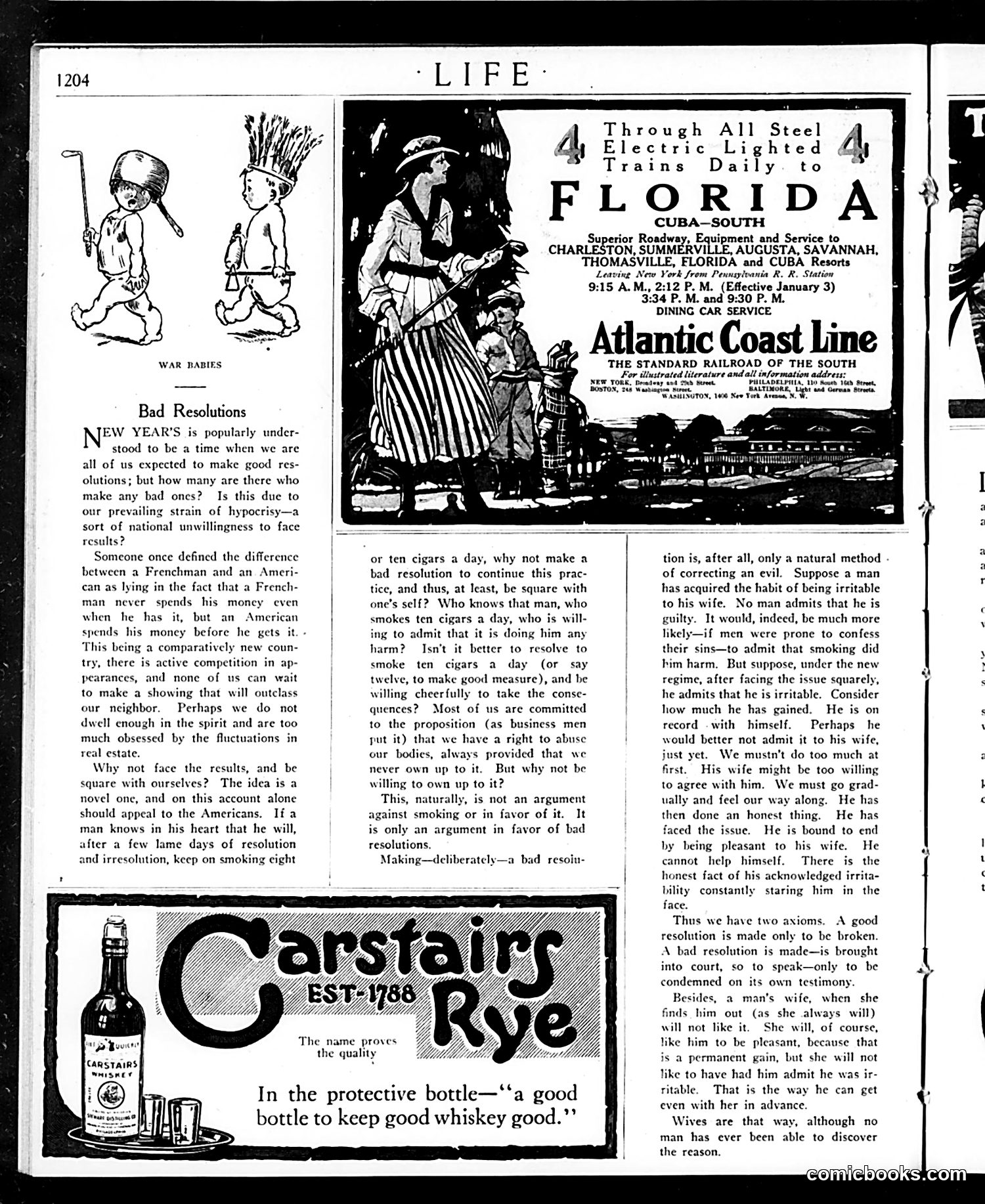
The cartoon labeled "War Babies" depicts two infants in military dress—likely referencing children born during or after World War I, satirizing how society might militarize or politicize the next generation. The accompanying essay "Bad Resolutions" is a New Year's commentary mocking American hypocrisy about self-improvement. It argues that rather than pretend to quit vices (smoking ten cigars daily), men should honestly *resolve to continue* them—at least admitting the truth to themselves. The satire targets masculine pretense: husbands claiming they'll reform but never doing so, then denying harm to their wives. The piece ironically suggests that openly acknowledging one's faults (irritability, smoking) is morally superior to self-deception, even if reform never follows. It reflects early-20th-century American anxieties about commercialism, masculine honor, and the gap between public respectability and private behavior. The Carstairs Rye whiskey advertisement below reinforces the era's acceptance of alcohol consumption (pre-Prohibition context, likely 1920).
📄 Transcribed text from this page (OCR, searchable)
Machine-transcribed from the original scan — historical spelling and the odd misread are preserved.
Through All Steel Electrie~Lighted a." Trains Daily. to FLORIDA CUBA—SOUTH Superior Roadway, Equipment and Service to CHARLESTON, SUMMERVI AUGUSTA, SAVANNAH, THOMASVILLE, FLORIDA and CUBA Resorts Leaving New York from Pennsyloania R. R. Station 9:15 A.M., 2:12 P.M. (Effective January 3) 3:34 P. M. and 9:30 P. M. DINING CAR SERVICE, Atlantic Coast Line THE STANDARD RAILROAD OF THE SOUTH For illustrated literature and all information address: KEW TORK, Dradeay asd 2b Street BosTox, 244 W ‘sere, get and Gareas WASTSUTON, 1406 New Tork. Avenan X. WAR BABIES. Bad Resolutions NEW YEAR’S is popularly under- stood to be a time when we are all of us expected to make good res- olutions; but how many are there who make any bad ones? Is this due to our prevailing strain of hypocrisy—a sort of national unwillingness to face results? Someone once defined the difference between a Frenchman and an Ameri- can as lying in the fact that a French- man never spends his money en when he has it, but an American spends his money before he gets it. « This being a comparatively new coun- try, there is active competition in ap- pearances, and none of us can wait to make a showing that will outclass our neighbor. Perhaps we do not dwell enough in the spirit and are too much obsessed by the fluctuations in real estate. Why not face the results, and be square with ourselv The idea is a novel one, and on this account alone should appeal to the Americans. If a man knows in his heart that he will, after a few lame days of resolution and irresolution, keep on smoking eight or ten cigars a day, why not make a bad resolution to continue this prac- tice, and thus, at least, be square with one’s self? Who knows that man, who smokes ten cigars a day, who is will- ing to admit that it is doing him any harm? Isn't it better to resolve to smoke ten cigars a day (or say twelve, to make good measure), and be willing cheerfully to take the conse- quences? Most of us are committed to the proposition (as business men put it) that we have a right to abuse our bodies, always provided that we never own up to it. But why not be willing to own up to it? Fi ly, is not an argument against smoking or in favor of it. It is only an argument in favor of bad resolutions, Making—dcliberately—a bad resoiu- TTL. Yj, Yy r188 | The name proves the quality In the protective bottle—‘‘a good bottle to keep good whiskey good.”’ tion is, after all, only a natural method of correcting an evil. Suppose a man has acquired the habit of being irritable to his wife. No man admits that he is guilty. It would, indeed, be much more if men were prone to confess their sins—to admit that smoking did him harm. But suppose, under the new regime, after facing the issue squarely, he admits that he is irritable. Consider low much he has gained. He is on record -with himself. Perhaps he would better not admit it to his wife, just yet. We mustn't do too much at first. His wife might be too willing to agree with him. We must go grad- ually and feel our way along. He has then done an honest thing. He has faced the issue. He is bound to end by being pleasant to his wife. He cannot help himself. There is the honest fact of his acknowledged irrita- bility constantly staring him in the face. Thus we have two axioms. A good resolution is made only to be broken. A bad resolution is made—is brought into court, so to speak—only to be condemned on its own testimony. Besides, a man’s wife, when she finds him out (as she always will) will not like it. She will, of course, like him to be pleasant, because that is a permanent gain, but she will not like to have had him admit he was ir- ritable. That is the way he can get even with her in advance. Wives are that way, although no man has ever been able to discover the reason.