
Life, 1916-12-28 · page 22 of 41
Life — December 28, 1916 — page 22: what you’re looking at
What you’re looking at
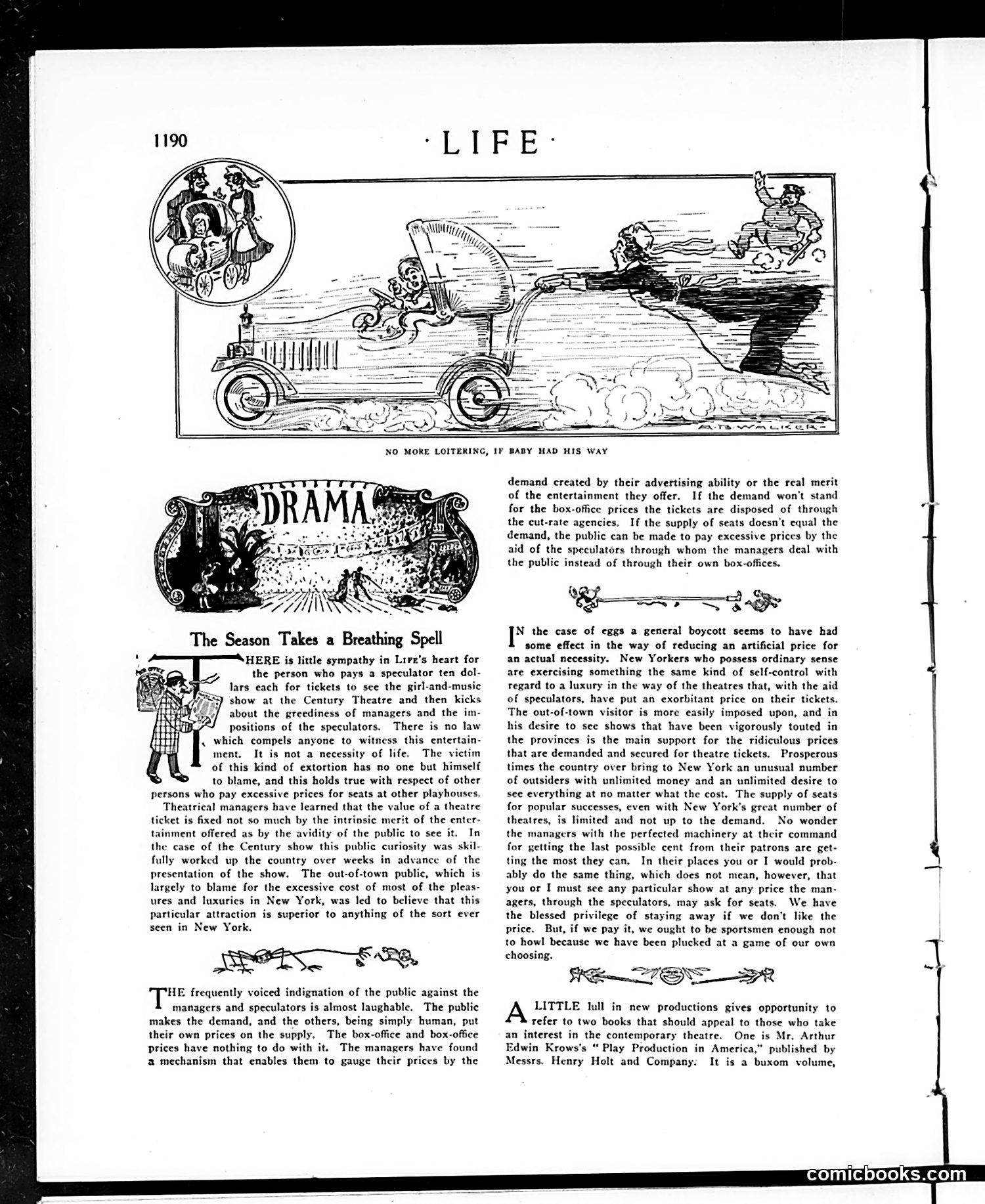
The top cartoon depicts a speeding automobile with a baby at the wheel, driven erratically while an adult passenger holds on desperately. The caption "NO MORE LOITERING, IF BABY HAD HIS WAY" appears to be a humorous commentary on reckless driving or impatient behavior. The accompanying article attacks theatrical ticket speculation, particularly regarding a show at the Century Theatre. The author argues that out-of-town visitors with disposable income artificially inflate ticket prices through their eagerness to see heavily-advertised productions. Rather than blaming speculators and theater managers, the writer criticizes the *public* for creating demand through their own choices and then complaining about high prices. The article draws a parallel to egg boycotts, suggesting consumers could exercise self-control. The satirical point: audiences willing to pay inflated prices have no legitimate grievance—they're "plucked at a game of our own choosing."
📄 Transcribed text from this page (OCR, searchable)
Machine-transcribed from the original scan — historical spelling and the odd misread are preserved.
NO MORE LOITERING, IF BABY HAD HIS WAY HERE is little sympathy in Lirr’s heart for the person who pays a speculator ten dol- lars each for tickets to see the girl-and-music show at the Century Theatre and then kicks about the greediness of managers and the im- positions of the speculators. There is no law « which compels anyone to witness this entertain- ment. It is not a necessity of life. The victim of this kind of extortion has no one but himself to blame, and this holds true with respect of other persons who pay excessive prices for seats at other playhouses. Theatrical managers have learned that the value of a theatre ticket is fixed not so much by the intrinsic merit of the enter- tainment offered as by the avidity of the public to see it, In the case of the Century show this public curiosity was skil- fully worked up the country over weeks in advance of the presentation of the show. The out-of-town public, which is largely to blame for the excessive cost of most of the pleas- ures and luxuries in New York, was led to believe that this particular attraction is superior to anything of the sort ever seen in New York. seetss Fee. HE frequently voiced indignation of the public against the managers and speculators is almost laughable. The public makes the demand, and the others, being simply human, put their own prices on the supply. The box-office and box-office prices have nothing to do with it. The managers have found a mechanism that enables them to gauge their prices by the demand created by their advertising ability or the real merit of the entertainment they offer. If the demand won't stand for the box-office prices the tickets are disposed of through the cut-rate agencies. If the supply of seats doesn’t equal the demand, the public can be made to pay excessive prices by the aid of the speculators through whom the managers deal with the public instead of through their own box-offices. N the case of eggs a general boycott seems to have had some effect in the way of reducing an artificial price for an actual necessity. New Yorkers who possess ordinary sense are exercising something the same kind of self-control with regard to a luxury in the way of the theatres that, with the aid of speculators, have put an exorbitant price on their ticket The out-of-town visitor is more easily imposed upon, and in his desire to see shows that have been vigorously touted in the provinces is the main support for the ridiculous prices that are demanded and secured for theatre tickets. Prosperous times the country over bring to New York an unusual number of outsiders with unlimited money and an unlimited desire to see everything at no matter what the cost. The supply of seats for popular successes, even with New York's great number of theatres, is limited and not up to the demand. No wonder the managers with the perfected machinery at their command for getting the last possible cent from their patrons are get- ting the most they can. In their places you or I would prob- ably do the same thing, which does not mean, however, that you or I must see any particular show at any price the man- agers, through the speculators, may ask for seats. We have the blessed privilege of staying away if we don’t like the price. But, if we pay it, we ought to be sportsmen enough not to howl because we have been plucked at a game of our own choosing. RELIES LITTLE lull in new productions gives opportunity to refer to two books that should appeal to those who take an interest in the contemporary theatre. One Mr. Arthur Edwin Krows’s “ Play Production in Americ: published by Messrs. Henry Holt and Company. It is a buxom volume, comicbooks.com