
Life, 1916-12-28 · page 23 of 41
Life — December 28, 1916 — page 23: what you’re looking at
What you’re looking at
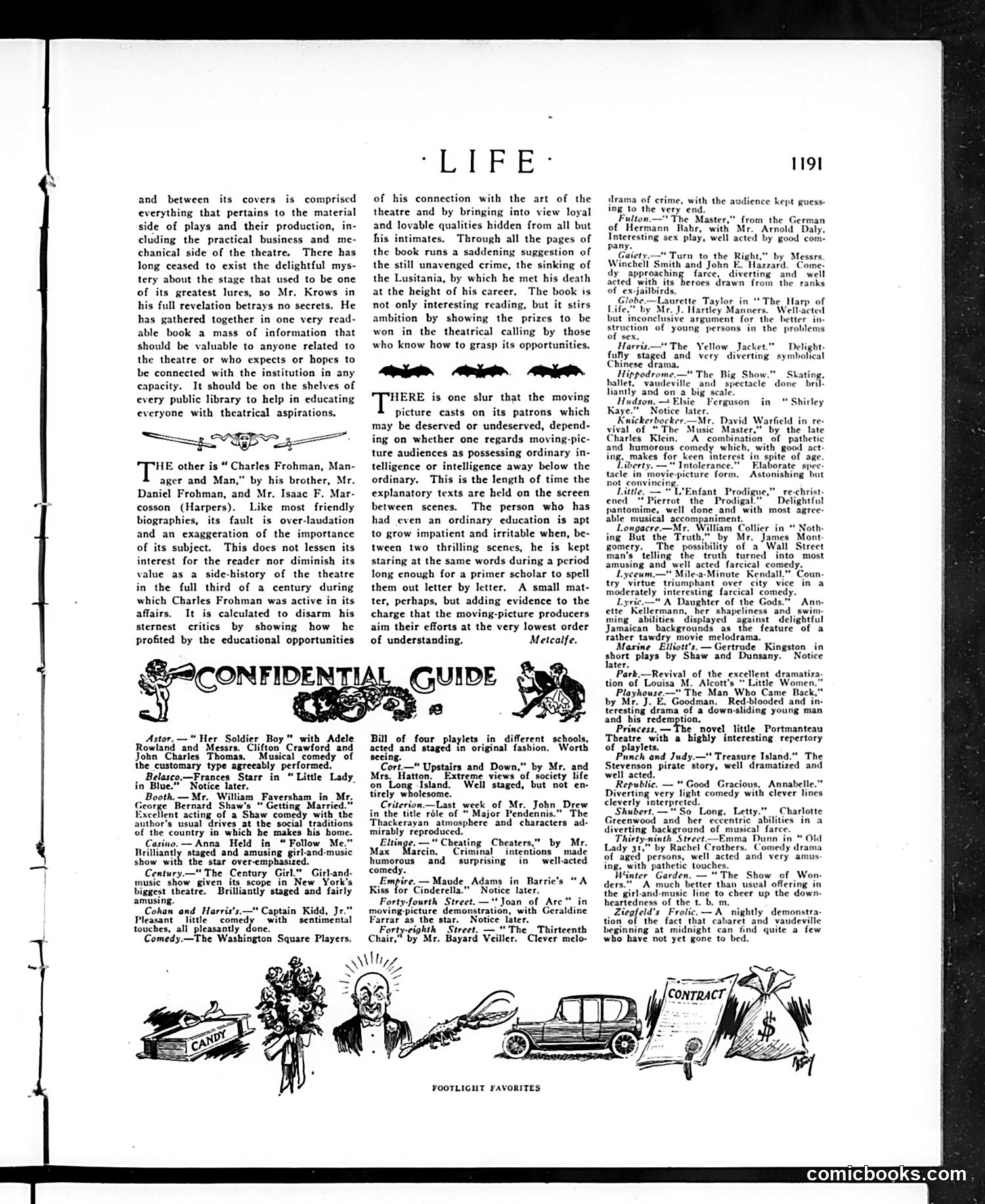
This page is primarily **theater and film reviews** rather than political cartoons. The small illustrations at the bottom labeled "Footlight Favorites" are decorative vignettes (candy box, jester, man's face, car, contract) representing entertainment themes—not satirical commentary. The substantive content critiques **early cinema's treatment of audiences**. Critic Metcalfe argues that moving pictures insult viewers by leaving explanatory text on-screen too long between scenes, implying producers assume audiences possess "intelligence away below the ordinary." This reflects early 20th-century anxieties about cinema as a "low" medium compared to theater. The page also reviews several Broadway productions, notably Shaw's "Getting Married" at the Booth Theatre, praised for its social critique. The reviews mention Charles Frohman's biography, referencing his death on the Lusitania (1915), dating this page to approximately 1916.
📄 Transcribed text from this page (OCR, searchable)
Machine-transcribed from the original scan — historical spelling and the odd misread are preserved.
| fy and between its covers is comprised everything that pertains to the material side of plays and their production, in- cluding the practical business and me- chanical side of the theatre. There has long ceased to exist the delightful mys- tery about the stage that used to be one of its greatest lures, so Mr. Krows in his full revelation betrays no secrets. He has gathered together in one very read- able book a mass of information that should be valuable to anyone related to the theatre or who expects or hopes to be connected with the institution in any capacity. It should be on the shelves of every public library to help in educating everyone with theatrical aspirations, 'HE other is “ Charles Frohman, Man- ager and Man,” by his brother, Mr. Daniel Frohman, and Mr. Isaac F. Mar- cosson (Harpers). Like most friendly biographies, its fault is over-laudation and an exaggeration of the importance of its subject. This does not lessen its interest for the reader nor diminish its value as a side-history of the theatre in the full third of a century during which Charles Frohman was active in its affairs. It is calculated to disarm his sternest critics by showing how he profited by the educational opportunities Astor. —“ Her Soldier Boy” with Adele Rowland and Messrs. Clifton Crawford and John Charles Thomas. Musical comedy of the customary type agreeably performed. Belasco.—Frances Starr in “Little Lady in Blue.” Notice later. Booth. — Mr. William Faversham in Mr, George Bernard Shaw's “ Getting Married.” Excellent acting of a Shaw comedy with the author's usual drives at the social traditions of the country in which he makes his home. Casino. — Anna Held in “ Follow M Brilliantly staged and amusing girl-and-m' show with the star overemphasized. Century—" The Century Girl.” Girland- music show given its scope in New York's biggest ‘theatre. Brilliantly staged and fairly amusing. Cohan and Harris's.—"* Captain Kidd, Jr.” Pleasant little comed: with sentimental touches, all pleasantly done. Comedy.—The Washington Square Players. ic oI ESE * of his connection with the art of the theatre and by bringing into view loyal and lovable qualities hidden from all but his intimates. Through all the pages of the book runs a saddening suggestion of the still unavenged crime, the sinking of the Lusitania, by which he met his death s career. The book is not only interesting reading, but it stirs ambition by showing the prizes to be won in the theatrical calling by those who know how to grasp its opportunities. Re ee wie 'HERE is one slur that the moving picture casts on its patrons which may be deserved or undeserved, depend- ing on whether one regards moving- ture audiences as possessing ordinary in- telligence or intelligence away below the ordinary. This is the length of time the explanatory texts are held on the screen between scenes. The person who has had even an ordinary education is apt to grow impatient and irritable when, be- tween two thrilling scenes, he is kept staring at the same words during a period long enough for a primer scholar to spell them out letter by letter. A small mat- ter, perhaps, but adding evidence to the charge that the moving-picture producers aim their efforts at the very lowest order of understanding. Metcalfe. Bill of four playlets in different schools, acted and st in original fashion. Worth seeing. Cort.—" Upstairs and Down,” by Mr. and Mrs. Hatton. Extreme views ‘of society life on Long -Island. Well staged, but not en- tirely wholesome. Criterion.—Last_ week of Mr. John, Drew in the title réle of “ Major Pendennis.” The Thackerayan atmosphere and characters ad- mirably reproduced. Eltinge, —"* Che Cheaters,” by Mr. Max. Marcin, Criminal intentions ” made humorous and surprising in well-acted comedy. Empire, — Maude, Adams in Barrie's “A i derella.” Notice later. Joan of Arc” in moving-picture demonstration, with Geraldine Farrar as the star. Notice later. Forty-eighth Street. — “The Thirteenth Chair,” by Mr. Bayard Veiller. Clever melo- fourth Street. FOOTLIGHT FAVORITES 1191 drama of crime, with the audience kept guess: ing to the very’ end. Fulton.—* The Master,” from the German of Hermann Bahr, with Mr. Arnold’ Daly. Interesting sex play, well acted by good com: pan, iety.—* Turn to the Right,” by Messrs Winchell Smith and John E. Hazzard. Come- dy approachi farce, diverting and well acted with its heroes drawn fro the ranks. of ex-jailbirds. be-—Laurette Taylor in “The Harp of Life.” by Mr. J, Hartley Manners. Well: but inconclusive argument for the hetter struction of young persons in the probl of sex. Harris.—" The Yellow Jacket.” Delight: fully staged and very diverting symbolical Chinese drama, Hippodrome.—" The Big Show. hallet, vaudeville and liantly and on a big scale. Hudson, — Elsie Ferguson in“ Shirley Kaye.” Notice later. Knickerbocker. David Wa ree vival of “The Music Master,” by the late Charles Klein. “A combination. of pathetic and humorous comedy which, with good act- ing,, makes for heen interest in spite of age iberty. —"* Intolerance.” Elaborate spec: tacle in movie-picture form. Astonishing but not convine ns % . L’Enfant, Prodigue,”_re-christ ened Pierrot the Prodigal. Delightfat pantomime, well done and with most agrce- able musical accom; Longacre.—Mr. William Collier in “ Noth- ing But the Troth,” by Mr. James Mont gomery. The possibility of a Wall Street man’s telling the truth turned into most amusing and well acted farcical comedy. Lyceum,—" Mile-a-Minute Kendall." Coun- try virtue triumphant over city vice in a moderately interesting farcical comedy. Lyric.—" A Daughter of the Gods.” Ann: cette Kellermann, ber shapeliness and swim: ming abilities displayed against delightful Jamaican backgrounds as the feature of a Tather tawdry movie melodrama. Maxine Elliott's. — Gertrude Kingston in ghort plays by Shaw and Dunsany.” Notice ter. Park.—Revival of the excellent dramatiza, tion of Louisa M. Alcott’s “ Little Women.” Playhouse —" The Man Who Came Back,” by Mr. J. E. Goodman. Red-blooded and in- teresting drama of a down-sliding young man and his redemption. Princess. —The ‘novel little Portmanteau Theatre with a highly interesting repertory of playlets. Punch and Judy.— Treasure Island.” The Stevenson pirate story, well dramatized and well acted. Republic. — “ Good Gracious, Annabelle.” Diverting very light comedy with clever lines cleverly interpreted. Shubert.—"So Long, Letty.” Charlotte Greenwood and her eccentric abilities in a diverting background of musical fare Thirty-ninth Street-—Emma Dunn in “ Old Lady 31,” by Rachel Crothers. Comedy drai of aged’ persons, well acted and very amus ing, with pathetic touches. Vitinter Garden. — "The Show of Won: ders.” “A much better than usval offering in the girl-and-music line to cheer up the down- heartedness of the t. bm, Ziegfeld’s Frolic. — A nightly demonstra- tion of the fact that cabaret and vaudeville beginning at midnight can find quite a few who have not yet gone to bed. comicbooks.com