
A complete issue · 40 pages · 1916
Life — November 9, 1916
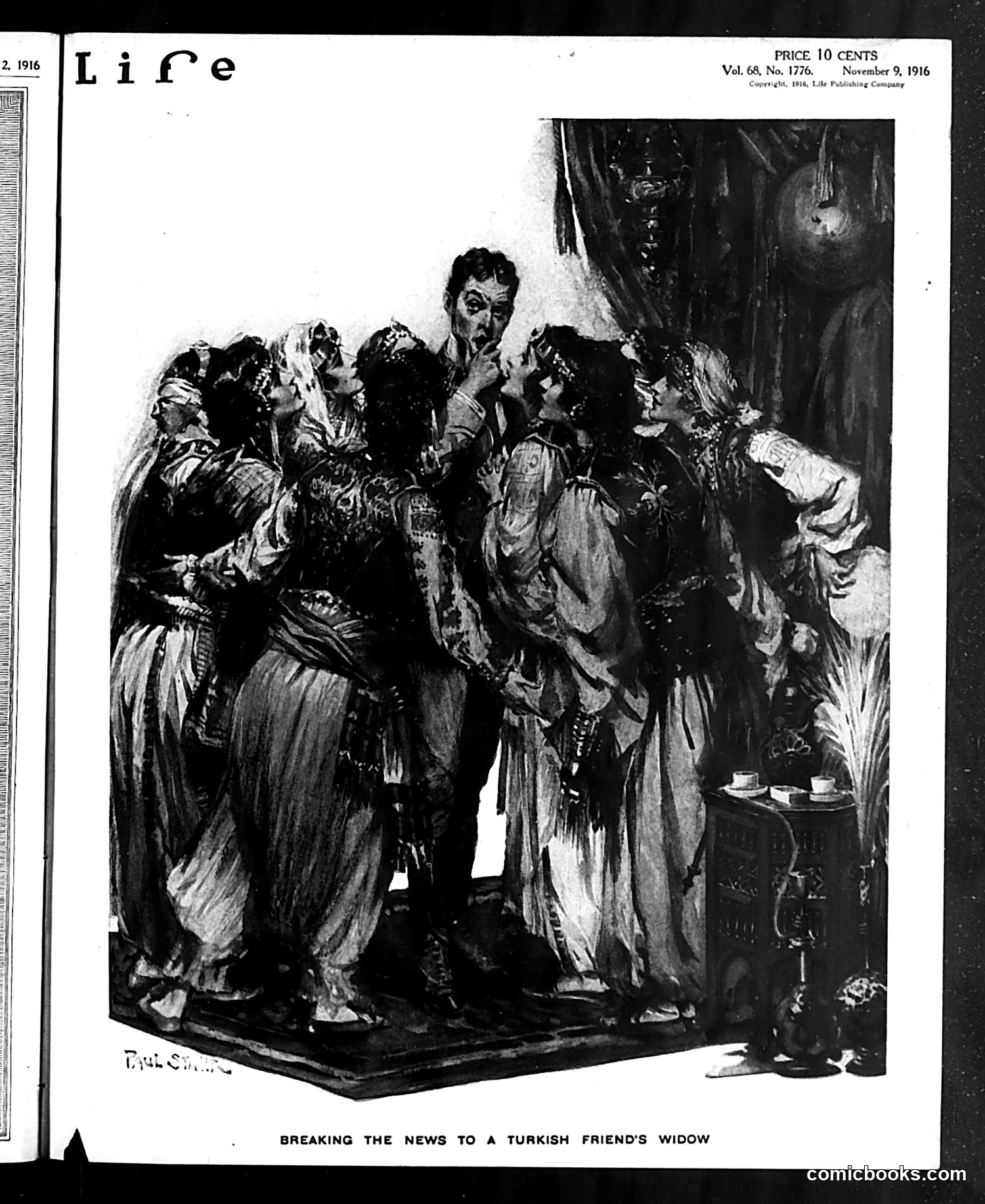
This November 1916 illustration depicts a somber scene during World War I. The caption indicates someone (likely a military official or messenger) is delivering tragic news to a Turkish widow—presumably informing her of her husband's death in combat. The drawing emphasizes the emotional weight of the moment through the gathered, grief-stricken women surrounding the central figure. The style suggests this is commentary on the human cost of the war, which Turkey had joined on the side of the Central Powers in 1914. The satirical point appears to be about the war's devastating impact on civilians and families across all nations involved, treating the subject with tragic rather than mocking tone.
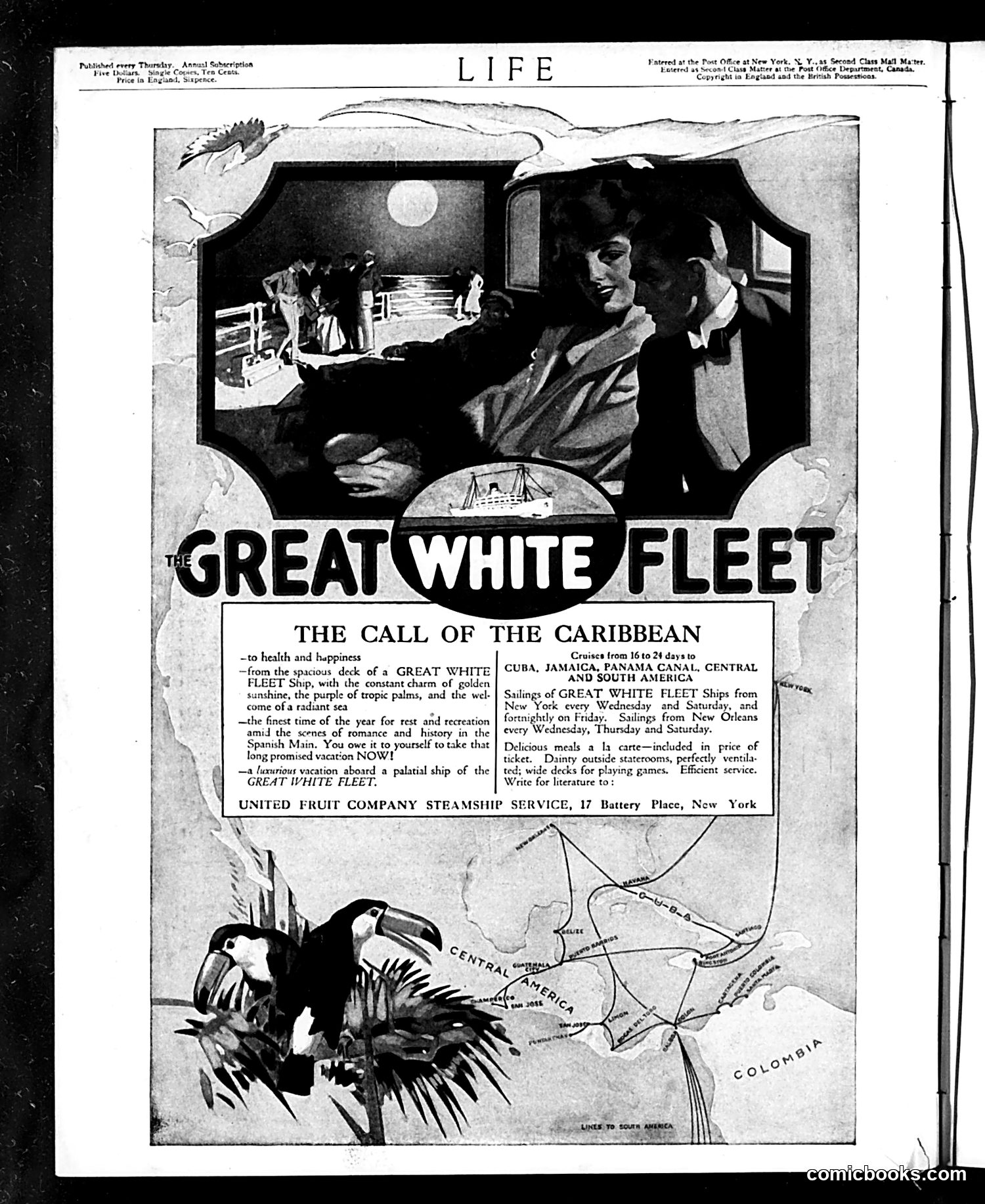
This page is primarily **advertising, not satire**. It's a cruise advertisement for the Great White Fleet, operated by United Fruit Company Steamship Service. The image shows two men in a ship's cabin looking toward a moonlit seascape, promoting Caribbean cruises departing from New York to Cuba, Jamaica, Panama Canal, and Central/South America. The advertisement emphasizes leisure—"rest and recreation," romance, history, and "delicious meals à la carte." The small map at bottom illustrates the cruise route. The toucan illustration adds exotic appeal. This represents early 20th-century leisure travel marketing to affluent American audiences, promoting tropical vacations as accessible luxury experiences. No political commentary is apparent—it's straightforward commercial promotion.
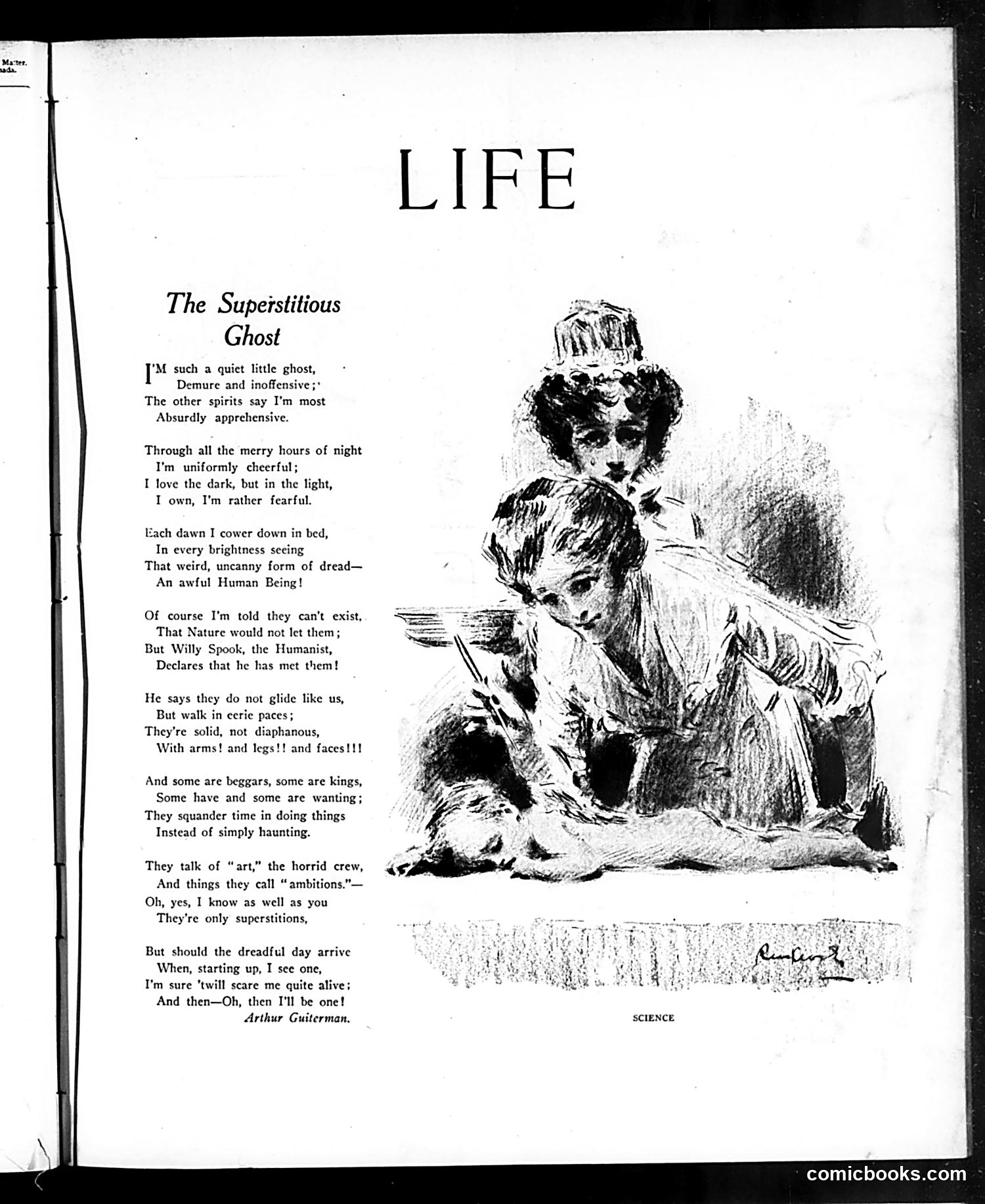
This satirical poem mocks the contradiction between ghosts' supposed existence and scientific rationalism. The ghost narrator claims to be "quiet" and "inoffensive," yet admits to being "rather fearful" and dreading human beings. The satire targets believers in spiritualism (referenced through "Willy Spook, the Humanist") who claimed to have encountered ghosts, contradicting scientific consensus that ghosts don't exist. The poem ridicules these spiritualists for describing ghosts as having physical forms—"solid, not diaphanous, / With arm! and legs! and faces!!!"—while simultaneously claiming ghosts are supernatural beings. The accompanying sketch shows a woman and child encountering a ghostly figure, visualizing the poem's ironic premise: a ghost anxious about meeting humans, the very beings it supposedly haunts.
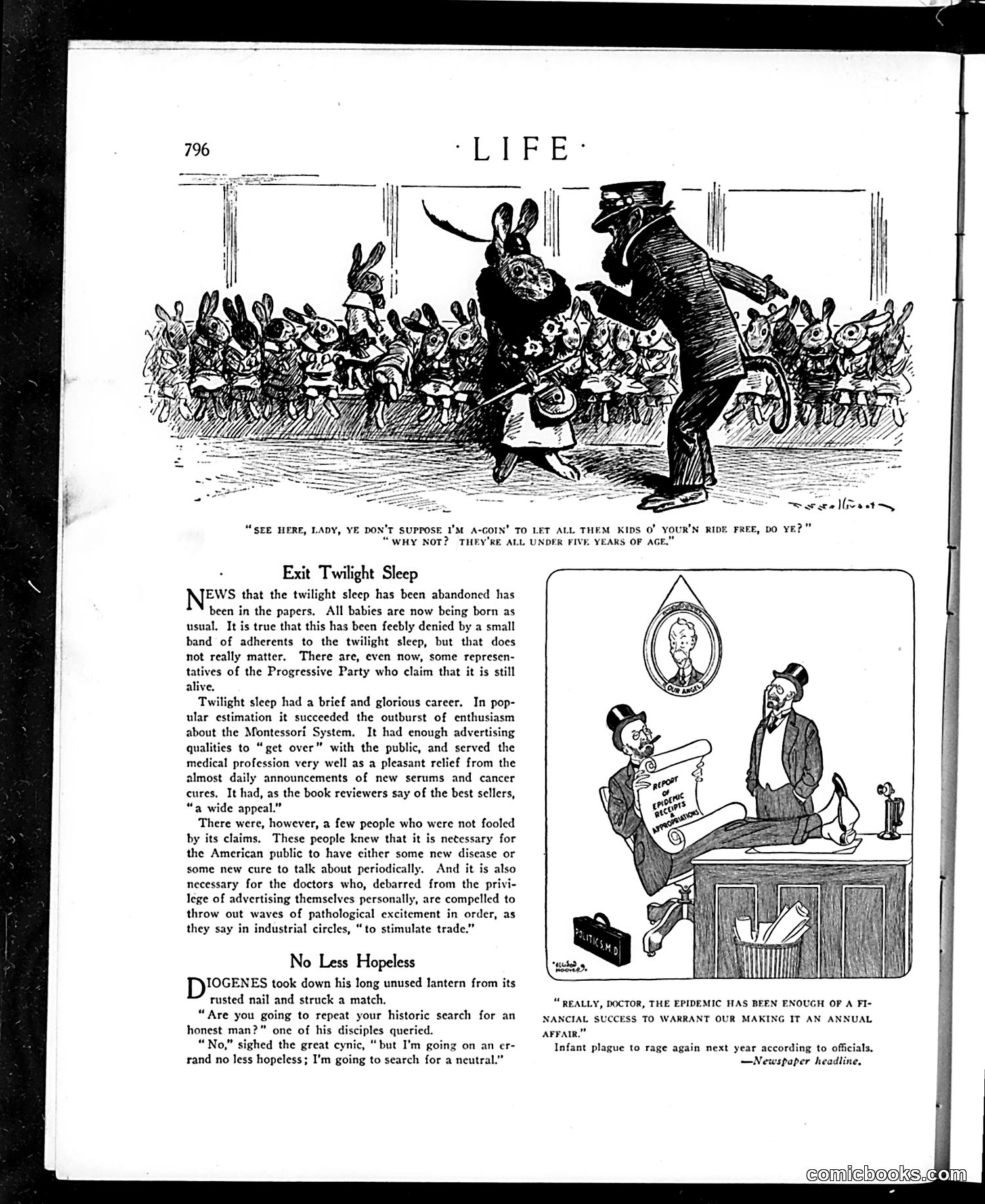
**Top Cartoon:** A uniformed official (appearing to be a police or military figure) addresses a crowd of rabbits, discussing whether children can ride them. This satirizes the "Progressive Party" and specifically mocks the Montessori educational method's popularity among progressives—suggesting their ideas are as absurd as letting children ride rabbits. **"Exit Twilight Sleep" Section:** Satirizes the abandonment of "twilight sleep" (a childbirth anesthesia trend). The text mocks how medical professionals and advertisers promoted it as revolutionary, then quietly dropped it. The accompanying cartoon shows a doctor pitching the epidemic as a financial success story—critiquing how medical marketers manufacture enthusiasm for treatments regardless of actual efficacy. The satire targets Progressive Era medical commercialism and faddish "scientific" trends.
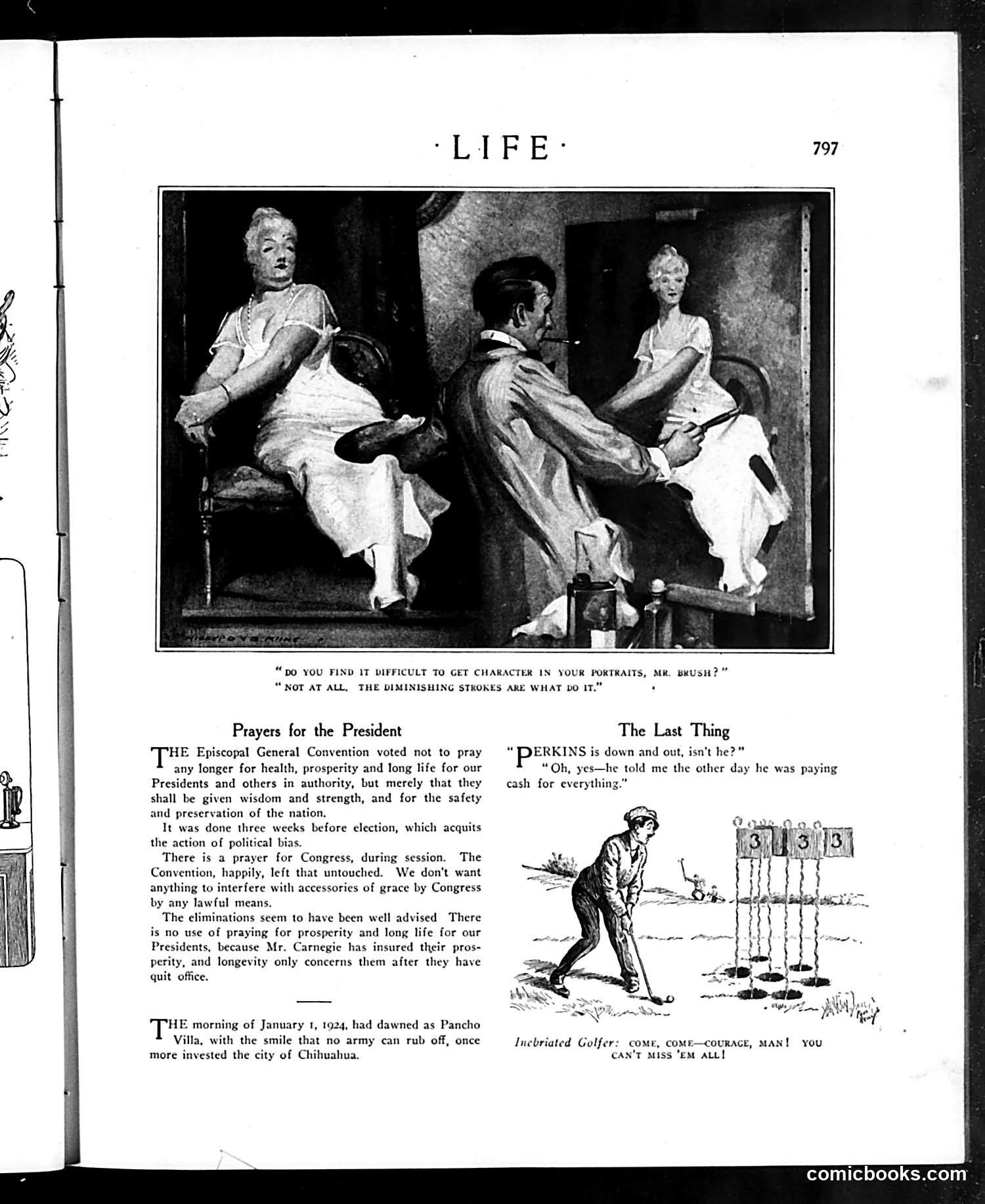
**Top Photograph:** Shows an artist at work with two female models. The caption quotes the artist saying character is difficult to capture—"the diminishing strokes are what do it." This appears to be commentary on portraiture technique rather than political satire. **"Prayers for the President":** Discusses an Episcopal General Convention's decision not to pray specifically for presidential health or prosperity, only for wisdom and national safety. The text argues this was wise, as praying for long life after leaving office would be inappropriate—likely referencing Andrew Carnegie's recent death and wealth accumulation concerns. **"The Last Thing":** A brief joke about someone paying cash for everything, with an unrelated golf cartoon below. The page mixes social commentary with light humor rather than sharp political satire.
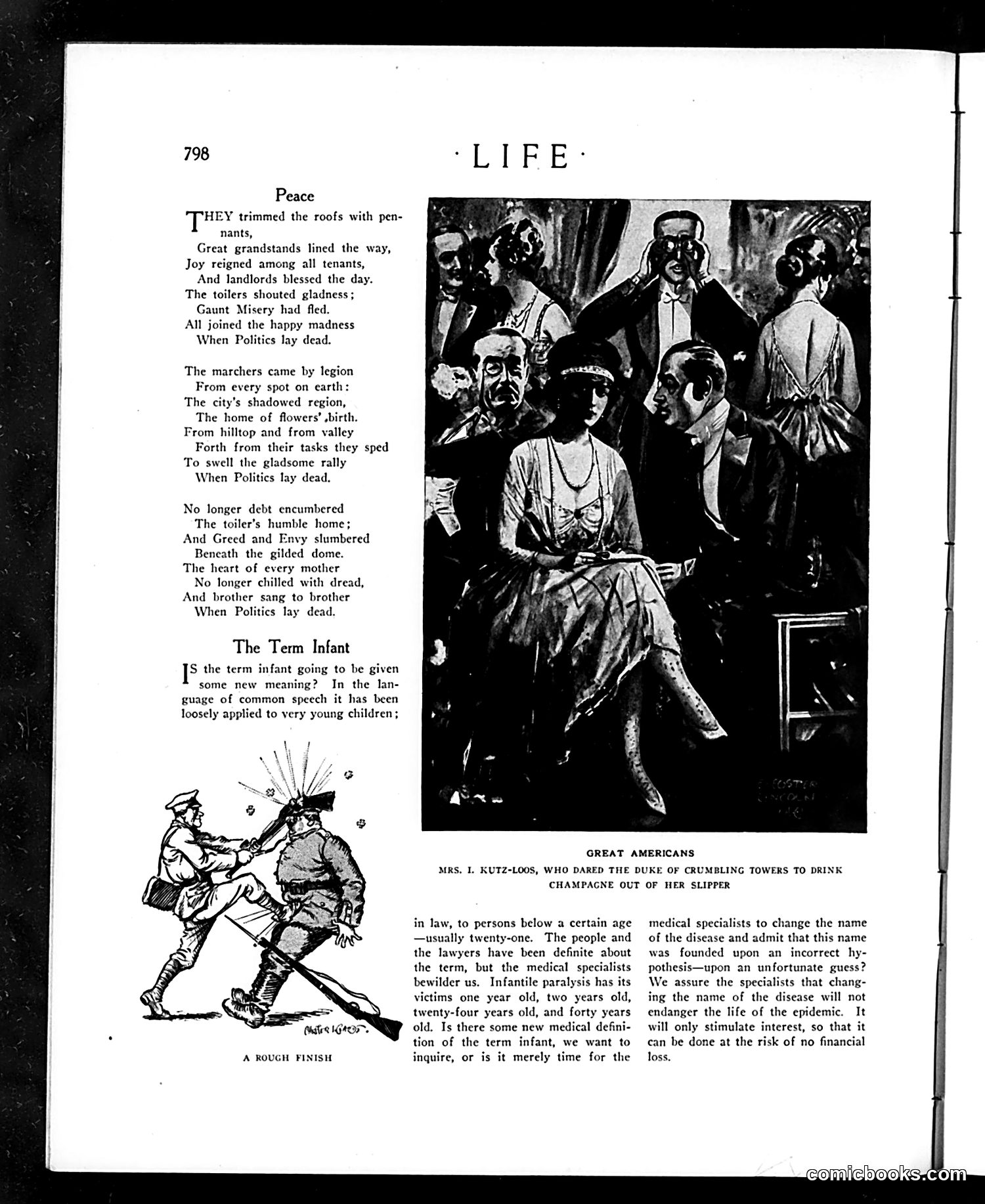
**"Peace" Poem & Main Illustration:** The poem celebrates peace following what appears to be WWI's end, depicting societal relief when "Politics lay dead"—tenants, landlords, and the poor all finding joy together. **"Great Americans" Photograph:** The caption references "Mrs. I. Kutz-Loos, who dared the Duke of Crumbling Towers to drink champagne out of her slipper"—likely a humorous society-page item mocking aristocratic pretension and nouveau riche Americans' fascination with European nobility. **"A Rough Finish" Cartoon:** Two figures engaged in combat, one appearing to be a soldier. The meaning is unclear without additional context, though it may reference post-war struggles or labor disputes common in 1920s America. The page blends satirical poetry, society mockery, and political cartooning typical of Life's format.
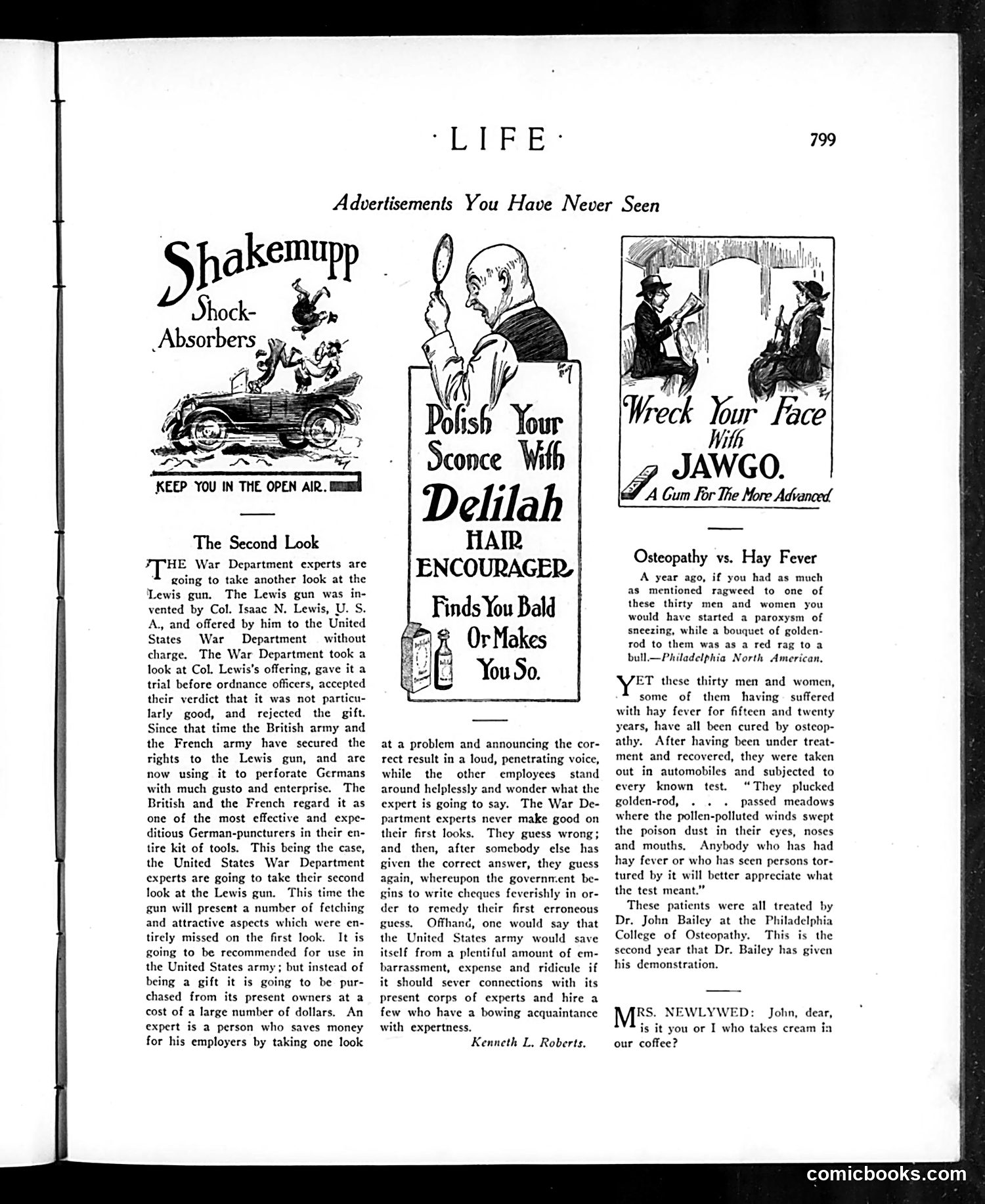
This page contains **fake advertisements** satirizing contemporary products and social issues. **"Shakemupp Shock-Absorbers"** mocks automotive technology with absurd imagery of cars bouncing chaotically—likely satirizing exaggerated marketing claims about new suspension systems. **"Delilah Hair Encouraged"** ridicules hair loss remedies by suggesting the product makes you bald (referencing the biblical Delilah who caused Samson's downfall). The pun "Or-Makes You So" suggests false advertising. **"Wrack Your Face with JAWGO"** parodies gum advertisements by showing destructive outcomes instead of benefits. The **"Osteopathy vs. Hay Fever"** article describes a dubious medical treatment claiming osteopathy cured hay fever patients, reflecting contemporary skepticism about alternative medicine's inflated claims. These pieces mock early 20th-century advertising's exaggerated health and product claims.
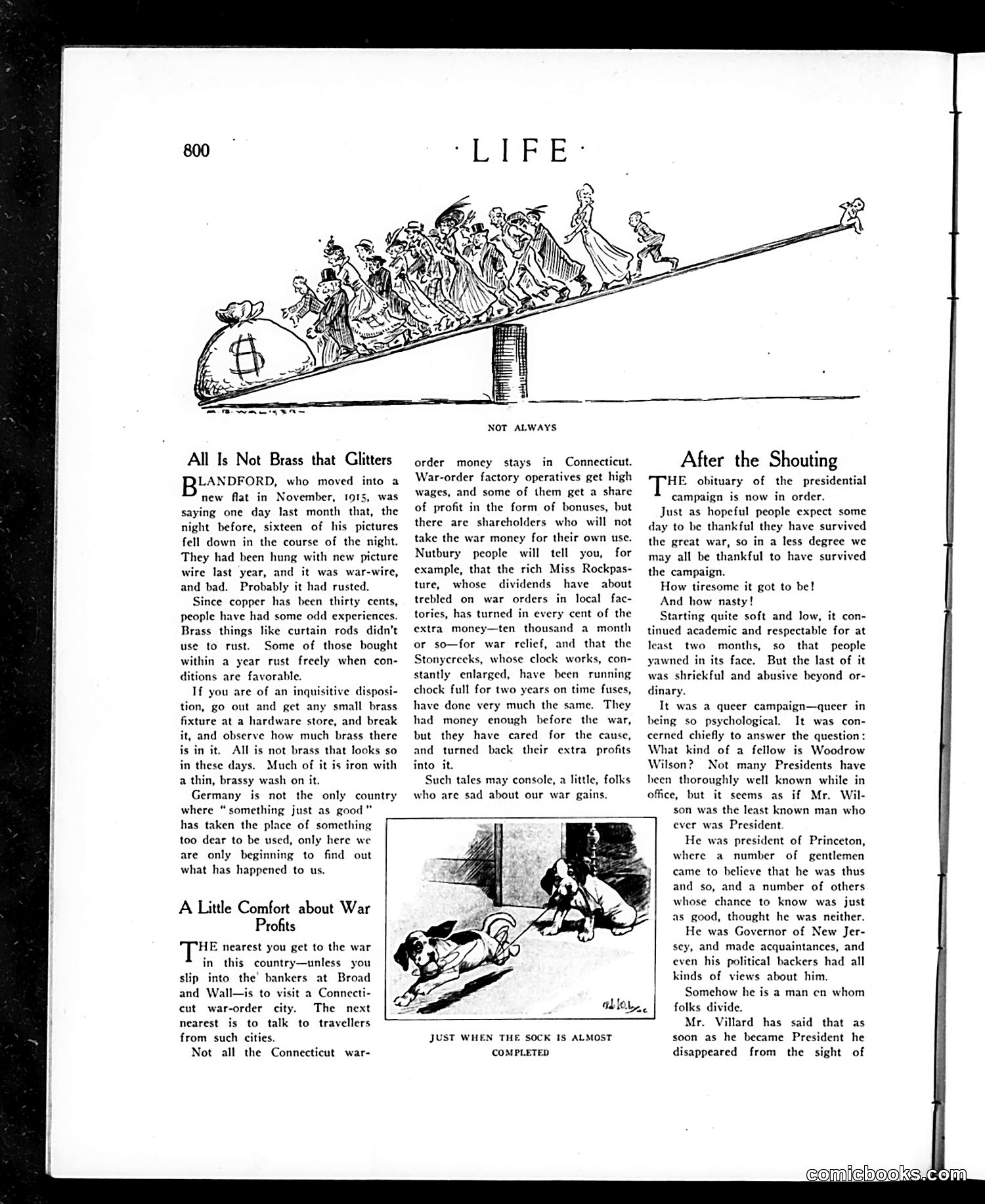
**Main Cartoon ("Not Always")**: A seesaw depicts people (representing the public) on one end balanced against a money bag on the other, illustrating how wartime profits tip the scales of social balance. **Articles Discussed**: 1. **"All Is Not Brass that Glitters"**: Critiques war profiteering, describing how Connecticut factory workers and shareholders grew wealthy from war contracts while ordinary people suffered deprivation. 2. **"A Little Comfort about War Profits"** and **"After the Shooting"**: Discusses President Woodrow Wilson's relative obscurity and anonymity compared to other political figures, suggesting he deliberately distanced himself from public view during his presidency. The page satirizes wartime economic inequality and questions Wilson's leadership visibility.
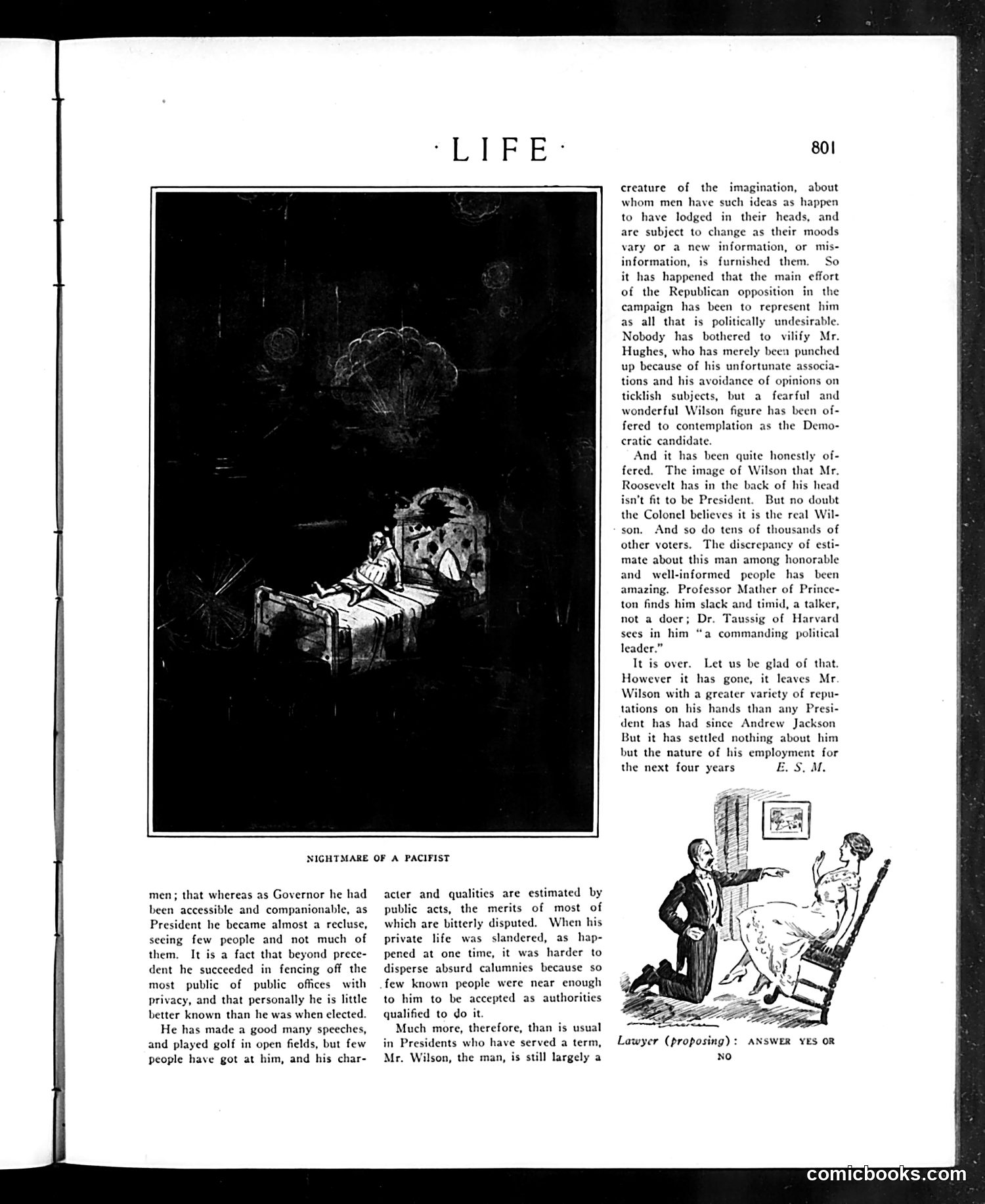
**Main Image**: "Nightmare of a Pacifist" shows a figure in bed experiencing a nightmare, likely depicting anxieties about pacifism during wartime. **Text Content**: The article discusses Woodrow Wilson's political reputation following his presidential campaign. It mentions that Wilson has been portrayed negatively by Republican opponents as an undesirable figure, with comparisons to Theodore Roosevelt. The piece notes Wilson was seen as "slack and timid" and lacking leadership qualities by critics. **The Cartoon Below**: Shows a lawyer proposing to a woman, with the caption "Answer Yes or No"—a simple visual joke about the difficulty of getting a direct answer, possibly satirizing Wilson's own tendency toward ambiguity on political issues. **Context**: This appears from the 1912 campaign period when Wilson faced criticism for his positions on preparedness and foreign policy before America's WWI involvement.
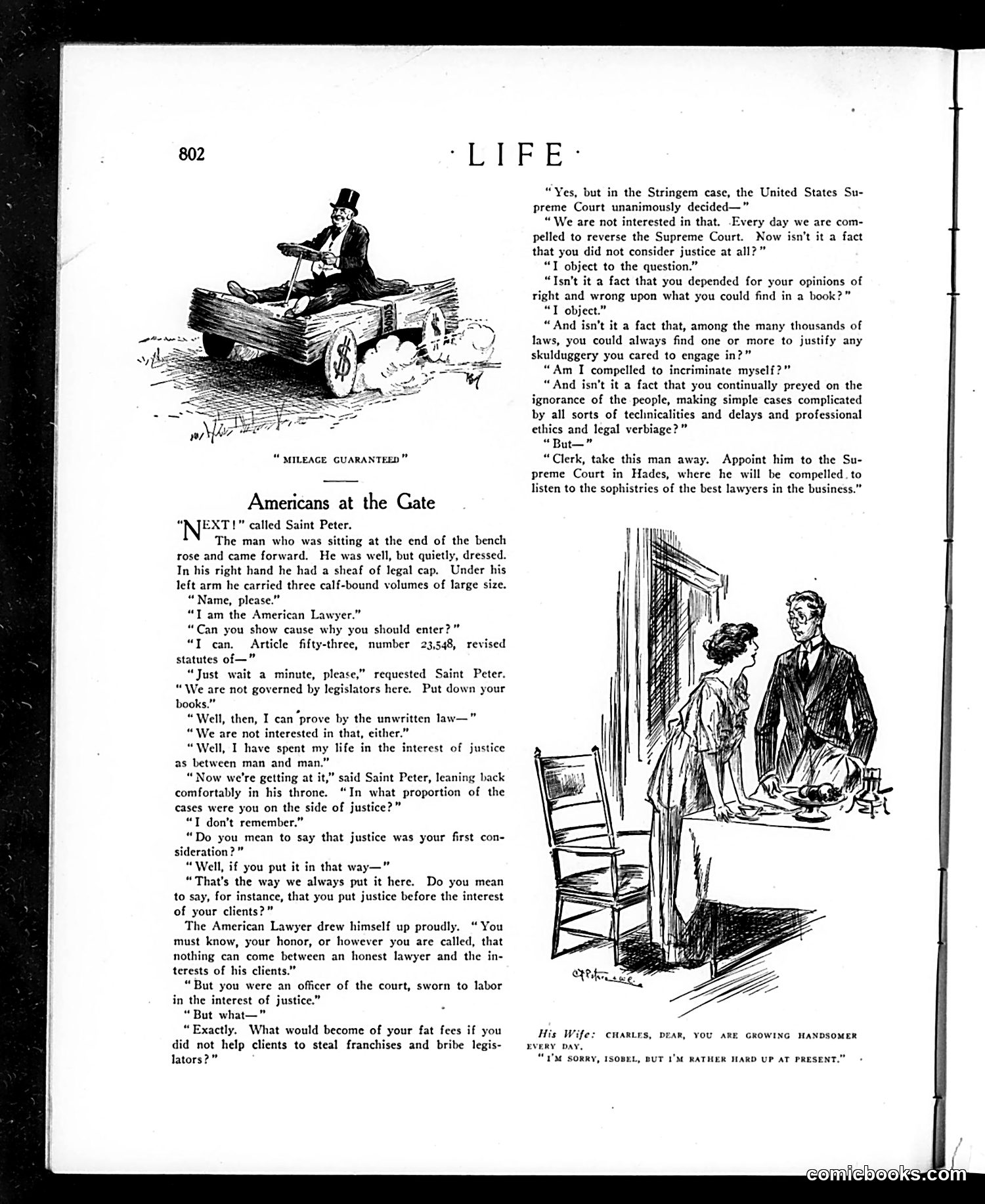
This page satirizes American lawyers and their ethical compromises. The main cartoon depicts Saint Peter at Heaven's gate confronting an "American Lawyer" carrying law books. The satire mocks lawyers for: - Prioritizing client interests over justice - Using legal technicalities to justify immoral acts - Helping clients "steal franchises and bribe legislators" - Claiming they must serve clients' interests above all else Saint Peter challenges the lawyer's moral fitness for heaven, suggesting American legal practice has become morally corrupt. The lawyer's defense—that justice between man and man is his concern—rings hollow given his actual practices. The secondary illustration shows a domestic scene, likely continuing the theme of compromised principles affecting personal life. The satire targets perceived corruption in the American legal profession and business culture.
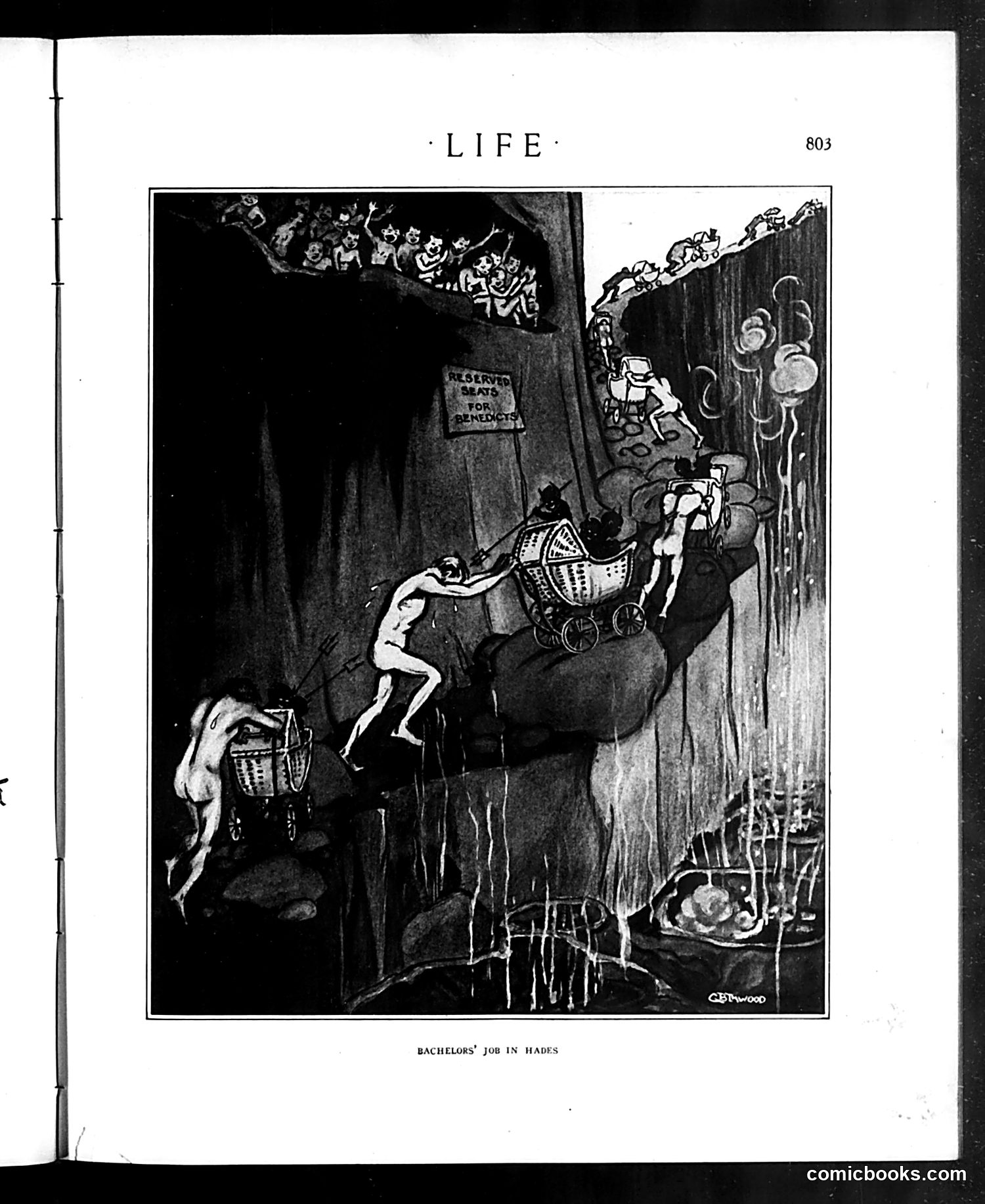
This satirical cartoon depicts unmarried men laboring in the underworld. The image shows several nude male figures struggling with heavy baskets or burdens while climbing upward, observed by demons or imps from above. A sign reading "RESERVED SEATS FOR THE BACHELORS" appears on the cave wall. The satire suggests that bachelors—unmarried men—face punishment in the afterlife for their unmarried status. This reflects early 20th-century social attitudes that viewed bachelorhood as a moral failing or social irresponsibility. The cartoon humorously warns that avoiding marriage carries consequences, even in damnation. The elaborate torment depicted serves as comedic social commentary on contemporary expectations that men should marry.
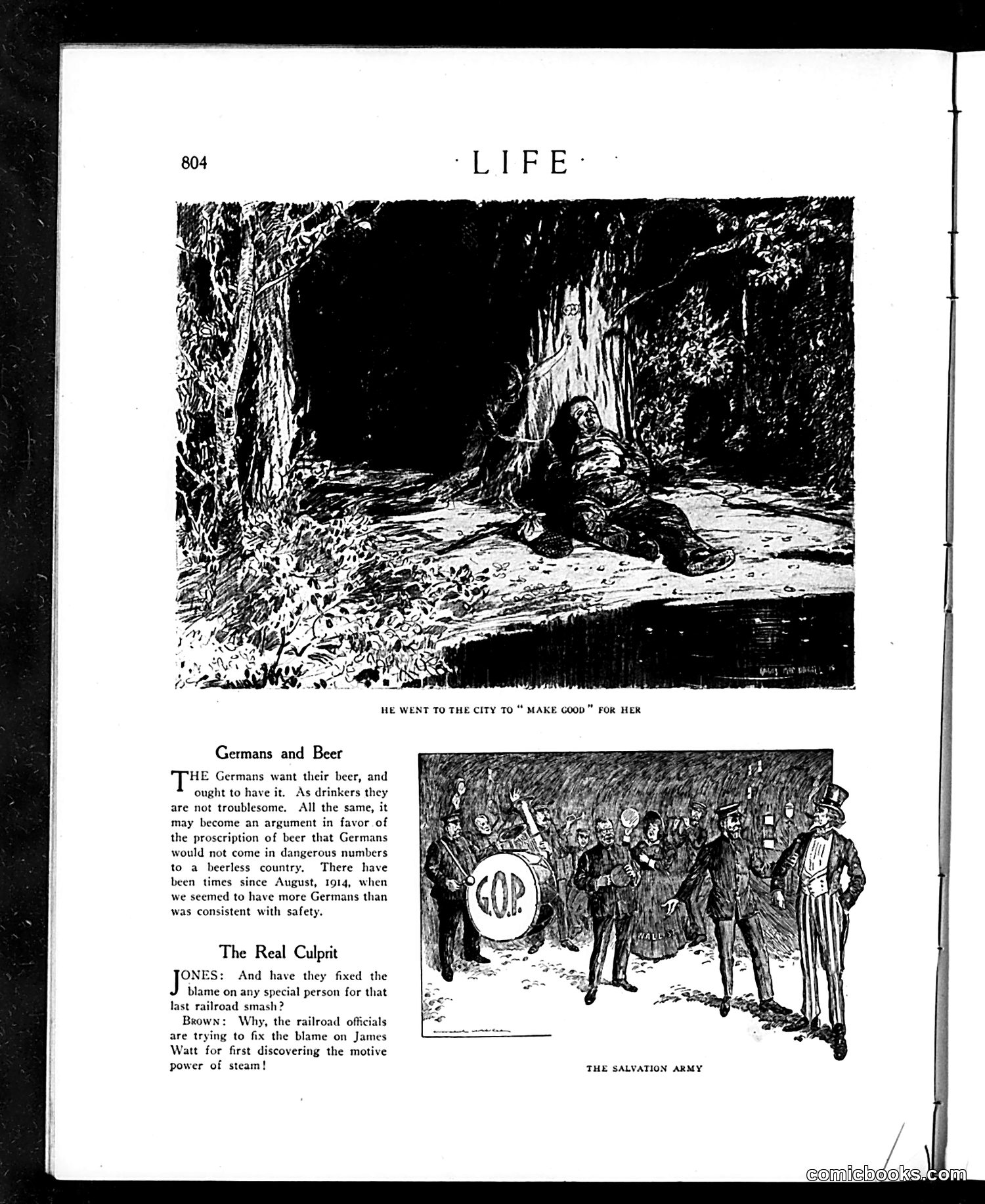
This page contains two satirical pieces from early 20th-century Life magazine. **Top cartoon** ("He Went to the City to 'Make Good' for Her"): Shows a man reclining in what appears to be a cave or shelter, suggesting he has failed to achieve success in the city despite presumably going there to improve his circumstances and impress someone (likely a woman). **"Germans and Beer" section**: Comments on German immigration to America, debating whether Germans pose a danger due to their beer consumption and large numbers (referencing post-August 1914, early WWI period). **"The Real Culprit" section**: A dialogue mocking railroad officials who blame inventor James Watt for a railroad crash by attributing it to his discovery of steam power—an absurdist critique of deflecting responsibility. **Bottom cartoon** ("The Salvation Army"): Depicts the Salvation Army with their distinctive drum, likely satirizing their social welfare activities.
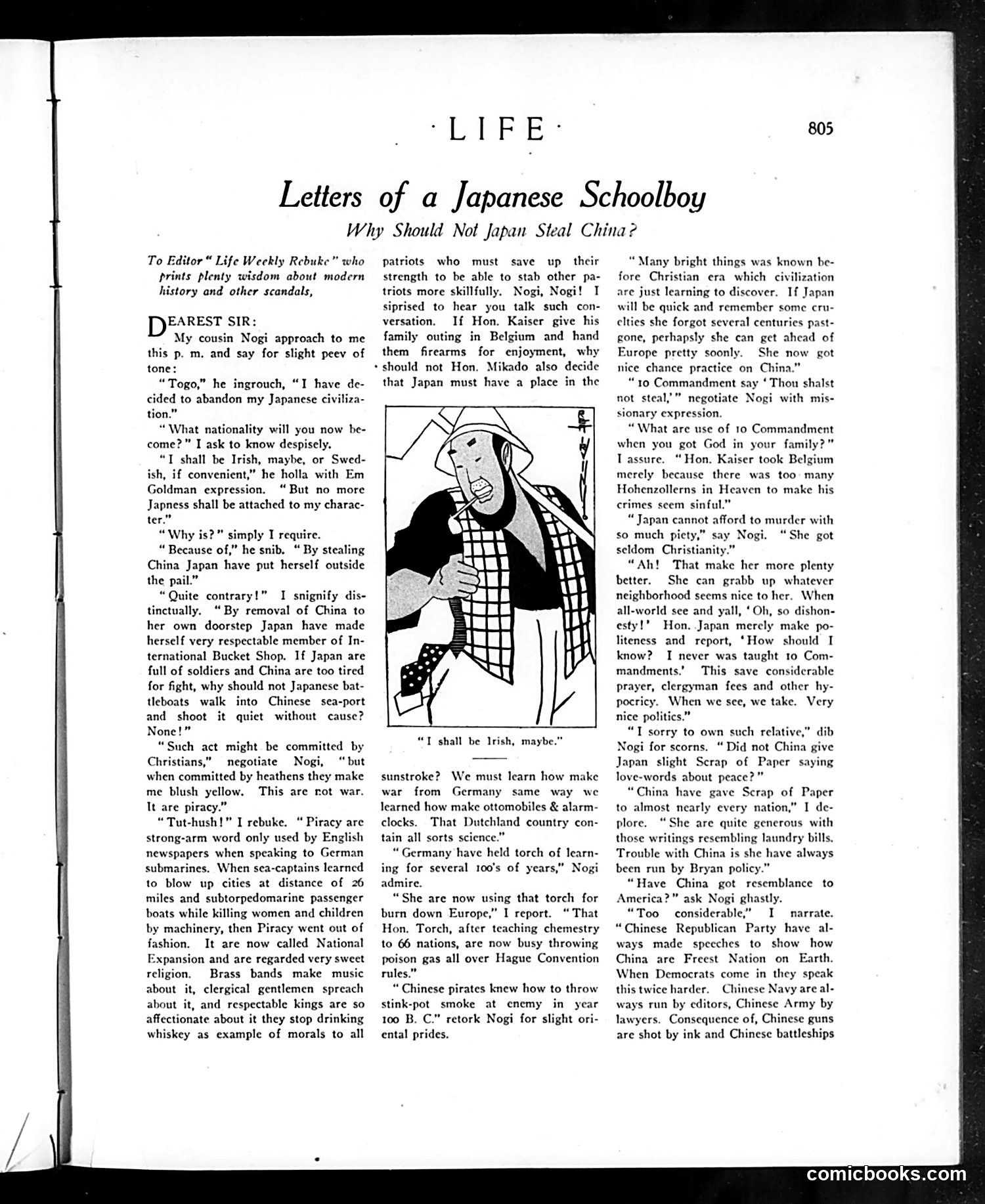
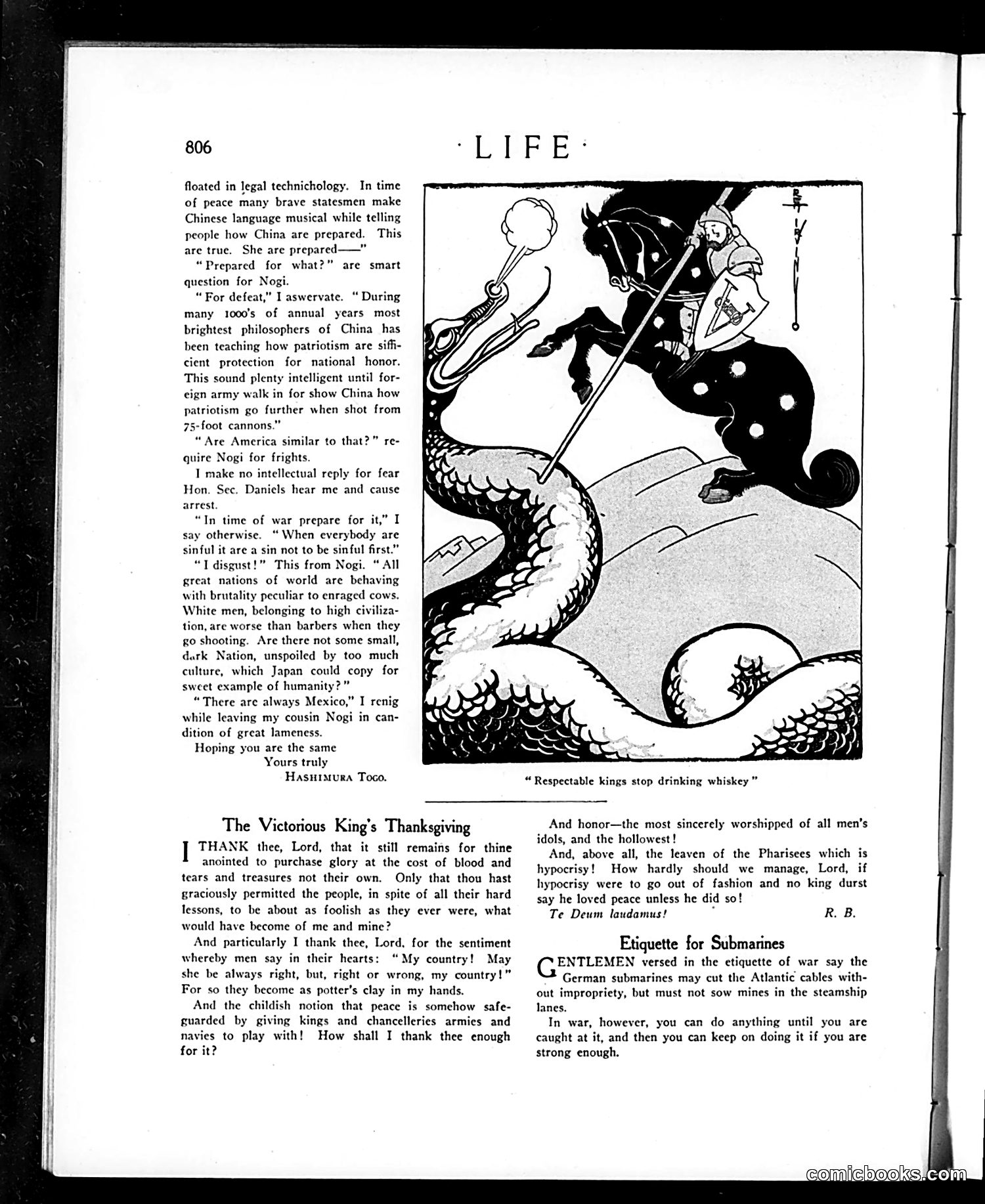
The main illustration depicts a figure (appearing to be a Western military or political leader, given the uniform and hat) riding atop a large dragon—a traditional symbol of China. The rider is wielding what looks like a polo mallet or stick, playing with a ball labeled with a swastika symbol. The caption reads: "Respectable kings stop drinking whiskey." This satirizes Western military intervention or imperialism in Asia, particularly Japan's imperial ambitions (referenced by the swastika). The dragon represents China being treated as a plaything by Western powers. The cartoon critiques the hypocrisy of "respectable" nations engaging in aggressive, sport-like conquest rather than honorable conduct—the swastika ball suggesting fascist ambitions being indulged by Western powers.
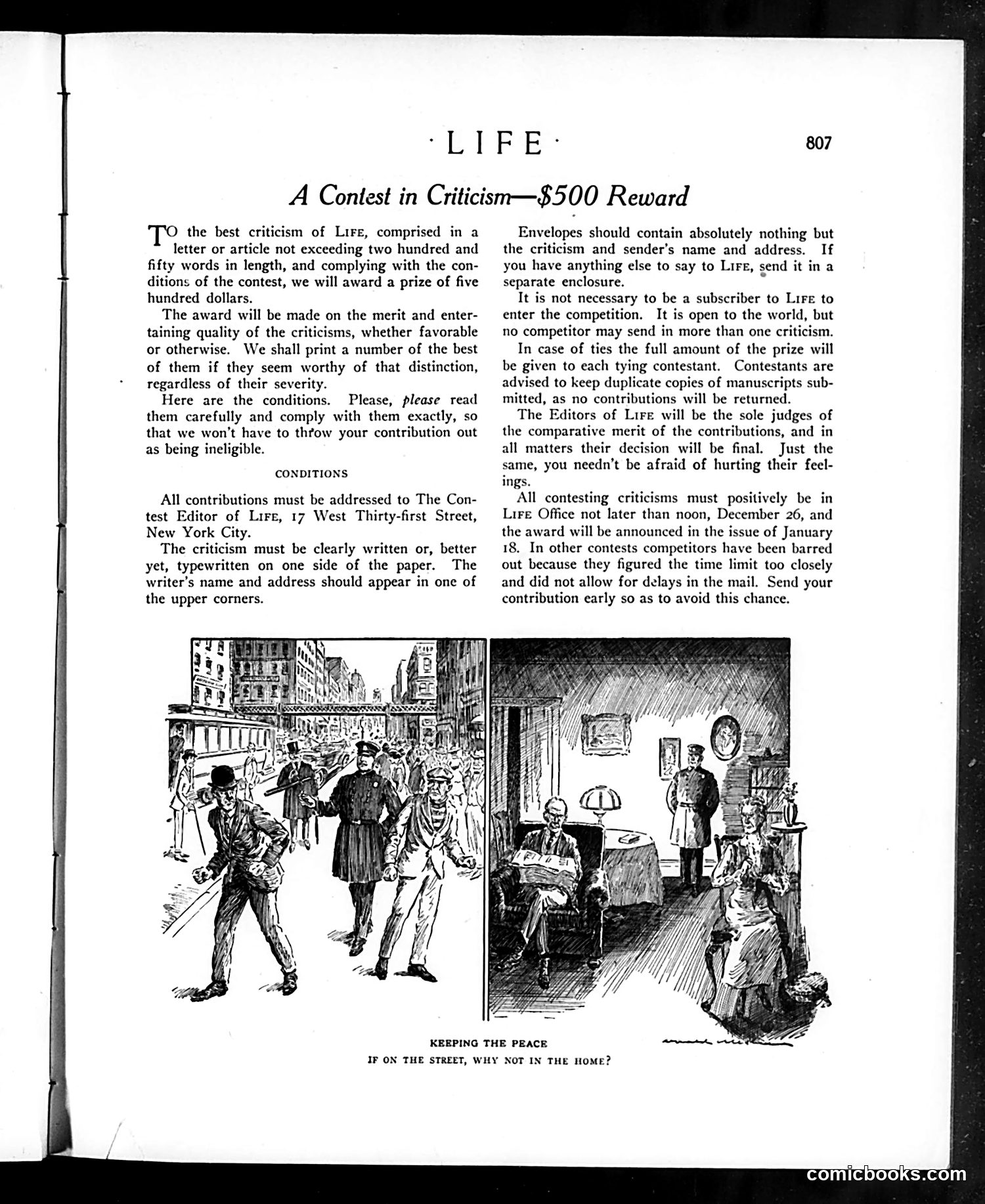
This cartoon satirizes the contrast between public and private behavior. The left panel shows men arguing loudly on a crowded city street, seemingly disturbing the peace. The right panel depicts a domestic interior where a man reads calmly while a woman sits nearby. The caption's rhetorical question suggests irony: if people struggle to keep peace in public spaces, why should homes be sanctuaries from conflict? This likely critiques either male behavior (aggressiveness in public but expecting quiet domesticity) or domestic discord being ignored while public disturbances receive attention. The cartoon appears to comment on gender dynamics and hypocrisy regarding civility standards across different social spaces.
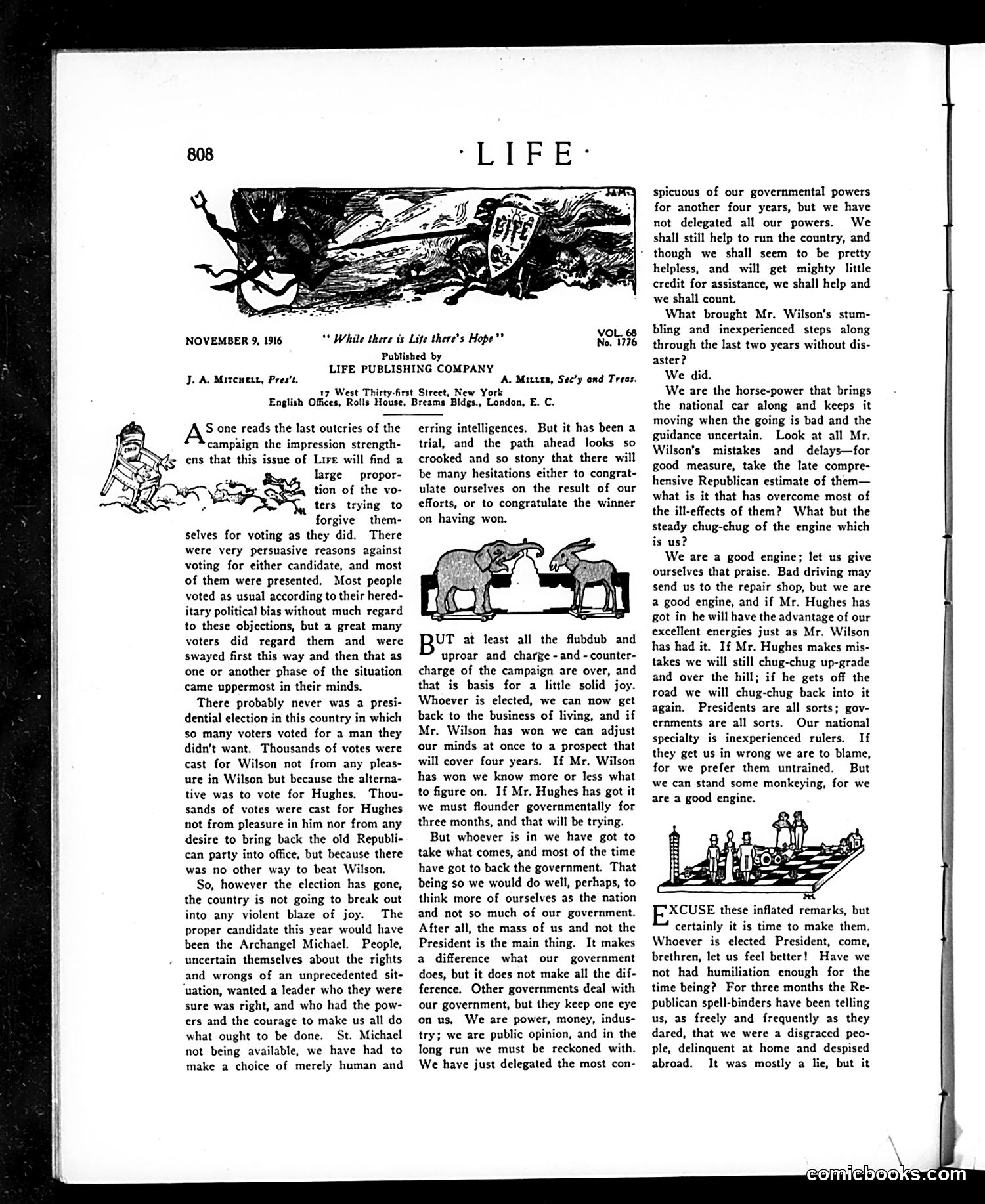
This is editorial commentary following the 1916 U.S. presidential election (Wilson vs. Hughes). The header cartoon shows a figure of "Hope" amid uncertainty—reflecting the election's ambiguity. The text argues that voters faced an unprecedented dilemma: both candidates seemed flawed, so many voted *against* someone rather than *for* someone. The author notes that thousands voted for Wilson reluctantly (as the alternative to Hughes) and vice versa—nobody was truly enthusiastic. The piece's main point: Americans themselves, not the president, are the nation's true engine ("We are the horse-power"). Voters shouldn't blame the president for everything; they share responsibility for the country's direction and must "back the government" regardless of who won. The author urges civic unity and perspective—citizens matter more than which candidate prevails. This reflects post-election fatigue and an appeal for national cohesion during uncertain times (pre-WWI America).
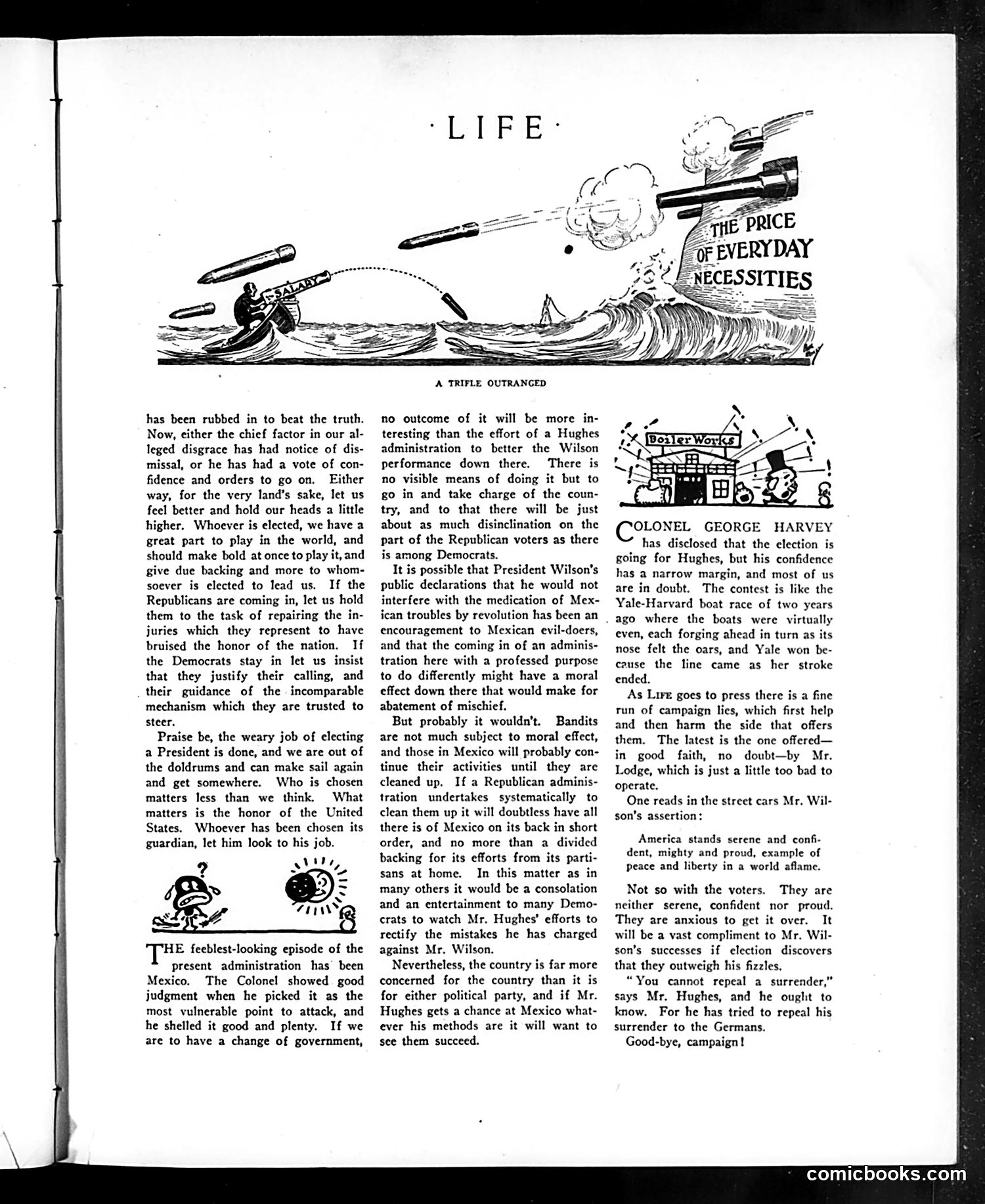
This page from *Life* magazine concerns the 1916 presidential election between incumbent President Woodrow Wilson (Democrat) and challenger Charles Evans Hughes (Republican). The satirical cartoon depicts shells and explosions labeled "The Price of Everyday Necessities," critiquing the cost-of-living impact on ordinary Americans during wartime. The article discusses Mexico as a vulnerable political point. Hughes has attacked Wilson's Mexican policy—likely referring to border raids and revolutionary instability. The satire suggests that whoever wins will face the same intractable problem: Mexican bandits and disorder cannot be solved by rhetoric or policy alone, only by military intervention, which would prove unpopular domestically. Colonel George Harvey (mentioned in the text) was a prominent Republican political figure and Hughes supporter. The piece implies the election remains genuinely close despite Harvey's confident predictions, comparing it to a close Yale-Harvard boat race. The article critiques campaign lies, particularly Lodge's claims about American stability under Wilson.
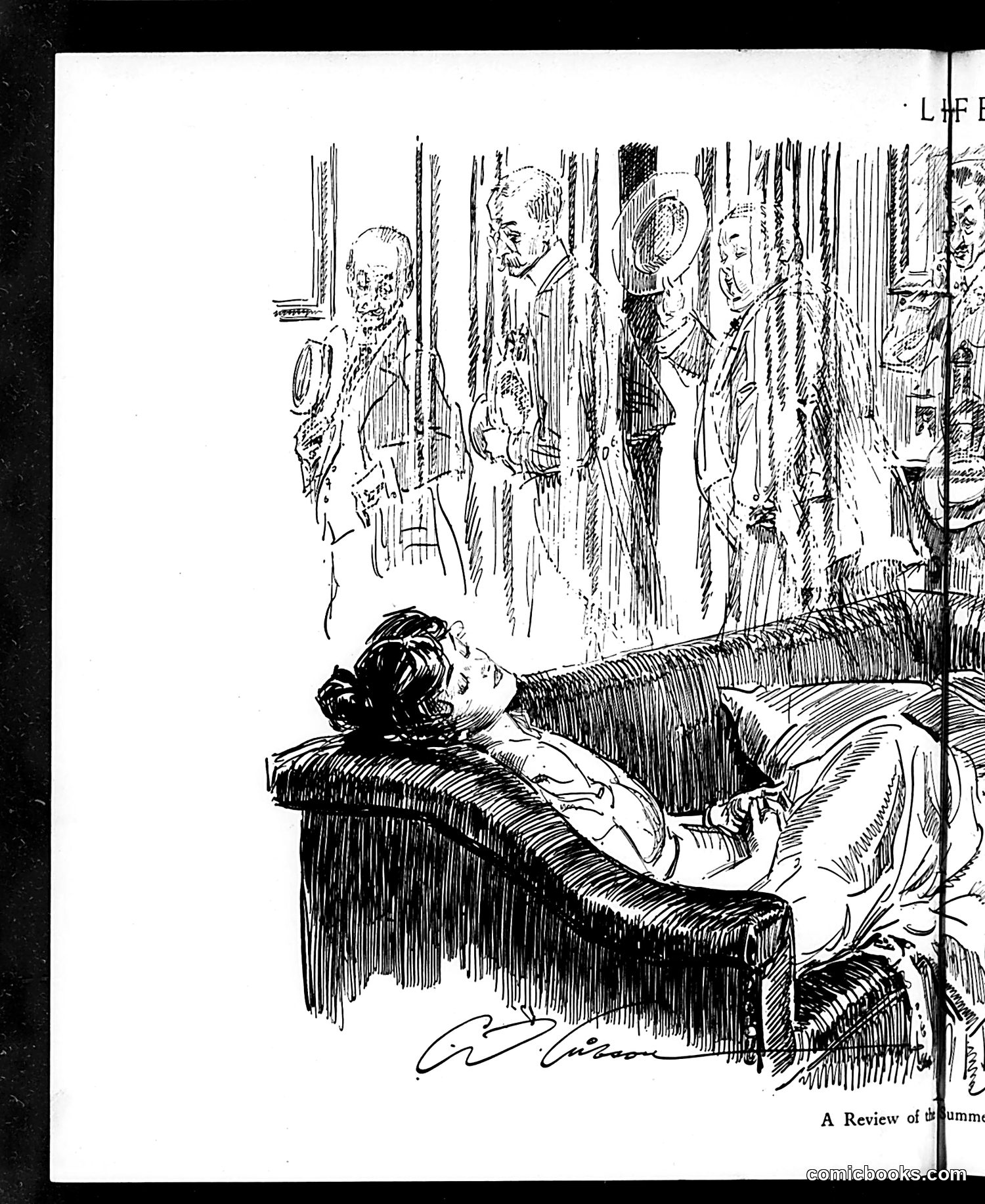
This page shows a satirical sketch depicting a man reclining on a couch or fainting couch, looking upward in apparent distress or exhaustion. Several figures stand behind him in the background, rendered lightly in sketch form. The caption reads "A Review of t#Bumme" (likely "A Review of the Summer" with OCR errors). The signature appears to be by the cartoonist. The satire appears to mock someone's reaction to summer—possibly commenting on social exhaustion, boredom, or the strain of social obligations during the season. The reclining figure's dramatic pose suggests exaggerated fatigue or emotional overwhelm, while the onlookers in the background suggest social pressure or unwanted company. Without additional context about specific 1910s-era events or figures, the exact target of satire remains unclear, though it likely comments on upper-class summer social life.
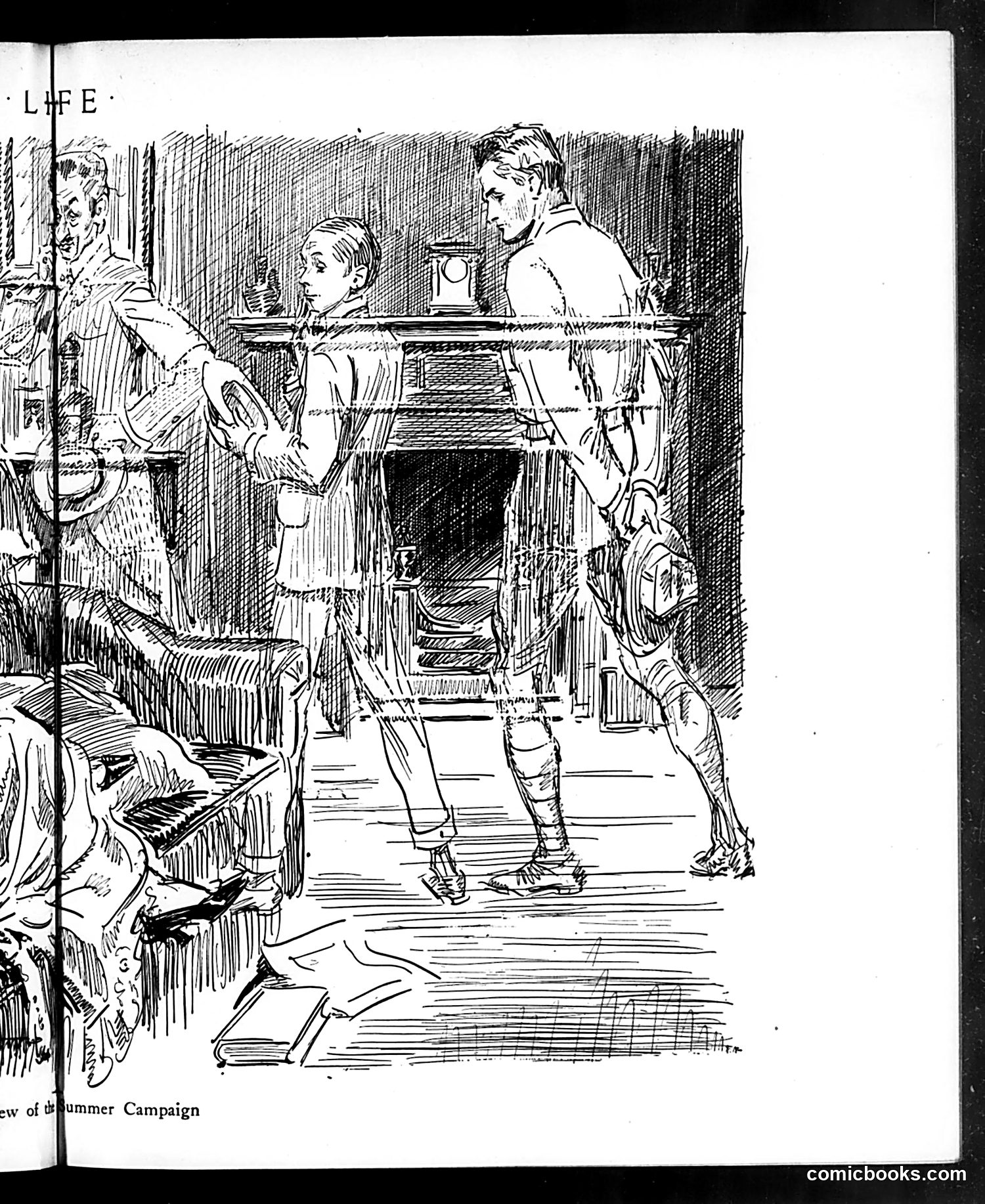
This is a black-and-white sketch from *Life* magazine showing what appears to be a military or political scene. Three men in early 20th-century attire are depicted in what looks like a barracks or military quarters, with a fireplace visible. The OCR text mentions "Bummer Campaign," suggesting this is satirical commentary on a military or political campaign viewed as unsuccessful or poorly executed. The drawing style and setting suggest this relates to a specific historical military operation, likely from World War I era or the American involvement in a regional conflict. Without clearer textual context or visible date information, I cannot definitively identify which specific campaign or figures are referenced. The "bummer" title indicates the satire criticizes the campaign's ineffectiveness or mismanagement, but the precise historical reference remains unclear from this page alone.
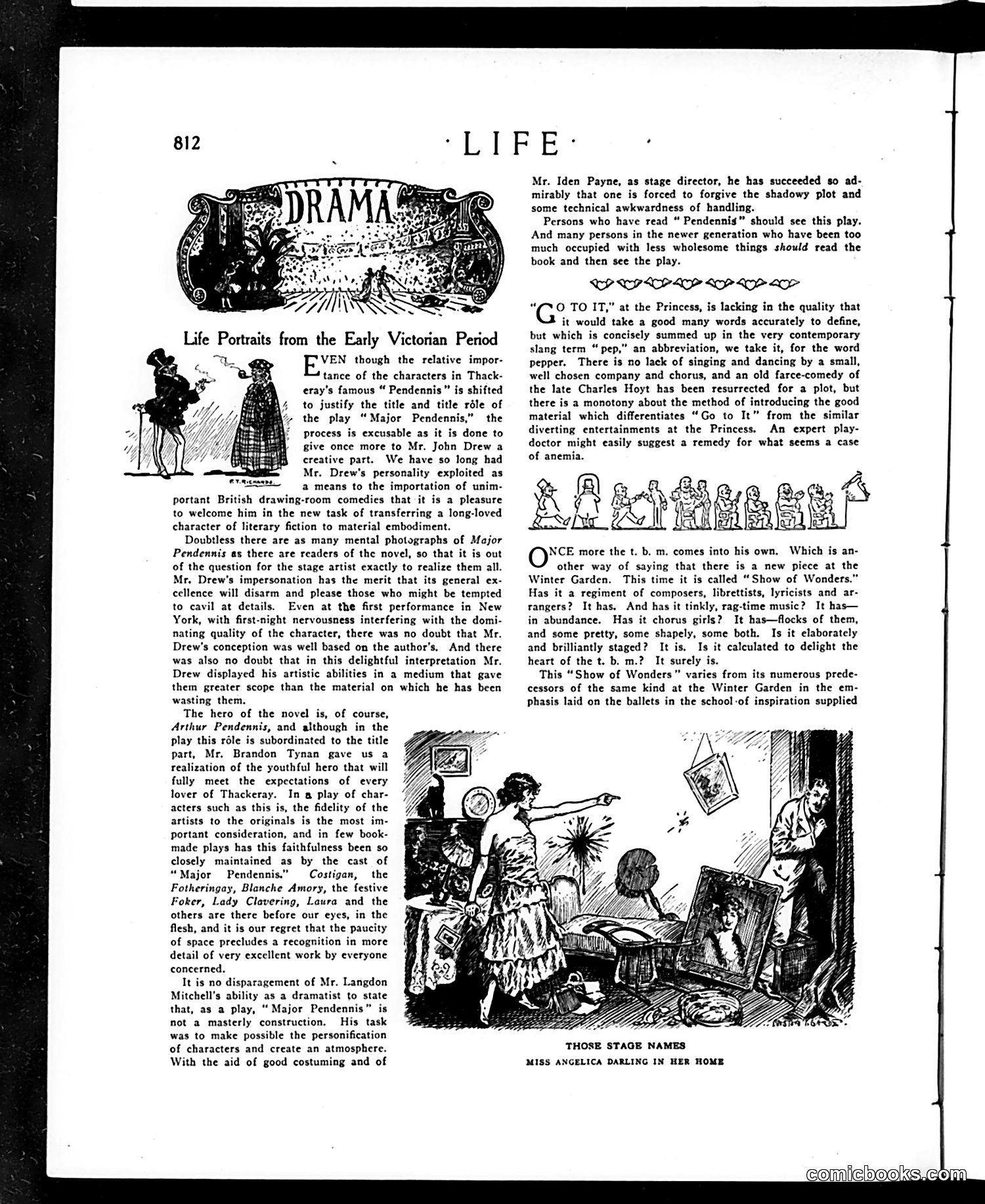
This page reviews theatrical adaptations of 19th-century literature. The main focus is "Major Pendennis," adapted from Thackeray's novel, starring actor John Drew. The critic praises Drew's performance and the cast's faithfulness to Thackeray's characters, though notes the play's plot is somewhat weak. The reviewer commends the stage direction by Iden Payne for compensating through atmosphere and costuming. A secondary review criticizes "Go to It" at the Princess Theatre for lacking "pep" (energy/excitement). Despite good singing, dancing, and an old Charles Hoyt farce as its foundation, the production suffers from monotonous presentation—what the critic calls a case of "anemia." The illustration shows a scene from a theatrical production. The page demonstrates how Life magazine covered contemporary theater, balancing praise for literary fidelity against production quality.
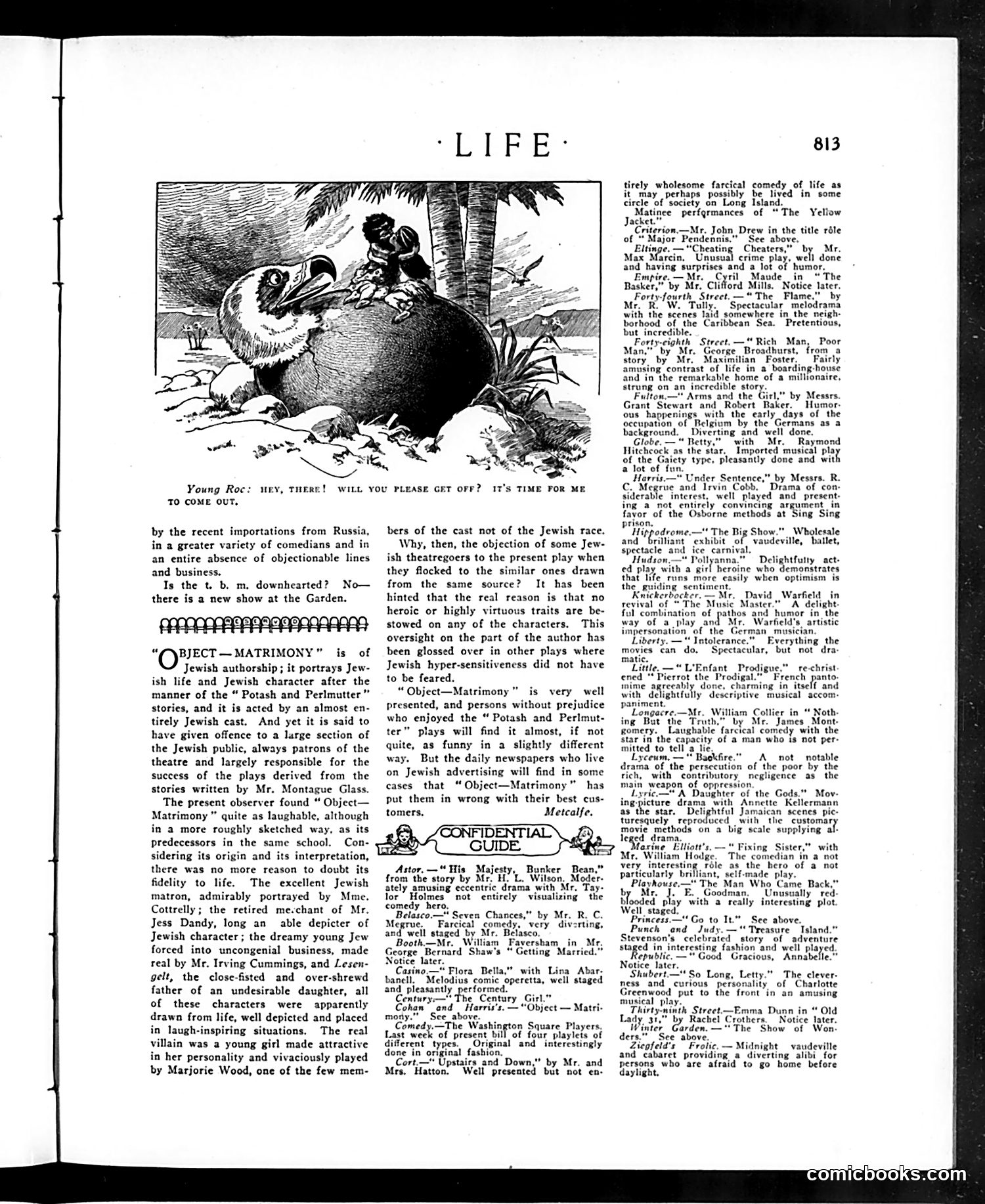
The main cartoon depicts a "Young Roc" (a mythical bird) telling someone to get off so it can come out—a visual pun on the phrase appearing below it. This illustrates Life magazine's characteristic absurdist humor. The page primarily reviews the play "Object—Matrimony," a Jewish-authored comedy about Jewish life. The critic (Metcalfe) notes that while the play entertainingly portrays Jewish characters drawn from life, some Jewish theatergoers objected to it because the characters lack "heroic or highly virtuous traits." The satire targets Jewish community sensitivity: the same audiences who enjoyed similar "Potash and Perlmutter" plays now reject this one, likely due to pressure from Jewish advertisers in newspapers. The critic implies the objection is hypocritical—the play's quality hasn't changed, only the community's willingness to accept unflattering portrayals has shifted, suggesting Jewish organizations were exercising cultural pressure on entertainment.
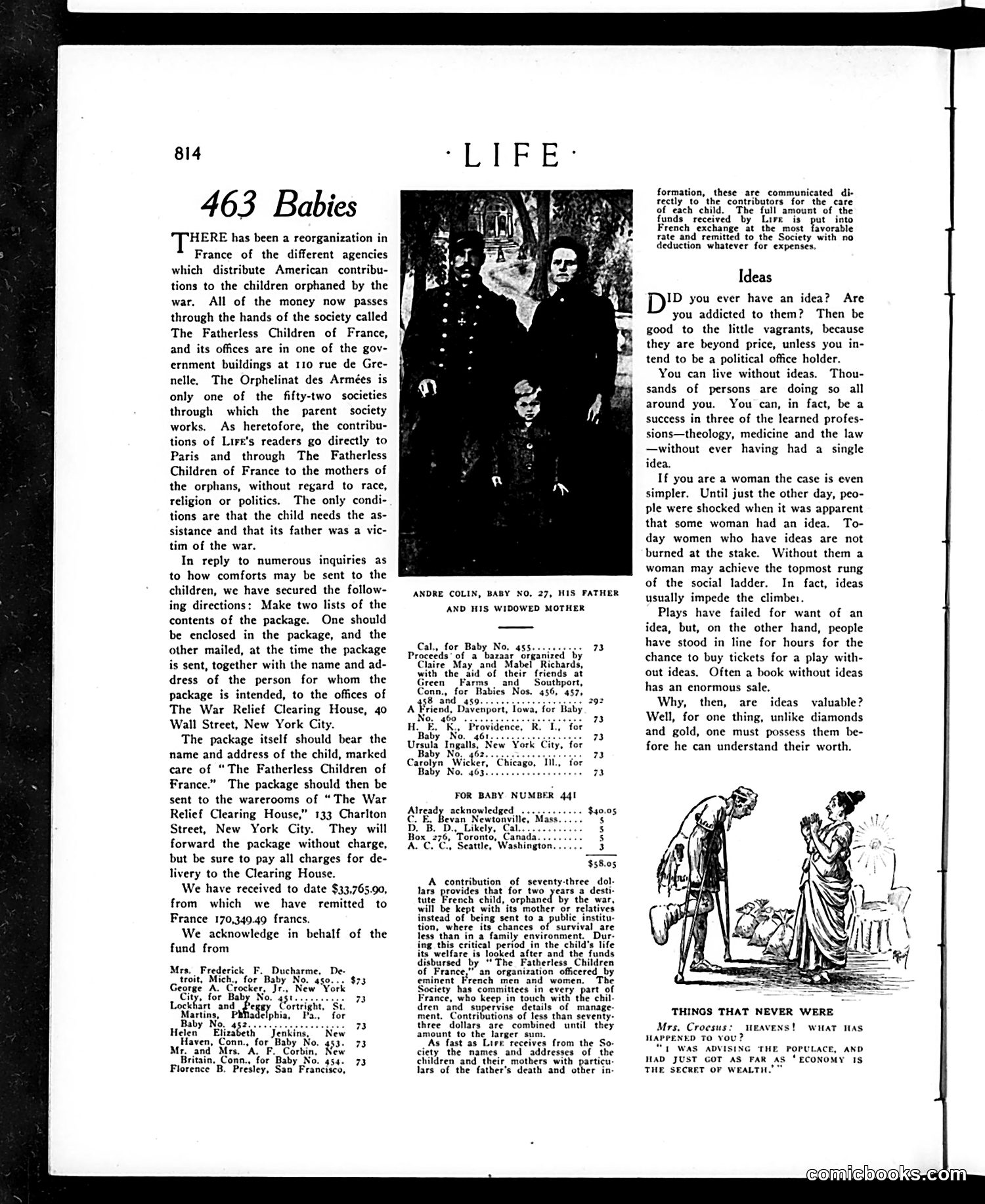
This page documents Life magazine's charitable fundraising campaign for French war orphans following World War I. The main content is a donation registry listing American contributors and the orphans they're sponsoring. The photograph shows **André Colin** (Baby No. 27), his widowed mother, and his father's image—illustrating the human impact of the war. The accompanying article explains that Life readers' contributions go through "The Fatherless Children of France" organization to support children whose fathers died in the war. The right-hand essay titled "Ideas" is a philosophical piece arguing that women especially need ideas to achieve social advancement—appearing somewhat tangential to the orphan-relief context. The page primarily serves as a **progress report and donor acknowledgment**, showing the magazine's role in coordinating transatlantic charitable relief during the post-WWI humanitarian crisis, rather than containing satire or political cartoons.
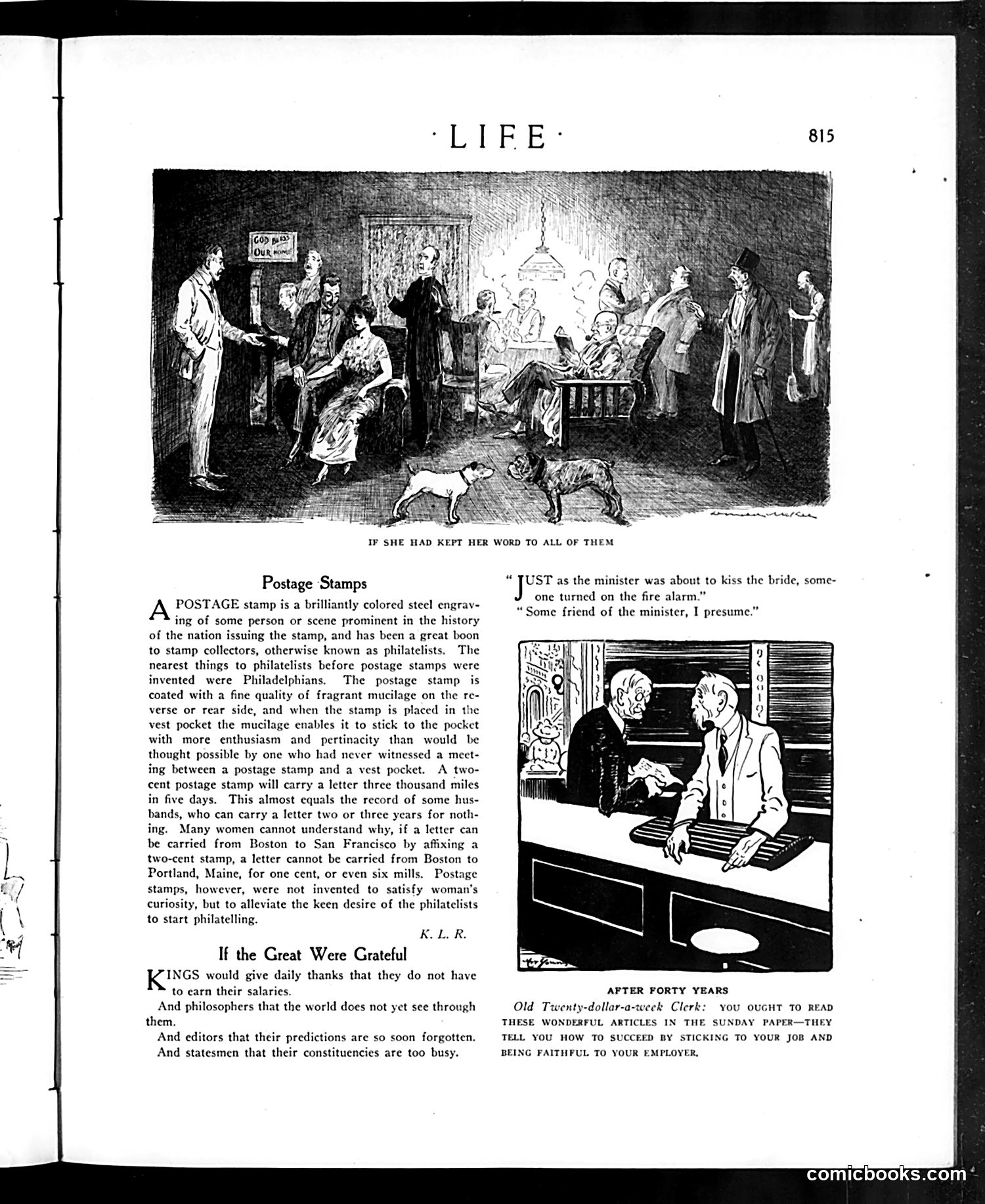
**Top Cartoon ("If She Had Kept Her Word to All of Them"):** A bride has apparently promised to marry multiple suitors. As the minister attempts to marry her, someone—described as "some friend of the minister"—deliberately pulls a fire alarm to interrupt the ceremony. The joke satirizes a woman who made conflicting romantic commitments, and the chaos that results. **"Postage Stamps" Article:** A humorous, tongue-in-cheek explanation of postage stamps and stamp collecting (philately). The author mockingly compares early collectors to Philadelphians, jokes that stamps stick to vest pockets better than mail reaches destinations, and sarcastically suggests women don't understand postal economics. The humor is light social commentary. **Bottom Cartoon ("After Forty Years"):** An elderly clerk, after four decades of employment, receives patronizing advice to read newspaper articles about career success—ironically recommending loyalty to one's employer, which he has already demonstrated exhaustively. The satire targets corporations' hollow appreciation for long-serving workers and the uselessness of generic self-help advice.
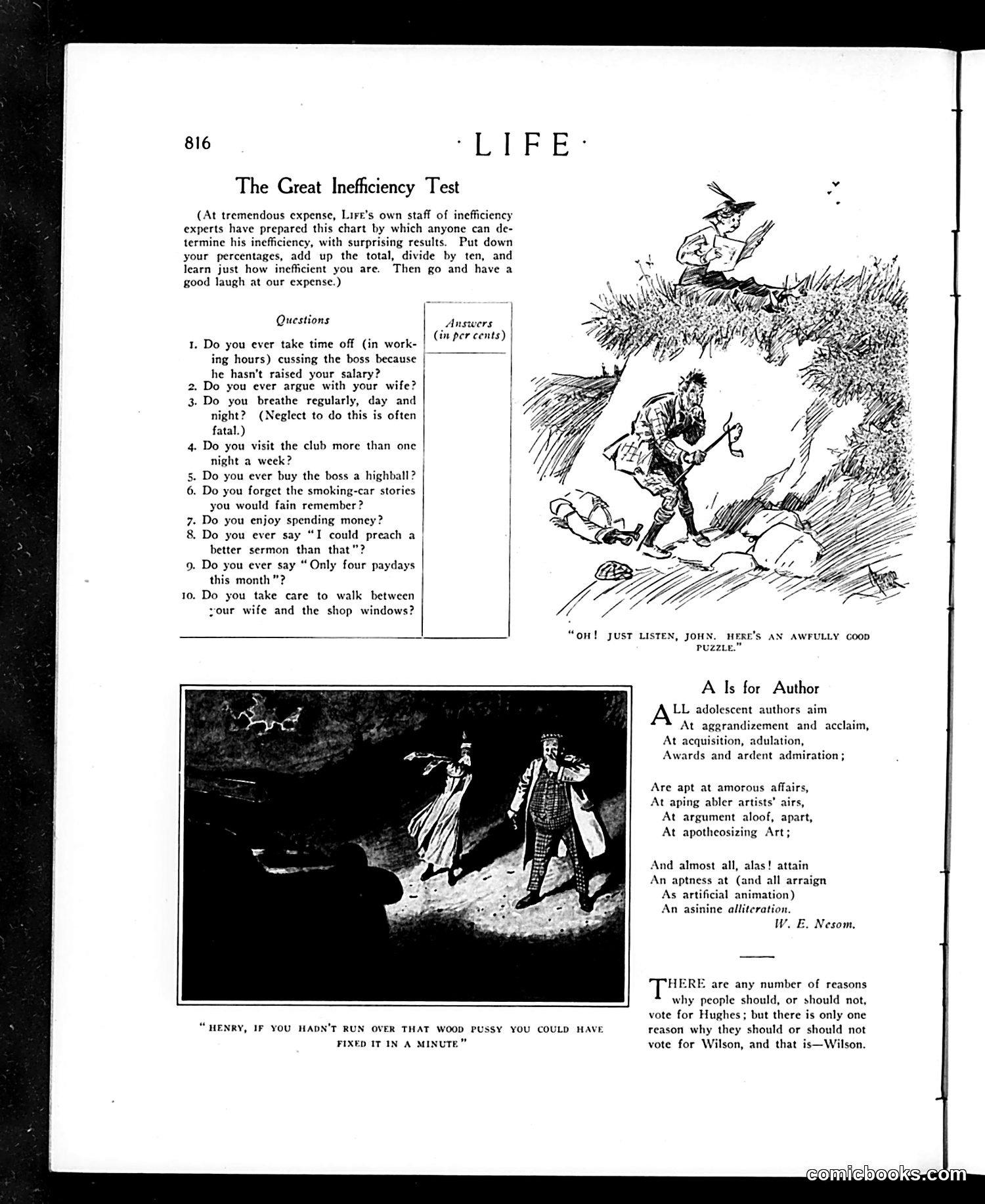
This Life magazine page contains three distinct satirical pieces: 1. **"The Great Inefficiency Test"**: A humorous self-assessment questionnaire mocking office workers and husbands. Questions range from complaining about low wages to nagging wives to breathing properly. The joke is that nearly everyone would score high in "inefficiency," inviting readers to laugh at themselves and Life's staff. 2. **Two cartoon vignettes**: - Top: A domestic scene where a wife presents a puzzle to her husband - Bottom: A husband criticized for running over a cat (called "wood pussy," period slang) Both depict henpecked husbands and marital friction—common early-20th-century humor tropes. 3. **"A Is for Author"**: A poem by W.E. Nesom satirizing young writers' pretentions—their desire for fame, imitation of better artists, and particularly their overuse of alliteration. The final stanza's "asinine alliteration" is self-demonstrating. 4. **Political note**: A brief comment on voting for Hughes versus Wilson (likely the 1916 election), suggesting Wilson's personality alone justifies voting for him.
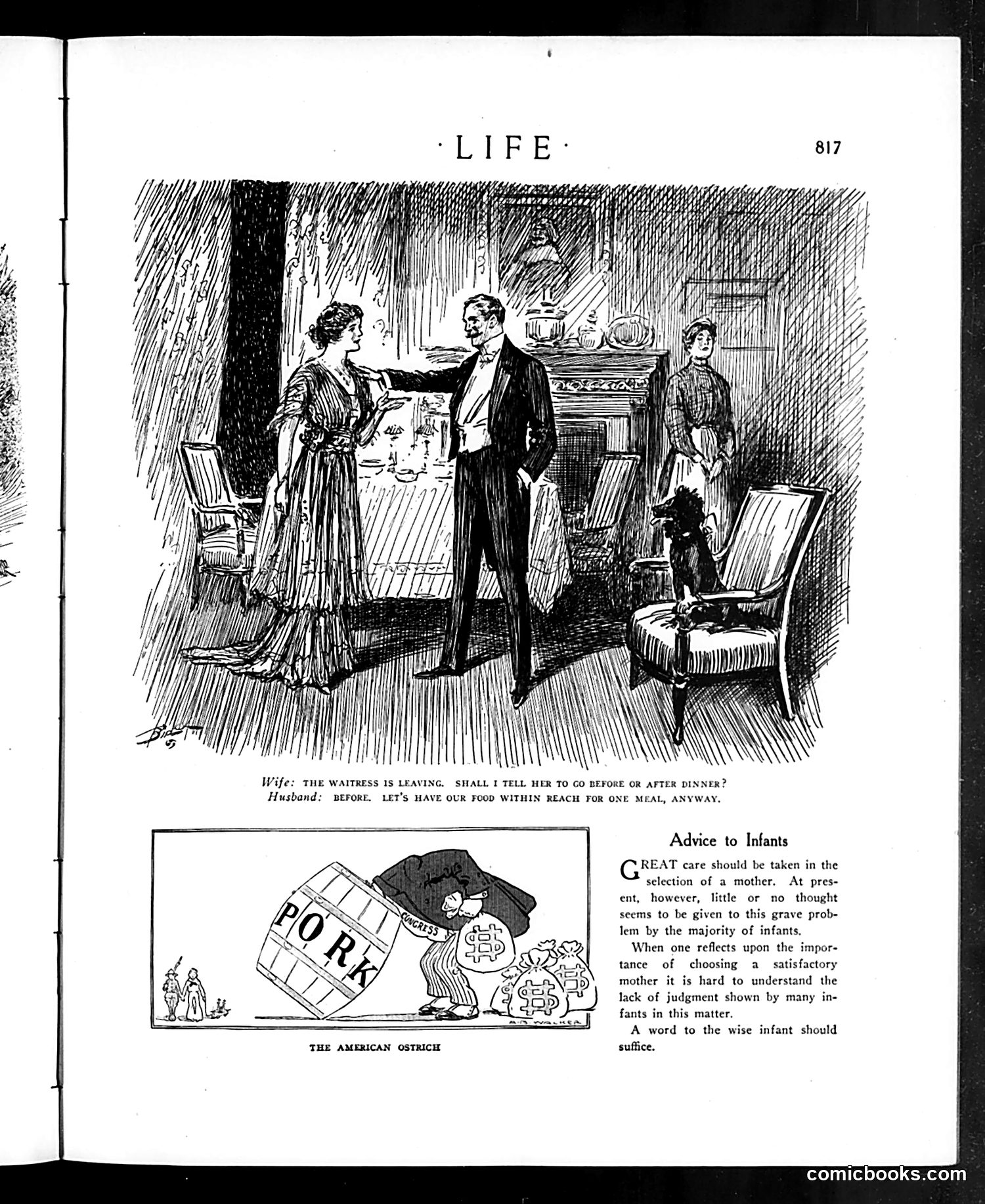
**Top Cartoon:** A domestic scene where a husband asks his departing wife whether to tell the waitress to come before or after dinner. The joke satirizes marital dynamics and servant hierarchies of the era—the husband's casual assumption that a waitress might be summoned for unclear purposes reflects period class attitudes. **Bottom Cartoon & Article:** "The American Ostrich" cartoon pairs with "Advice to Infants," which sarcastically suggests babies should carefully select their mothers. The ostrich reference (symbolizing willful blindness) implies society ignores an important problem. The satire targets parental irresponsibility—that people reproduce without considering whether they're fit parents. This reflects Progressive Era concerns about eugenics, child welfare, and social responsibility.
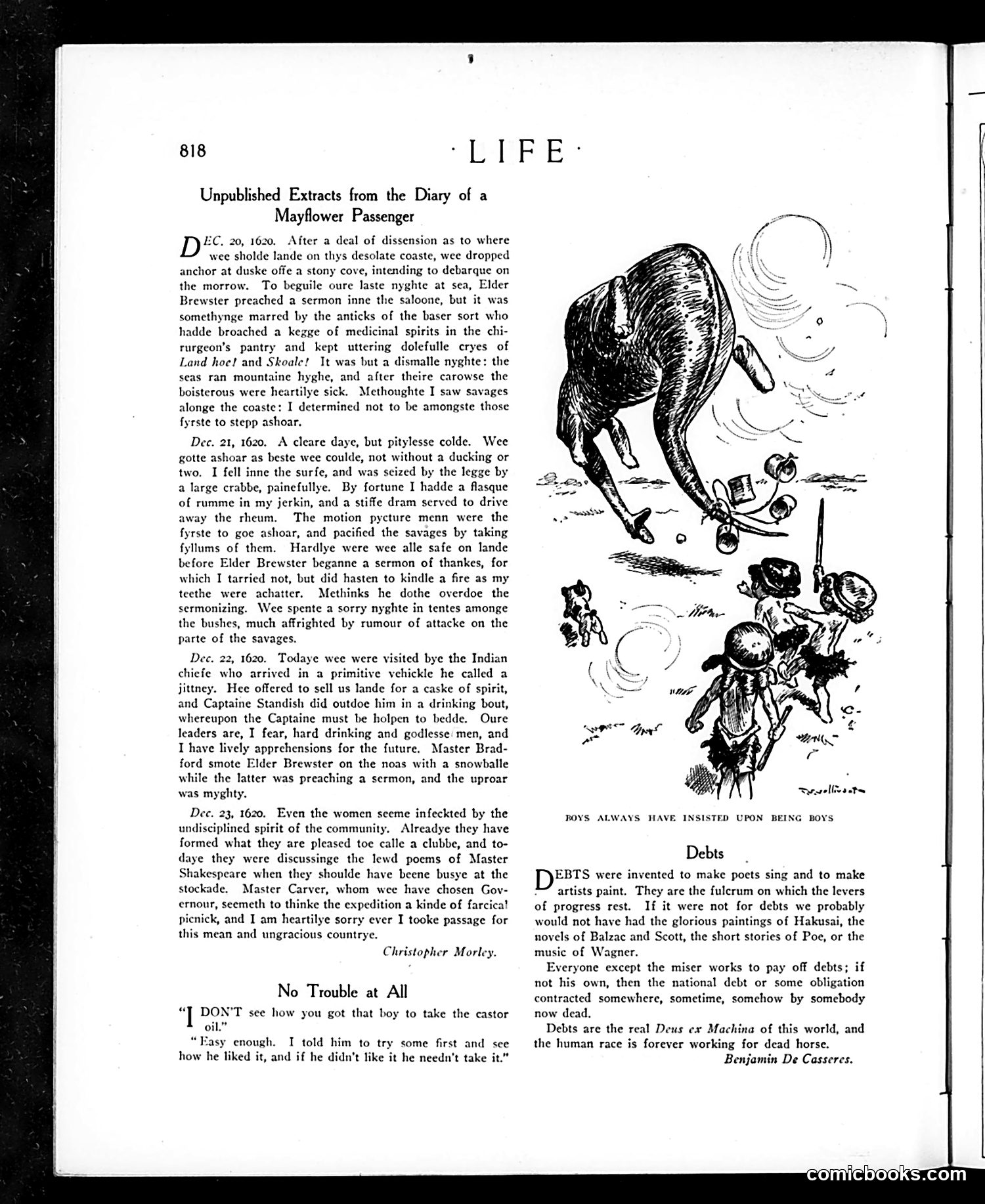
This satirical piece mocks modern American life by fictionally inserting 1920s references into the Pilgrims' 1620 voyage. The humor stems from anachronisms: sailors crying "Land hoe!" while drunk on medicinal spirits; "motion picture men" pacifying Native Americans with film; an Indian chief arriving in a "jittney" (a small taxi); women forming clubs discussing Shakespeare's "lewd poems." Author Christopher Morley uses this device to critique contemporary American society—depicting the Pilgrims as hard-drinking, irreverent, and undisciplined, mirroring Jazz Age excess. The commentary suggests modern Americans haven't progressed morally from their ancestors, undermining the Pilgrims' mythic status as disciplined, godly founders. It's gentle social satire questioning American exceptionalism and cultural decline.
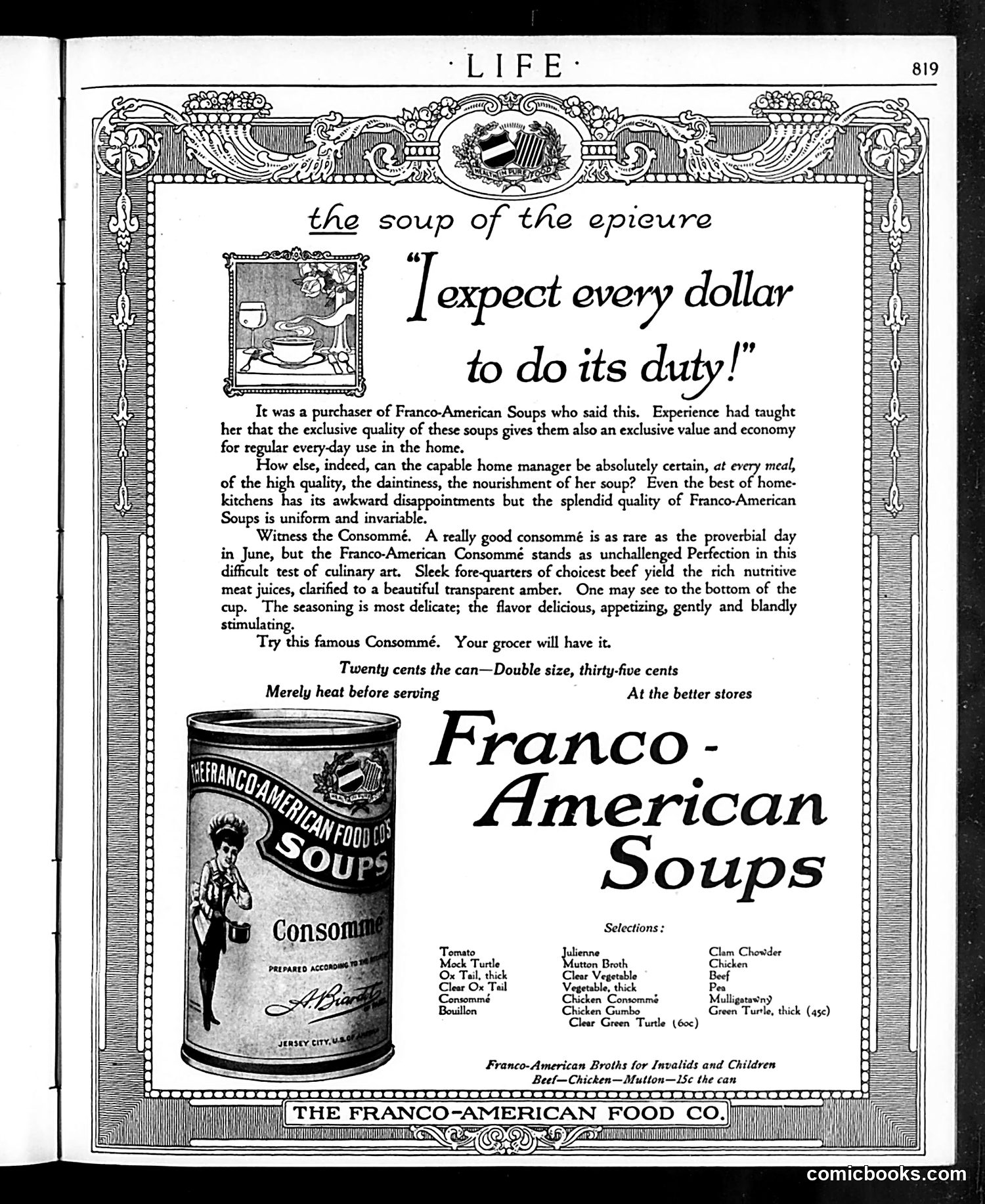
This is **not a cartoon or satire**—it's a straightforward product advertisement for canned soup, occupying most of the page. The ad quotes an unnamed female purchaser claiming "I expect every dollar to do its duty!"—appealing to early 20th-century values of household economy and domestic responsibility. The copy targets the "capable home manager," emphasizing that Franco-American Soups guarantee consistent quality and nutrition across every meal, unlike homemade cooking which has "awkward disappointments." The ad highlights their **Consommé** as the premium product, describing its transparent amber clarity as proof of quality. Pricing is modest (20 cents per can). The only visual is a **product label** showing the soup can and a woman serving soup—typical advertising imagery of the era. This reflects early 1900s marketing that sold convenience foods to middle-class housewives by validating their desire for reliable, economical meal preparation while emphasizing that store-bought could match or exceed homemade quality.
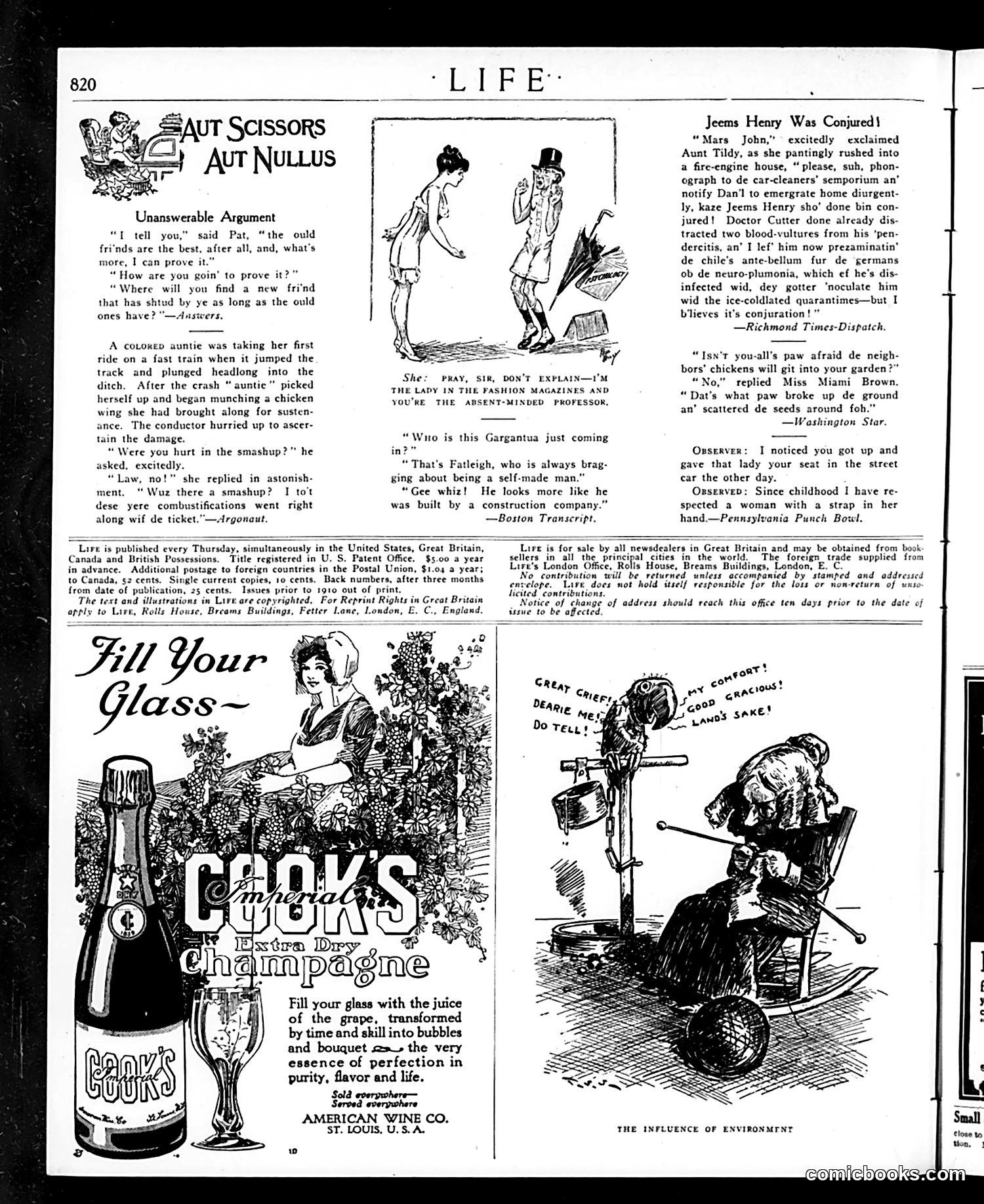
This page contains humorous short jokes and anecdotes typical of early 20th-century American humor magazines, along with advertising. **The cartoons and jokes satirize:** 1. **Ethnic/dialect humor**: Multiple pieces feature exaggerated African American vernacular ("Mars John," "Jeems Henry"), reflecting the period's casual racism. The "Jeems Henry" piece mocks both the dialect and superstitious beliefs about conjuration. 2. **Gender roles**: A cartoon shows a fashionable woman correcting a man's explanation, with the caption establishing her as a "fashion magazine lady" and him as an "absent-minded professor"—satirizing the stereotype of vain women and bumbling men. 3. **Self-made men**: A brief joke suggests that a boastful "self-made man" actually looks like he was constructed by a company—mocking the era's worship of self-made success mythology. 4. **Class observation**: A final anecdote about giving up a bus seat to women "with a strap in her hand" suggests respect based on physical intimidation rather than genuine chivalry. The page also includes a **Cook's champagne advertisement** featuring Victorian imagery.
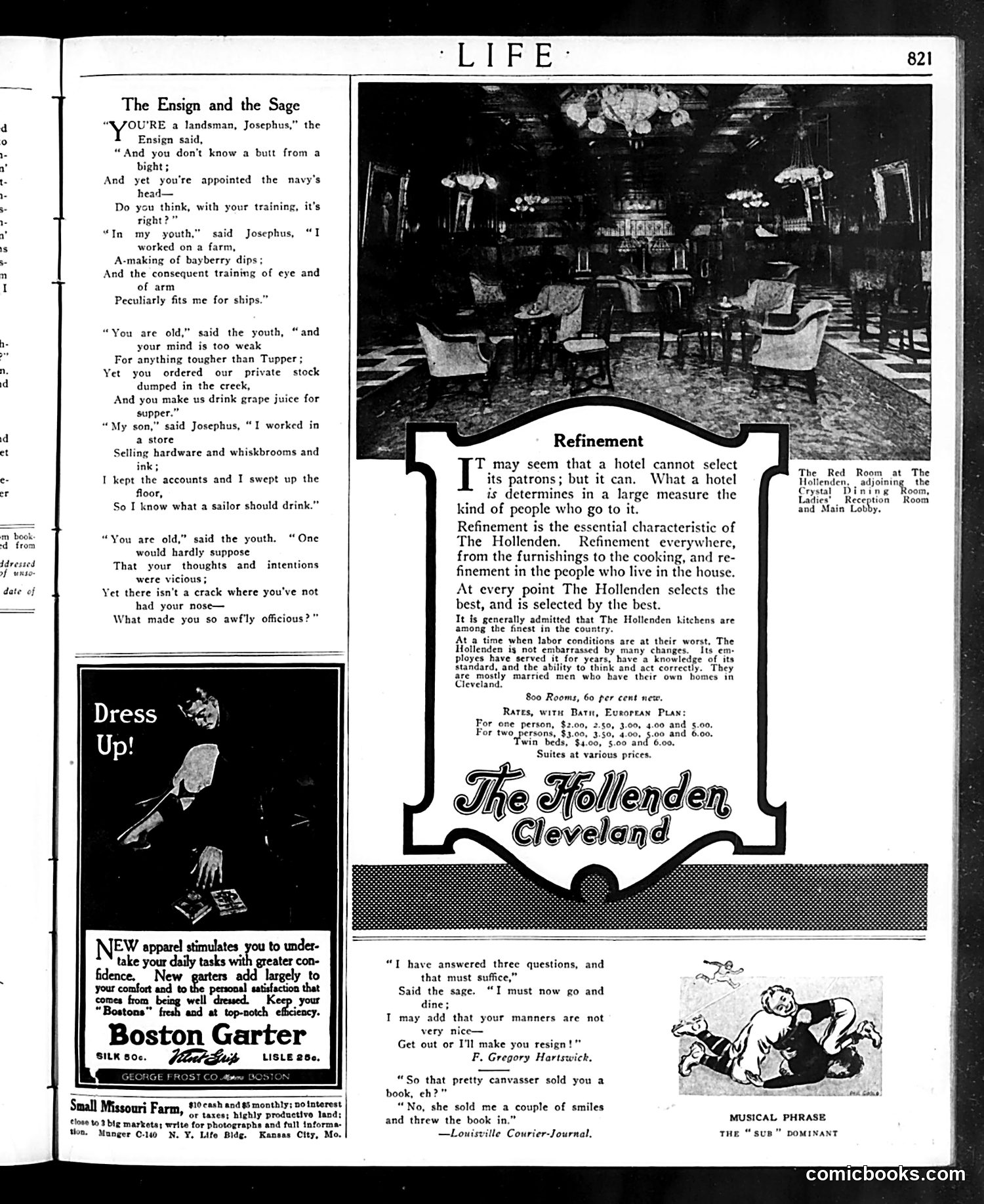
This poem satirizes an older naval official (Josephus) appointed to leadership despite lacking maritime experience. A young ensign questions his authority, highlighting the absurdity of his qualifications: he made bayberry candles and worked in a hardware store in youth. The joke targets **Prohibition-era politics**. Josephus ordered the ship's private whiskey stock dumped and replaced it with grape juice—referencing the recent 18th Amendment (1919). The ensign mocks this as sanctimonious meddling by an officious old man imposing moral reforms despite having no legitimate naval credentials. The satire criticizes both the unqualified appointee AND the Prohibition crusaders he represents—suggesting their moral authority is as baseless as an old shopkeeper's claim to naval expertise. It's a common Life magazine jab at Prohibition's supporters as busybodies lacking practical judgment.
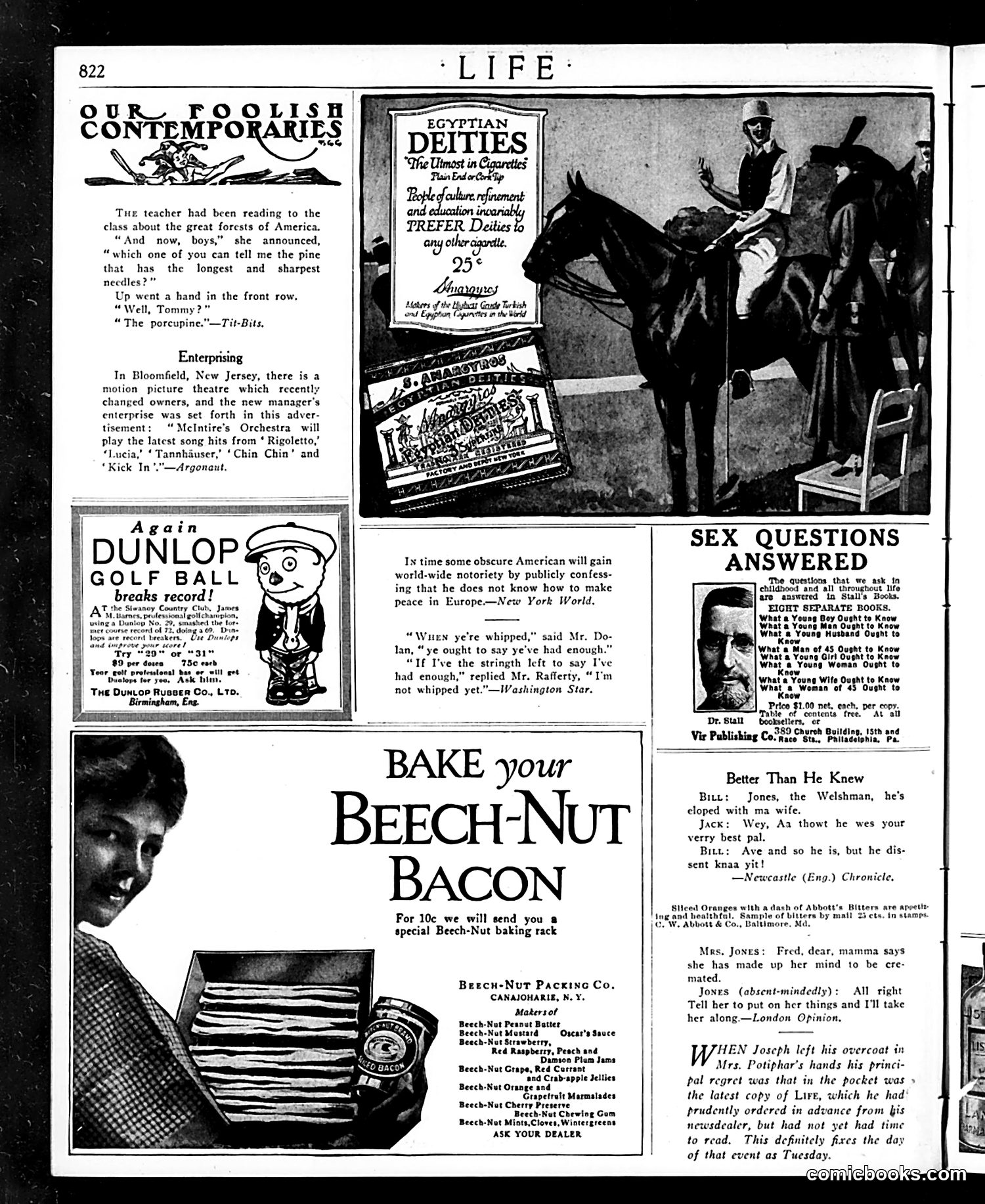
This page mixes humor, advertising, and social commentary typical of early 20th-century Life magazine. **"Our Foolish Contemporaries"** presents a schoolroom joke: a teacher asks which pine has the sharpest needles; a student answers "porcupine"—a pun on "pine" that satirizes childish literalism. **The "Sex Questions Answered" section** advertises a mail-order booklet addressing topics considered taboo or embarrassing for young people—suggesting Life positioned itself as candid about subjects others avoided. **Advertisement humor** appears throughout: Dunlop Golf Ball's endorsement, Beech-Nut Bacon's recipe offer, and Egyptian Deities cigarettes. **The closing anecdote** about Joseph's overcoat references the biblical story of Potiphar's wife (Genesis 39), but humorously reduces the scandal to Joseph's regret about not having time to read the latest *Life* magazine—a self-promotional joke placing the publication above even biblical drama. Overall, the page exemplifies Life's brand of genteel satire and advertising-supported humor.
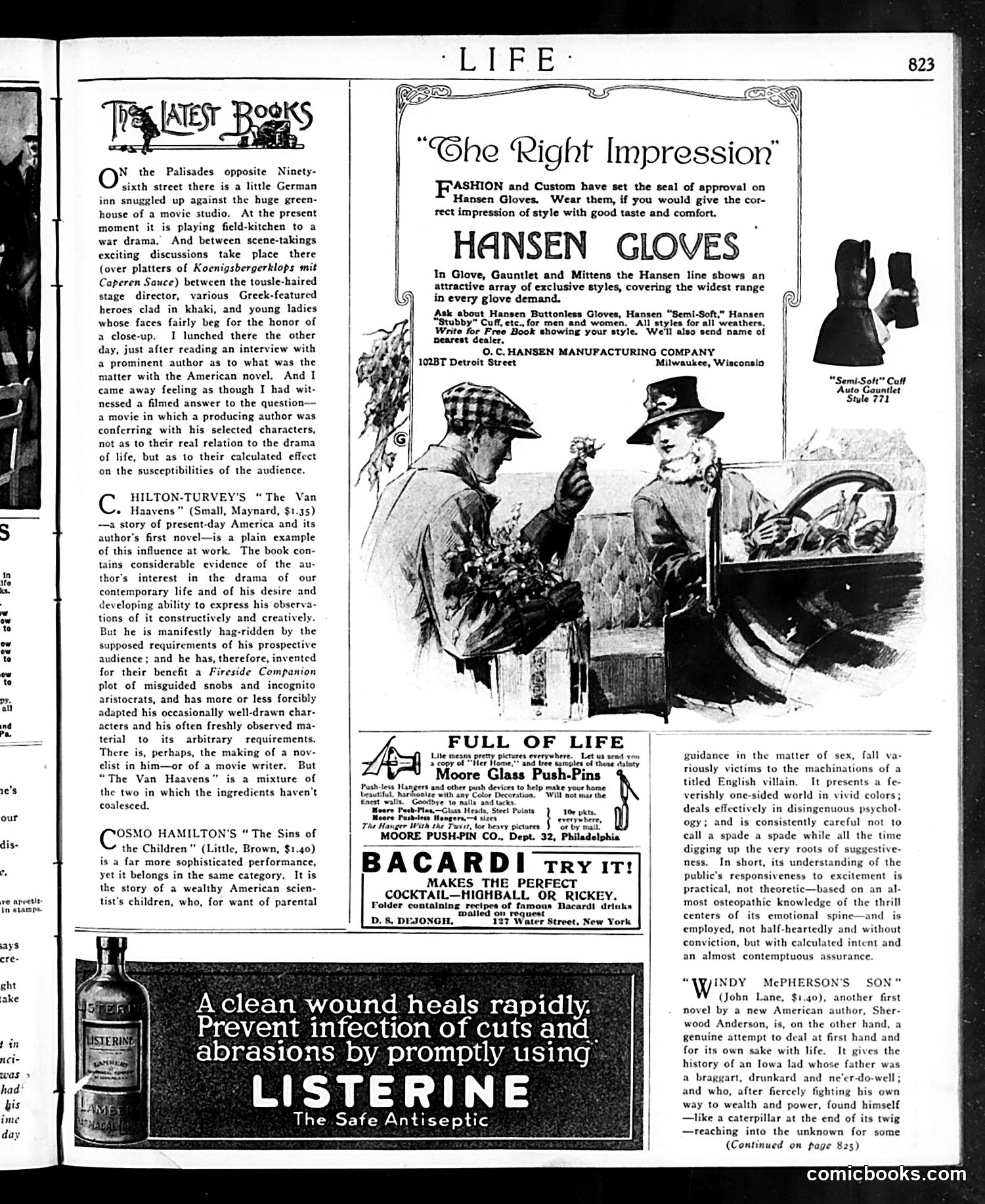
This page is primarily **advertisements and book reviews**, not political satire. The "Latest Books" section critiques contemporary American novels, particularly those influenced by cinema. The reviewer argues that modern authors like Hilton-Turvey are compromising literary merit by writing for mass audiences and adapting their work to perceived movie-industry requirements. The complaint reflects anxiety about **how commercial entertainment media was degrading serious literature** in the 1920s. The illustrations are period advertisements (Hansen Gloves, Bacardi cocktails, Listerine antiseptic, Moore Push-Pins) reflecting 1920s consumer products and marketing styles. There is **no political cartoon** on this page—the "cartoon" reference in your prompt appears to be an error. This is a standard magazine page mixing book criticism with vintage advertisements typical of the era.
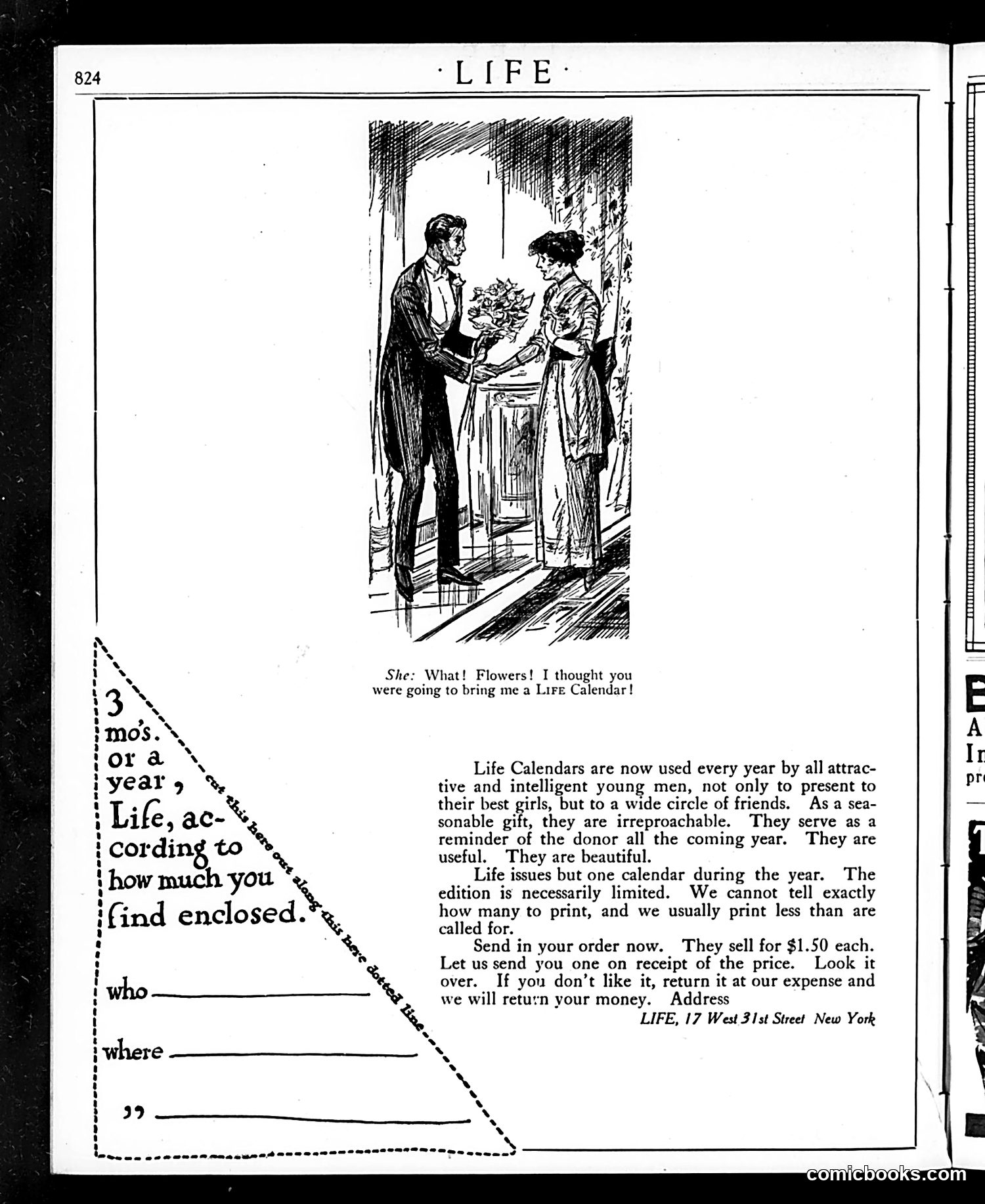
This is primarily **advertising copy** for Life magazine's calendar product, circa early 1900s. The cartoon depicts a romantic scene: a man presents flowers to a woman, who expresses disappointment—she expected a **Life Calendar** instead. The joke is gentle social satire: the advertisement suggests that giving a Life Calendar is actually the *superior* gift choice, more thoughtful and useful than flowers, as it reminds the recipient of the giver all year. The ad positions Life Calendars as fashionable among "attractive and intelligent young men" as gifts for girlfriends and friends. It's a self-promotional piece using humor and romance to market the product ($1.50 each), emphasizing scarcity ("necessarily limited") to create urgency. The sidebar form on the left appears to be a gift-enclosure card readers could customize and send with their order. This is straightforward period advertising dressed up with comic appeal—no political satire is present.
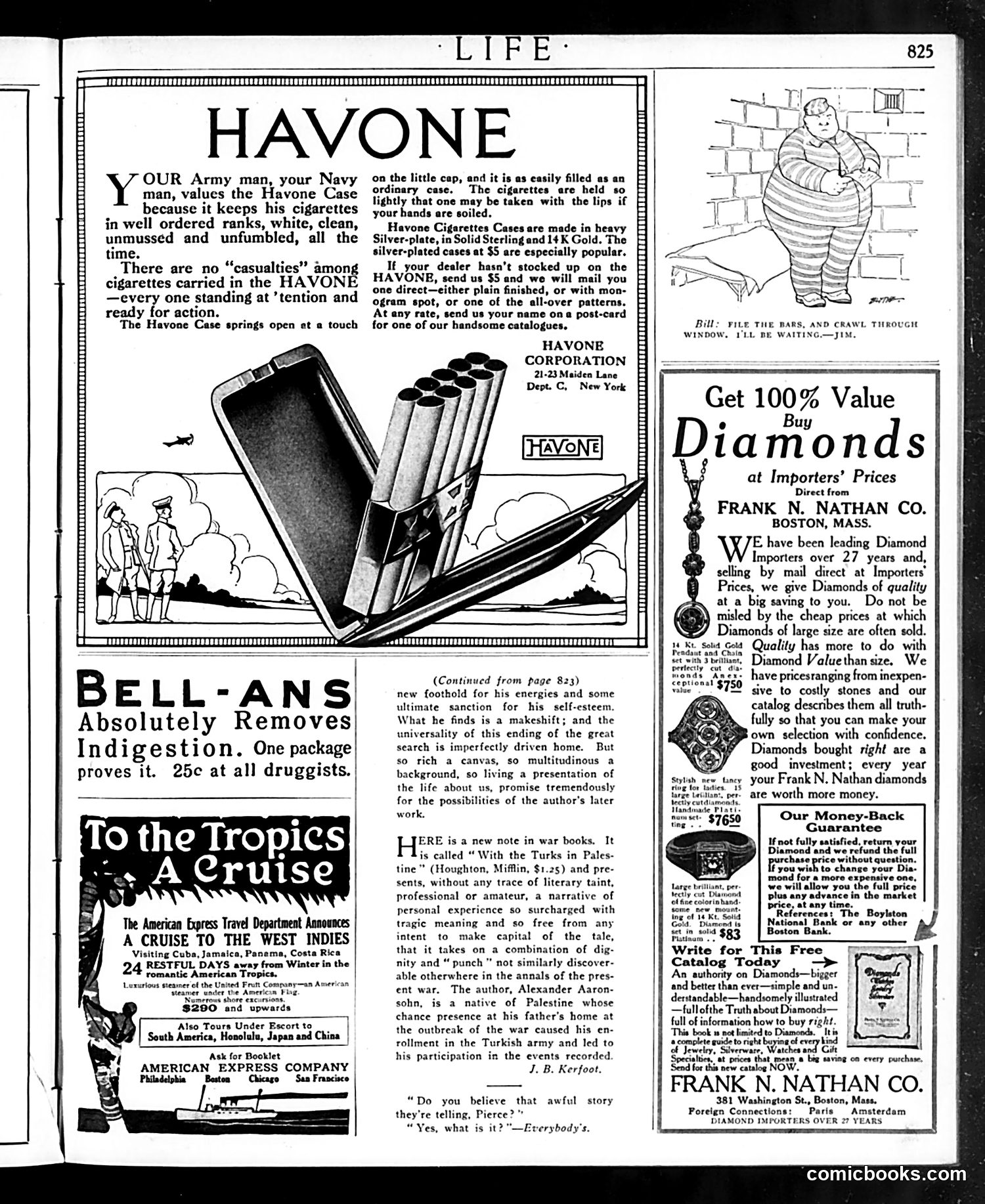
This page is primarily **advertisements with one book review**—not political satire. The **Havone Case ad** uses military language ("standing at 'tention," "casualties") to market a cigarette case to servicemen, playing on WWI-era Army/Navy appeal. The cartoon shows a uniformed soldier, illustrating the target market. The **book review** discusses "With the Turks in Palestine" by Alexander Aaronsohn, praising its authentic WWI narrative without "literary taint"—a serious review, not satire. Other ads include Bell-Ans (indigestion remedy), American Express tropical cruises, and Frank N. Nathan diamonds. These reflect 1920s consumer culture. The small cartoon captioned "Bill: FILL THE BARS, AND CRAWL THROUGH WINDOW, I'LL BE WAITING.—JIM" appears to be a humorous domestic scene but lacks sufficient context to interpret its specific meaning or reference. This is fundamentally a **commercial page**, not a satirical one.
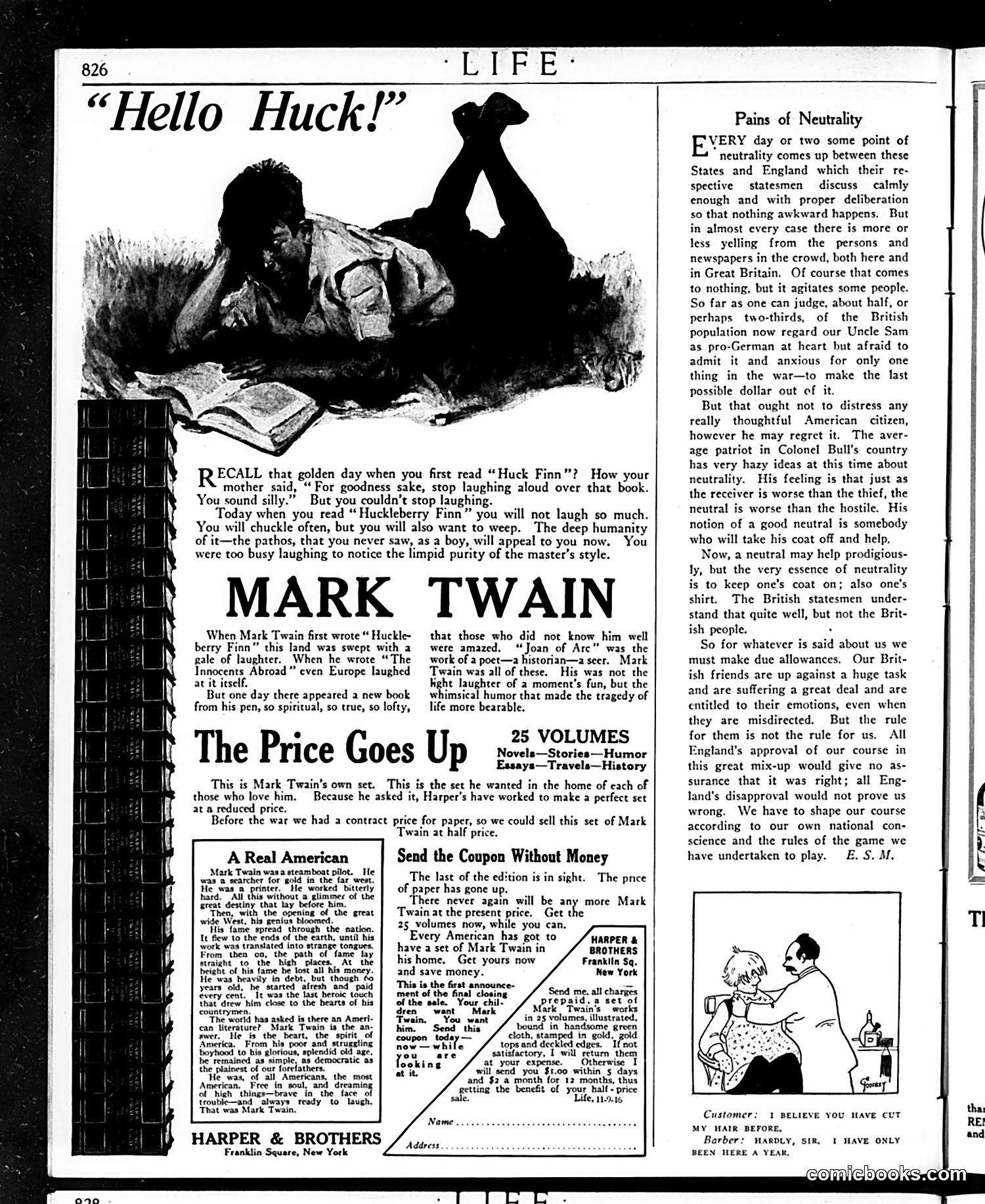
This page primarily advertises Mark Twain's complete 25-volume works set through Harper & Brothers. The illustrated cartoon "Hello Huck!" depicts a silhouetted figure reclining with a book—likely Huck Finn himself—establishing nostalgia for childhood reading. The accompanying text celebrates Twain as quintessentially American: a steamboat pilot, gold prospector, and self-made man who repaid debts despite financial ruin. Publishers emphasize that this "definitive" collection represents American literature itself. A sidebar titled "Pains of Neutrality" shifts tone entirely, discussing U.S.-British tensions. It suggests Americans and British newspapers generate unnecessary friction over diplomatic disputes that statemen handle calmly. The author argues both nations should resist emotional reactions and maintain rational judgment. The page juxtaposes commercial celebration of American cultural achievement with commentary on Anglo-American diplomatic friction—likely reflecting pre-WWI anxieties about U.S. neutrality.
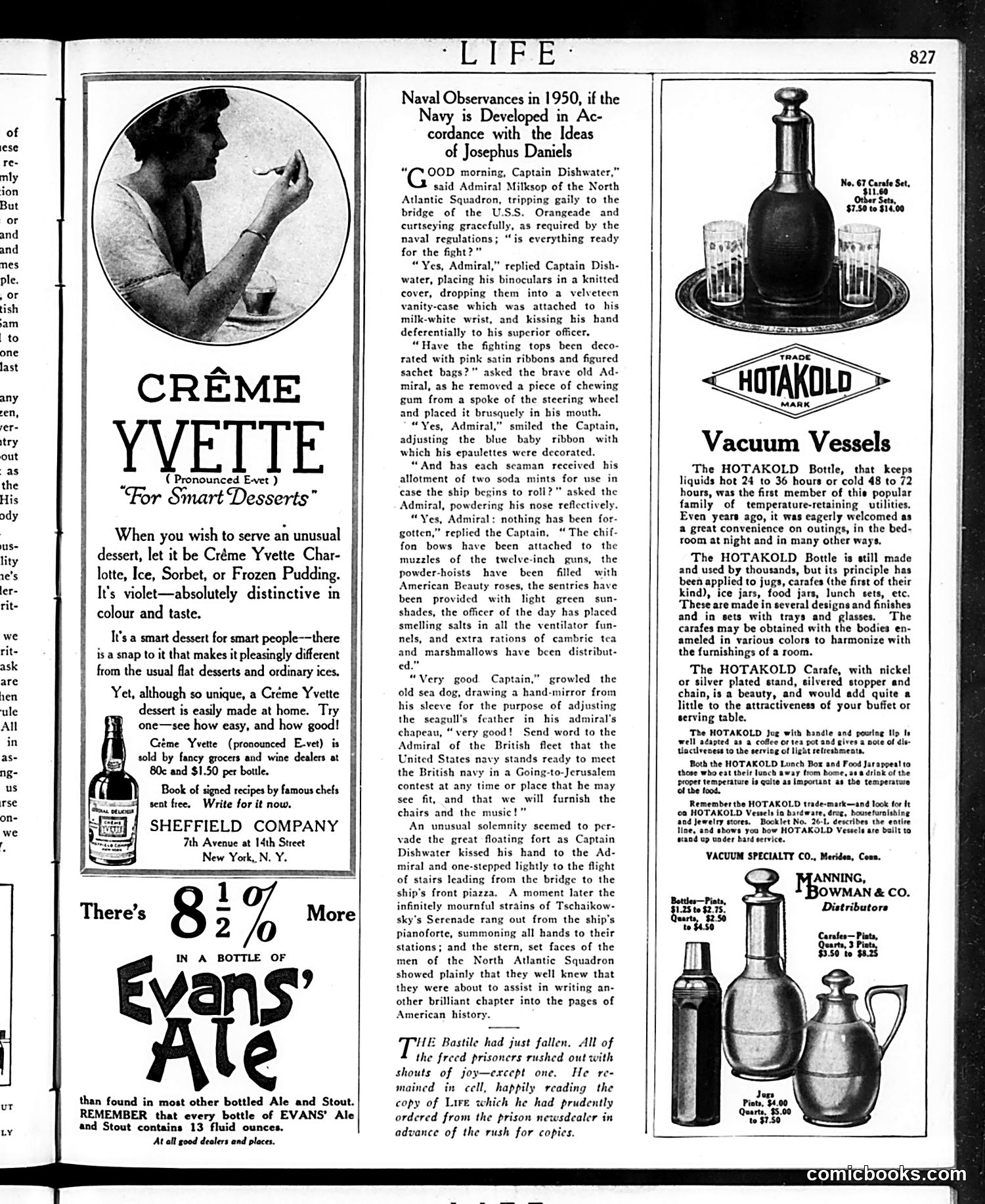
This cartoon mocks Secretary of the Navy Josephus Daniels' policies, which conservatives viewed as excessively prudish and "feminizing" the Navy. The satire depicts Admiral Milksop and Captain Dishwater—deliberately emasculating names—engaging in absurdly dainty behavior: curtsying, carrying vanity cases, applying makeup, decorating gun muzzles with chiffon bows, and distributing "cambric tea and marshmallows" to sailors. Daniels was known for prohibiting alcohol aboard naval vessels and implementing various moral reforms. Critics attacked these policies as weakening military discipline and masculine toughness. The cartoon exaggerates these reforms into a parody of excessive femininity, suggesting they've transformed the Navy into something frivolous and unfit for combat—culminating in a "Going-to-Jerusalem" game instead of actual naval warfare. The joke targets not the Navy itself but Daniels' reformist agenda, which political opponents ridiculed as undermining American military strength.
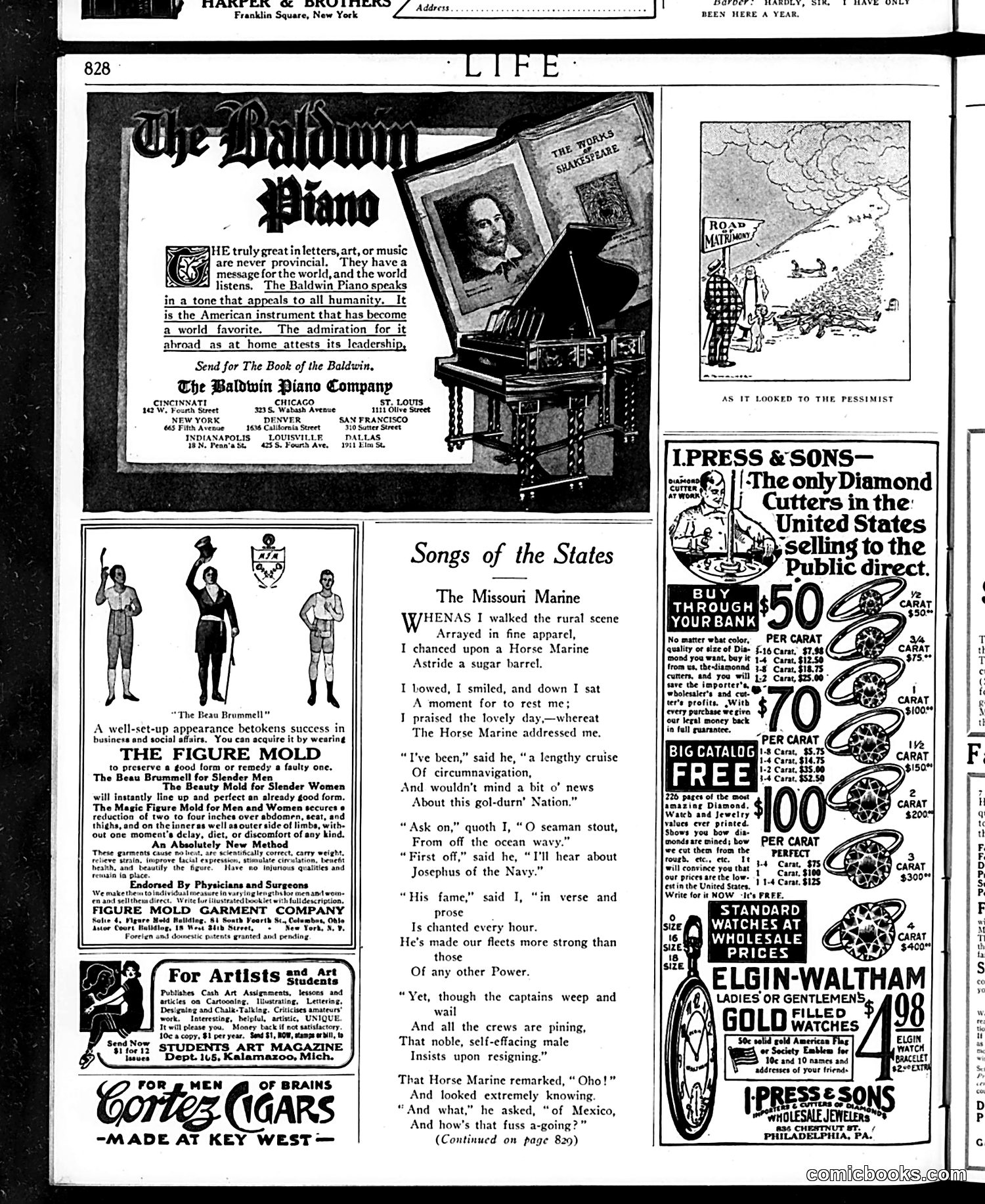
This page features a humorous poem about a "Horse Marine"—a nonsensical figure (a marine assigned to a ship, speaking colloquially) encountered by a traveler. The satire appears to reference contemporary American politics, specifically: **Josephus Daniels**, Secretary of the Navy under President Wilson, is explicitly named. The poem jokes that despite Daniels' fame and the Navy's strength, he "insists upon resigning"—likely mocking either his actual resignation or political controversies surrounding his tenure. **Mexico** is also referenced, alluding to ongoing American military tensions and interventions there during the 1910s-1920s era. The humor relies on the absurdity of a talking horse-marine serving as a vehicle for political commentary—a typical Life magazine approach blending whimsy with current events criticism. The poem continues beyond this page, suggesting sustained satirical commentary on naval leadership and foreign policy.
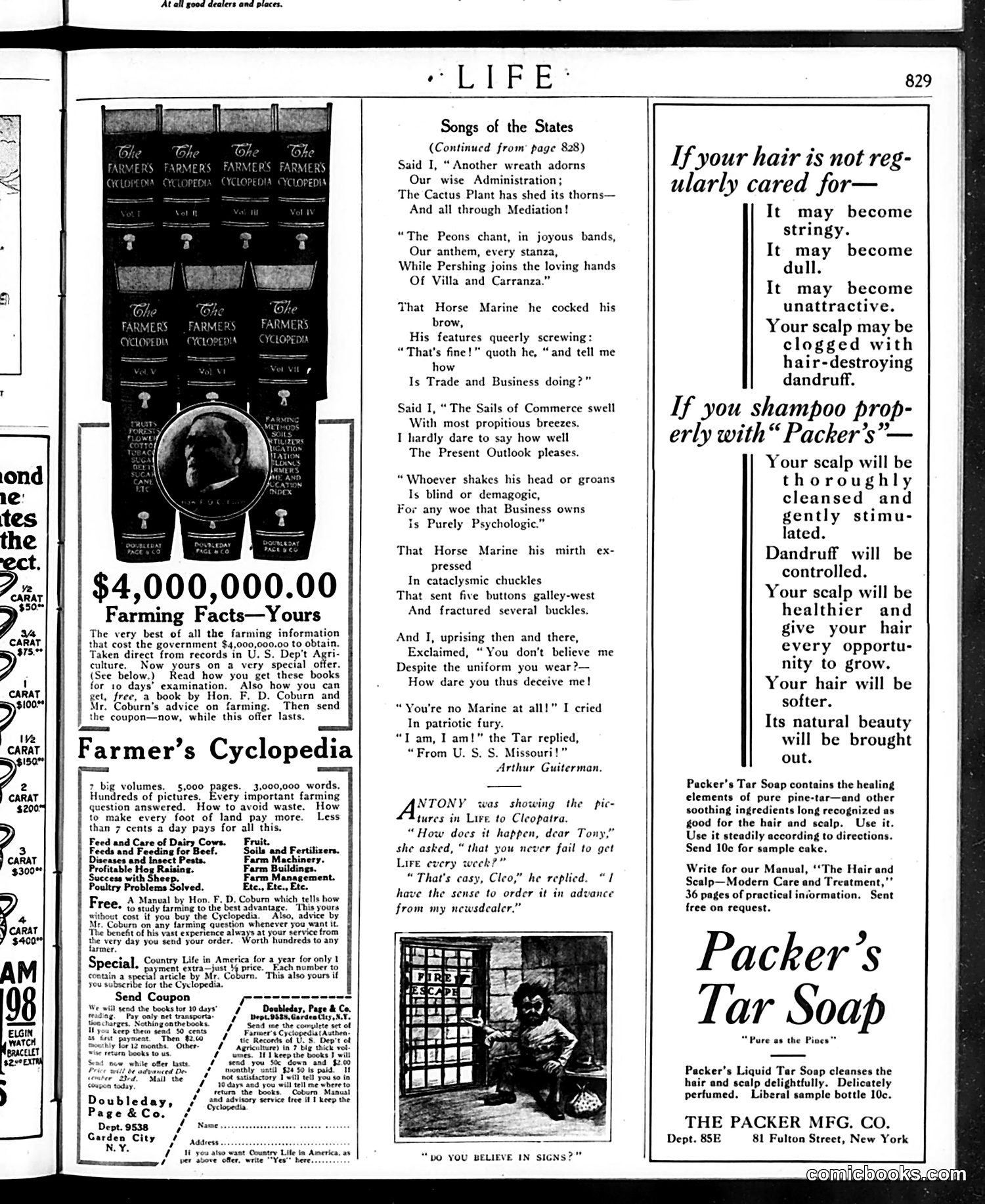
This page contains satirical poetry and advertisements typical of Life magazine's format. The main content is "Songs of the States" (continued), a poem by Arthur Guiterman mocking President Wilson's administration's handling of the Mexican Revolution. The poem ridicules Wilson's mediation efforts between Villa and Carranza, and references General Pershing's military involvement—suggesting the administration's diplomatic claims of peace are hollow. A "Horse Marine" character expresses skepticism about the government's rosy economic claims, calling business confidence merely "psychologic." The page is otherwise dominated by period advertisements: the Farmer's Encyclopedia (a $4 million government agricultural publication offered cheaply), and two ads for Packer's Tar Soap, which promise hair and scalp health benefits. A small cartoon showing someone at a window asks "Do You Believe in Signs?"—likely commenting on gullibility, fitting the page's satirical tone about believing official narratives.
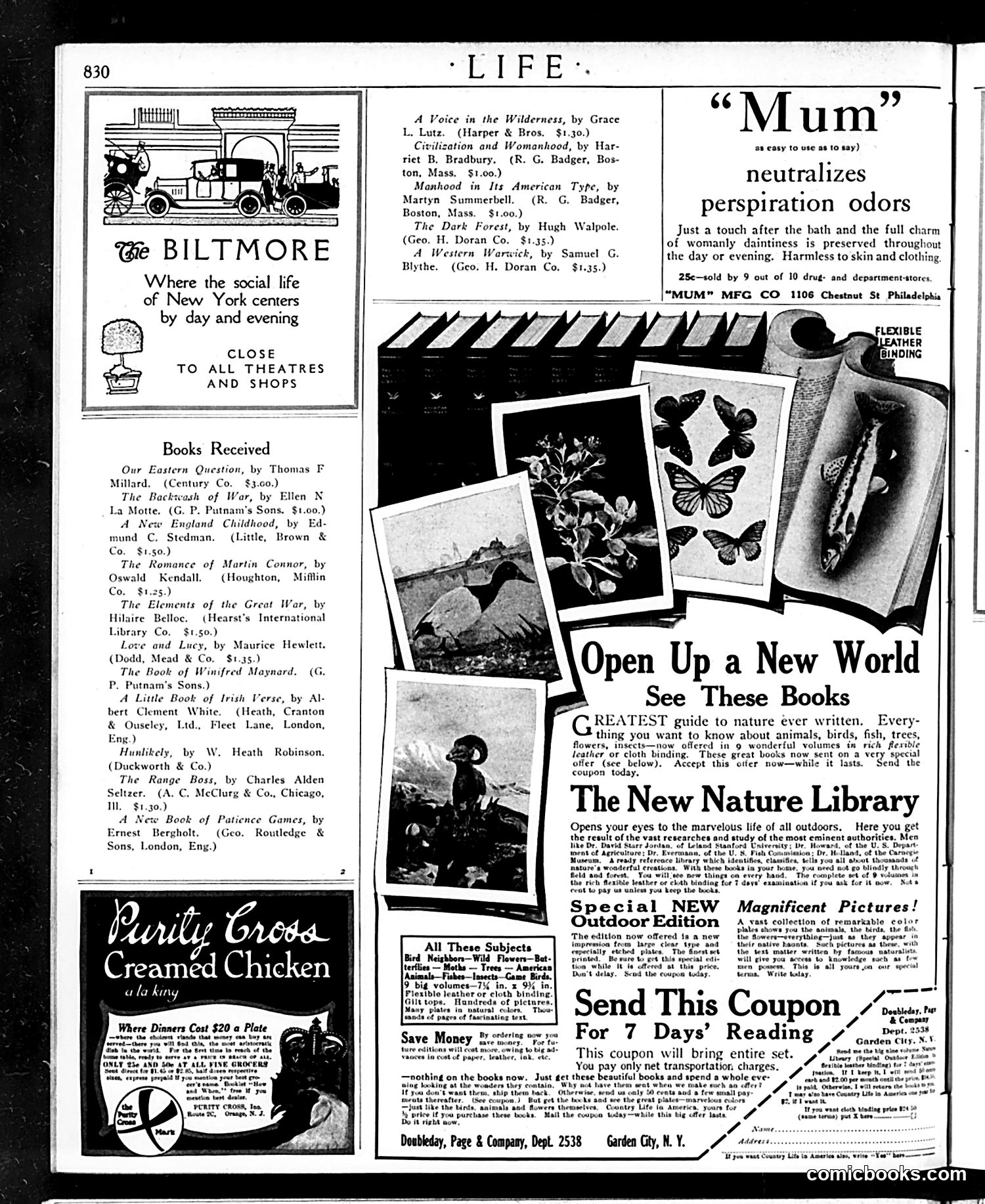
This is primarily an **advertising page** from Life magazine, not a satirical cartoon. The page contains: **Main Advertisements:** - **"Mum" deodorant**: Promises to neutralize perspiration odors, positioning itself as essential for maintaining "womanly daintiness" throughout the day - **The Biltmore Hotel**: Advertises as where New York's social life centers, near theaters and shops - **Purity Cross Creamed Chicken**: Restaurant ad highlighting luxury dining ("Where Dinners Cost $20 a Plate") - **The New Nature Library**: A multi-volume book set on animals, birds, plants, and natural history, offered via coupon for a trial period **Context for Modern Readers:** The language reflects early 20th-century gender expectations—the Mum ad's focus on "womanly daintiness" shows how deodorant marketing targeted female insecurity about bodily functions. Luxury dining at $20/plate and hotel elegance reflect aspirational upper-class lifestyle marketing typical of the era.
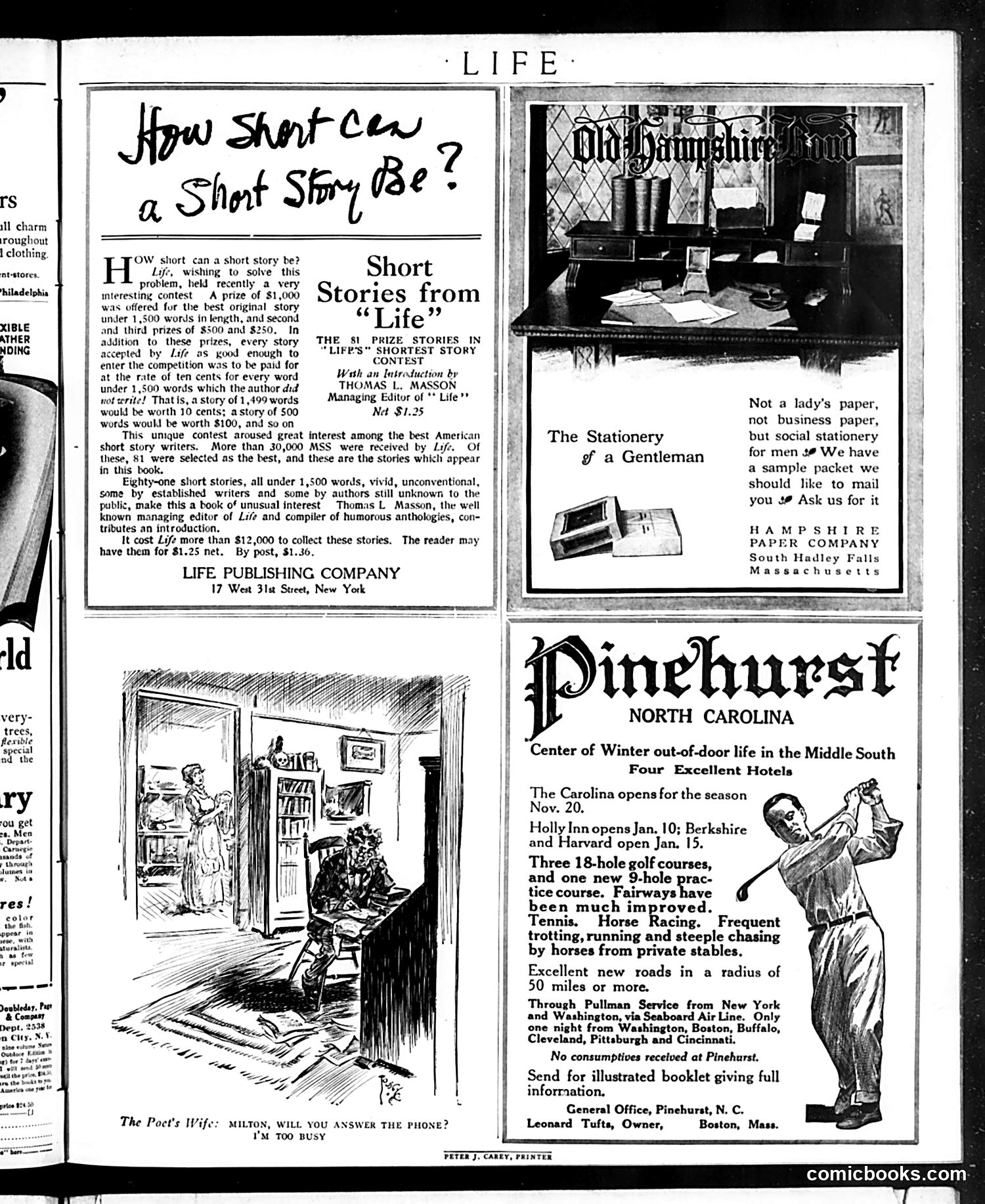
This page primarily features **advertisements and promotional content** rather than political satire. The main content announces Life's short-story contest, offering $1,000 for the best original story under 1,500 words. The contest's gimmick: authors were paid ten cents per word *not* written—incentivizing brevity. Over 30,000 submissions were received; 81 were selected for publication. Managing Editor Thomas L. Masson provides an introduction. The page includes one cartoon titled "The Poet's Wife," showing a domestic scene where a woman calls upstairs to her husband (Milton), asking him to answer the phone while she's busy. This is mild domestic satire about spousal dynamics and the poet's reluctance to interrupt his work. The remaining content consists of advertisements: Hampshire Paper Company (gentlemen's stationery) and Pinehurst, North Carolina (a resort promoting winter golf, tennis, and horse racing). The page reflects early 20th-century advertising and literary culture rather than political commentary.
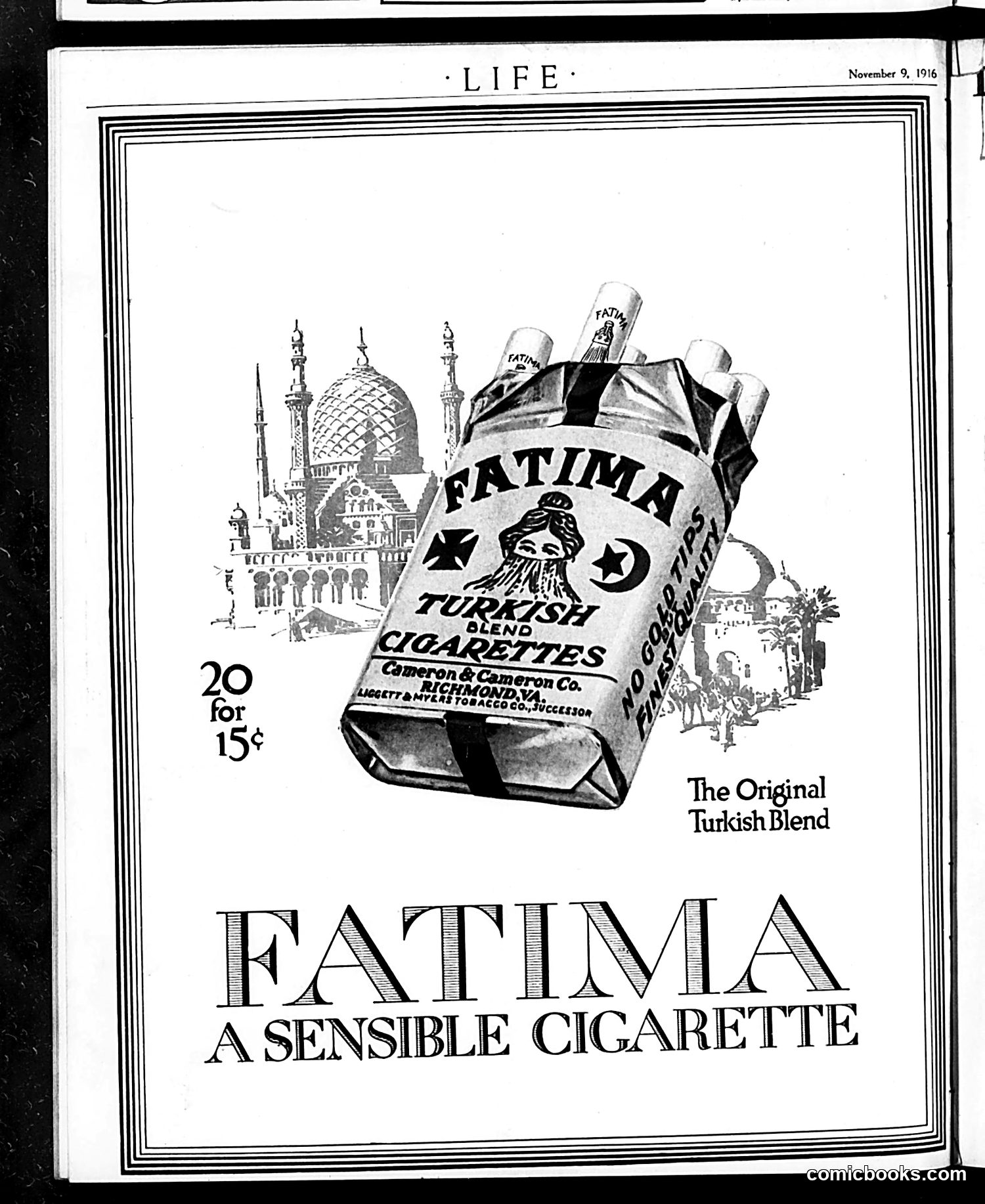
This is a **cigarette advertisement**, not political satire. It appeared in *Life* magazine on November 9, 1916. The ad promotes **Fatima Turkish Blend Cigarettes** made by Cameron & Cameron Co. (Richmond, VA), priced at "20 for 15¢." The image features an ornate cigarette pack decorated with a turbaned figure and Islamic architectural elements (a mosque with dome and minarets), emphasizing the "Turkish" branding. The text claims it's "The Original Turkish Blend" and "A Sensible Cigarette"—marketing language suggesting quality and value. This reflects early 20th-century advertising practices using Orientalist imagery to market "exotic" tobacco products. The term "sensible" likely played on contemporary health debates about cigarettes, though by modern standards such advertising would be considered misleading and offensive in its cultural stereotyping.