
Life, 1916-11-09 · page 20 of 40
Life — November 9, 1916 — page 20: what you’re looking at
What you’re looking at
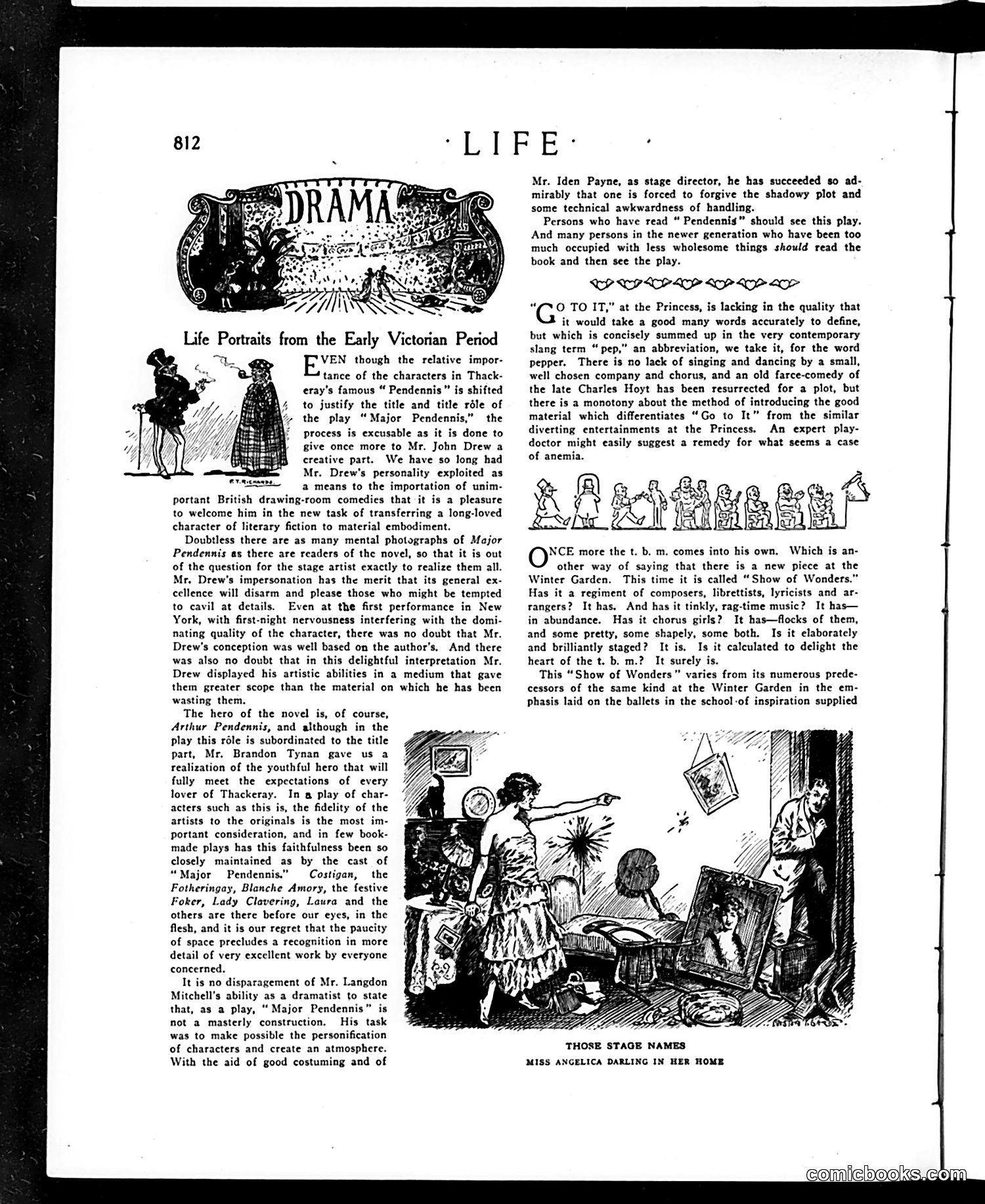
This page reviews theatrical adaptations of 19th-century literature. The main focus is "Major Pendennis," adapted from Thackeray's novel, starring actor John Drew. The critic praises Drew's performance and the cast's faithfulness to Thackeray's characters, though notes the play's plot is somewhat weak. The reviewer commends the stage direction by Iden Payne for compensating through atmosphere and costuming. A secondary review criticizes "Go to It" at the Princess Theatre for lacking "pep" (energy/excitement). Despite good singing, dancing, and an old Charles Hoyt farce as its foundation, the production suffers from monotonous presentation—what the critic calls a case of "anemia." The illustration shows a scene from a theatrical production. The page demonstrates how Life magazine covered contemporary theater, balancing praise for literary fidelity against production quality.
📄 Transcribed text from this page (OCR, searchable)
Machine-transcribed from the original scan — historical spelling and the odd misread are preserved.
LIFE Life Portraits from the Early Victorian Period VEN though the relative impor- tance of the characters in Thack- eray’s famous “ Pendennis” is shifted to justify the title and title réle of the play “Major Pendennis,” the process is excusable as it is done to give once more to Mr. John Drew a creative part. We have so long had Mr. Drew's personality exploited as a means to the importation of unim- portant British drawing-room comedies that it is a pleasure to welcome him in the new task of transferring a long-loved character of literary fiction to material embodiment. Doubtless there are as many mental photographs of Major Pendennis as there are readers of the novel, so that it is out of the question for the stage artist exactly to realize them all. Mr. Drew's impersonation has the merit that its general ex- cellence will disarm and please those who might be tempted to cavil at details. Even at the first performance in New York, with first-night nervousness interfering with the domi- nating quality of the character, there was no doubt that Mr. Drew's conception was well based on the author's. And there was also no doubt that in this delightful interpretation Mr. Drew displayed his artistic abilities in a medium that gave them greater scope than the material on which he has been wasting them. The hero of the novel is, of course, Arthur Pendennis, and although in the play this rdle is subordinated to the title part, Mr. Brandon Tynan gave us a realization of the youthful hero that will fully meet the expectations of every lover of Thackeray. In a play of char- acters such as this is, the fidelity of the artists to the originals is the most im- portant consideration, and in few book- made plays has this faithfulness been so closely maintained as by the cast of “Major Pendennis.” Costigan, the Fotheringay, Blanche Amory, the festive Foker, Lady Clavering, Laura and the others are there before our eyes, in the flesh, and it is our regret that the paucity of space precludes a recognition in more detail of very excellent work by everyone concerned. It is no disparagement of Mr. Langdon Mitchell's ability as a dramatist to te that, as a play, “ Major Pendennis” i: not a masterly construction. His task was to make possible the personification of characters and create an atmosphere. With the aid of good costuming and of Mr. Iden Payne, as stage director, he has succeeded so ad- mirably that one forced to forgive the shadowy plot and some technical awkwardness of handling. Persons who have read “ Pendennis” should see this play. And many persons in the newer generation who have been too much occupied with less wholesome things should read the book and then see the play. PIP LAP LP LOO O TO IT,” at the Princess, is lacking in the quality that it would take a good many words accurately to define, but which is concisely summed up in the very contemporary slang term “ pep,” an abbreviation, we take it, for the word pepper. There is no lack of singing and dancing by a small, well chosen company and chorus, and an old farce-comedy of the late Charles Hoyt has been resurrected for a plot, but there is a monotony about the method of introducing the good material which differentiates “Go to It” from the similar diverting entertainments at the Princess. An expert play- doctor might easily suggest a remedy for what seems a case of anemia. A ichiaagenr NCE more the t. b. m. comes into his own. Which is an- other way of saying that there is a new piece at the Winter Garden. This time it is called “Show of Wonders.” Has it a regiment of composers, librettists, lyricists and ar- rangers? It has. And has it tinkly, rag-time music? It has— in abundance. Has it chorus girls? It has—flocks of them, and some pretty, some shapely, some both. Is it elaborately and brilliantly staged? It is, Is it calculated to delight the heart of the t. b. m.? It surely is. This “Show of Wonders” varies from its numerous prede- cessors of the same kind at the Winter Garden in the em- phasis laid on the ballets in the school-of inspiration supplied THOSE STAGE NAMES MISS ANGELICA DARLING IN HER HOME