
Life, 1916-11-09 · page 8 of 40
Life — November 9, 1916 — page 8: what you’re looking at
What you’re looking at
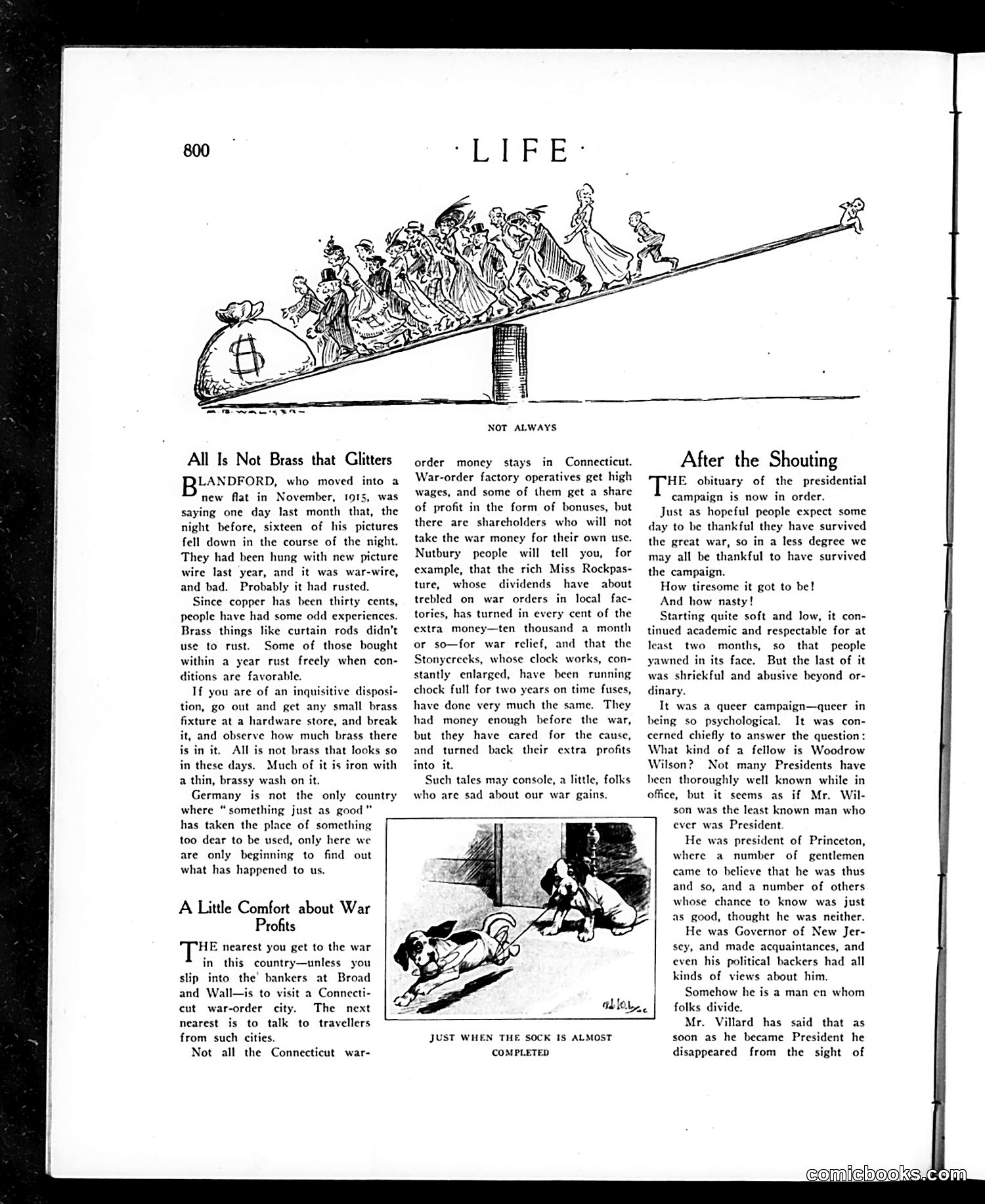
**Main Cartoon ("Not Always")**: A seesaw depicts people (representing the public) on one end balanced against a money bag on the other, illustrating how wartime profits tip the scales of social balance. **Articles Discussed**: 1. **"All Is Not Brass that Glitters"**: Critiques war profiteering, describing how Connecticut factory workers and shareholders grew wealthy from war contracts while ordinary people suffered deprivation. 2. **"A Little Comfort about War Profits"** and **"After the Shooting"**: Discusses President Woodrow Wilson's relative obscurity and anonymity compared to other political figures, suggesting he deliberately distanced himself from public view during his presidency. The page satirizes wartime economic inequality and questions Wilson's leadership visibility.
📄 Transcribed text from this page (OCR, searchable)
Machine-transcribed from the original scan — historical spelling and the odd misread are preserved.
All Is Not Brass that Glitters BEANREORD: who moved into a new flat in November, 1915, was saying one day last month that, the night before, sixteen of his pictures fell down in the course of the night. They had been hung with new picture wire last year, and it was war-wire, and bad. Probably it had rusted. Since copper has been thirty cents, people have had some odd experiences. Brass things like curtain rods didn’t use to rust. Some of those bought within a year rust freely when con- ditions are favorable. If you are of an inquisitive disposi- tion, go out and get any small brass fixture at a hardware store, and break it, and observe how much brass there is in it. All is not brass that looks so in these days. Much of it is iron with a thin, brassy wash on it. Germany is not the only country where “something just as good” NOT ALWAYS order money stays in Connecticut. War-order factory operatives get high wages, and some of them get a share of profit in the form of bonuses, but there are shareholders who will not take the war moncy for their own use. Nutbury people will tell you, for example, that the rich Miss Rockpas- ture, whose dividends have about trebled on war orders in local fac- tories, has turned in every cent of the extra money—ten thousand a month or so—for war relief, and that the Stonyereeks, whose clock works, con- stantly enlarged, have been running chock full for two years on time fuses, have done very much the same. They had money enough before the war, but they have cared for the cause, and turned back their extra profits into it. Such tales may console, a little, folks who are sad about our war gains. After the Shouting HE obituary of the presidential campaign is now in order. Just as hopeful people expect some day to be thankful they have survived the great war, so in a less degree we may all be thankful to have survived the campaign. How tiresome it got to be! And how nasty! Starting quite soft and low, it con- tinued academic and respectable for at least’ two months, so that people yawned in its face. But the last of it was shrickful and abusive beyond or- dinary. It was a queer campaign—queer in being so psychological. It was con- cerned chiefly to answer the question: What kind of a fellow is Woodrow Not many Presidents have been thoroughly well known while in office, but it seems as if Mr. Wil- son was the least known man who has taken the place of something too dear to be used, only here we are only beginning to find out what has happened to us. A Little Comfort about War Profits HE nearest you get to the war in this country—unless you slip into the’ bankers at Broad and Wall—is to visit a Connecti- cut war-order city. The next nearest is to talk to travellers from such cities. Not all the Connecticut war- JUST WHEN THE SOCK IS ALMOST COMPLETED ever was President. He was president of Princeton, where a number of gentlemen came to believe that he was thus and so, and a number of others whose chance to know was just as good, thought he was neither. He was Governor of New Jer- sey, and made acquaintances, and even his political backers had all kinds of views about him. Somehow he is a man cn whom folks divide, Mr. Villard has said that as soon as he became President he disappeared from the sight of