
Life, 1916-11-09 · page 16 of 40
Life — November 9, 1916 — page 16: what you’re looking at
What you’re looking at
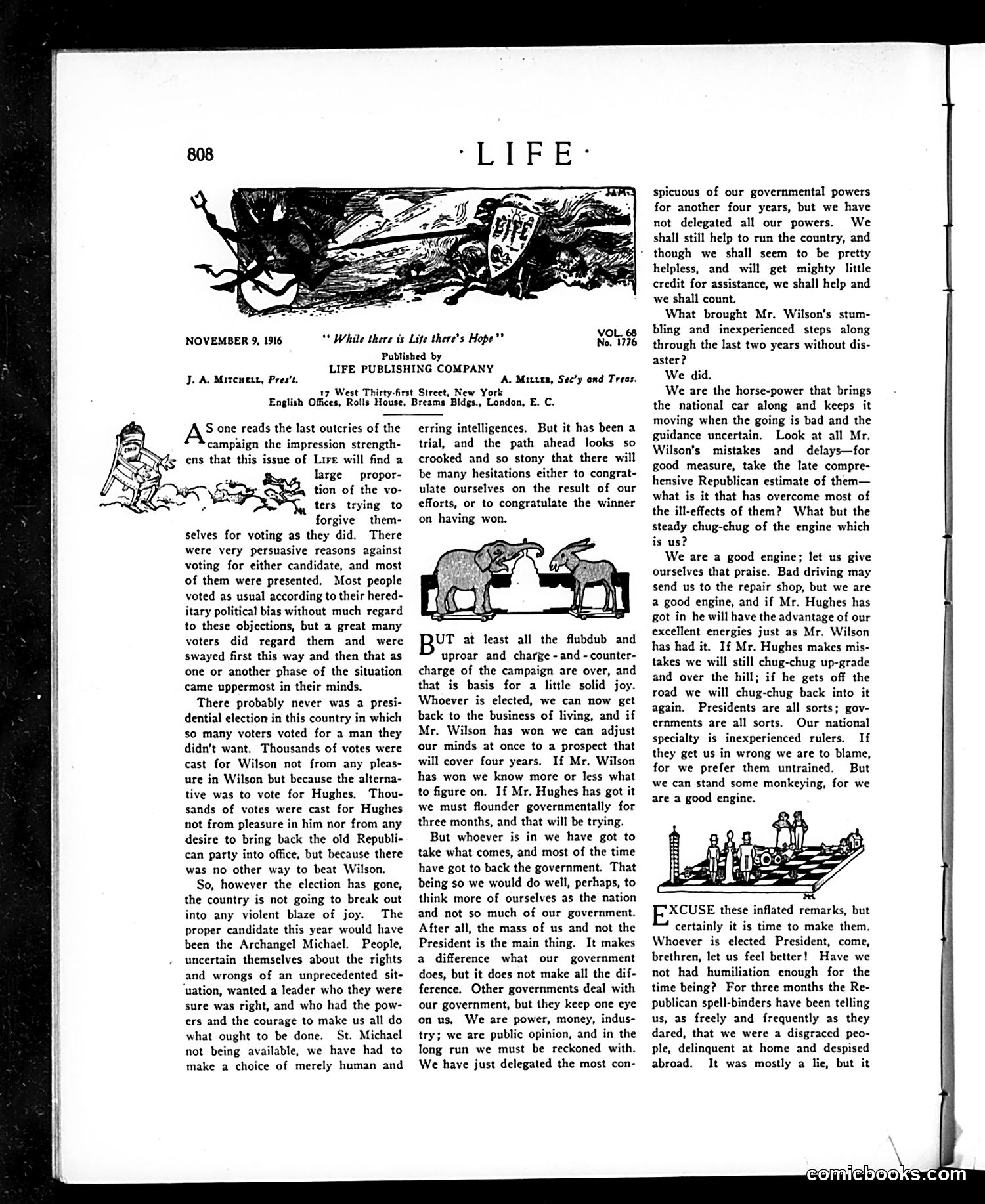
This is editorial commentary following the 1916 U.S. presidential election (Wilson vs. Hughes). The header cartoon shows a figure of "Hope" amid uncertainty—reflecting the election's ambiguity. The text argues that voters faced an unprecedented dilemma: both candidates seemed flawed, so many voted *against* someone rather than *for* someone. The author notes that thousands voted for Wilson reluctantly (as the alternative to Hughes) and vice versa—nobody was truly enthusiastic. The piece's main point: Americans themselves, not the president, are the nation's true engine ("We are the horse-power"). Voters shouldn't blame the president for everything; they share responsibility for the country's direction and must "back the government" regardless of who won. The author urges civic unity and perspective—citizens matter more than which candidate prevails. This reflects post-election fatigue and an appeal for national cohesion during uncertain times (pre-WWI America).
📄 Transcribed text from this page (OCR, searchable)
Machine-transcribed from the original scan — historical spelling and the odd misread are preserved.
NOVEMBER 9, 1916 “* While there is Lite there's Hope"* Published by LIFE PUBLISHING COMPANY J. A. Mircment, Pres’t. S one reads the last outcries of the campaign the impression strength- ens that this issue of Lire will find a . large propor- ESAS tion of the vo- pes ters trying to forgive them- selves for voting as they did. There were very persuasive reasons against voting for either candidate, and most of them were presented. Most people voted as usual according to their hered- itary political bias without much regard to these objections, but a great many voters did regard them and were swayed first this way and then that as one or another phase of the situation came uppermost in their minds. There probably never was a presi- dential election in this country in which so many voters voted for a man they didn’t want. Thousands of votes were cast for Wilson not from any pleas- ure in Wilson but because the alterna- tive was to vote for Hughes. Thou- sands of votes were cast for Hughes not from pleasure in him nor from any desire to bring back the old Republi- can party into office, but because there was no other way to beat Wilson. So, however the election has gone, the country is not going to break out into any violent blaze of joy. The proper candidate this year would have been the Archangel Michael. People, uncertain themselves about the rights and wrongs of an unprecedented sit- uation, wanted a leader who they were sure was right, and who had the pow- ers and the courage to make us all do what ought to be done. St. Michael not being available, we have had to make a choice of merely human and A. Mitten, Sec’y ond Treas. 17 West Thirty-first Street, New York English Offices, Rolls House, Breams Bldgs., London, E. C. erring intelligences. But it has been a trial, and the path ahead looks so crooked and so stony that there will be many hesitations either to congrat- ulate ourselves on the result of our efforts, or to congratulate the winner on having won. UT at least all the flubdub and uproar and charge - and -counter- charge of the campaign are over, and that is basis for a little solid joy. Whoever is elected, we can now get back to the business of living, and if Mr. Wilson has won we can adjust our minds at once to a prospect that will cover four years. If Mr. Wilson has won we know more or less what to figure on. If Mr. Hughes has got it we must flounder governmentally for three months, and that will be trying. But whoever is in we have got to take what comes, and most of the time have got to back the government. That being so we would do well, perhaps, to think more of ourselves as the nation and not so much of our government. After all, the mass of us and not the President is the main thing. It makes a difference what our government does, but it does not make all the dif- ference. Other governments deal with our government, but they keep one eye on us. We are power, money, indus- try; we are public opinion, and in the long run we must be reckoned with. We have just delegated the most con- spicuous of our governmental powers for another four years, but we have not delegated all our powers. We shall still help to run the country, and though we shall seem to be pretty helpless, and will get mighty little credit for assistance, we shall help and we shall count. What brought Mr. Wilson's stum- bling and inexperienced steps along through the last two years without dis- aster? We did. We are the horse-power that brings the national car along and keeps it moving when the going is bad and the guidance uncertain. Look at all Mr. Wilson’s mistakes and delays—for good measure, take the late compre- hensive Republican estimate of them— what is it that has overcome most of the ill-effects of them? What but the steady chug-chug of the engine which is us? We are a good engine; let us give ourselves that praise. Bad driving may send us to the repair shop, but we are a good engine, and if Mr. Hughes has got in he will have the advantage of our excellent energies just as Mr. Wilson has had it. If Mr. Hughes makes mis- takes we will still chug-chug up-grade and over the hill; if he gets off the road we will chug-chug back into it again. Presidents are all sorts; gov- ernments are all sorts. Our national specialty is inexperienced rulers. If they get us in wrong we are to blame, for we prefer them untrained. But we can stand some monkeying, for we are a good engine. XCUSE these inflated remarks, but certainly it is time to make them. Whoever is elected President, come, brethren, let us feel better!’ Have we not had humiliation enough for the time being? For three months the Re- publican spell-binders have been telling us, as freely and frequently as they dared, that we were a disgraced peo- ple, delinquent at home and despised abroad. It was mostly a lie, but it