
Life, 1916-11-09 · page 21 of 40
Life — November 9, 1916 — page 21: what you’re looking at
What you’re looking at
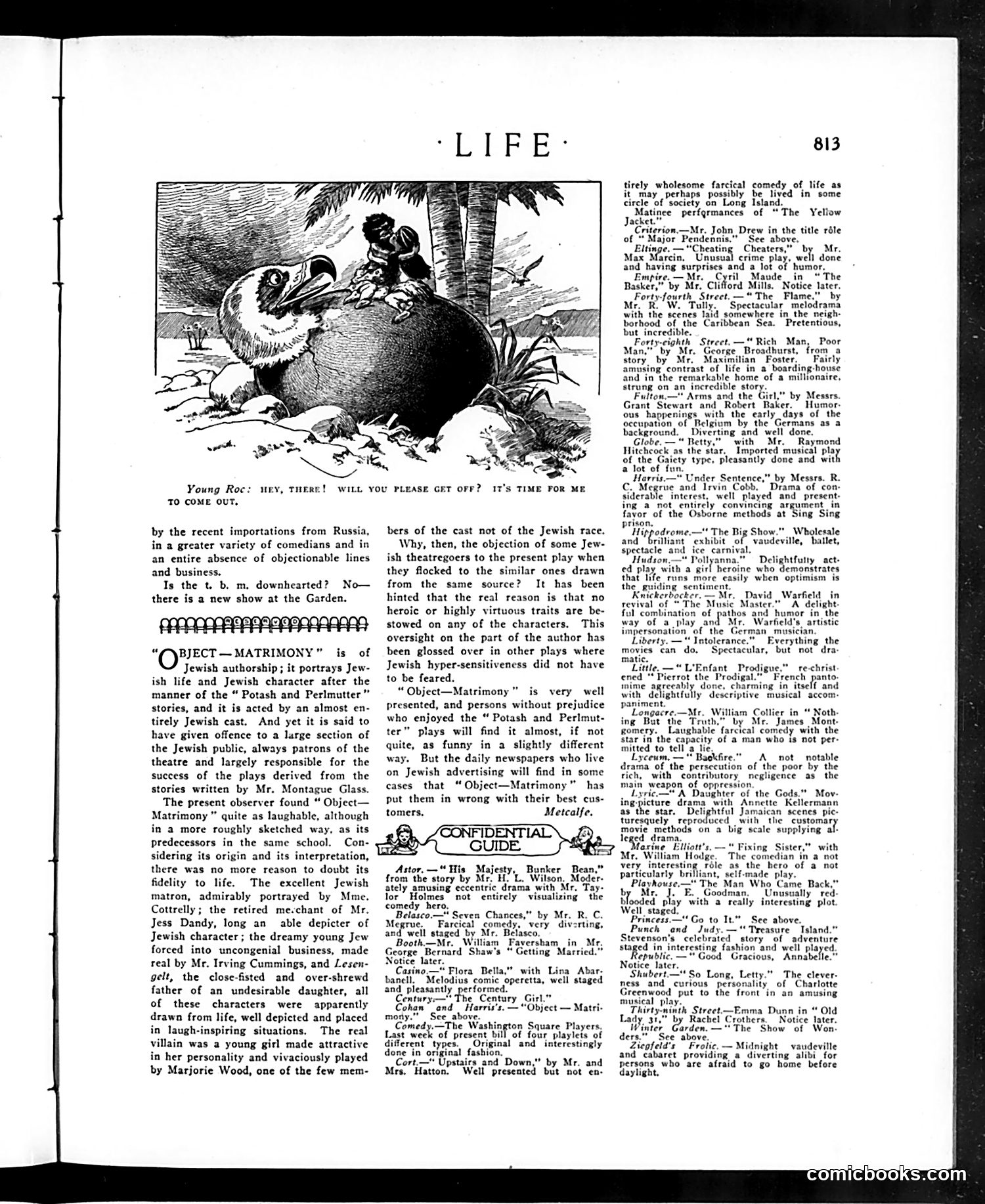
The main cartoon depicts a "Young Roc" (a mythical bird) telling someone to get off so it can come out—a visual pun on the phrase appearing below it. This illustrates Life magazine's characteristic absurdist humor. The page primarily reviews the play "Object—Matrimony," a Jewish-authored comedy about Jewish life. The critic (Metcalfe) notes that while the play entertainingly portrays Jewish characters drawn from life, some Jewish theatergoers objected to it because the characters lack "heroic or highly virtuous traits." The satire targets Jewish community sensitivity: the same audiences who enjoyed similar "Potash and Perlmutter" plays now reject this one, likely due to pressure from Jewish advertisers in newspapers. The critic implies the objection is hypocritical—the play's quality hasn't changed, only the community's willingness to accept unflattering portrayals has shifted, suggesting Jewish organizations were exercising cultural pressure on entertainment.
📄 Transcribed text from this page (OCR, searchable)
Machine-transcribed from the original scan — historical spelling and the odd misread are preserved.
Young Roc: ury, tHere! 70 come out, by the recent importations from Russia, in a greater variety of comedians and in an entire absence of objectionable lines and business. Is the t. b, m. downhearted? No— there is a new show at the Garden. “C)BJECT— MATRIMONY” is of Jewish authorship ; it portrays Jew- ish life and Jewish character after the manner of the “ Potash and Perlmutter” stories, and it is acted by an almost en- tirely Jewish cast, And yet it is said to have given offence to a large section of the Jewish public, always patrons of the theatre and largely responsible for the success of the plays derived from the stories written by Mr. Montague Glass. The present observer found “ Object— Matrimony ” quite as laughable, although in a more roughly sketched way, as its predecessors in the same school. Con- sidering its origin and its interpretation, there was no more reason to doubt i fidelity to li The excellent Jewish matron, admirably portrayed by Mme. Cottrelly; the retired meschant of Mr. Jess Dandy, long an able depicter of Jewish character; the dreamy young Jew forced into uncongenial business, made real by Mr. Irving Cummings, and Lesen- gelt, the close-fisted and over-shrewd father of an undesirable daughter, all of these characters were apparently drawn from life, well depicted and placed in laugh-inspiring situations. The real villain was a young girl made attractive in her personality and vivaciously played by Marjorie Wood, one of the few mem- WILL YOU PLEASE GET OFF? 17's TIME FOR ME bers of the cast not of the Jewish race. Why, then, the objection of some Jew- ish theatregoers to the present play when they flocked to the similar ones drawn from the same source? It has been hinted that the real reason is that no heroic or highly virtuous traits are be- stowed on any of the characters. This oversight on the part of the author has been glossed over in other plays where Jewish hyper-sensitiveness did not have to be feared. “ Object—Matrimony” is very well presented, and persons without prejudice who enjoyed the “ Potash and Perlmut- ter” plays will find it almost, if not quite, as funny in a slightly different way. But the daily newspapers who live on Jewish advertising will find in some cases that “ Object—Matrimony" has put them in wrong with their best cus- tomers, Metcalfe. e) ‘CONFIDENTIAL Tee? GUIDE 2 8s Astor. —“ His Majesty, Bunker Bean,” from the story by Mr. H. L. Wilson. Moder- ately amusing eccentric drama with Mr. Tay- lor Holmes” not entirely visualizing the comedy hero, Seven Chances,” by Mr. R. C. Belasco. Megrue. Farcical comedy, very diverting, in Mr, and well staged by Mr. Belasco. Booth.—Mr. William Faversham George Bernard Shaw's " Getting Married.” Notice later. Casino.—" Flora Bella.” with Lina Abar- banell. Melodius comic operetta, well staged and pleasantly performed. Century-—" The Century Girl.” Cohan and Harris's. — “Object — Matri- moty.”” See_above. Comedy.—The Washington Square Players, Last week of present bill of four playlets of different types. Original and done in original fashion, Cort.—" Upstairs and Down,” by Mr. and Mrs. Hatton, Well presented but not en- interestingly 813 ely wholesome farcical comedy of life as ‘may perhaps possibly be lived in some circle of society on Long Island. Matinee perfgrmances of “The Yellow Jacke" Mr. John Drew in the title réle enden: * See abov w= "Cheating Cheaters." by Mr. Max Marcin, Unusual crime play, well done and having surprises and a lot of humor, Empire. —Mr. Cyril) Maude in “The Basker,” by Mr. Clifford Mills. Notice later. Forty-fourth Street. —“ The Flame.” by Mr, R. W. Tully. Spectacular melodrama with the scenes laid somewhere in the neigh- borhood of the Caribbean Sea. Pretentious, but incredible. Forty-eighth Street. —" Rich Man, Poor Man,” by Mr. George Broadhurst, from a story. by Mr. Maximilian Foster. Fairly amusing contrast of life in a boarding-house and in the remarkable home of a millionaire, strung on an incredible stor, Fulton-—" Arms and the Girl,” by Messrs Grant Ste t and Robert Baker. Humor- fous happenings with the early days of the occupation of Relgium by the Germans as a background. Di ing and well done. Globe. with Mr. Raymond Hitchcock as the star. Imported musical play of the Gaiety type, pleasantly done and wit a lot of fun. Herris.—" Under Sentence,” by Messrs. R. C.. Megrue and Irvin Cobb, Drama of con- siderable interest, well played and present- ing a not entirely convincing argument. in ‘or of the Osborne methods at Sing Sing on. PTHippodrome.—"' The Big Show." Wholesale and “brilliant, exhibit. of vaudeville, ballet, spectacle and ice carnival Hudson.—" Pollyanna.” Delightfutty act: ed play with a girl heroine who demonstrates that life runs more easily when optimism is the guiding sentiment Knickerbocker. David | Warfield in revival of “The Music Master.” A delight ful combination of pathos and humor in the way of a play and Mr, Warfeld’s. artistic impersonation of the German musician Liberty. —"' Intolerance.” Everything the movies can do, Spectacular, but not dra- matic, Little. —“L'Enfant Prodigue,” re-christ ened " Pierrot the Prodigal.” French panto. mime agreeably done, charming in itself and with delightfully descriptive musical accom paniment. Longacre.—Mr. William Collier in Noth- ing But the Truth,” by Mr. James Mont- gomery. Laughable farcical comedy the star in the capacity of a man who is not per- mitted to tell a lie. Lyceum. —" Backfire.” A not _ notable drama of the persecution of the poor by the rich, with contributory negligence as the ‘of oppression A Daughter of the Gods." Mov- ing-picture drama with Annette Kellermann as the star. Delightful Jamaican scenes pic- turesquely reproduced with the customary movie methods on a big scale supplying a: leged dram: Sasi “s.—" Fixing Sister,” with Mr. William Hodge. The comedian in a not very interesting role as the hero of a not particularly brilliant, self-made play. Playhouse.—" The Man Who Came Back,” by Mr. JE. Goodman.” Unusually red blooded’ play with a really interesting plot. Well staged. Princess.—"Go to It. Punch and Jud Treasure Island.” Stevenson's celebrated story of adventure staged in interesting fashion and well played. fepublic. —""Good ‘Gracious, Annabelle.” Notice Iai Shubert—*" So Long, Letty." The clever- ness and curious personality of Charlotte Greenwood put to the front in an amusing musical play. Thirty-ninth Street—Emma Dunn in “ Old Lady 31,” by Rachel Crothers. Notice late Winter Garden. —“ The Show of Won- ders." See above. Zicgfeld's ic. — Midnight and cabaret providing a diverting alibi for persons who are afraid to go home before daylight, See above. vaudeville