
Life, 1916-11-09 · page 4 of 40
Life — November 9, 1916 — page 4: what you’re looking at
What you’re looking at
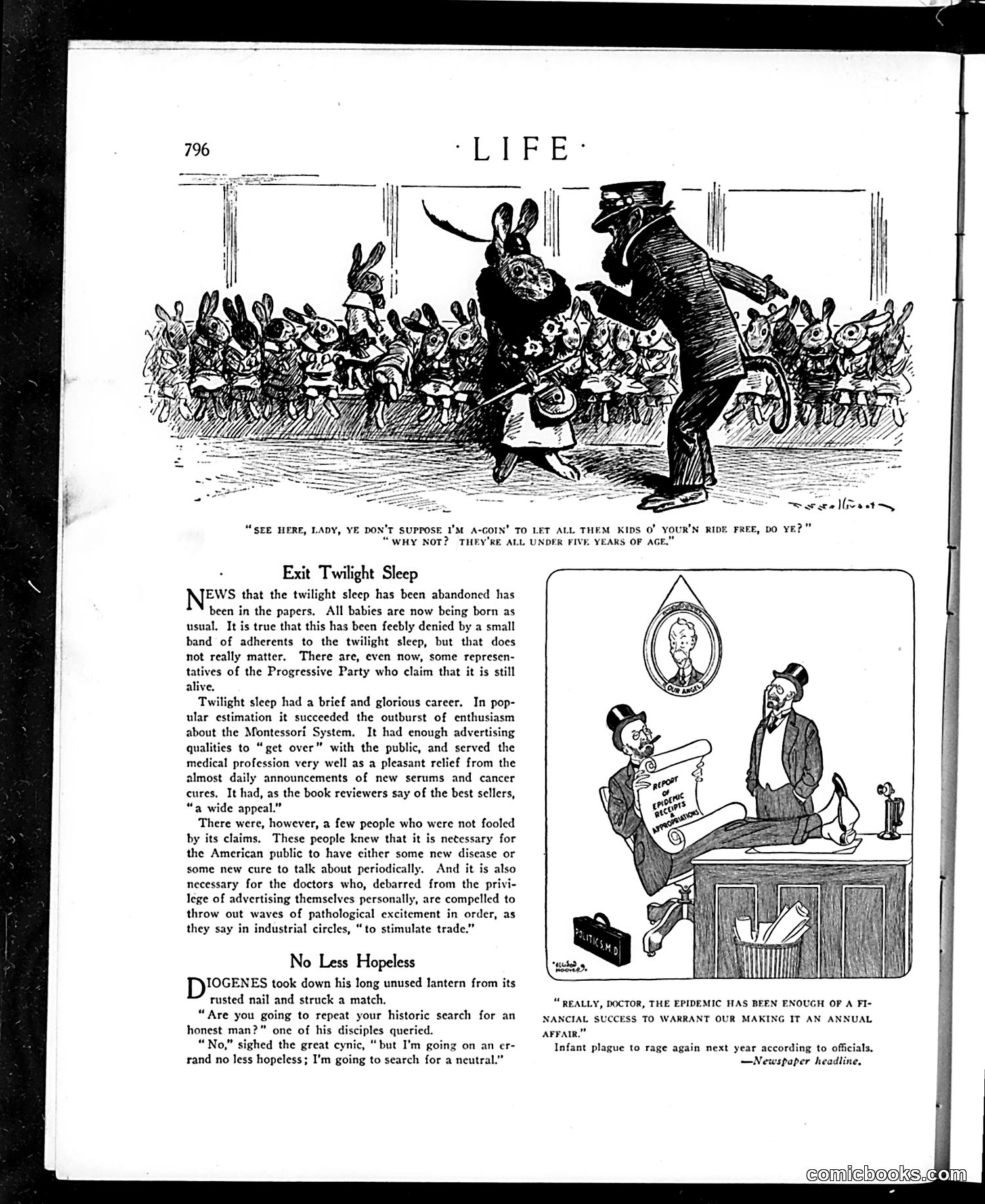
**Top Cartoon:** A uniformed official (appearing to be a police or military figure) addresses a crowd of rabbits, discussing whether children can ride them. This satirizes the "Progressive Party" and specifically mocks the Montessori educational method's popularity among progressives—suggesting their ideas are as absurd as letting children ride rabbits. **"Exit Twilight Sleep" Section:** Satirizes the abandonment of "twilight sleep" (a childbirth anesthesia trend). The text mocks how medical professionals and advertisers promoted it as revolutionary, then quietly dropped it. The accompanying cartoon shows a doctor pitching the epidemic as a financial success story—critiquing how medical marketers manufacture enthusiasm for treatments regardless of actual efficacy. The satire targets Progressive Era medical commercialism and faddish "scientific" trends.
📄 Transcribed text from this page (OCR, searchable)
Machine-transcribed from the original scan — historical spelling and the odd misread are preserved.
“SEE HERE, LADY, YE DON'T SUPPOSE I'M A-GOIN’ TO LET ALL THEM KIDS 0’ YOUR'N RIDE FREE, DO YE?” “WHY NOT? THEY'RE ALL UNDER FIVE YEARS OF AGE.” Exit Twilight Sleep EWS that the twilight sleep has been abandoned has been in the papers. All babies are now being born as usual. It is true that this has been feebly denied by a small band of adherents to the twilight sleep, but that does not really matter. There are, even now, some represen- tatives of the Progressive Party who claim that it is still alive. Twilight sleep had a brief and glorious career. In pop- ular estimation it succeeded the outburst of enthusiasm about the Montessori System. It had enough advertising qualities to “get over” with the public, and served the medical profession very well as a pleasant relief from the almost daily announcements of new serums and cancer cures, It had, as the book reviewers say of the best sellers, “a wide appeal.” There were, however, a few people who were not fooled by its claims. These people knew that it is netessary for the American public to have either some new disease or some new cure to talk about periodically. And it is also necessary for the doctors who, debarred from the privi- lege of advertising themselves personally, are compelled to throw out waves of pathological excitement in order, as they say in industrial circles, “to stimulate trade.” No Less Hopeless D!0GEXES took down his long unused lantern from its rusted nail and struck a match. “Are you going to repeat your historic search for an honest man?” one of his disciples queried. “No,” sighed the great cynic, “but I’m going on an er- rand no less hopeless; I'm going to search for a neutral.” “ REALLY, DOCTOR, THE EPIDEMIC HAS BEEN ENOUGH OF A FI- NANCIAL SUCCESS TO WARRANT OUR MAKING IT AN ANNUAL AFFAIR.” Infant plague to rage again next year according to officials, —Newspaper headline, comichooks.cerm