
A complete issue · 40 pages · 1916
Life — September 7, 1916
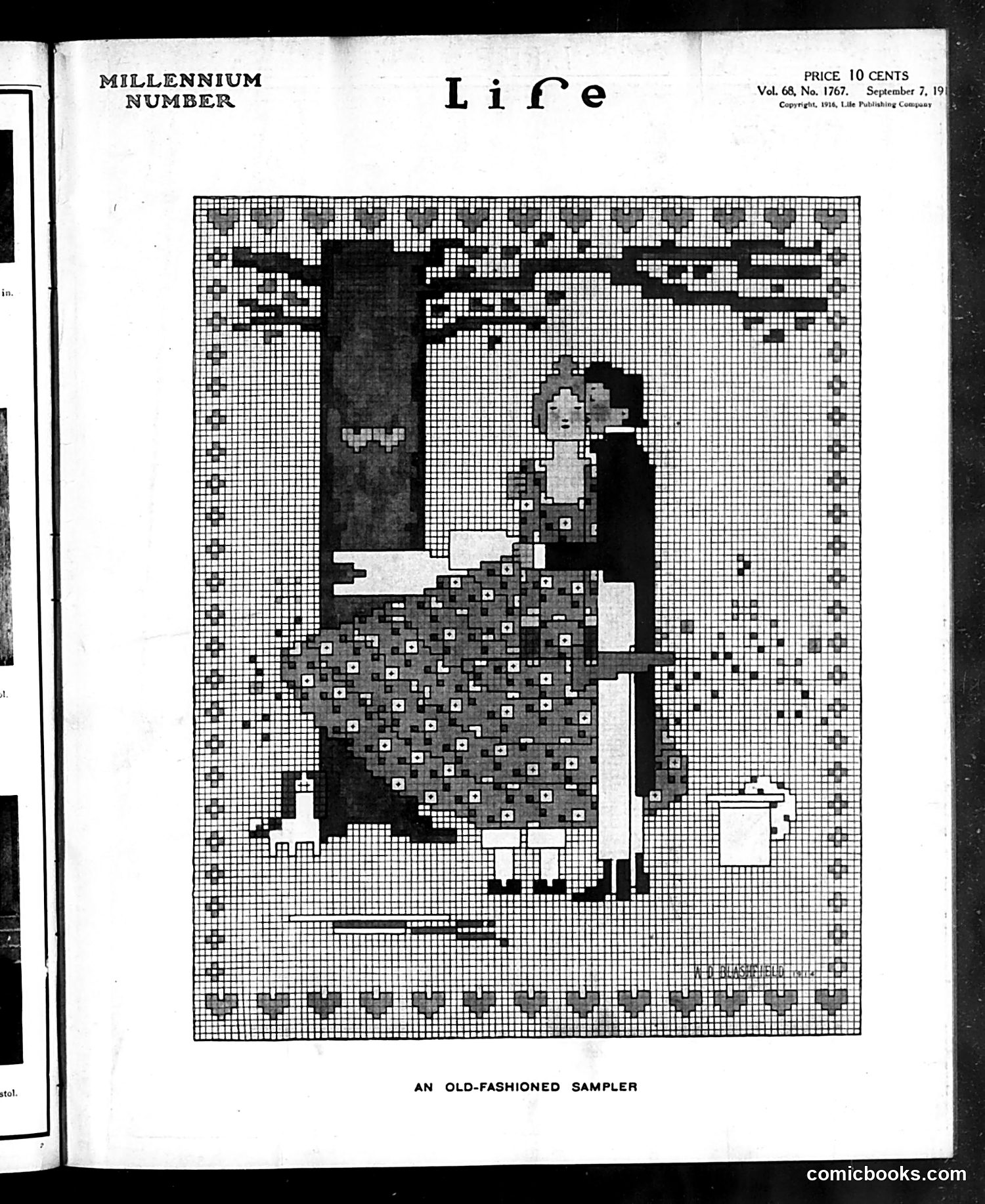
This is a needlework sampler—a cross-stitch embroidery pattern—rendered as a pixelated grid image. The composition shows a woman at a spinning wheel with a child, domestic furnishings, and decorative borders typical of traditional samplers. The satire likely references nostalgia for "old-fashioned" domestic values, popular during the 1910s. The title suggests irony: the magazine is presenting domestic craftsmanship and family life as quaint relics worth preserving or mocking. Given *Life* magazine's sophistication and urban audience, the joke appears to be gentle mockery of rural or conservative domestic sentimentality—perhaps suggesting such simple domestic scenes were already dated or idealized by 1918. The "Millennium Number" designation suggests special themed content.
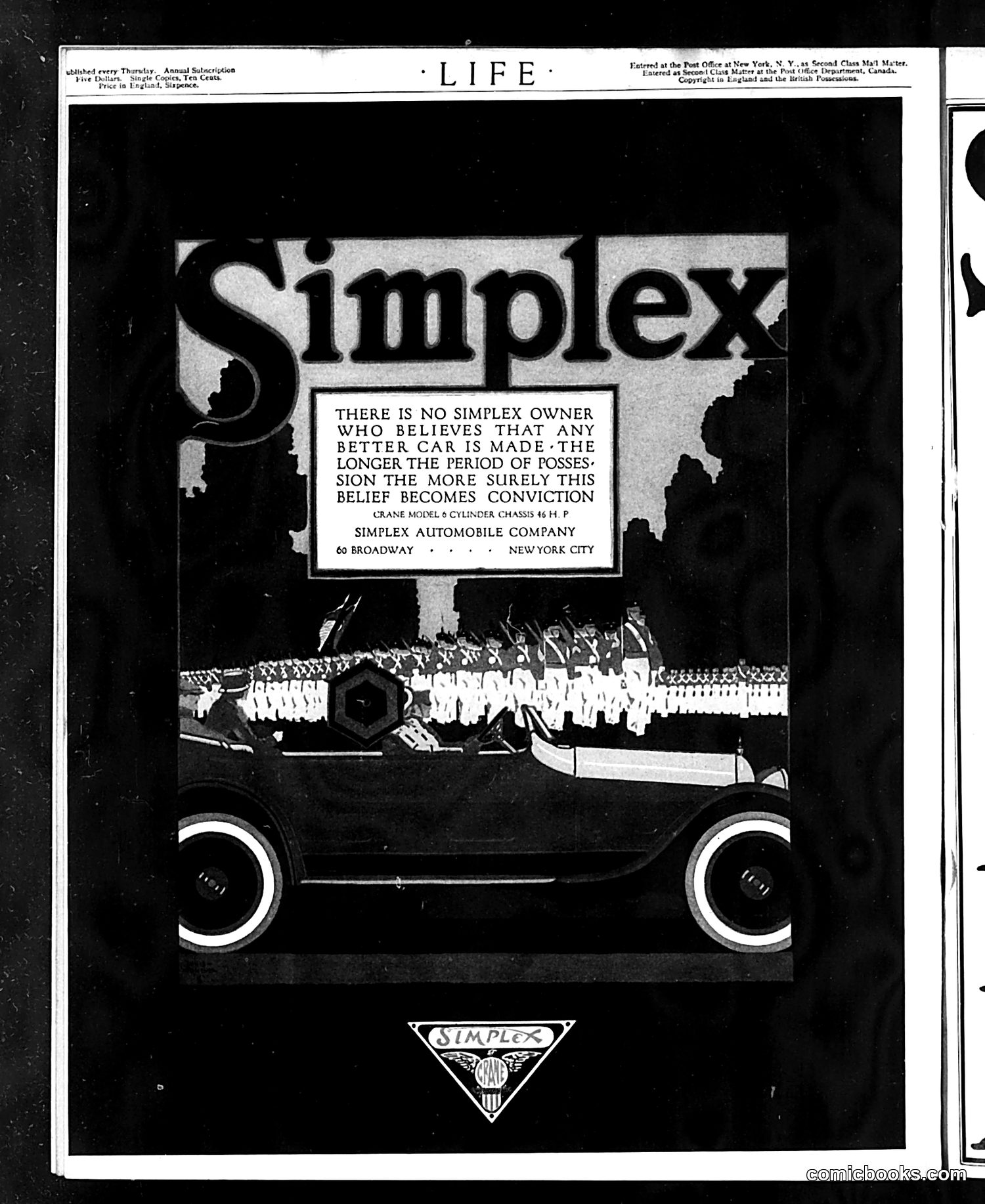
This is a **vintage automobile advertisement**, not political satire. The Simplex Automobile Company (located at 60 Broadway, New York City) is marketing their car by appealing to owner loyalty and satisfaction. The ad's central message claims: "There is no Simplex owner who believes that any better car is made—the longer the period of possession the more surely this belief becomes conviction." The advertisement features a Simplex automobile with distinctive white-wall tires displayed prominently. Below the car is the company's triangular logo. The ad emphasizes durability and owner satisfaction as selling points, suggesting that long-term ownership reinforces customer belief in the vehicle's quality—a common advertising strategy for early automobiles.
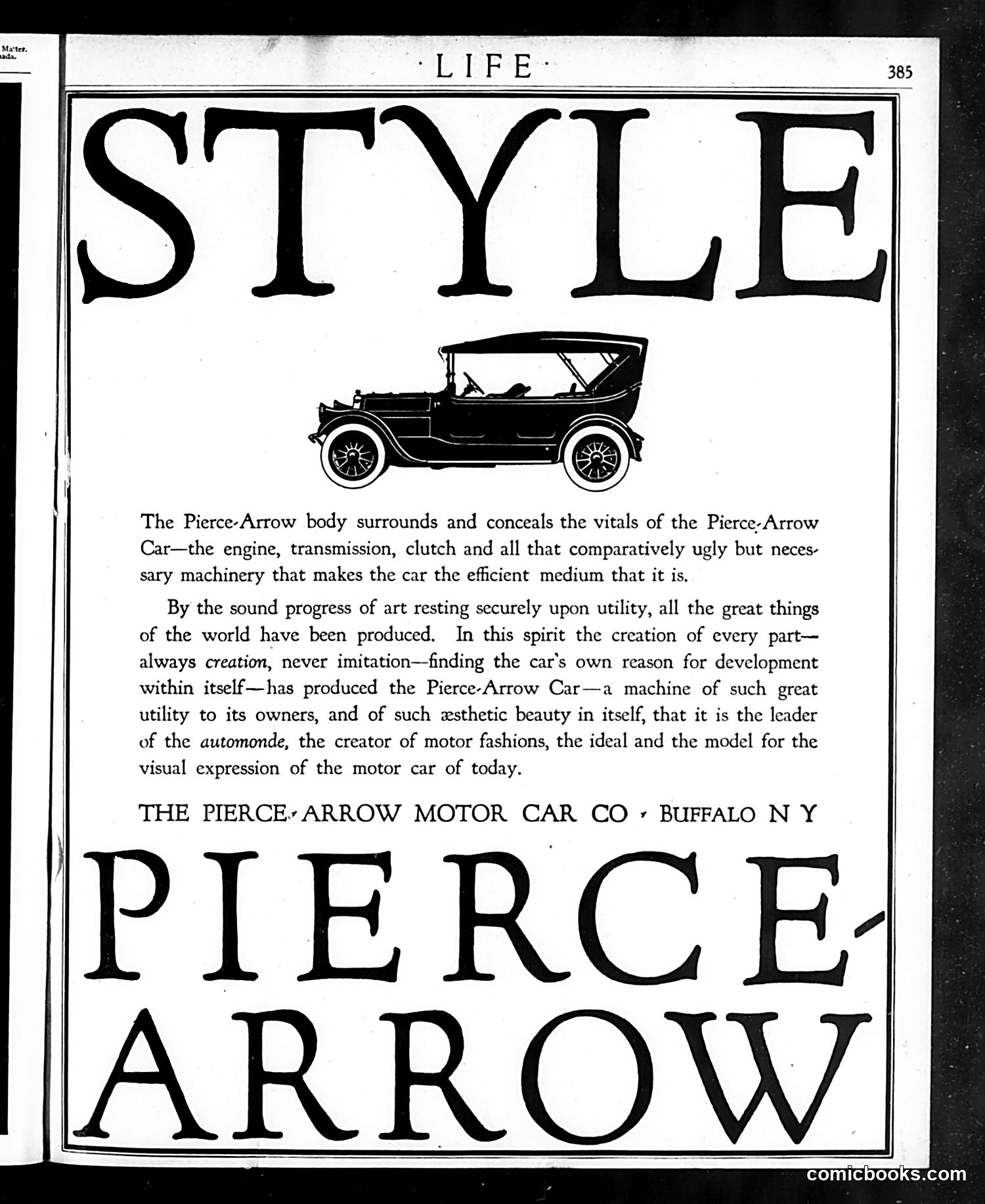
This page is **not satirical content** — it is a **straightforward advertisement** for the Pierce-Arrow automobile, published in Life magazine (page 385). The ad emphasizes Pierce-Arrow's design philosophy: concealing mechanical "ugliness" beneath an aesthetically refined body. It claims the car represents "creation, never imitation" and positions Pierce-Arrow as the industry leader — the "creator of motor fashions" and "ideal and model for the visual expression of the motor car." The elegant serif typography and formal language reflect early 20th-century luxury automotive marketing. Pierce-Arrow, based in Buffalo, NY, was indeed a prestigious marque of that era. The advertisement targets affluent readers by equating the car with artistic achievement and aesthetic superiority.
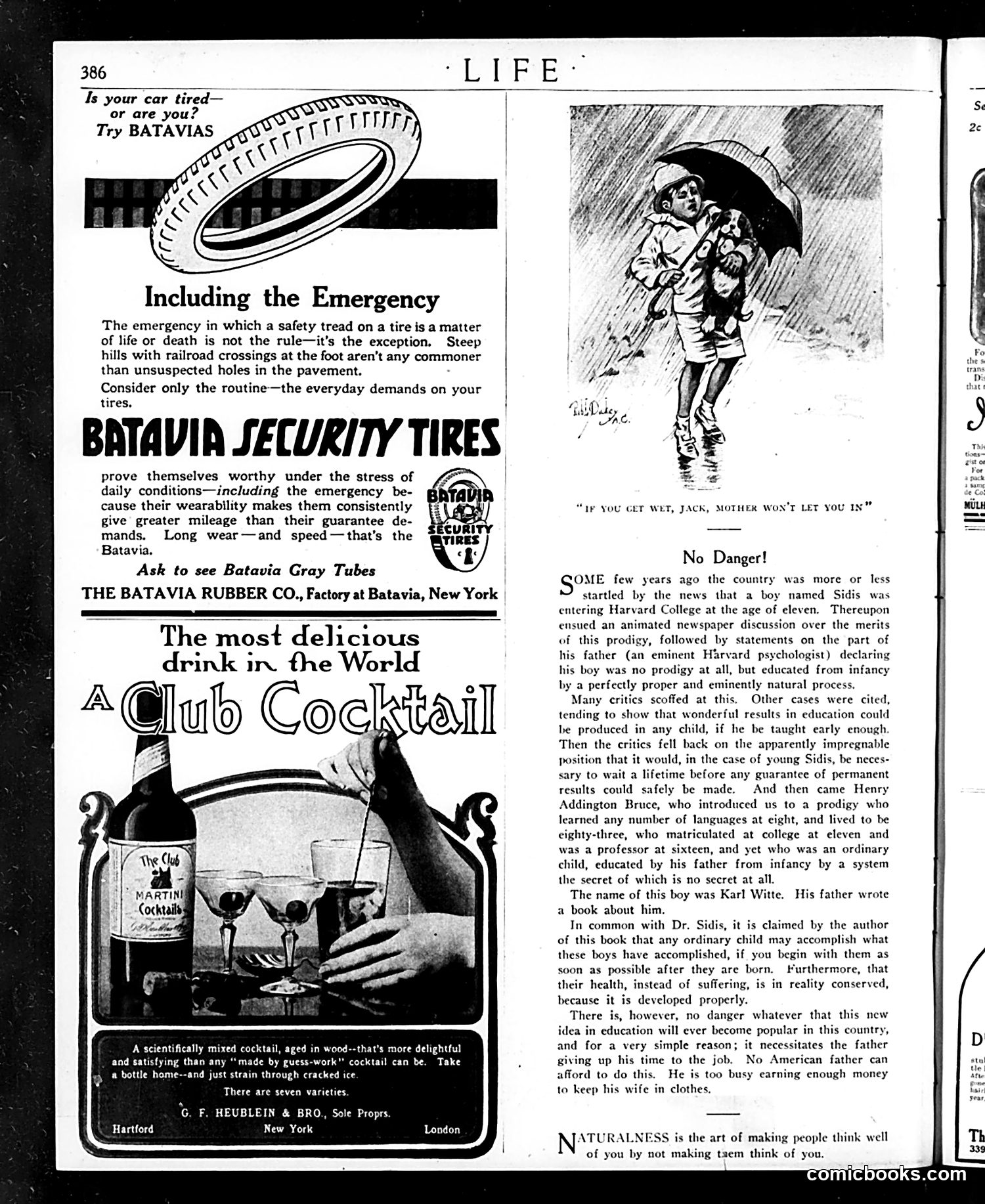
This page contains primarily **advertisements** rather than satirical political content. The main cartoon shows a **mother and child in the rain under an umbrella** with the caption "If you get wet, Jack, mother won't let you in." This is a gentle domestic humor piece about parental discipline, not political satire. The article "No Danger!" discusses educational prodigies—boys like Sidis who entered college at young ages. The text debates whether such early education is beneficial or harmful, ultimately arguing it poses no real danger if children begin studies young enough. The remaining content consists of **product advertisements**: Batavia Security Tires, Old Martini Club Cocktails, emphasizing consumer goods rather than satirical commentary on politics or society.
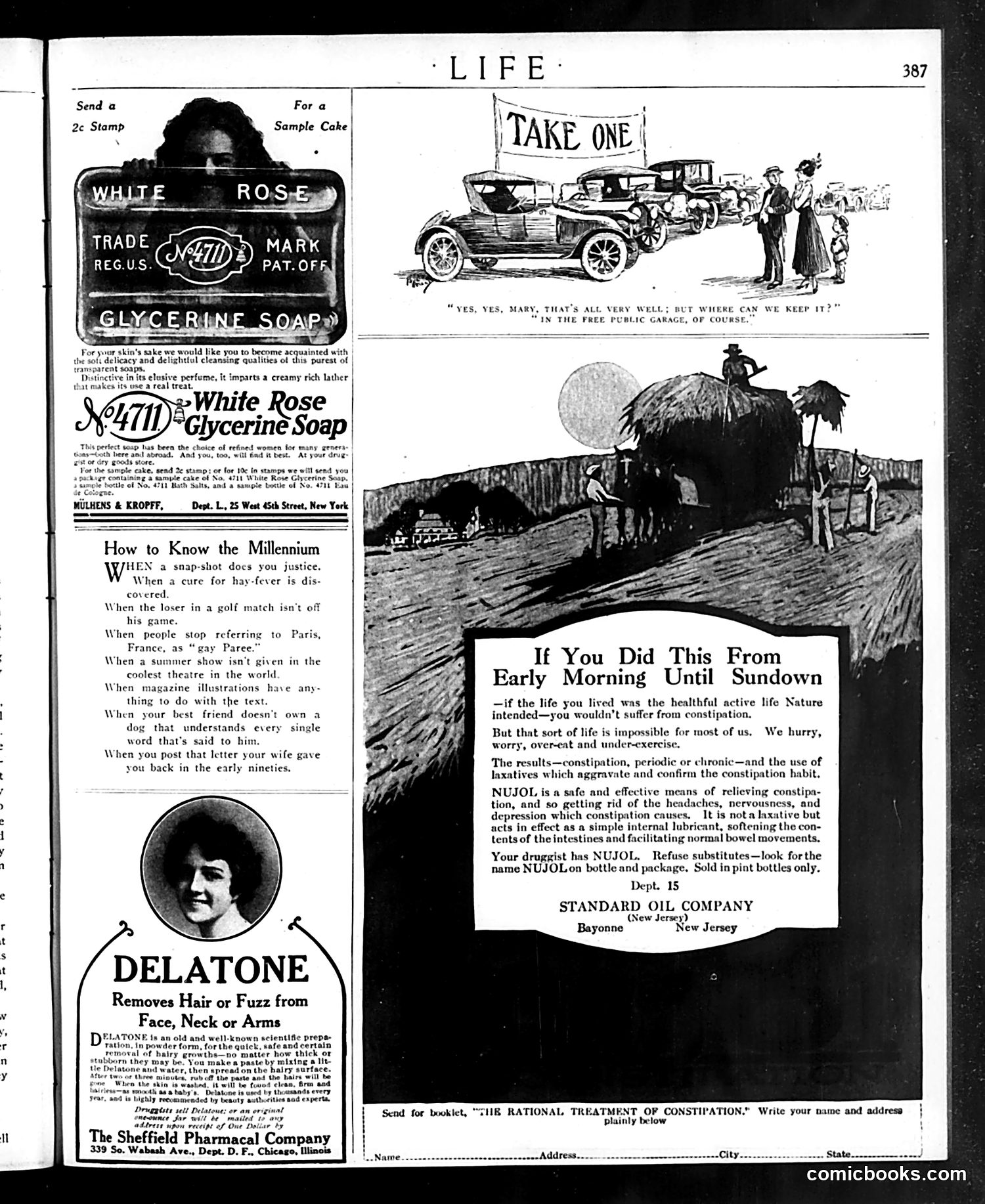
This page is primarily **advertising**, not political satire. The main content includes: 1. **White Rose Glycerine Soap** ad (left): Standard cosmetic advertising emphasizing skin care benefits. 2. **"Take One" cartoon** (top right): A humorous domestic scene showing a line of automobiles at a "free public garage," with a woman (Mary) asking where they can park. The joke satirizes the **growing automobile congestion problem** of the era—a common concern as car ownership increased. 3. **"How to Know the Millennium"** (left): A witty list of signs indicating modern times (snapshots, Paris fashion, golf, magazines with illustrations, etc.). 4. **Delatone hair removal** and **Nujol laxative** ads round out the page. The cartoon reflects early 20th-century anxiety about rapid urbanization and automobile proliferation rather than political commentary.
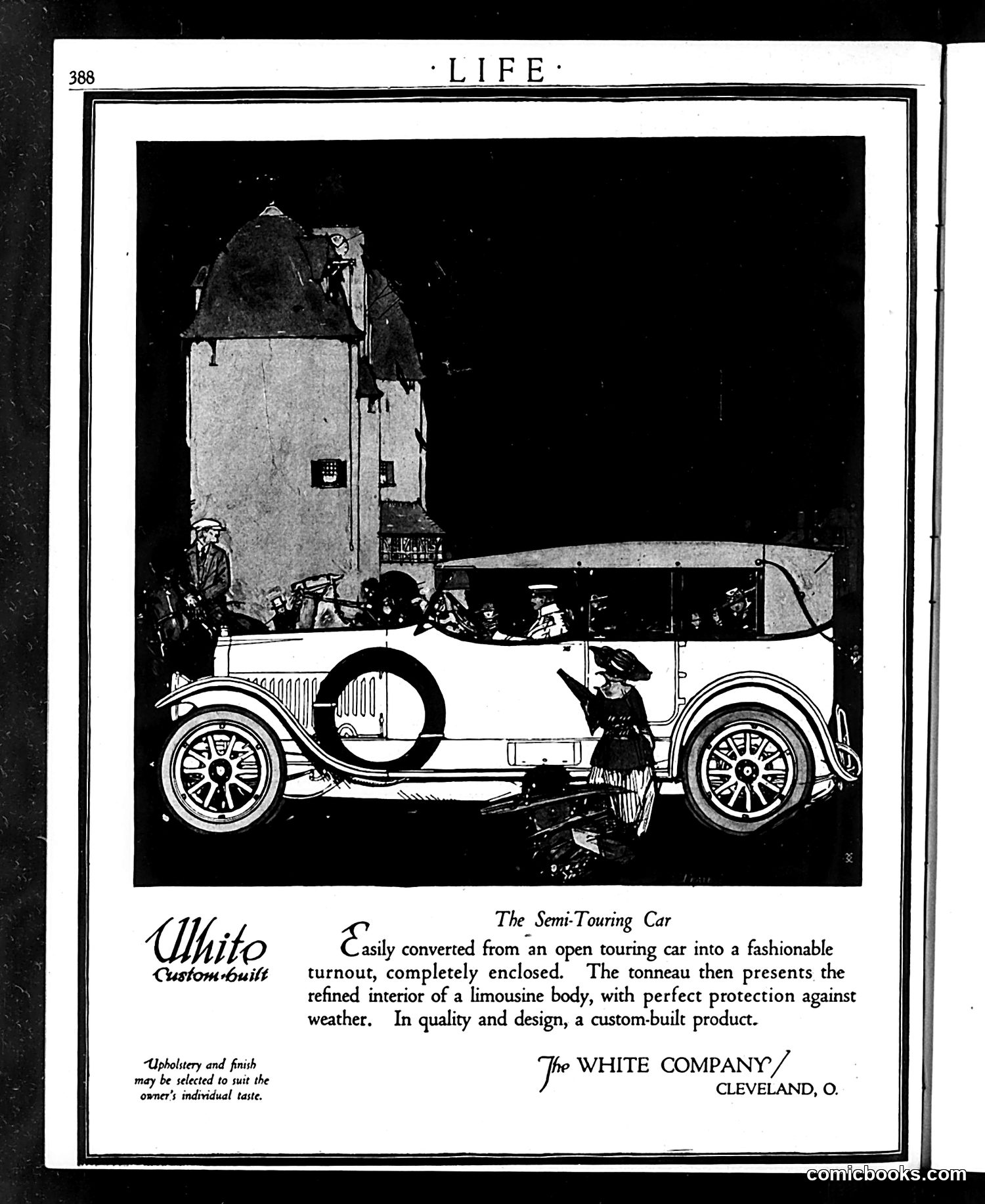
This page is **primarily an advertisement**, not political satire. It promotes the White Company's "Semi-Touring Car," a custom-built automobile from Cleveland, Ohio. The image shows a convertible car with its tonneau (rear roof section) raised, positioned before a tower-like structure. Small figures appear around the vehicle. The ad copy emphasizes that the car converts "easily...from an open touring car into a fashionable turnout, completely enclosed," offering "refined interior of a limousine body, with perfect protection against weather." The tower and figures appear decorative rather than satirical—likely meant to suggest luxury, travel, or prestige. The visual composition simply showcases the vehicle's convertible design feature. This is commercial advertising typical of Life magazine's revenue model during the early automotive era.
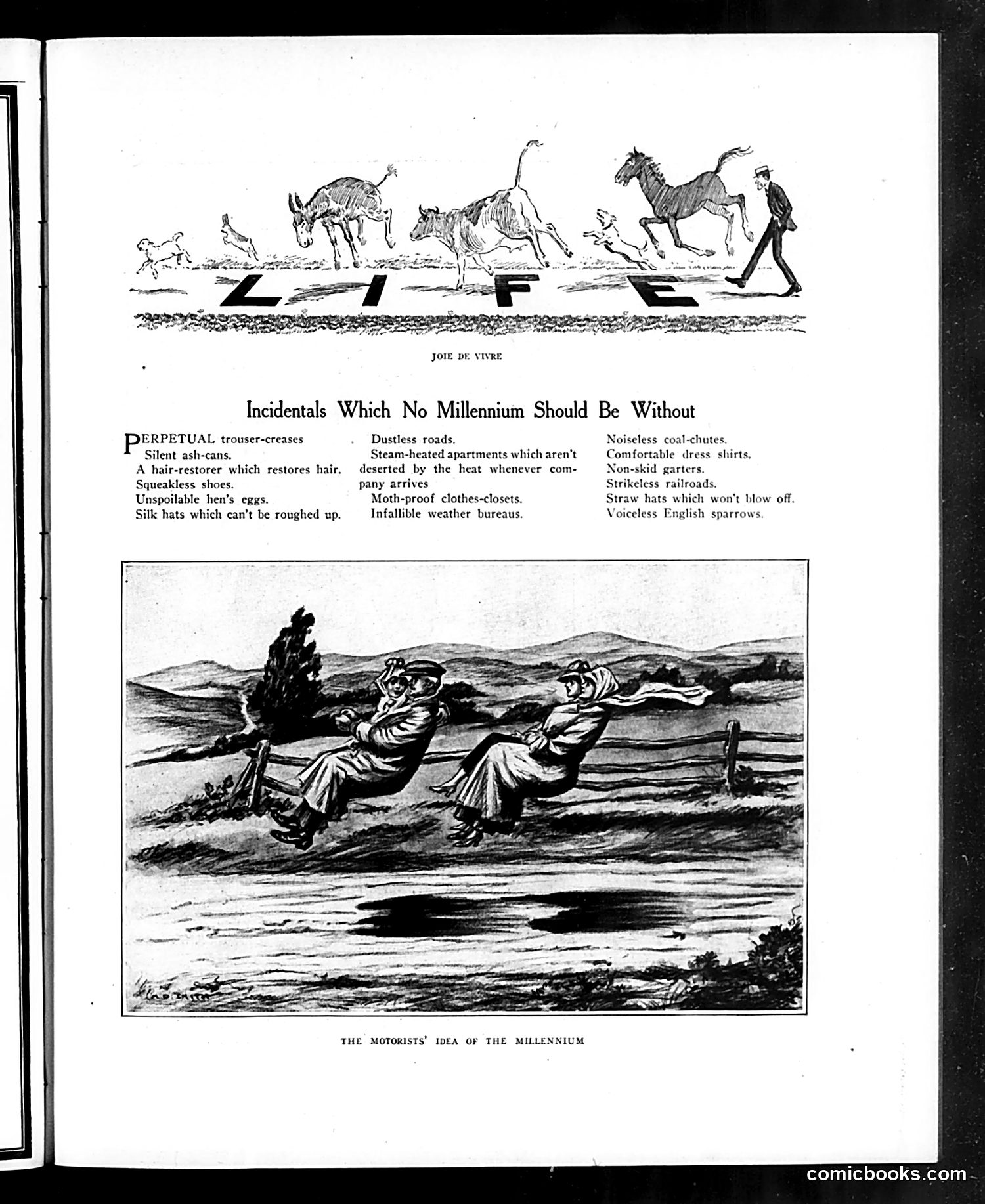
This page satirizes early-1900s predictions about life in the year 2000 (the coming "millennium"). The top illustration shows absurd inventions like mechanical animals and self-propelled devices, labeled "JOIE DE VIVRE" (joy of living). The text humorously lists ridiculous "necessities" for the future millennium—perpetual trouser creases, silent ash-cans, squeakless shoes, noiseless sparrows, and strikeless railroads. It's mock-serious in tone, satirizing optimistic technological predictions by imagining trivial, often impossible "improvements." The bottom illustration, "The Motorists' Idea of the Millennium," depicts two wealthy figures lounging comfortably in a motorcar while driving—suggesting that future technology would enable ultimate leisure and laziness. The satire mocks both utopian futurism and the emerging automobile culture's promise of effortless living.
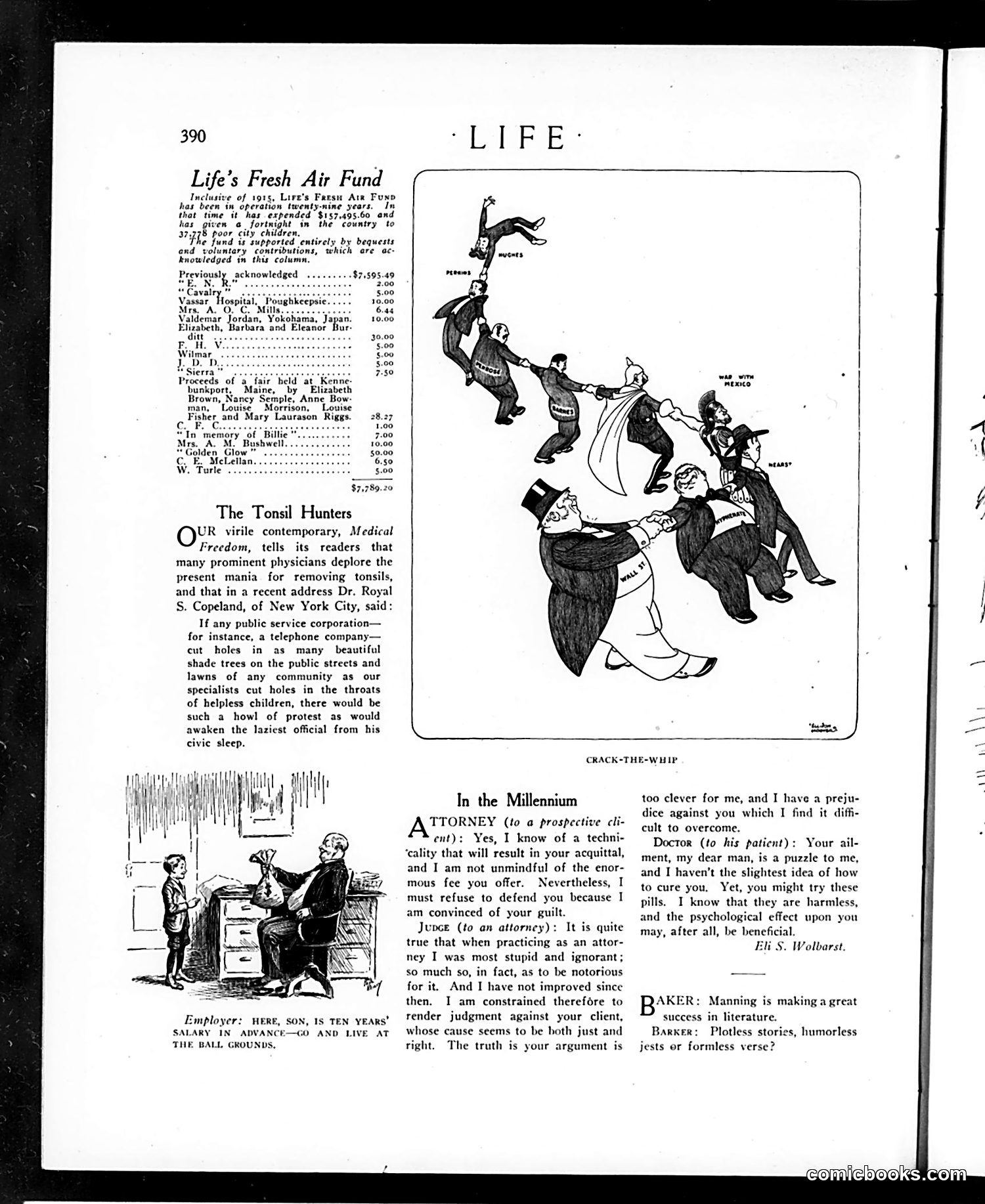
This cartoon depicts Life magazine's satirical commentary on tonsil removal surgery. The illustration shows a group of figures in a "crack-the-whip" formation being pulled along by a large doctor or surgeon figure at the front. The chain of people being dragged appears to represent children or patients, suggesting they're being forcibly subjected to tonsil removal procedures. The accompanying article, "The Tonsil Hunters," critiques physicians' enthusiasm for removing tonsils, quoting Dr. Royal S. Copeland comparing it to public utility companies recklessly destroying valuable resources. The satire mocks the trend of aggressive tonsil extraction as a widespread medical practice with insufficient justification, treating children as passive victims in the medical establishment's pursuit.
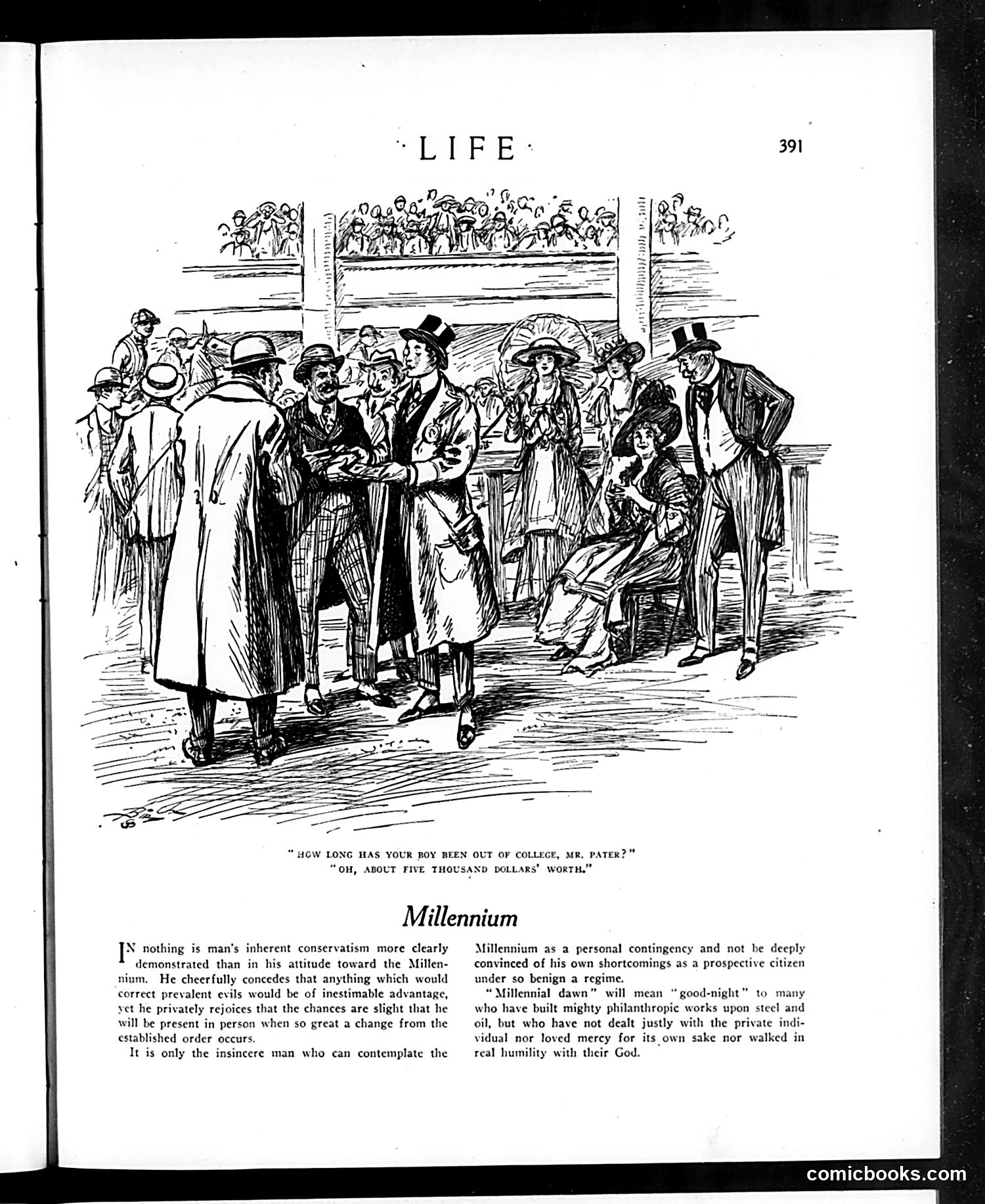
**The Cartoon:** A street scene showing well-dressed men in top hats and coats conversing with what appears to be working-class individuals. The caption reads: "How long has your boy been out of college, Mr. Pater?" "Oh, about five thousand dollars' worth." **The Satire:** This jokes about the economic burden of college education and parental financial anxiety. The play on words—measuring time by monetary cost rather than years—suggests that a college education is so expensive it feels endless in financial terms. The gentleman's wry response indicates frustration with the investment required. **Social Context:** The cartoon satirizes the American upper-middle class concern about education costs and their children's economic prospects during what appears to be the Gilded Age or early 20th century. The accompanying essay "Millennium" discusses man's conservatism regarding social change.
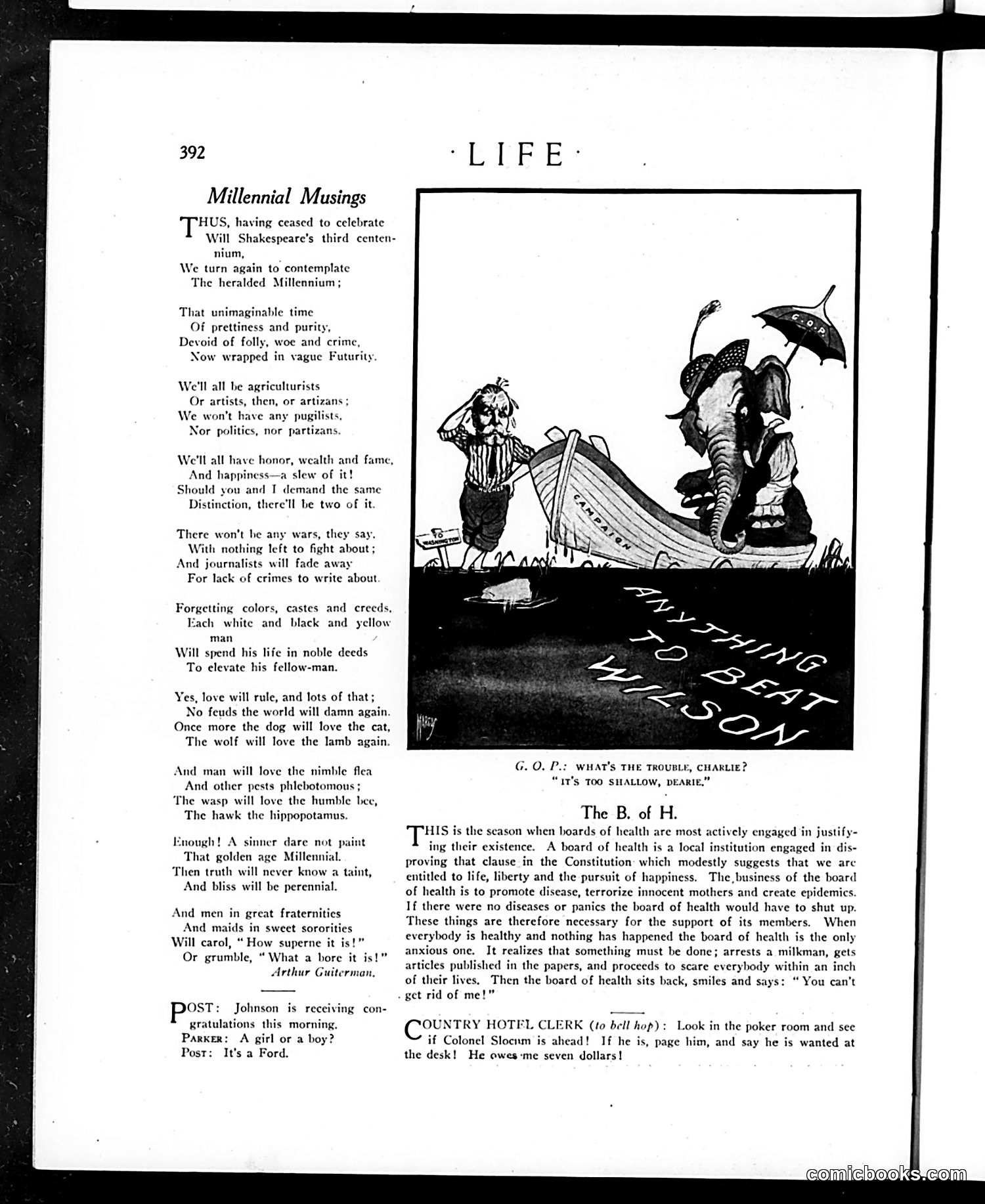
The main cartoon titled "Casting Bet Parson" depicts a small man presenting something to a large elephant wearing an umbrella. The caption reads: "G.O.P.: What's the trouble, Charlie? / 'It's too shallow, Pearlie.'" This appears to be Republican Party satire (G.O.P. = Grand Old Party). The elephant is the Republican Party symbol; the small figure likely represents a Republican politician or leader. The joke suggests the party's platform or foundation is "too shallow"—a criticism of Republican political substance or depth of policy. The surrounding text includes "Millennial Musings," satirical poetry about an idealized future millennium, and unrelated brief humor pieces. The cartoon's specific political context is unclear without dating information, but it mocks Republican Party inadequacy.
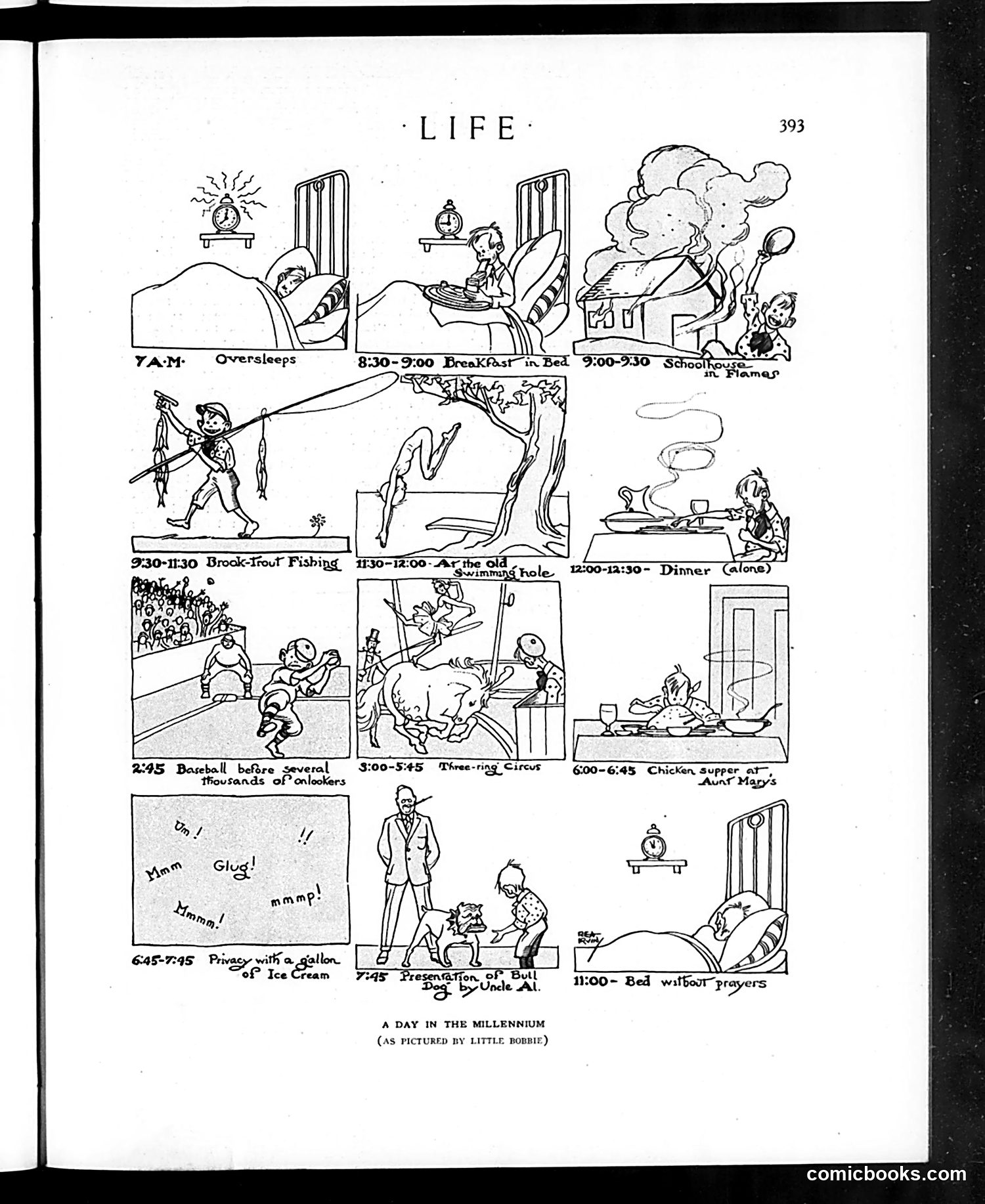
This is a satirical comic strip depicting an imagined future day, drawn from a child's perspective. The strip shows a fantastical schedule featuring: - Oversleeping until 7 AM - Breakfast in bed - Schoolhouse on a rooftop with a plank - Brook trout fishing and swimming hole activities - A three-ring circus at 3:00 PM - Baseball games with "several thousands of onlookers" - Dinner alone, chicken supper at an aunt's house - Private ice cream consumption - Presentation of a "Bull Dog by Uncle Al" - Bed without prayers at 11:00 PM The satire mocks utopian visions of the future by depicting an absurdly indulgent, consequence-free childhood where a boy enjoys unlimited leisure activities, entertainment, and treats—a humorous commentary on unrealistic millennial fantasies.
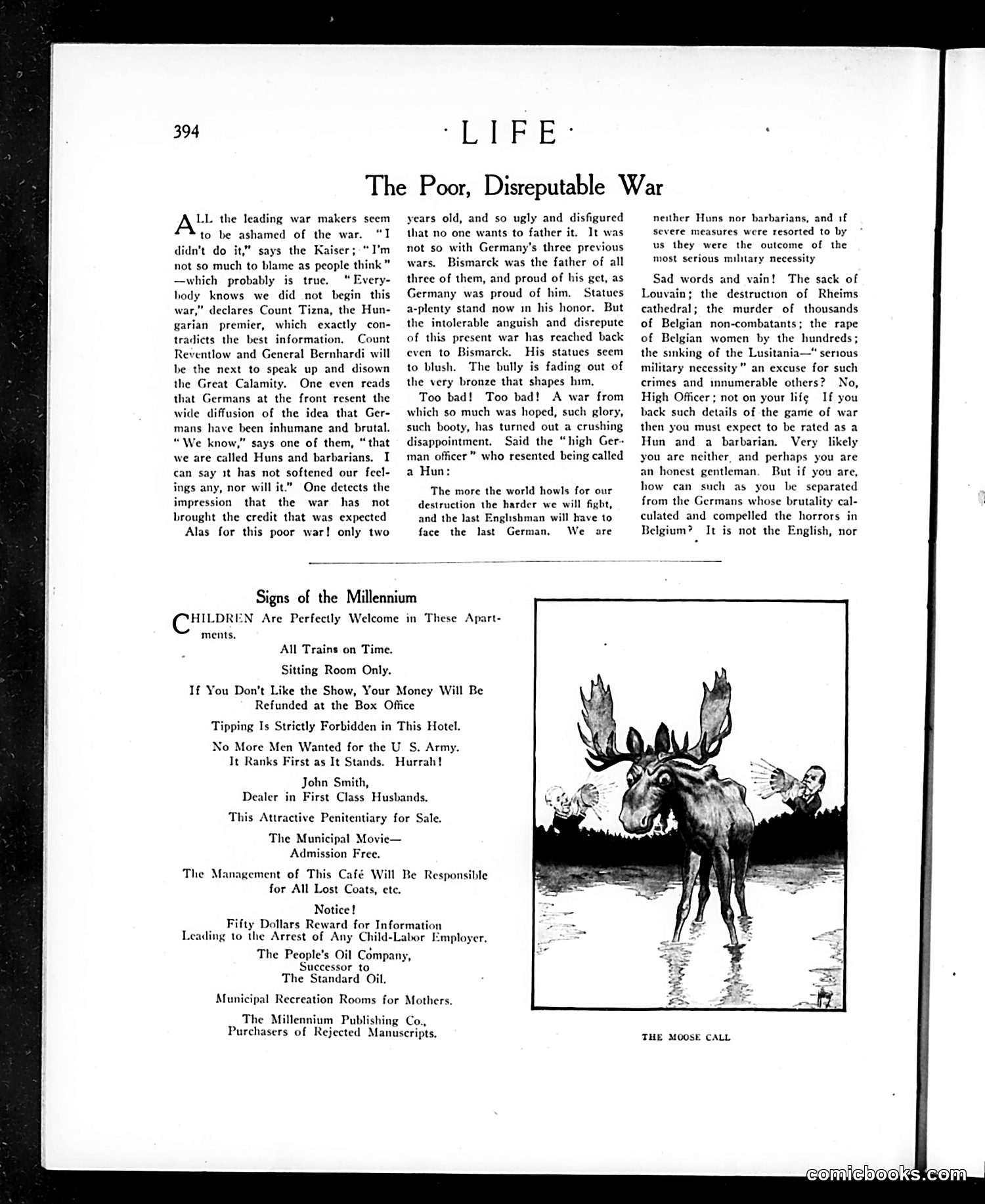
This article critiques World War I's brutality and how it has disappointed its architects. The writer notes that German leaders like the Kaiser and Bismarck are ashamed of the war's conduct—it has become "ugly and disfigured" rather than glorious. The piece condemns the war's devastating casualties: the sack of Louvain, destruction of Rheims Cathedral, murders of Belgian non-combatants, and rape of Belgian women. The author argues that severe German military measures, while perhaps militarily justified, have fundamentally discredited the war itself. Rather than achieving honor, the conflict has devolved into atrocity, forcing any participant to accept being labeled a "Hun"—essentially a barbarian—rather than an honorable combatant. The accompanying illustration, "The Moose Call," appears decorative rather than directly related to the war commentary.
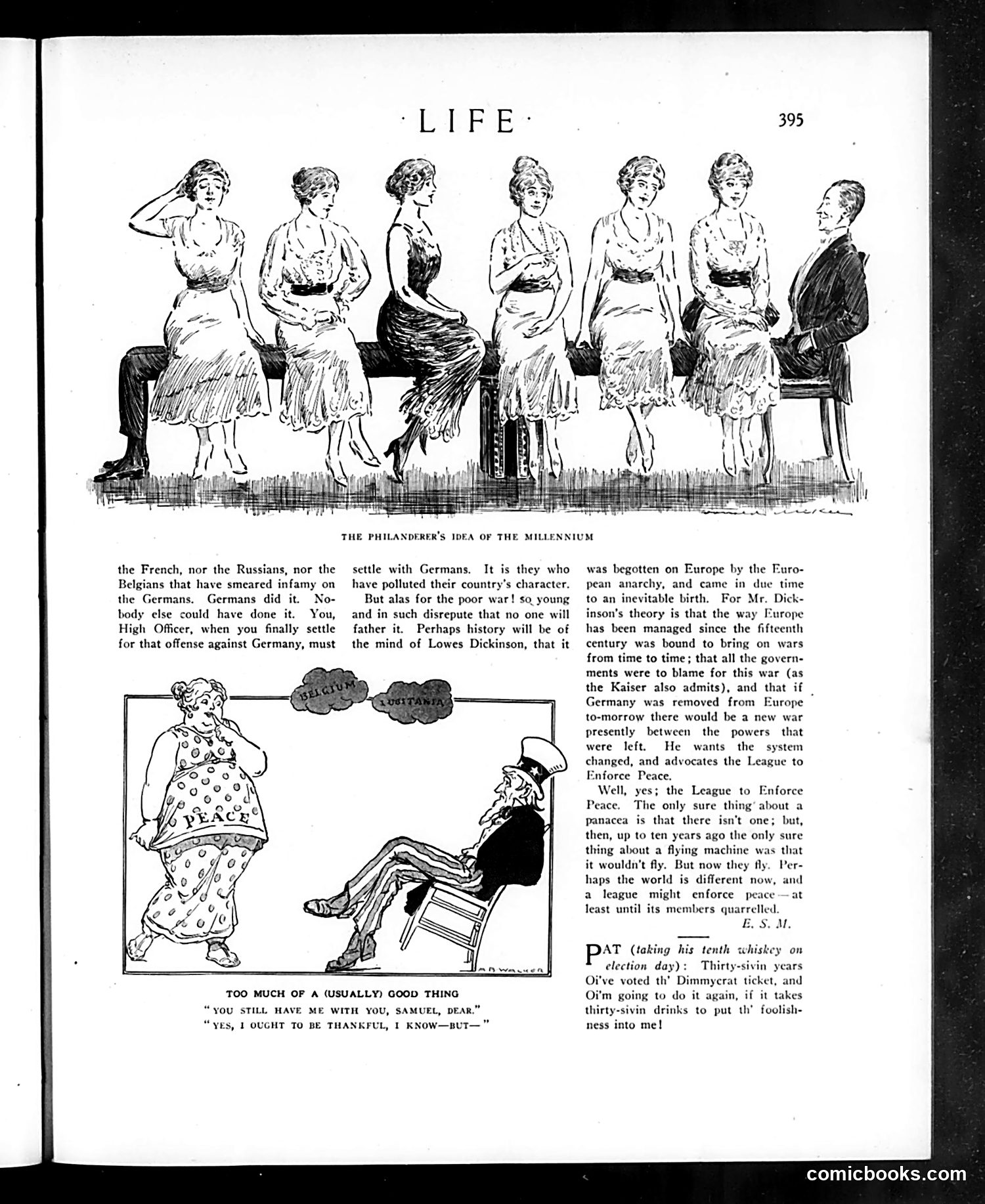
**Top Cartoon**: "The Philanderer's Idea of the Millennium" depicts seven women seated on a bench with one man. This satirizes male fantasy about unlimited romantic/sexual access to multiple women simultaneously—the "millennium" being an imagined perfect world for the philanderer. **Bottom Cartoon**: "Too Much of a (Usually) Good Thing" shows a woman labeled "Peace" with a man (likely representing a statesman or politician) in a chair. The dialogue suggests he's grown tired of peace advocacy, finding even something "good" excessive when pushed relentlessly. This likely critiques post-WWI peace movements or League of Nations advocates as overly insistent or nagging in promoting their agenda. Both cartoons use humor to mock contemporary social and political behaviors.
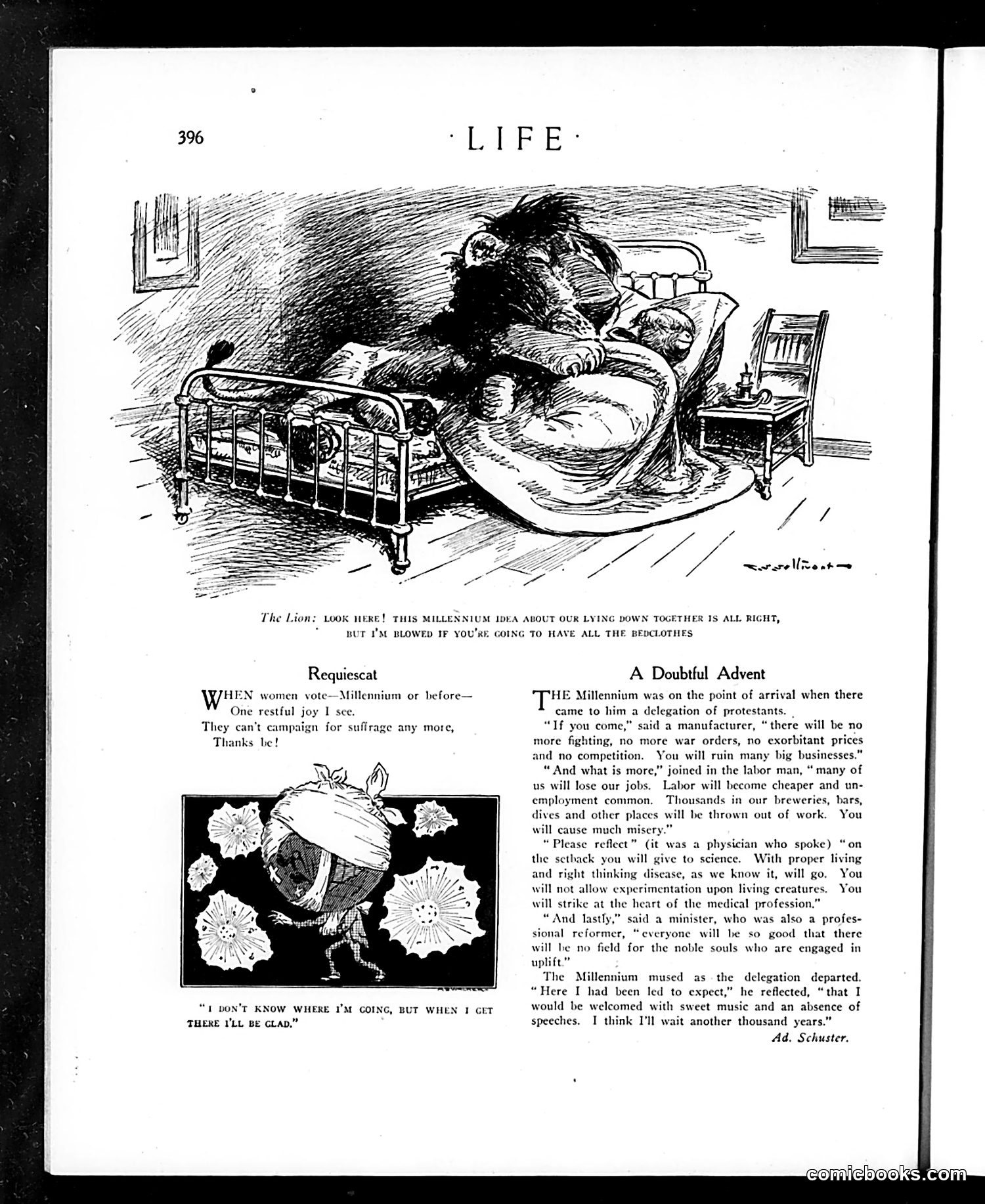
This page satirizes early 20th-century anxieties about women's suffrage and the coming "Millennium" (modernized future). **Top cartoon**: A lion lounges in bed with a woman, captioned with his dismissive comment about cohabiting together—satirizing male resistance to women's equality. **"Requiescat" section**: Celebrates women finally abandoning suffrage campaigns ("They can't campaign for suffrage any more, Thanks be!"), mocking anti-suffrage sentiment. **"A Doubtful Advent"**: The main satire. A delegation warns the "Millennium" (arriving figure) that women's advancement will bring catastrophe—no more wars, business competition, unemployment, medical experimentation. A physician and minister protest losing their professional authority. The satire ridicules these doomsday predictions as absurd, exposing how opponents exaggerated women's equality's dangers.
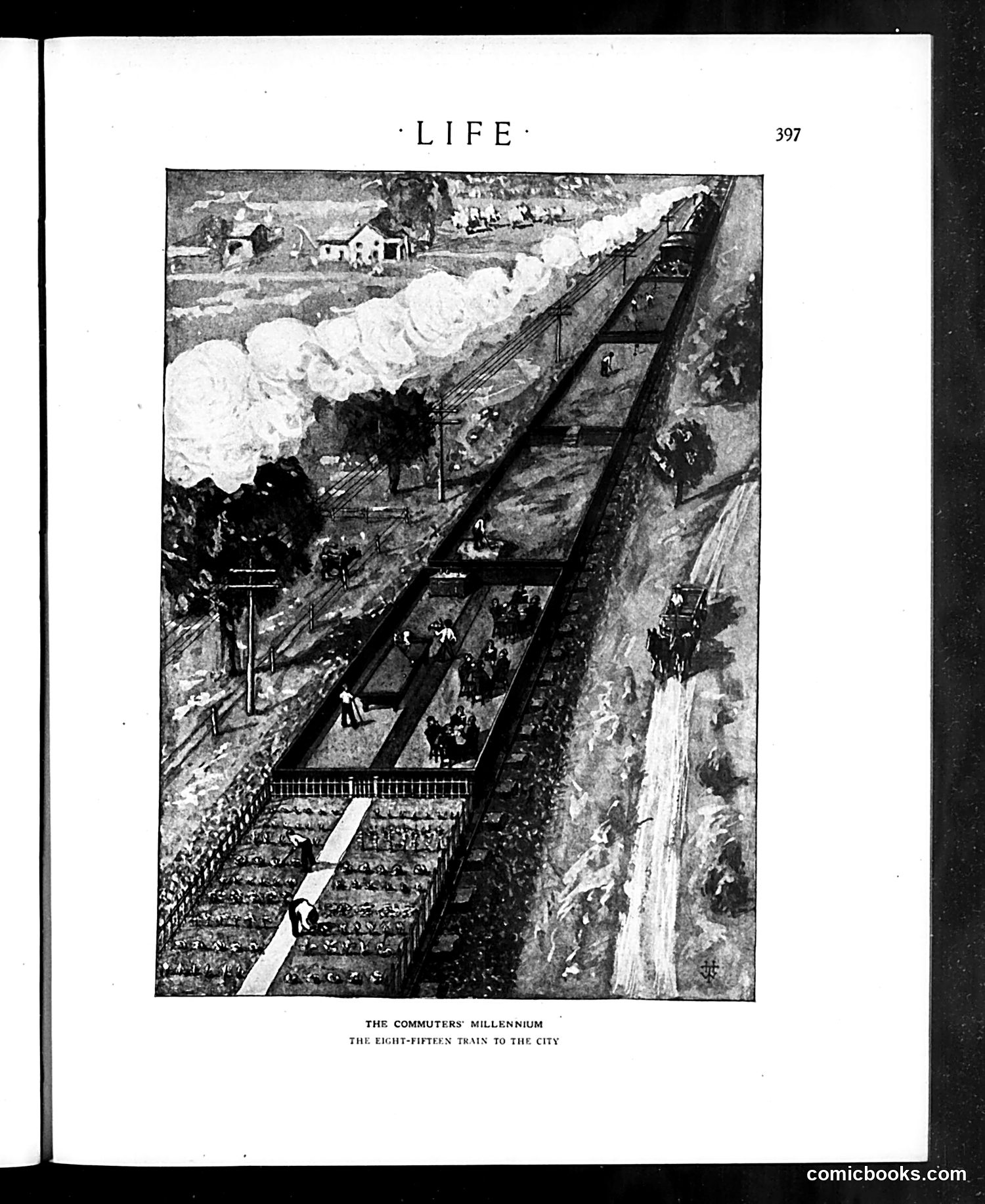
This illustration satirizes the daily commute experience, likely from the early 20th century. The aerial perspective shows a crowded passenger train packed with commuters traveling to the city, with suburban houses visible in the background. The caption's phrase "commuters' millennium" suggests this represents an idealized vision—though the cramped, densely packed conditions suggest irony rather than genuine celebration. The satire appears to critique the reality of modern commuter rail: the promised convenience of suburban living and easy city access creates instead overcrowded, unpleasant daily journeys. The "eight-fifteen train" references the standardized timing of routine commute patterns that defined emerging suburban culture in America.
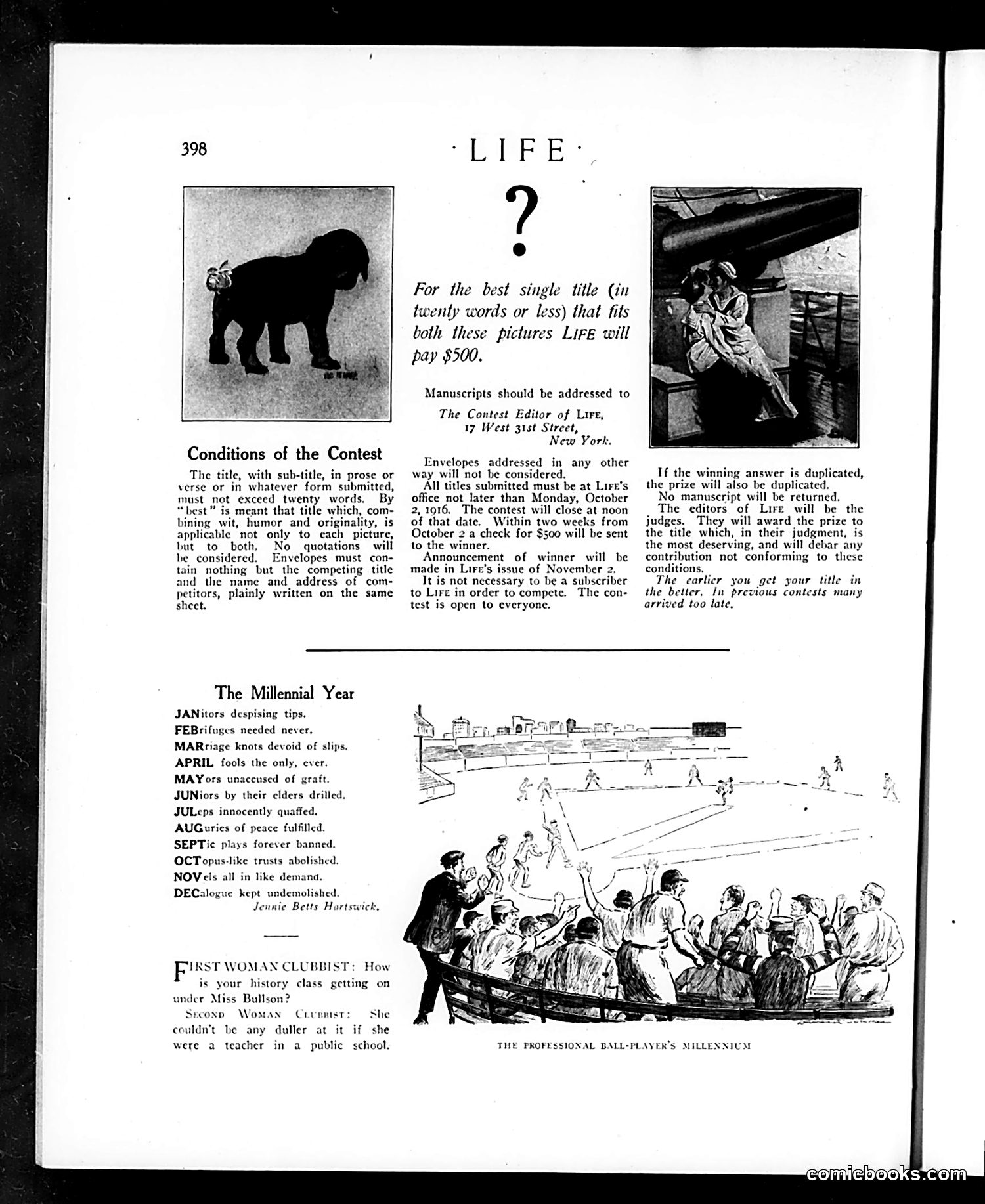
This page features a contest and satirical content typical of Life's format: **The Contest**: Life offers $500 for the best single title (under 20 words) describing two images: a silhouetted dog (left) and what appears to be a baseball player or athlete (right). The contest references "professional ball-player's millennium" below. **"The Millennial Year"**: A humorous alphabetical poem satirizing an idealized future where social problems disappear—janitors aren't underpaid, marriage works perfectly, mayors aren't corrupt, trusts are abolished, etc. It's satirical precisely because none of these conditions actually existed in Progressive Era America (1916). **The Woman Clubbist Exchange**: A brief joke about a woman's history class under "Miss Bullson"—likely mocking women's clubs' educational efforts while suggesting female teachers were inherently boring instructors. The overall tone mocks both contemporary social problems and idealistic visions of reform, characteristic of Life's satirical approach to American society and politics.
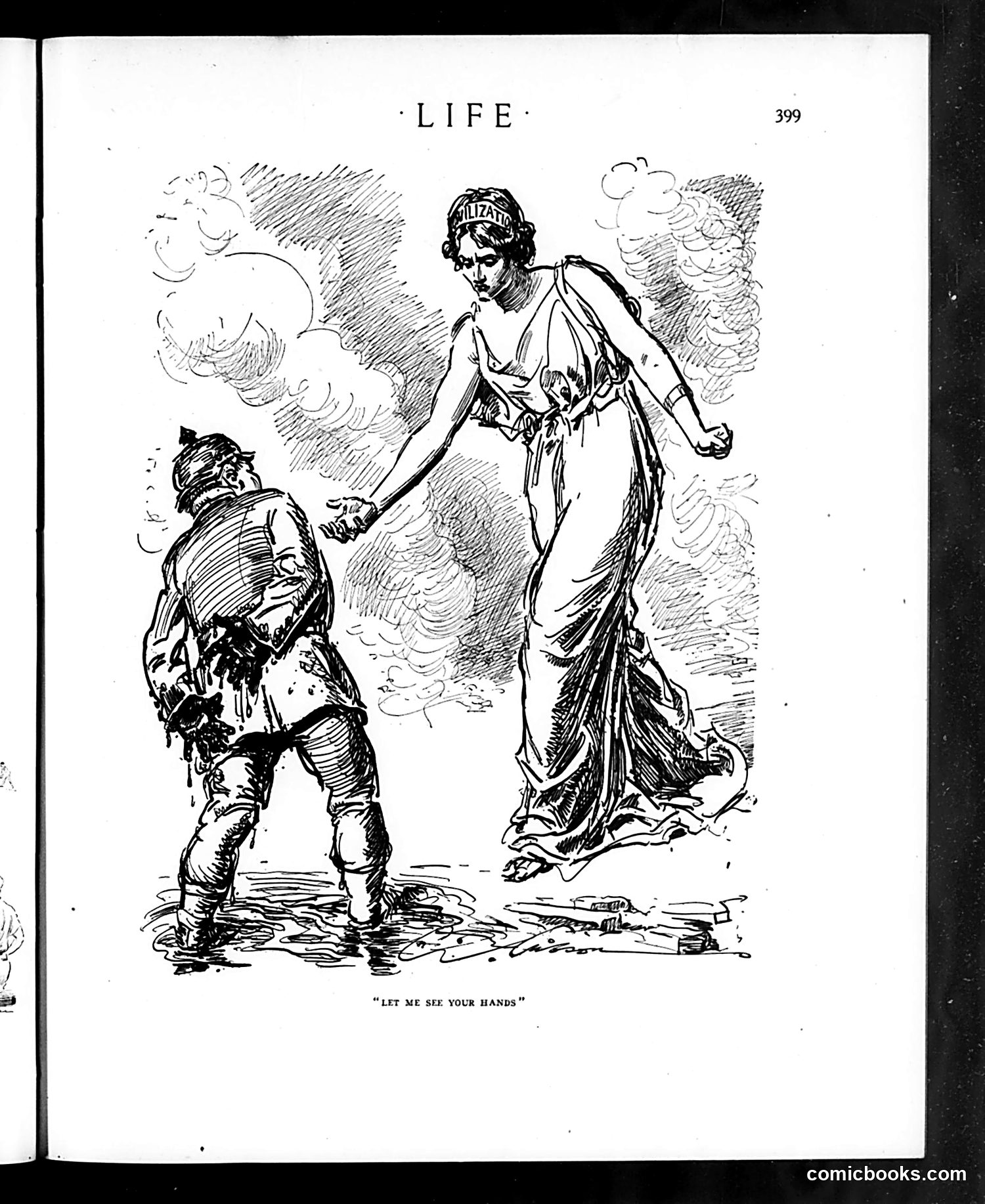
This illustration from *Life* magazine (page 399) depicts two figures in what appears to be a confrontation scene. A soldier or military figure in uniform, viewed from behind, addresses a woman in classical or allegorical dress. The caption "Let Me See Your Hands" suggests an inspection or interrogation scenario. The soldier's demand to examine the woman's hands likely references a satirical commentary on military authority, suspicion, or control—possibly commenting on wartime security measures, searches, or the assertion of power. The woman's classical aesthetic suggests she may represent an allegorical figure (Liberty, Justice, or similar), making this potentially political satire about government overreach or military authority constraining ideals of freedom. Without additional context about the publication date or historical moment, the precise political reference remains unclear.
This page critiques President Woodrow Wilson's handling of an impending railroad strike. The author sarcastically attacks Wilson as "guilty" (referencing the Sun newspaper's criticism), yet suggests he may actually prevent the strike through political maneuvering—which the author grudgingly admits might benefit the public. The core tension: railroad workers (the "Brotherhoods") demand higher pay disguised as an eight-hour workday. Wilson proposes that railroads grant this IF they can demonstrate affordability to taxpayers. The author mocks this Catch-22: railroads claim they can't afford raises without passenger/freight rate increases, creating circular deadlock. The satire targets Wilson as politically opaque—simultaneously antagonizing both pro-Germany "Hyphens" and pro-France Republicans (like candidate Robert Bacon and editor George Harvey), leaving voters unable to judge whether he's statesman or opportunist. The cartoons' imagery reinforces chaos and exhaustion surrounding the labor dispute.
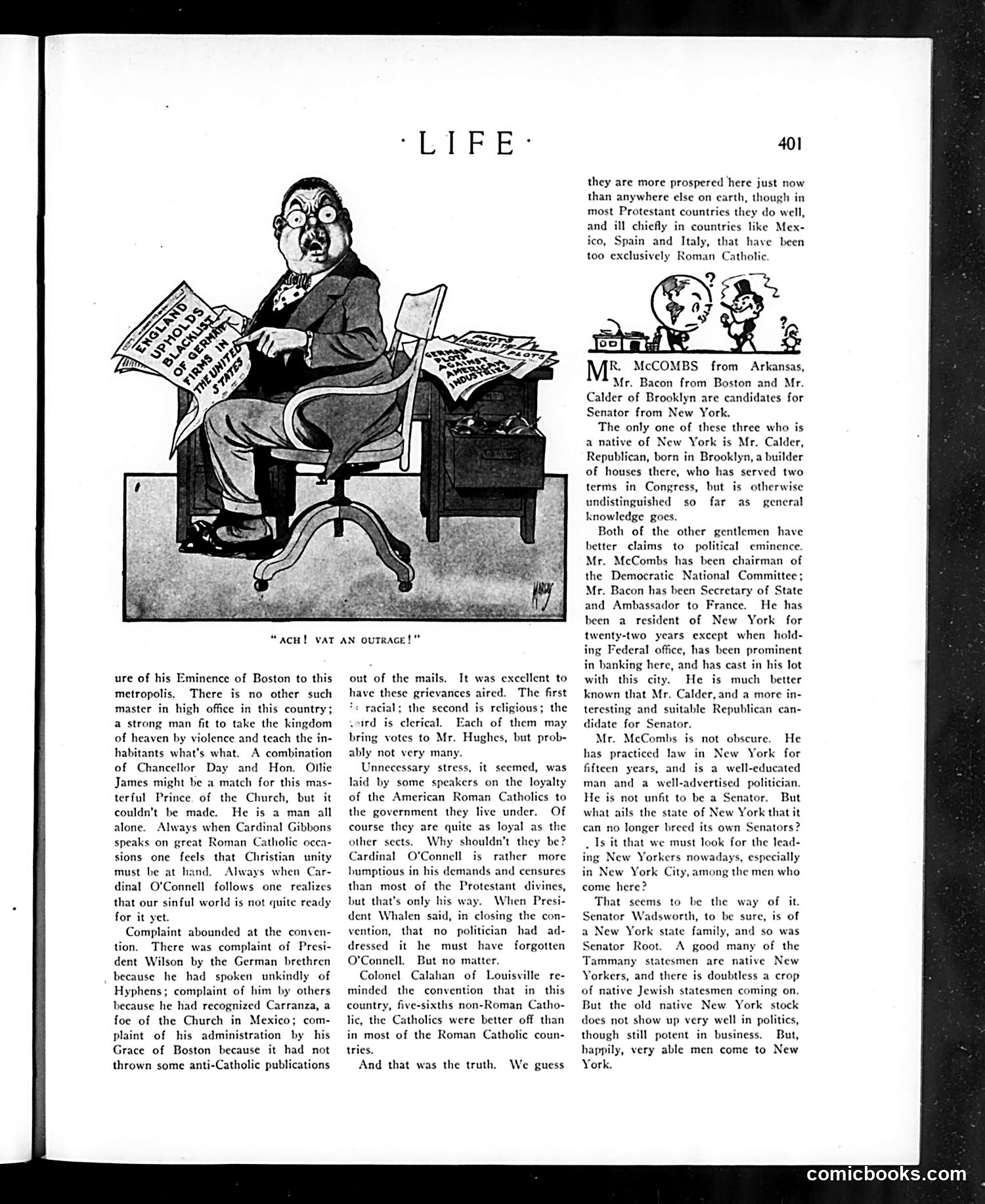
The main cartoon depicts a caricatured figure (likely Cardinal William O'Connell of Boston, based on the accompanying text) sitting at a desk covered with anti-Catholic publications, exclaiming "Ach! Vat an outrage!"—using a German accent stereotype to mock his complaints. The satire targets O'Connell's aggressive demands that the government suppress anti-Catholic materials from the mail. Life's editors criticize him as overbearing compared to Protestant clergy, though they acknowledge American Catholics' legitimate prosperity and loyalty. The German-accented dialect caricature may reference wartime anti-German sentiment (this appears to be WWI-era). The accompanying article discusses Senate candidates for New York, noting life magazine's concern that the state can no longer produce native political leaders, now importing talent from elsewhere—a separate but related commentary on American civic life and regional decline.
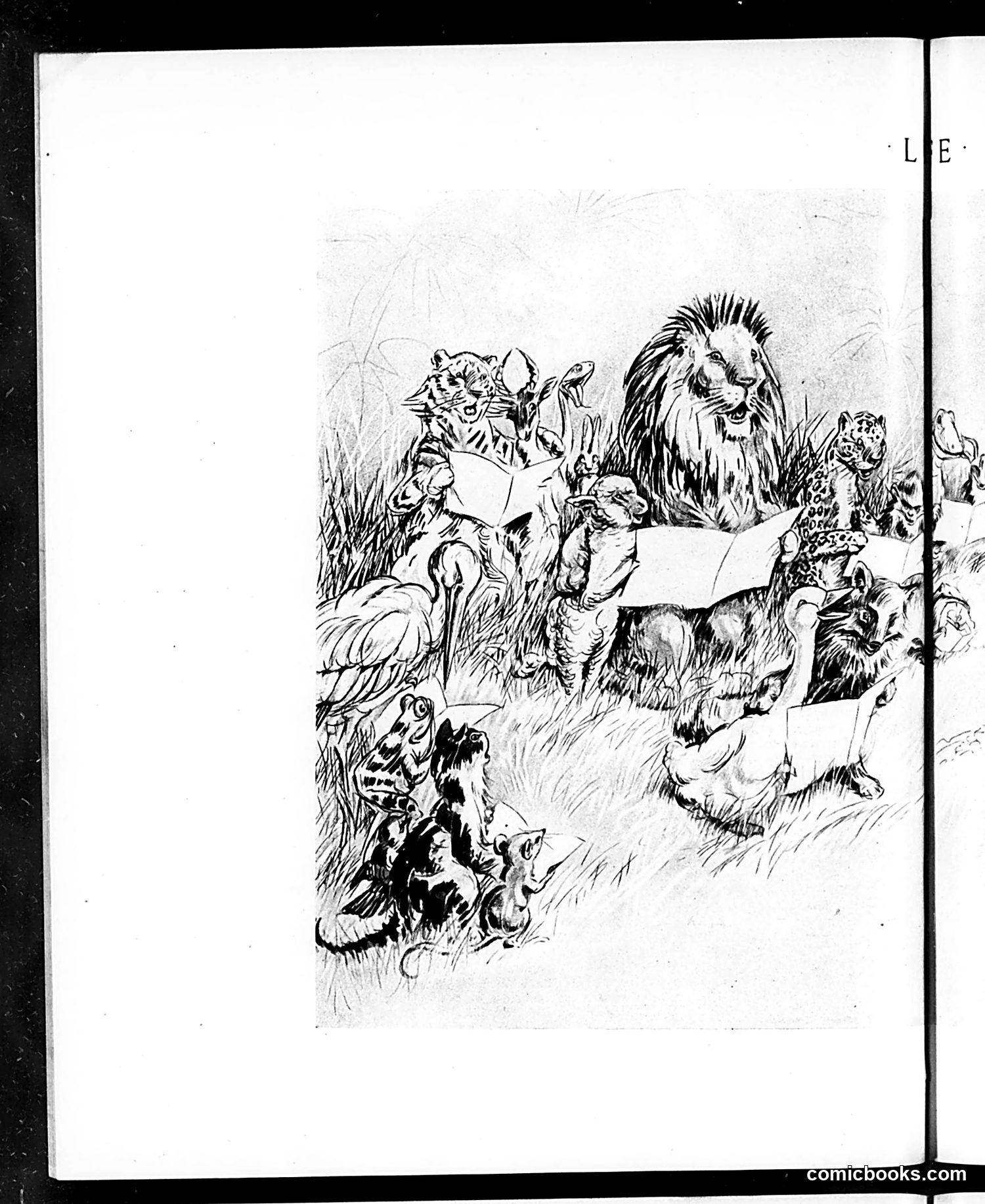
This illustration appears to be a whimsical political cartoon featuring anthropomorphized animals in a woodland assembly. A large lion presides centrally, while various creatures—including what appear to be tigers, bears, and smaller animals—hold blank scrolls or documents. The scene suggests a political gathering or legislative body. The satire likely critiques political processes: the animals' blank documents suggest empty promises or meaningless legislation. The lion's prominent position implies leadership or tyranny. The diverse animal participants may represent different political factions or nations coming together. Without visible text identifying specific figures or dates, the exact political target remains unclear—this could reference general criticism of government ineffectiveness, international diplomacy, or a specific historical event. The style suggests early-to-mid 20th century American editorial cartooning.
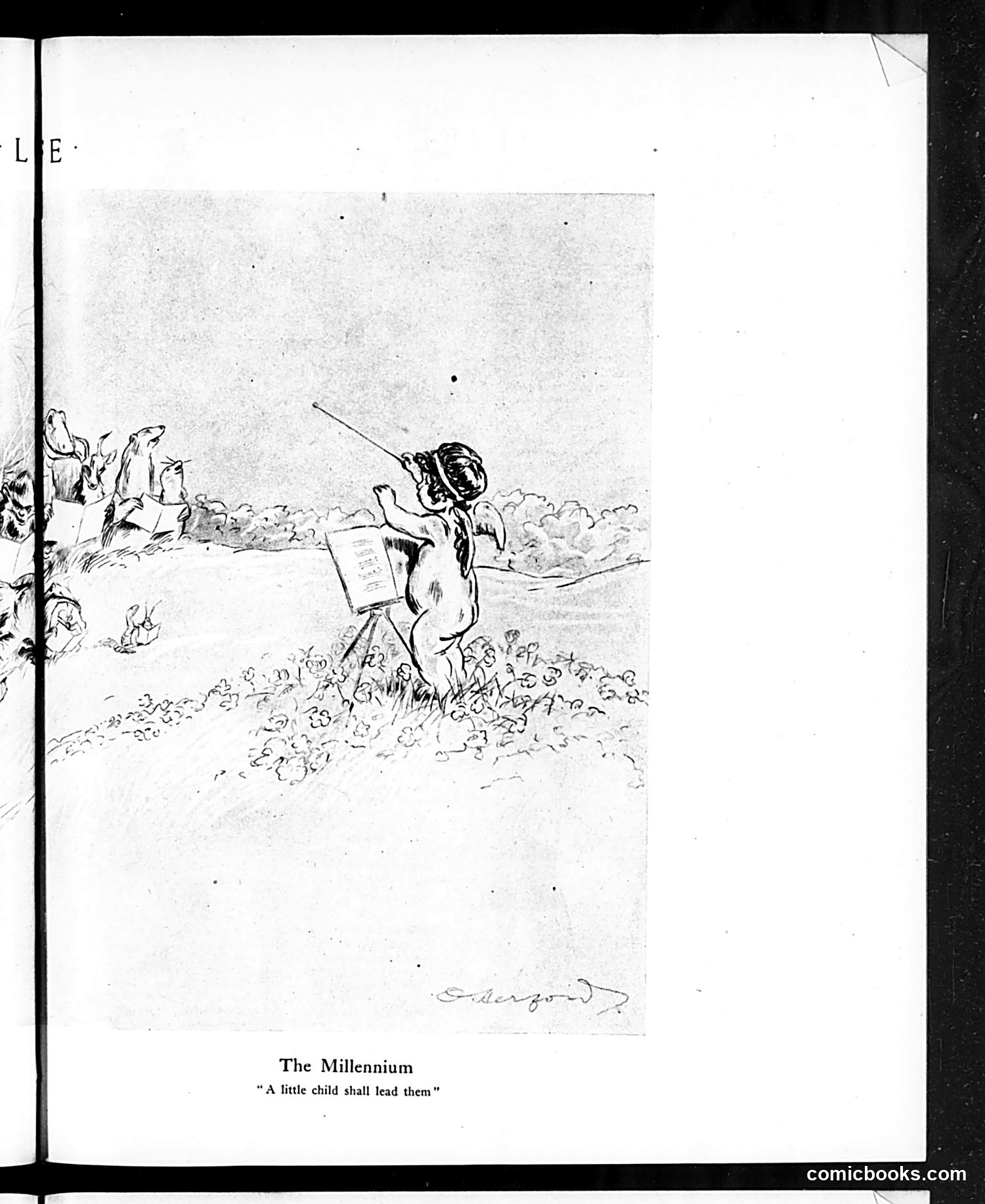
This cartoon illustrates the biblical prophecy from Isaiah 11:6, "A little child shall lead them," which describes a future utopian age of peace. The image shows a naked cherub or child figure holding a pointer or wand, appearing to direct or instruct a group of figures in the background—likely representing world leaders, politicians, or humanity generally. The satire suggests that only innocent childhood wisdom could guide the world toward peace and harmony, implying contemporary political leaders are incapable of achieving such ideals through their own efforts. It's a commentary on early 20th-century political dysfunction, proposing that radical moral reformation—symbolized by childlike innocence—is necessary for achieving the promised peaceful "millennium."
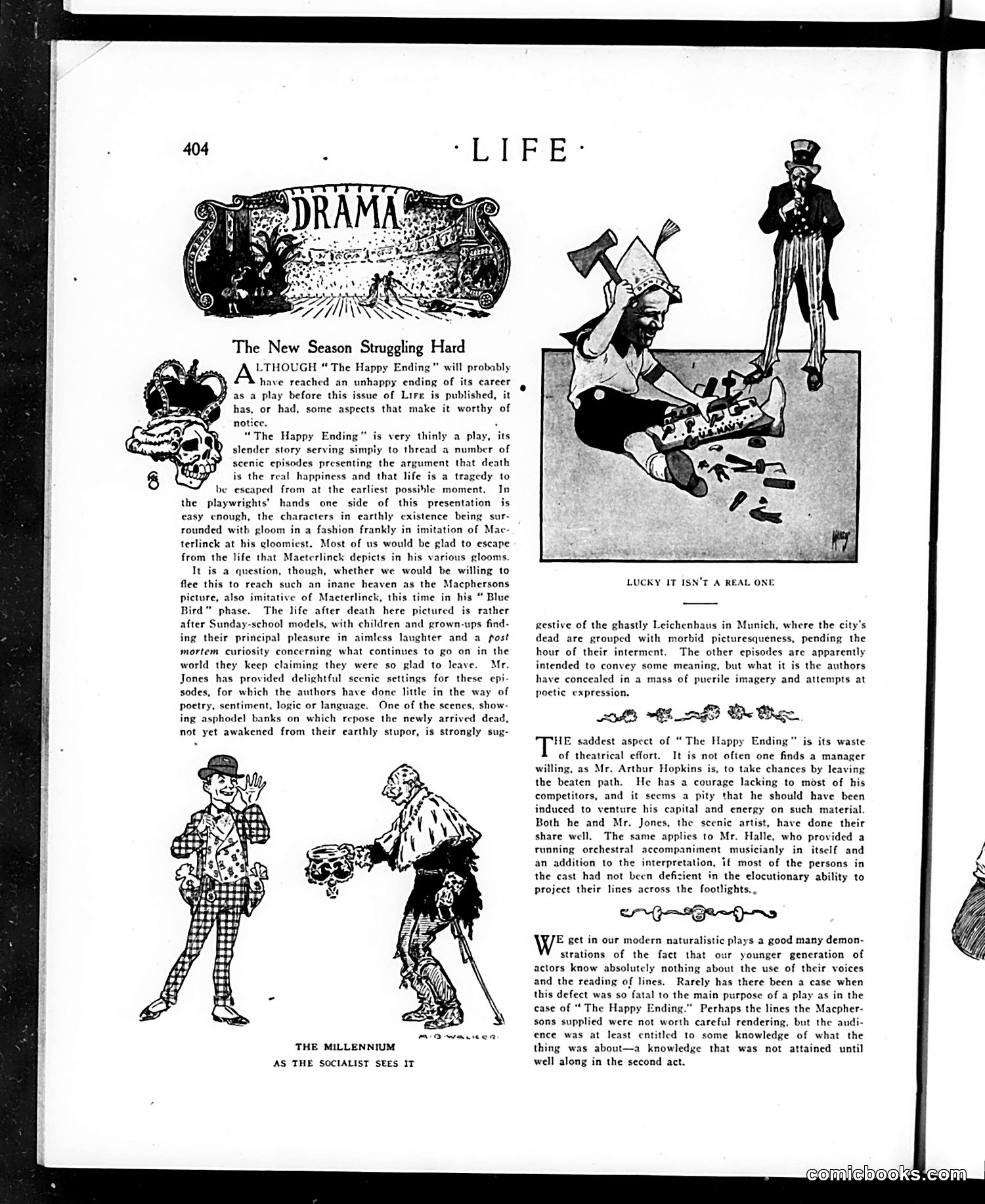
This page critiques a contemporary Broadway play by that title. The main illustration labeled "LUCKY IT ISN'T A REAL ONE" depicts a man chopping apart a wooden dummy—satirizing the play's central argument that death is preferable to life. The text reviews "The Happy Ending," which presents a bleak earthly existence followed by an insipid afterlife of childish pleasures. The critic praises manager Arthur Hopkins's courage in backing experimental work, but condemns the play itself as shallow, poorly written, and derivative of Maeterlinck's gloomy theatrical style. The small cartoon "THE MILLENNIUM AS THE SOCIALIST SEES IT" (bottom left) shows contrasting figures—likely representing socialist ideology versus capitalism—though specifics remain unclear. The review's harshest criticism targets the cast's poor vocal projection and inability to deliver lines effectively, making the play's already-thin meaning incomprehensible to audiences.
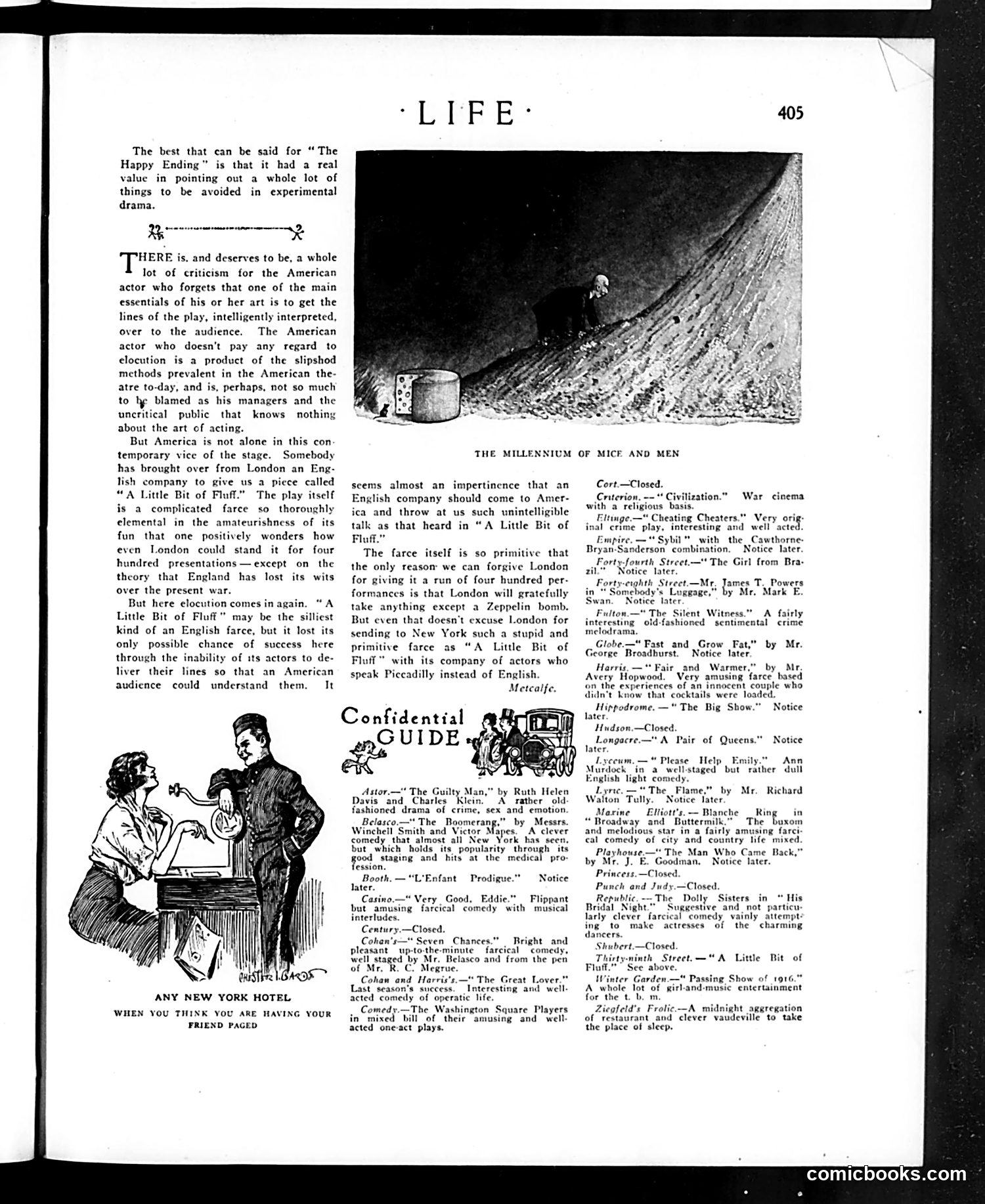
This page critiques American and British theater practices circa World War I. The main article attacks the English import "A Little Bit of Fluff" for two failures: the play itself is primitive and silly, and—more damningly—the British actors speak with such impenetrable "Piccadilly" accents that American audiences cannot understand them. The author (Metcalfe) argues this violates a fundamental rule of acting: delivering lines intelligibly to the audience. The piece also criticizes American actors and theater managers for abandoning proper elocution. A secondary jab suggests London audiences will accept anything during wartime—even this drivel—as long as it's not a Zeppelin bomb. The cartoon (left) depicts a hotel page summoning a guest, illustrating the advertisement below it. The right image shows a pastoral scene titled "The Millennium of Mice and Men." The page concludes with theater listings and reviews.
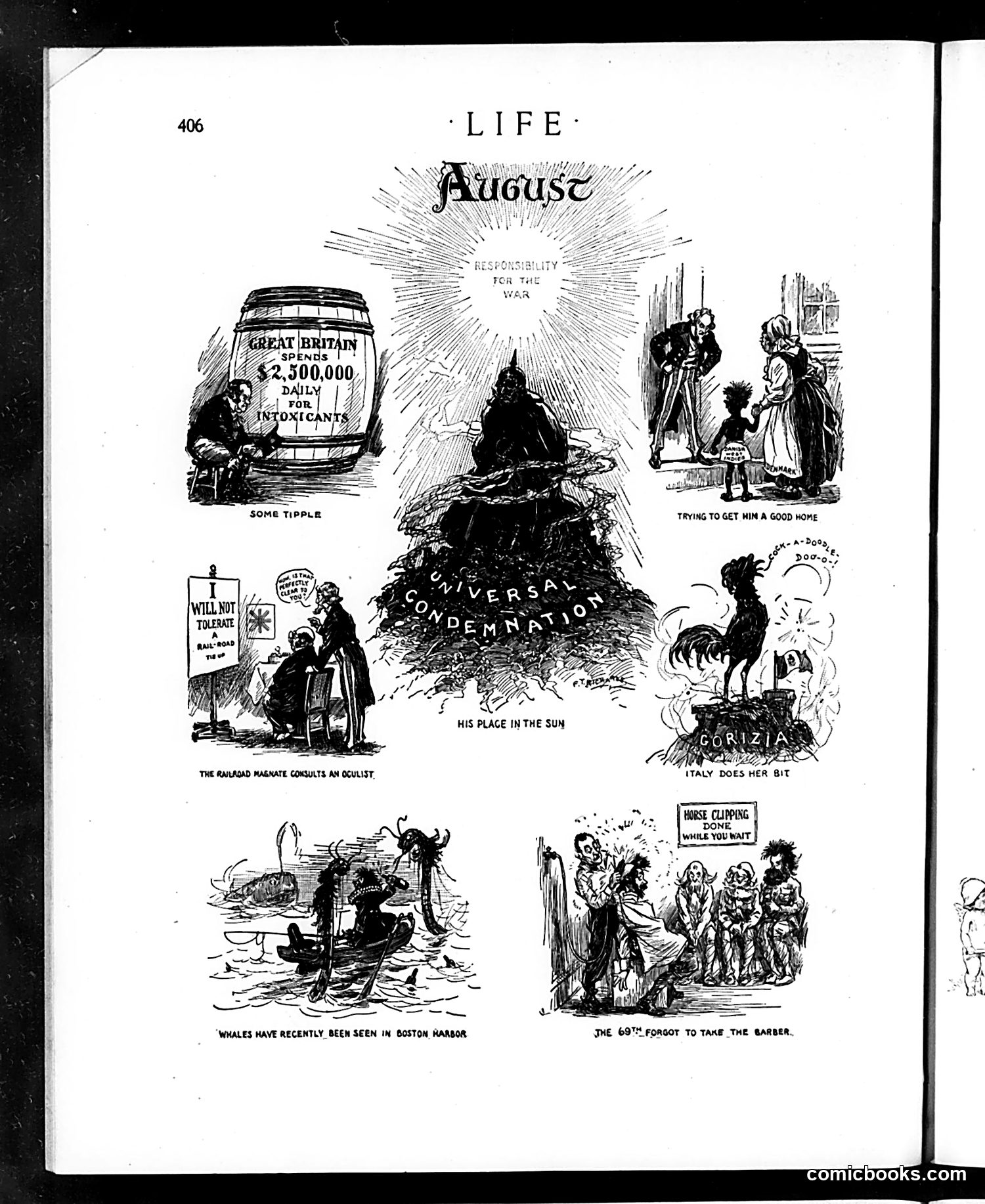
This page of political cartoons satirizes various August 1917 concerns during World War I. The central image shows "Universal Condemnation" as a dark mountain, referencing wartime moral judgments. Individual cartoons mock specific targets: "Some Tipple" criticizes profiteering (Great Britain spending $2.5 million on intoxicants); "The Railroad Magnate Consults an Occultist" mocks business leaders seeking supernatural guidance; "Trying to Get Him a Good Hope" appears to reference recruitment or conscription efforts; "Italy Does Her Bit" uses the rooster and Corizia to comment on Italian military involvement; and "Whales in Boston Harbor" and "The 69th Forgot to Take the Barber" are humorous non-sequiturs about military preparedness oversights. The cartoons collectively satirize wartime inefficiency, profiteering, and institutional failures.
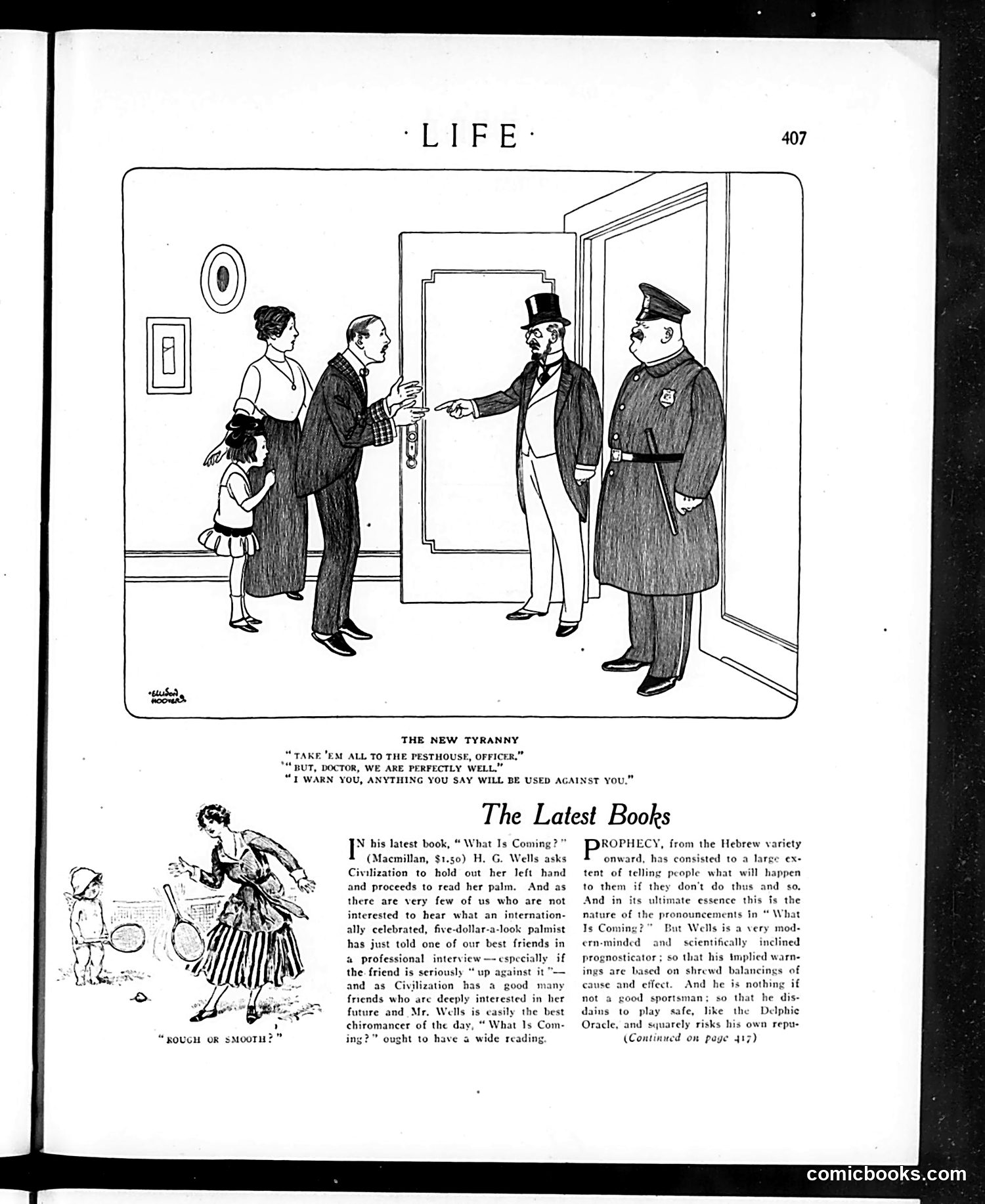
**The Cartoon's Meaning:** This satirizes government overreach and medical authoritarianism. A doctor orders a police officer to take a healthy family to a "pesthouse" (quarantine facility), ignoring their protests of wellness. The family's warning that "anything you say will be used against you" echoes arrest Miranda rights, suggesting loss of civil liberties. **The Satire:** The cartoon criticizes how governments invoke public health emergencies to justify removing individual freedoms without consent or due process. The "tyranny" is government imposing quarantine on the unwilling, treating citizens as threats rather than respecting their autonomy. **Historical Context:** Given the reference to "pesthouse" and wartime language, this likely critiques either WWI-era quarantine policies or early pandemic responses, mocking how officials weaponized health concerns against civilians' objections and constitutional protections. The accompanying book review of H.G. Wells' "What Is Coming?" reinforces the issue: warnings about civilization's future if society doesn't heed predictions.
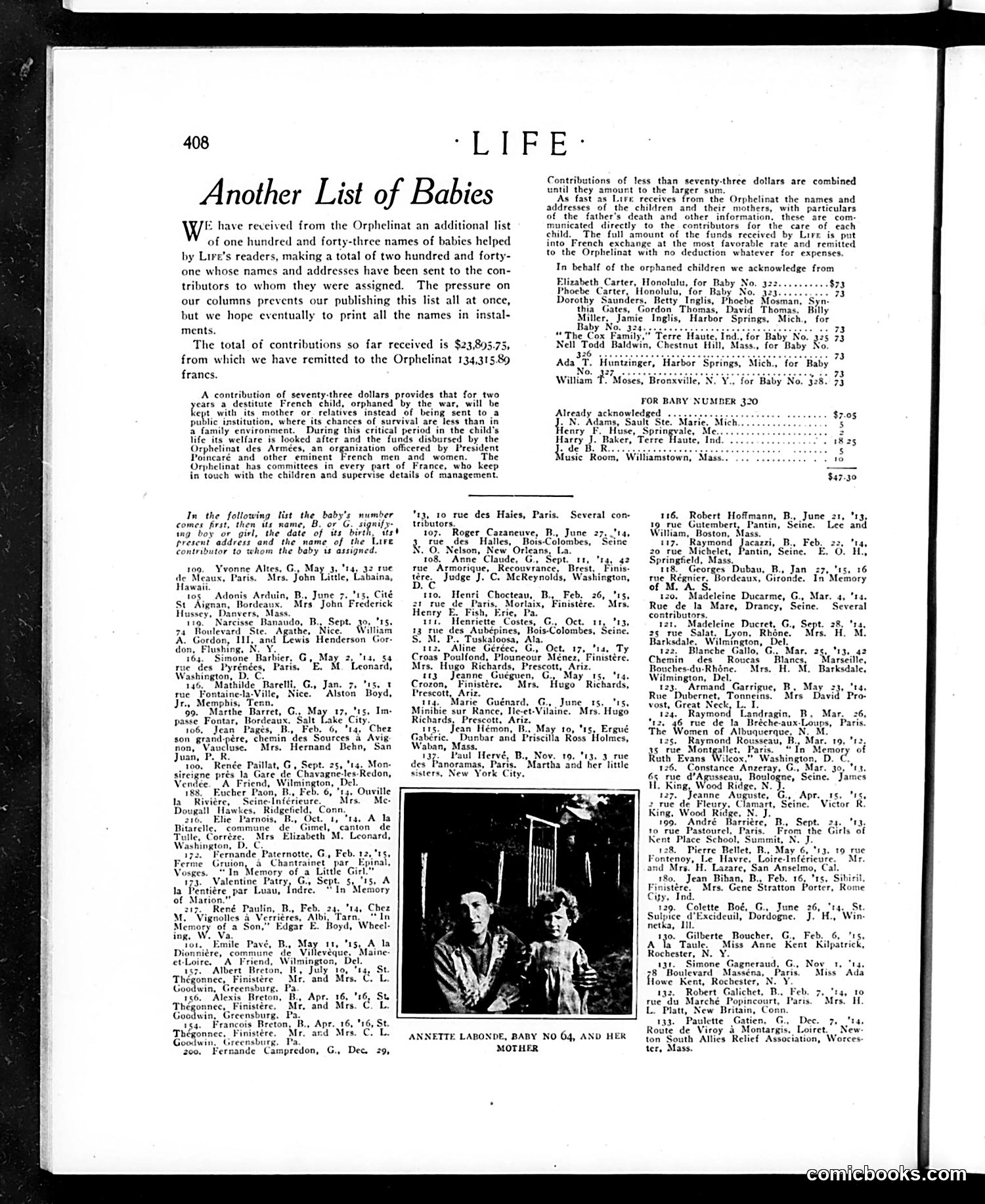
This page documents **Life magazine's charitable fundraising campaign for French war orphans** following World War I. The photograph shows **Annette Labonde, Baby No. 64, and her mother**—one of hundreds of orphaned children supported through readers' donations. The campaign worked by matching American contributors with specific French orphans. For $73, donors would support a child for two years, allowing them to remain with family rather than enter institutions. The page lists baby names, birth dates, addresses, and their American sponsors' names. This reflects the **post-WWI humanitarian crisis** when France faced widespread poverty and orphaning. Life's role was brokering this transatlantic charity, combining small contributions and remitting funds to the *Orphelinat des Armées* (Army Orphanage), headed by President Poincaré. The repeated publication of names served dual purposes: **acknowledging donors and humanizing distant beneficiaries** through individual identification rather than abstract statistics.
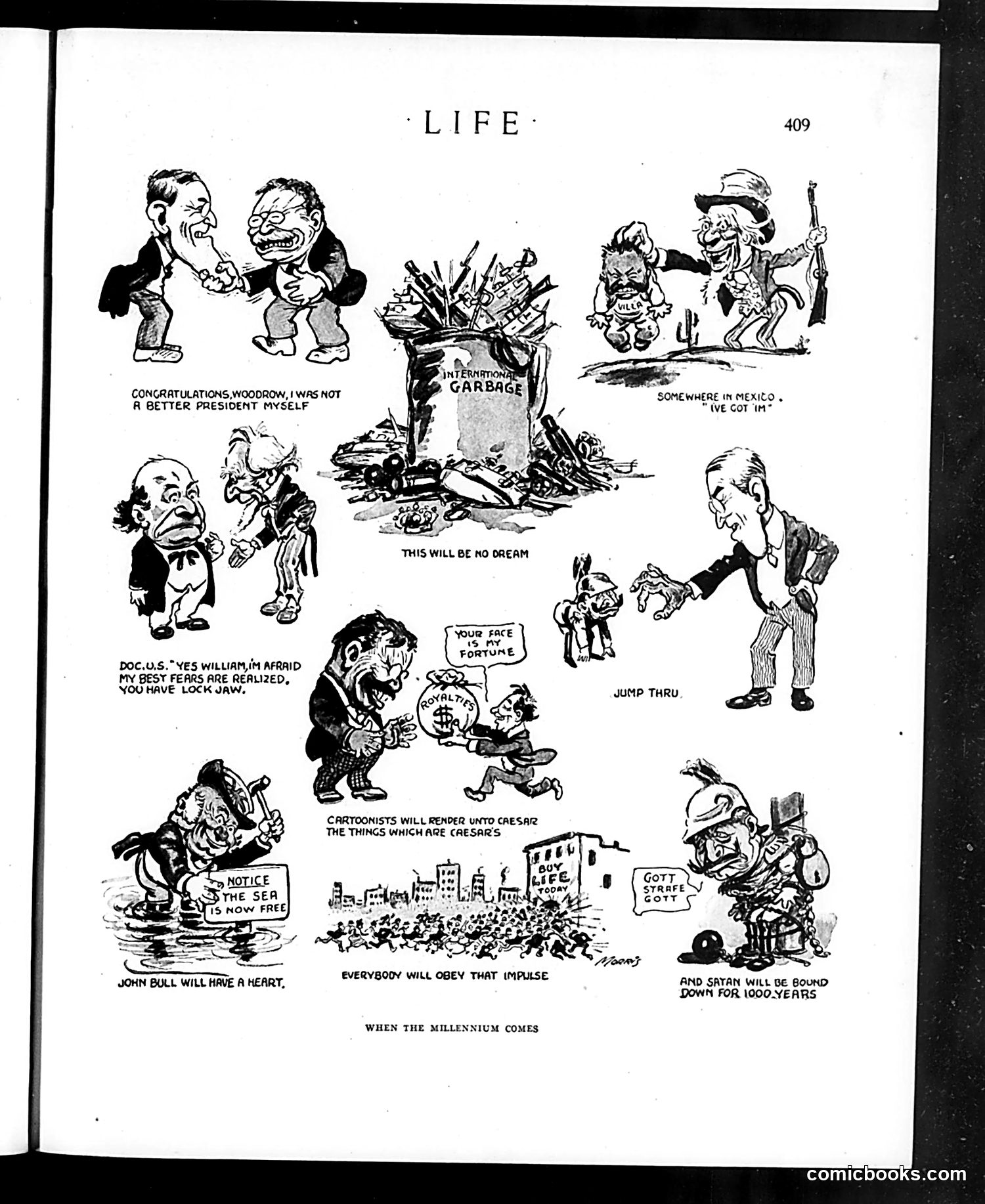
This Life magazine page satirizes millennial/utopian predictions through exaggerated caricatures. The central theme mocks idealistic visions of a perfect future world. Key figures appear to include **Woodrow Wilson** (referenced in the opening panel about presidential comparisons) and **"Doc U.S."** (personifying America). The "International Garbage" can symbolizes political waste or corruption. References include: - **John Bull** (Britain) gaining a heart - **Mexico** and imperial ambitions ("we got 'im") - Satan being bound for 1,000 years (biblical millennium imagery) - Fortune-telling and face-reading as fraudulent prediction methods The satire suggests that utopian promises of world peace, moral transformation, and perfection are absurd fantasies. By juxtaposing grandiose millennial claims with crude caricatures and ridiculous scenarios, the cartoonist mocks both political rhetoric and public gullibility about idealistic futures. The page ridicules naive optimism about human nature and social progress.
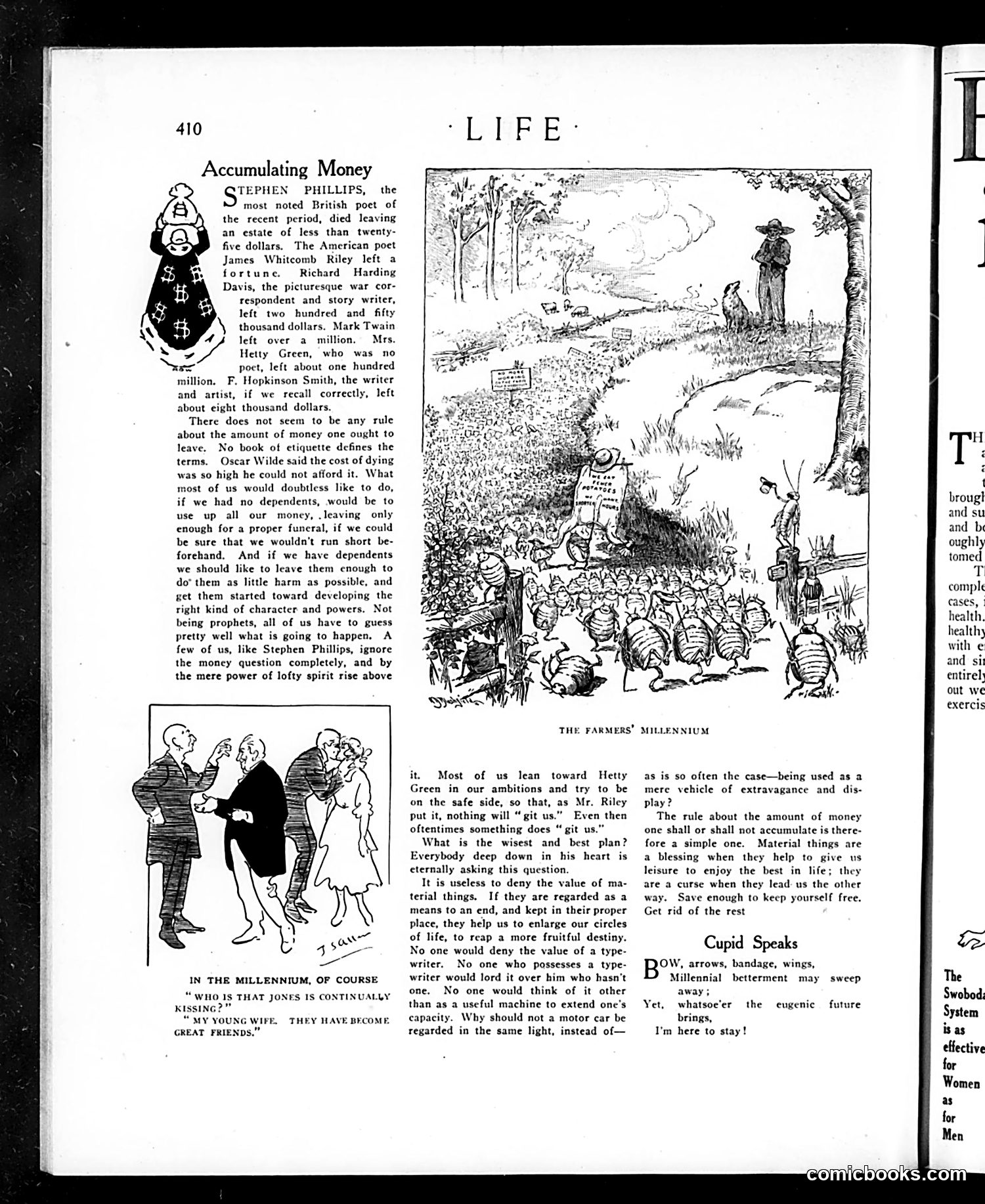
This page discusses wealth accumulation through contrasting examples of notable figures—British poet Stephen Phillips died nearly penniless, while American writers like James Whitcomb Riley and Mark Twain left substantial fortunes. The article argues there's no fixed rule for how much money one should leave behind. The main cartoon, "The Farmers' Millennium," depicts rural laborers celebrating, likely referencing agrarian prosperity or reform movements of the era. A smaller cartoon shows Jones "continually kissing" a young woman, captioned "In the Millennium, of course / Who is that Jones is continually kissing? / They have become great friends"—suggesting that in an idealized future, class barriers preventing romance between social classes would dissolve. The "Cupid Speaks" verse at bottom humorously asserts that romantic love will endure despite future eugenic and social reforms. The overall message: material wealth matters only insofar as it provides leisure; beyond that, accumulation becomes mere vanity.
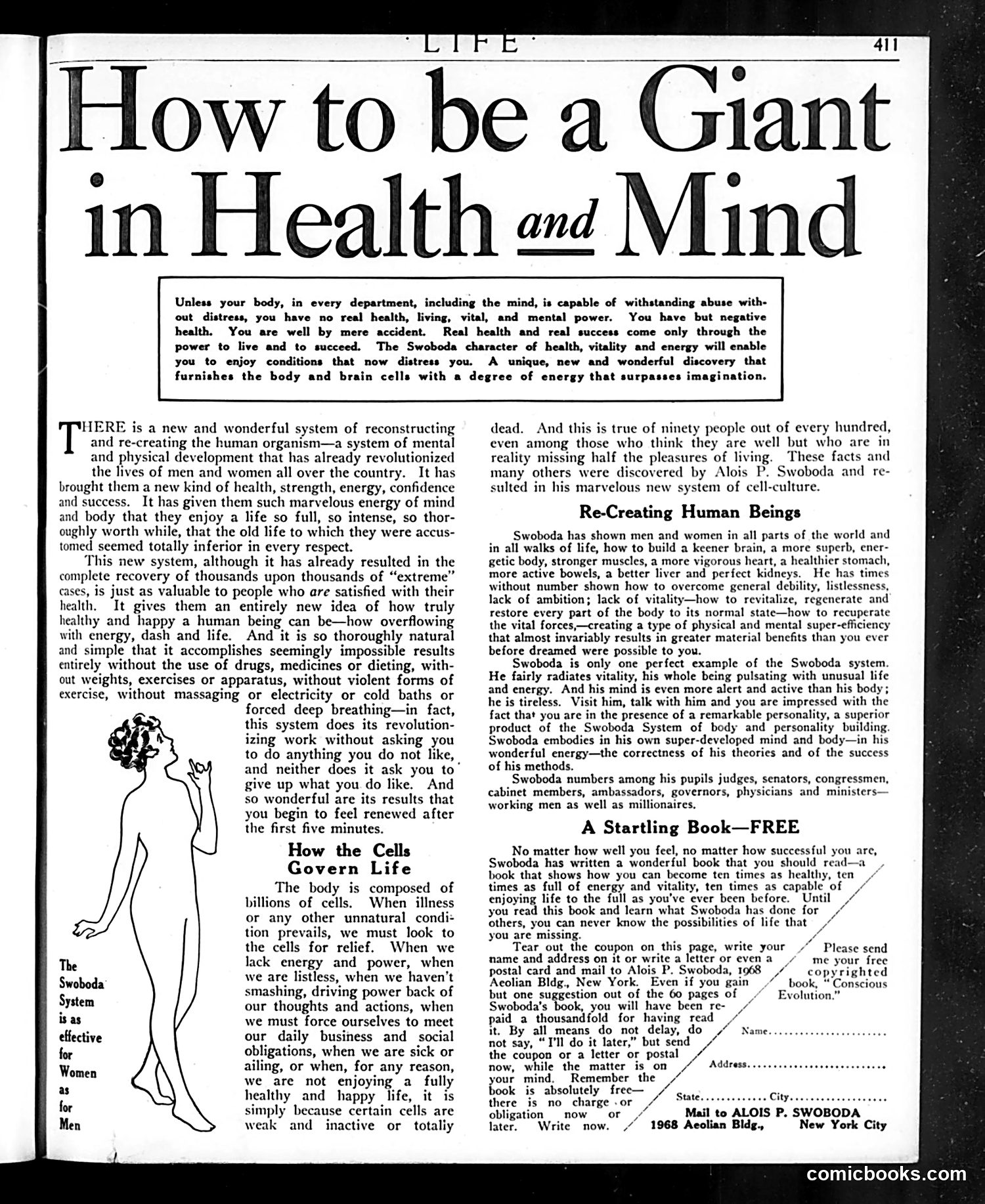
This page is primarily **advertising content** disguised as editorial material—a common early 20th-century marketing practice. It promotes the "Swoboda System," a health and vitality method by Alois P. Swoboda. The small illustration of a slim female figure on the left demonstrates the promised physical transformation. The text claims Swoboda's system requires no drugs, exercise, dieting, or apparatus—just mental/physical "reconstruction" that supposedly produces extraordinary energy and health. **The satire/critique**: This represents the era's proliferation of dubious "miracle cure" systems that made grandiose claims without scientific evidence. The language ("marvelous discovery," "revolutionary," "almost invariably results") uses hyperbole typical of quack health promotions. The promise of dramatic results without effort appealed to readers seeking easy solutions. A coupon at bottom offers a free book, a classic direct-mail sales tactic. This reflects skepticism about such unfounded wellness claims that pervaded Life magazine's satirical approach.
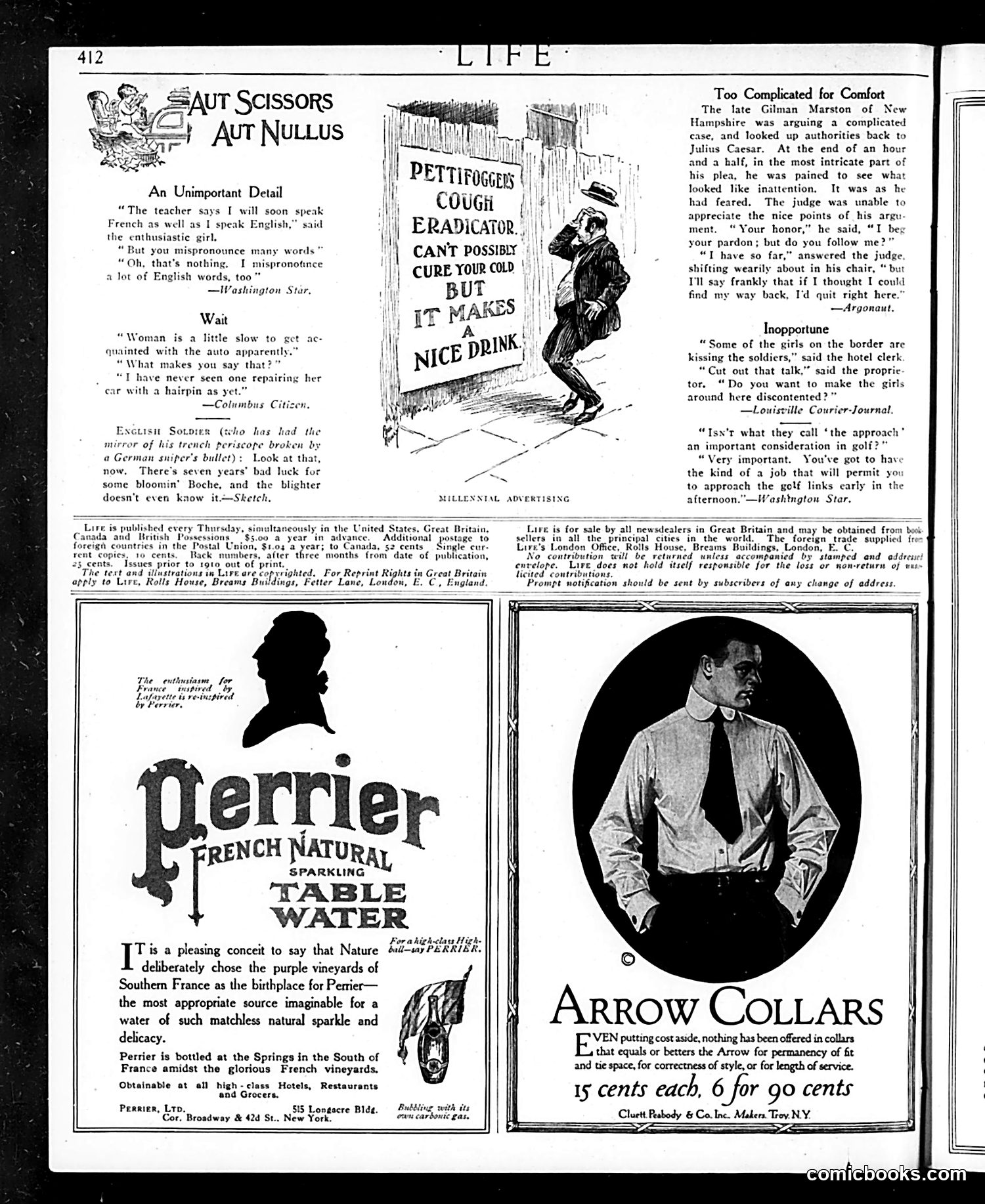
This page combines satirical humor with period advertising. The top section features four brief humorous anecdotes typical of Life's format: 1. **"An Unimportant Detail"** mocks language learning—a girl claims near-fluency in French despite mispronouncing words, reasoning she mispronounces English too. 2. **"Wait"** jokes about women's automotive incompetence, suggesting they can't repair cars (a gendered stereotype of the era). 3. **"English Soldier"** references WWI trench warfare, where a British soldier notes that a broken periscope mirror will bring "seven years' bad luck" to "some bloomin' Boche" (German soldier)—dark humor about enemy misfortune. Additional anecdotes address judicial impatience, border soldier behavior, and golf etiquette. The advertisements feature **Perrier water** (bottled French mineral water marketed as sophisticated) and **Arrow Collars** (men's formal wear). These represent typical early-20th-century luxury goods aimed at affluent readers. The page reflects pre-modern attitudes: gender stereotypes, WWI references, and class-conscious consumerism.
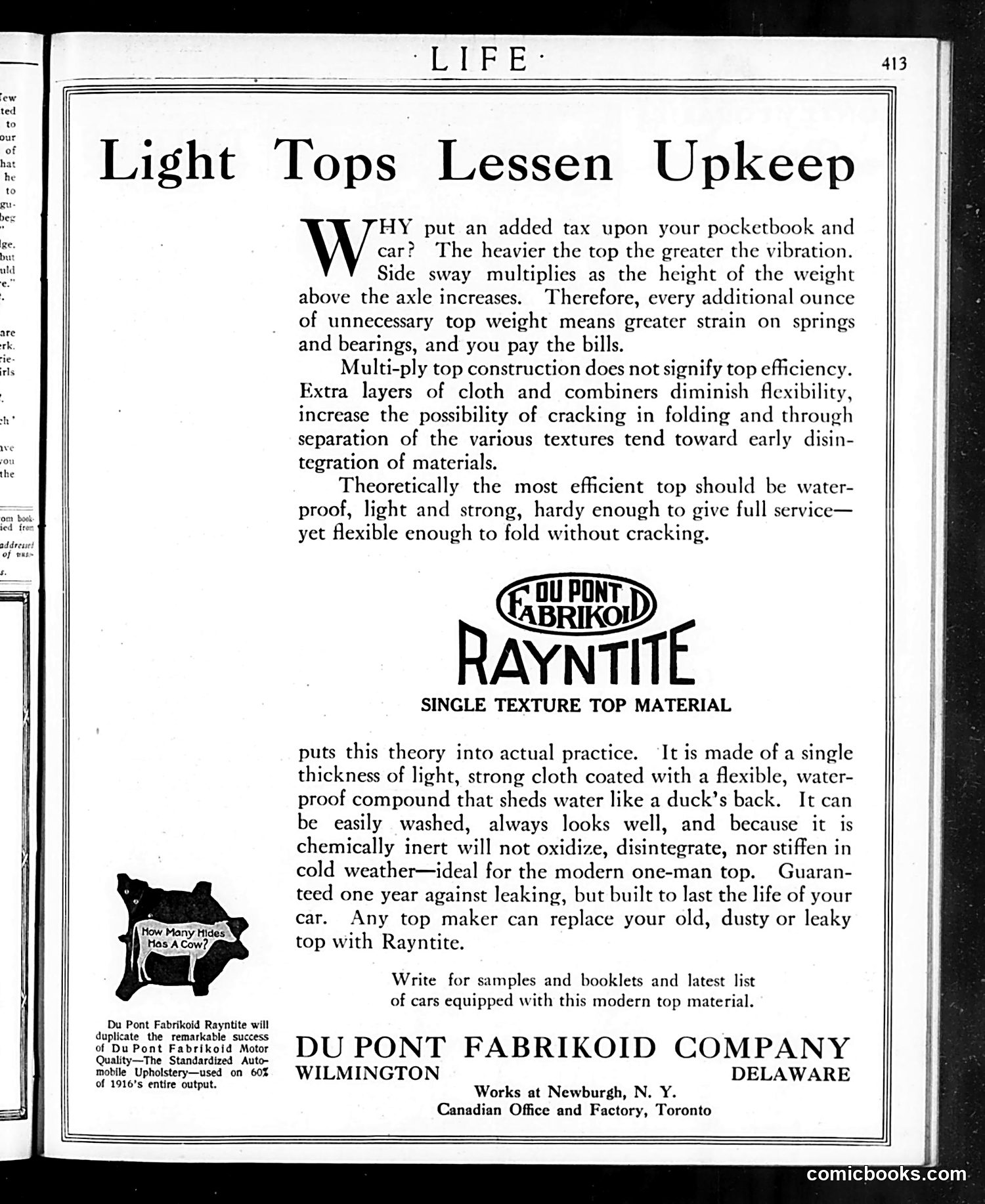
This page is primarily **advertising**, not satire or political cartoon. It promotes Du Pont Fabrikoid's "Rayntite" automobile convertible top material, published in *Life* magazine (page 413). The small illustration showing a cow with text "How Many Hides Has a Cow?" is a visual pun: it sarcastically asks how many cow hides a competitor's multi-ply top requires, implying their rivals use excessive layers of material. **The argument:** The ad criticizes heavy, multi-layered convertible tops as wasteful and prone to cracking. It positions Rayntite—a single-texture, waterproof cloth—as the superior, economical alternative for "modern one-man tops" (early automobiles with collapsible tops). The messaging emphasizes **practicality for car owners**: lighter tops reduce strain on vehicles, lower maintenance costs, and remain flexible. This reflects 1910s automotive concerns about durability and operating expenses. The tone is educational rather than humorous—typical of early automotive advertising targeting economically-conscious consumers.
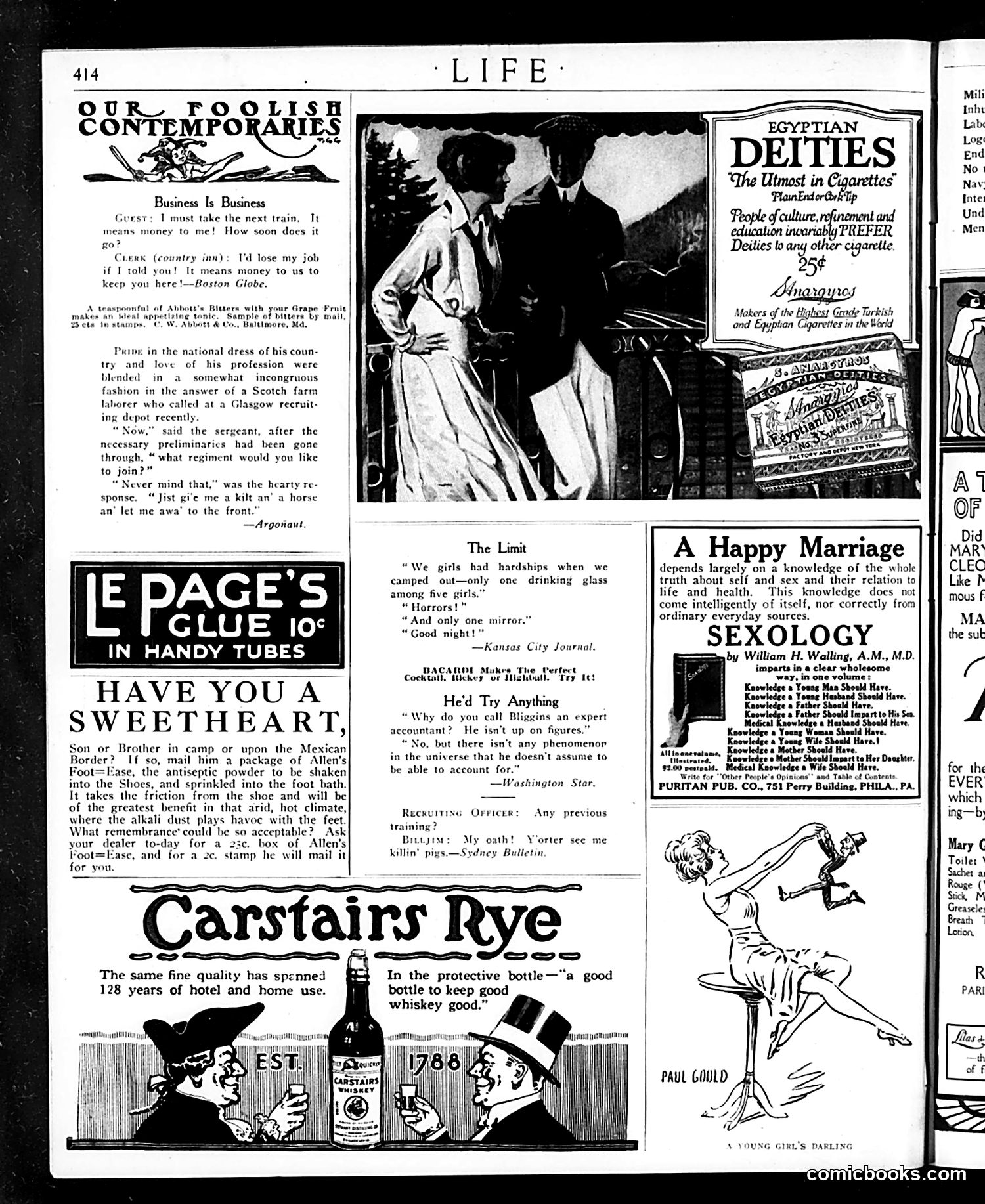
This page from *Life* magazine contains several satirical pieces and advertisements typical of the early 20th century. **"Our Foolish Contemporaries"** presents brief humorous observations: a clerk chooses job security over travel convenience, and a Scottish farm laborer enthusiastically volunteers for military service, asking only for a kilt and horse—prioritizing patriotic duty and national dress over regiment choice. **"The Limit"** jokes about wartime camping hardships among women, with dark humor about shared drinking glasses and mirrors—likely referencing WWI-era women's auxiliary service. **"He'd Try Anything"** mocks an accountant's overconfidence, suggesting he assumes responsibility for unexplainable phenomena. The page is primarily **advertisements**: Le Page's Glue, Allen's Foot-Ease (marketed to soldiers), Carstairs Rye whiskey (emphasizing 128 years of quality), and Egyptian Deities cigarettes. A *Sexology* book advertisement promotes marital knowledge. The humor reflects early-1900s American attitudes toward military service, gender roles, and commercial products marketed to soldiers and families separated by war.
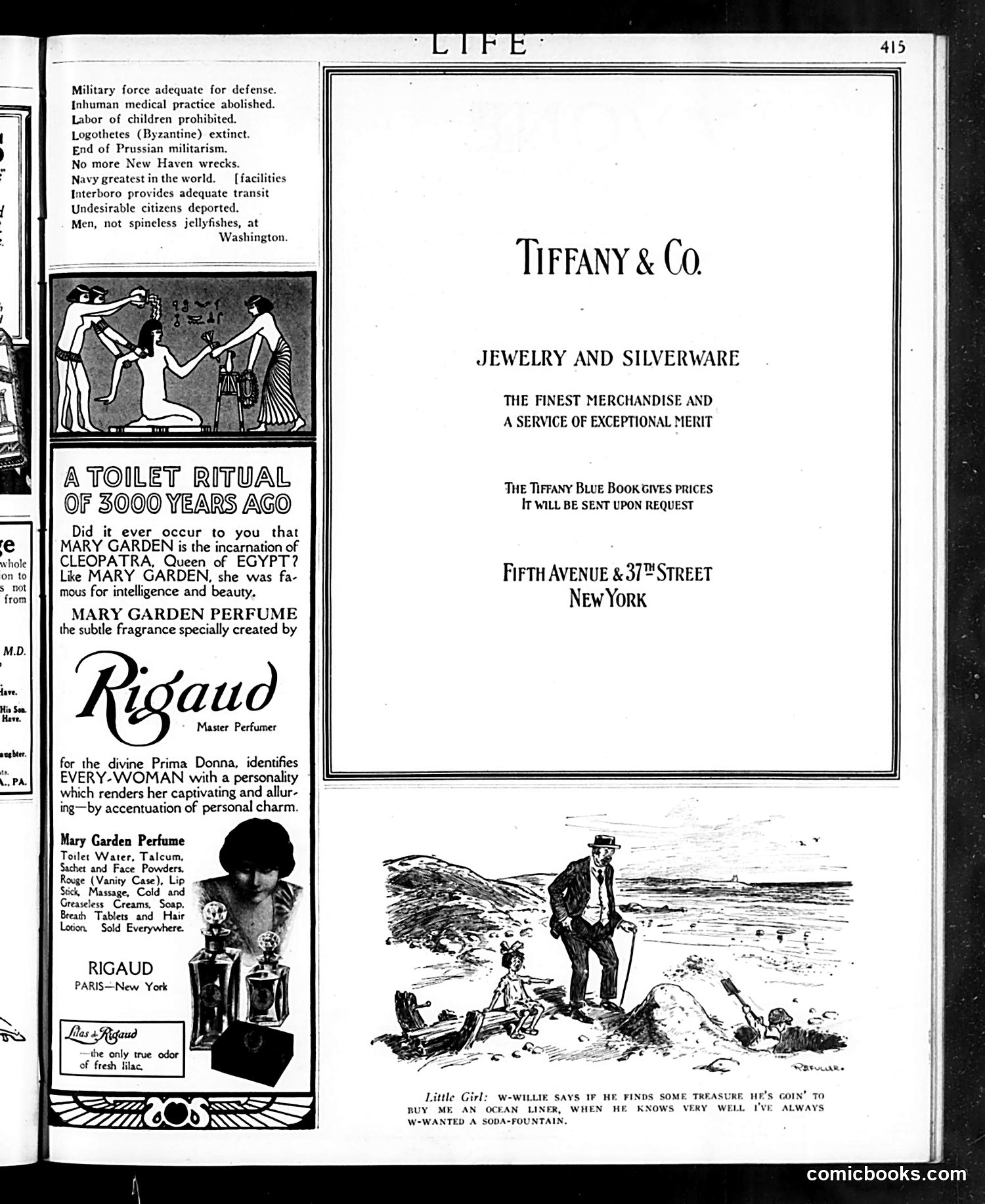
**Left Column:** A satirical list mocking progressive ideals, likely from the WWI era. References include "End of Prussian militarism," "Navy greatest in the world," and "Men, not spineless jellyfishes, at Washington"—suggesting criticism of pacifism or weak leadership. **Mary Garden Advertisement:** Exploits the famous opera singer's persona, comparing her to Cleopatra to market perfume. Uses celebrity endorsement to suggest that purchasing the product grants feminine allure and personality—early 20th-century marketing tying luxury goods to glamour. **Bottom Cartoon:** A humorous domestic scene where a little girl reports that "Willie" promises to buy her an ocean liner if he finds treasure—knowing he'll actually get her a soda fountain instead. Satirizes childhood innocence and exaggerated promises. **Right Page:** Tiffany & Co. luxury jewelry advertisement emphasizing merchandise quality and exclusive service—typical high-end advertising from this era. The page blends social commentary, celebrity marketing, and gentle humor typical of *Life* magazine's satirical approach.
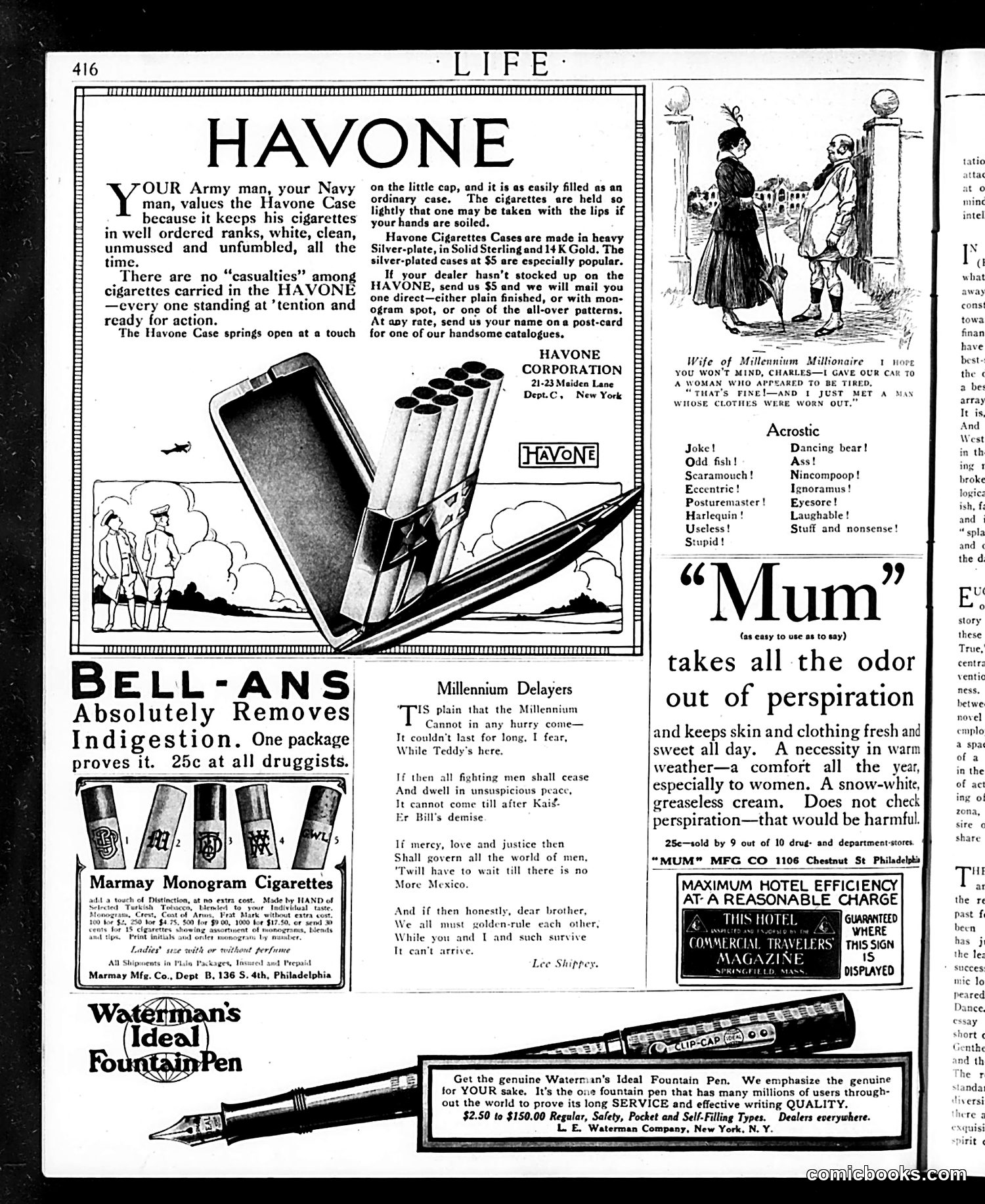
This is primarily an **advertising page** from Life magazine, not a political cartoon. The page contains four product advertisements with minimal editorial content. The main advertisements are: 1. **Havone Cigarette Case** — marketed to military personnel (Army/Navy), emphasizing orderliness and cleanliness of cigarettes stored in the case. Uses military language ("standing at 'tention"). 2. **Bell-Ans** — antacid medication promising to remove indigestion. 3. **"Mum" Deodorant** — a cream product claiming to eliminate perspiration odor while keeping skin fresh. Appeals particularly to women as a "necessity in warm weather." 4. **Waterman's Ideal Fountain Pen** — emphasizing reliability and widespread use. There is one short **poem by Lee Shippey** titled "Millennium Delayers" that satirizes delayed progress, referencing Teddy (Roosevelt), Mexico, and Bill's demise—likely topical political commentary of the era—but this appears to be filler editorial content rather than the page's primary focus.
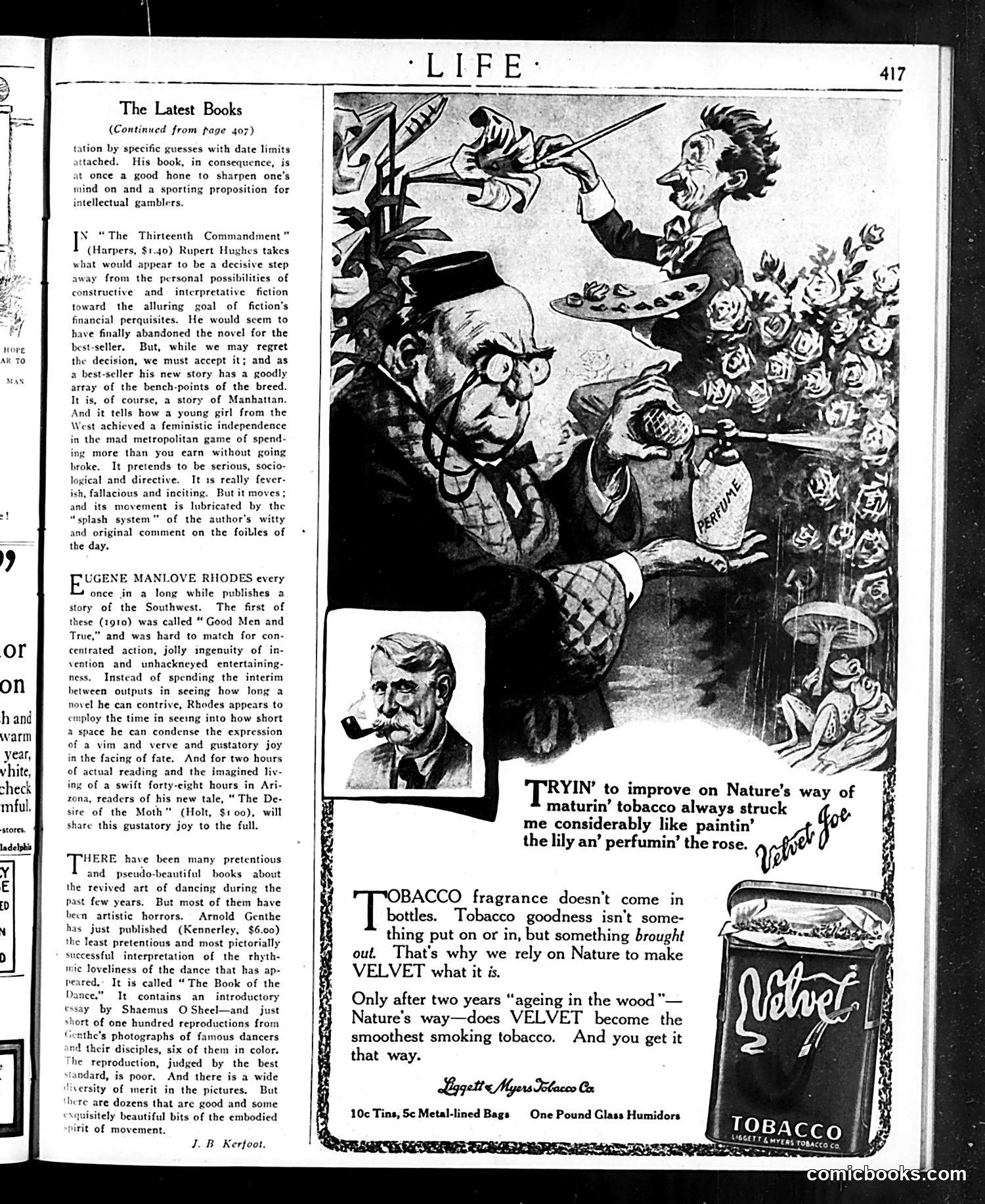
This page is primarily a **book review column** with an integrated **tobacco advertisement**. The text reviews three books: Rupert Hughes's "The Thirteenth Commandment" (criticized as abandoning literary fiction for commercial "best-seller" status), Eugene Manlove Rhodes's southwestern fiction, and Arnold Genthe's "The Book of the Dance" (a photography collection). The dominant visual element is a **Velvet Tobacco advertisement** featuring a caricatured man with exaggerated features (large nose, jutting chin) amid roses and flowers. The copy uses the phrase "Tryin' to improve on Nature's way of maturin' tobacco" with dialect speech ("like paintin' the lily an' perfumin' the rose"), suggesting the ad employs period-typical ethnic caricature humor—mocking someone attempting to artificially enhance natural products. The advertisement's message emphasizes natural aging processes ("two years 'ageing in the wood'") as superior to artificial enhancement, a common marketing strategy of the era. The cartoonish figure appears designed to make the over-refinement concept humorous through visual mockery.
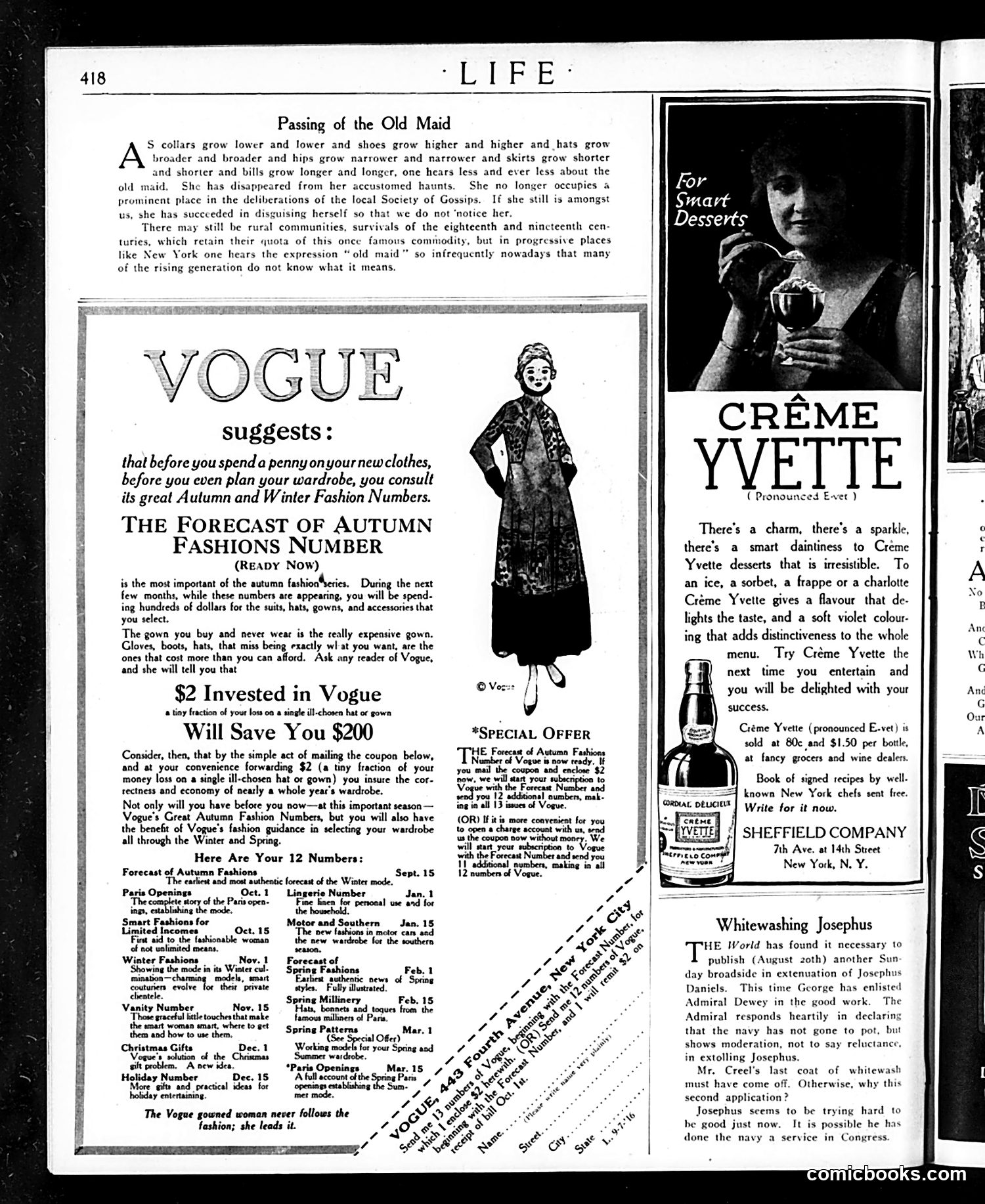
This satirical piece celebrates the social disappearance of unmarried women due to changing fashion and morality. As hemlines rise, collars drop, and silhouettes modernize, the author claims the "old maid" has vanished—either married off or indistinguishable from other women in progressive cities like New York. The article mocks outdated social categories by suggesting that rapid fashion evolution has made the spinster obsolete or invisible. Where earlier generations could identify unmarried women, modern dress codes no longer signal marital status through conservative styling. The piece reflects early 20th-century attitudes: the "old maid" was once a prominent social fixture worthy of gossip, but contemporary women's liberation through fashion and changing social norms has rendered this designation meaningless—presented as progress, though the tone implies ambivalence about what's been lost.
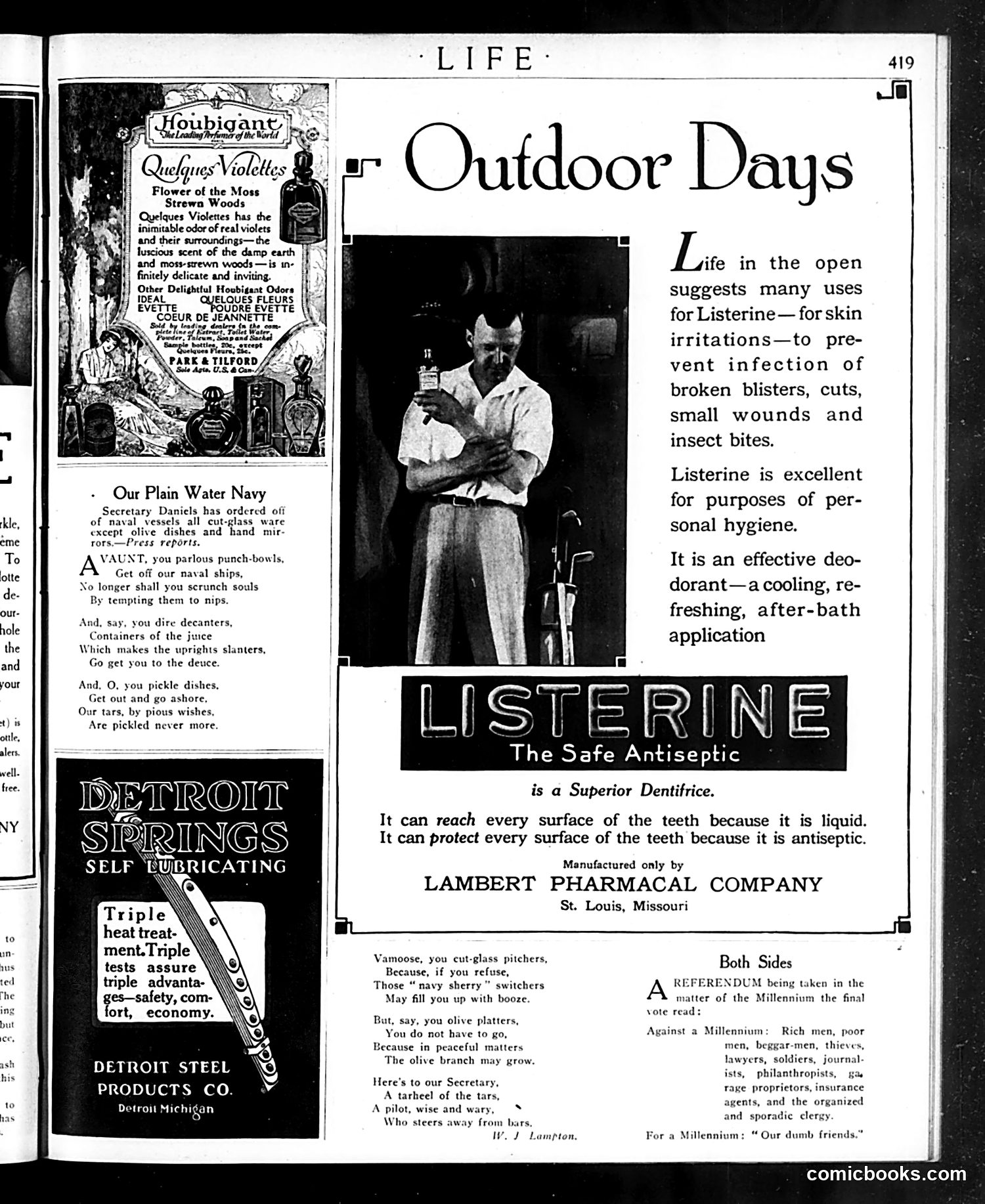
This page is primarily **advertising** with a satirical poem as secondary content. The main satire is "Our Plain Water Navy," a humorous poem mocking Secretary of the Navy Josephus Daniels's order removing cut-glass dishware from naval vessels—an apparent temperance measure to discourage drinking among sailors. The poem personifies glassware (punch-bowls, decanters, pickle dishes, pitchers) as being "banished" from ships, with only olive dishes exempted because olives symbolize peace rather than alcohol. The joke: Daniels's reform is presented as comically ineffectual moralizing. The poem's tone is light mockery of prohibition-era naval policy, portraying the Secretary as a "tarheel" (North Carolinian) killjoy trying to reform sailors through removing temptation. The page also includes a brief satirical "Both Sides" section contrasting who opposes versus supports "a Millennium"—the wealthy, professionals, and clergy oppose it, while only "our dumb friends" (animals) favor it—a cynical jab at human hypocrisy. The remainder consists of period advertisements for perfume, springs, and Listerine antiseptic.
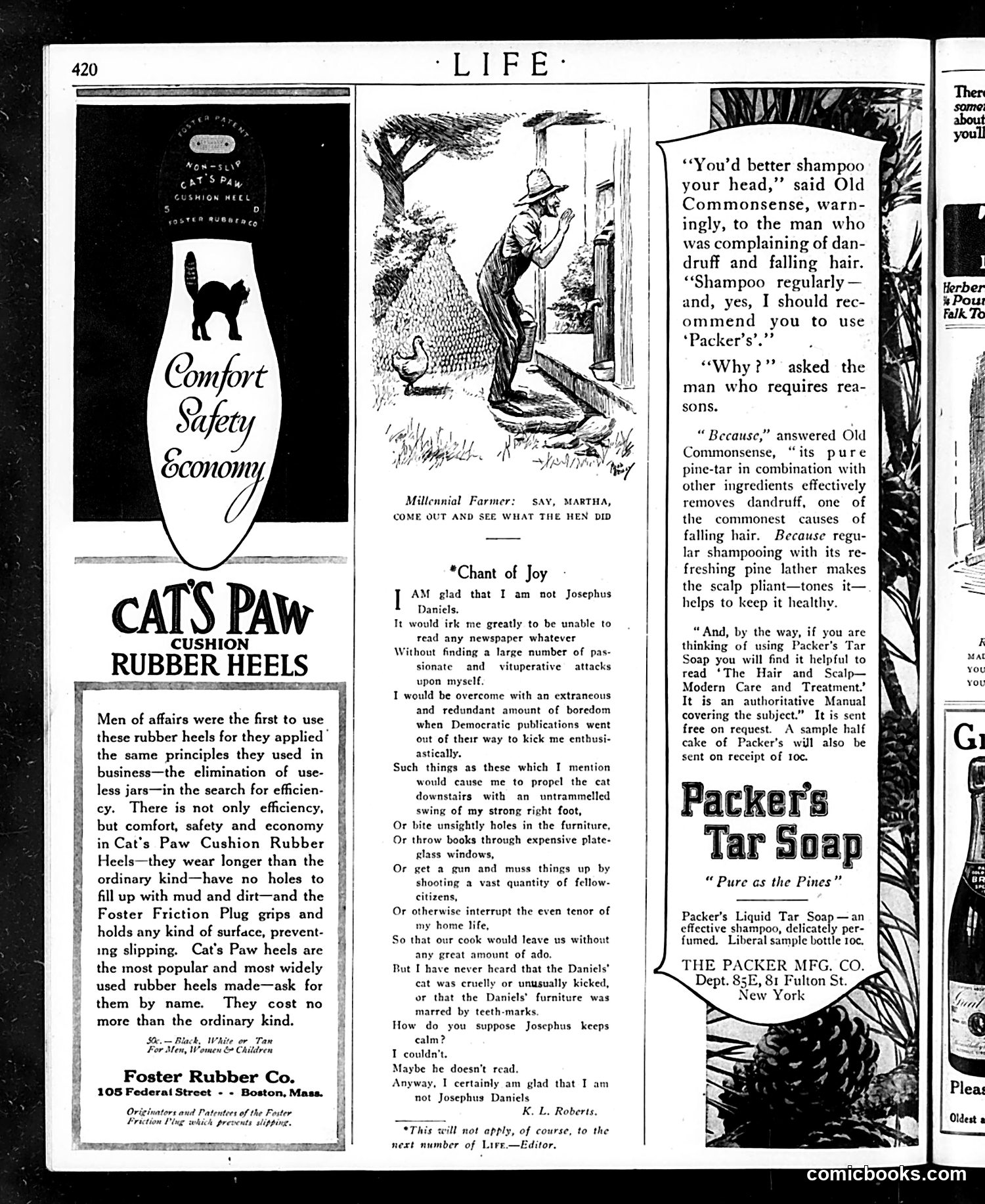
This page contains primarily **advertisements** interspersed with two editorial pieces. The main cartoon depicts a farmer discovering something amusing about a hen—likely a visual gag about farm life, though the specific joke is unclear without seeing the hen's action. The more substantial content is **"Chant of Joy"** by K.L. Roberts, a satirical poem about Josephus Daniels (Secretary of the Navy under Woodrow Wilson, known for controversial policies). Roberts humorously contrasts himself—who would lose emotional control if constantly attacked in newspapers—with Daniels, who apparently maintains composure despite sustained public criticism. The editor's note suggests Daniels was a frequent target of press attacks during this period. The remaining content consists of product advertisements: Cat's Paw rubber heels and Packer's Tar Soap, presented with typical period testimonial formats emphasizing efficiency and health benefits.
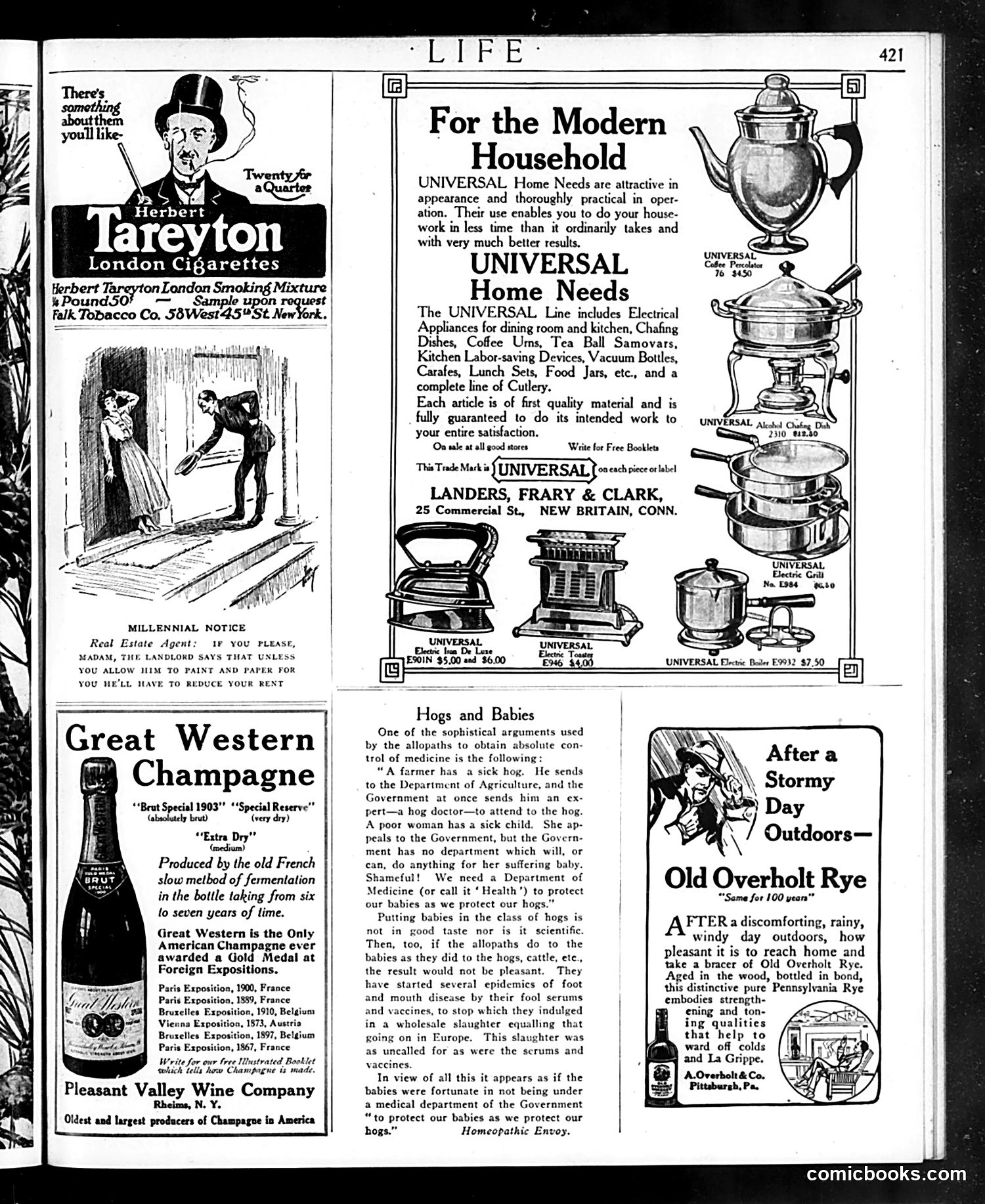
This page is primarily advertisements, but includes a notable satirical article titled "Hogs and Babies" attributed to "Homeopathic Envoy." The piece attacks allopathic medicine (conventional medical practice) using a reductio ad absurdum argument. It mocks the argument that the government should create a Department of Medicine to protect children, just as the Department of Agriculture protects livestock. The author argues this comparison is both tasteless and scientifically flawed. The satire's core point: the author claims allopathic doctors have caused disease epidemics through vaccines and serums in livestock, resulting in mass culling. Therefore, placing babies under similar government medical control would be harmful, not protective. Homeopathic practitioners apparently used this rhetorical strategy to argue against expanded government medical authority and conventional medical oversight during this era. This reflects early 20th-century tensions between homeopathy and allopathy—competing medical philosophies competing for legitimacy and regulatory control.
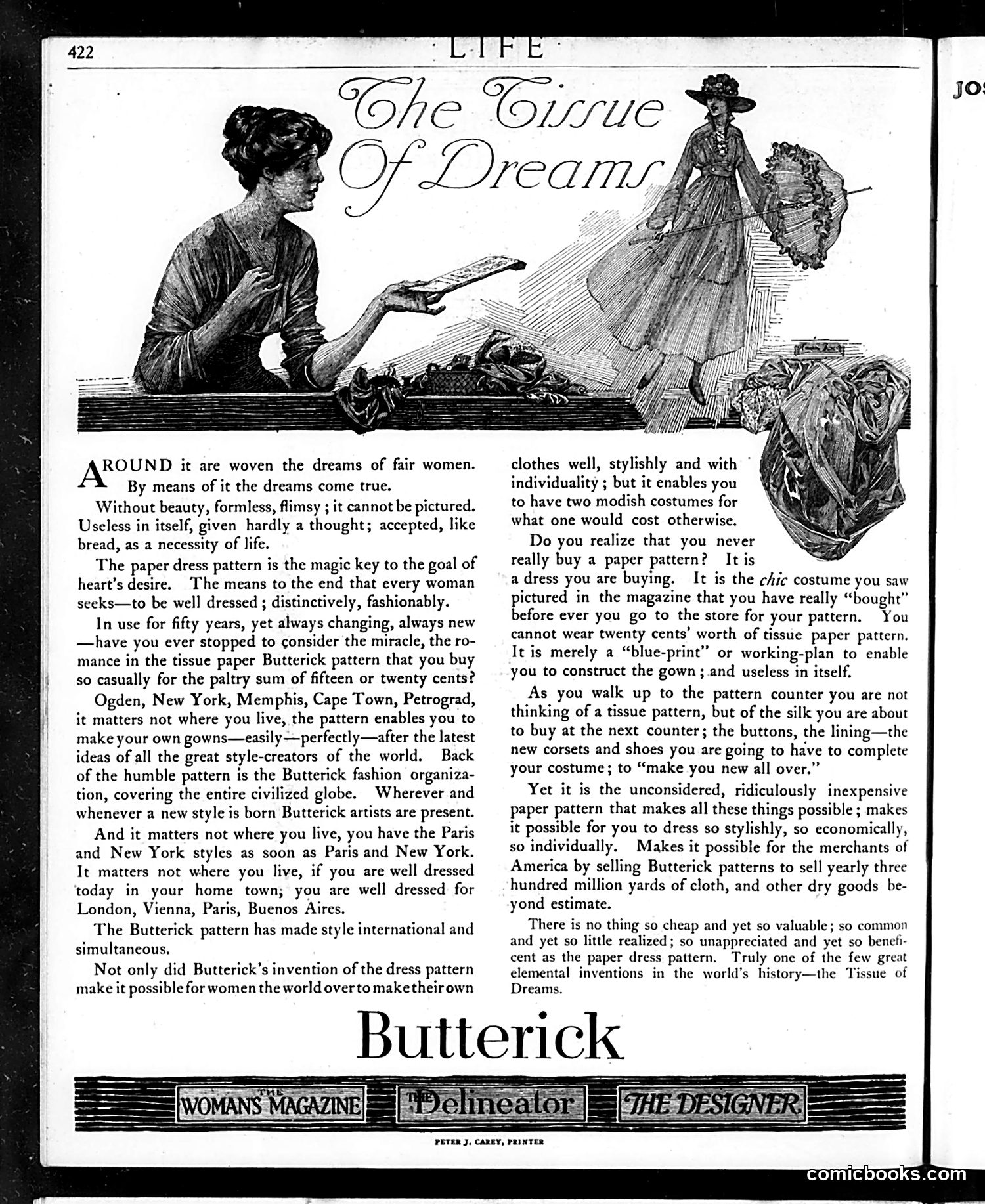
This is a **full-page advertisement**, not satire. It promotes Butterick dress patterns, positioning them as democratizing fashion globally. The illustration shows a woman conjuring elegant gowns from a simple paper pattern—visualizing the ad's central claim: that inexpensive tissue-paper patterns (costing 15-20 cents) enable working-class women to create high-fashion clothing matching Paris and New York styles. The text argues Butterick patterns are a social miracle: they make fashionable dress universally accessible across class and geography (mentioning cities from Ogden to Buenos Aires). The patterns function as "blueprints" for silk, buttons, linings—essentially selling dreams rather than paper itself. The satire is gentle: the ad mocks consumers' psychology (women buy the imagined finished dress, not the pattern) while celebrating capitalism's apparent benevolence. It claims patterns drive massive textile sales (300 million yards annually) while appearing to serve women's desires for beauty and individuality. This reflects early 1900s advertising celebrating mass production and consumer culture as liberating.