
Life, 1916-09-07 · page 28 of 40
Life — September 7, 1916 — page 28: what you’re looking at
What you’re looking at
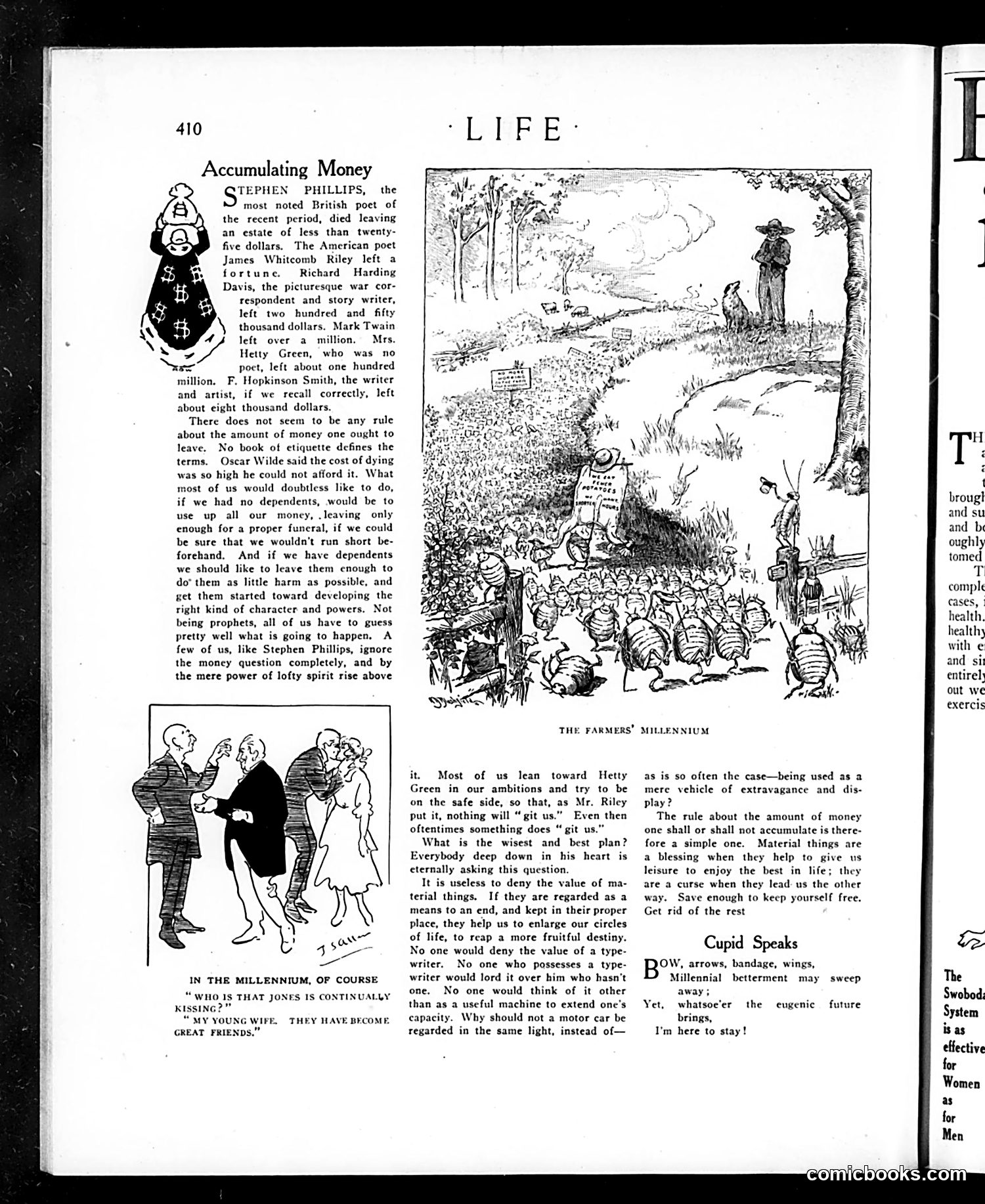
This page discusses wealth accumulation through contrasting examples of notable figures—British poet Stephen Phillips died nearly penniless, while American writers like James Whitcomb Riley and Mark Twain left substantial fortunes. The article argues there's no fixed rule for how much money one should leave behind. The main cartoon, "The Farmers' Millennium," depicts rural laborers celebrating, likely referencing agrarian prosperity or reform movements of the era. A smaller cartoon shows Jones "continually kissing" a young woman, captioned "In the Millennium, of course / Who is that Jones is continually kissing? / They have become great friends"—suggesting that in an idealized future, class barriers preventing romance between social classes would dissolve. The "Cupid Speaks" verse at bottom humorously asserts that romantic love will endure despite future eugenic and social reforms. The overall message: material wealth matters only insofar as it provides leisure; beyond that, accumulation becomes mere vanity.
📄 Transcribed text from this page (OCR, searchable)
Machine-transcribed from the original scan — historical spelling and the odd misread are preserved.
410 Accumulating Money TEPHEN PHILLIPS, the most noted British poet of the recent period, died leaving an estate of less than twenty- five dollars. The American poet James Whitcomb Riley left a fortune. Richard Harding Davis, the picturesque war cor- respondent and story writer, left two hundred and fifty thousand dollars. Mark Twain left over a million, Mrs. Hetty Green, who was no poet, left about one hundred F. Hopkinson Smith, the writer and artist, if we recall correctly, left about eight thousand dollars. There does not seem to be any rule about the amount of money one ought to leave. No book of etiquette defines the terms. Oscar Wilde said the cost of dying was so high he could not afford it. What most of us would doubtless like to do, if we had no dependents, would be to use up all our money, leaving only enough for a proper funcral, if we could be sure that we wouldn't run short be- forehand. And if we have dependents we should like to leave them enough to do* them as little harm as possible, and get them started toward developing the right kind of character and powers. Not being prophets, all of us have to guess pretty well what is going to happen. A few of us, like Stephen Phillips, ignore the moncy question completely, and by the mere power of lofty spirit rise above IN THE MILLENNIUM, OF COURSE WHO 18 THAT JONES 1S CONTINUALLY ING?” THEY HAVE BECOME, THE FARMERS’ MILLENNIUM it. Most of us lean toward Hetty Green in our ambitions and try to be on the safe side, so that, as Mr. Riley put it, nothing will “git us.” Even then oftentimes something does “ git us.” What is the wisest and best plan? Everybody deep down in his heart is eternally asking this question. It is useless to deny the value of ma- terial things. If they are regarded as a means to an end, and kept in their proper place, they help us to enlarge our circles of life, to reap a more fruitful destiny. No one would deny the value of a type- writer, No one who possesses a type- writer would lord it over him who hasn't one. No one would think of it other than as a useful machine to extend one’s capacity. Why should not a motor car be regarded in the same light, instead of— as is so often the case—being used as a mere vehicle of extravagance and dis- play? The rule about the amount of money one shall or shall not accumulate is there- fore a simple one. Material things are a blessing when they help to give us leisure to enjoy the best in life; they are a curse when they lead-us the other way. Save enough to keep yourself free. Get rid of the rest Cupid Speaks OW, arrows, bandage, wings, Millennial betterment may sweep away; Yet, whatsoe'er the eugenic future brings, I'm here to stay! — T° ; brougt and su and be oughly tomed T comple cases, | health. healthy with e and sit entirel, out we exercis