
Life, 1916-09-07 · page 18 of 40
Life — September 7, 1916 — page 18: what you’re looking at
What you’re looking at
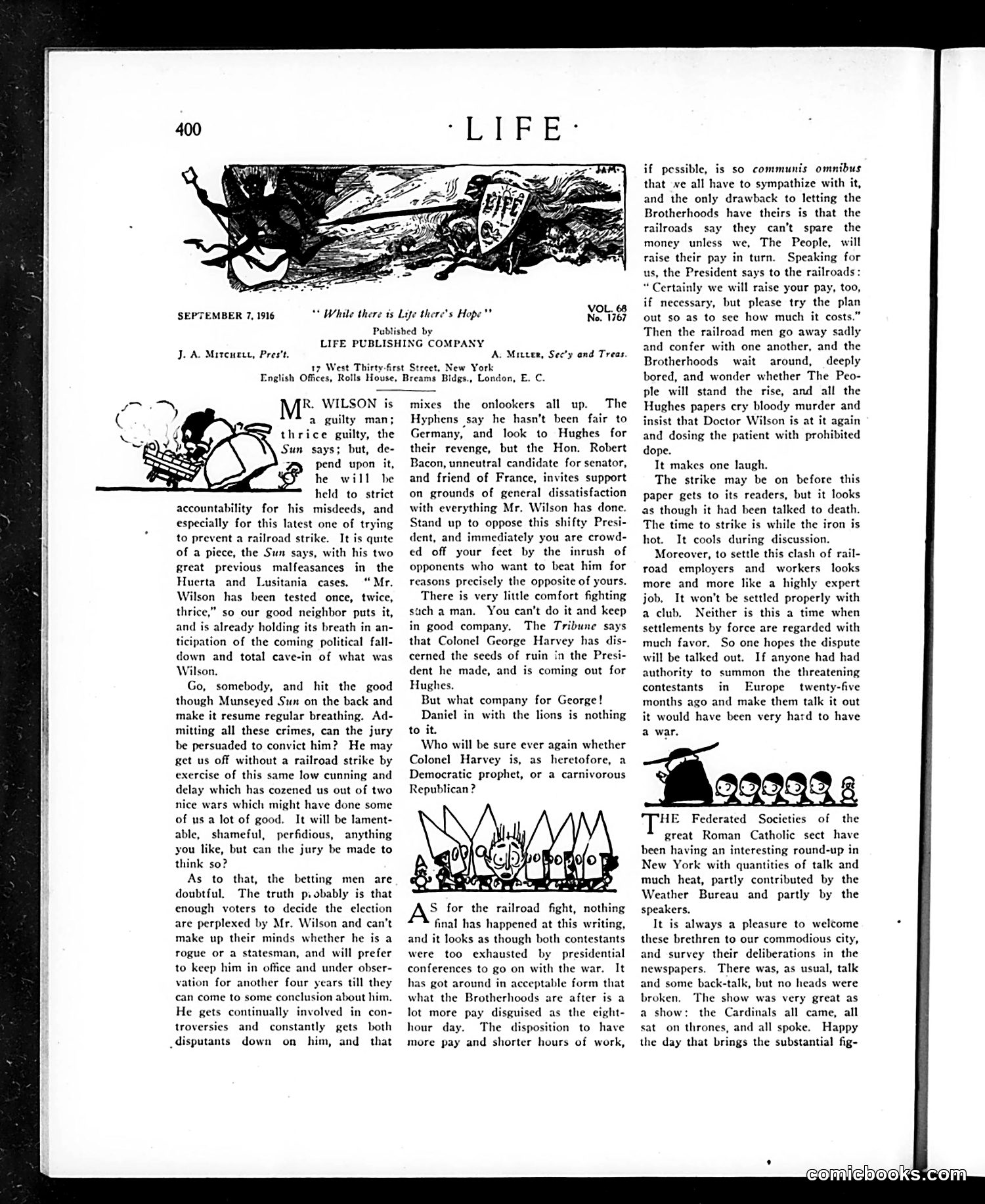
This page critiques President Woodrow Wilson's handling of an impending railroad strike. The author sarcastically attacks Wilson as "guilty" (referencing the Sun newspaper's criticism), yet suggests he may actually prevent the strike through political maneuvering—which the author grudgingly admits might benefit the public. The core tension: railroad workers (the "Brotherhoods") demand higher pay disguised as an eight-hour workday. Wilson proposes that railroads grant this IF they can demonstrate affordability to taxpayers. The author mocks this Catch-22: railroads claim they can't afford raises without passenger/freight rate increases, creating circular deadlock. The satire targets Wilson as politically opaque—simultaneously antagonizing both pro-Germany "Hyphens" and pro-France Republicans (like candidate Robert Bacon and editor George Harvey), leaving voters unable to judge whether he's statesman or opportunist. The cartoons' imagery reinforces chaos and exhaustion surrounding the labor dispute.
📄 Transcribed text from this page (OCR, searchable)
Machine-transcribed from the original scan — historical spelling and the odd misread are preserved.
SEPTEMBER 7, 1916 “While there is Life the VOL. 68 s Hope"* No. 1767 Published by LIFE PUBLISHING COMPANY J. A. Mircurte, Pres’t. A. Miter, Sec’y and Treas. 17 West Thirty-first Street, New York English Offices, Rotls House, Breams Bidgs., London, E. C. R. WILSON is a guilty man; thrice guilty, the Sun says; but, de- Z pend upon it, he will be held to. strict accountability for his misdeeds, and especially for this latest one of trying to prevent a railroad strike. It is quite of a piece, the Sun says, with his two great previous malfeasances in the Huerta and Lusitania cases. “ Mr. Wilson has been tested once, twice, thrice,” so our good neighbor puts it, and is already holding its breath in an- ticipation of the coming political fall- down and total cave-in of what was Wilson, Go, somebody, and hit the good though Munseyed Sun on the back and make it resume regular breathing. Ad- mitting all these crimes, can the jury be persuaded to convict him? He may get us off without a railroad strike by exercise of this same low cunning and delay which has cozened us out of two nice wars which might have done some of usa lot of good. It will be lament- able, shameful, perfidious, anything you like, but can the jury be made to think so? As to that, the betting men are doubtful. The truth psobably is that enough voters to decide the election are perplexed by Mr. Wilson and can't make up their minds whether he is a rogue or a statesman, and will prefer to keep him in office and under obser- vation for another four years till they can come to some conclusion about him. He gets continually involved in con- troversies and constantly gets both .disputants down on him, and that mixes the onlookers all up. The Hyphens say he hasn't been fair to Germany, and look to Hughes for their revenge, but the Hon. Robert Bacon, unneutral candidate for senator, and friend of France, invites support on grounds of general dissatisfaction with everything Mr, Wilson has done. Stand up to oppose this shifty Pres’ dent, and immediately you are crowd- ed off your feet by the inrush of opponents who want to beat him for reasons precisely the opposite of yours. There is very little comfort fighting such a man. You can’t do it and keep in good company, The Tribune say: that Colonel George Harvey has di: cerned the seeds of ruin in the Presi- dent he made, and is coming out for Hughes. But what company for George! Daniel in with the lions is nothing to it. Who will be sure ever again whether Colonel Harvey is, as heretofore, a Democratic prophet, or a carnivorous Republican? for the railroad fight, nothing final has happened at this writing, and it looks as though both contestants were too exhausted by presidential conferences to go on with the war. It has got around in acceptable form that what the Brotherhoods are after is a lot more pay disguised as the eight- hour day. The disposition to have more pay and shorter hours of work, if pessible, is so communis omnibus that we all have to sympathize with it, and the only drawback to letting the Brotherhoods have theirs is that the railroads say they can’t spare the money unless we, The People, will raise their pay in turn. Speaking for us, the President says to the railroads: “Certainly we will raise your pay, too, if necessary, but please try the plan out so as to see how much it costs.” Then the railroad men go away sadly and confer with one another, and the Brotherhoods wait around, deeply bored, and wonder whether The Peo- ple will stand the rise, and all the Hughes papers cry bloody murder and insist that Doctor Wilson is at it again and dosing the patient with prohibited dope. It makes one laugh. The strike may be on before this paper gets to its readers, but it looks as though it had been talked to death. The time to strike is while the iron is hot. It cools during discussion. Moreover, to settle this clash of rail- road employers and workers looks more and more like a highly expert job. It won't be settled properly with a club. Neither is this a time when settlements by force are regarded with much favor, So one hopes the dispute will be talked out. If anyone had had authority to summon the threatening contestants in Europe twenty-five months ago and make them talk it out it would have been very hard to have HE Federated Societies of the great Roman Catholic sect have been having an interesting round-up in New York with quantities of talk and much heat, partly contributed by the Weather Bureau and partly by the speakers. It always a pleasure to welcome these brethren to our commodious city, and survey their deliberations in the newspapers. There was, as usual, talk and some back-talk, but no heads were broken. The show was very great as a show: the Cardinals all came, all sat on thrones, and all spoke. Happy the day that brings the substantial fig-