
Life, 1916-09-07 · page 23 of 40
Life — September 7, 1916 — page 23: what you’re looking at
What you’re looking at
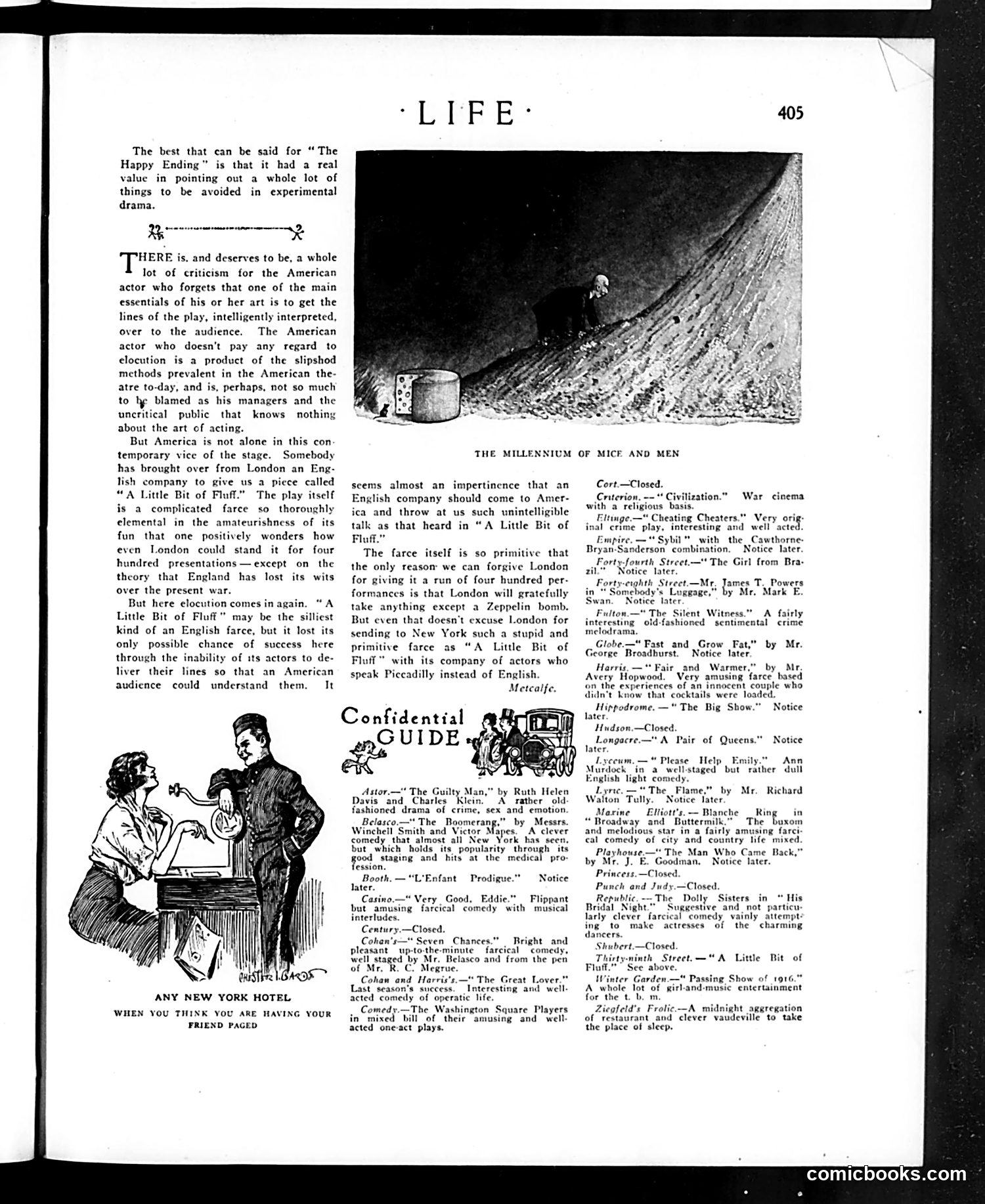
This page critiques American and British theater practices circa World War I. The main article attacks the English import "A Little Bit of Fluff" for two failures: the play itself is primitive and silly, and—more damningly—the British actors speak with such impenetrable "Piccadilly" accents that American audiences cannot understand them. The author (Metcalfe) argues this violates a fundamental rule of acting: delivering lines intelligibly to the audience. The piece also criticizes American actors and theater managers for abandoning proper elocution. A secondary jab suggests London audiences will accept anything during wartime—even this drivel—as long as it's not a Zeppelin bomb. The cartoon (left) depicts a hotel page summoning a guest, illustrating the advertisement below it. The right image shows a pastoral scene titled "The Millennium of Mice and Men." The page concludes with theater listings and reviews.
📄 Transcribed text from this page (OCR, searchable)
Machine-transcribed from the original scan — historical spelling and the odd misread are preserved.
The best that can be said for “ The Happy Ending” is that it had a real value in pointing out a whole lot of things to be avoided in experimental drama. RAR HERE is. and deserves to be, a whole lot of criticism for the American actor who forgets that one of the main essentials of his or her art is to get the lines of the play, intelligently interpreted, over to the audience. The American actor who doesn’t pay any regard to clocution is a product of the slipshod methods prevalent in the American the- atre to-day, and is, perhaps, not so much to by blamed as his managers and the uncritical public that knows nothing about the art of acting. But America is not alone in this con temporary vice of the stage. Somebody has brought over from London an Eng- lish company to give us a piece called “A Little Bit of Fluff”. The play itself is a complicated farce thoroughly elemental in the amateurishness of its fun that one positively wonders how even London could stand it for four hundred presentations — except on the theory that England has lost its wits over the present war. But here elocution comes in again. “A Little Bit of Fluff” may be the silliest kind of an English farce, but it lost its only possible chance of success here through the inability of its actors to de- liver their lines so that an American audience could understand them. It so ANY NEW YORK HOTEL. WHEN YOU THINK YOU ARE HAVING YOUR FRIEND PAG! THE MILLENNIUM OF MICE AND MEN scems almost an impertinence that an English company should come to Amer- ica and throw at us such unintelligible talk as that heard in “A Little Bit of Fluff.” The farce itself is so primitive that the only reasom we can forgive London for giving it a run of four hundred per- formances is that London will gratefully take anything except a Zeppelin bomb. But even that doesn't excuse London for sending to New York such a stupid and primitive farce as “A Little Bit of Fluff” with its company of actors who speak Piccadilly instead of English. Metcalfe. as Confidential G ax Astor. —* The Guilty Man,” by Ruth Helen Davis and Charles Klein.’ A rather old fashioned drama of crime, sex and emotion. Belasco.—" The Boomerang.” by Messrs. Winchell Smith and Victor Mapes. A clever comedy that almost all New York bas seen. but which holds its popularity through its food staging and hits at the medical pro- fession. Booth. —“L'Enfant later. Casino.—" Very Good, Eddie.” but amusing farcical comedy with interludes. Century.—Closed. Cohen's—" Seven Chances.” Rright and pleasant up-to-the-minute farcical ‘comedy, well staged by Mr. Belasco and from the pen of Mr, R. C. Megrue. Cohan and Harris's.—" The Great Lover.” Last season's success. Interesting and well- acted comedy of operatic life. Comedy.—The Washington Square Players in ‘mixed bill of their amusing and well acted one-act plays. Prodigue." Notice Flippant musical Cort.—Closed. Criterion, -~** Civilization.” with a religious basis. sndittinge—" Cheating Cheaters" Very orig- al erime play, interesting and well acted Empire. —** Sybil” with Bryan-Sanderson combination. Forty-fourth Street-—" The zil.” Notice later. Forty-cighth Strect—Mr, James T, Powers in * Somebody's Luggage,” by Mr. Mark E. Swan. Notice later Fulton.—" The Silent Witness.” interesting old-fashioned sentimental melodrama. Globe. George Broadburst Harris, —** Fair and Warmer,” by Mr. Avery Hopwood. Very amusing farce based on the experiences of an innocent couple who didn't know that cocktails were loaded. Hippodrome. —“ The Big Show." Notice later Hudson.—Closed. Longacre.—" A Pair of Queens.” later. Lycer —“ Please Help Murdock in a well-staged but English light comedy, Lyre. —" The Flame,” by Mr. Walton Tully Notice later. Marine Elfiott's. — Blanche Rin, in “roadway and. Buttermilk.” The buxom and melodious star in a fairly amusing farci- cal comedy of city and country life mixed. Playhouse —" The Man Who Came Back,” by Mr. J. E. Goodman, Notice later. Princess.—Closed Punch and Judy.—Closed. Repub The Dolly Sisters in“ His Bridal Night.” Suggestive and not particu larly clever farcical comedy vainly attempt: ing to make actresses of the charming dancers. Shubert.—Closed inth Street. —" A Little ‘See above. ter Garden.—" Passing Show of 1916." A whole lot of girl-and-music entertainment for the t. b. m. Zicgfetd’s Frolic.—A midnight aggregation of restaurant and clever vaudeville to take the place of sleep. War cinema the Cawthorne- Notice later. from Bra- A fairly crime ‘ast and Grow Fat,” by Mr. Notice later. Notice Ann Emily.” H dull rather Richard Bit of comicbooks.com