
Life, 1916-09-07 · page 40 of 40
Life — September 7, 1916 — page 40: what you’re looking at
What you’re looking at
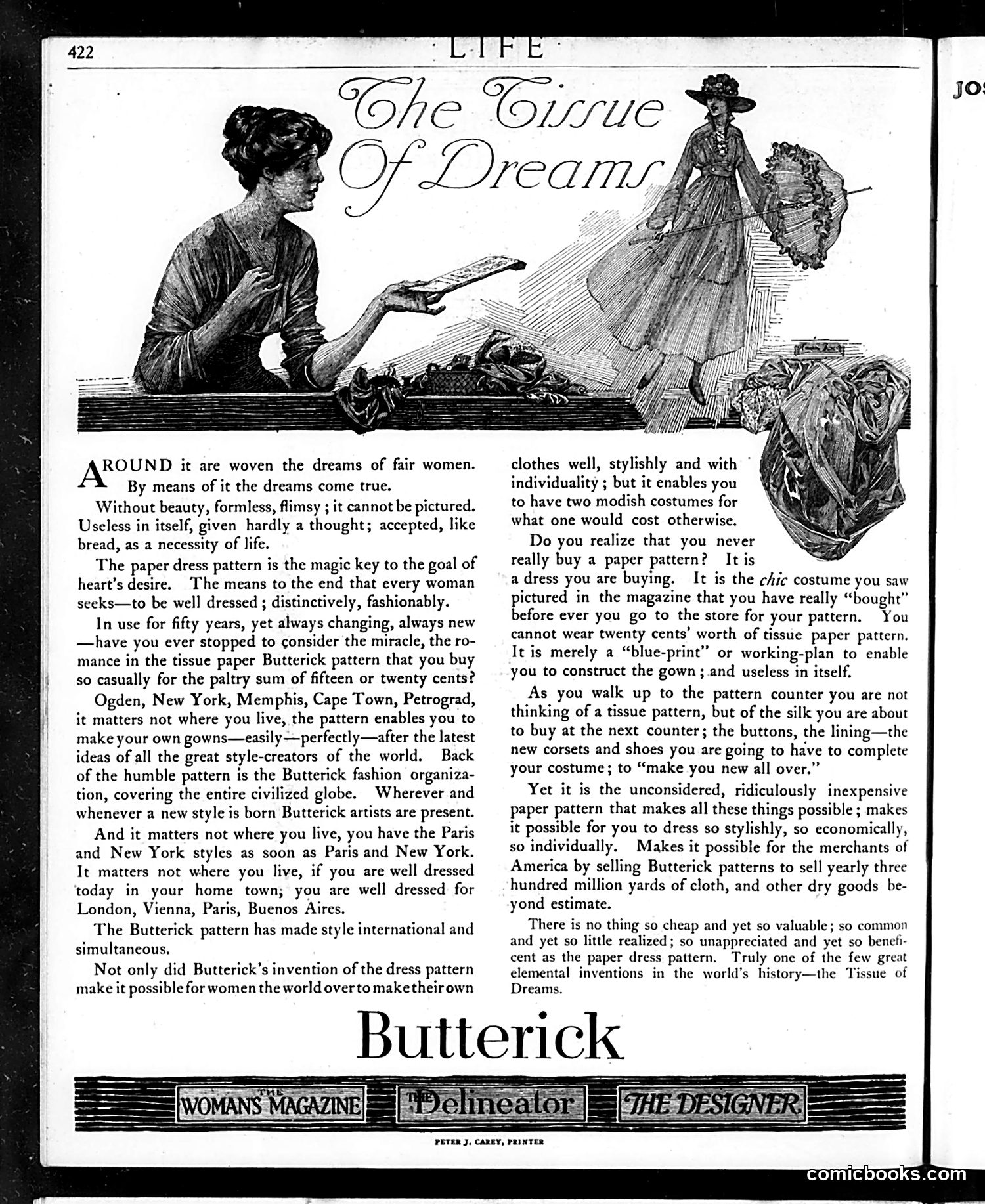
This is a **full-page advertisement**, not satire. It promotes Butterick dress patterns, positioning them as democratizing fashion globally. The illustration shows a woman conjuring elegant gowns from a simple paper pattern—visualizing the ad's central claim: that inexpensive tissue-paper patterns (costing 15-20 cents) enable working-class women to create high-fashion clothing matching Paris and New York styles. The text argues Butterick patterns are a social miracle: they make fashionable dress universally accessible across class and geography (mentioning cities from Ogden to Buenos Aires). The patterns function as "blueprints" for silk, buttons, linings—essentially selling dreams rather than paper itself. The satire is gentle: the ad mocks consumers' psychology (women buy the imagined finished dress, not the pattern) while celebrating capitalism's apparent benevolence. It claims patterns drive massive textile sales (300 million yards annually) while appearing to serve women's desires for beauty and individuality. This reflects early 1900s advertising celebrating mass production and consumer culture as liberating.
📄 Transcribed text from this page (OCR, searchable)
Machine-transcribed from the original scan — historical spelling and the odd misread are preserved.
ROUND it are woven the dreams of fair women. By means of it the dreams come true. Without beauty, formless, flimsy ; it cannot be pictured, Useless in itself, given hardly a thought; accepted, like bread, as a necessity of life. The paper dress pattern is the magic key to the goal of heart’s desire. The means to the end that every woman seeks—to be well dressed ; distinctively, fashionably. In use for fifty years, yet always changing, always new —have you ever stopped to consider the miracle, the ro- mance in the tissue paper Butterick pattern that you buy so casually for the paltry sum of fifteen or twenty cents? Ogden, New York, Memphis, Cape Town, Petrograd, it matters not where you live, the pattern enables you to make your own gowns—easily —perfectly—after the latest ideas of all the great style-creators of the world. Back of the humble pattern is the Butterick fashion organiza- tion, covering the entire civilized globe. Wherever and whenever a new style is born Butterick artists are present. And it matters not where you live, you have the Paris and New York styles as soon as Paris and New York. It matters not where you live, if you are well dressed today in your home town; you are well dressed for London, Vienna, Paris, Buenos Aires. The Butterick pattern has made style international and simultaneous. Not only did Butterick’s invention of the dress pattern make it possible for women the world over tomake their own clothes well, stylishly and with ~ individuality ; but it enables you to have two modish costumes for what one would cost otherwise. Do you realize that you never really buy a paper pattern? It is adress you are buying. It is the chic costume you saw pictured in the magazine that you have really “bought” before ever you go to the store for your pattern. You cannot wear twenty cents’ worth of tissue paper pattern. It is merely a “blue-print” or working-plan to enable you to construct the gown ; and useless in itself. As you walk up to the pattern counter you are not thinking of a tissue pattern, but of the silk you are about to buy at the next counter; the buttons, the lining—the new corsets and shoes you are going to have to complete your costume; to “make you new all over.” Yet it is the unconsidered, ridiculously inexpensive paper pattern that makes all these things possible ; makes it possible for you to dress so stylishly, so economically, so individually. Makes it possible for the merchants of America by selling Butterick patterns to sell yearly three hundred million yards of cloth, and other dry goods be- yond estimate. There is no thing so cheap and yet so valuable; so common and yet so little realized; so unappreciated and yet so benefi- cent as the paper dress pattern. Truly one of the few great elemental inventions in the world’s history—the Tissue of Dreams. PETER J. CAREY, PRINTER comicbooks.com