
Life, 1916-09-07 · page 35 of 40
Life — September 7, 1916 — page 35: what you’re looking at
What you’re looking at
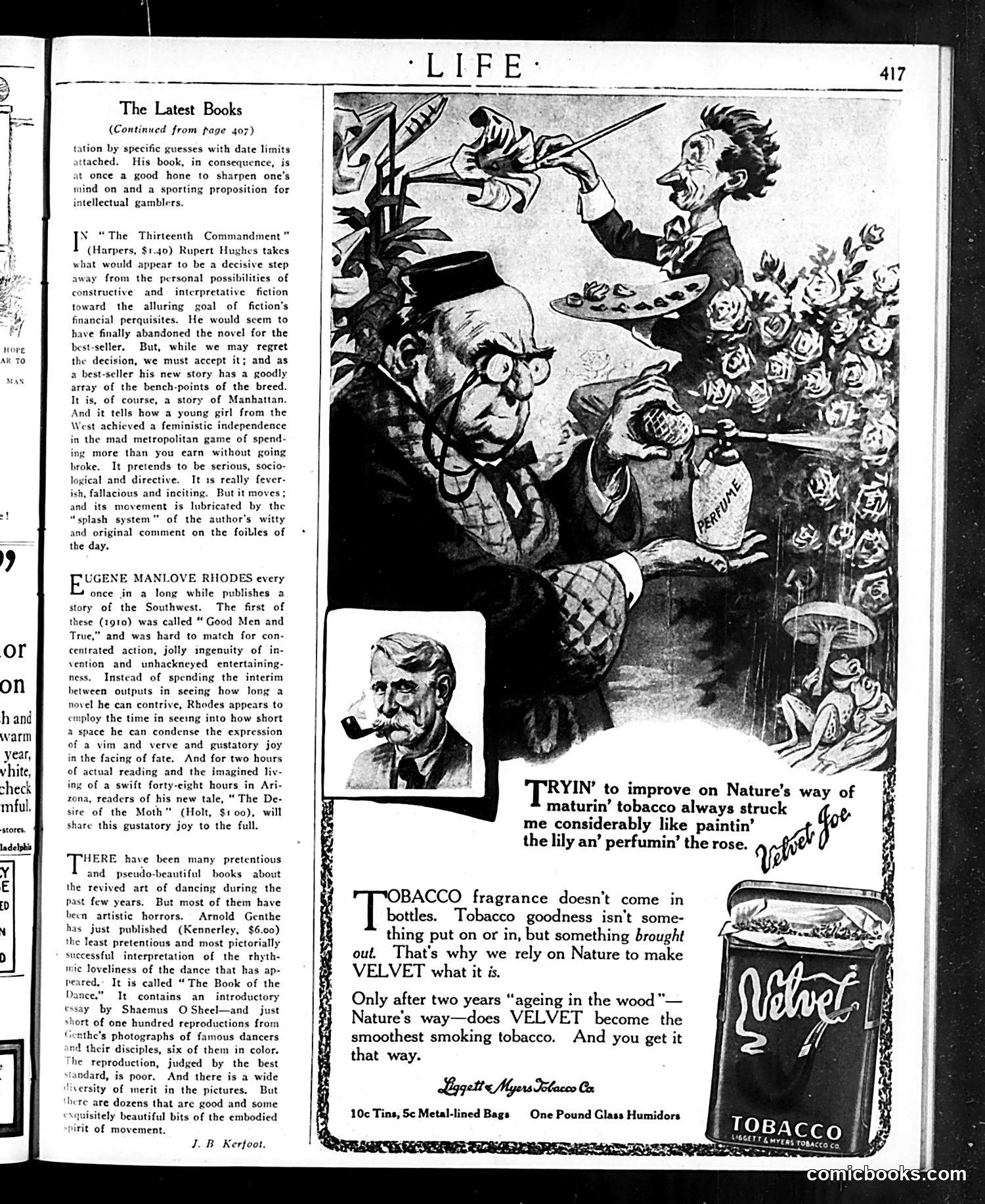
This page is primarily a **book review column** with an integrated **tobacco advertisement**. The text reviews three books: Rupert Hughes's "The Thirteenth Commandment" (criticized as abandoning literary fiction for commercial "best-seller" status), Eugene Manlove Rhodes's southwestern fiction, and Arnold Genthe's "The Book of the Dance" (a photography collection). The dominant visual element is a **Velvet Tobacco advertisement** featuring a caricatured man with exaggerated features (large nose, jutting chin) amid roses and flowers. The copy uses the phrase "Tryin' to improve on Nature's way of maturin' tobacco" with dialect speech ("like paintin' the lily an' perfumin' the rose"), suggesting the ad employs period-typical ethnic caricature humor—mocking someone attempting to artificially enhance natural products. The advertisement's message emphasizes natural aging processes ("two years 'ageing in the wood'") as superior to artificial enhancement, a common marketing strategy of the era. The cartoonish figure appears designed to make the over-refinement concept humorous through visual mockery.
📄 Transcribed text from this page (OCR, searchable)
Machine-transcribed from the original scan — historical spelling and the odd misread are preserved.
oy “| | The Latest Books (Continued from page 407) tation by specific guesses with date limits tached. His book, in consequence, is at once a good hone to sharpen one’s mind on and a sporting proposition for intellectual gamblers. IX “The Thirteenth Commandment” (Harpers, $1.40) Rupert Hughes takes what would appear to be a decisive step away from the personal possibilities of constructive and interpretative fiction toward the alluring goal of fiction’s financial perquisites. He would scem to have finally abandoned the novel for the best-seller, But, while we may regret the decision, we must accept it; and as a best-seller his new story has a goodly array of the bench-points of the breed. It is, of course, a story of Manhattan. And it tells how a young girl from the West achieved a feministic independence in the mad metropolitan game of spend- ing more than you earn without going broke. It pretends to be serious, socio- logical and directive. It 1 really fever- ish, fallacious and inciting. But it moves; and its movement is lubricated by the “splash system" of the author's witty and original comment on the foibles of the day. Sp rere ne ner AS i UGENE MANLOVE RHODES every once in a long while publishes a story of the Southwest. The first of these (1910) was called “ Good Men and True,” and was hard to match for con- centrated action, jolly ingenuity of in- vention and unhackneyed entertaining- ness, Instead of spending the interim between outputs in seeing how long a novel he can contrive, Rhodes appears to h and employ the time in seeing into how short atin a space he can condense the expression of a vim and verve and gustatory joy year, in the facing of fate. And for two hours j 4 of actual reading and the imagined liv- " TI 2 ing of a swift forty-eight hours in Ari- “ $ R ¥ ii , zona, readers of his new tale, “The De- ] hal te improve on Nature’s way of maturin’ tobacco always struck for f fj sire of the Moth” (Holt, $100), will js fi share this gustatory joy to the full. me considerably like paintin’ 18 the lily an’ perfumin’ the rose. yl HERE have been many pretentious and pseudo-beautiful books about the revived art of dancing during the Past few years. But most of them have been artistic horrors, Arnold Genthe has just published (Kennerley, $6.00) the least pretentious and most pictorially successful interpretation of the rhyth- wie loveliness of the dance that has ap- peared,- It is called “The Book of the Dance.” It contains an introductory y by Shaemus O Sheel—and just 6. BACCO fragrance doesn’t come in bottles. Tobacco goodness isn't some- thing put on or in, but something brought out. That's why we rely on Nature to make VELVET what it is. Only after two years “ageing in the wood "— short of one hundred reproductions from Nature's way—does VELVET become the Genthe’s photographs of famous dancers smoothest smoking tobacco. And you get it ad their disciples, six of them in color. thatswai he reproduction, judged by the best y standard, is poor. And there is a wide § “iversity of merit in the pictures, But é- oLiggette Myers Tobacco Cx ¢ dozens that are good and some itely beautiful bits of the embodied pirit of movement. OP SERENE 10c Tins, Sc Metal-lined Bags = One Pound Glass Humidors J.B Kerfoot. 3 Mery : Ft NN,