
Life, 1916-09-07 · page 22 of 40
Life — September 7, 1916 — page 22: what you’re looking at
What you’re looking at
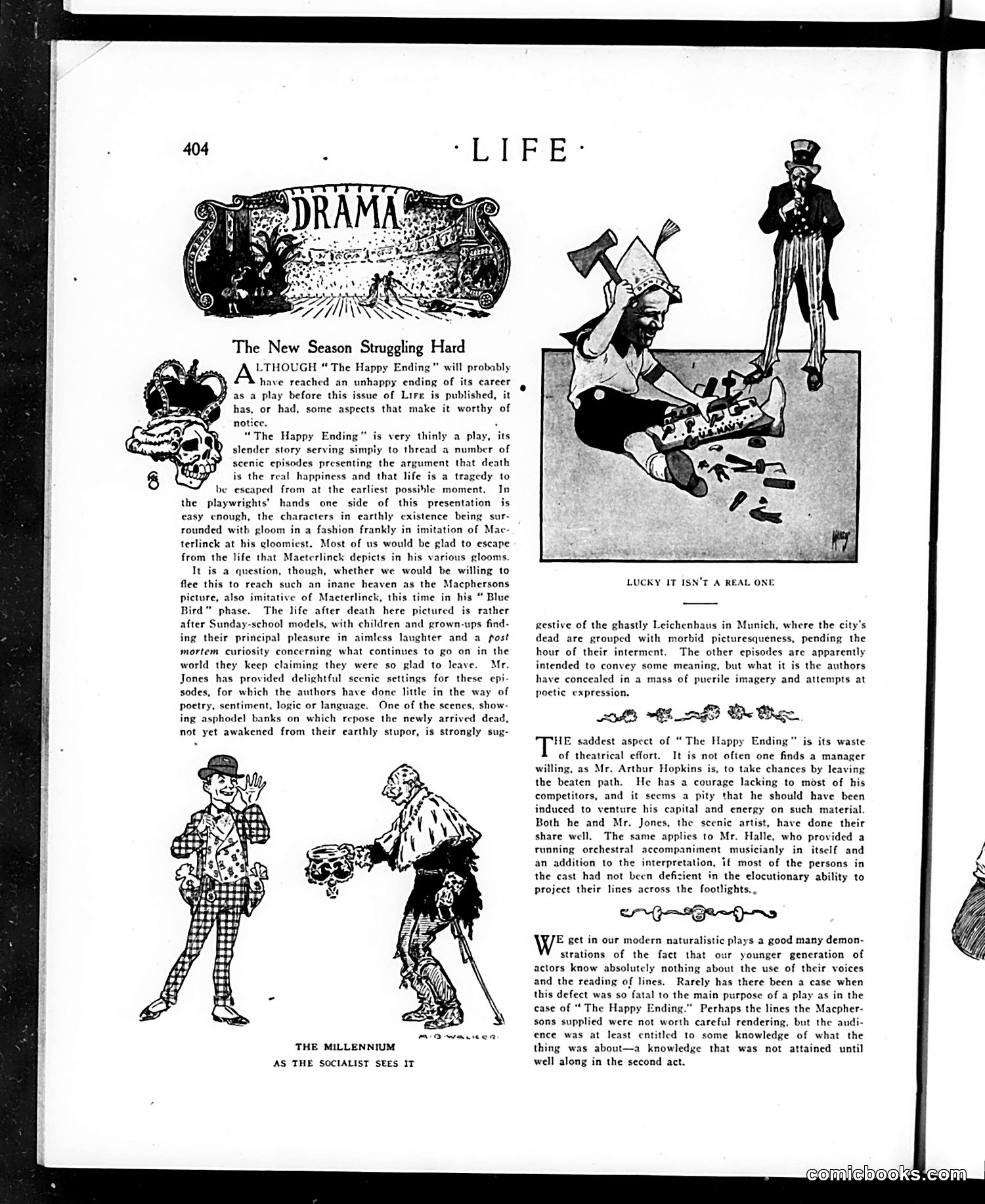
This page critiques a contemporary Broadway play by that title. The main illustration labeled "LUCKY IT ISN'T A REAL ONE" depicts a man chopping apart a wooden dummy—satirizing the play's central argument that death is preferable to life. The text reviews "The Happy Ending," which presents a bleak earthly existence followed by an insipid afterlife of childish pleasures. The critic praises manager Arthur Hopkins's courage in backing experimental work, but condemns the play itself as shallow, poorly written, and derivative of Maeterlinck's gloomy theatrical style. The small cartoon "THE MILLENNIUM AS THE SOCIALIST SEES IT" (bottom left) shows contrasting figures—likely representing socialist ideology versus capitalism—though specifics remain unclear. The review's harshest criticism targets the cast's poor vocal projection and inability to deliver lines effectively, making the play's already-thin meaning incomprehensible to audiences.
📄 Transcribed text from this page (OCR, searchable)
Machine-transcribed from the original scan — historical spelling and the odd misread are preserved.
The New Season Struggling Hard LTHOUGH “ The Happy Ending” will probably have reached an unhappy ending of its career as a play before this issue of Lirr is published, it has, or had, some aspects that make it worthy of notice. F “The Happy Ending” is very thinly a play, its slender story serving simply to thread a number of scenic episodes presenting the argument that death is the real happiness and that life is a tragedy to be escaped from at the earliest possible moment, In the playwrights’ hands one side of this presentation is easy cnough, the characters in earthly existence being sur- rounded with gloom in a fashion frankly in imitation of Mac- terlinck at his gloomicst. Most of us would be glad to escape from the life that Maeterlinek depicts in his various glooms It is a question, though, whether we would be willing to flee this to reach such an inane heaven as the Macphersons picture, also imitative of Macterlinck, this time in his “ Blue Bird” phase. The life after death here pictured is rather after Sunday-school models, with children and grown-ups find- ing their principal pleasure in aimless laughter and a post mortem curiosity concerning what continues to go on in the world they keep claiming they were so glad to leave. Mr Jones has provided delightful scenic settings for these epi sodes, for which the authors have done little in the way of poetry, sentiment, logic or language. One of the scenes, show- ing asphodel banks on which repose the newly arrived dead, not yet awakened from their earthly stupor, is strongly sug- THE MILLENNIUM AS THE SOCIALIST SEES IT LUCKY IT ISN'T A REAL ONE, gestive of the ghastly Leichenhaus in Munich, where the city’s dead are grouped with morbid picturesqueness, pending the hour of their interment. The other episodes are apparently intended to convey some meaning, but what it is the authors have concealed in a mass of pucrile imagery and attempts at poetic expression. OM) EE _ AGS Oe Chee HE saddest aspect of “ The Happy Ending” is its waste of theatrical effort. It is not often one finds a manager willing, as Mr. Arthur Hopkins is, to take chances by leaving the beaten path. He has a courage lacking to most of his competitors, and it seems a pity that he should have been induced to venture his capital and energy on such material. Both he and Mr. Jones, the scenic artist, have done their share well. The same applies to Mr. Halle, who provided a running orchestral accompaniment musicianly in itself and an addition to the interpretation, if most of the pers ii the cast had not been deficient in the elocutionary abi project their lines across the footlights., Gm OGe~ fm E get in our modern naturalistic plays a good many demon- strations of the fact that our younger generation of actors know absolutcly nothing about the use of their voices and the reading of lines. Rarely has there been a case when this defect was so fatal to the main purpose of a play as in the case of “ The Happy Ending.” Perhaps the lines the Macpher- sons supplied were not worth careful rendering, but the audi- ence was at least entitled to some knowledge of what the thing was about—a knowledge that was not attained until well along in the second act.