
Life, 1916-09-07 · page 19 of 40
Life — September 7, 1916 — page 19: what you’re looking at
What you’re looking at
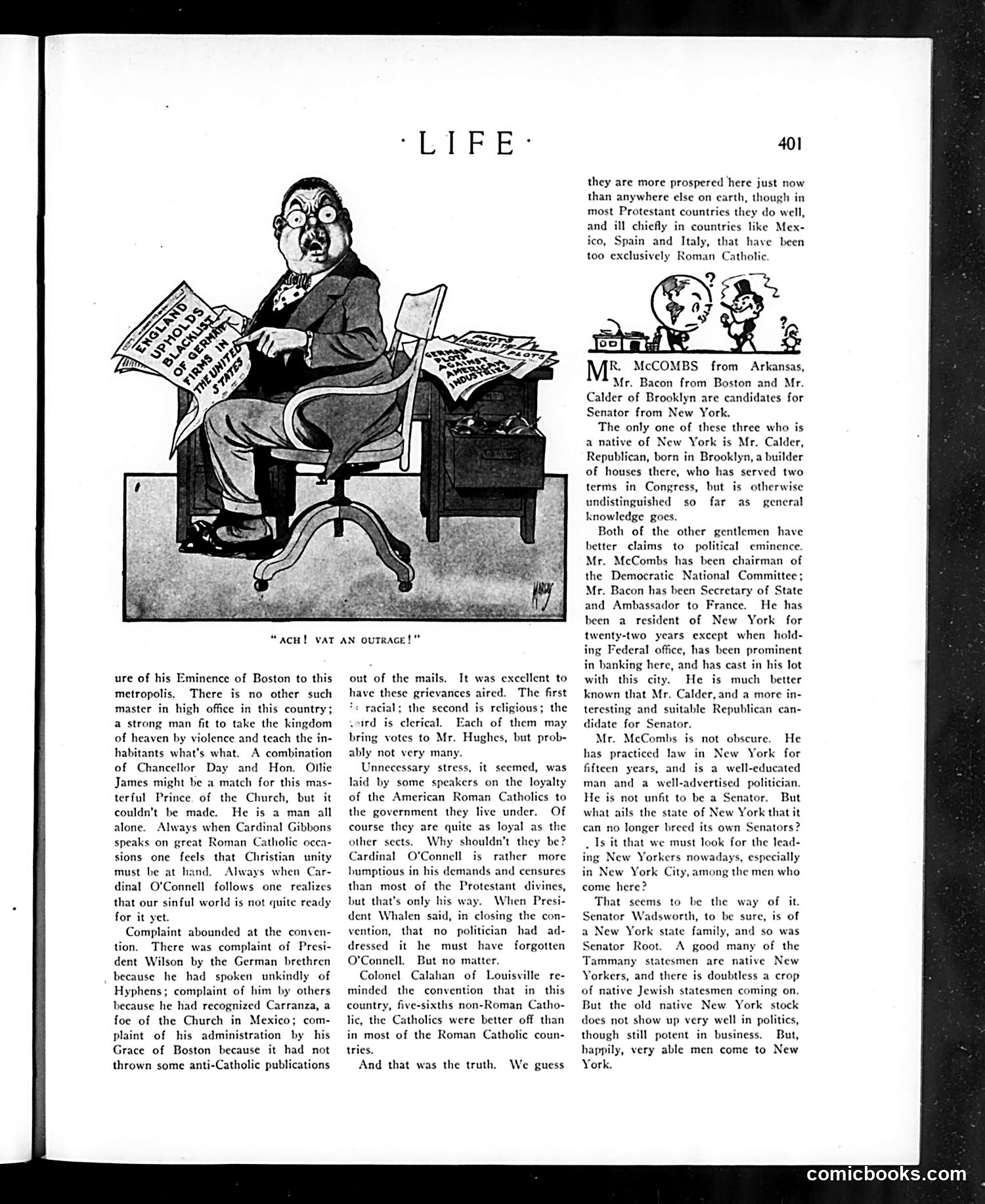
The main cartoon depicts a caricatured figure (likely Cardinal William O'Connell of Boston, based on the accompanying text) sitting at a desk covered with anti-Catholic publications, exclaiming "Ach! Vat an outrage!"—using a German accent stereotype to mock his complaints. The satire targets O'Connell's aggressive demands that the government suppress anti-Catholic materials from the mail. Life's editors criticize him as overbearing compared to Protestant clergy, though they acknowledge American Catholics' legitimate prosperity and loyalty. The German-accented dialect caricature may reference wartime anti-German sentiment (this appears to be WWI-era). The accompanying article discusses Senate candidates for New York, noting life magazine's concern that the state can no longer produce native political leaders, now importing talent from elsewhere—a separate but related commentary on American civic life and regional decline.
📄 Transcribed text from this page (OCR, searchable)
Machine-transcribed from the original scan — historical spelling and the odd misread are preserved.
“acu! VAT AN ouTRAGE!” ure of his Eminence of Boston to this metropolis. There is no other such master in high office in this country; a strong man fit to take the kingdom of heaven by violence and teach the in- habitants what's what. A combination of Chancellor Day and Hon. Ollie James might be a match for this mas- terful Prince. of the Church, but it couldn’t be made. He is a man all alone. Always when Cardinal Gibbons speaks on great Roman Catholic occa sions one feels that Christian unity must be at hand. Always when Car- dinal O'Connell follows one realizes that our sinful world is not quite ready for it yet. Complaint abounded at the conven- tion. There was complaint of Presi- dent Wilson by the German brethren because he had spoken unkindly of Hyphens; complaint of him by others because he had recognized Carranza, a foe of the Church in Mexico; com- plaint of his administration by his Grace of Boston because it had not thrown some anti-Catholic publications out of the mails. It was excellent to have these grievances aired. The first racial; the second is religious; the vurd is clerical. Each of them may bring votes to Mr. Hughes, but prob- ably not very many. Unnecessary stress, it seemed, was laid by some speakers on the loyalty of the American Roman Catholics to the government they live under. Of course they are quite as loyal as the other sects. Why shouldn't they be? Cardinal O'Connell is rather more bumptious in his demands and censures than most of the Protestant divines, but that’s only his way. When Presi- dent Whalen said, in closing the con- vention, that no politician had ad- dressed it he must have forgotten O'Connell. But no matter. Colonel Calahan of Louisville re- minded the convention that in this country, five-sixths non-Roman Catho- lic, the Catholics were better off than in most of the Roman Catholic coun- tries. And that was the truth. We guess 401 they are more prospered here just now than anywhere else on earth, though in most Protestant countries they do well, and ill chiefly in countries like Mex- ico, Spain and Italy, that have been too exclusively Roman Catholic. R. McCOMBS from Arkansas, Mr. Bacon from Boston and Mr. Calder of Brooklyn are candidates for Senator from New York. The only one of these three who is a native of New York is Mr. Calder, Republican, born in Brooklyn, a builder of houses there, who has served two terms in Congress, but is otherwise undistinguished so far as general knowledge goes. Both of the other gentlemen have better claims to political eminence. Mr. McCombs has been chairman of the Democratic National Committee; Mr. Bacon has been Secretary of State and Ambassador to France. He has been a resident of New York for twenty-two years except when hold- ing Federal office, has been prominent in banking here, and has cast in his lot with this city. He is much better known that Mr. Calder, and a more in- teresting and suitable Republican can- didate for Senator. Mr. McCombs is not obscure. He has practiced law in New York for fifteen years, and is a well-educated man and a well-advertised politician. He is not unfit to be a Senator. But what ails the state of New York that it can no longer breed its own Senators? _ Is it that we must look for the lead- ing New Yorkers nowadays, especially in New York City, among the men who come here? That scems to be the way of it. Senator Wadsworth, to be sure, is of a New York state family, and so was Senator Root. A good many of the Tammany statesmen are native New Yorkers, and there is doubtless a crop of native Jewish statesmen coming on. But the old native New York stock does not show up very well in politics, though still potent in business. But, happily, very able men come to New York. comicbooks.com