
A complete issue · 42 pages · 1916
Life — August 24, 1916
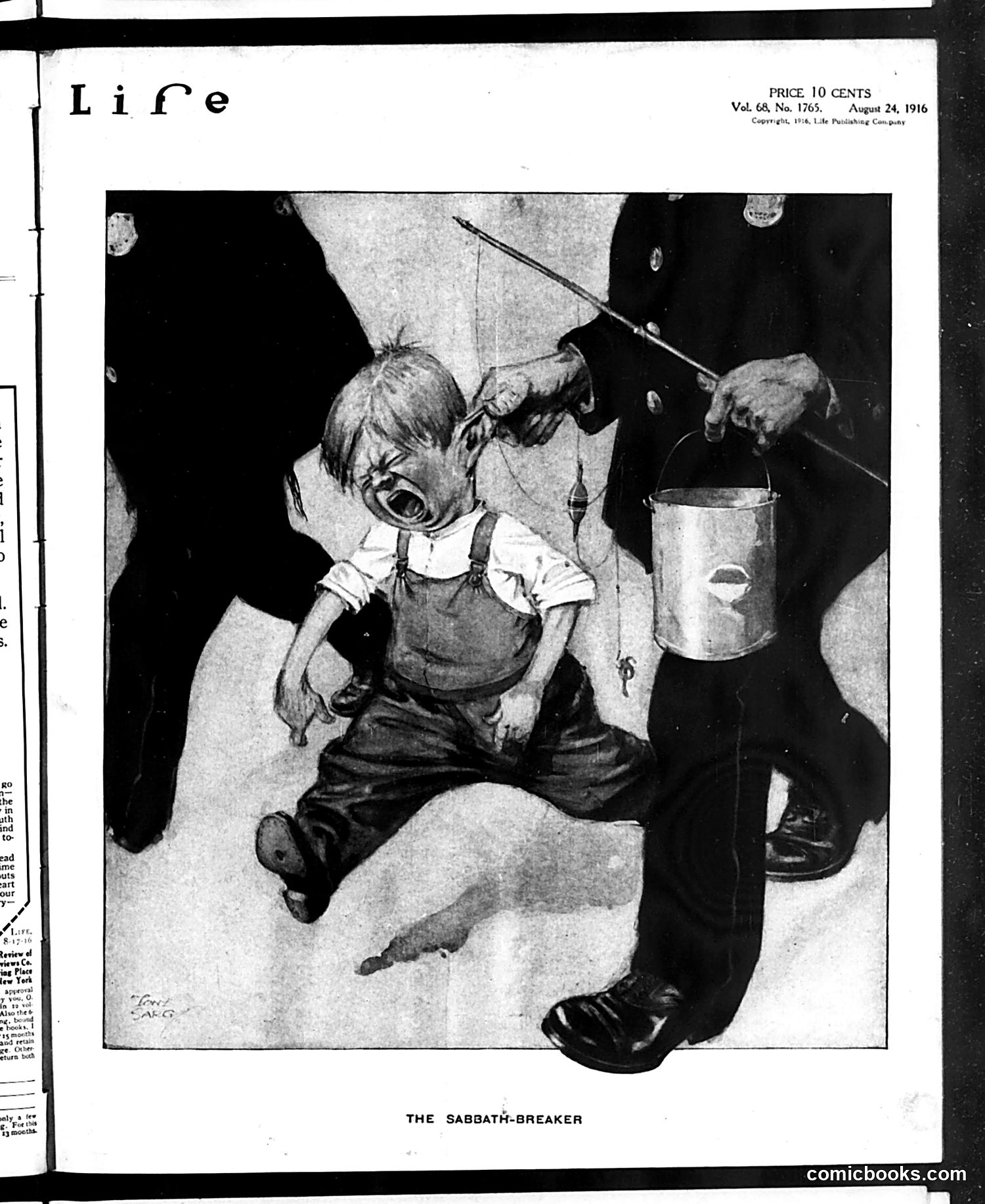
This cartoon satirizes someone violating religious observance of the Sabbath (Sunday). The image shows an adult pouring what appears to be beer or alcohol into a container held by a distressed child, while an umbrella suggests rainy weather—implying leisure activities on a day traditionally reserved for rest and worship. The satire targets the hypocrisy or casual disregard for Sabbath-keeping norms common in early 20th-century America. The exaggerated anguish on the child's face emphasizes the moral transgression. The cartoon likely comments on changing social attitudes toward religious observance and commercial/recreational activities encroaching on traditionally sacred time, or critiques adults corrupting children through irreverent behavior on the Lord's day.
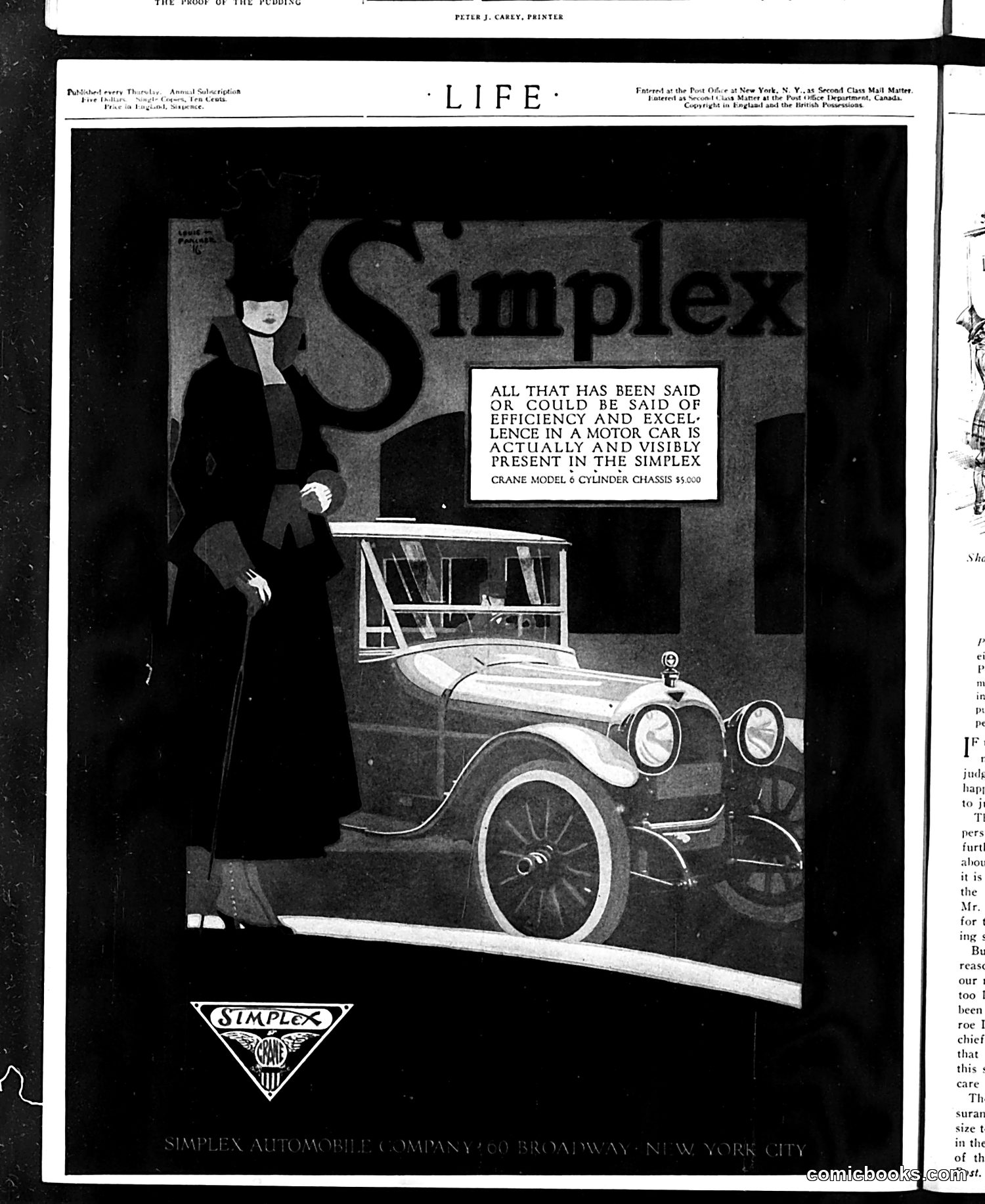
This page is primarily a **car advertisement**, not political satire. It features a Simplex automobile from the early 20th century, displayed in a stylized showroom setting with two well-dressed figures examining the vehicle. The advertisement emphasizes the car's quality through the quote: "ALL THAT HAS BEEN SAID OR COULD BE SAID OF EFFICIENCY AND EXCELLENCE IN A MOTOR CAR IS ACTUALLY AND VISIBLY PRESENT IN THE SIMPLEX." The Crane Model 6-Cylinder Chassis is priced at $5,000—a substantial sum for the era. The elegant presentation, with formally dressed potential buyers and the automobile's prominent display, targets wealthy consumers. This reflects early automotive marketing that positioned cars as luxury goods for the affluent.
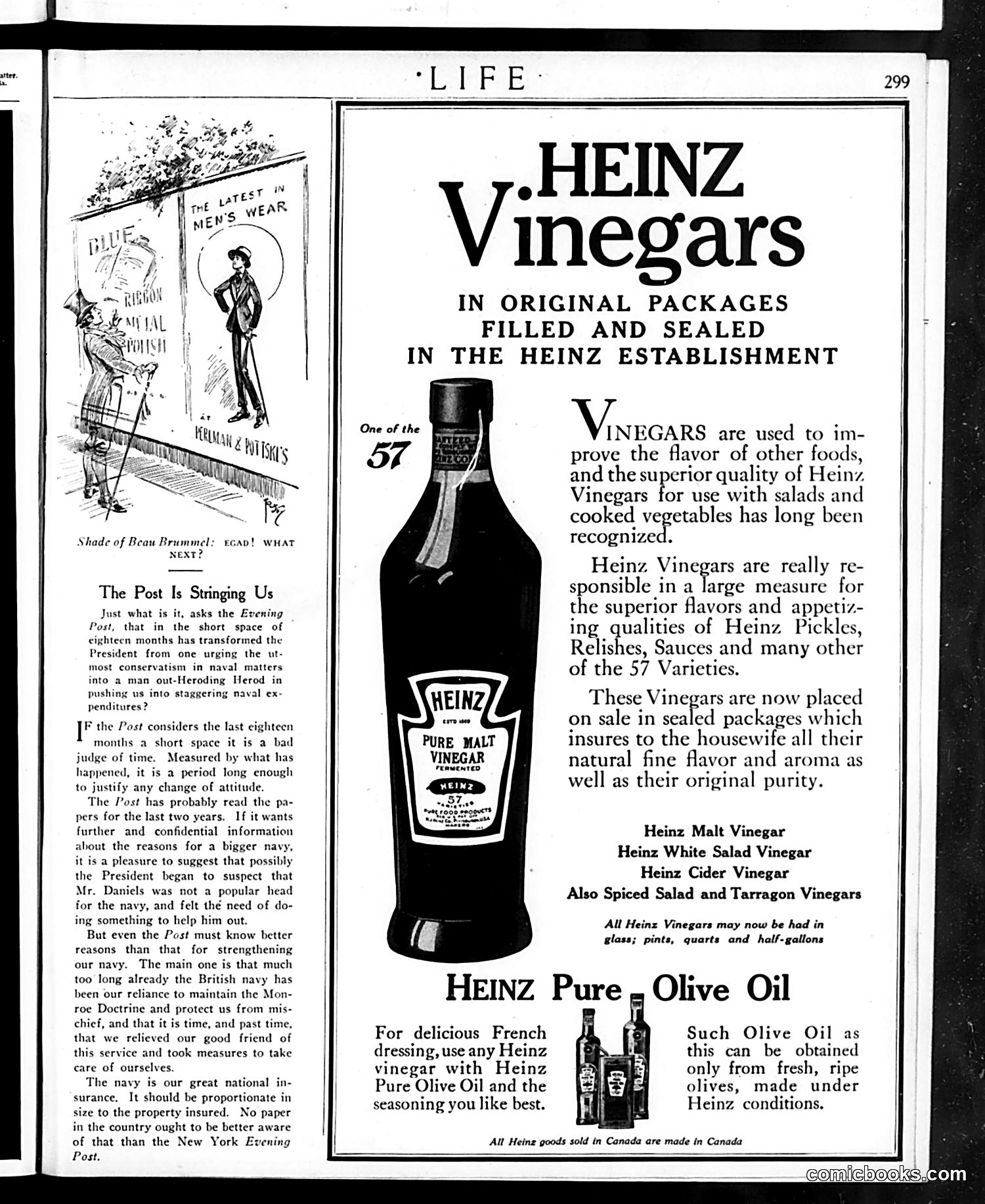
This Life magazine page is primarily **advertising** for Heinz products (vinegars and olive oil), not political satire. The left side contains a small cartoon titled "Shade of Bean Brummell: Egad! What Next?" showing a well-dressed man viewing a display labeled "The Latest in Men's Wear" at what appears to be a shop. The satire is social rather than political: it mocks contemporary men's fashion as absurdly exaggerated or ridiculous, with the reference to "Beau Brummell" (the famous 19th-century arbiter of men's style) suggesting ironic commentary on current taste. The bulk of the page promotes Heinz's vinegars and pure olive oil, emphasizing their quality and original packaging. This is straightforward product advertising rather than editorial content with political meaning.
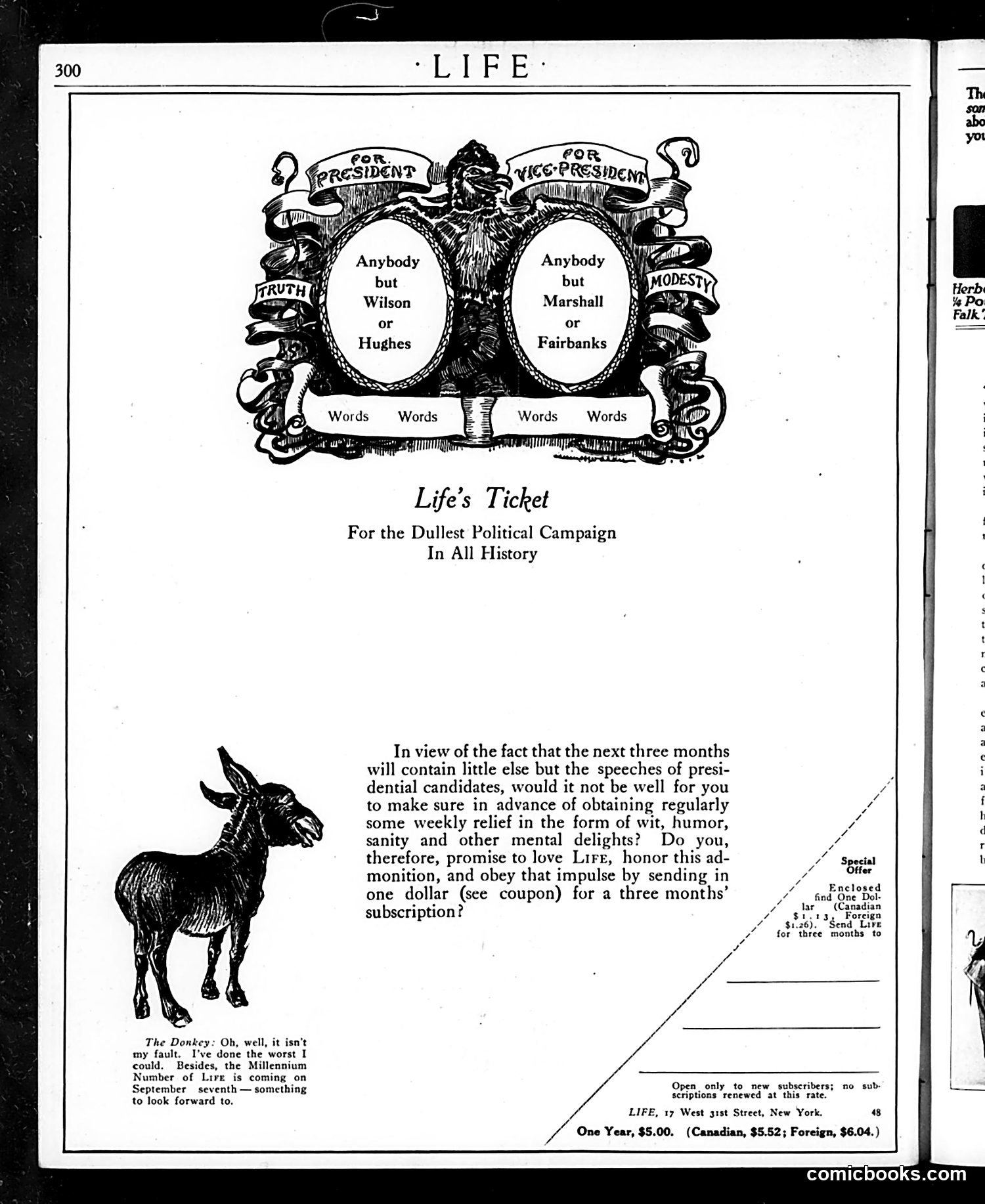
This page satirizes a U.S. presidential election campaign as "the Dullest Political Campaign In All History." The central image shows a decorative frame labeled "Life's Ticket" with two oval spaces for candidates—one for "President" (labeled "Anybody but Wilson or Hughes") and one for "Vice-President" (labeled "Anybody but Marshall or Fairbanks"). The satire suggests the 1916 election offered uninspiring choices between incumbent President Woodrow Wilson and Republican Charles Evans Hughes, with their respective running mates. The donkey illustration reinforces the joke. Life magazine is essentially mocking the campaign's lack of compelling candidates or ideas, inviting readers to subscribe for "wit, humor, sanity" as relief during the upcoming election season.
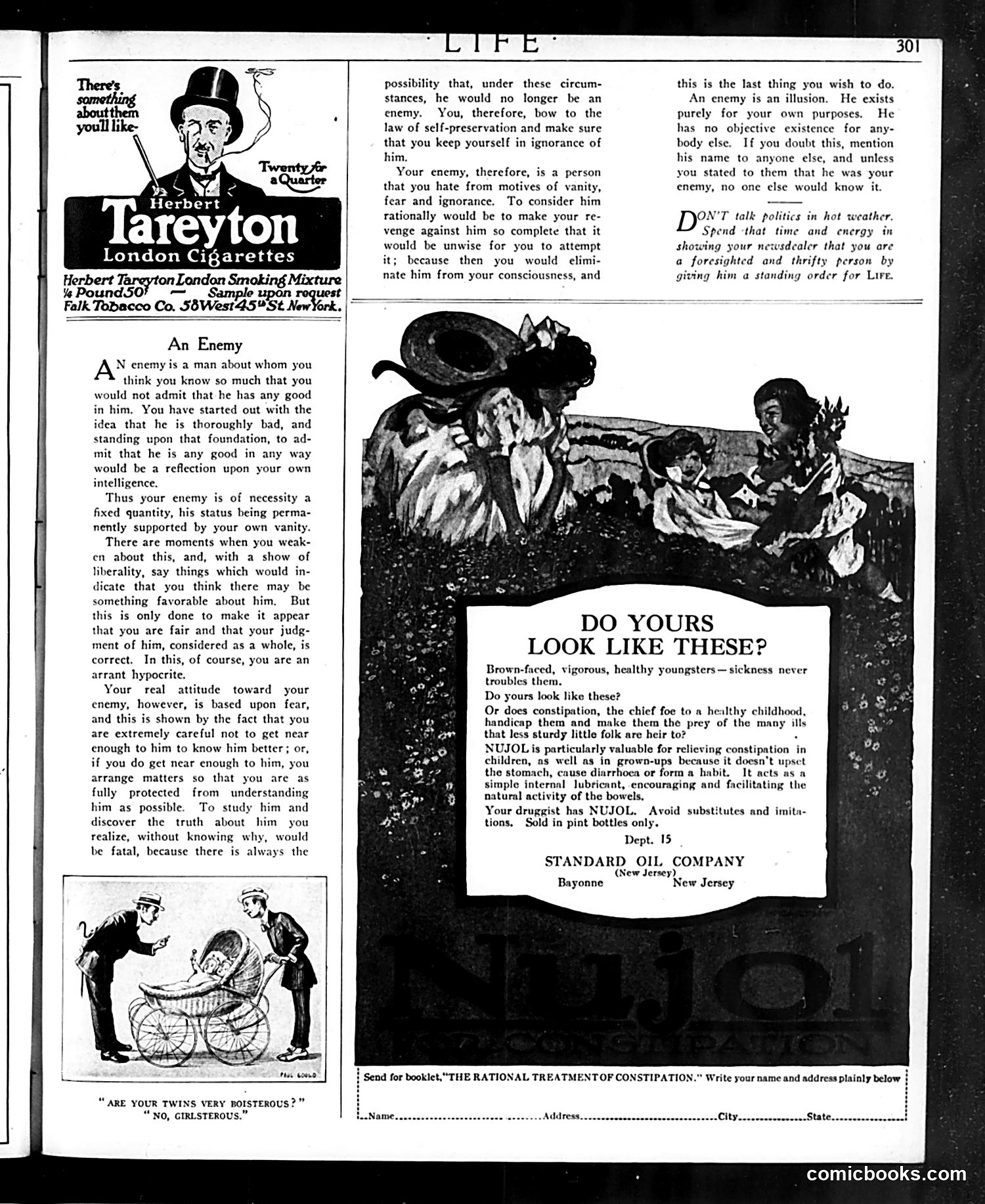

This is **not a political cartoon or satire page** — it's a straightforward **advertisement for Timken Roller Bearings**, published in Life magazine (page 302). The image shows a mechanical hub assembly with roller bearings. The ad's rhetorical strategy uses the question "What's Under the Hub Cap?" to educate readers about bearing quality differences. It argues that while many bearing types exist, Timken Bearings are superior because they're used by "one hundred and fifty-nine makers of motor cars." The text emphasizes that hub bearings endure exceptional stress from vehicle weight and road shocks, making quality crucial. This is a **technical product advertisement**, not satire — it targets car owners and manufacturers by positioning Timken as the standard-bearer for automotive bearing reliability.
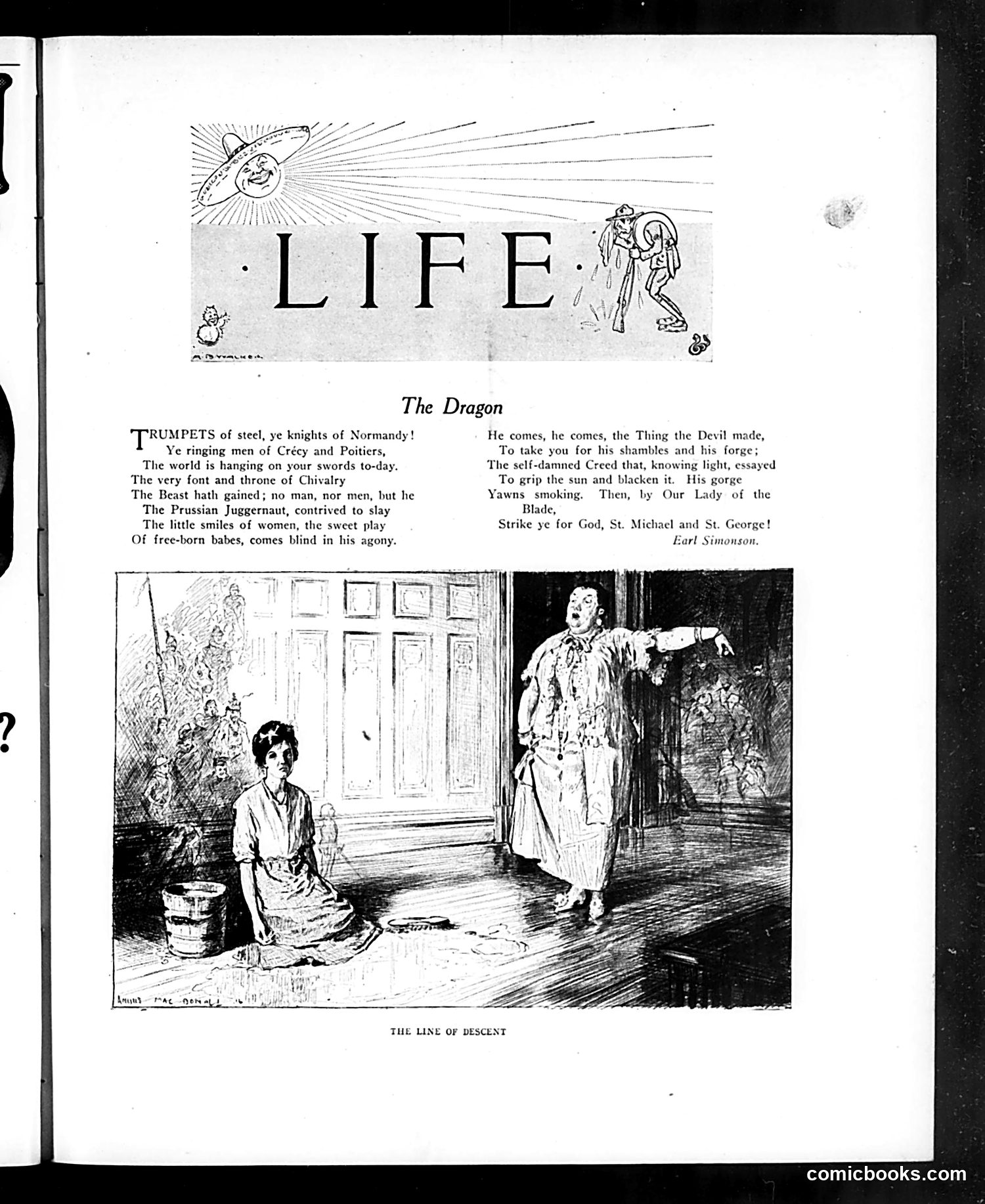
This page features a poem and illustration titled "The Dragon," credited to Earl Simonson. The poem invokes medieval imagery—"Trumpets of steel, ye knights of Normandy!"—calling upon Christian warriors to battle a demonic creature ("the Thing the Devil made"). The accompanying illustration shows "THE LINE OF DESCENT," depicting a woman cowering before an aggressive man in what appears to be a domestic interior. The satire appears to equate male domestic violence or aggression with the mythological dragon—reframing household tyranny as a modern "beast" requiring confrontation. The juxtaposition mocks chivalric ideals by suggesting that true knightly virtue should address contemporary social problems (likely domestic abuse or male dominance) rather than historical crusades.
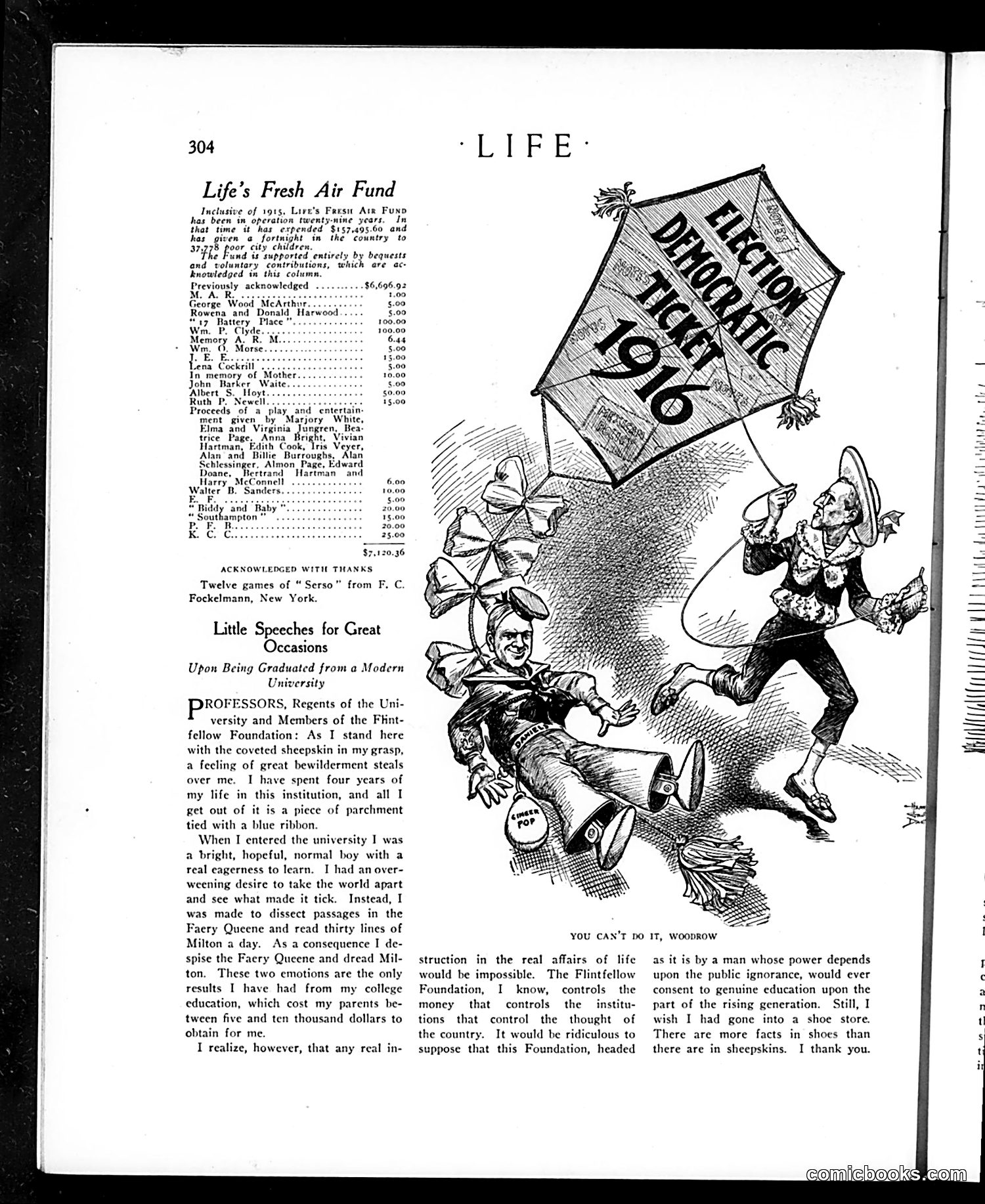
This page contains a satirical illustration titled "YOU CAN'T DO IT, WOODROW" accompanying an article called "Little Speeches for Great Occasions." The cartoon depicts a figure (likely representing Woodrow Wilson, given the caption) struggling comically with an oversized diploma or degree marked "1916," while other figures assist or interfere with the effort. The visual joke suggests Wilson cannot accomplish something—possibly referring to his educational or political ambitions. The article below is a mock-serious "speech" criticizing university education, sarcastically suggesting that rather than valuable knowledge, universities teach impractical idealism. The satire targets the disconnect between academic learning and real-world practicality, a recurring theme in Life's commentary on American institutions during the World War I era.
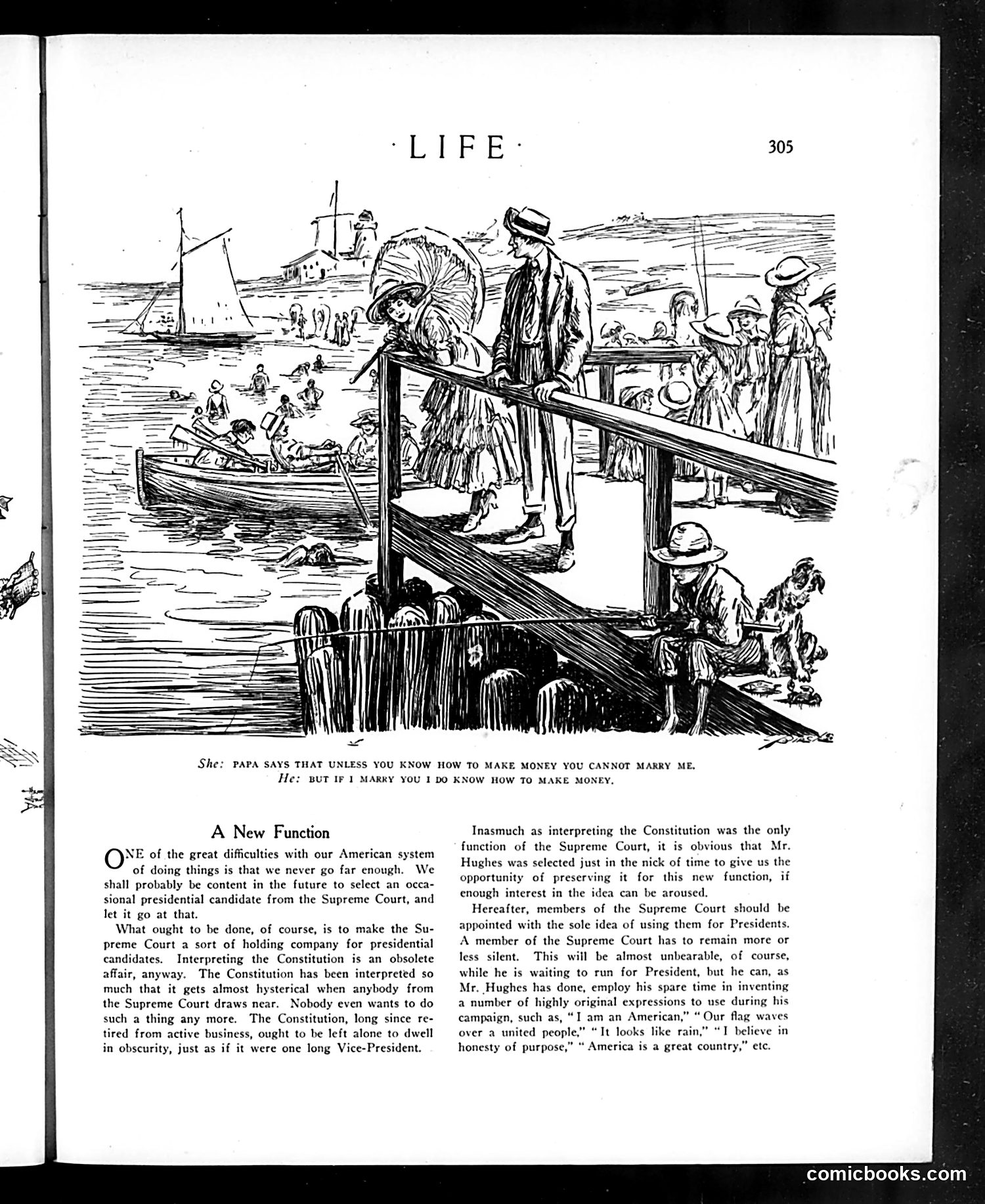
**The Cartoon:** The illustration shows a seaside beach scene with well-dressed figures on a pier. The dialogue caption reads: "She: PAPA SAYS THAT UNLESS YOU KNOW HOW TO MAKE MONEY YOU CANNOT MARRY ME. / He: BUT IF I MARRY YOU I DO KNOW HOW TO MAKE MONEY." This is a romantic/courtship joke playing on the double meaning of "making money"—the young man suggests that marrying a wealthy woman would itself constitute financial gain. **The Article:** "A New Function" satirizes the idea of appointing Supreme Court justices as presidential candidates. The author argues the Court should remain independent and removed from politics, not serve as a "holding company for presidential candidates." The piece criticizes Charles Evans Hughes (identifiable from context) for allegedly using his Court position to campaign, using invented patriotic slogans. The satire targets the politicization of the judiciary and the inappropriate merging of judicial and executive branch ambitions.
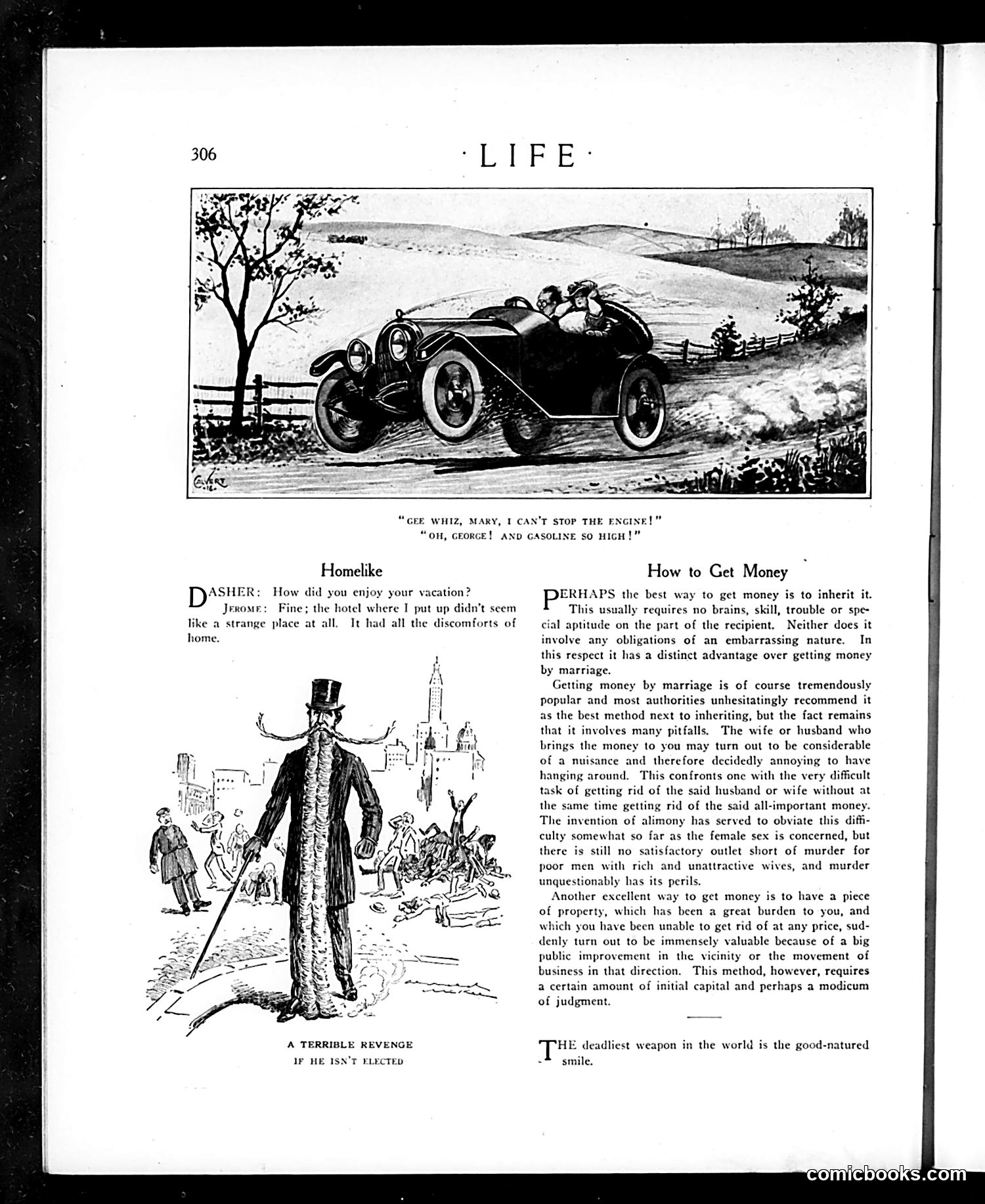
**Top Cartoon:** A humorous illustration of an early automobile with multiple occupants losing control on a rural road. The dialogue ("Gee whiz, Mary, I can't stop the engine!" / "Oh, George! And gasoline so high!") satirizes both the mechanical unreliability of early cars and contemporary anxiety about fuel costs. **"Homelike" Section:** A brief dialogue joke about vacation hotels lacking home comforts. **"How to Get Money" Section:** A satirical essay on wealth acquisition, ranking methods from best (inheritance) to worst (marriage). The accompanying illustration titled "A Terrible Revenge if He Isn't Elected" depicts a tall, thin political figure, likely referencing electoral consequences, though the specific candidate is unclear from the image alone.
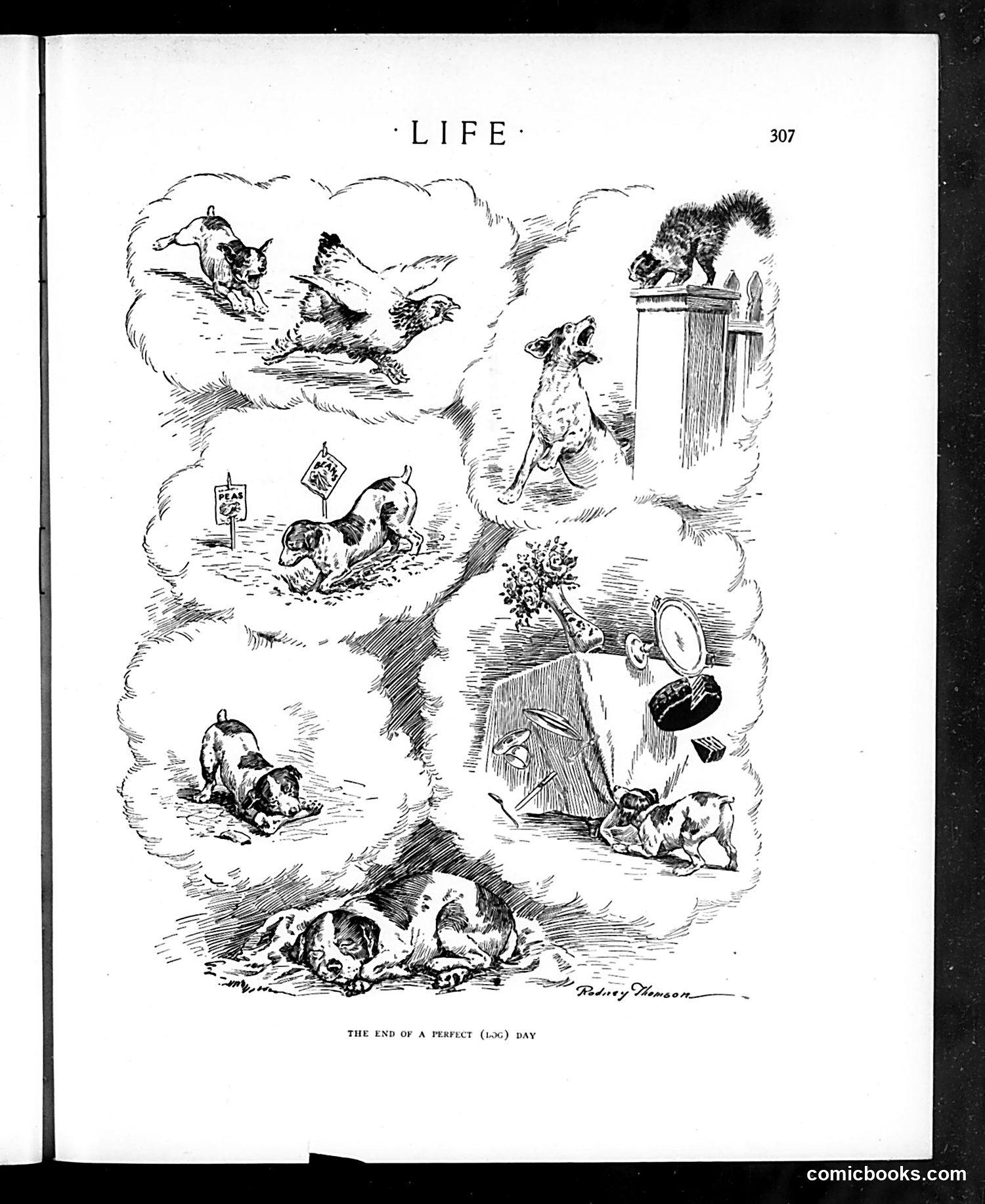
This is a humorous illustration by Rollin Thomson depicting various scenes from a dog's ideal day, arranged within a cloud-like thought bubble or memory sequence. The cartoon shows dogs engaged in activities that would constitute perfect leisure: playing/fighting with other dogs, digging, chasing a cat near a fence, knocking over household items (a potted plant, cookware), and resting contentedly at the end of the day. The satire lies in the contrast between human and canine values—what constitutes perfection for a dog (mischief, play, destruction) directly opposes human domestic ideals. The image celebrates dogs' natural instincts and independent pleasures rather than obedience or restraint, offering gentle social commentary on the gap between what humans expect from pets and what dogs actually desire.
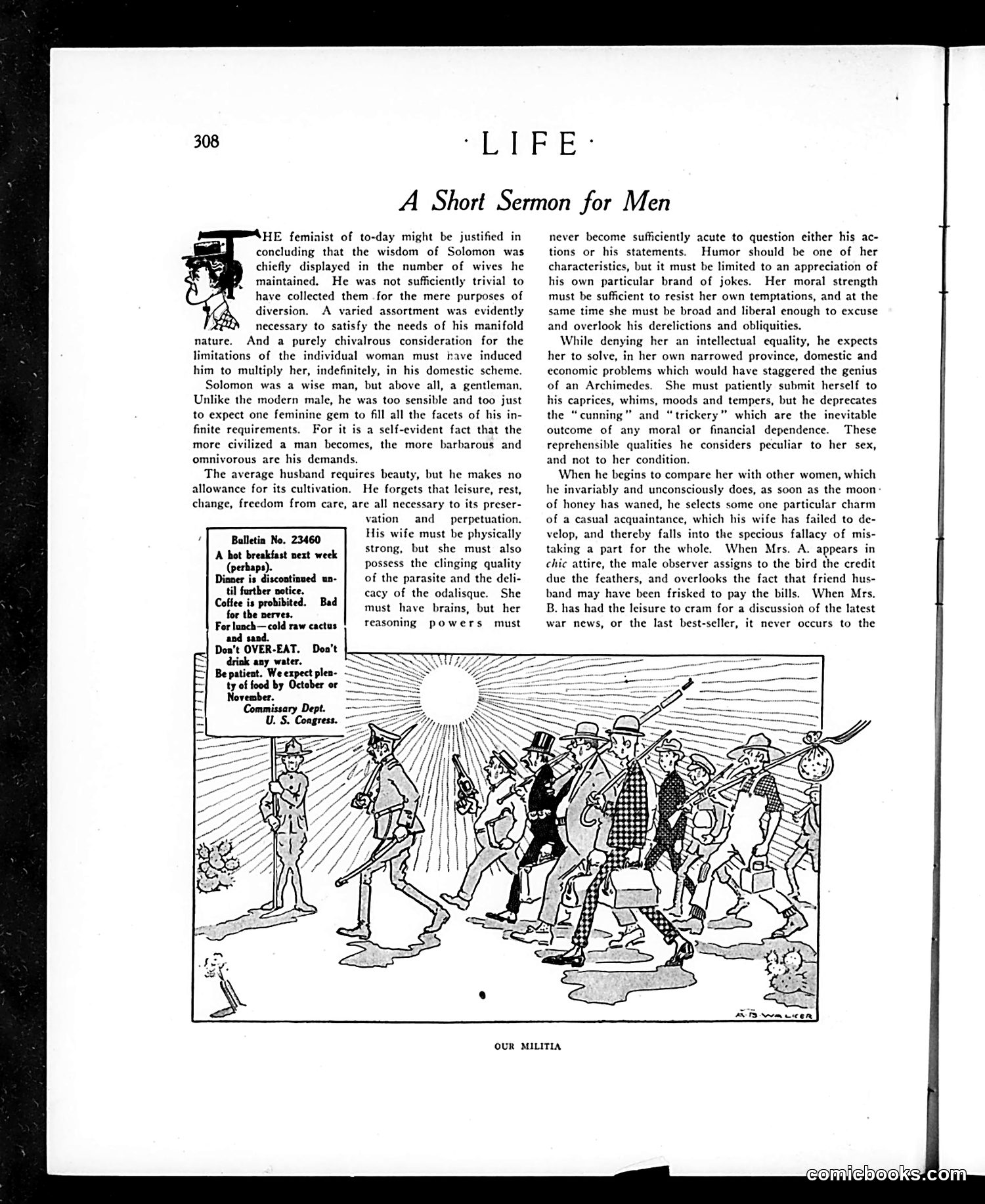
This cartoon satirizes America's military readiness (likely pre-WWI era). The illustration shows a ragtag group of civilians in mismatched clothing and uniforms—including what appears to be a man in a top hat, someone in checkered pants, and figures with improvised weapons—marching chaotically under the sun. The caption "OUR MILITIA" is ironic: rather than displaying an organized, professional fighting force, the image depicts an undisciplined, unprepared citizen militia. The varied costumes and casual demeanor suggest incompetence and lack of training. The accompanying essay about Solomon's wisdom and marital relations appears unrelated to the cartoon, suggesting this is a multi-topic magazine page typical of Life's format.
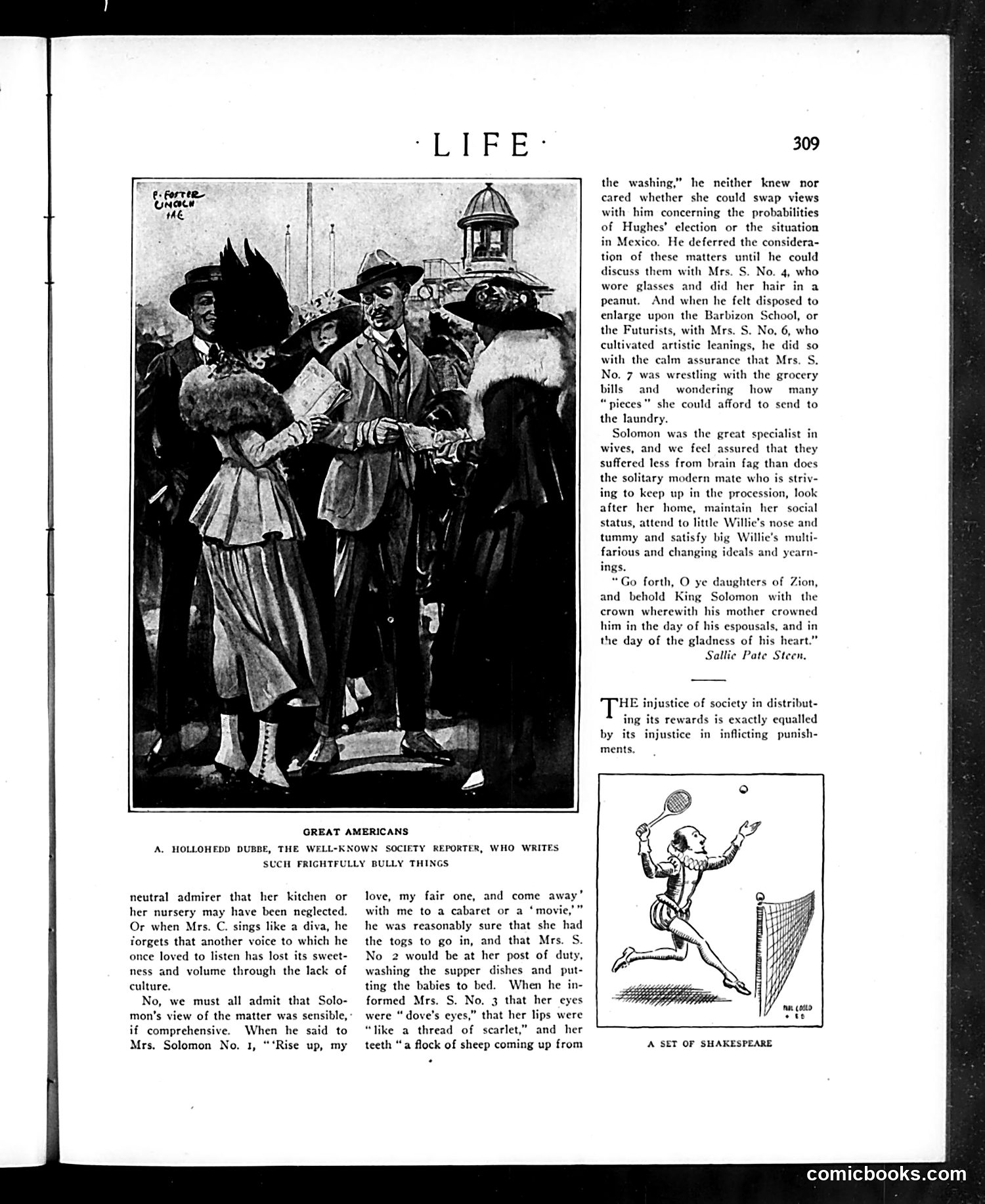
**Main Content:** This page features an article about "Great Americans" focusing on **A. Hollowhead Dubbe, the well-known society reporter**, described as someone "who writes such frightfully bully things." **The Satire:** The piece satirizes both society reporters and wealthy socialites. It mocks Dubbe's breathless coverage of high-society figures (Mrs. Solomon and her wives) while critiquing the women themselves—their shallow concerns with laundry bills, housekeeping, and maintaining social status despite marital arrangements. **The Joke:** The term "Hollowhead" in the reporter's name suggests the satirical target: society journalism is portrayed as empty-headed gossip-mongering, while the socialites exist in equally vacuous worlds of etiquette and conspicuous consumption. **Secondary Element:** A small illustration labeled "A Set of Shakespeare" appears to show athletic/acrobatic figures—likely another satirical reference, though its specific meaning is unclear.
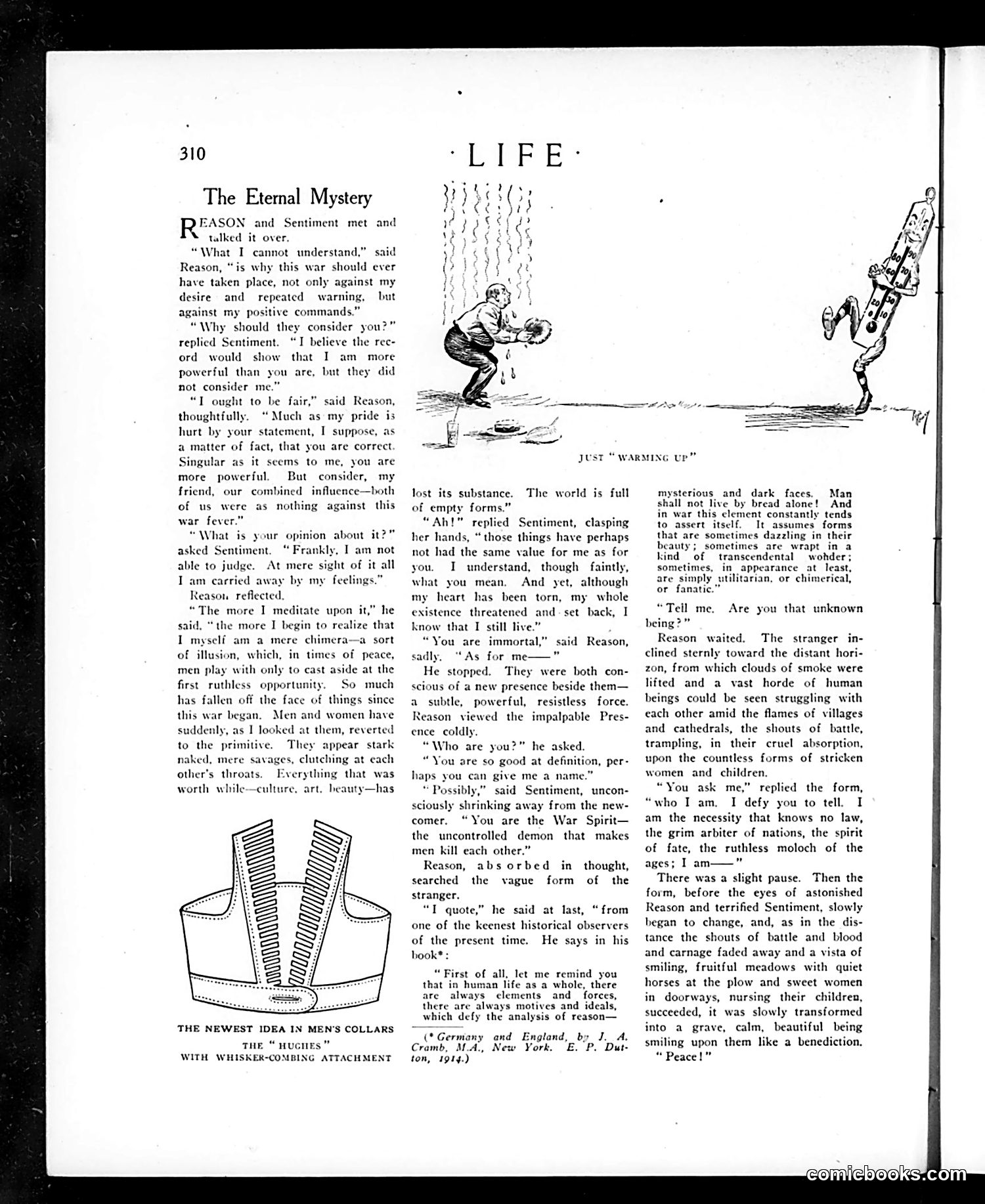
This is a literary allegorical dialogue between "Reason" and "Sentiment" debating World War I's justification. The text presents Reason defending the war's necessity while Sentiment expresses emotional anguish at its brutality. The accompanying illustration shows two figures in dynamic poses—one crouching defensively, the other lunging aggressively—labeled "Just 'Warming Up,'" suggesting soldiers preparing for combat. The narrative culminates with an unnamed "War Spirit" figure—described as an "uncontrolled demon"—transforming a peaceful pastoral landscape into death and destruction. The satire critiques how abstract rationalization ("Reason") justifies war's terrible human costs, while the War Spirit itself remains an unstoppable, dehumanizing force beyond rational control. The advertisement below promotes "Hughes" men's collars, typical of period *Life* magazine content.
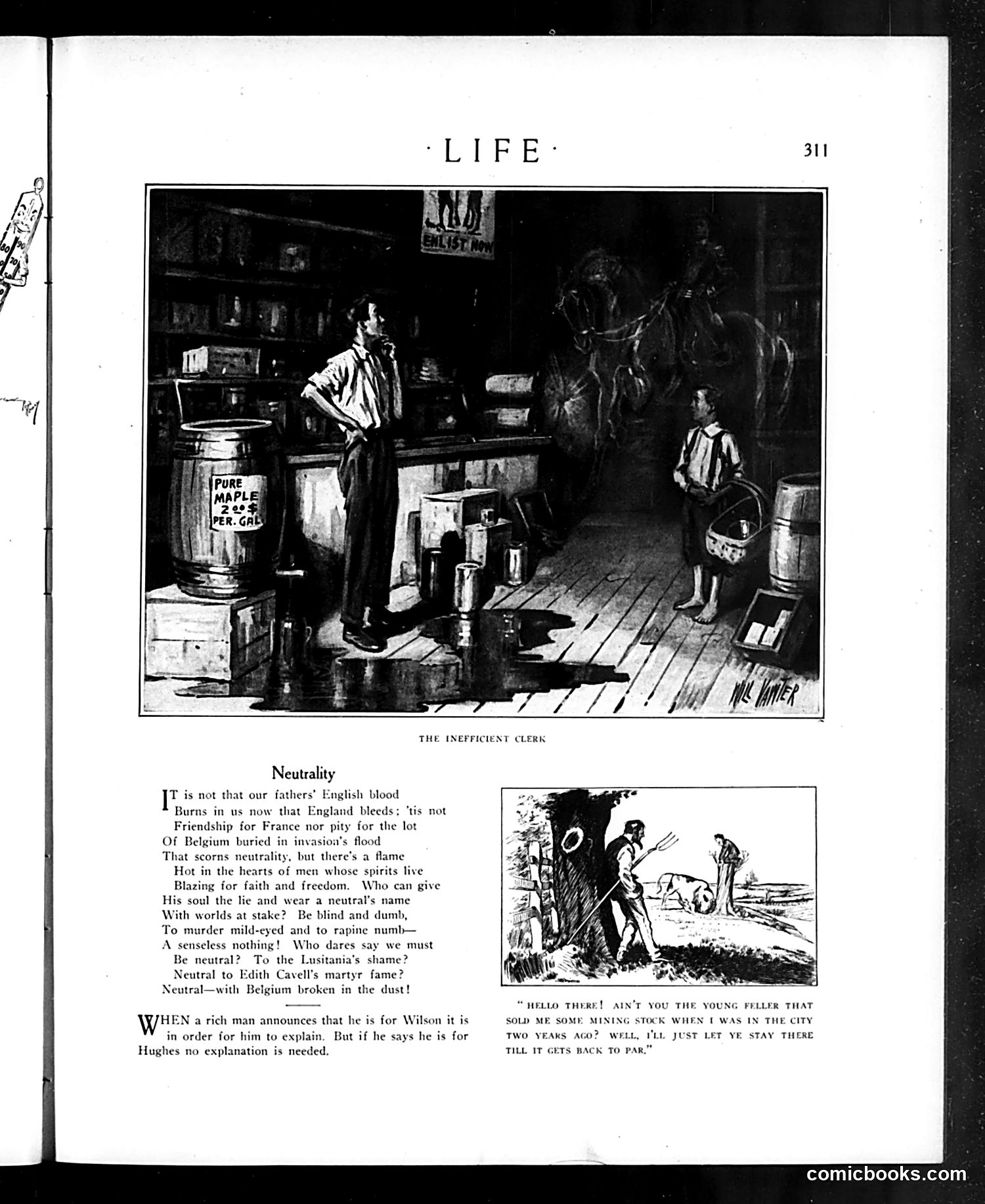
This page critiques American neutrality during World War I. The top cartoon, "The Inefficient Clerk," depicts a store scene where a clerk appears indifferent while customers (representing nations) conduct business—likely satirizing American failure to take decisive action while European nations fight. The poem "Neutrality" directly attacks the concept, questioning how Americans can claim neutrality while profiting from or ignoring Belgium's suffering (invaded by Germany in 1914). It invokes patriotic language about English blood and Belgian victims to shame neutral inaction. The bottom cartoon and accompanying caption suggest that wealthy men like Wilson or Hughes profit financially (mining stock reference) while remaining politically uncommitted—exposing hypocrisy between claimed neutrality and actual self-interest during wartime.
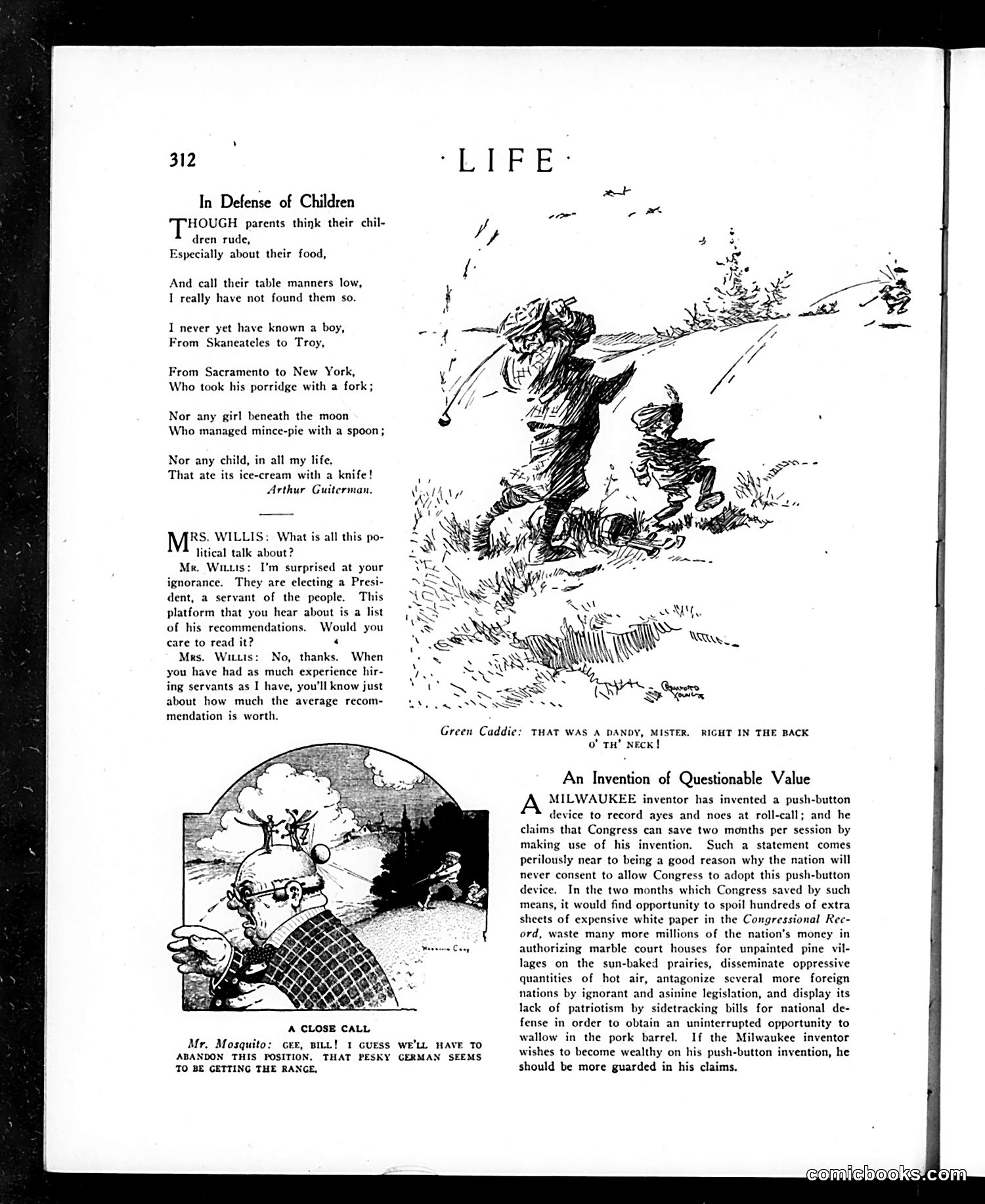
This page contains three distinct satirical pieces: **"In Defense of Children"** (top): A humorous poem by Arthur Guiterman defends children's table manners, sarcastically noting that he's never known a child to eat porridge with a fork or ice-cream with a knife—implying parents' complaints about rudeness are exaggerated. **"Mrs. Willis" dialogue** (middle): A domestic comedy where Mrs. Willis dismisses political campaign platforms by comparing them to hiring servants' recommendations, implying both are unreliable. This satirizes the hollow nature of political promises. **"A Close Call" (bottom cartoon)**: A mosquito and presumably a German soldier discuss abandoning position because "that pesky German seems to be getting the range." This appears to reference World War I combat, using insect characters for humorous effect. **"An Invention of Questionable Value"** (right): Sarcastically attacks a Milwaukee inventor's push-button Congressional voting device, arguing that Congress would waste the time saved on wasteful spending and pork-barrel legislation rather than productive work.
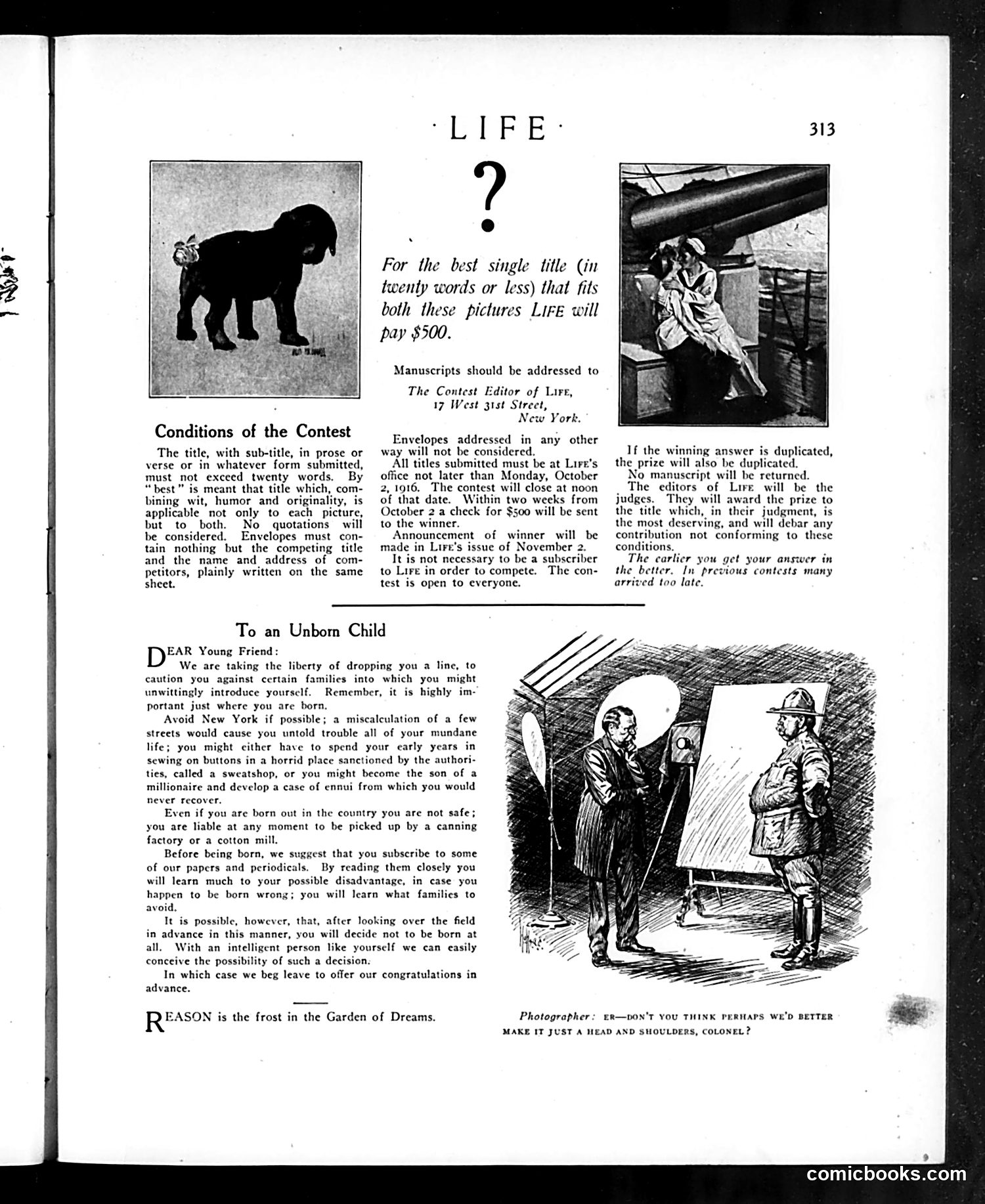
This page contains a $500 contest offering a prize for the best single title (under 20 words) describing both photographs shown. The **top left image** shows a dog in silhouette—likely meant to represent a wealthy person's pet or companion. The **top right image** depicts what appears to be a working-class figure beneath industrial machinery, suggesting labor or poverty. The **bottom cartoon** satirizes photography and social class: a photographer suggests to a "Colonel" that they photograph only "head and shoulders" rather than the full figure—implying the Colonel's lower body or shabby clothing should be hidden from view. This mocks how the wealthy use photography to present false, flattering images while concealing unflattering realities. The broader theme appears to critique class inequality and social pretense in early 20th-century America.
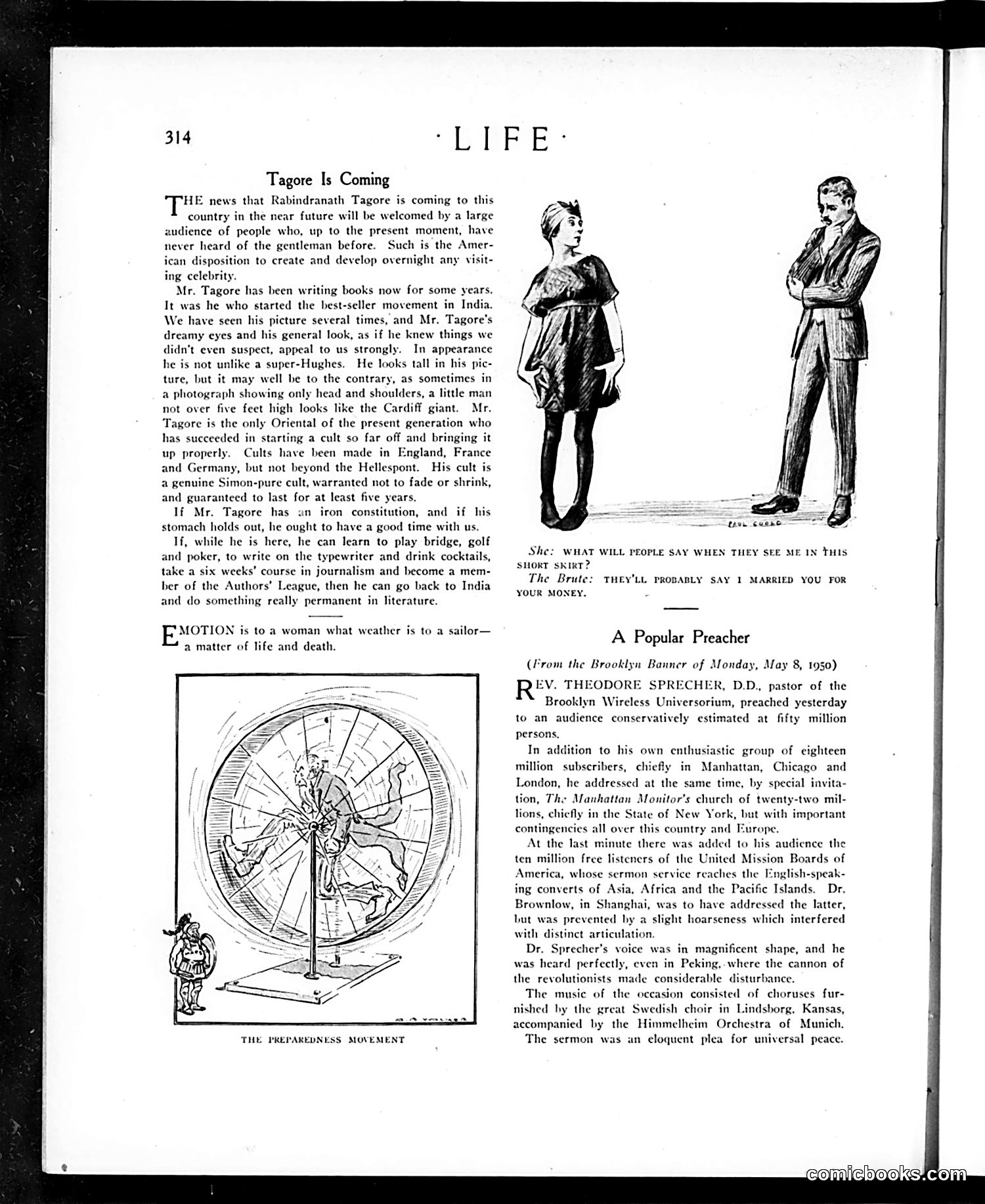
**"Tagore Is Coming":** This article satirizes American celebrity culture's superficiality. Rabindranath Tagore, the Bengali poet and philosopher, is coming to America, but Life mocks how Americans will instantly elevate him to celebrity status despite knowing nothing about him beforehand. The satire highlights American gullibility—the piece jokes that Tagore's "dreamy eyes" appeal to American vanity, and suggests he'll only truly succeed if he learns bridge, poker, and cocktails rather than pursuing serious literature. **"Short Skirt" Cartoon:** A man's dismissive quip about his wife's revealing hemline. When she worries about scandal, he replies she'll be assumed to have married him for money—implying she's either unattractive or socially undesirable enough that only wealth explains the match. The joke mocks both marital dynamics and women's social anxieties. **"A Popular Preacher":** Absurdist satire about Rev. Sprecher broadcasting simultaneously to impossibly vast audiences (50 million) across continents via radio and other media, even reaching Peking despite revolutionary cannon fire. It parodies radio evangelism's grandiose claims.
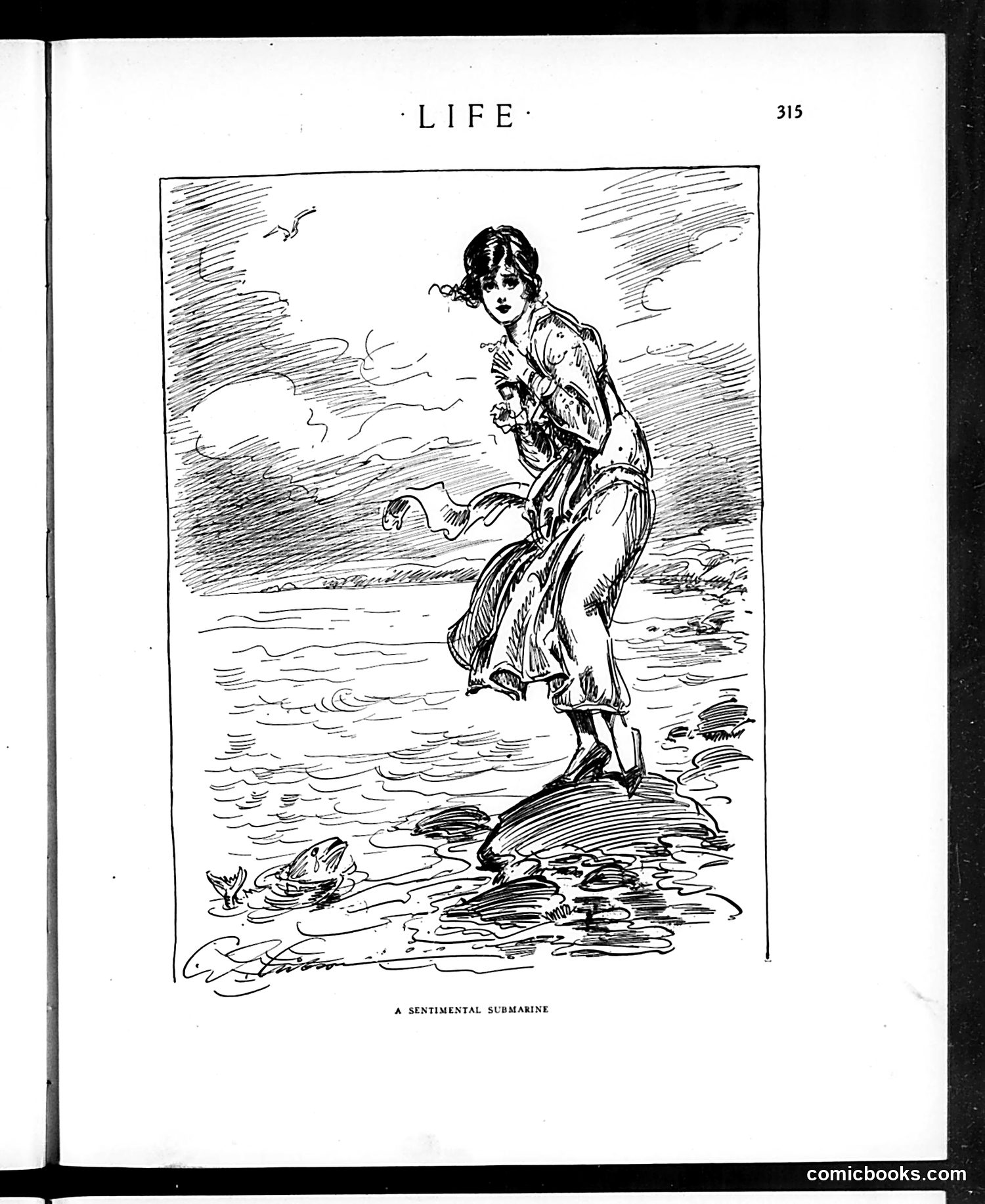
This pen-and-ink cartoon depicts a young woman standing on a rock in shallow water, gazing wistfully seaward while cradling what appears to be a small submarine in her arms. The title's wordplay suggests romantic sentiment—she cradles the submarine as one might hold a beloved object or person. The satire likely comments on World War I-era anxieties about submarines. Given the sentimental pose and the woman's romantic demeanor, the cartoon probably mocks either wartime sentimentality about military technology, or satirizes the public's emotional attachment to submarines as weapons. The juxtaposition of the delicate, romantic scene with the deadly military vessel creates ironic commentary on how civilians romanticized warfare or military hardware during the conflict.
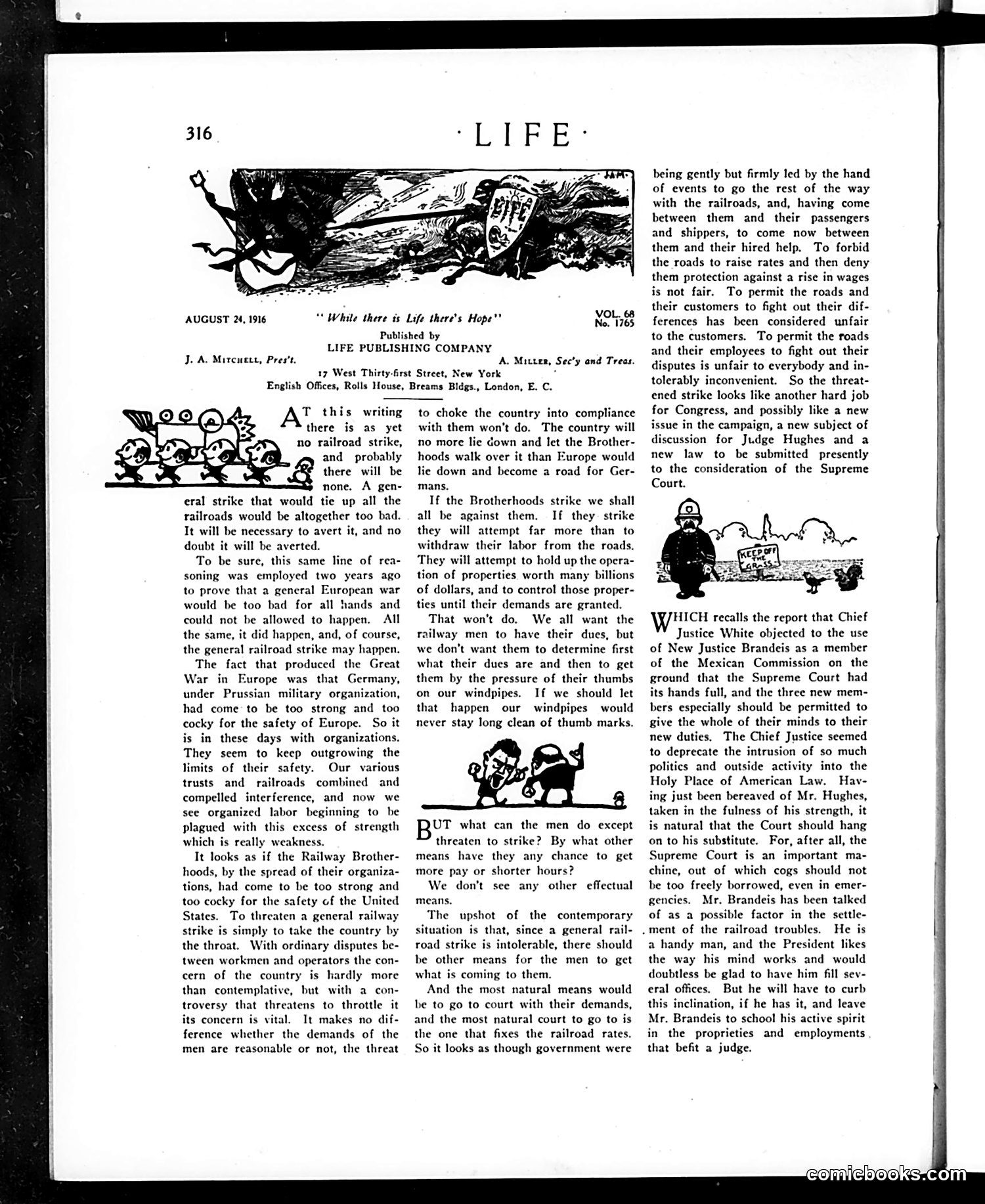
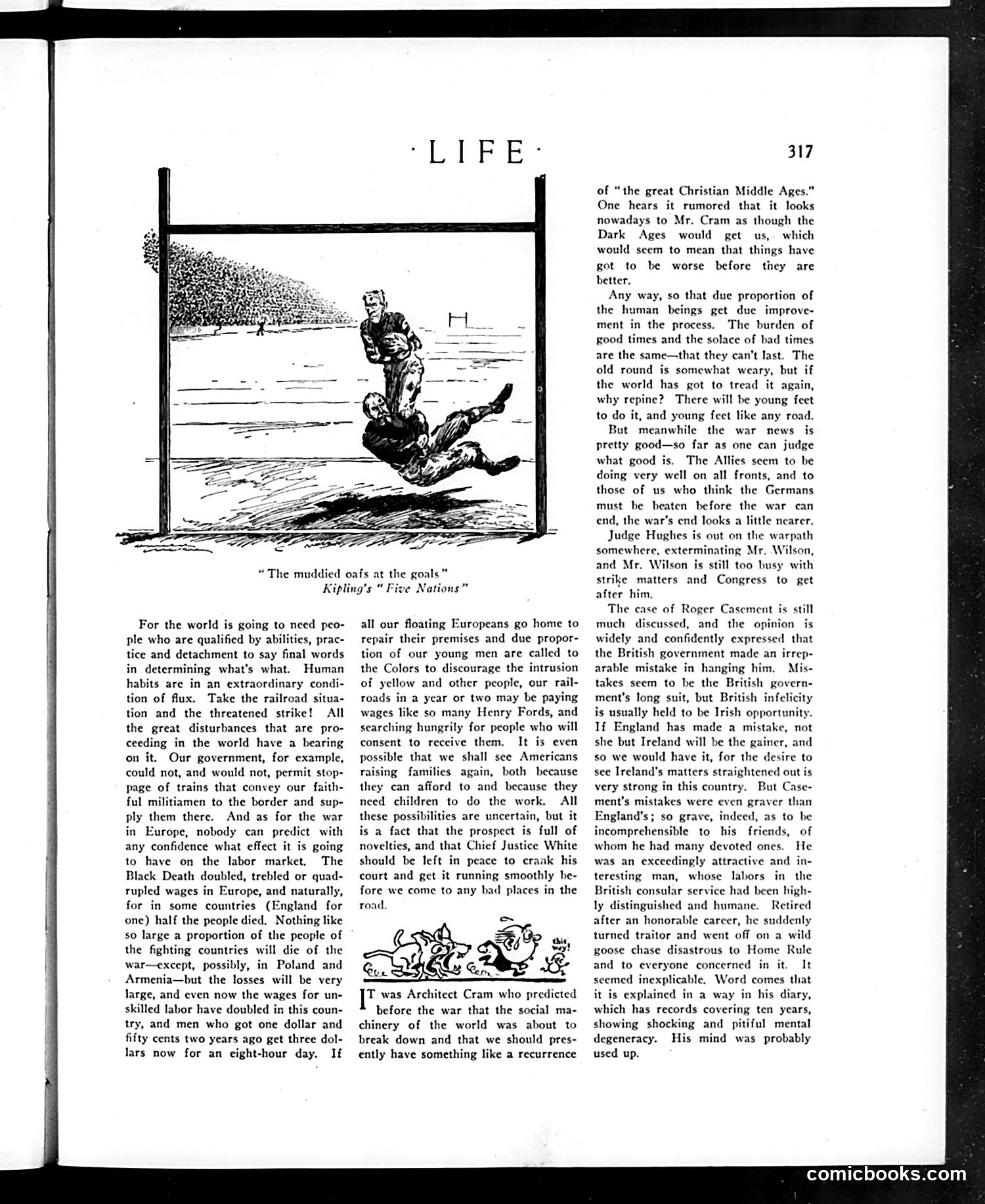
The cartoon, captioned "The muddied oafs" from Kipling's "Five Nations," depicts a soldier slipping or falling in mud while another watches from above. It illustrates the text's discussion of World War I's human and economic consequences. The accompanying essay addresses post-war labor disruptions, railroad strikes, and wage inflation caused by massive casualties in Europe. The author predicts that if young Americans are conscripted and Europeans return home to rebuild, labor shortages will force American wages to rise dramatically—possibly high enough that families could afford children again to work. The piece also mentions political figures: Chief Justice White, Judge Hughes (Charles Evans Hughes, apparently running against Wilson), and Roger Casement (the Irish nationalist executed by Britain, sparking controversy). The essay suggests this period of upheaval might precipitate either a "Christian Middle Ages" recovery or descent into actual "Dark Ages," depending on how societies manage the transition.
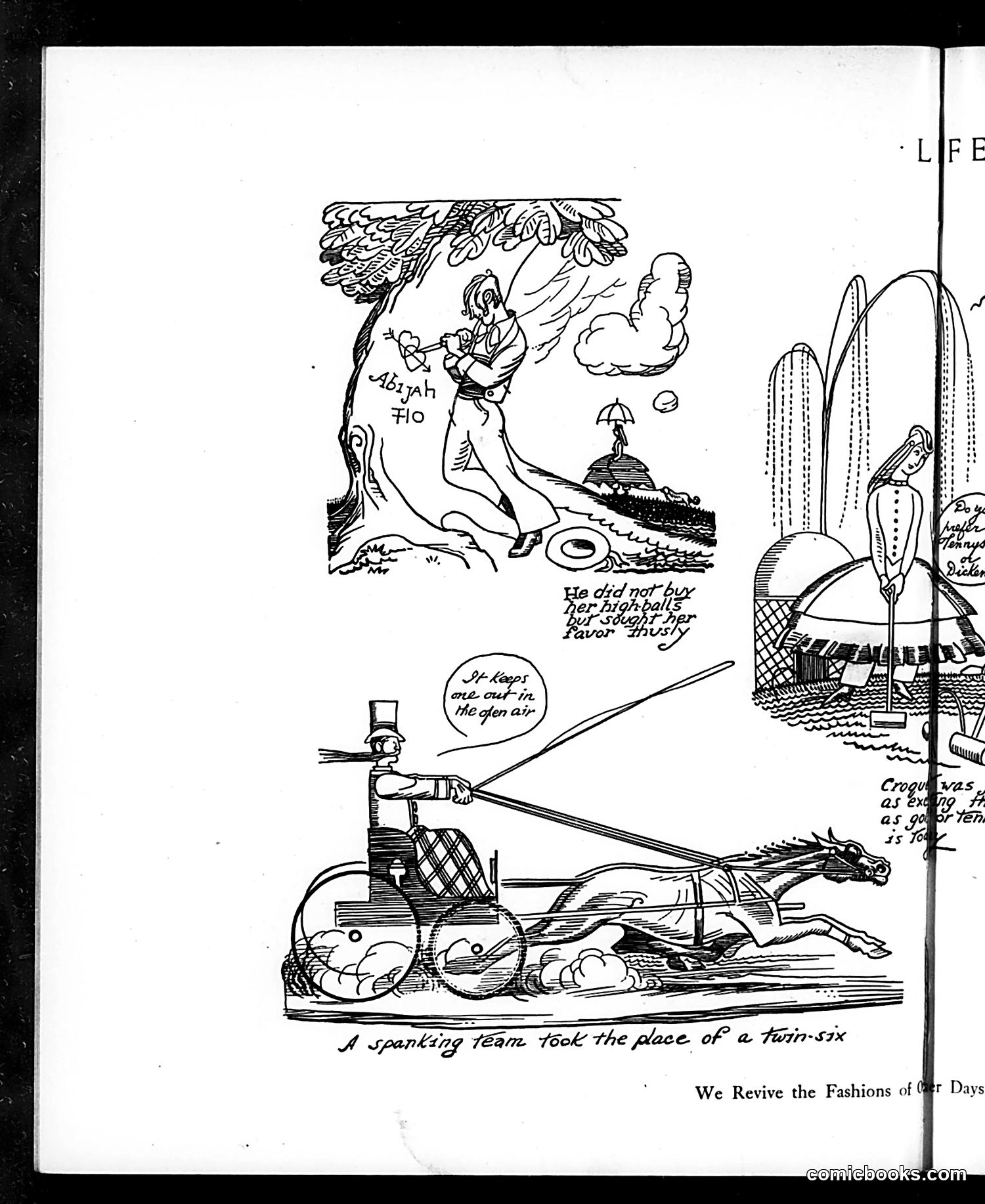
This page satirizes outdated fashion and transportation customs through whimsical illustrations. The top panel depicts "Abiyah Ho" under a tree with the caption "He did not buy her high-balls but sought her favor thirsty"—likely mocking overly romantic or affected courtship language. The bottom illustration shows a gentleman in a top hat being pulled by a horse in a makeshift contraption, captioned "A spanking team took the place of a twin-six," referencing how horses formerly replaced automobiles. The figure's speech bubble states "Sir keeps fresh in the glen air." The heading "We Revive the Fashions of [olden] Days" frames the entire piece as commentary on returning to antiquated customs. The satire targets both nostalgia for "simpler times" and the absurdity of abandoning modern conveniences like cars for horse-drawn transport. Right panel imagery of cacti and exotic settings suggests additional period-costume references.
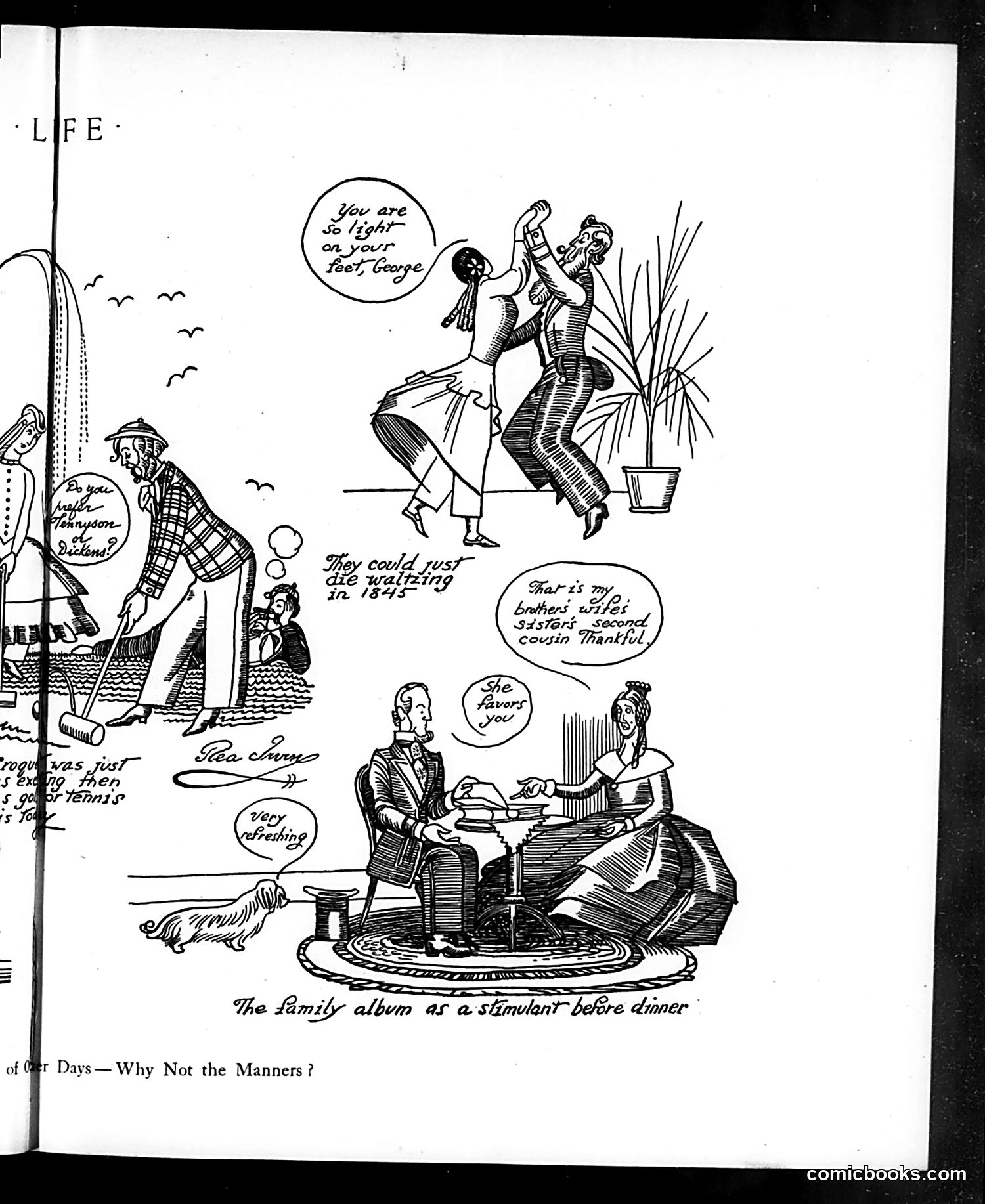
This page contains satirical illustrations about Victorian-era social customs and family relationships. The top scene shows a couple dancing, with commentary on their "light" behavior. The left side depicts a seaside scene with period figures and handwritten notes referencing family relationships and 1843. The bottom illustration, captioned "The family album as a stimulant before dinner," shows a couple reviewing photographs together. The woman says "She favors you," suggesting the album viewing was meant to improve mood and conversation before dining. The overall satire critiques Victorian social rituals—how families used formal activities like album-viewing as prescribed etiquette to stimulate proper behavior and mood before social occasions. The page title "Of Olden Days—Why Not the Manners?" suggests nostalgia for or ironic commentary on past genteel traditions.
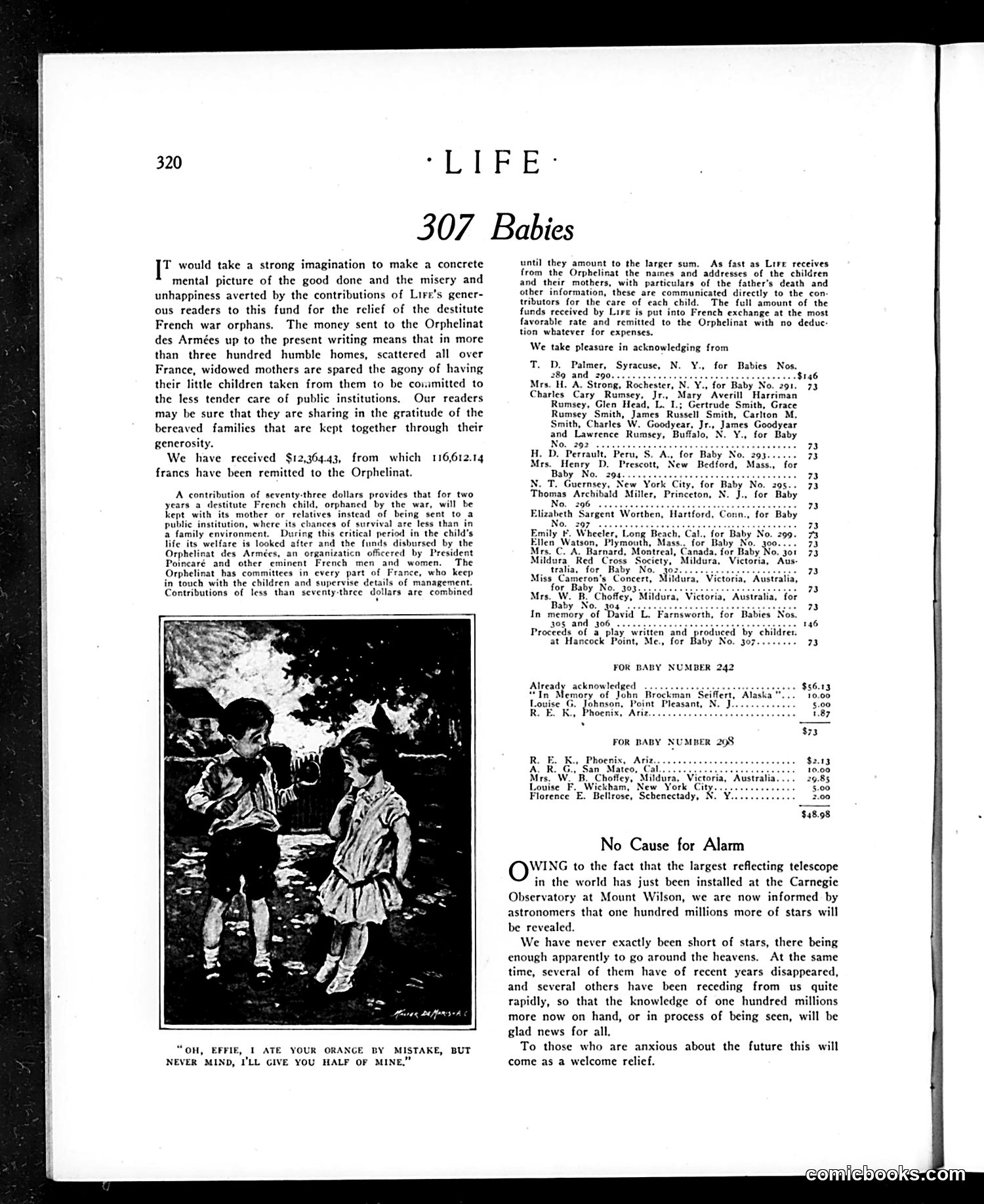
This page documents a charitable fundraising campaign by the American magazine *Life* to support French war orphans. The accompanying illustration depicts two children—likely representing French orphans—sharing a piece of fruit with what appears to be genuine affection. The campaign worked by allowing American donors to sponsor individual children through the Orphelinat des Armées, a French relief organization. Contributors paid seventy-three dollars to keep a destitute child with relatives rather than in a public institution for two years. The page lists numerous donors' names, locations, and the babies they sponsored (numbered up to at least 307). The satire is gentle: the campaign asks readers to prevent separation of war-orphaned children from their families. The illustration's caption—"Oh, Effie, I ate your orange by mistake, but never mind, I'll give you half of mine"—suggests American middle-class generosity solving French suffering through individual charity. This represents post-WWI relief efforts, when American publications mobilized readers to support European reconstruction through personal sponsorship programs.
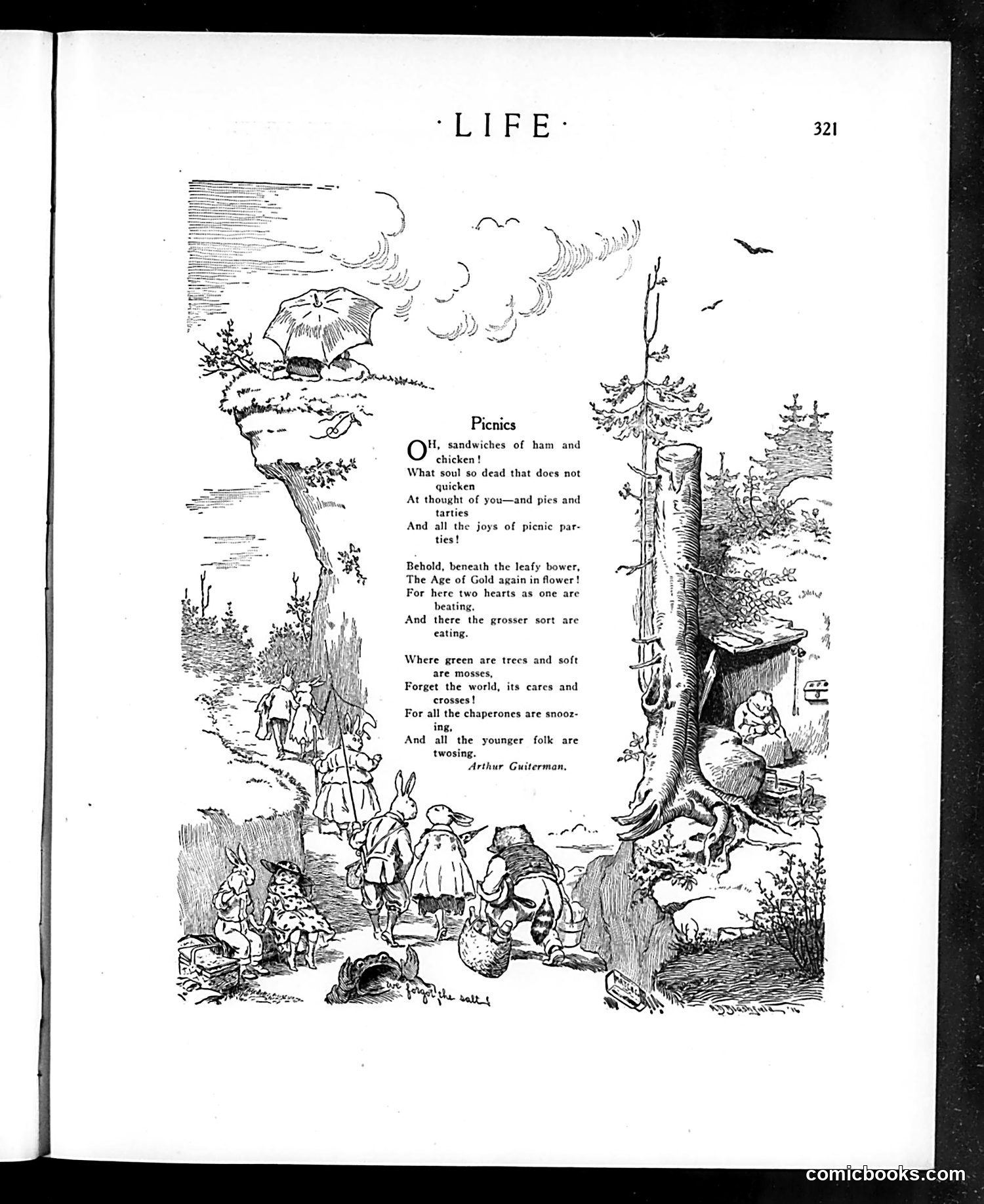
This is a lighthearted poem celebrating picnics as romantic and social occasions. The verse contrasts two groups: romantic couples ("two hearts as one") and those focused on food ("the grosser sort are eating"). The accompanying illustrations show a pastoral picnic scene with families and young people gathered outdoors near trees and natural settings. The poem's humor lies in its mock-romantic tone—elevating simple picnic pleasures (sandwiches, pies) to quasi-spiritual experiences while gently mocking both romance ("twosing") and gluttony. The reference to "chaperones are snoozing" suggests young courting couples taking advantage of unsupervised moments—a mild social commentary on dating customs of the era when chaperones were expected to supervise young unmarried people.
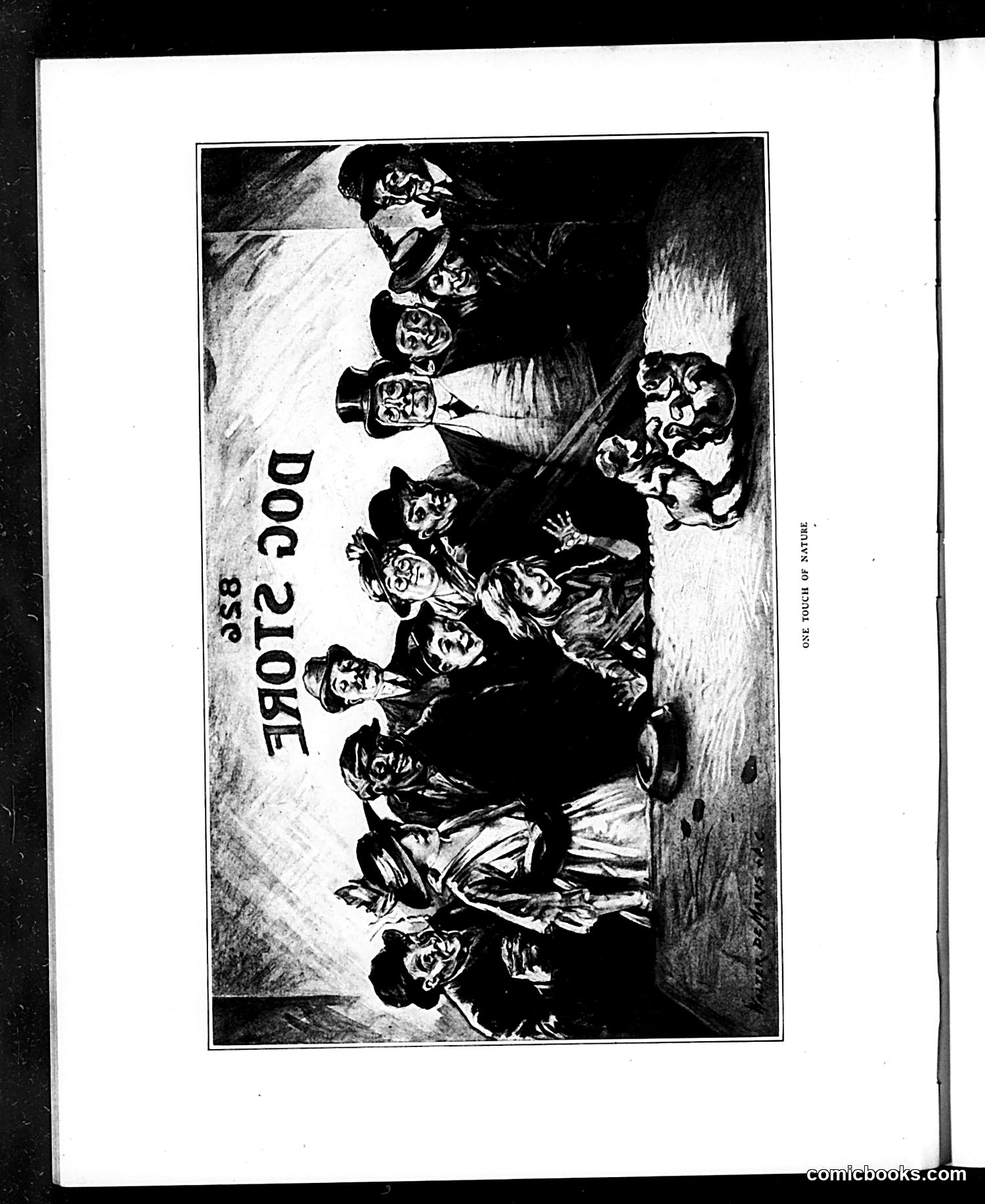
This appears to be a satirical cartoon depicting a doctor or medical figure surrounded by what seem to be distressed or afflicted patients or people in need. The title "DOC 2 BROKE" suggests financial ruin or bankruptcy of a medical professional. The imagery and composition suggest commentary on either medical practice difficulties, financial hardship during economic crisis, or perhaps critiques of healthcare accessibility. The expressive faces and crowded composition emphasize desperation or suffering. Without clearer context or additional text identifying specific historical figures or events, the exact satirical target remains unclear, though it likely relates to early 20th-century concerns about medical practice, poverty, or economic conditions affecting healthcare providers or patients.
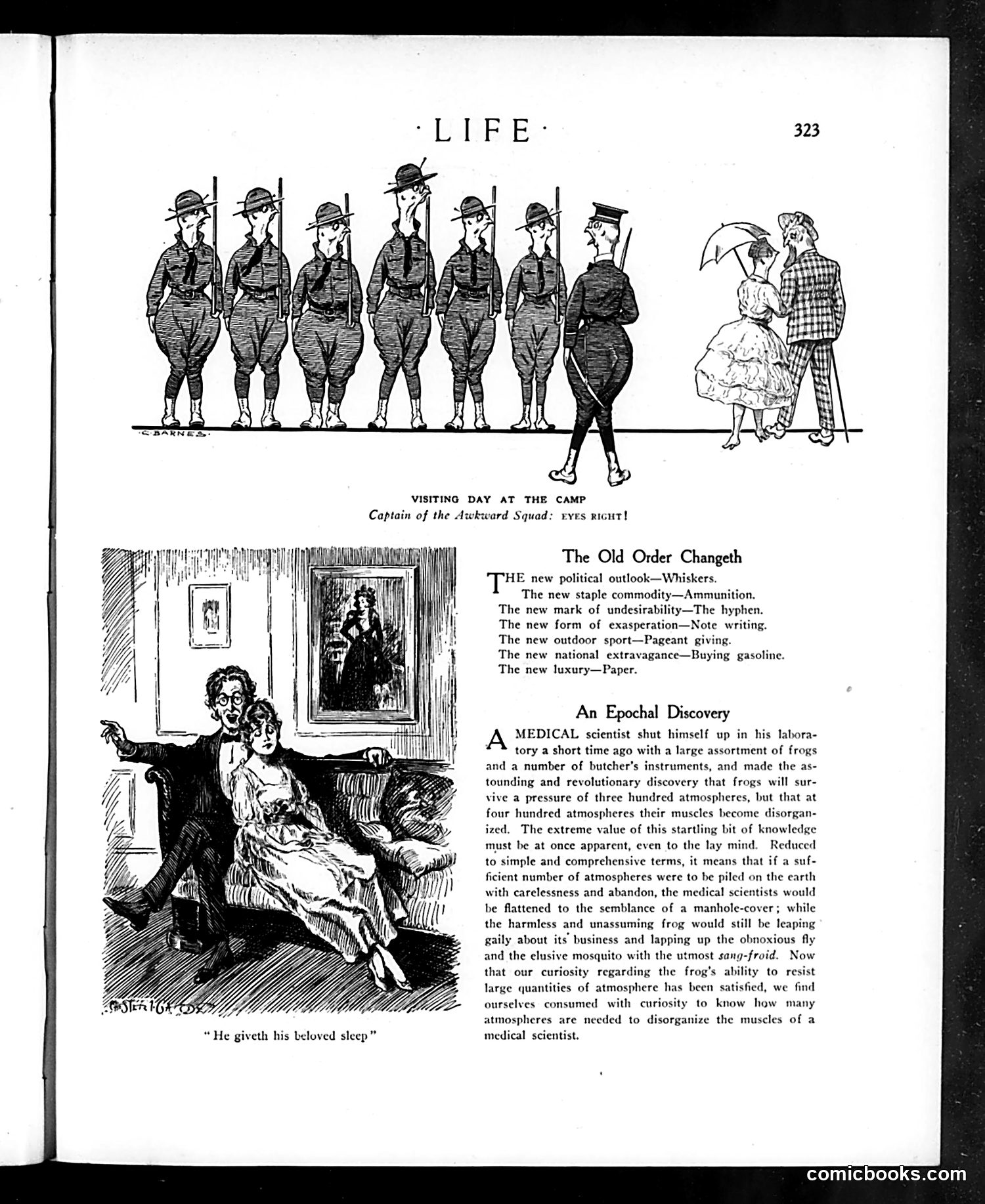
**Top Cartoon:** "Visiting Day at the Camp" shows seven soldiers in formation being inspected by a visiting officer, with civilians (women and a man with umbrella) observing. The caption "Captain of the Awkward Squad: yes right!" suggests these are poorly trained or clumsy recruits—likely WWI-era draftees. The humor lies in their apparent incompetence during inspection. **"The Old Order Changeth":** A satirical list mocking wartime changes: facial hair as fashion, ammunition shortages, the "hyphen" (likely referencing German-Americans or hyphenated identities), note-writing as complaint, pageants as entertainment, gasoline rationing, and paper scarcity. This critiques the disruptions and absurdities of wartime society. **"An Epochal Discovery":** Humorous pseudo-scientific satire about a scientist discovering frogs survive 300 atmospheres of pressure but not 400. The joke mocks pointless research—sarcastically suggesting the scientist himself should be pressurized, implying academic work disconnected from practical wartime needs.
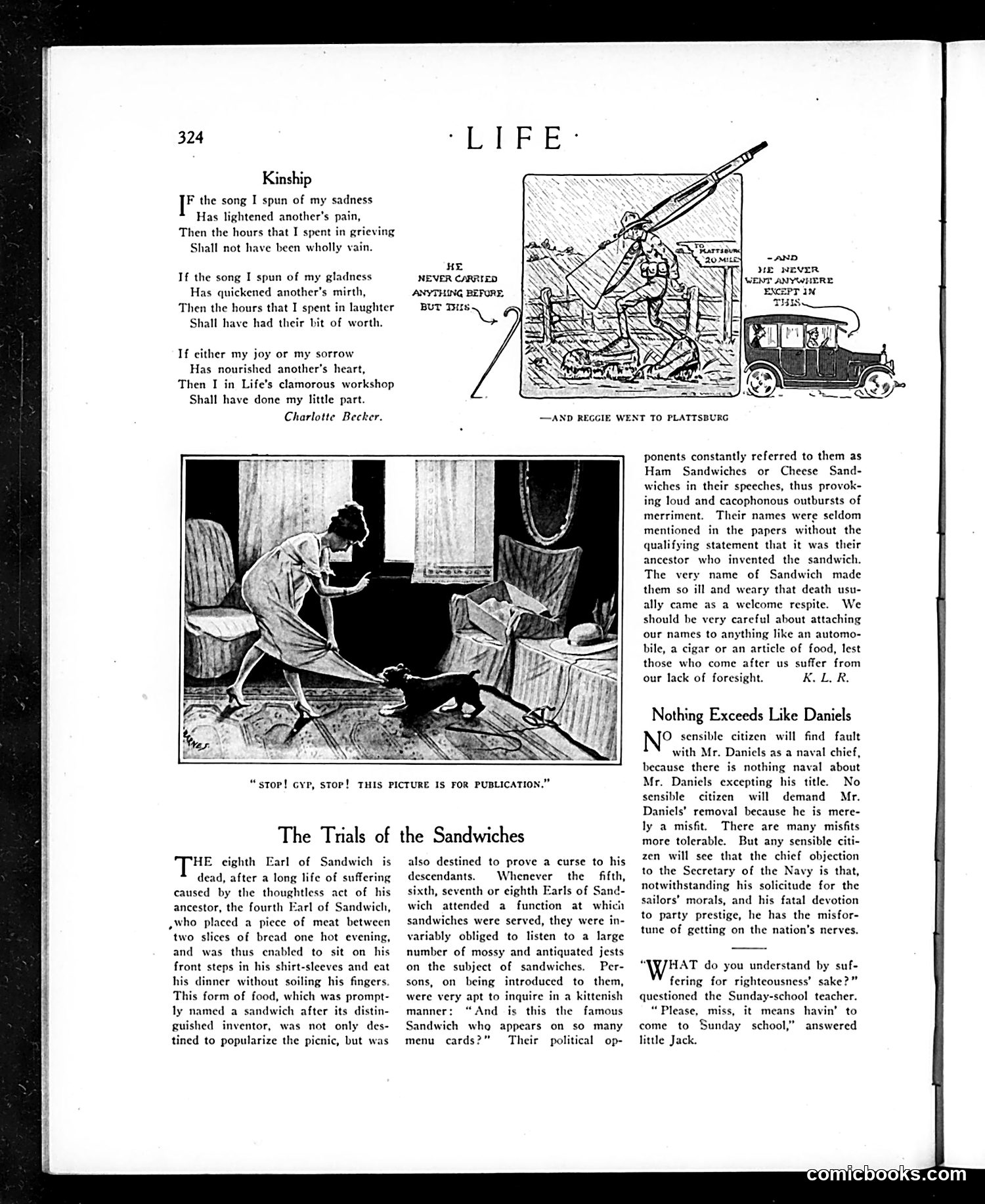
This page contains three distinct satirical pieces: **"The Trials of the Sandwiches"** mocks the real Earl of Sandwich family, who suffered centuries of tedious puns and references to their ancestor's 18th-century invention. The joke is that attaching one's name to any food, invention, or product—like automobiles or cigars—dooms descendants to endless ridicule. It's a cautionary satire about unintended consequences of fame. **"Nothing Exceeds Like Daniels"** criticizes Josephus Daniels, Secretary of the Navy under President Wilson. The piece sarcastically defends him while actually attacking his leadership, claiming his obsession with sailors' morals and party politics makes him unpopular with the military—he "gets on the nation's nerves." **The illustrated cartoon** (captioned "Stop! Cyp, Stop! This Picture Is for Publication") appears to show someone photographing an indoor scene; its specific meaning is unclear without additional context. The page reflects typical early-20th-century *Life* magazine humor: witty social commentary mixed with gentle mockery of public figures.
This is a serialized fiction story, not a political cartoon. It depicts an American military confrontation in what appears to be colonial-era Mexico or the American Southwest. The narrative follows Tuck Carter, a young American soldier defending a fortified position against impending attack by Mexican forces (referred to pejoratively as "yellow-skinned natives" and "yellow greasers"). Carter experiences fear for the first time in actual combat, mentally imagining the trauma of being shot. **Historical context**: This likely references late 19th or early 20th-century American imperial conflicts, possibly the Mexican-American War era or U.S. interventions in Mexico. The offensive racial language reflects period attitudes toward Mexican and Indigenous peoples. The story explores themes of masculine courage, duty, and the psychological terror of modern warfare—contrasting Carter's previous hand-to-hand dominance over natives with his vulnerability to gunfire.
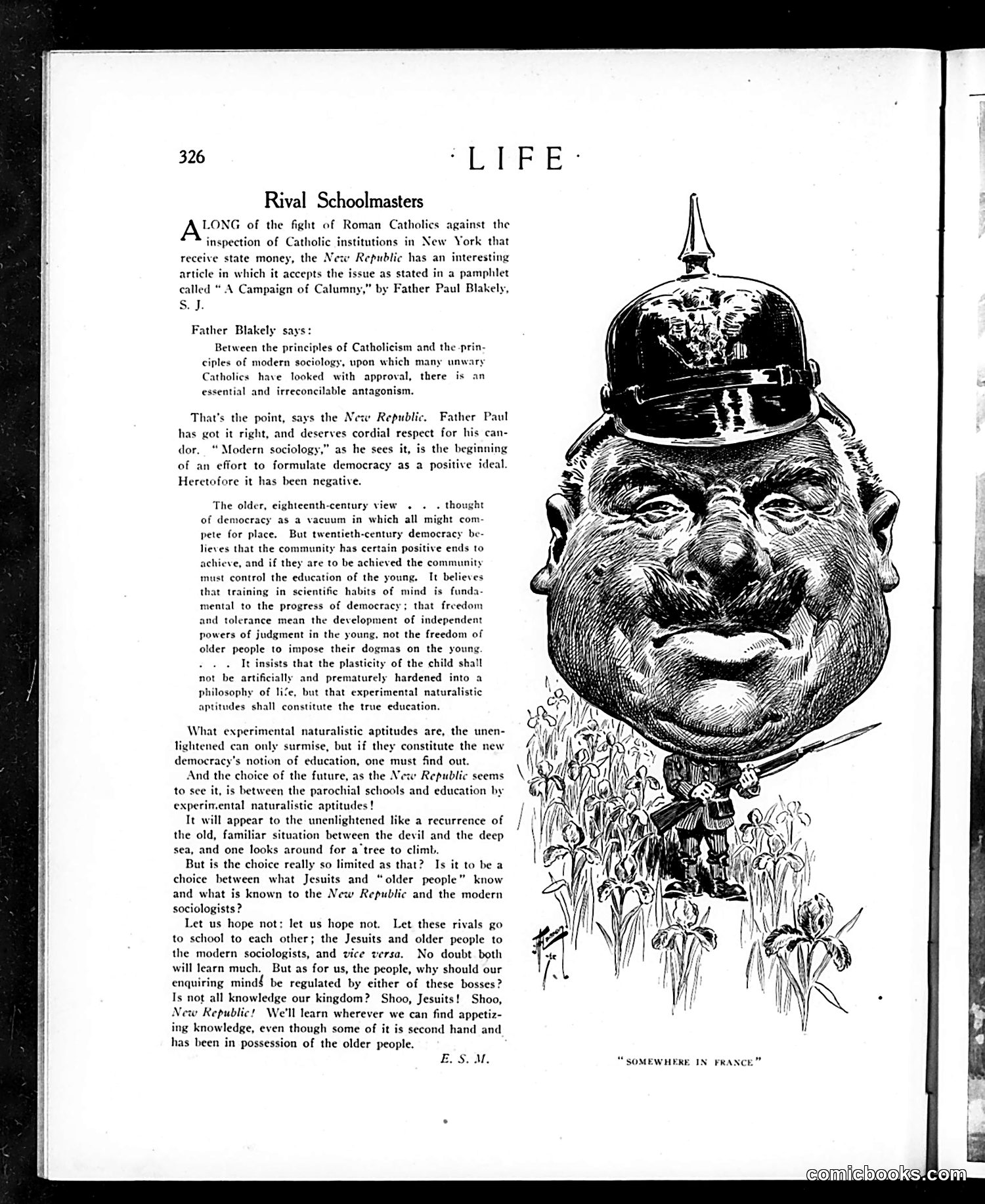
This satirical piece concerns a real 1920s debate over Catholic schools receiving state funding while resisting government inspection. The cartoon depicts a German military officer (identified by the spiked "Pickelhaube" helmet) with an aggressive, authoritarian expression, labeled "Somewhere in France." The accompanying article, attributed to E.S.M., compares two competing educational philosophies as incompatible "rivals": Catholic/Jesuit education versus modern sociology-based "experimental naturalistic" education. The cartoon's use of a German militarist figure suggests the author views both rigid educational systems as authoritarian threats—implying that whether imposed by religious dogma or modern ideology, top-down control of youth education produces the same dangerous conformity seen in militaristic regimes. The satire's point: Americans shouldn't have to choose between two oppressive systems; knowledge should come from multiple sources.
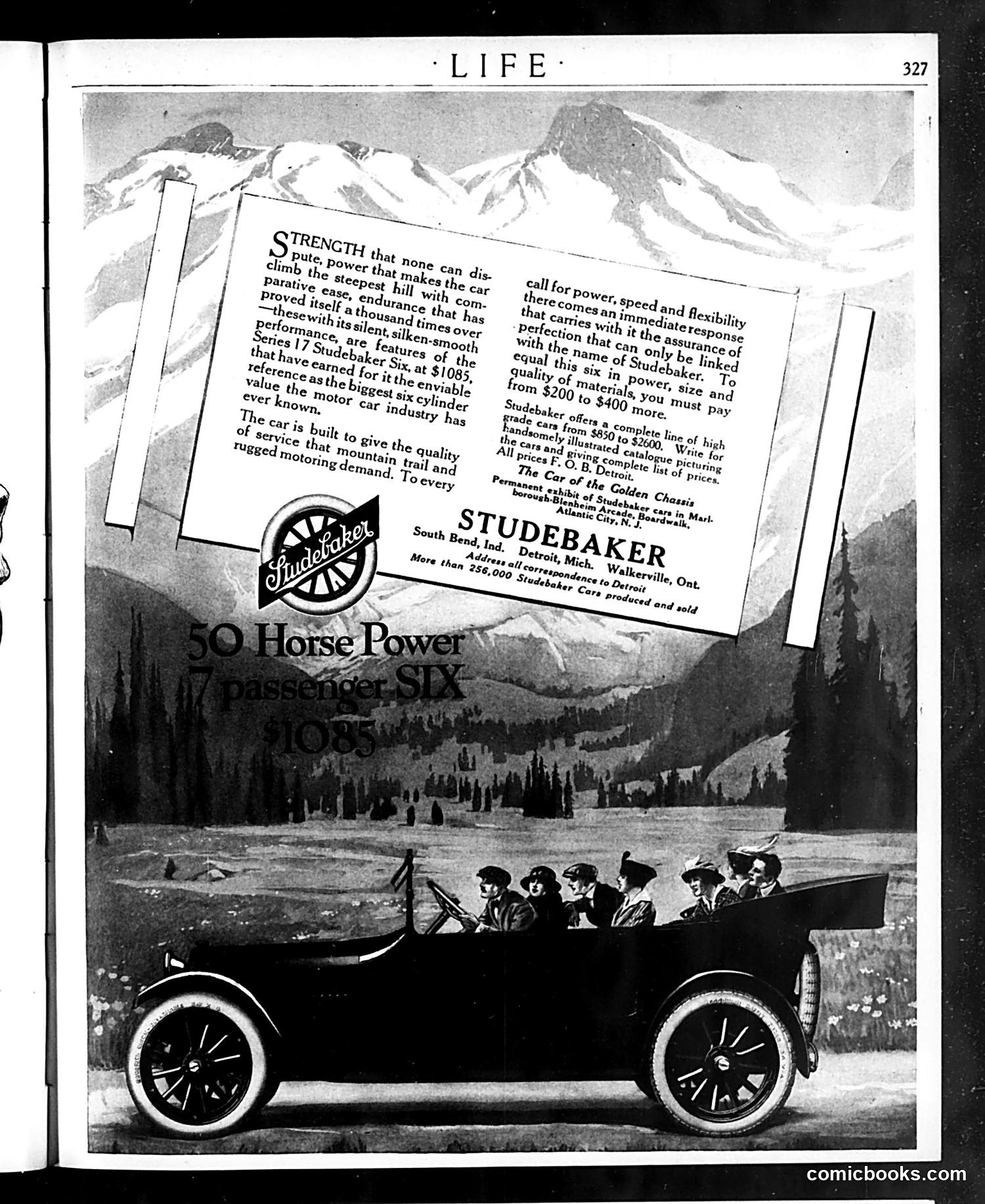
This is primarily a **product advertisement** for Studebaker automobiles, not a political cartoon. The page features a luxury car advertisement positioned against a scenic mountain landscape with passengers inside. The ad emphasizes the car's technical specifications—50 horsepower, 7-passenger capacity, priced at $1,085—highlighting engineering prowess and value. The text stresses "strength," "power," and "flexibility," marketing language designed to appeal to affluent early-1900s consumers seeking both performance and reliability. The mountainous backdrop suggests adventure and capability, implying the vehicle can handle challenging terrain. This appears to be aspirational marketing: ownership signals social status and modern technological sophistication. The page number (327) suggests this appeared in Life magazine's advertising section.
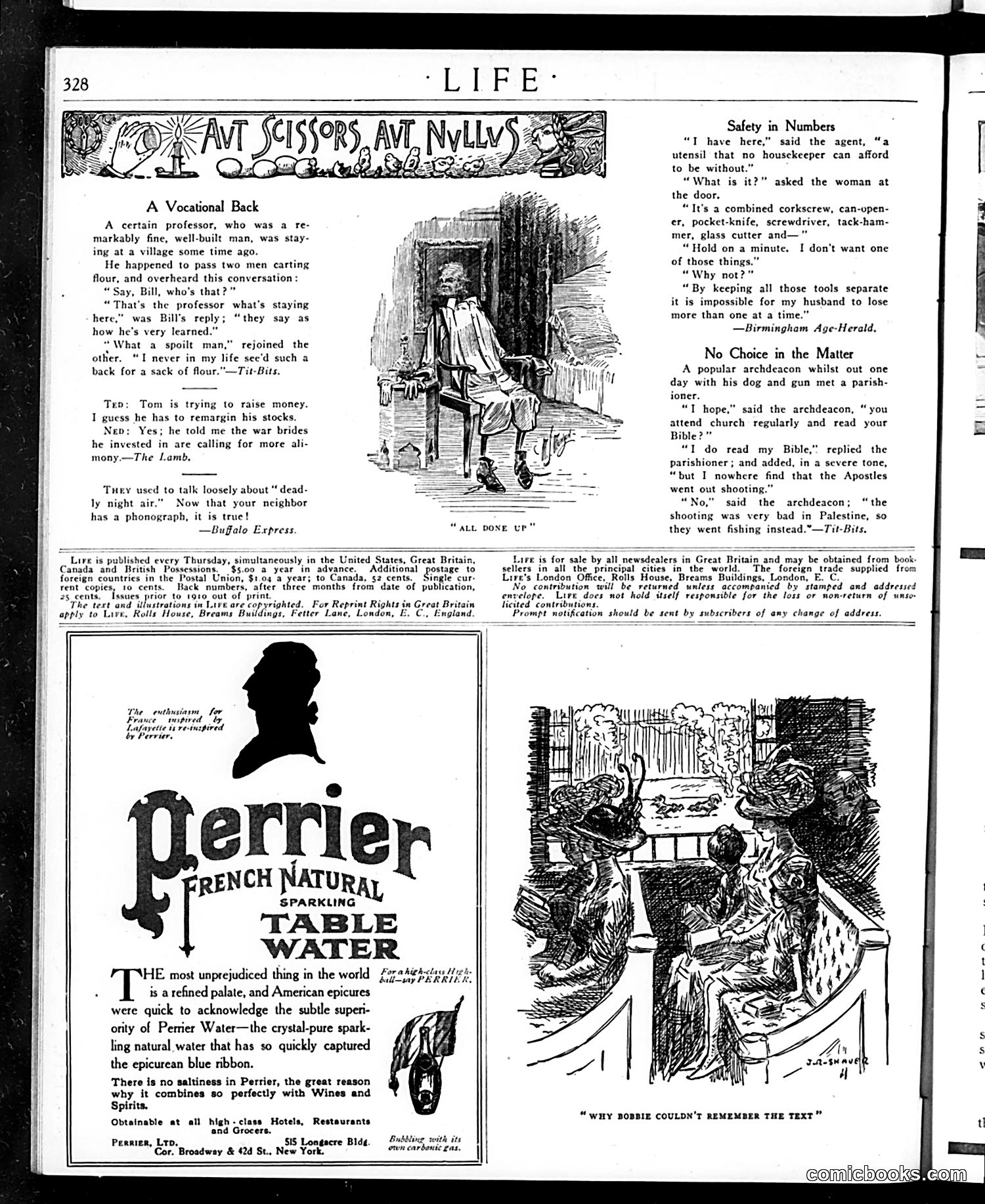
This page contains several brief humorous anecdotes and advertisements typical of early 20th-century American satirical magazines. **The cartoons/jokes mock:** 1. **"A Vocational Back"** — A professor is insulted by laborers who say his back is too refined for manual work, satirizing class pretensions. 2. **"Safety in Numbers"** — A salesman pitches a multi-tool device, but a housewife refuses because she actually *wants* her husband to lose tools one at a time, mocking both consumer gadgetry and marital dynamics. 3. **"No Choice in the Matter"** — An archdeacon defends shooting on religious grounds by joking that apostles fished instead because hunting was "bad in Palestine"—satirizing clergy who rationalize worldly pursuits. 4. **"All Done Up"** — A sketch of an exhausted man, likely referencing fatigue or burnout. The page also features a Perrier water advertisement claiming American refinement has come to appreciate French sparkling water, appealing to aspirational consumers.
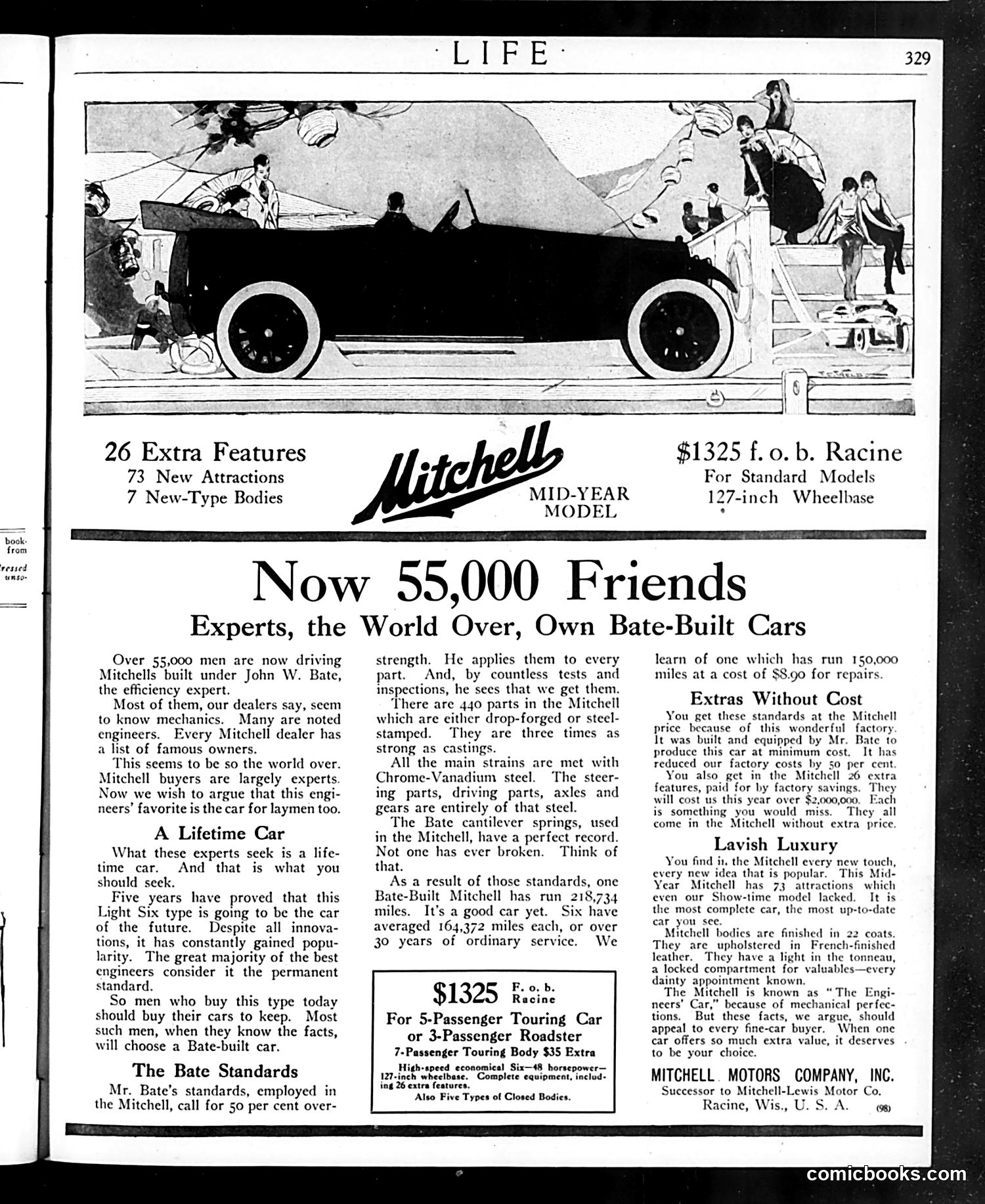
This is primarily a **car advertisement**, not political satire. It promotes the Mitchell automobile's mid-year model, priced at $1,325. The ad's central claim is that Mitchell cars—built under efficiency expert John W. Bate's standards—appeal to both professional engineers (55,000 owners reportedly) and ordinary consumers. The marketing strategy positions the car as a "lifetime" vehicle with superior durability: parts are drop-forged or steel-stamped (three times stronger than castings), using Chrome-Vanadium steel, with proven reliability (one owner reportedly drove 150,000 miles for only $8.90 in repairs). The ad emphasizes value: 26 extra features and 73 "new attractions" cost nothing extra due to factory efficiency savings of 50 percent. The vehicle offers luxury (22-coat finish, French leather upholstery, lockable compartments) at a reasonable price point. The illustration shows a sleek convertible roadster surrounded by fashionable people at what appears to be a recreational venue, conveying aspirational lifestyle appeal.
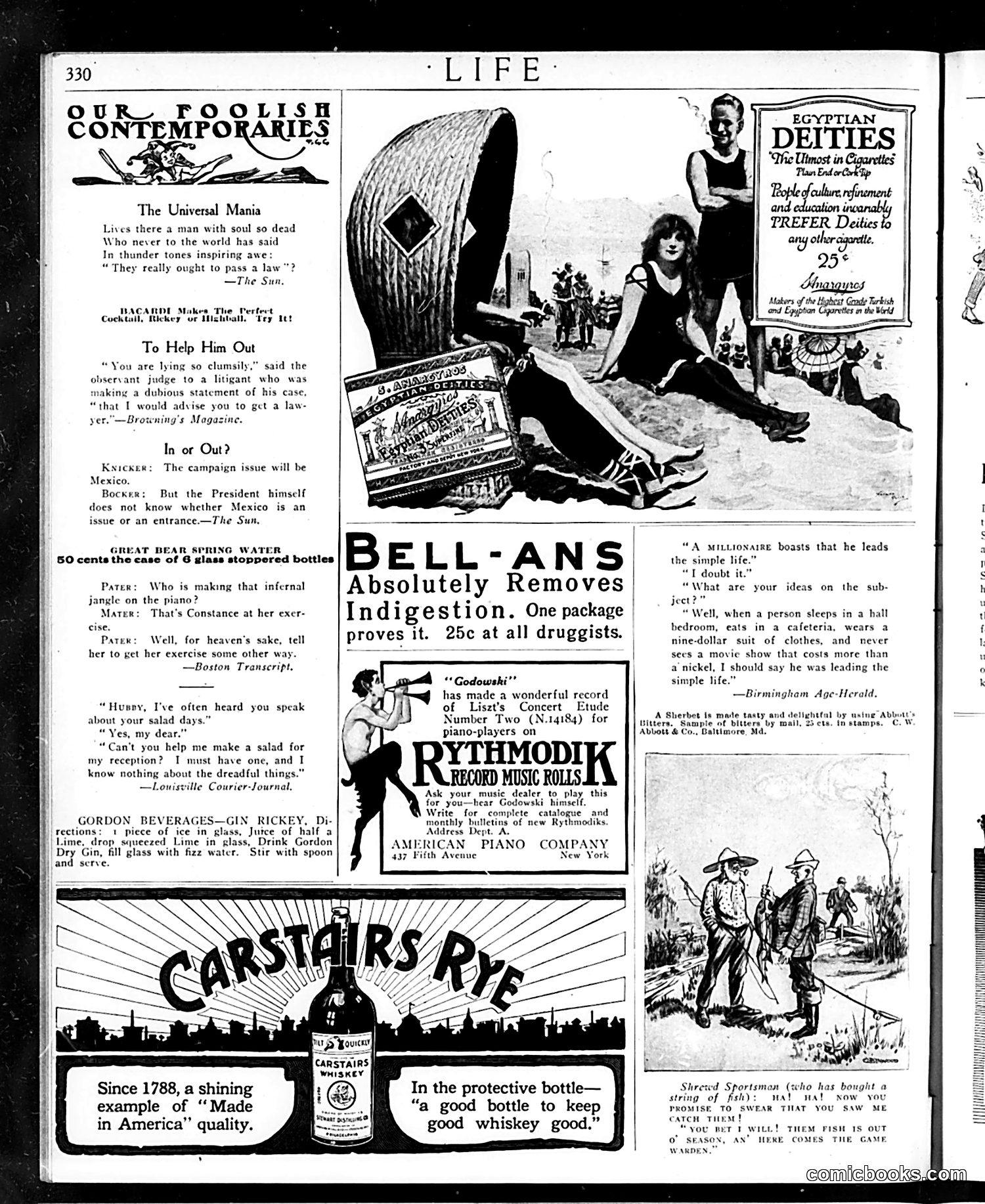
This page from Life magazine (appears to be early 1900s) is primarily **advertising with satirical humor sections**. The main content includes: **Satirical Snippets** ("Our Foolish Contemporaries"): Short joke pieces mocking contemporary attitudes, including: - Universal compulsion to propose laws - A judge criticizing a clumsy liar - Uncertainty about Mexico's status (likely referencing early 1900s U.S.-Mexico tensions) - A woman asking her husband to help make salad **Large Advertisement**: Bell-Ans indigestion remedy dominates the center, claiming to "absolutely remove indigestion." **Other Ads**: Bacardi cocktails, Egyptian Deities cigarettes, Rythmodik music rolls, Carstairs whiskey, and Abbott's bitters fill the margins. **Bottom Cartoon**: A "shrewd sportsman" caught with out-of-season fish warns his companion to lie to authorities ("promise to swear you saw me catch them") as the game warden approaches—satirizing casual dishonesty about hunting regulations. The page reflects turn-of-century American consumer culture and genteel humor about social pretension.
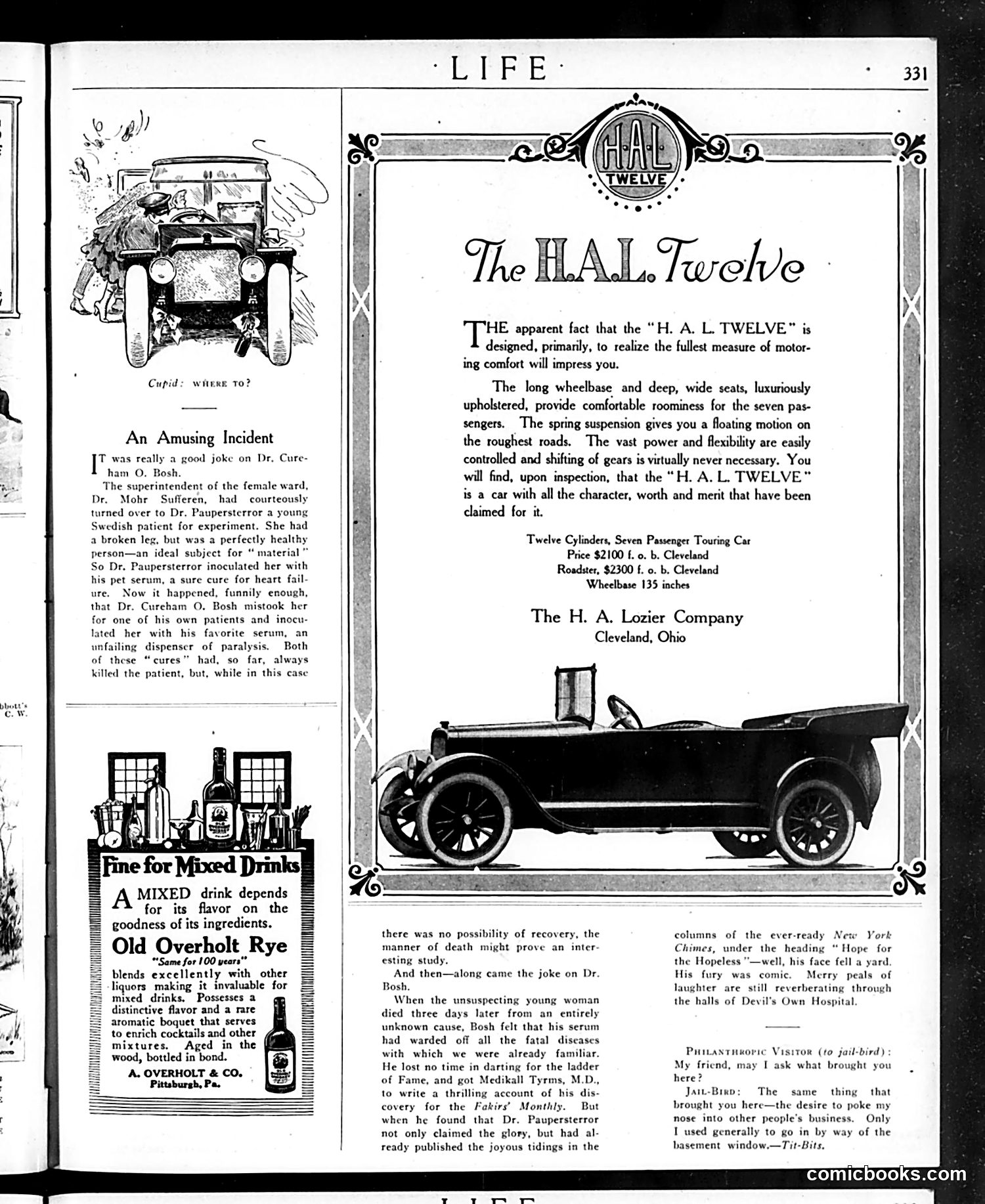
This story mocks unethical medical experimentation and scientific fraud in early 20th-century medicine. Dr. Paupersterror and Dr. Cureham O. Bosh represent quack physicians who conduct lethal experiments on vulnerable patients (here, a Swedish woman with a broken leg). Both doctors' "cures" have "always killed the patient," yet they publish fraudulent success claims in medical journals like the fictional "Fakirs' Monthly" and "New York Chimes." The "joke" is that when the woman dies anyway from an unknown cause, Bosh falsely claims credit for "warding off fatal diseases," while his rival Paupersterror publishes first, stealing his glory. The humor derives from exposing how corrupt doctors fabricated results and raced to publish dubious medical "discoveries" — a real problem of the era. The cartoon shows Cupid asking "Where to?" — presumably directing these charlatans somewhere appropriate, likely Hell.
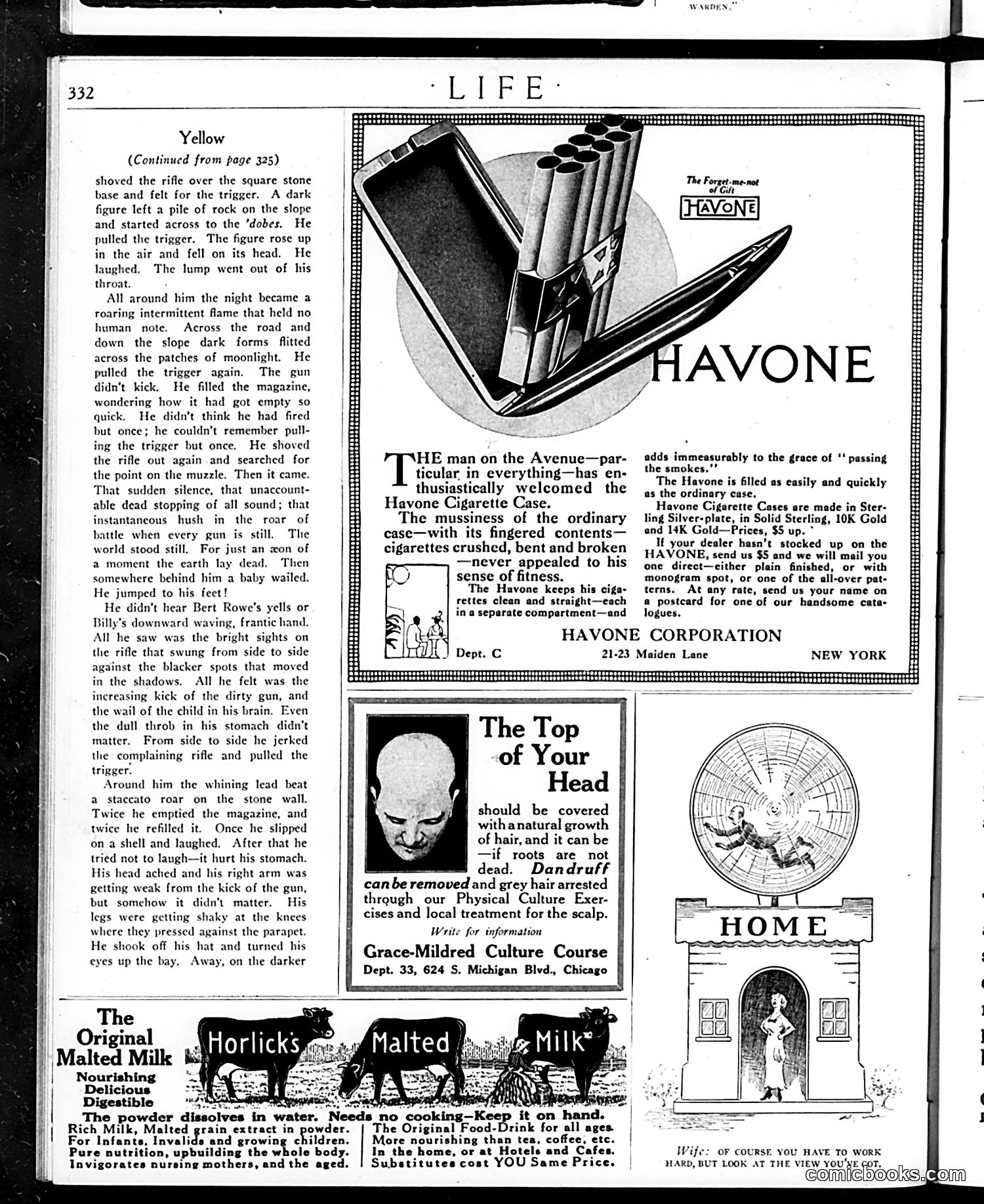
This page primarily contains **fiction and advertisements** rather than political cartoons. The main text is a continuation of a story titled "Yellow" depicting a soldier in combat—likely from World War I or a similar conflict—experiencing psychological breakdown. The narrative describes a man firing a rifle repeatedly, growing increasingly detached and mechanically violent, until a baby's cry breaks his composure. The advertisements include: - **Havone Cigarette Cases** (luxury goods for the refined gentleman) - **Grace-Mildred Culture Course** (hair/scalp treatments) - **Horlick's Malted Milk** (nutritional drink) The small illustration at bottom right, captioned "Wife: OF COURSE YOU HAVE TO WORK HARD, BUT LOOK AT THE VIEW YOU'VE GOT," appears to be a domestic humor cartoon showing a woman at a window—likely satirizing working-class aspirations or marriage dynamics. The page reflects early 20th-century Life magazine content: serious literary fiction alongside consumer advertising and mild domestic satire.
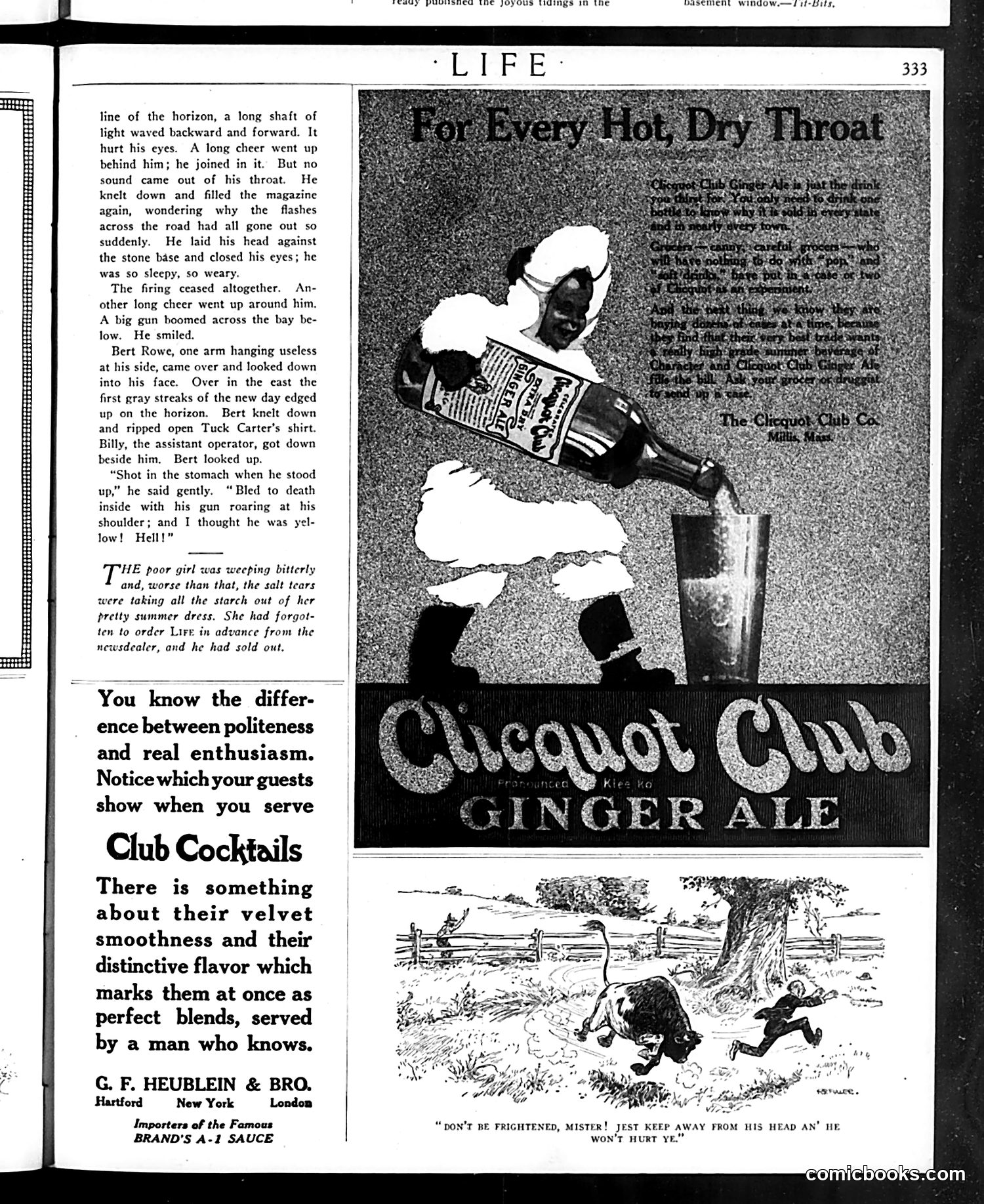
This page mixes a WWI story excerpt with period advertising. The main narrative describes a soldier (Tuck Carter) dying in combat—shot in the stomach while fighting, bleeding to death while manning his gun. His comrade Bert Rowe discovers the body at dawn after the bombardment ends, expressing regret that he'd misjudged Carter's courage, calling him a coward when he proved heroic. The satirical content appears in a small paragraph mocking a girl distressed not about wartime tragedy, but because she forgot to order *Life* magazine in advance and the newsdealer sold out—trivializing female concerns as petty consumer complaints during wartime. The page also contains ads for Club Cocktails and ginger ale, and a cartoon (bottom) showing a child being warned away from a donkey's head, unrelated to the war narrative.
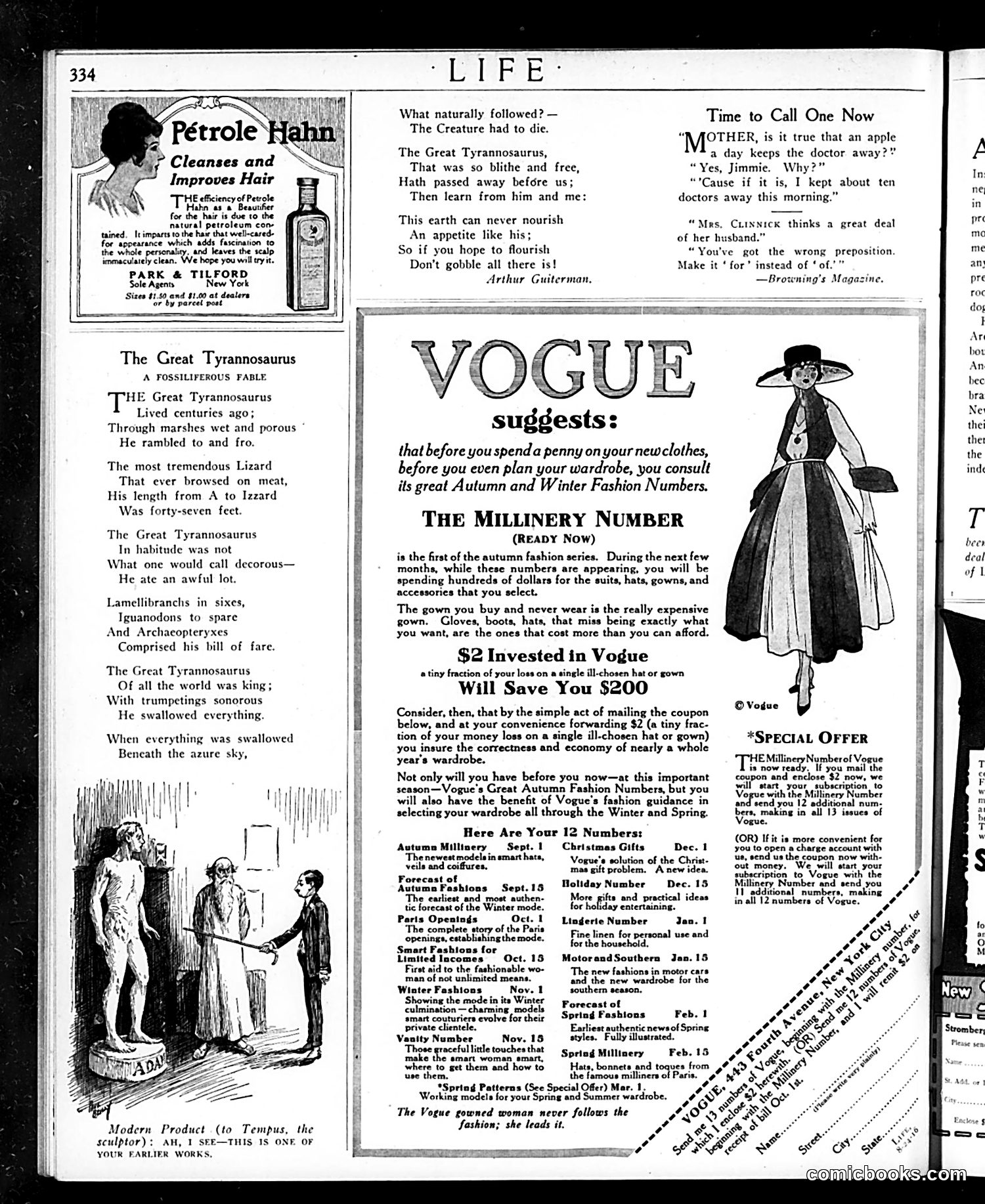
This page contains three distinct elements: **"The Great Tyrannosaurus" Poem**: A satirical fable by Arthur Guiterman uses an extinct dinosaur as metaphor for unchecked greed. The creature consumed everything voraciously until nothing remained, then starved. The moral warns against over-consumption: "Don't gobble all there is!" This reflects post-WWI concerns about resource depletion and excess. **"Time to Call One Now" Joke**: A brief humorous exchange where a mother corrects her son's grammar—he should say "a doctor" instead of "one," referencing the aphorism "an apple a day keeps the doctor away." **Vogue Advertisement**: Promotes subscription to Vogue's fashion numbers, claiming a $2 investment prevents $200 in wardrobe mistakes. The accompanying illustration shows a fashionable woman in a wide-brimmed hat. The page is primarily advertising, with the dinosaur poem as the main editorial content—typical of Life's mix of satirical commentary and commercial content.
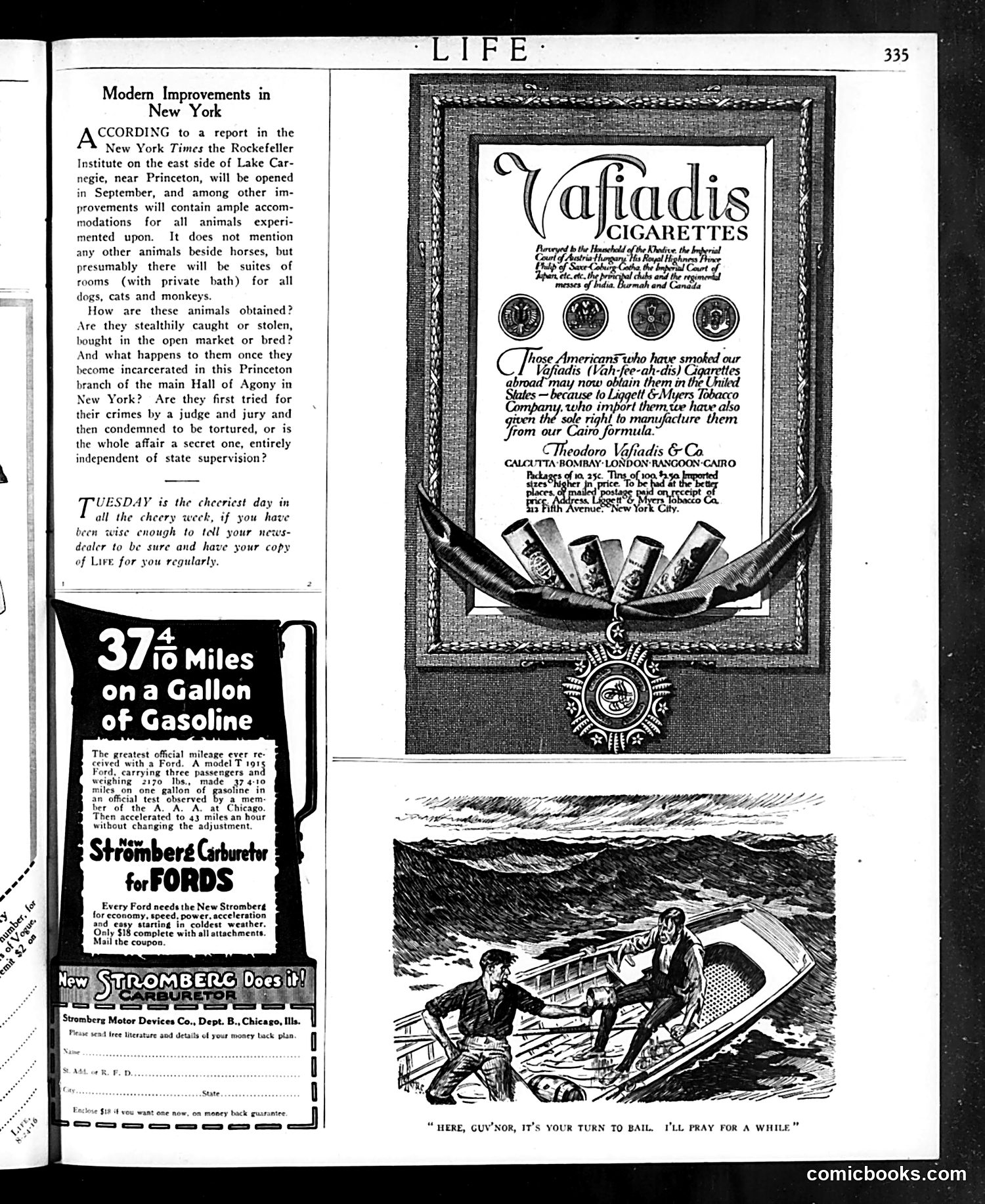
This page mixes advertisements with satirical commentary. The main text section critiques the Rockefeller Institute's animal experimentation facility near Princeton, sarcastically questioning whether lab animals are obtained through theft, purchase, or breeding—and whether their treatment involves judicial process or secret torture. The author implies the research happens without adequate state oversight. The advertisements are period-typical: a Stromberg carburetor promoting fuel economy for Ford automobiles, and a Vafiadis cigarette ad claiming Egyptian manufacture and endorsement from prominent smokers. The cartoon at bottom depicts two men in a boat during rough seas; one says "Here, guv'nor, it's your turn to bail. I'll pray for a while"—a humorous exchange suggesting the speaker avoids labor by offering prayer as his contribution to their survival. The joke relies on the contrast between practical action and religious passivity during crisis.
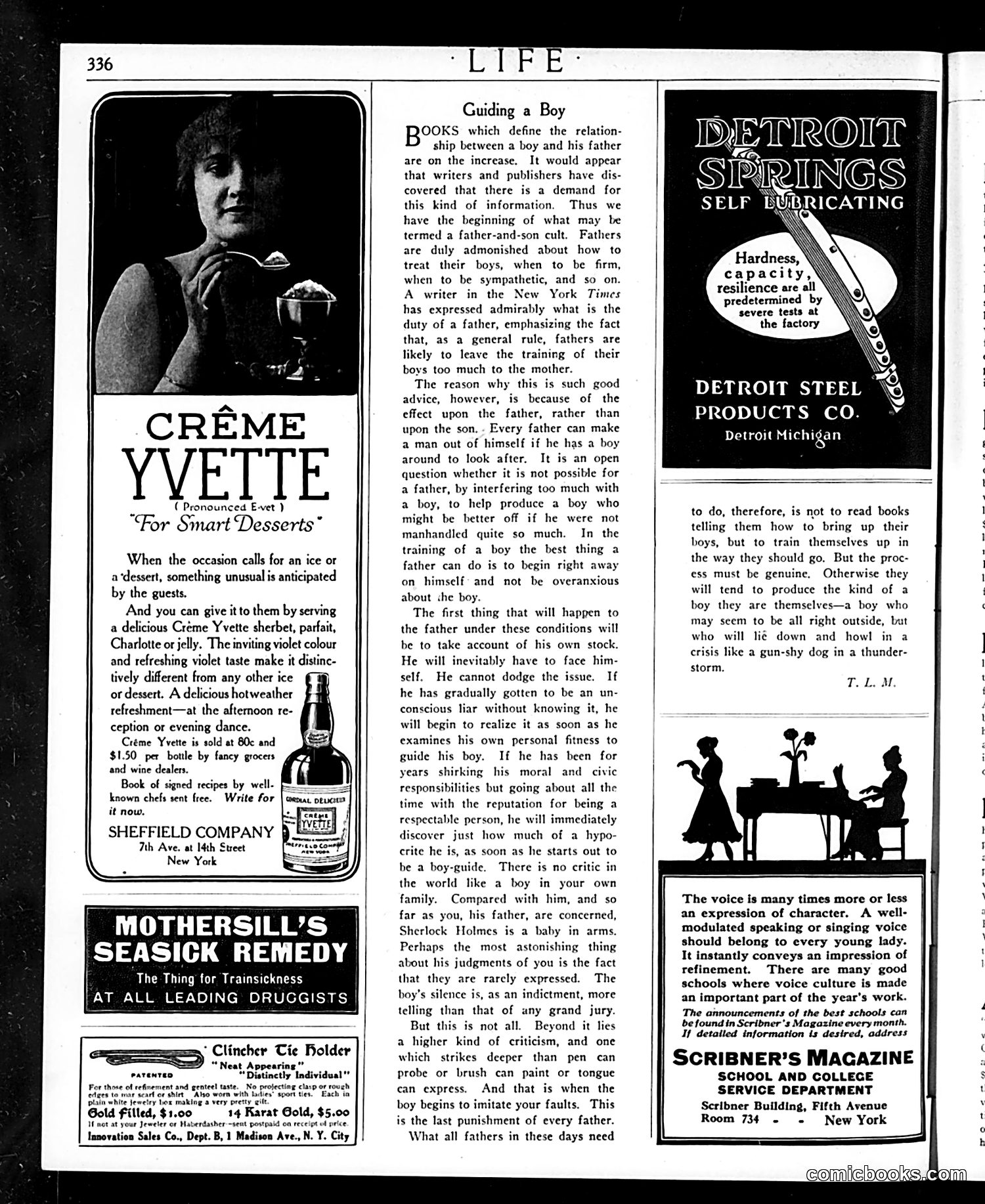
This page is primarily **advertising and editorial content**, not political satire or comics. The main article, "Guiding a Boy," discusses popular parenting literature and father-son relationships. It argues that fathers benefit more from training boys than boys benefit—a father must examine his own character to guide effectively. The piece emphasizes that a boy's silent observation and imitation of paternal faults serves as the ultimate paternal criticism. This reflects **early 20th-century anxieties about masculinity and parental responsibility**. The page contains advertisements for Crème Yvette (a dessert/liqueur), Mothersill's Seasick Remedy, and Clincher Tie Holders—typical commercial content for Life magazine. There is also an advertisement for Scribner's Magazine's School and College Service Department. **No political cartoons or satirical commentary appears on this page.** The content reflects period concerns about child-rearing and consumer products marketed to middle-class readers.
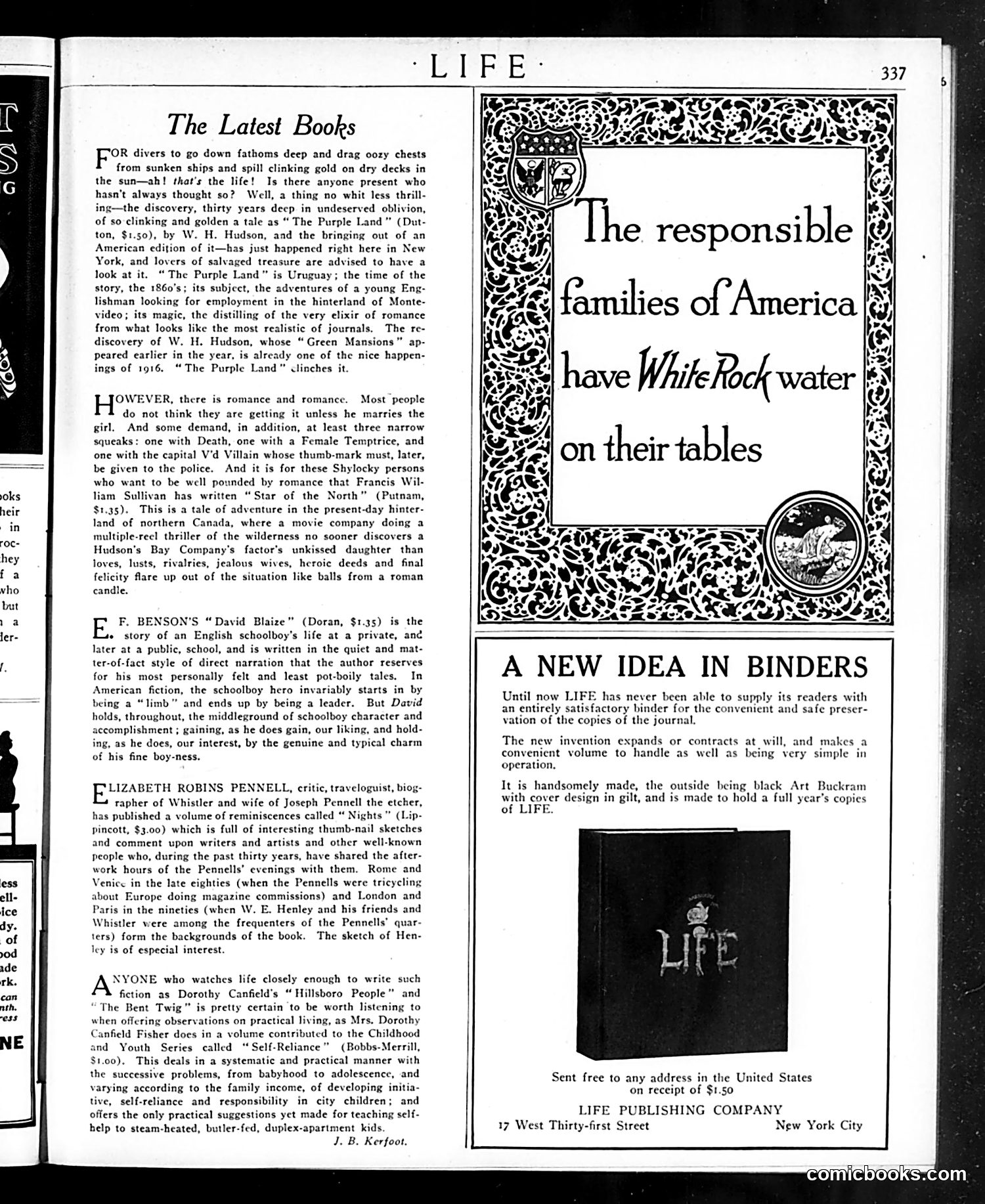
This page is primarily **book reviews**, not political satire or editorial cartoons. It discusses recent literary releases from 1916, including: - W.H. Hudson's rediscovered novel *The Purple Land* (set in 1860s Uruguay) - Francis William Sullivan's *Star of the North* (adventure tale set in Canadian wilderness) - E.F. Benson's *David Blaize* (English schoolboy story) - Elizabeth Robins Pennell's memoir *Nights* (reminiscences of artistic circles) - Dorothy Canfield Fisher's observations on practical living The right page contains a **White Rock water advertisement**—not editorial content. The ad claims "responsible families of America" use White Rock water, a common advertising appeal of the era associating a product with middle-class respectability. There is **no political cartoon or satire** visible. The page represents typical early-20th-century magazine content mixing literary criticism with advertising.
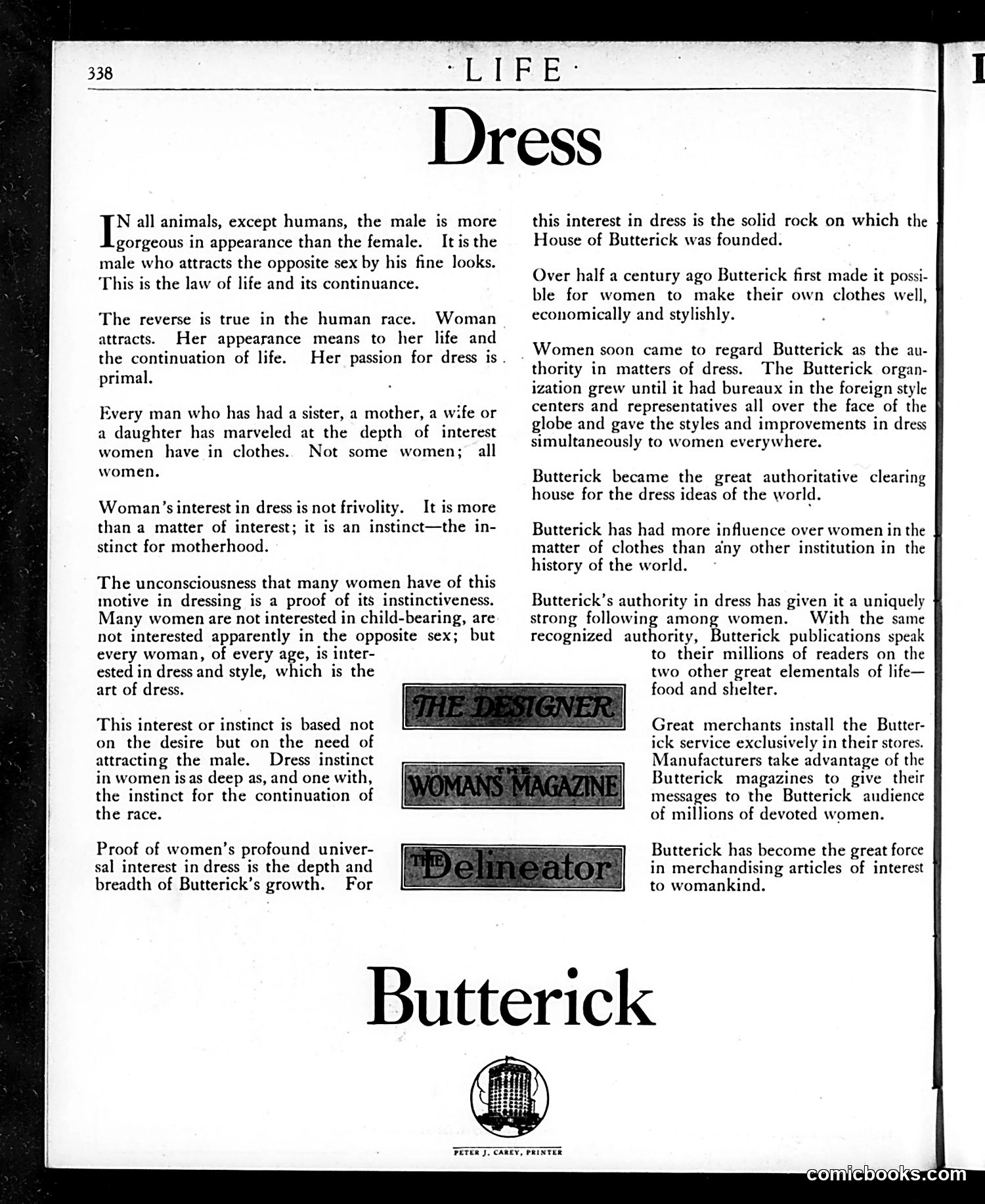
This is primarily a Butterick pattern company advertisement, not a satirical cartoon. It appears in **Life magazine** (page 338), using pseudo-scientific and pseudo-psychological arguments to justify women's interest in clothing. The "satire" (if present) lies in the article's earnest biological claims: that women's dress interest is an evolutionary instinct tied to reproduction, deeper than conscious choice. By modern standards, this reads as absurdly reductive—reducing women's agency to biological drives while simultaneously celebrating Butterick's influence as the "great force in merchandising." The text positions Butterick as authoritative not just for fashion but for "food and shelter"—essentially claiming dominion over women's domestic lives. The logic is circular: women universally care about dress (presented as biological fact), therefore Butterick's success proves this instinct's universality, therefore merchants should trust Butterick to reach female consumers. The logos shown (**The Designer, Woman's Magazine, The Delineator**) represent Butterick's publishing empire used to disseminate fashion authority.