
Life, 1916-08-24 · page 14 of 42
Life — August 24, 1916 — page 14: what you’re looking at
What you’re looking at
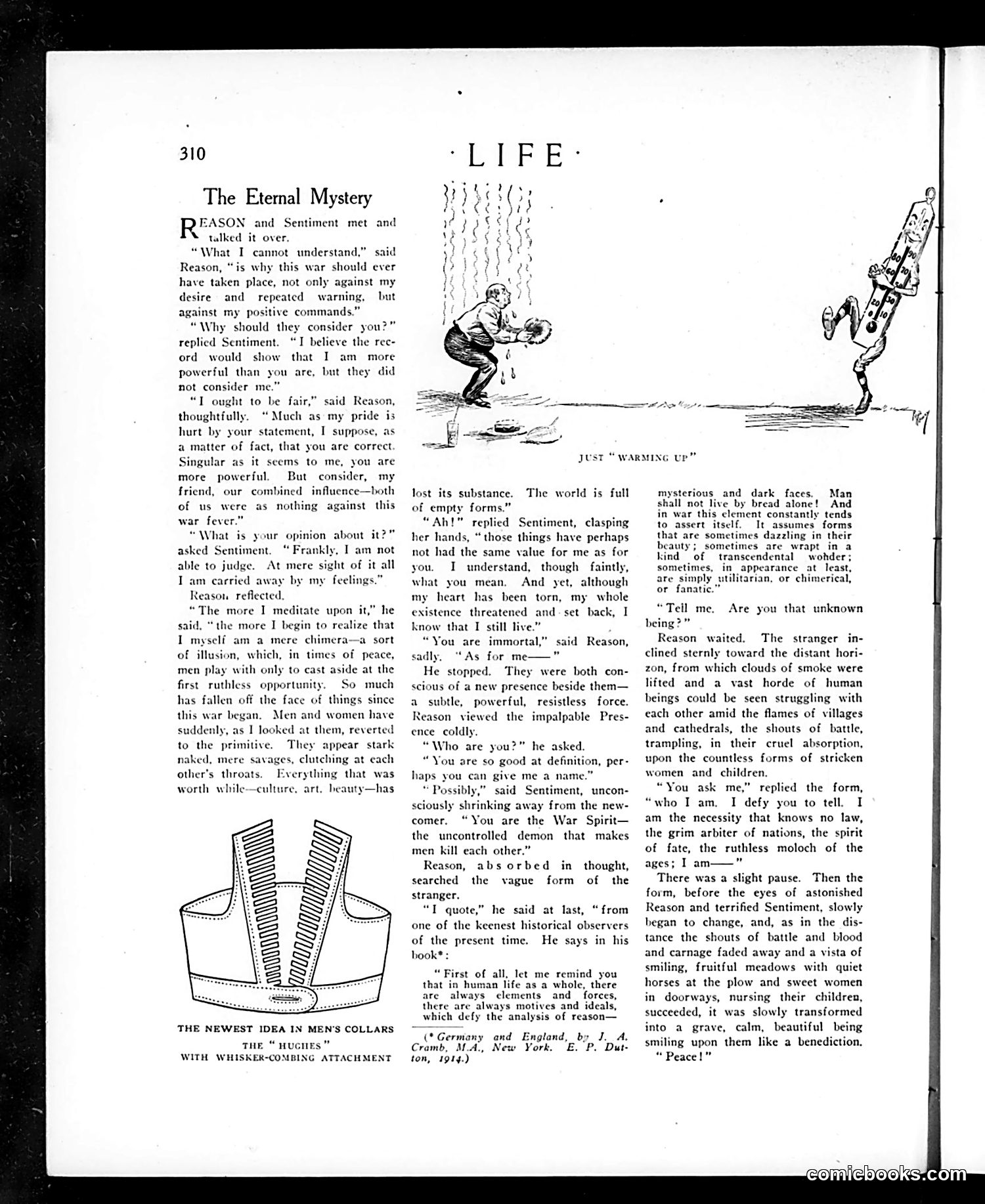
This is a literary allegorical dialogue between "Reason" and "Sentiment" debating World War I's justification. The text presents Reason defending the war's necessity while Sentiment expresses emotional anguish at its brutality. The accompanying illustration shows two figures in dynamic poses—one crouching defensively, the other lunging aggressively—labeled "Just 'Warming Up,'" suggesting soldiers preparing for combat. The narrative culminates with an unnamed "War Spirit" figure—described as an "uncontrolled demon"—transforming a peaceful pastoral landscape into death and destruction. The satire critiques how abstract rationalization ("Reason") justifies war's terrible human costs, while the War Spirit itself remains an unstoppable, dehumanizing force beyond rational control. The advertisement below promotes "Hughes" men's collars, typical of period *Life* magazine content.
📄 Transcribed text from this page (OCR, searchable)
Machine-transcribed from the original scan — historical spelling and the odd misread are preserved.
310 The Eternal Mystery ASON and talked it over. “What I cannot understand,” said Reason, “is why this war should ever have taken place, not only against my desire and repeated — warnin; but against my positive commands. “Why should they consider you?” replied Sentiment. “I believe the rec- ord would show that I am = more powerful than you are, but they did not consider me.” “I ought to be fair,” said Reason, thoughtfully. “Much as my pride is hurt by your statement, I suppose, as a matter of fact, that you are correct Singular as it seems to me, you are more powerful, But consider, my friend, our combined influence—both of us were as nothing against this war fever.” “What is your opinion about it?” asked Sentiment.“ Fi » Lam not able to judge. At mere sight of it all I am carried away by my feelings. Reason reflected, “The more I meditate upon it,” he said, “the more I begin to realize that I myself am a mere chimera—a sort of illusion, which, in times of peace, men play with only to cast aside at the first ruthless opportunity. So much has fallen off the face of things since this war began. Men and women have suddenly, as I looked at them, reverted to the primitive. They appear stark naked, mere savages, clutching at each other's throats. Everything that was worth while—culture. art. heauty—has Sentiment met and THE NEWEST IDEA IN MEN'S COLLARS THE “ HUGHE WITH WHISKER-COMBING ATTACHMENT just lost its substance. The world is full of empty forms.’ “Ah!” replied Sentiment, clasping her hands, “those things have perhaps not had the same value for me as for you. I understand, though faintly, what you mean. And yet, although my heart has been torn, my whole existence threatened and: set back, I know that I still live.” “You are immortal,” adly, “As for me— He stopped. They were both con- scious of a new presence beside then— a subtle, powerful, resistless force. Reason viewed the impalpable Pres- ence coldly. “Who are you?” he asked. “You are so good at definition, per- haps you can give me a name.” “ Possibly,” said Sentiment, uncon- sciously shrinking away from the new- comer. “You are the War Spirit— the uncontrolled demon that makes men kill each other,” Reason, absorbed in searched the vague stranger. “IT quote,” he said at last, “from one of the keenest historical observers of the present time. He says in his hook* : irst of all, let me remind you that in human life as a whole, there are always elements and forces, there are always motives and ideals, which defy the analysis of reason— and England, by J. A. New York. E. P. Dut- aid Reason, thought, form of the (* German: Cramb, M.A. ton, 1914.) “WARMING UP Man And mysterious and dark faces. shall not live by bread alone! in war this element constantly tends to assert itself. It assumes forms that are sometimes dazzling in their beauty; sometimes are wrapt in a kind "of transcendental wohder; sometimes, in appearance at least, are simply utilitarian, or chimerical, or fanatic.” “Tell me. being?” Reason waited. The stranger in- clined sternly toward the distant hori- zon, from which clouds of smoke were lifted and a vast horde of human beings could be seen struggling with each other amid the flames of villages and cathedrals, the shouts of battle, trampling, in their cruel absorption, upon the countless forms of stricken women and children. “You ask me,” replied the form, “who Iam. I defy you to tell. I am the necessity that knows no law, the grim arbiter of nations, the spirit of fate, the ruthless moloch of the Are you that unknown ages; 1 am—— There was a slight pause. Then the form, before the eyes of astonished Reason and terrified Sentiment, slowly began to change, and, as in the dis- tance the shouts of battle and blood and carnage faded away and a vista of smiling, fruitful meadows with quiet horses at the plow and sweet women in doorways, nursing their children, succeeded, it was slowly transformed into a grave, calm, beautiful being smiling upon them like a benediction. “ Peace!”