
Life, 1916-08-24 · page 42 of 42
Life — August 24, 1916 — page 42: what you’re looking at
What you’re looking at
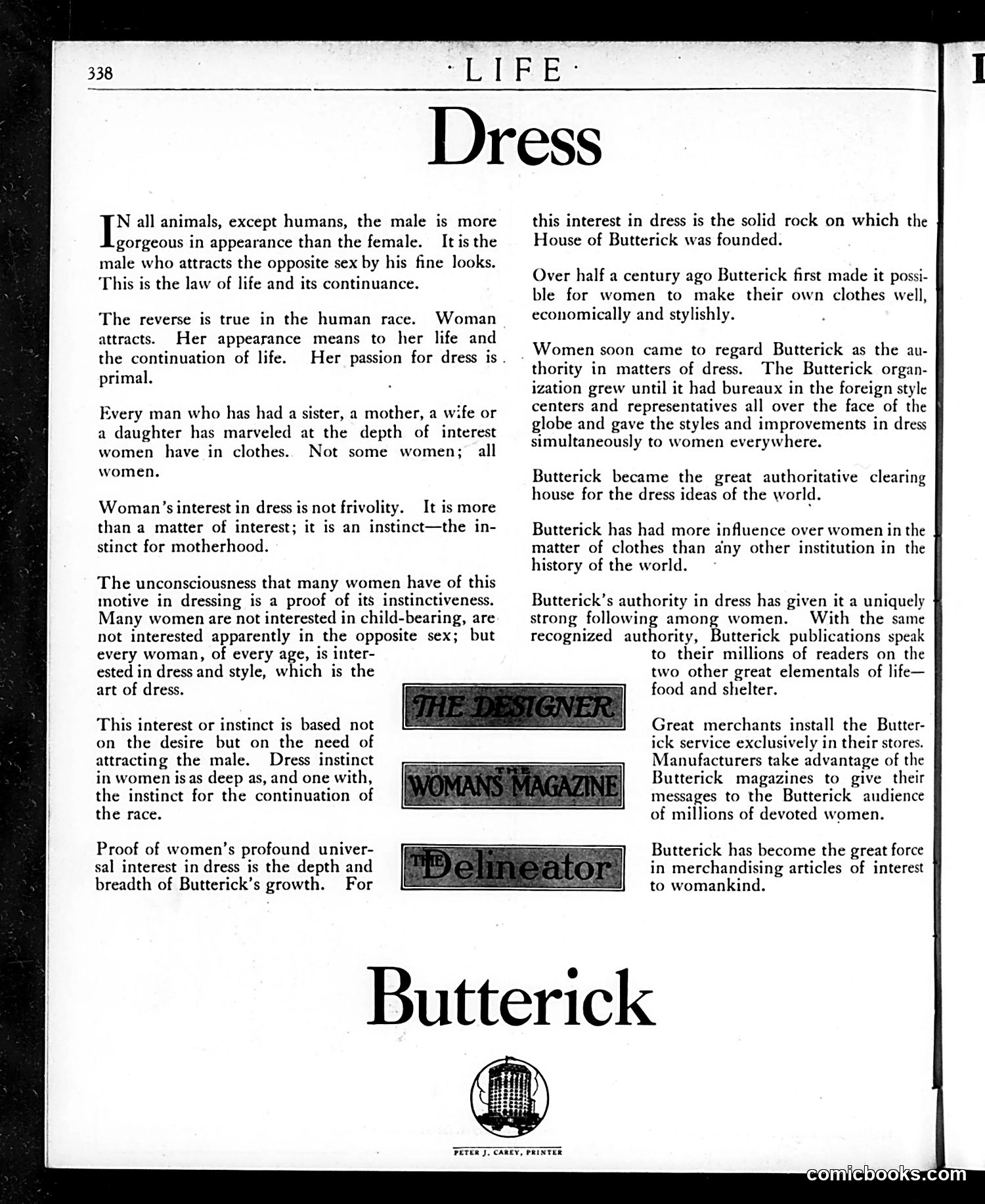
This is primarily a Butterick pattern company advertisement, not a satirical cartoon. It appears in **Life magazine** (page 338), using pseudo-scientific and pseudo-psychological arguments to justify women's interest in clothing. The "satire" (if present) lies in the article's earnest biological claims: that women's dress interest is an evolutionary instinct tied to reproduction, deeper than conscious choice. By modern standards, this reads as absurdly reductive—reducing women's agency to biological drives while simultaneously celebrating Butterick's influence as the "great force in merchandising." The text positions Butterick as authoritative not just for fashion but for "food and shelter"—essentially claiming dominion over women's domestic lives. The logic is circular: women universally care about dress (presented as biological fact), therefore Butterick's success proves this instinct's universality, therefore merchants should trust Butterick to reach female consumers. The logos shown (**The Designer, Woman's Magazine, The Delineator**) represent Butterick's publishing empire used to disseminate fashion authority.
📄 Transcribed text from this page (OCR, searchable)
Machine-transcribed from the original scan — historical spelling and the odd misread are preserved.
elbg Pde Dress N all animals, except humans, the male is more gorgeous in appearance than the female. It is the male who attracts the opposite sex by his fine looks. This is the law of life and its continuance. The reverse is true in the human race. Woman attracts. Her appearance means to her life and the continuation of life. primal. Every man who has had a sister, a mother, a wife or a daughter has marveled at the depth of interest women have in clothes. Not some women; all women. Woman’s interest in dress is not frivolity. It is more than a matter of interest; it is an instinct—the in- stinct for motherhood. The unconsciousness that many women have of this motive in dressing is a proof of its instinctiveness. Many women are not interested in child-bearing, are not interested apparently in the opposite sex; but every woman, of every age, is inter- ested in dress and style, which is the art of dress. This interest or instinct is based not on the desire but on the need of attracting the male. Dress instinct in women isas deep as, and one with, the instinct for the continuation of the race. Proof of women’s profound univer- sal interest in dress is the depth and breadth of Butterick’s growth. For Her passion for dress is . this interest in dress is the solid rock on which the House of Butterick was founded. Over half a century ago Butterick first made it possi- ble for women to make their own clothes well, economically and stylishly. Women soon came to regard Butterick as the au- thority in matters of dress. The Butterick organ- ization grew until it had bureaux in the foreign style centers and representatives all over the face of the globe and gave the styles and improvements in dress simultaneously to women everywhere. Butterick became the great authoritative clearing house for the dress ideas of the world. Butterick has had more influence over women in the matter of clothes than any other institution in the history of the world. Butterick’s authority in dress has given it a uniquely strong following among women. With the same recognized authority, Butterick publications speak to their millions of readers on the two other great elementals of life— food and shelter. Great merchants install the Butter- ick service exclusively in their stores. Manufacturers take advantage of the Butterick magazines to give their messages to the Butterick audience of millions of devoted women. Butterick has become the great force in merchandising articles of interest to womankind. Butterick Pere J, CAREY,