
Life, 1916-08-24 · page 27 of 42
Life — August 24, 1916 — page 27: what you’re looking at
What you’re looking at
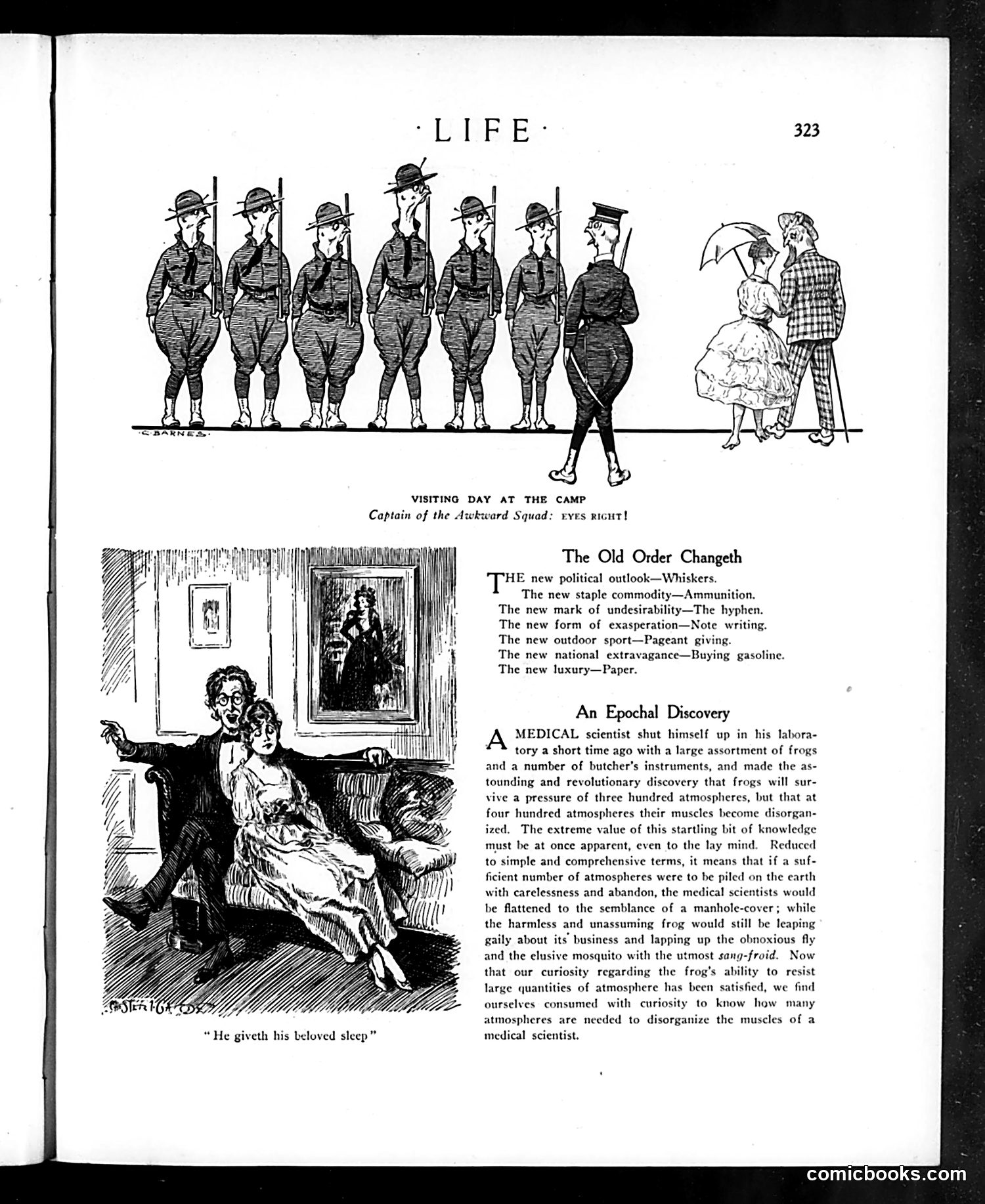
**Top Cartoon:** "Visiting Day at the Camp" shows seven soldiers in formation being inspected by a visiting officer, with civilians (women and a man with umbrella) observing. The caption "Captain of the Awkward Squad: yes right!" suggests these are poorly trained or clumsy recruits—likely WWI-era draftees. The humor lies in their apparent incompetence during inspection. **"The Old Order Changeth":** A satirical list mocking wartime changes: facial hair as fashion, ammunition shortages, the "hyphen" (likely referencing German-Americans or hyphenated identities), note-writing as complaint, pageants as entertainment, gasoline rationing, and paper scarcity. This critiques the disruptions and absurdities of wartime society. **"An Epochal Discovery":** Humorous pseudo-scientific satire about a scientist discovering frogs survive 300 atmospheres of pressure but not 400. The joke mocks pointless research—sarcastically suggesting the scientist himself should be pressurized, implying academic work disconnected from practical wartime needs.
📄 Transcribed text from this page (OCR, searchable)
Machine-transcribed from the original scan — historical spelling and the odd misread are preserved.
VISITING DAY AT THE CAMP Captain of the Awkward Squad: yes ricut! y a } } The Old Order Changeth ‘| a . A 'HE new political outlook—Whiskers. i The new staple commodity—Ammunition. The new mark of undesirability—The hyphen. The new form of exasperation—Note writing. The new outdoor sport—Pageant giving. The new national extravagance—Buying gasoline. The new luxury—Paper. f t An Epochal Discovery MEDICAL scientist shut himself up in his labora- tory a short time ago with a large assortment of frogs : and a number of butcher's instruments, and made the as- Cagil j tounding and revolutionary discovery that frogs will sur- y vive a pressure of three hundred atmospheres, but that at i( four hundred atmospheres their muscles become disorgan- ized. The extreme value of this startling bit of knowledge must be at once apparent, even to the lay mind. Reduced to simple and comprehensive terms, it means that if a suf- ficient number of atmospheres were to be piled on the earth with carelessness and abandon, the medical scientists would be flattened to the semblance of a manhole-cover; while the harmless and unassuming frog would still be leaping gaily about its business and lapping up the obnoxious fly and the elusive mosquito with the utmost sang-froid. Now that our curiosity regarding the frog’s ability to resist large quantities of atmosphere has been satisfied, we find ourselves consumed with curiosity to know how many atmospheres are needed to disorganize the muscles of a “He giveth his beloved sleep” medical scientist. comicbooks.com