
Life, 1916-08-24 · page 20 of 42
Life — August 24, 1916 — page 20: what you’re looking at
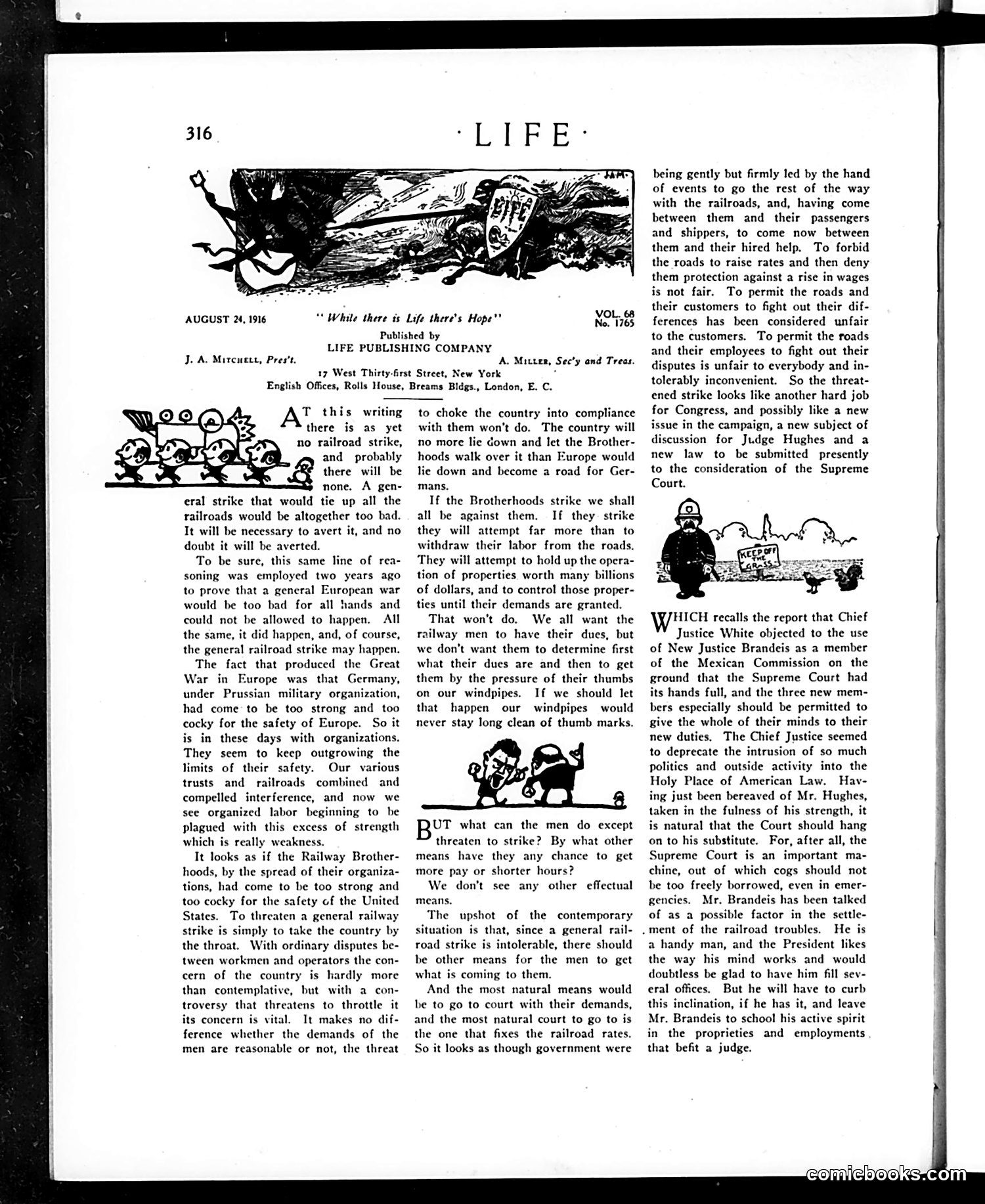
A restored page from Life, 1916-08-24. Page through the whole issue in the reader above.
📄 Transcribed text from this page (OCR, searchable)
Machine-transcribed from the original scan — historical spelling and the odd misread are preserved.
AUGUST 24, 1916 “* While there ts Life there's Hope"’ VOL. 68 1765 Published by LIFE PUBLISHING COMPANY J. A. Mircuett, Pres’t. A. Mitten, Sec’y and Treas. 17 West Thirty-first Street, New York English Offices, Rolls House, Breams Bldgs., London, E. C. T this w rd there is as yet no railroad strike, and probably there will be none, A gen- eral strike that would tie up all the railroads would be altogether too bad. It will be necessary to avert it, and no doubt it will be averted. To be sure, this same line of rea- soning was employed two years ago to prove that a general European war would be too bad for all hands and could not be allowed to happen. All the same, it did happen, and, of course, the general railroad strike may happen. The fact that produced the Great War in Europe was that Germany, under Prussian military organization, had come to be too strong and too cocky for the safety of Europe. So it is in these days with organizations. They seem to keep outgrowing the limits of their safety. Our various trusts and railroads combined and compelled interference, and now we see organized labor beginning to be plagued with this excess of strength which is really weakness. It looks as if the Railway Brother- hoods, by the spread of their organiza- tions, had come to be too strong and too cocky for the safety of the United States. To threaten a general railway strike is simply to take the country by the throat. With ordinary disputes be- tween workmen and operators the con- cern of the country is hardly more than contemplative, but with a con- troversy that threatens to throttle it its concern is vital. It makes no dif- ference whether the demands of the men are reasonable or not, the threat to choke the country into compliance with them won't do. The country will no more lic down and let the Brother- hoods walk over it than Europe would lie down and become a road for Ger- mans. If the Brotherhoods strike we shall all be against them. If they strike they will attempt far more than to withdraw their labor from the roads. They will attempt to hold up the opera- tion of properties worth many billions of dollars, and to control those proper- ties until their demands are granted. That won't do. We all want the railway men to have their dues, but we don’t want them to determine first what their dues are and then to get them by the pressure of their thumbs on our windpipes. If we should let that happen our windpipes would never stay long clean of thumb marks. Be what can the men do except threaten to strike? By what other means have they any chance to get more pay or shorter hours? We don’t see any other effectual means. The upshot of the contemporary situation is that, since a general rail- road strike is intolerable, there should be other means for the men to get what is coming to them. And the most natural means would be to go to court with their demands, and the most natural court to go to is the one that fixes the railroad rates. So it looks as though government were «ment of the railroad troubles. being gently but firmly led by the hand of events to go the rest of the way with the railroads, and, having come between them and their passengers and shippers, to come now between them and their hired help. To forbid the roads to raise rates and then deny them protection against a rise in wages is not fair. To permit the roads and their customers to fight out their dif- ferences has been considered unfair to the customers. To permit the roads and their employees to fight out their disputes is unfair to everybody and in- tolerably inconvenient. So the threat- ened strike looks like another hard job for Congress, and possibly like a new issue in the campaign, a new subject of discussion for Judge Hughes and a new law to be submitted presently to the consideration of the Supreme Court. Wick recalls the report that Chief Justice White objected to the use of New Justice Brandeis as a member of the Mexican Commission on the ground that the Supreme Court had its hands full, and the three new mem- bers especially should be permitted to give the whole of their minds to their new duties, The Chief Justice seemed to deprecate the intrusion of so much politics and outside activity into the Holy Place of American Law. Hav: ing just been bereaved of Mr. Hughes, taken in the fulness of his strength, it is natural that the Court should hang on to his substitute. For, after all, the Supreme Court is an important ma- chine, out of which cogs should not be too freely borrowed, even in emer- gencies. Mr. Brandeis has been talked of as a possible factor in the settle- He is a handy man, and the President likes the way his mind works and would doubtless be glad to have him fill sev- eral offices. But he will have to curb this inclination, if he has it, and leave Mr. Brandeis to school his active spirit in the proprieties and employments that befit a judge.