
Life, 1916-08-24 · page 21 of 42
Life — August 24, 1916 — page 21: what you’re looking at
What you’re looking at
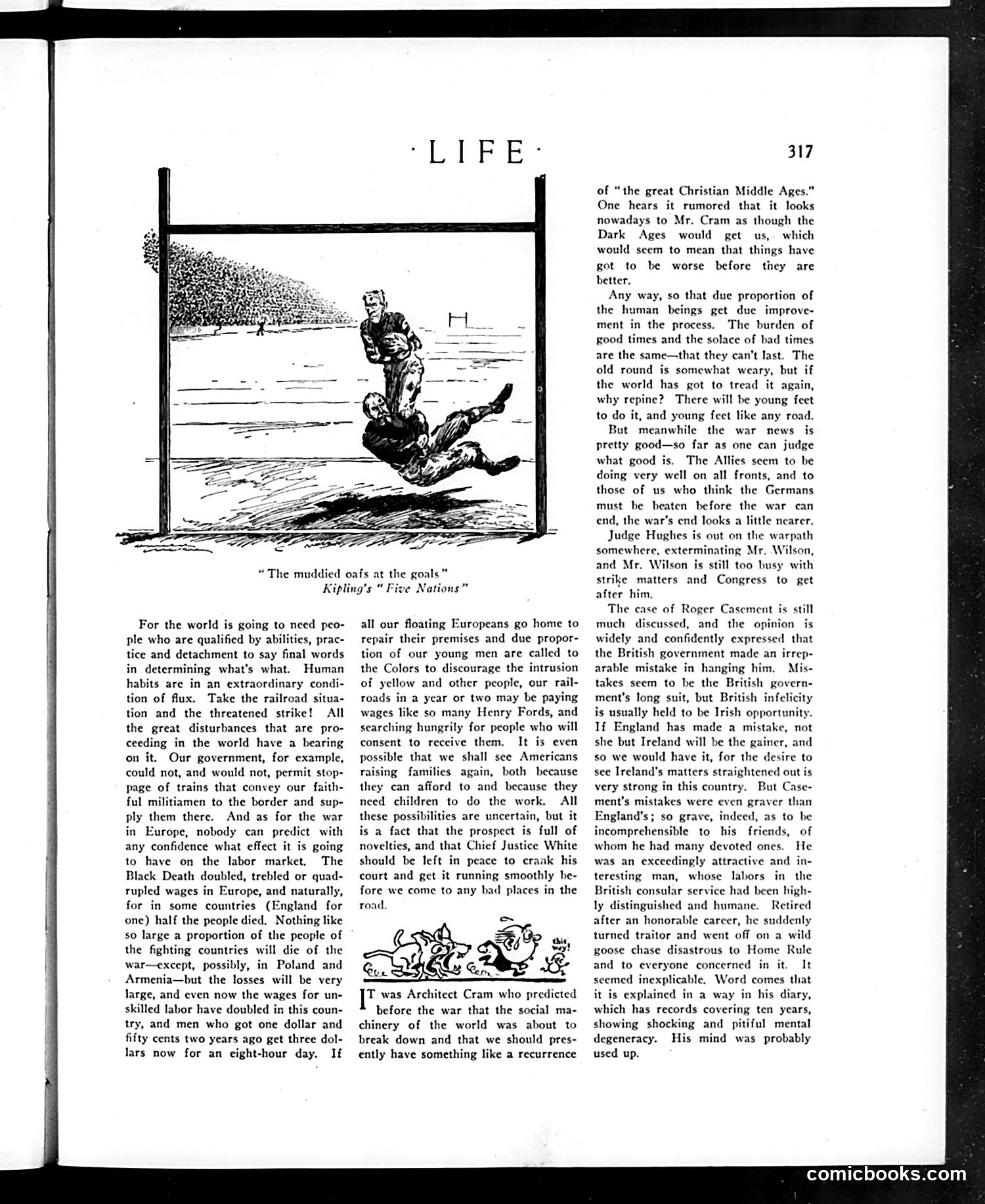
The cartoon, captioned "The muddied oafs" from Kipling's "Five Nations," depicts a soldier slipping or falling in mud while another watches from above. It illustrates the text's discussion of World War I's human and economic consequences. The accompanying essay addresses post-war labor disruptions, railroad strikes, and wage inflation caused by massive casualties in Europe. The author predicts that if young Americans are conscripted and Europeans return home to rebuild, labor shortages will force American wages to rise dramatically—possibly high enough that families could afford children again to work. The piece also mentions political figures: Chief Justice White, Judge Hughes (Charles Evans Hughes, apparently running against Wilson), and Roger Casement (the Irish nationalist executed by Britain, sparking controversy). The essay suggests this period of upheaval might precipitate either a "Christian Middle Ages" recovery or descent into actual "Dark Ages," depending on how societies manage the transition.
📄 Transcribed text from this page (OCR, searchable)
Machine-transcribed from the original scan — historical spelling and the odd misread are preserved.
“The muddied oafs Kipling’s “ For the world is going to need peo- ple who are qualified by abilities, prac- tice and detachment to say final words in determining what's what. Human habits are in an extraordinary condi- tion of flux. Take the railroad situa- tion and the threatened strike! All the great disturbances that are pro- ceeding in the world have a bearing on it. Our government, for example, could not, and would not, permit stop- page of trains that convey our faith- ful militiamen to the border and sup- ply them there. And as for the war in Europe, nobody can predict with any confidence what effect it is going to have on the labor market, The Black Death doubled, trebled or quad- rupled wages in Europe, and naturally, for in some countries (England for one) half the people died, Nothing like so large a proportion of the people of the fighting countries will die of the war—except, possibly, in Poland and Armenia—but the losses will be very large, and even now the wages for un- skilled labor have doubled in this coun- try, and men who got one dollar and fifty cents two years ago get three dol- lars now for an eight-hour day. If ve Nations” all our floating Europeans go home to repair their premises and due propor- tion of our young men are called to the Colors to discourage the intrusion of yellow and other people, our rail- roads in a year or two may be paying wages like so many Henry Fords, and searching hungrily for people who will consent to receive them. It is even possible that we shall see Americans raising families again, both because they can afford to and because they need children to do the work. All these possibilities are uncertain, but it is a fact that the prospect is full of novelties, and that Chief Justice White should be left in peace to crank his court and get it running smoothly be- fore we come to any bad places in the road. T was Architect Cram who predicted before the war that the social ma- chinery of the world was about to break down and that we should pres- ently have something like a recurrence 317 of “the great Christian Middle Ages.” One hears it rumored that it looks nowadays to Mr. Cram as though the Dark Ages would get us, which would seem to mean that things have got to be worse before they are better. Any way, so that due proportion of the human beings get due improve- ment in the process. The burden of good times and the solace of had times are the same—that they can't last. The old round is somewhat weary, but if the world has got to tread it again, why repine? There will be young feet to do it, and young feet like any road. But meanwhile the war news is pretty good—so far as one can judge what good The Allies seem to be doing very well on all fronts, and to those of us who think the Germans must he beaten before the war can end, the war's end looks a little nearer. Judge Hughes is out on the warpath somewhere, exterminating Mr. Wilson, and Mr. Wilson is still too busy with strike matters and Congress to get after him. The case of Roger Casement is still much discussed, and the opinion is widely and confidently expressed that the British government made an irrep- arable mistake in hanging him. Mis- takes seem to be the British govern- ment’s long suit, but British infelicity is usually held to be Irish opportunity. If England has made a mistake, not she but Ireland will be the gainer, and so we would have it, for the desire to see Ireland's matters straightened out is very strong in this country. But Case- ment’s mistakes were even graver than England's; so grave, indeed, as to be incomprehensible to his friends, of whom he had many devoted ones. He was an exceedingly attractive and in- teresting man, whose labors in the British consular service had been high- ly distinguished and humane. Retired after an honorable career, he suddenly turned traitor and went off on a wild goose chase disastrous to Home Rule and to everyone concerned in it. It seemed inexplicable. Word comes that it is explained in a way in his diary, which has records covering ten years, showing shocking and pitiful mental degeneracy. His mind was probably used up. comicbooks.com