
Life, 1916-08-24 · page 29 of 42
Life — August 24, 1916 — page 29: what you’re looking at
What you’re looking at
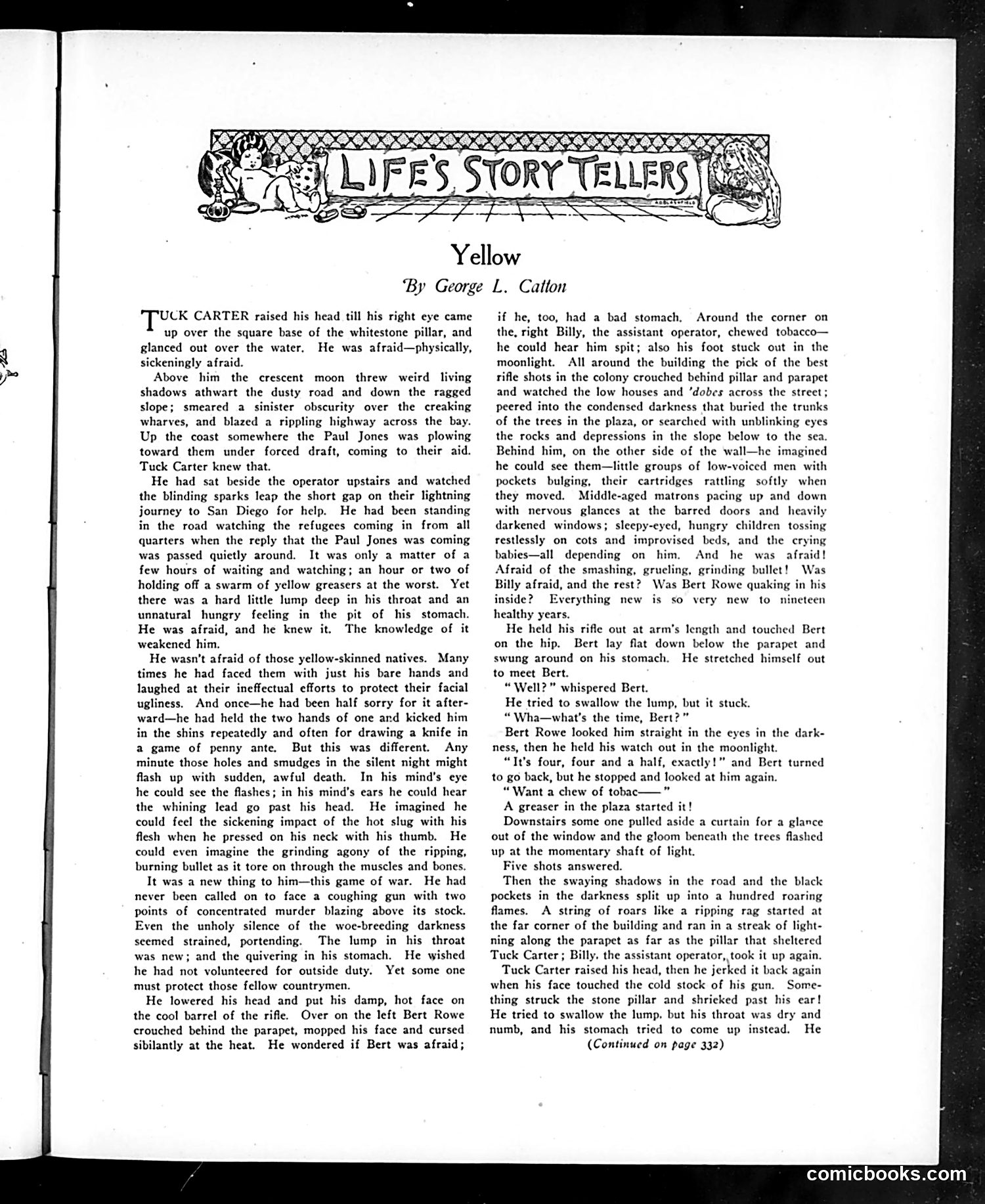
This is a serialized fiction story, not a political cartoon. It depicts an American military confrontation in what appears to be colonial-era Mexico or the American Southwest. The narrative follows Tuck Carter, a young American soldier defending a fortified position against impending attack by Mexican forces (referred to pejoratively as "yellow-skinned natives" and "yellow greasers"). Carter experiences fear for the first time in actual combat, mentally imagining the trauma of being shot. **Historical context**: This likely references late 19th or early 20th-century American imperial conflicts, possibly the Mexican-American War era or U.S. interventions in Mexico. The offensive racial language reflects period attitudes toward Mexican and Indigenous peoples. The story explores themes of masculine courage, duty, and the psychological terror of modern warfare—contrasting Carter's previous hand-to-hand dominance over natives with his vulnerability to gunfire.
📄 Transcribed text from this page (OCR, searchable)
Machine-transcribed from the original scan — historical spelling and the odd misread are preserved.
SETee AMGODS ‘By George 'UCK CARTER raised his head till his right eye came up over the square base of the whitestone pillar, and glanced out over the water. He was afraid—physically, sickeningly afraid. Above him the crescent moon threw weird living shadows athwart the dusty road and down the ragged slope; smeared a sinister obscurity over the creaking wharves, and blazed a rippling highway across the bay. Up the coast somewhere the Paul Jones was plowing toward them under forced draft, coming to their aid. Tuck Carter knew that. He had sat beside the operator upstairs and watched the blinding sparks leap the short gap on their lightning journey to San Diego for help. He had been standing in the road watching the refugees coming in from all quarters when the reply that the Paul Jones was coming was passed quietly around. It was only a matter of a few hours of waiting and watching; an hour or two of holding off a swarm of yellow greasers at the worst. Yet there was a hard little lump deep in his throat and an unnatural hungry feeling in the pit of his stomach. He was afraid, and he knew it. The knowledge of it weakened him. He wasn’t afraid of those yellow-skinned natives. Many times he had faced them with just his bare hands and laughed at their ineffectual efforts to protect their facial ugliness. And once—he had been half sorry for it after- ward—he had held the two hands of one ard kicked him in the shins repeatedly and often for drawing a knife in a game of penny ante. But this was different. Any minute those holes and smudges in the silent night might flash up with sudden, awful death. In his mind’s eye he could see the flashes; in his mind’s ears he could hear the whining lead go past his head. He imagined he could feel the sickening impact of the hot slug with his flesh when he pressed on his neck with his thumb. He could even imagine the grinding agony of the ripping, burning bullet as it tore on through the muscles and bones. It was a new thing to him—this game of war. He had never been called on to face a coughing gun with two points of concentrated murder blazing above its stock. Even the unholy silence of the woe-breeding darkness seemed strained, portending. The lump in his throat was new; and the quivering in his stomach. He wished he had not volunteered for outside duty. Yet some one must protect those fellow countrymen. He lowered his head and put his damp, hot face on the cool barrel of the rifle. Over on the left Bert Rowe crouched behind the parapet, mopped his face and cursed sibilantly at the heat. He wondered if Bert was afraid; L. Catton if he, too, had a bad stomach, Around the corner on the, right Billy, the assistant operator, chewed tobacco— he could hear him spit; also his foot stuck out in the moonlight. All around the building the pick of the best rifle shots in the colony crouched behind pillar and parapet and watched the low houses and ‘dobes across the street; peered into the condensed darkness that buried the trunks of the trees in the plaza, or searched with unblinking eyes the rocks and depressions in the slope below to the sea. Behind him, on the other side of the wall—he imagined he could see them—little groups of low-voiced men with pockets bulging, their cartridges rattling softly when they moved. Middle-aged matrons pacing up and down with nervous glances at the barred doors and heavily darkened windows; sleepy-eyed, hungry children tossing restlessly on cots and improvised beds, and the crying babies—all depending on him. And he was afraid! Afraid of the smashing, grueling, grinding bullet! Was Billy afraid, and the rest? Was Bert Rowe quaking in his inside? Everything new is so very new to nineteen healthy years. He held his rifle out at arm's length and touched Bert on the hip. Bert lay flat down below the parapet and swung around on his stomach. He stretched himself out to meet Bert. “Well?” whispered Bert. He tried to swallow the lump, but it stuck. “ Wha—what’s the time, Bert?” Bert Rowe looked him straight in the eyes in the dark- ness, then he held his watch out in the moonlight. “It's four, four and a half, exactly!" and Bert turned to go back, but he stopped and looked at him again. “Want a chew of tobac——” A greaser in the plaza started it! Downstairs some one pulled aside a curtain for a glance out of the window and the gloom beneath the trees flashed up at the momentary shaft of light. Five shots answered. Then the swaying shadows in the road and the black pockets in the darkness split up into a hundred roaring flames. A string of roars like a ripping rag started at the far corner of the building and ran in a streak of light- ning along the parapet as far as the pillar that sheltered Tuck Carter; Billy, the assistant operator, took it up again. Tuck Carter raised his head, then he jerked it back again when his face touched the cold stock of his gun. Some- thing struck the stone pillar and shrieked past his ear! He tried to swallow the lump, but his throat was dry and numb, and his stomach tried to come up instead. He (Continued on page 332) comicbooks.com