
Life, 1916-08-24 · page 30 of 42
Life — August 24, 1916 — page 30: what you’re looking at
What you’re looking at
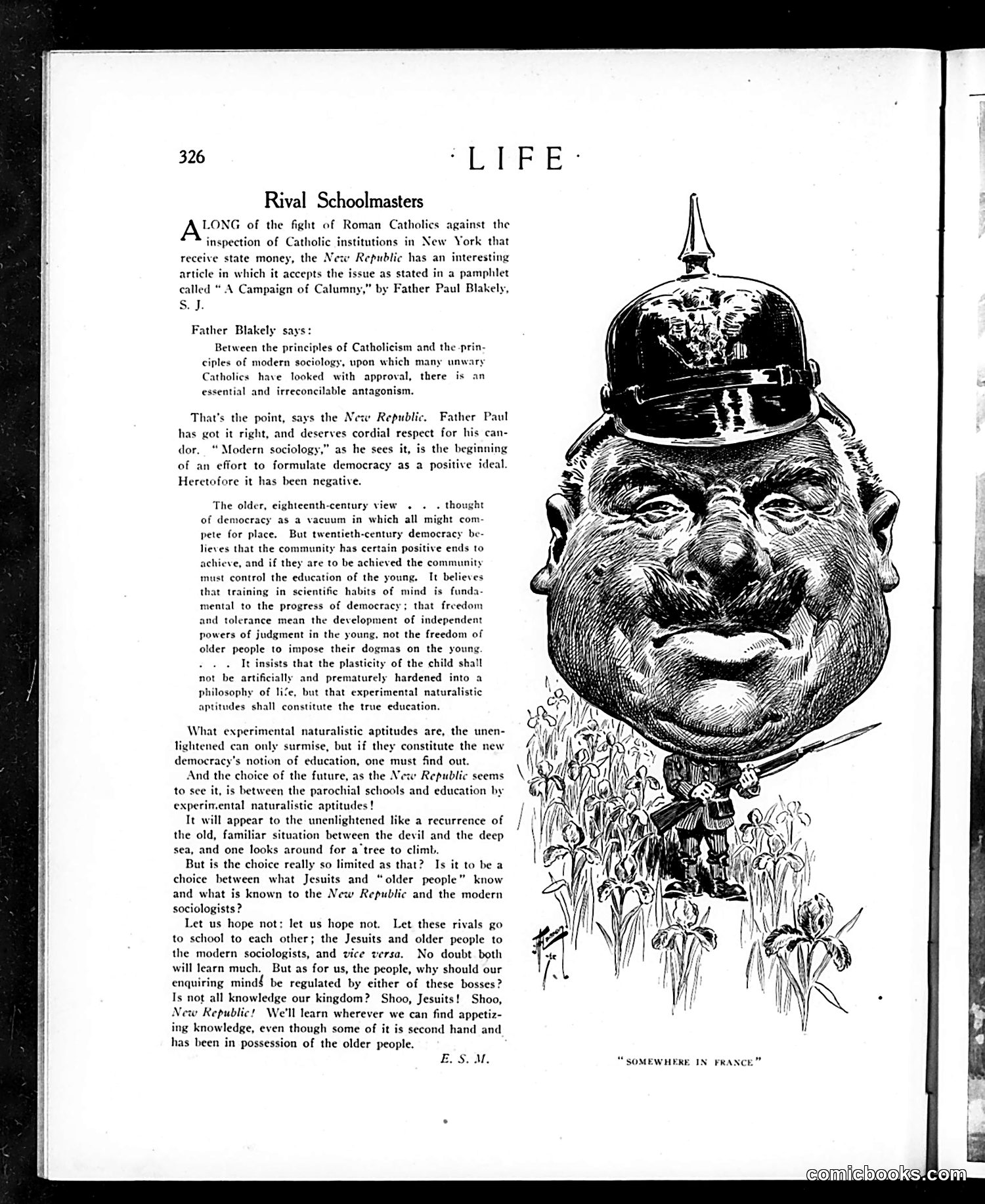
This satirical piece concerns a real 1920s debate over Catholic schools receiving state funding while resisting government inspection. The cartoon depicts a German military officer (identified by the spiked "Pickelhaube" helmet) with an aggressive, authoritarian expression, labeled "Somewhere in France." The accompanying article, attributed to E.S.M., compares two competing educational philosophies as incompatible "rivals": Catholic/Jesuit education versus modern sociology-based "experimental naturalistic" education. The cartoon's use of a German militarist figure suggests the author views both rigid educational systems as authoritarian threats—implying that whether imposed by religious dogma or modern ideology, top-down control of youth education produces the same dangerous conformity seen in militaristic regimes. The satire's point: Americans shouldn't have to choose between two oppressive systems; knowledge should come from multiple sources.
📄 Transcribed text from this page (OCR, searchable)
Machine-transcribed from the original scan — historical spelling and the odd misread are preserved.
“LPP'G Rival Schoolmasters ONG of the fight of Roman Catholics against the inspection of Catholic institutions in New York that receive state money, the New Republic has an interesting article in which it accepts the issue as stated in a pamphlet called “A Campaign of Calumny,” by Father Paul Blakely, S. J. Father Blakely says: Between the principles of Catholicism and the-prin- ciples of modern sociology, upon which many unwary Catholics have looked with approval, there is an essential and irreconcilable antagonism. That's the point, says the New Republic. Father Paul has got it right, and deserves cordial respect for his can- dor, “ Modern sociology,” as he sees it, is the beginning of an effort to formulate democracy as a positive ideal Heretofore it has been negative. The older, eighteenth-century view . . . thought of democracy as a vacuum in which all might com- pete for place, But twentieth-century democracy be- lieves that the community has certain positive ends to achieve, and if they are to be achieved the community must control the education of the young. It believes that training in scientific habits of mind is funda- mental to the progress of democracy; that freedom and tolerance mean the development of independent powers of judgment in the young, not the freedom of older people to impose their dogmas on the young. « It insists that the plasticity of the child shal not be artificially and prematurely hardened into a philosophy of life, but that experimental naturalistic aptitudes shall constitute the true education. What experimental naturalistic aptitudes are, the unen- lightened can only surmise, but if they constitute the new democracy's notion of education, one must find out. And the choice of the future, as the New Republic seems to see it, is between the parochial schools and education by experimental naturalistic aptitudes! It will appear to the unenlightened like a recurrence of the old, familiar situation between the devil and the deep sea, and one looks around for a‘tree to climb. But is the choice really so limited as that? Is it to be a choice between what Jesuits and “older people” know and what is known to the New Republic and the modern sociologists? Let us hope not: let us hope not. Let these rivals go to school to each other; the Jesuits and older people to the modern sociologists, and vice versa. No doubt both will learn much. But as for us, the people, why should our enquiring mind{ be regulated by either of these bosses? Is not all knowledge our kingdom? Shoo, Jesuits! Shoo, New Republic! We'll learn wherever we can find appetiz- ing knowledge, even though some of it is second hand and has been in possession of the older people. ELS. M.