
A complete issue · 38 pages · 1916
Life — August 17, 1916
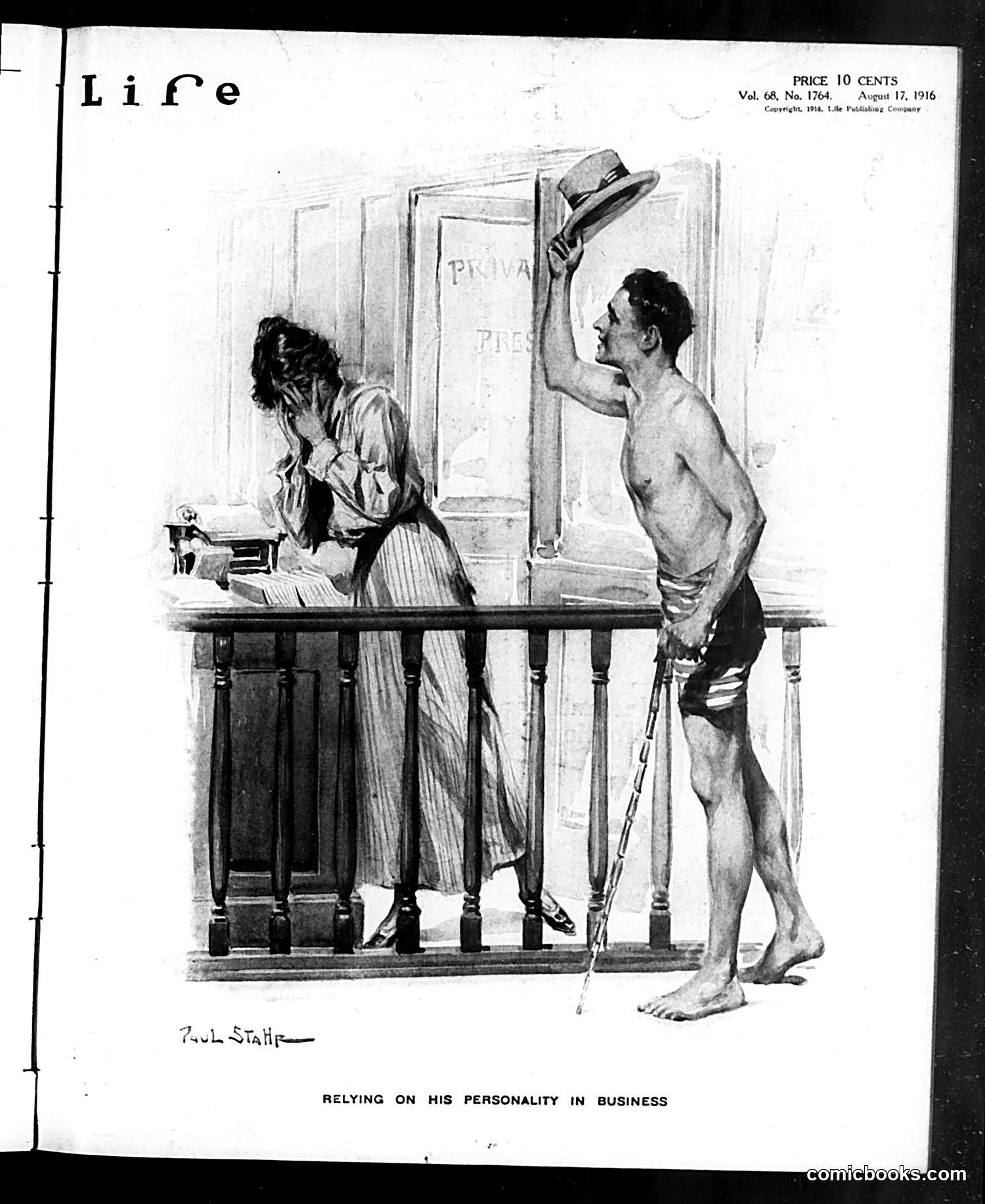
This 1916 Life magazine cartoon satirizes a man attempting to conduct business through charm and physical appearance rather than competence or proper attire. The illustration shows a shirtless, barefoot man in casual swimming trunks approaching a businesswoman at her desk, hat in hand. The caption suggests he's relying solely on his "personality"—his physical attractiveness—to succeed in professional matters. The satire likely critiques workplace confidence schemes or con men of the era who depended on charisma rather than legitimate credentials. It may also mock the general notion that personal charm could substitute for actual business skills, professionalism, or appropriate dress codes. The woman's dismissive posture reinforces that such an approach would fail in serious commercial dealings.
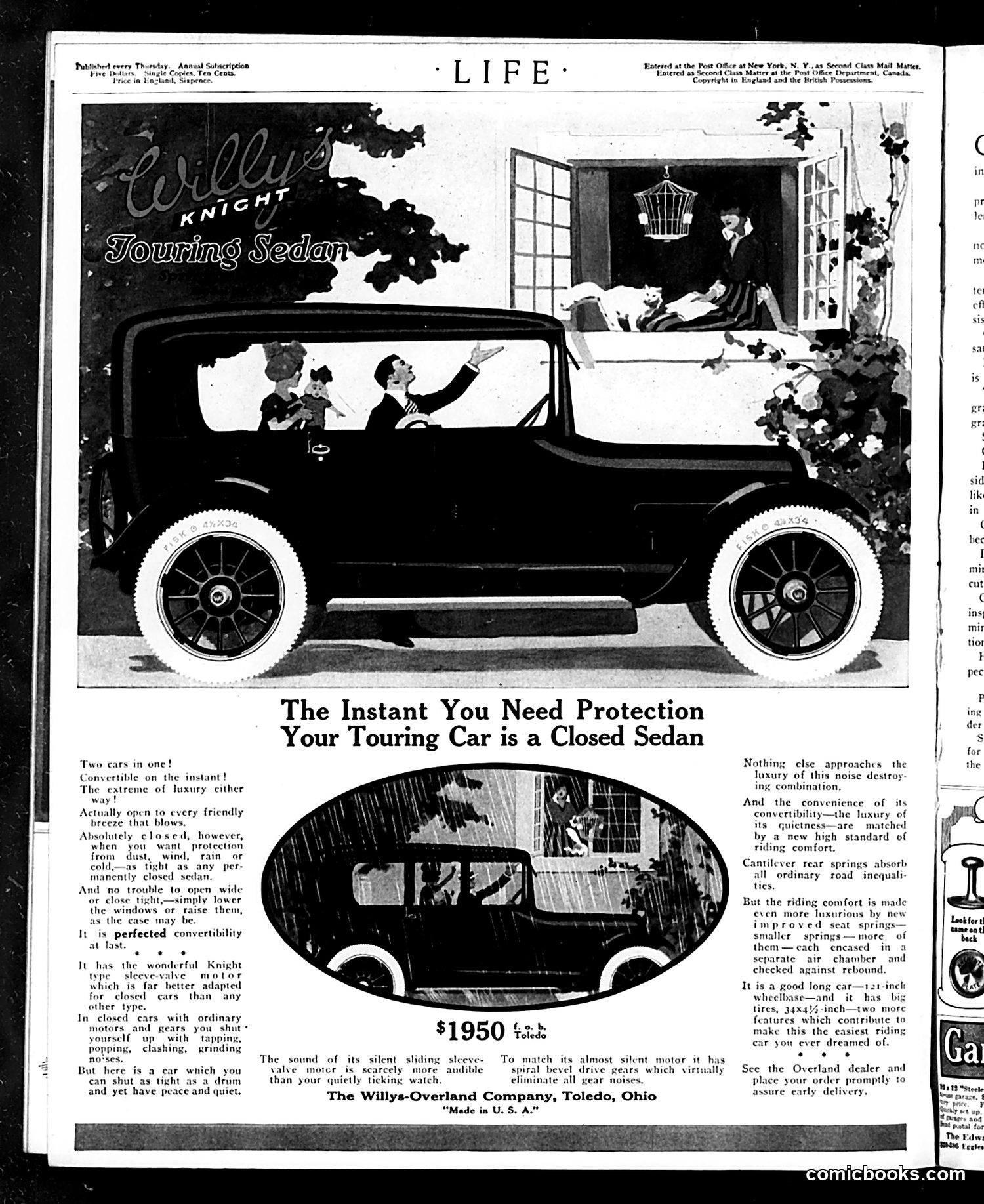
This page is **primarily an advertisement**, not satire or political commentary. It's a full-page ad for the Willys Knight Touring Sedan, priced at $1950 (f.o.b. Toledo). The ad uses a comparative visual narrative: the top illustration shows the car as an open convertible; the bottom shows it as a closed sedan. The "joke" or sales pitch is straightforward—this single vehicle provides "two cars in one," offering luxury and protection when needed. The accompanying text emphasizes practical benefits: weather protection, quiet operation (via the "silent sliding sleeve valve motor"), comfort features, and the prestige of closed-car ownership during an era when such vehicles were still a significant luxury. This is commercial messaging, not political commentary or satire.
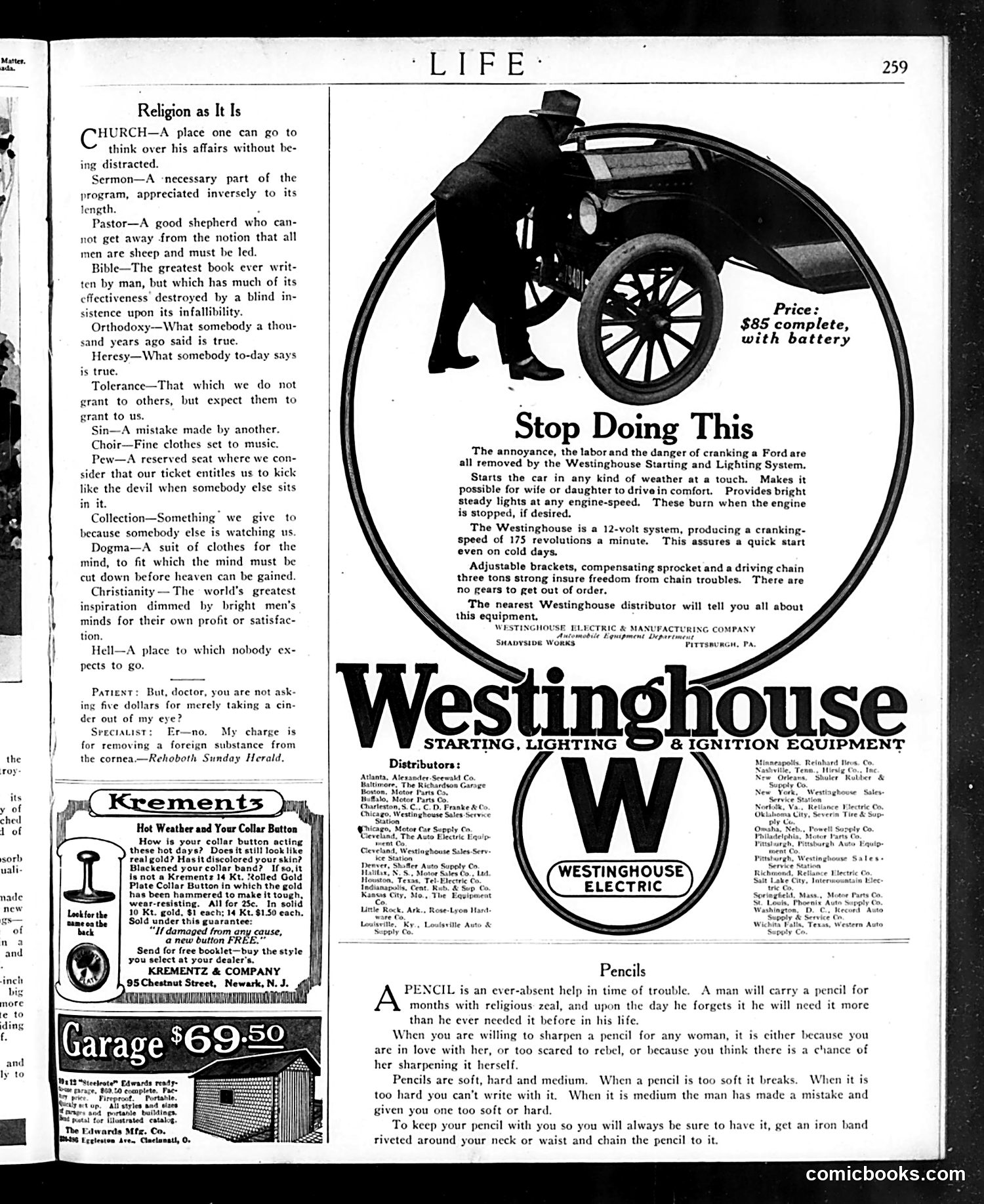
This Life magazine page is primarily **advertising**, not satire or political commentary. The dominant feature is a Westinghouse Electric advertisement promoting their "Starting, Lighting & Ignition Equipment" for automobiles. The ad shows a man hand-cranking a Model T Ford, with text urging readers to "Stop Doing This"—the implied complaint being that manual cranking was dangerous, labor-intensive, and unreliable. The Westinghouse system promised electric starting that worked in any weather and eliminated cranking entirely, at a price of $85 complete with battery. Additional advertisements on the page include Krementz (collar buttons) and an Edwards garage ($69.50). The page also contains a "Religion as It Is" column with satirical religious definitions, but this is standard magazine filler, not the primary content.
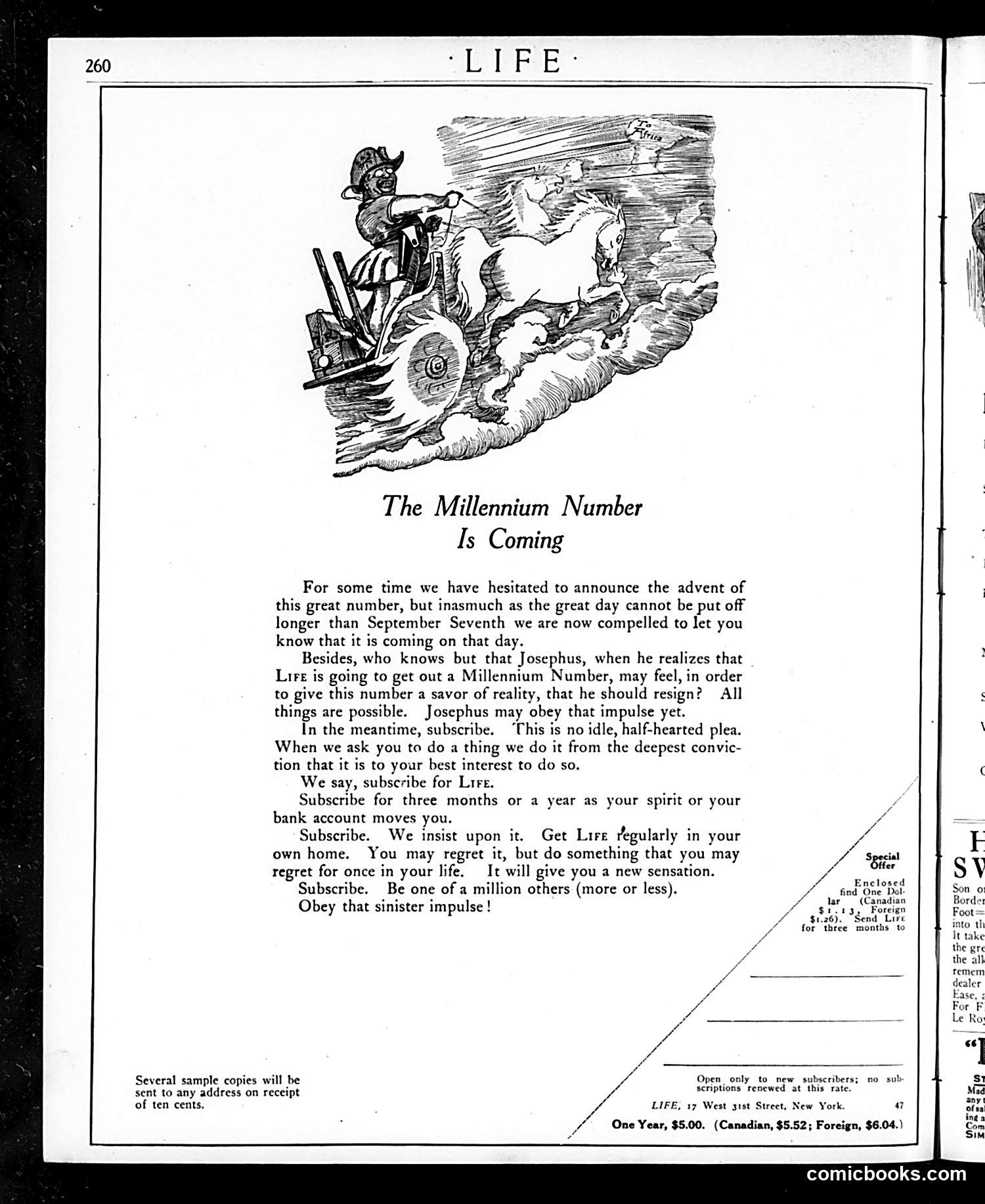
This page is primarily a **subscription advertisement** for *Life* magazine, not political satire. The illustration depicts a figure in classical/Roman military dress driving a chariot pulled by horses, representing the approach of the new millennium (the year 1900). The text addresses readers directly, urging them to subscribe before September 7th to receive a special "Millennium Number"—apparently a major issue *Life* planned to publish marking the arrival of the new century. The appeal combines humor with urgency: the copy playfully warns that editor Josephus (likely Joseph Keppler Jr.) might resign if the magazine doesn't achieve sufficient subscriptions, and jokes that readers who subscribe will have "no idle, half-hearted plea" to regret. This represents turn-of-century publishing marketing strategy.
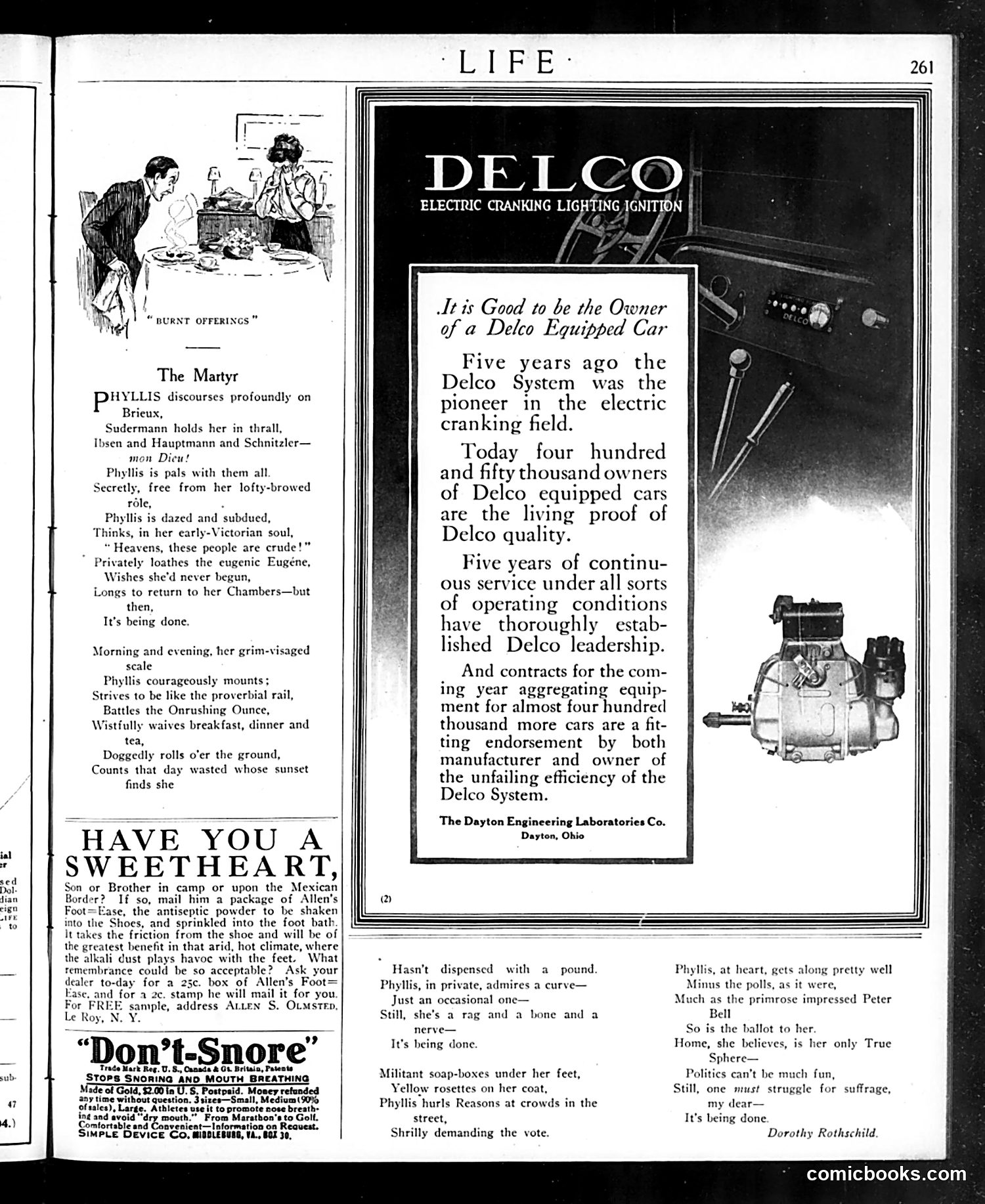
This page contains a satirical poem titled "The Martyr" about a character named Phyllis who advocates for women's suffrage. The accompanying sketch shows a domestic scene where Phyllis argues passionately about voting rights while her male family members react with resignation. The satire mocks suffragettes by portraying Phyllis as relentlessly earnest—"grim-visaged" and determined—who lectures her family "morning and evening" while they endure her activism. The poem presents her cause as admirable yet exhausting to those around her, using humor to both support and gently ridicule the women's suffrage movement. The page also includes advertisements for Delco electrical systems and Don't-Snore products, typical of Life magazine's commercial content from this pre-1923 era.
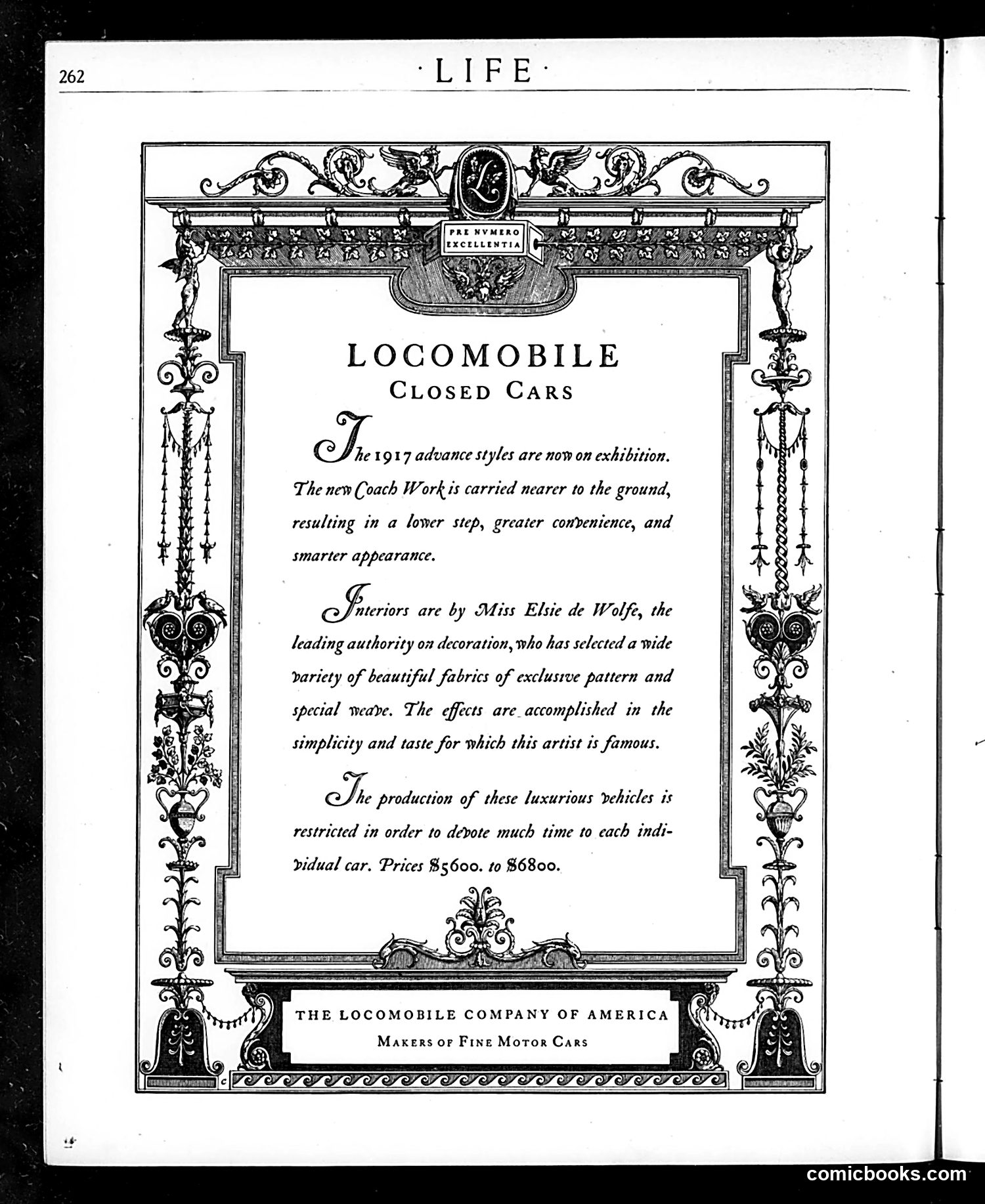
This is **not a cartoon or satire page**, but rather a **luxury automobile advertisement** from Life magazine (page 262). The Locomobile Company of America is advertising their 1917 closed-car models. The text highlights that the new coach work sits closer to the ground for "lower step, greater convenience, and smarter appearance." Interior design credits go to Miss Elsie de Wolfe, described as "the leading authority on decoration," known for simplicity and taste. The ad emphasizes exclusivity—production is deliberately limited to allow individual attention to each car. Prices range from $5,600 to $6,800 (substantial sums in 1917). The ornate Art Deco border frames this as premium, high-end marketing. No satire or political commentary is present; this is straightforward aspirational advertising for wealthy consumers.
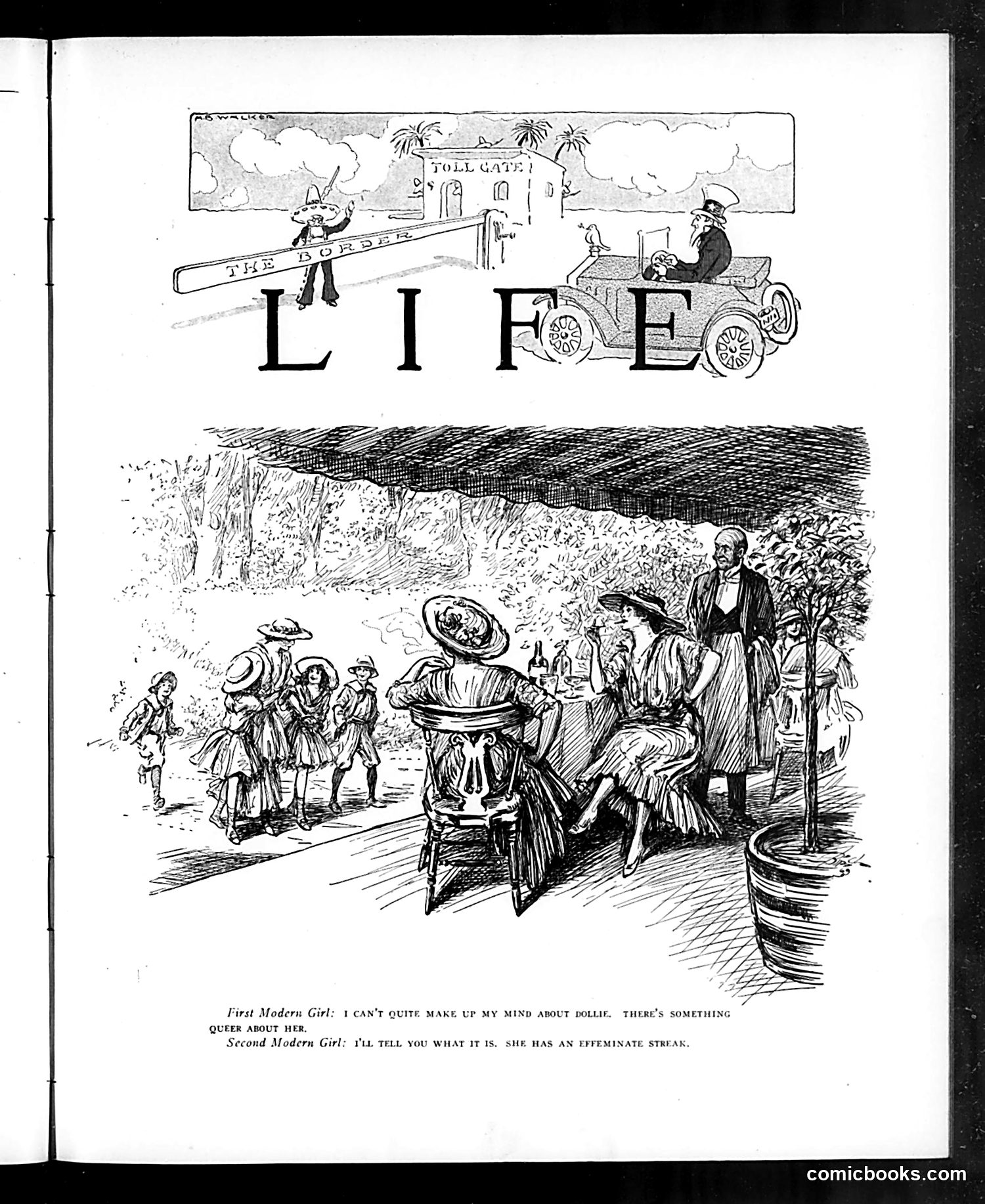
This page from *Life* magazine satirizes early 20th-century gender dynamics. The header illustration shows contrasting "modern life"—a toll gate with an old-fashioned barrier and a fast automobile—suggesting social change. The main cartoon depicts a seaside or park scene where women socialize. The dialogue below compares two "modern girls": the First Modern Girl is indecisive about someone named "Bollie," while the Second Modern Girl reveals the answer—Bollie has "an effeminate streak." The satire targets early 20th-century anxieties about changing gender roles and masculinity. It mocks both women's emerging independence (they're evaluating men's character) and contemporary concerns about men failing to meet traditional masculine standards. The joke relies on period assumptions about what constitutes proper male behavior.
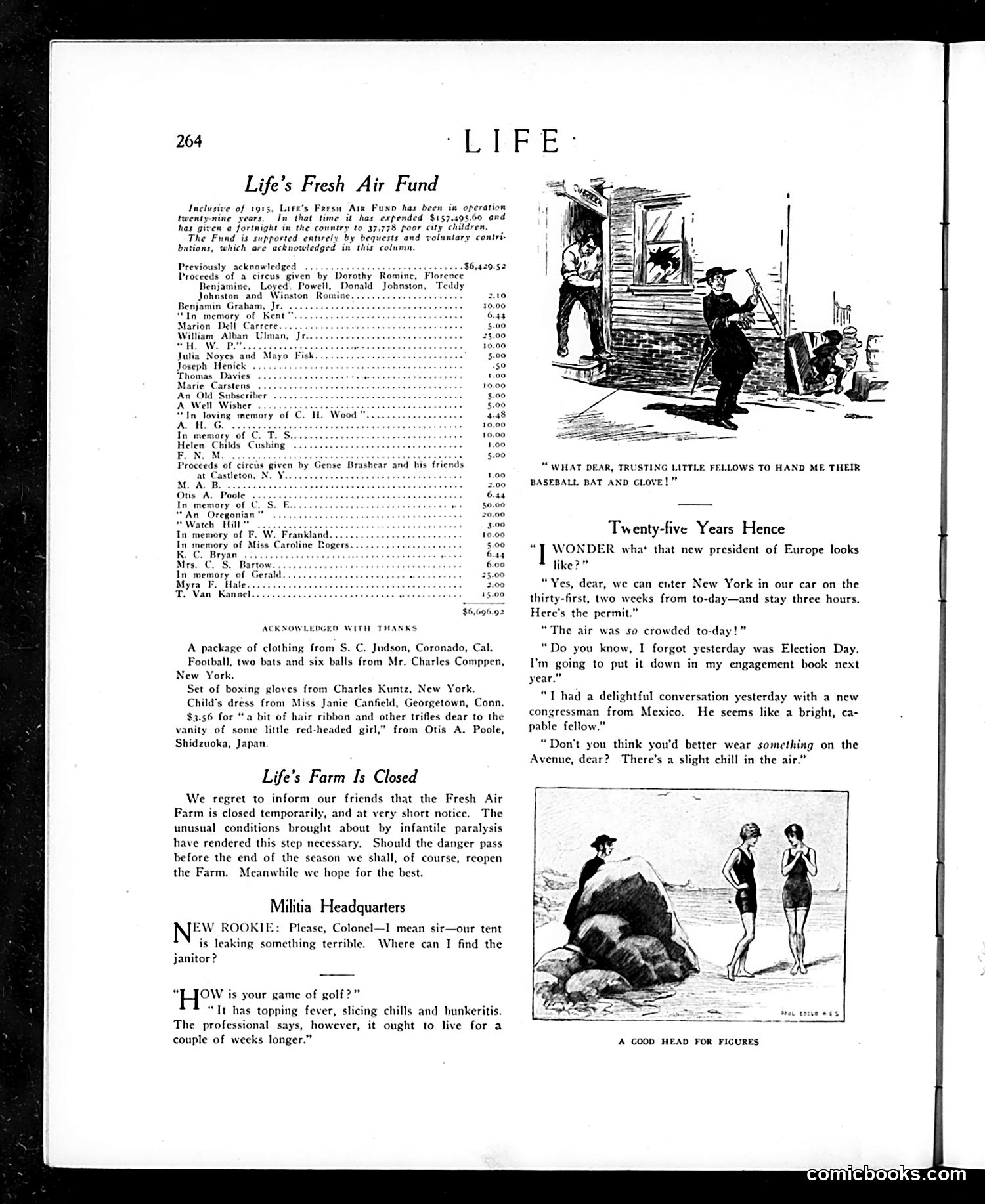
This page consists primarily of **fundraising announcements** for Life's Fresh Air Fund, which provided poor city children with country vacations. The main content lists donors and contributions totaling over $6,000. The **two cartoons** are humorous vignettes unrelated to the fundraising: 1. **Top illustration**: Shows a man giving a baseball bat and glove to poor urban children—visually supporting the Fresh Air Fund's mission of helping disadvantaged youth. 2. **Bottom cartoon** ("A Good Head for Figures"): Depicts beach-goers observing a large rock formation, captioned as a joke about someone's physique. It's period humor with no deeper political meaning. The page reflects early 20th-century American philanthropic efforts and genteel magazine humor.
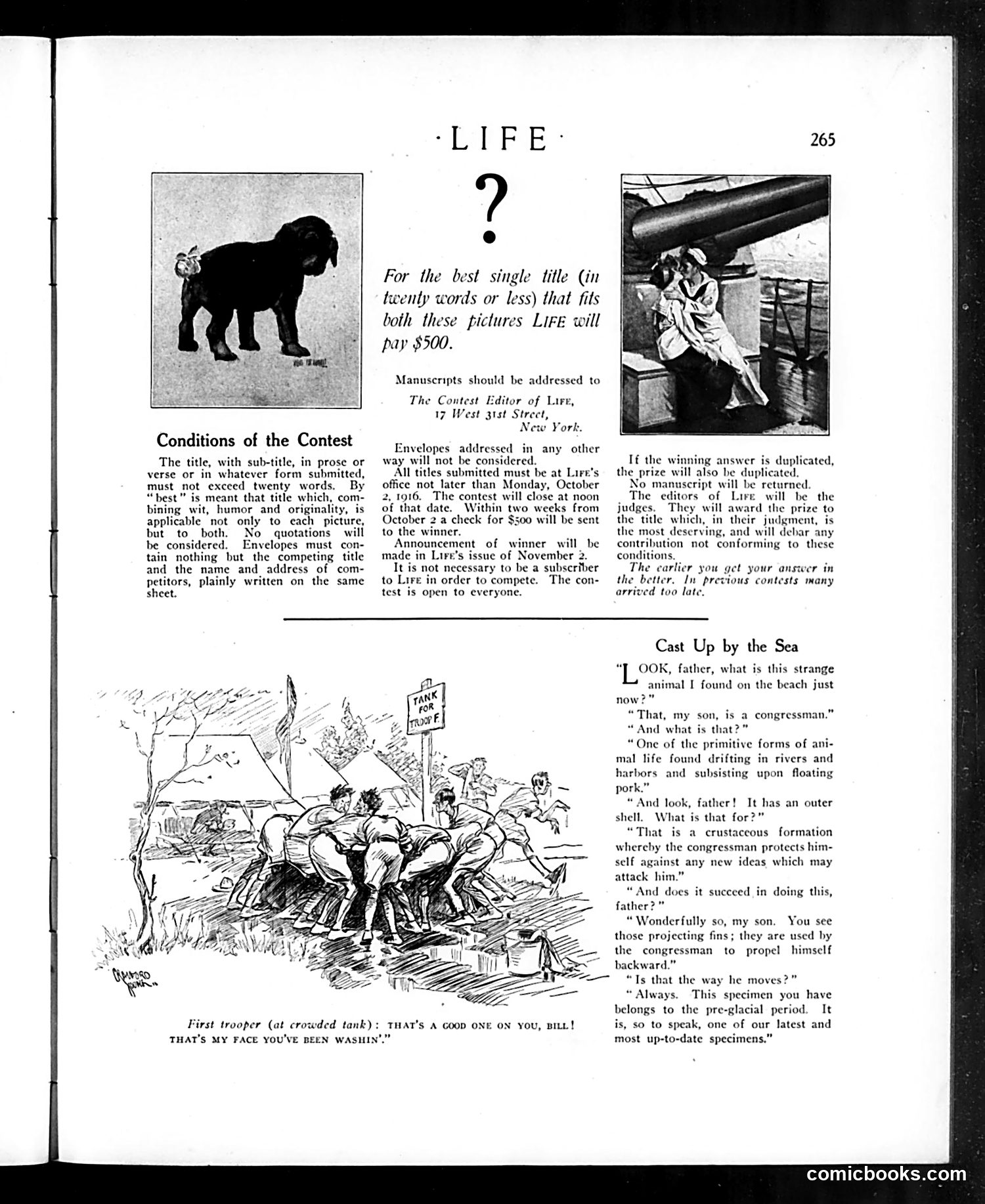
This page contains a **contest announcement** and a **political cartoon**. The contest (top) offers $500 for the best single-title caption fitting two pictures: a dog and a person on what appears to be a ship. The cartoon (bottom), titled "Cast Up by the Sea," depicts soldiers in what appears to be a **World War I trench scene**. The dialogue suggests satire about military life and the "pre-glacial period" specimen—likely mocking the outdated tactics or attitudes of military leadership. One soldier comments on another's "protective shell" against new ideas, implying military hierarchy resists innovation. The crude drawing style and conversation format are typical of Life's early 20th-century political humor, satirizing military bureaucracy and resistance to change during wartime.
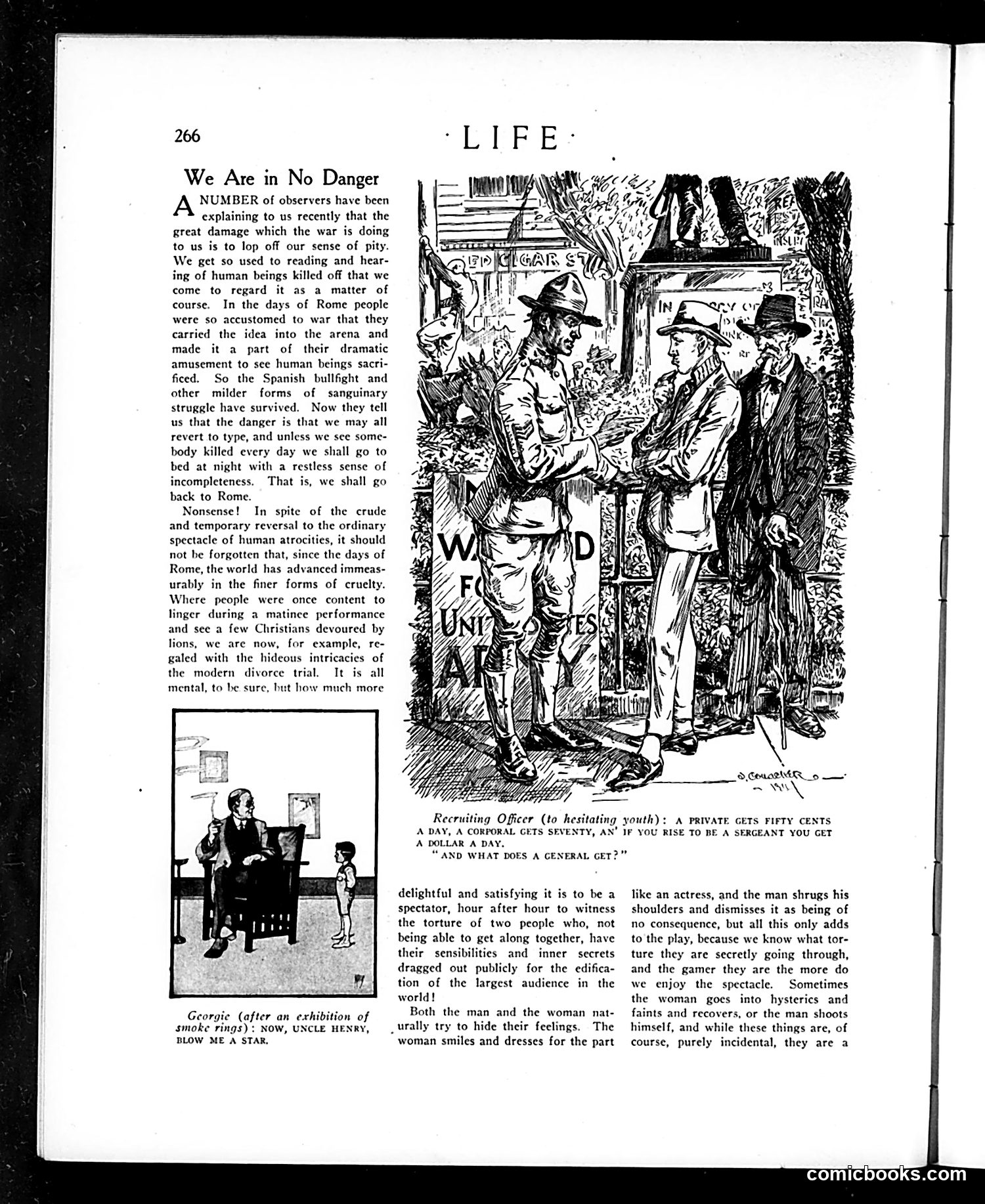
This page critiques societal indifference to war's casualties. The article "We Are in No Danger" sarcastically argues that people have become desensitized to human suffering—comparing ancient Rome's gladiatorial spectacles to modern entertainment like divorce trials, where audiences treat real human tragedy as spectacle. The main cartoon depicts a military recruiting officer (identifiable by uniform) offering enlistment terms to a young man at what appears to be a storefront or public space. The caption suggests financial incentives (fifty cents daily, potential sergeant rank), satirizing how economic desperation drives recruitment. The smaller illustration shows a woman and child watching a theatrical performance, reinforcing the theme that people passively consume entertainment—including wartime content—without emotional engagement or moral concern.
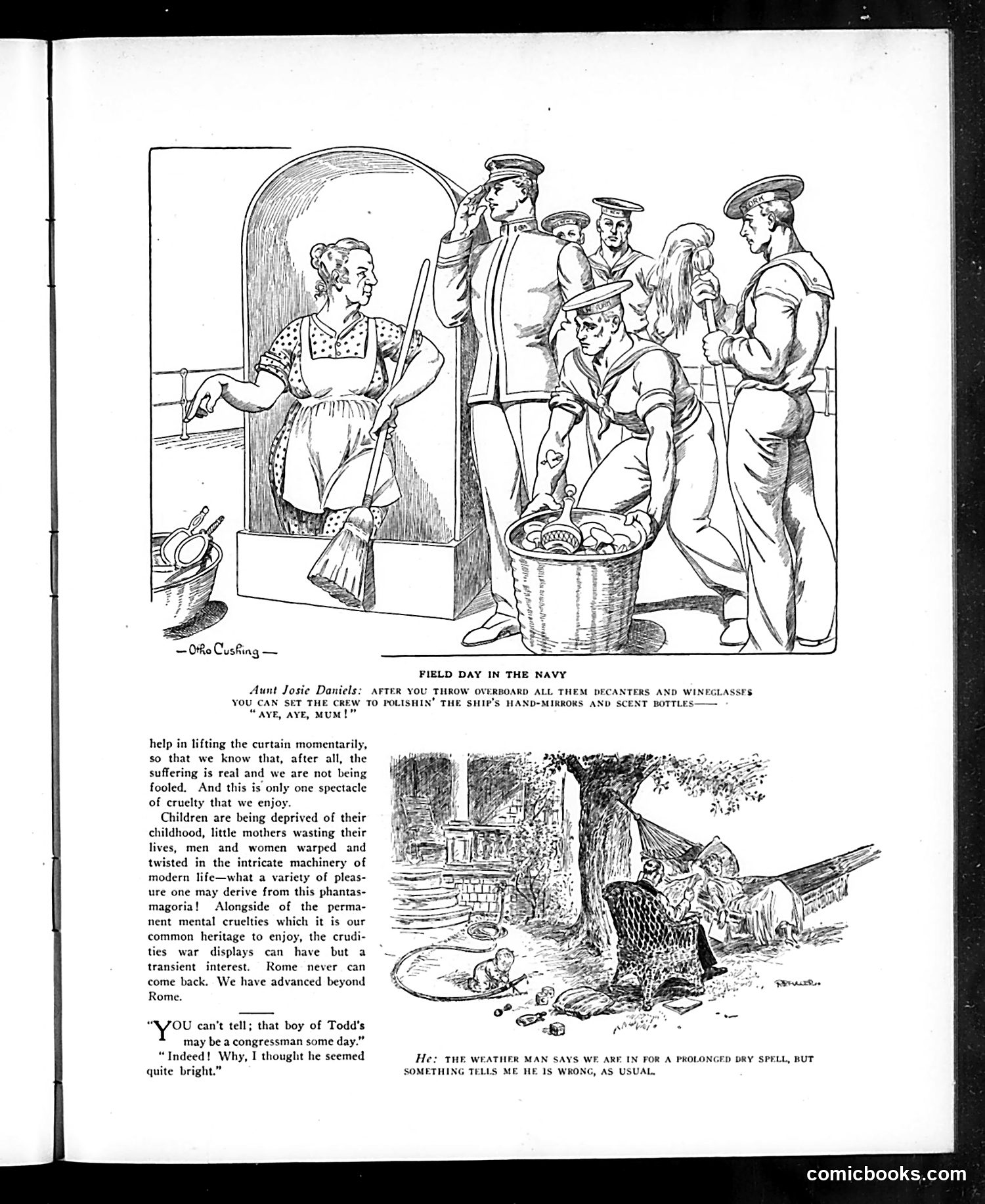
This page contains two satirical cartoons by Otis Cushing commenting on wartime conditions (indicated by "Field Day in the Navy"). **Top cartoon**: Shows a woman (identified as "Aunt Josie Daniels") instructing naval sailors. The caption mocks her suggestion that throwing overboard decanters and wineglasses would give sailors something productive to do—polishing ship's mirrors and scent bottles. This appears to satirize well-meaning but impractical civilian advice for keeping idle sailors occupied during wartime. **Bottom cartoon**: Depicts a weather forecaster proven wrong about weather conditions. The joke emphasizes his habitual inaccuracy. Both cartoons use humor to critique civilian interference in military matters and the unreliability of "experts," reflecting wartime anxieties about competence and social disruption.
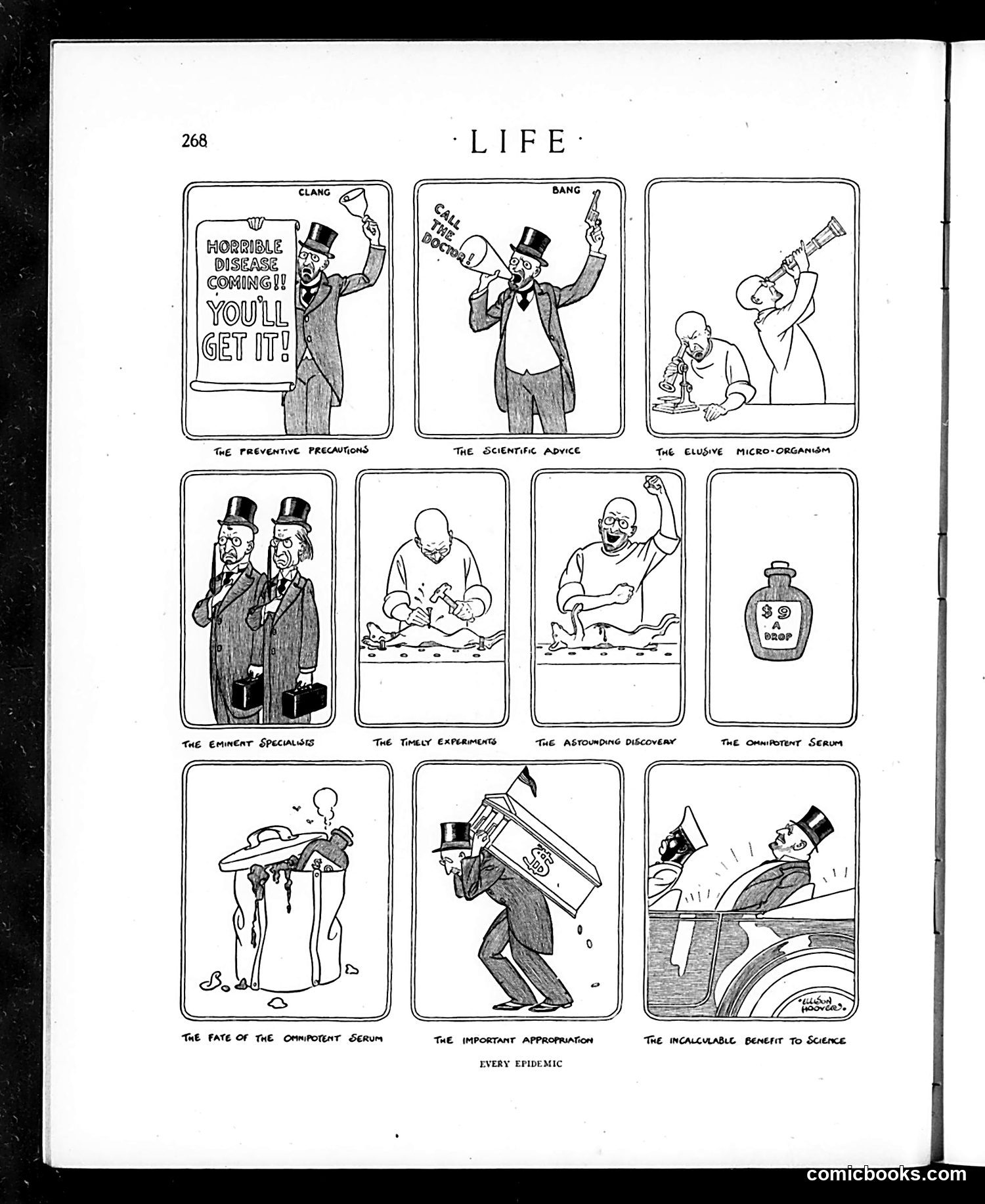
This satirical comic strip mocks the predictable public and scientific responses to disease outbreaks. Each panel ridicules a different recurring element: - **"Preventive Precautions"** and **"Scientific Advice"**: Officials make vague, contradictory pronouncements while the public panics - **"Elusive Micro-organism"**: Scientists search fruitlessly with microscopes - **"Eminent Specialists"**: Competing "experts" provide conflicting guidance - **"Timely Experiments"** and **"Astounding Discovery"**: Researchers conduct dubious experiments - **"Omnipotent Serum"**: A dubious cure-all is promoted - **"The Fate"** and **"Important Appropriation"**: The serum fails; funding gets misappropriated anyway - **"Incalculable Benefit to Science"**: Despite failure, scientists claim victory The satire suggests epidemic responses are cyclical theater—authorities posture, experts contradict each other, unproven remedies circulate, and science captures credit regardless of actual results.
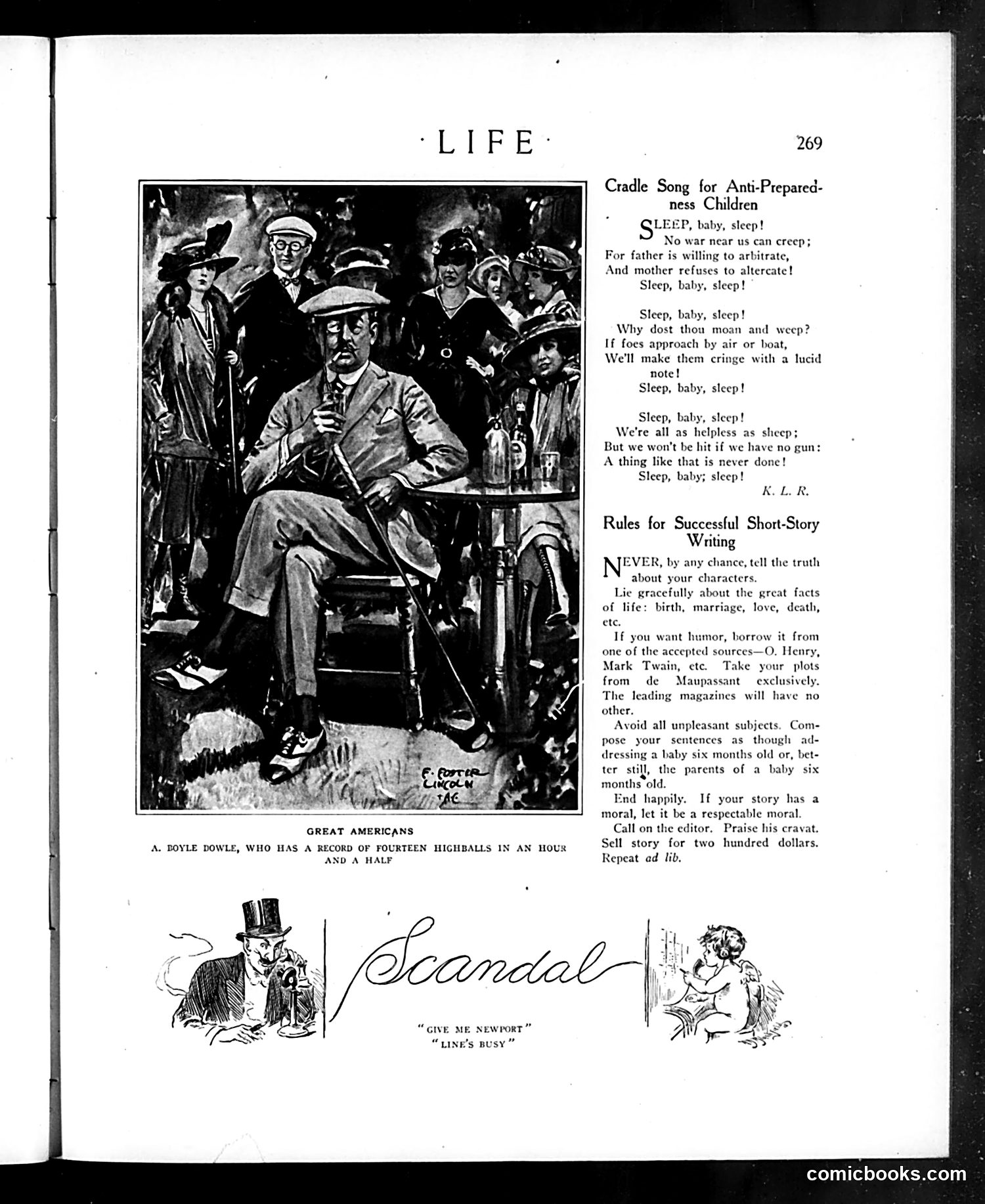
The main illustration depicts "A. Doyle Conan [sic], who has a record of fourteen highballs in an hour and a half" under the heading "Great Americans." This is a satirical jab at the famous author Arthur Conan Doyle, mocking him for his heavy drinking rather than celebrating his literary achievements. The cartoon shows him seated among admirers, holding a glass, implying his reputation extended to prodigious alcohol consumption—likely a reference to Prohibition-era concerns about drinking. The page also includes a "Cradle Song for Anti-Preparedness Children" (a pacifist lullaby) and writing advice mocking commercial magazine formulas. The lower section advertises "Scandal" publications.
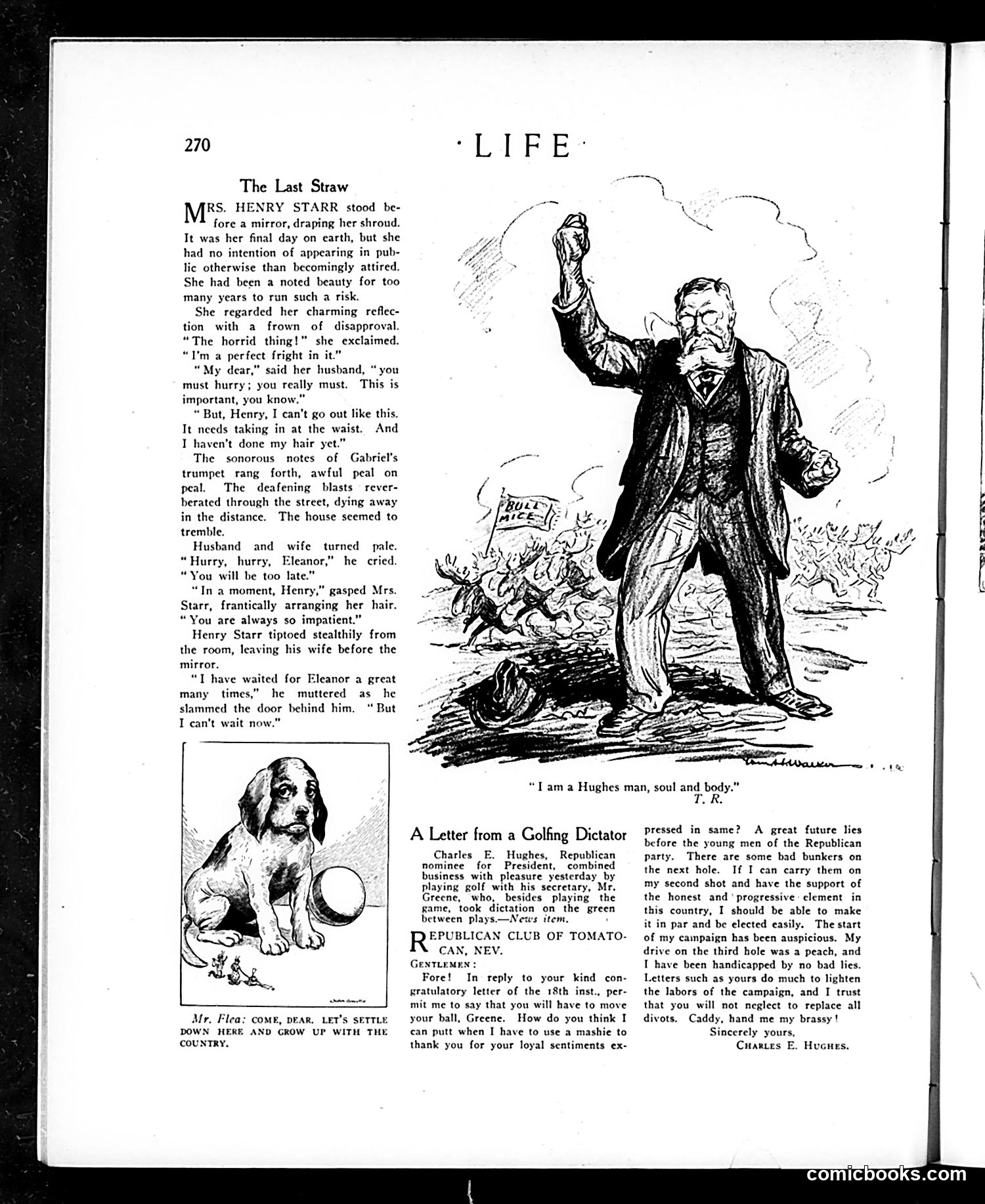
This page contains two distinct items: **"The Last Straw"** (top): A domestic comedy story about Mrs. Henry Starr preparing for an outing. Her husband rushes her, insisting they'll be late, but she hasn't finished her hair or taken in her dress at the waist. The story mocks the traditional tension between husbands wanting punctuality and wives taking time with appearance—a common domestic humor trope of the era. **"A Letter from a Golfing Dictator"** (bottom): A satirical letter from Charles E. Hughes, Republican presidential candidate, written from the Republican Club of Tomato-Can, Nevada. Hughes boasts about golf while discussing his campaign, mixing casual sports commentary with political ambition. The satire suggests Hughes is too focused on leisure activities rather than serious campaigning—a critique of his candidacy.
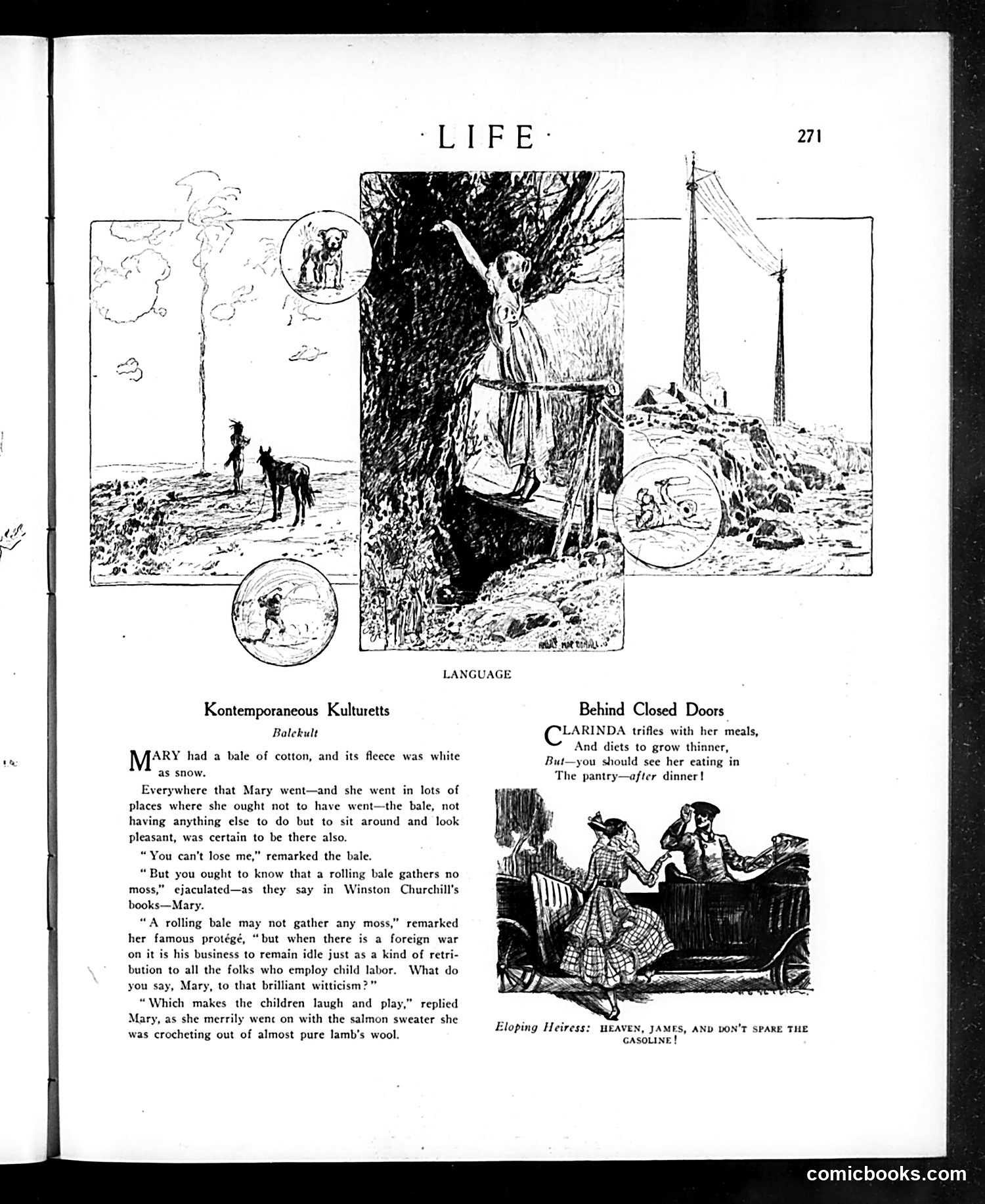
This page contains two separate satirical pieces: **"Kontemporaneous Kulturetts"** (left): A dialogue mocking Mary's pretentiousness about a cotton bale. Someone quotes Winston Churchill's saying that "a rolling bale gathers no moss," and Mary responds that the bale has nothing to do but "sit around and look pleasant"—a veiled insult about idle wealthy women. The satire targets upper-class women who contribute nothing productive to society while maintaining airs of sophistication. **"Behind Closed Doors"** (right): A domestic scene showing Clarinda feeding her meals strategically—in the pantry after dinner—to make her thinner. The caption sarcastically lists "Eloping Heiress: HEAVEN, JAMES, AND DON'T SPARE THE GASOLINE," mocking young wealthy women who elope. The humor targets both wasteful wealth and deceptive domestic practices. Both mock affluent women's superficiality.
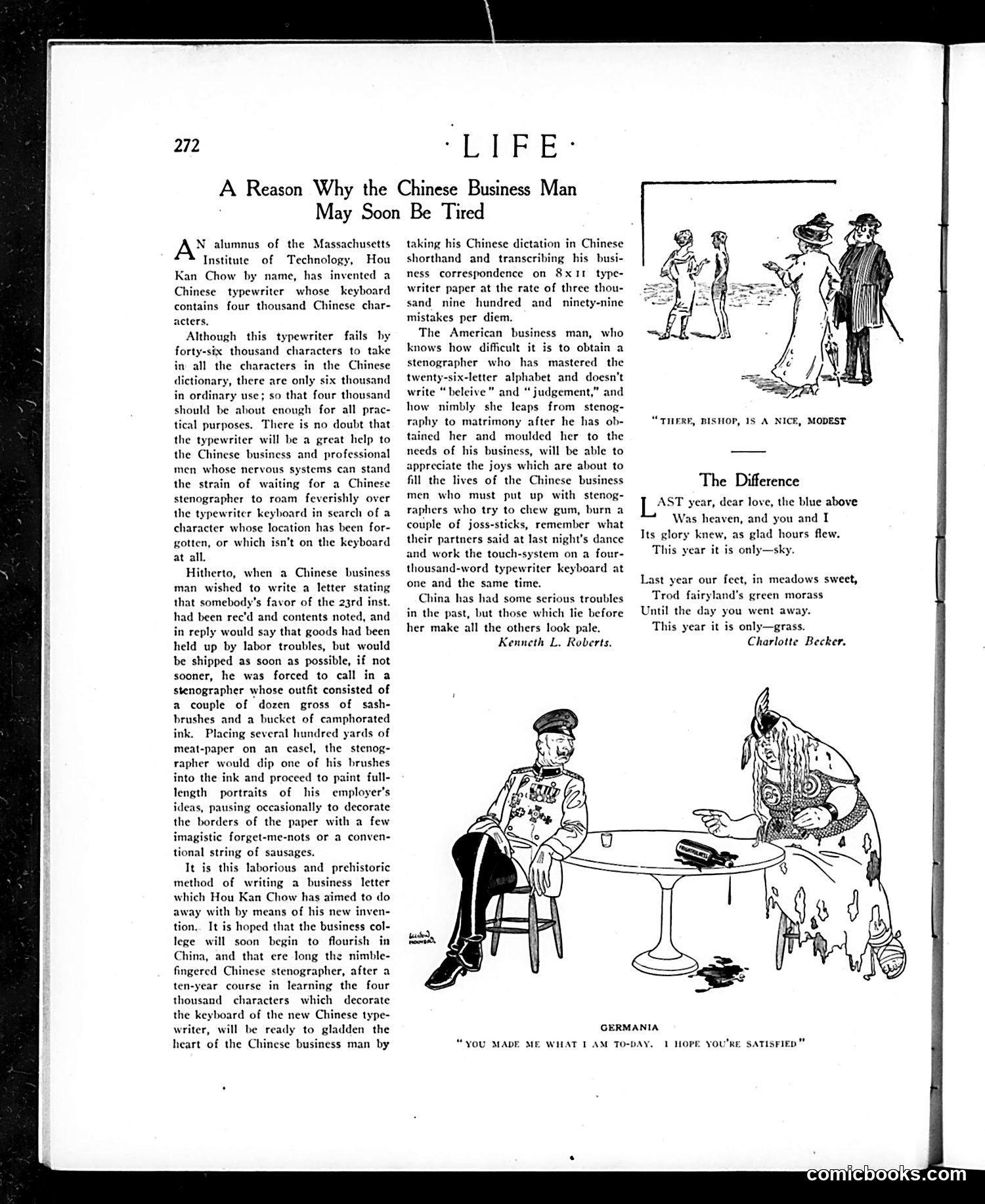
This satirical article by Kenneth L. Roberts mocks the impracticality of a new Chinese typewriter invention by MIT alumnus Hou Kan Chow. The typewriter contains 4,000 characters—enough for ordinary use, but a fraction of the full Chinese written language. Roberts uses exaggerated humor to highlight the absurdity: he describes traditional Chinese business letter writing as requiring stenographers with "sash-brushes" and "camphorated ink" who paint full-length portraits of ideas on meat-paper. He then predicts the new typewriter will require stenographers undergoing "a ten-year course" to master 4,000 characters, making them prone to "three thousand nine hundred and ninety-nine mistakes per diem." The joke targets both Chinese and American business practices—satirizing the already-difficult task of finding competent English stenographers who master just 26 letters, while suggesting Chinese businessmen face even more impossible odds. The cartoons illustrate unrelated social humor; the lower cartoon labeled "Germania" appears to satirize German culture or politics through a grotesque caricature.
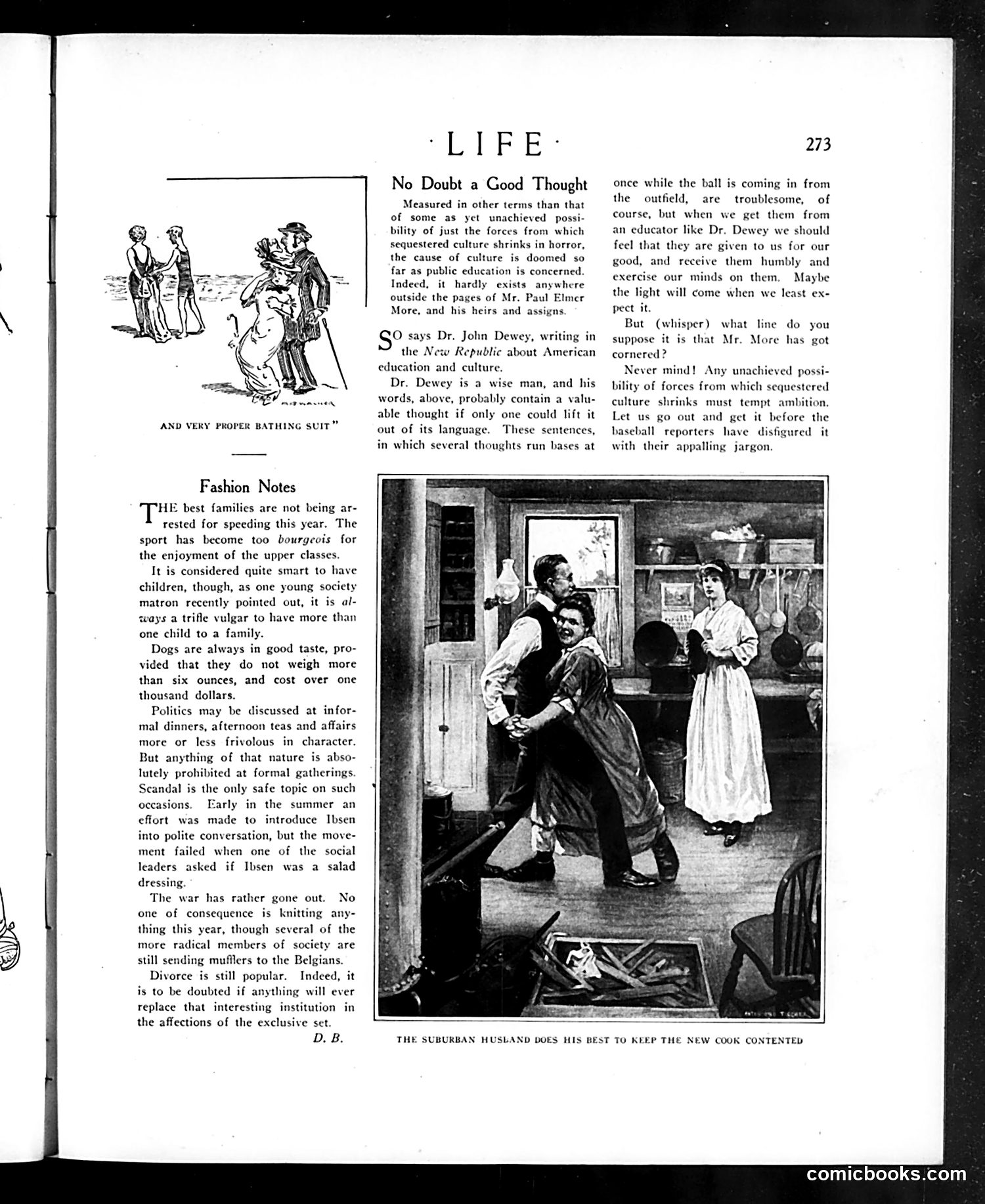
This page contains two satirical pieces mocking early 20th-century American upper-class pretension. **"Fashion Notes"** ridicules wealthy society's arbitrary status rules: speeding is now "too bourgeois," having multiple children is "vulgar," and dogs must cost over $1,000. The humor peaks when a socialite asks if Henrik Ibsen (a celebrated playwright) is a "salad dressing"—satirizing the upper class's shallow cultural pretense despite claiming sophistication. References to knitting for Belgian war relief suggest WWI-era concerns treated as mere fashion trends. **"No Doubt a Good Thought"** mocks philosopher John Dewey's opaque academic writing about education and culture through Dr. Paul Elmer More's work. The author suggests Dewey's sentences are so convoluted they're meaningless, humorously comparing parsing his prose to following a baseball game. It's satire of inflated intellectual jargon masking empty ideas. The cartoon below depicts a suburban domestic scene, likely illustrating the tension of managing household staff—a middle-class concern contrasting with the upper-class pretension above.
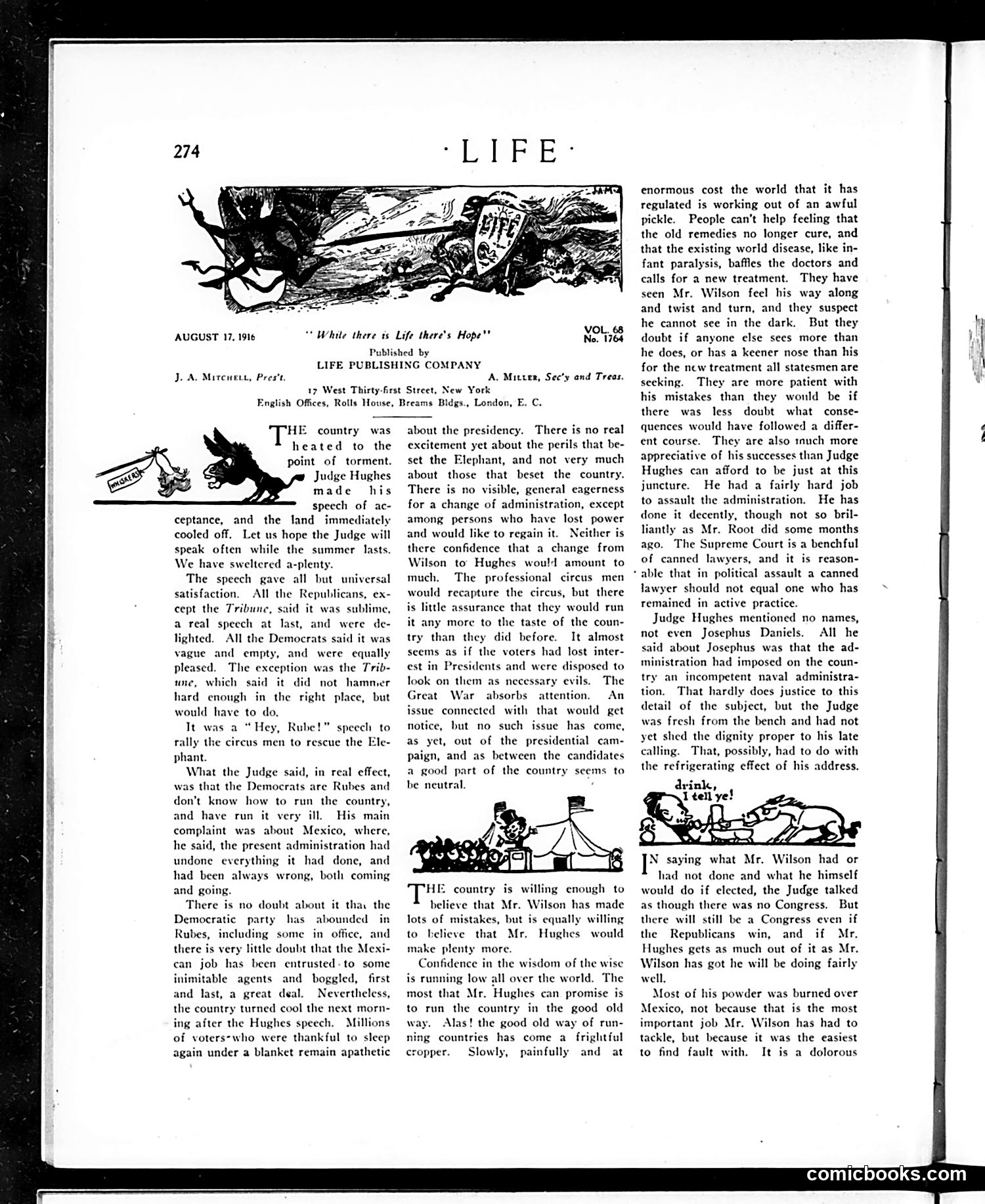
This article analyzes Judge Charles Evans Hughes's acceptance speech as the Republican presidential nominee against incumbent Democrat Woodrow Wilson in the 1916 election. The satire captures voter apathy. Hughes's speech—depicted as a "Hey, Rube!" carnival call to rally Republicans (the "Elephant")—criticized Wilson's handling of Mexico but generated only lukewarm enthusiasm. Life's columnist notes both parties found the speech satisfying yet unconvincing: Republicans praised it as "sublime," Democrats dismissed it as "vague and empty." The key point: voters have lost faith in political solutions generally. The Great War dominates attention. While acknowledging Wilson's mistakes, voters doubt Hughes would do better, trusting neither candidate's wisdom. The article reflects 1916's deep political exhaustion—voters see presidents as "necessary evils" rather than solutions, unable to address fundamental modern problems that old remedies cannot cure.
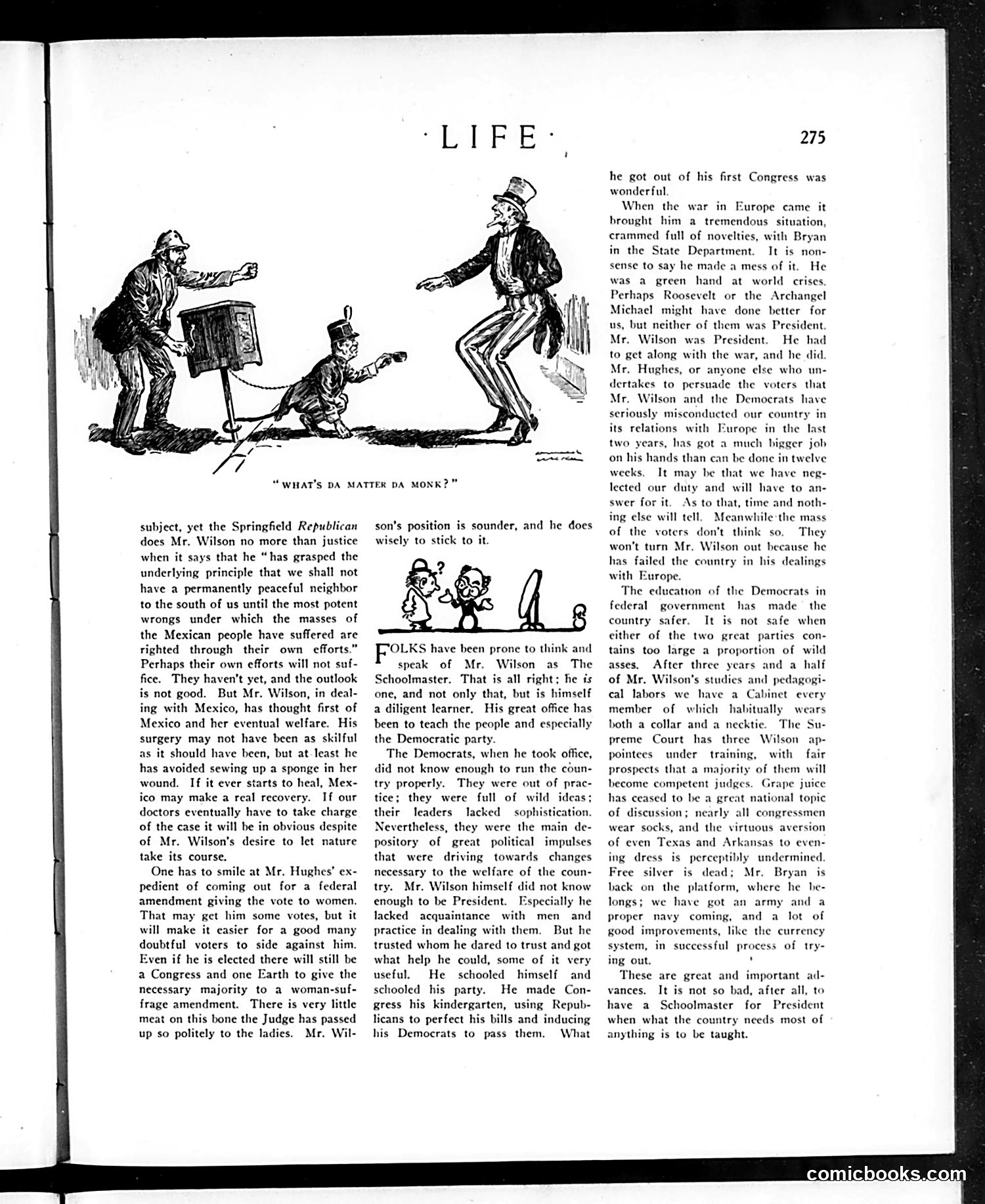
This page critiques President Wilson's handling of Mexico and defends his overall record during the 1916 election campaign (Wilson vs. Republican challenger Charles Evans Hughes). **The Cartoon:** The crude dialect caption ("What's da matter da monk?") depicts three figures—likely representing different political perspectives or nations—gesturing at each other in apparent confusion or conflict. The cartoon illustrates the complexity of Wilson's Mexico policy. **The Text's Point:** The article defends Wilson's approach to Mexican affairs as prioritizing Mexico's welfare over American surgical intervention. It criticizes Hughes for opportunistically endorsing women's suffrage as a campaign tactic. Most importantly, it argues Wilson has successfully "schooled" the Democratic Party and handled European war diplomacy reasonably, given his inexperience. The piece essentially argues voters shouldn't remove Wilson mid-crisis based on Hughes's vague criticism.
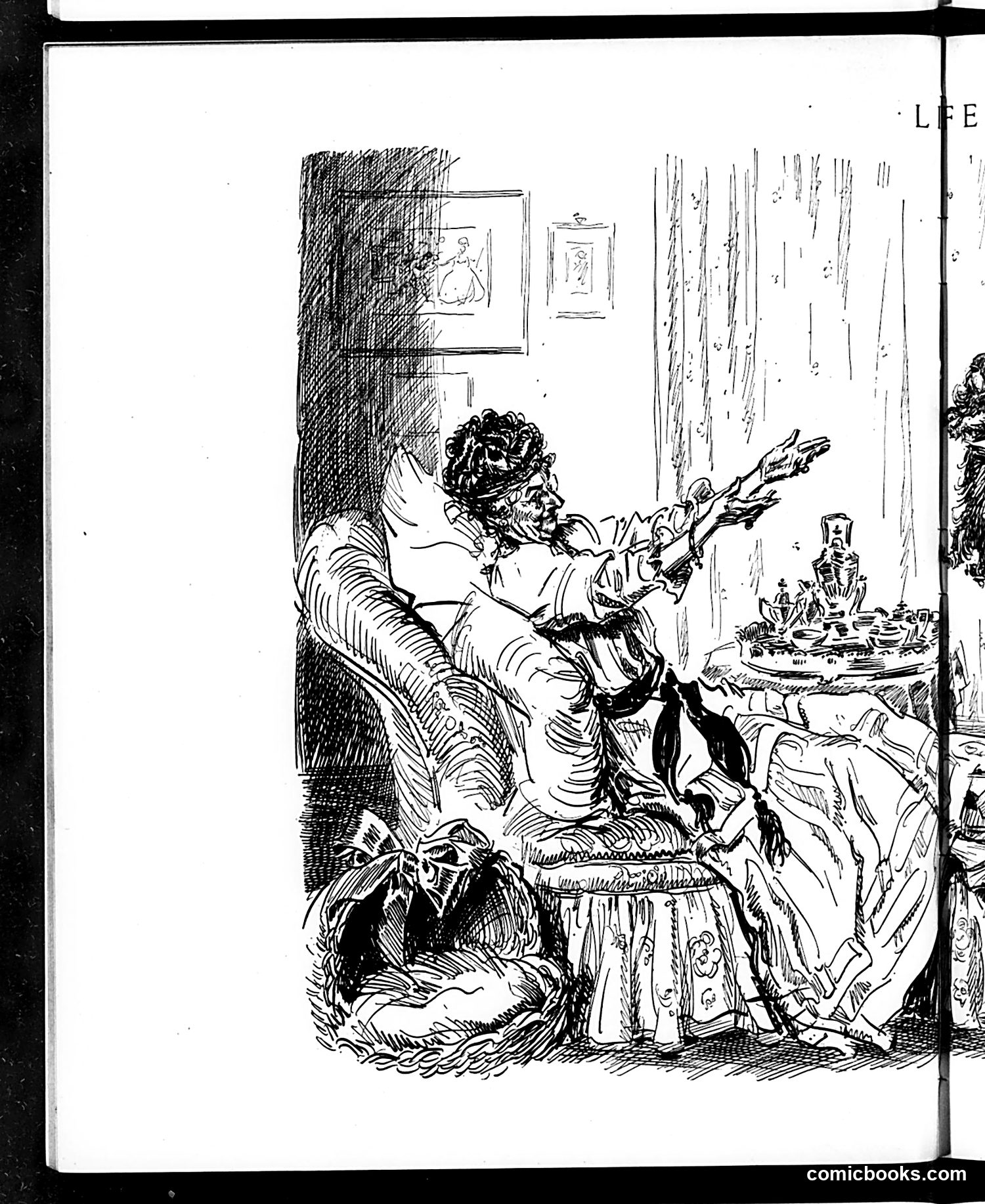
This is a satirical illustration from *Life* magazine showing a well-dressed woman seated luxuriously in an ornate interior, gesturing dramatically while appearing to relate an anecdote or story. A small dog sits at her feet. The scene depicts an upper-class domestic setting with decorative elements visible on a table. The satire appears to target wealthy women's leisure-class behavior—specifically, the exaggerated theatricality and self-importance of society women engaged in idle conversation or storytelling. The woman's animated gestures and luxurious surroundings emphasize the satirical point about frivolous upper-class entertainments. Without additional text identifying the specific target, the cartoon seems a general mockery of Gilded Age or early 20th-century high-society affectations rather than commentary on a particular historical figure or event.
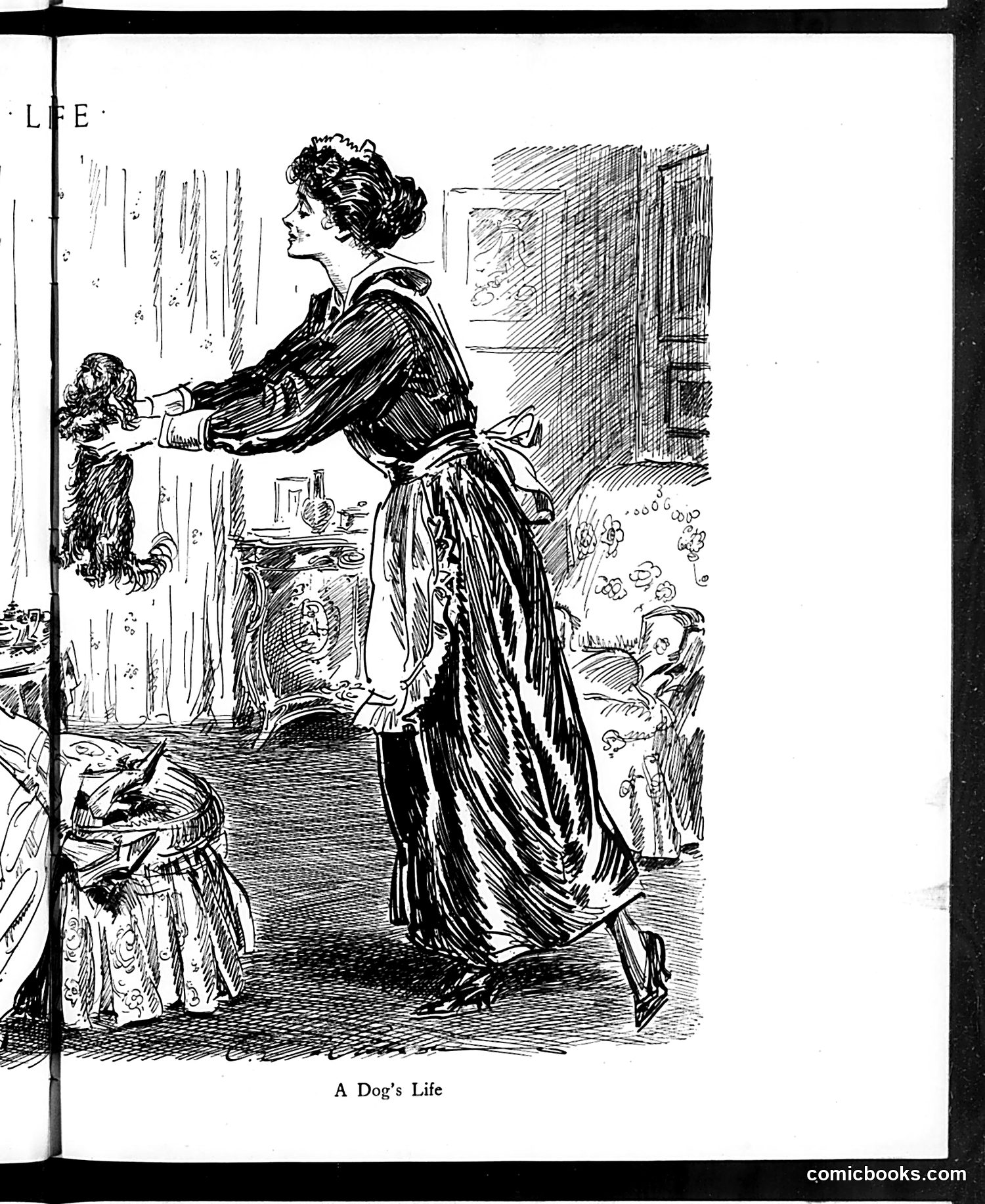
This illustration depicts a well-dressed woman in Edwardian-era clothing interacting with a small dog in an interior domestic setting. The title "A Dog's Life" is a common phrase suggesting hardship or struggle. The satire likely compares the woman's constrained social position to that of a dog—both subject to control and dependency. Her elaborate dress, fashionable updo, and domestic confinement suggest commentary on women's restricted roles in early 20th-century society. The dog's posture mirrors human servitude. *Life* magazine frequently satirized gender relations and social conventions of its era. This piece appears to use the dog metaphor to critique women's limited autonomy and agency within the home, suggesting their life circumstances are as circumscribed as a pet's—dependent, obedient, and lacking independent agency.
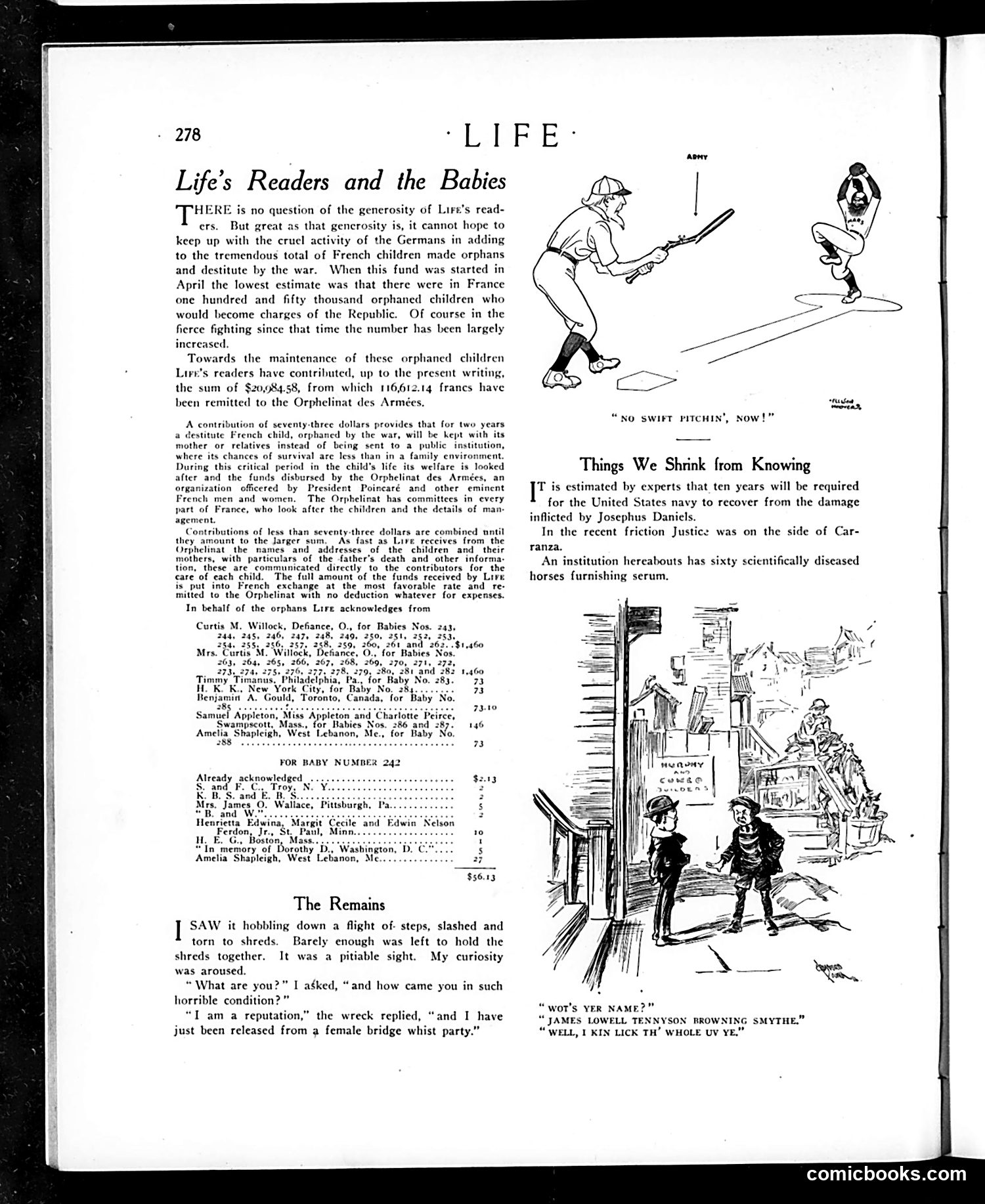
This page contains three distinct sections: 1. **"Life's Readers and the Babies"** - A fundraising appeal describing French orphans created by WWI, requesting reader contributions to the "Orphelinat des Armees" (Army Orphanage). It includes a list of donors and amounts. 2. **"No Swift Pitchin', Now!"** - A cartoon showing baseball players, likely satirizing amateur or casual play. 3. **"Things We Shrink from Knowing"** - A section with a sketch of urban street life showing men near a building, accompanying text about disease in horses and American post-war recovery. The dialogue mentions "Lord's ver names" and references to Tennyson and Smythe. The page reflects WWI-era concerns: charity, American recovery, and social commentary through humor and illustration.
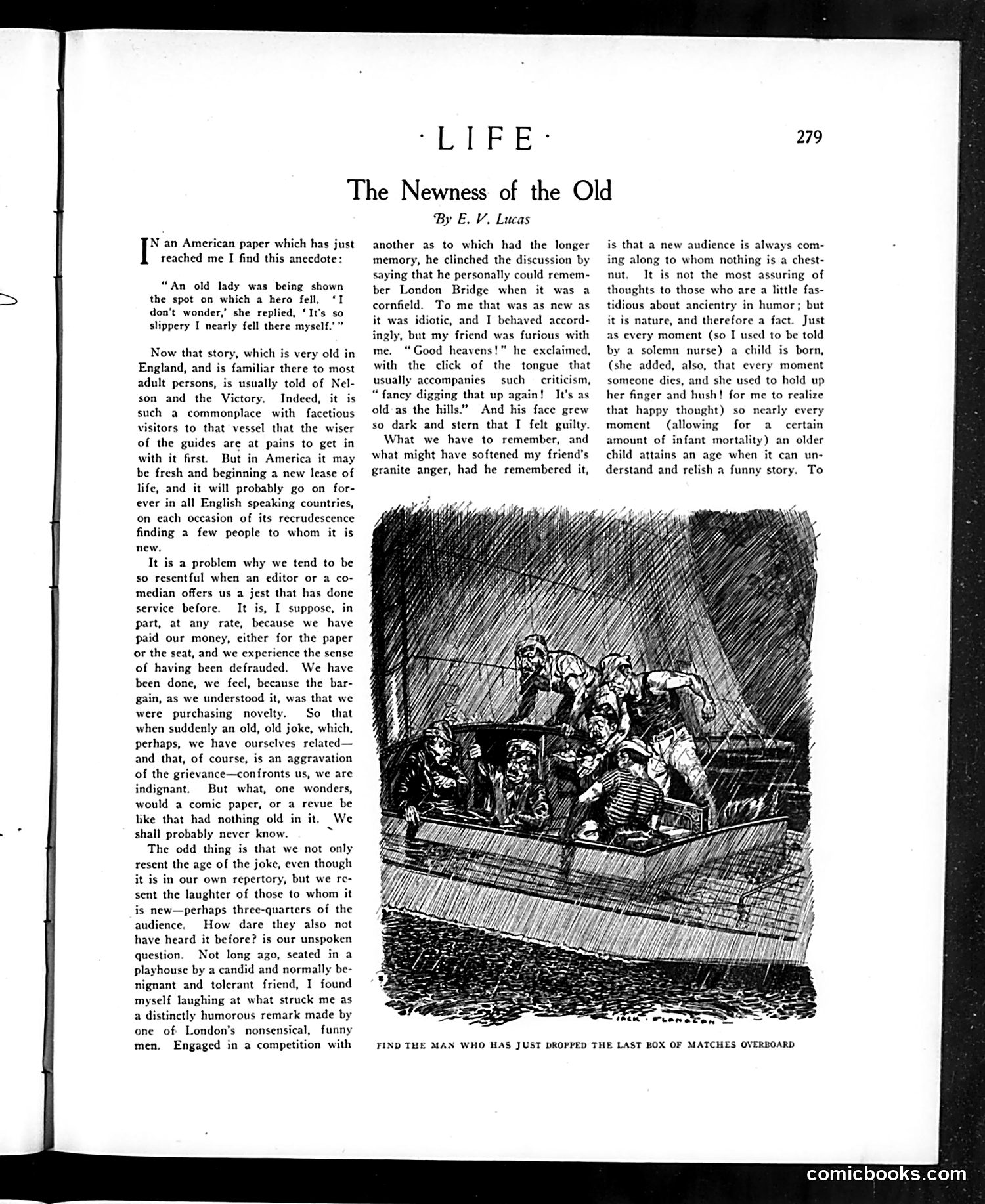
This essay critiques our resentment toward recycled humor. Lucas argues that old jokes feel like fraud when we pay for entertainment, yet this resentment is illogical—new audiences constantly arrive for whom "nothing is a chestnut" (slang for old joke). The accompanying illustration depicts a chaotic boat scene with multiple figures, captioned "FIND THE MAN WHO HAS JUST DROPPED THE LAST BOX OF MATCHES OVERBOARD." This is itself an old riddle/joke—a visual gag showing pandemonium where everyone looks equally guilty, making identification impossible. **The satire is meta:** by illustrating an ancient joke while discussing why we resent ancient jokes, Lucas demonstrates his own point. The puzzle-picture was a popular Victorian parlor game format that likely felt "new" to many readers despite its age, proving Lucas's thesis that generational turnover constantly refreshes stale material.
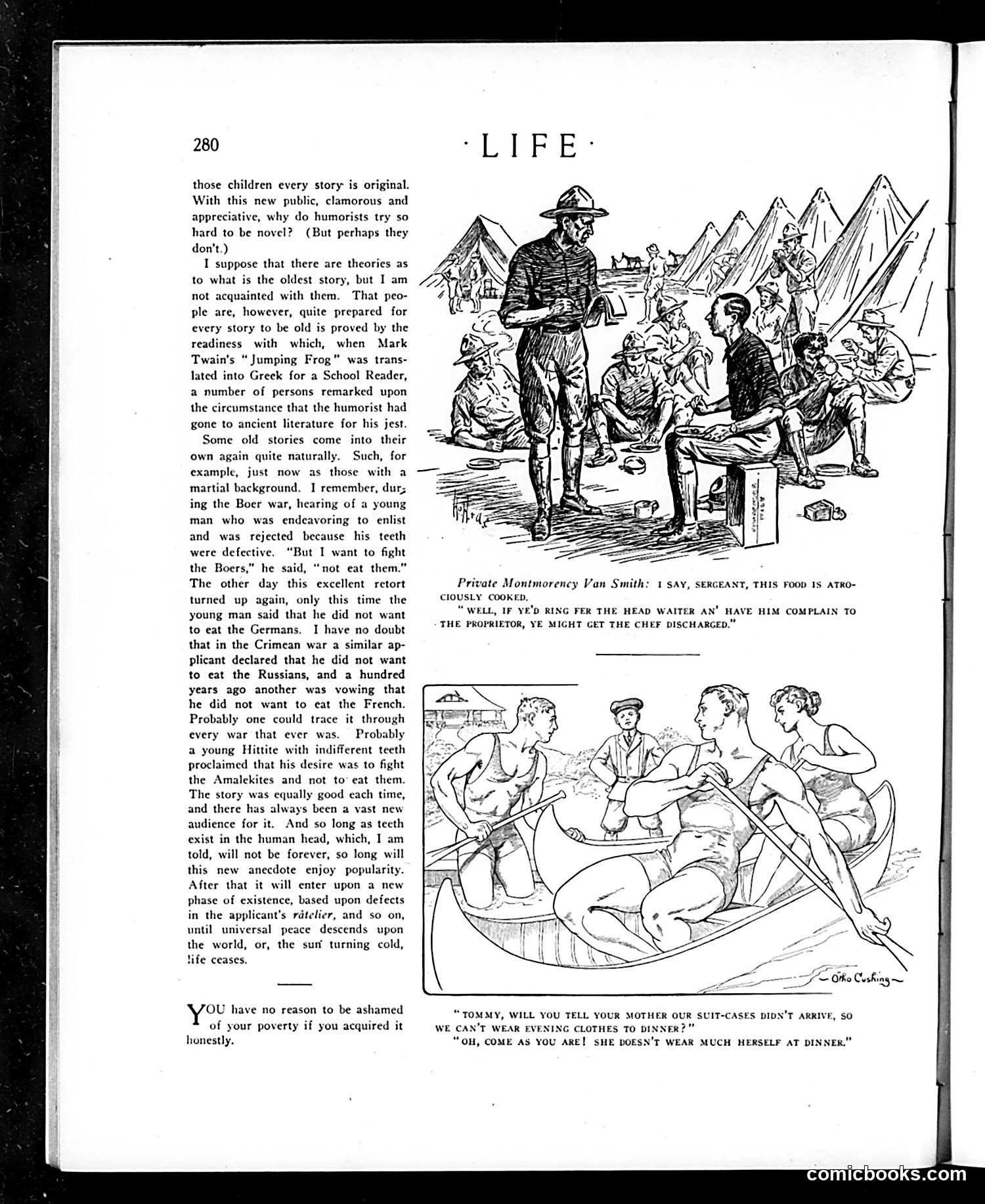
This page satirizes the recycling of old stories across generations, particularly jokes tied to military conflicts. The essay notes that a joke about a recruit with bad teeth wanting to fight enemies "not eat them" has appeared during the Boer War, and now resurfaces during WWI (the "Germans" reference), likely having circulated through the Crimean War and Napoleonic conflicts. The satire suggests this anecdote will persist as long as dentition exists. The two cartoons mock social pretension. The upper cartoon shows "Private Montmorency Van Smith," a soldier with an aristocratic name complaining about military food quality—the sergeant's response mocks his entitled expectation of restaurant service standards. The lower cartoon depicts wealthy characters worrying about formal dinner attire when suitcases went missing, with a child's innocent reminder that his mother doesn't dress formally either. Both ridicule upper-class affectations clashing absurdly with actual circumstances.
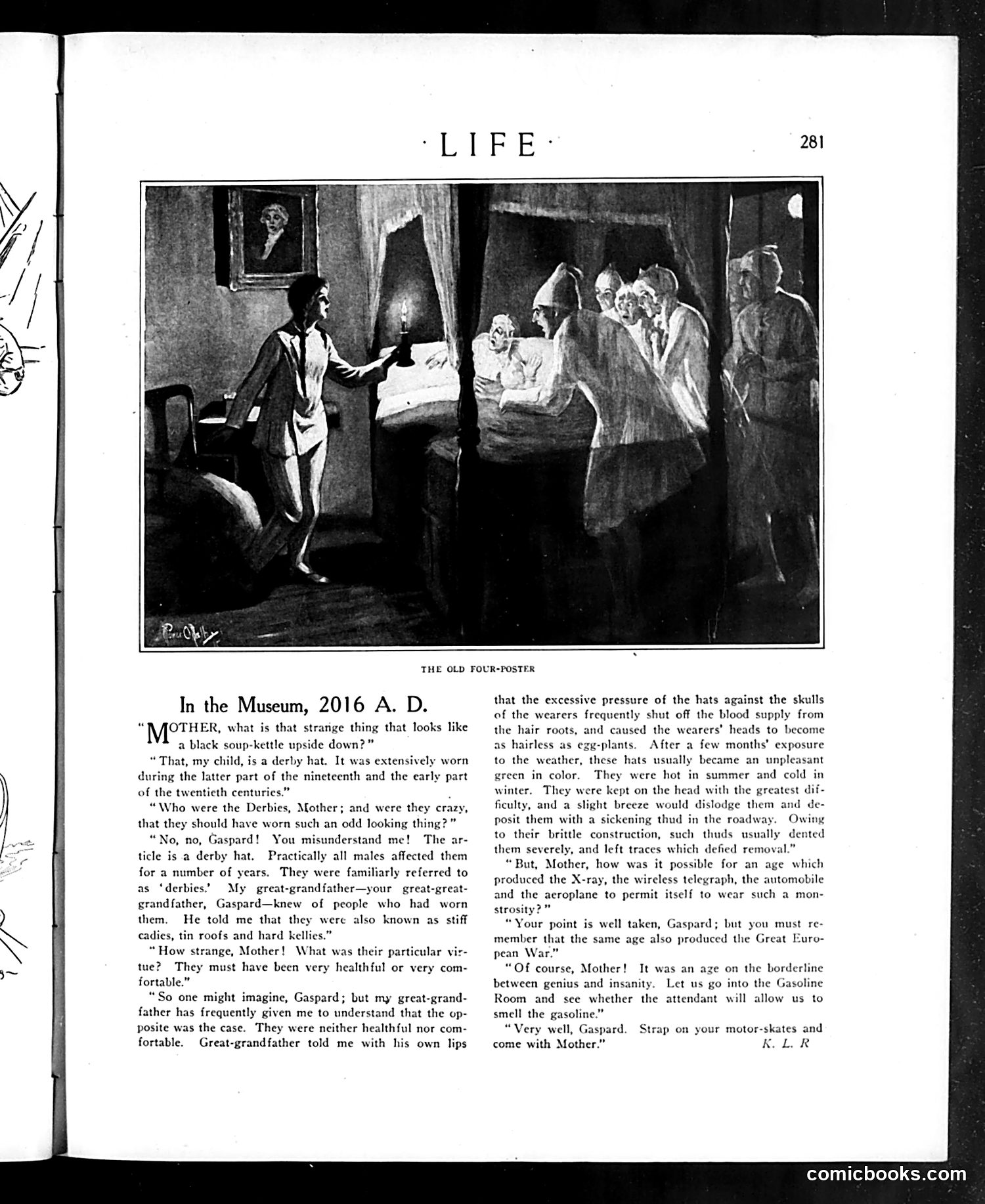
This piece satirizes the derby hat, a ubiquitous symbol of early 20th-century masculinity. Set in a future museum (2016), a mother explains to her son Gaspard why men wore these impractical hats despite technological progress. The satire works on two levels: it mocks the derby's obvious discomforts (causing baldness, breaking easily, flying off in wind, uncomfortable in all weather) while simultaneously critiquing the era's contradictions. The punchline—that an age producing X-rays, wireless telegraphs, automobiles, and aeroplanes also produced the derby hat AND World War I—suggests that modern "progress" coexists with absurdity and destruction. By framing this as future anthropology, the author ridicules both fashion conformity and the pretensions of technological advancement. The mention of "motor-skates" and "gasoline rooms" emphasizes the satirist's skepticism about what future society will find equally ridiculous about the present day.
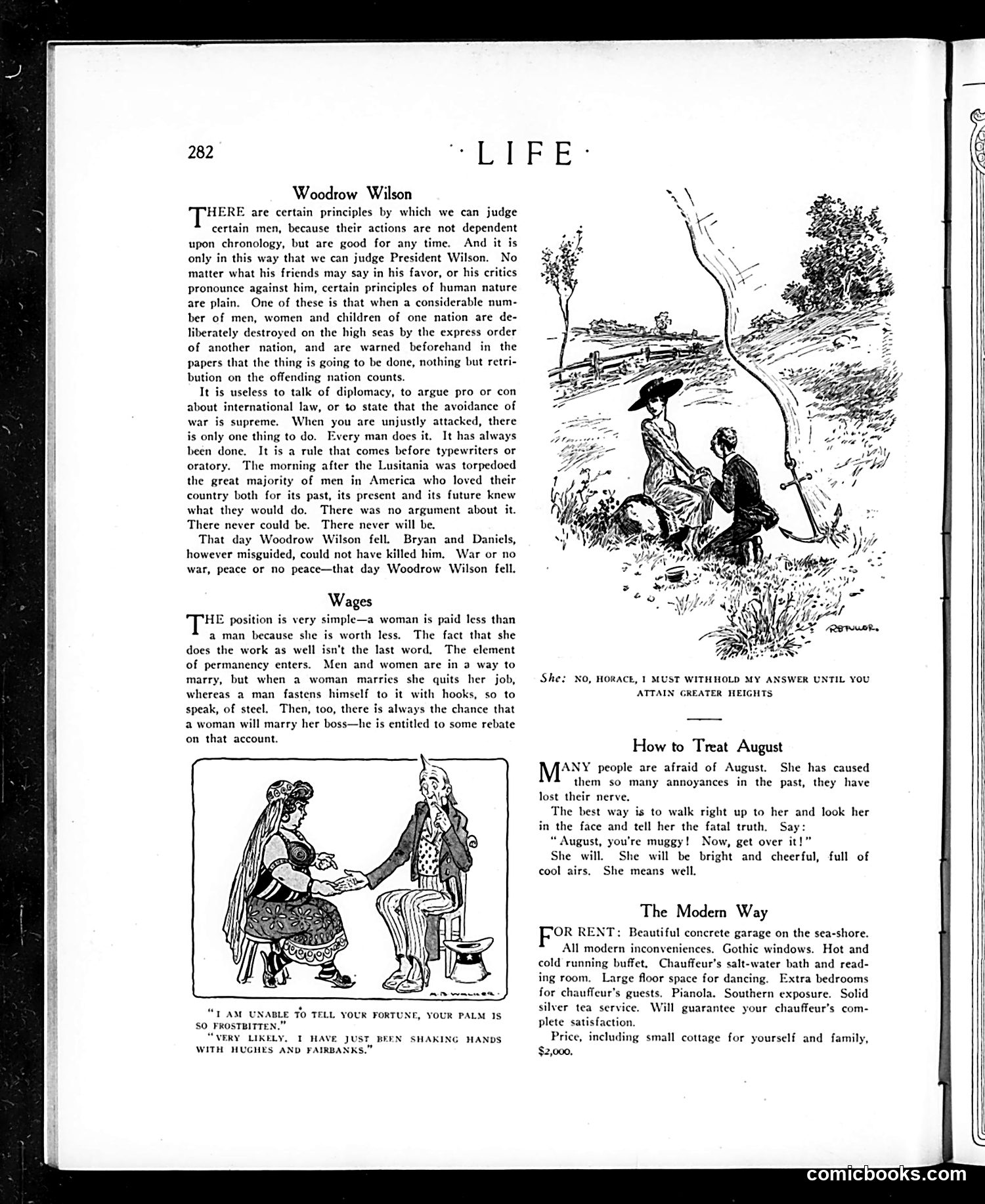
This 1915 *Life* page contains editorial and satirical content attacking President Woodrow Wilson's response to the Lusitania sinking (May 1915), when a German U-boat torpedoed the British passenger ship, killing nearly 1,200 civilians including Americans. **The Wilson essay** argues Wilson failed morally by not immediately declaring war. The author claims "the morning after the Lusitania was torpedoed," Americans knew retribution was necessary—yet Wilson pursued diplomacy instead. The verdict: "That day Woodrow Wilson fell." **The fortune-teller cartoon** mocks Wilson indirectly through a palm-reader telling a client she cannot read his palm because it's "frostbitten"—a dig at Wilson's cold diplomatic response when "hot" military action was demanded. **"Wages"** satirizes gender pay discrimination as economically rational, since women supposedly quit after marriage while men are "fastened" to jobs permanently. The remaining items are lighter satire about August (personified) and absurdist real-estate humor.
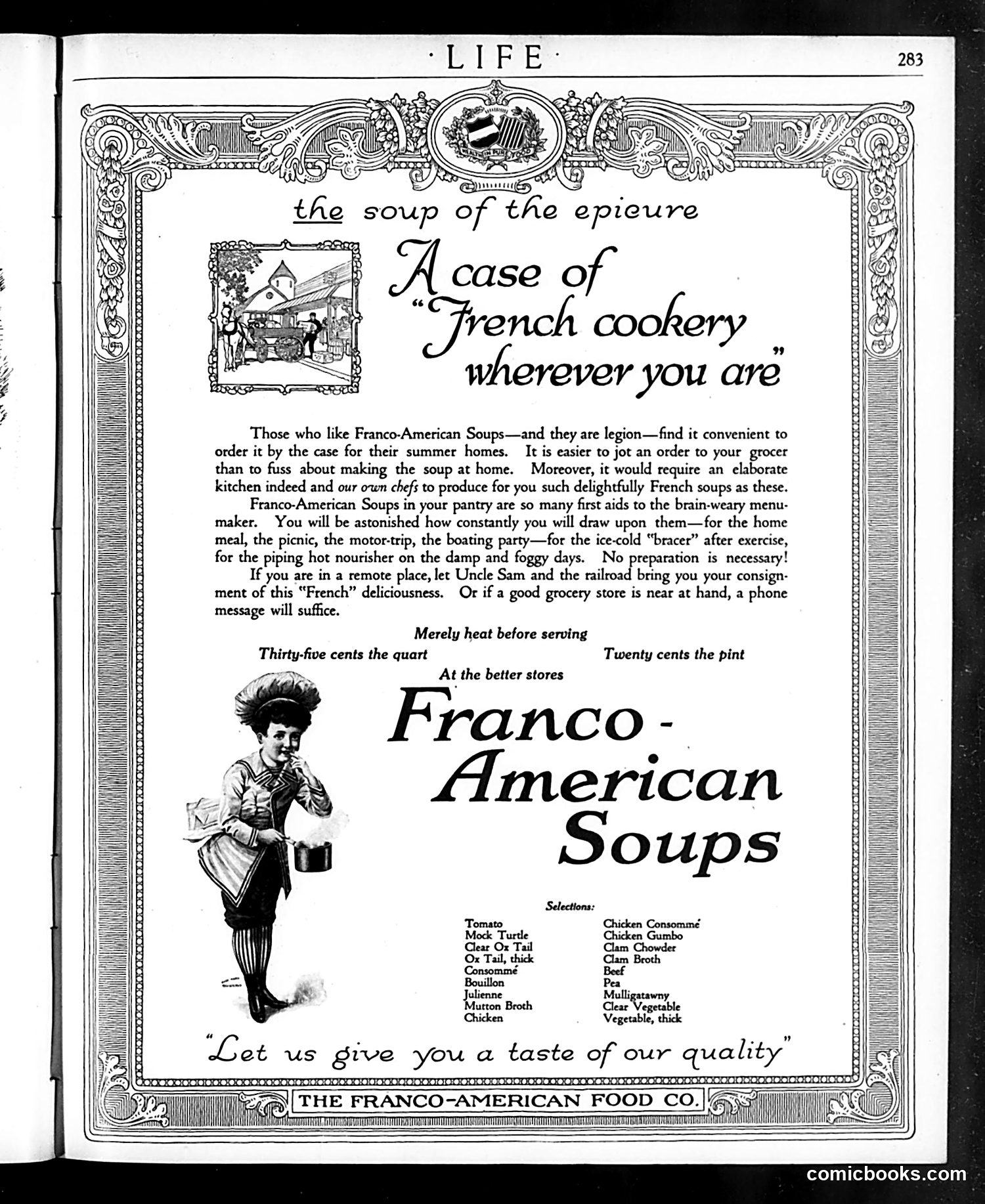
This is a **full-page advertisement**, not satire or political commentary. It promotes Franco-American Soups, a commercial product marketed to Americans desiring convenient "French" cuisine. The illustrated figure is a stylized **French chef** character—a common advertising trope of the era—meant to evoke sophistication and authenticity. The pitch emphasizes *convenience* for middle-class consumers: canned soups arrive by mail or grocer delivery, eliminating actual cooking labor. The humor (mild for modern readers) lies in the marketing's irony: these mass-produced American canned soups are marketed as "French delicacies" requiring no skill, no "elaborate kitchen," and minimal heating. The ad targets busy housewives and vacation-home owners seeking the *appearance* of culinary refinement without actual effort. Prices listed (35¢ quart, 20¢ pint) reflect early 20th-century costs. The page reflects period attitudes about gender, convenience, and commercialized aspirations to European sophistication.
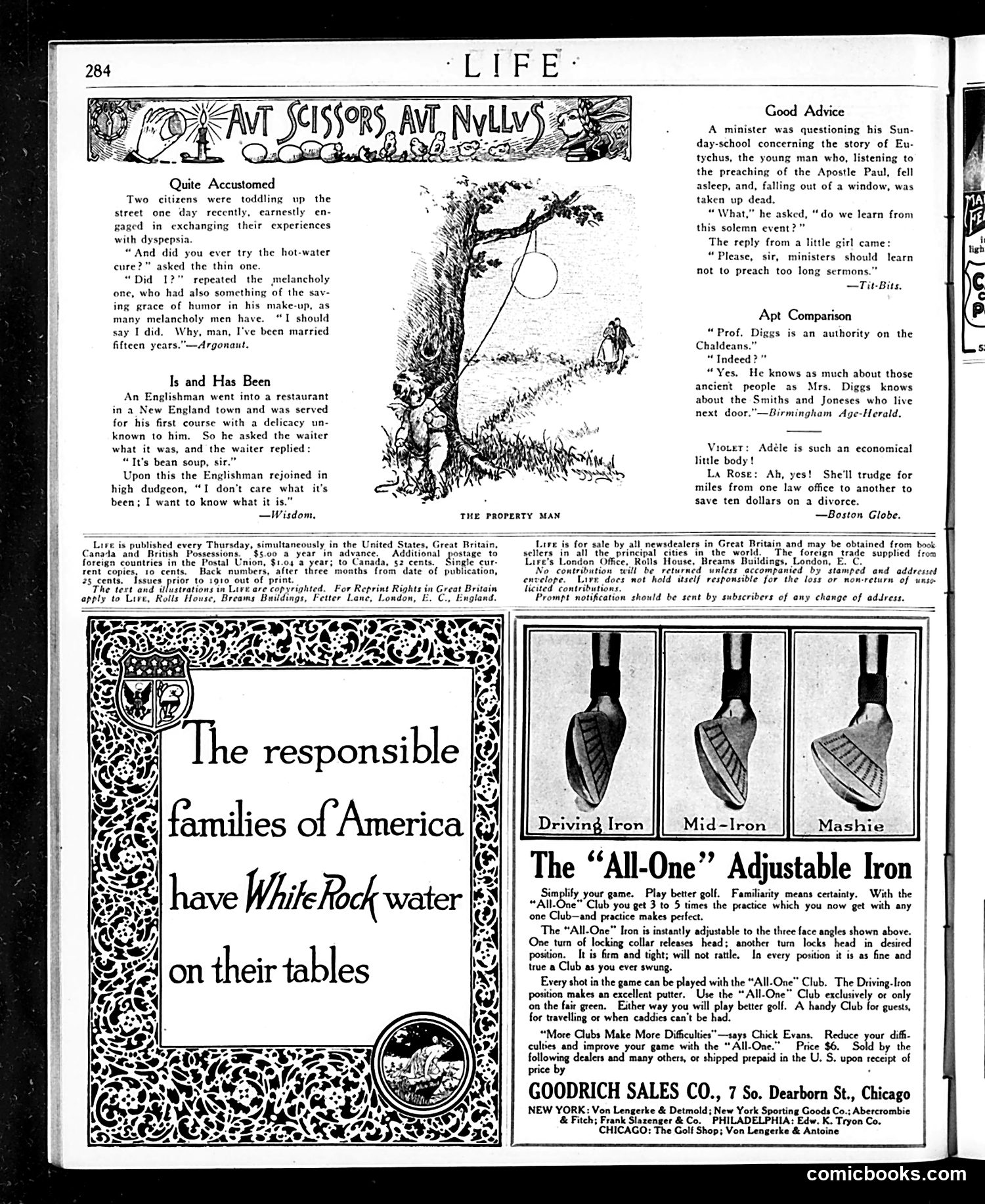
This page contains three brief humorous anecdotes typical of early 20th-century American humor magazines: **"Quite Accustomed"** jokes that marriage itself is a "hot-water cure" for dyspepsia—implying marital stress causes digestive troubles. **"Is and Has Been"** plays on British formality: an Englishman, served bean soup, pedantically insists on knowing what it *is* currently, not what it *has been*, missing the obvious pun entirely. **"Good Advice"** features a Sunday school lesson where a child concludes that preachers should give shorter sermons (referencing the biblical Eutychus who fell asleep during St. Paul's lengthy sermon and died). The page is primarily **advertising-heavy**, featuring White Rock water and an "All-One" adjustable golf iron prominently. The cartoons are mild domestic and workplace humor reflecting period anxieties about marriage, British eccentricity, and clerical verbosity—nothing politically charged or requiring specialized historical knowledge beyond recognizing these as common satirical targets of the era.
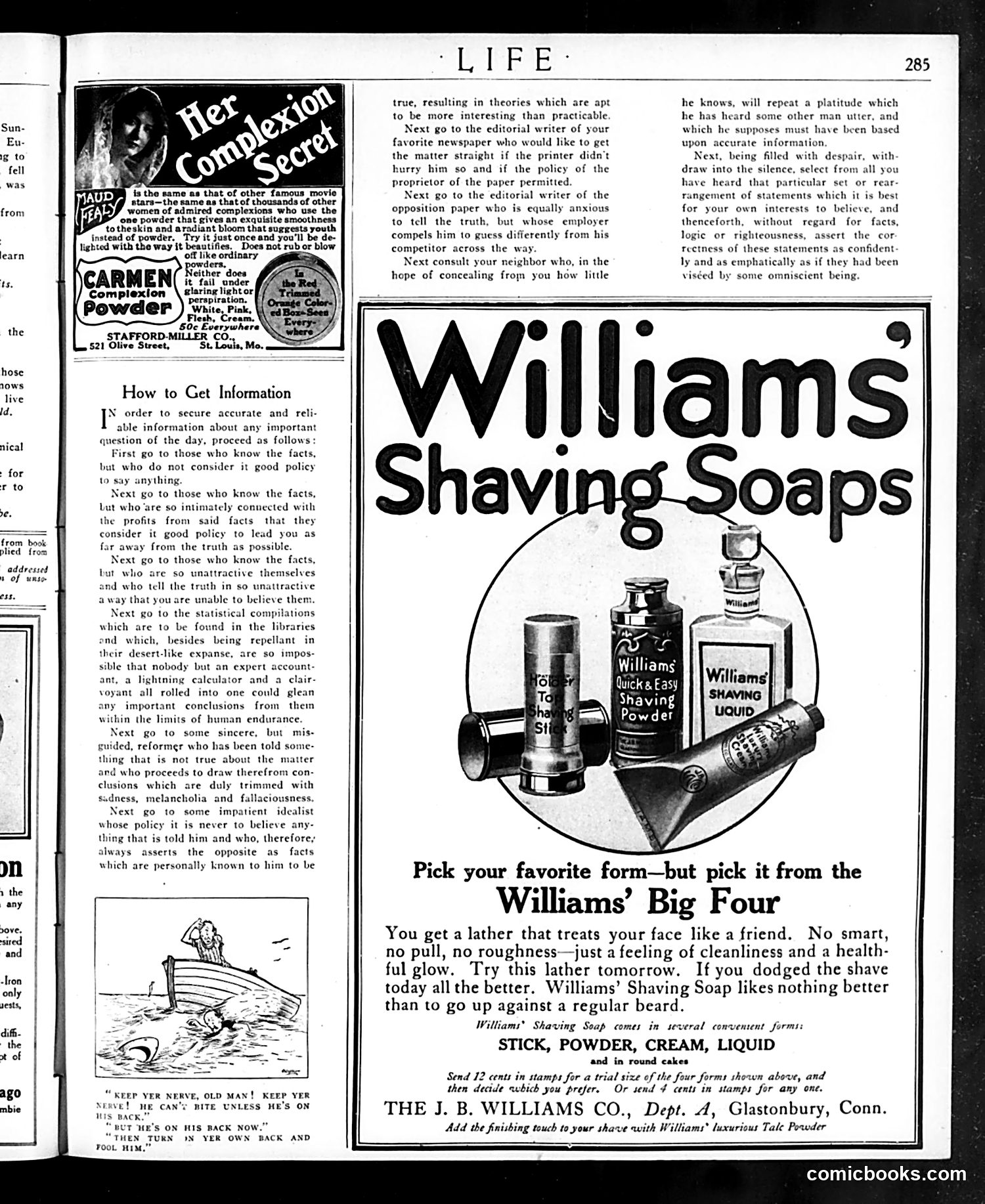
This page features a cynical satirical essay titled "How to Get Information," which mocks the difficulty of finding truth in early 20th-century America. The author sardonically lists sources in descending order of usefulness: those with facts but won't share them, those profiting from concealing facts, those telling truth unattractively, statistical compilations too complex to parse, misguided reformers, idealistic skeptics, editorial writers constrained by newspaper politics and owners, and finally one's misinformed neighbor. The punchline: after exhausting all sources, the reader should simply retreat into silence and believe whatever serves their personal interests—then defend it as confidently as if divinely ordained. The accompanying cartoon depicts a man in a small boat, apparently struggling, with dialogue suggesting he's unable to escape his circumstances. The page also contains period advertisements for Carmen Complexion Powder and Williams' Shaving Soaps, typical of Life magazine's revenue model.
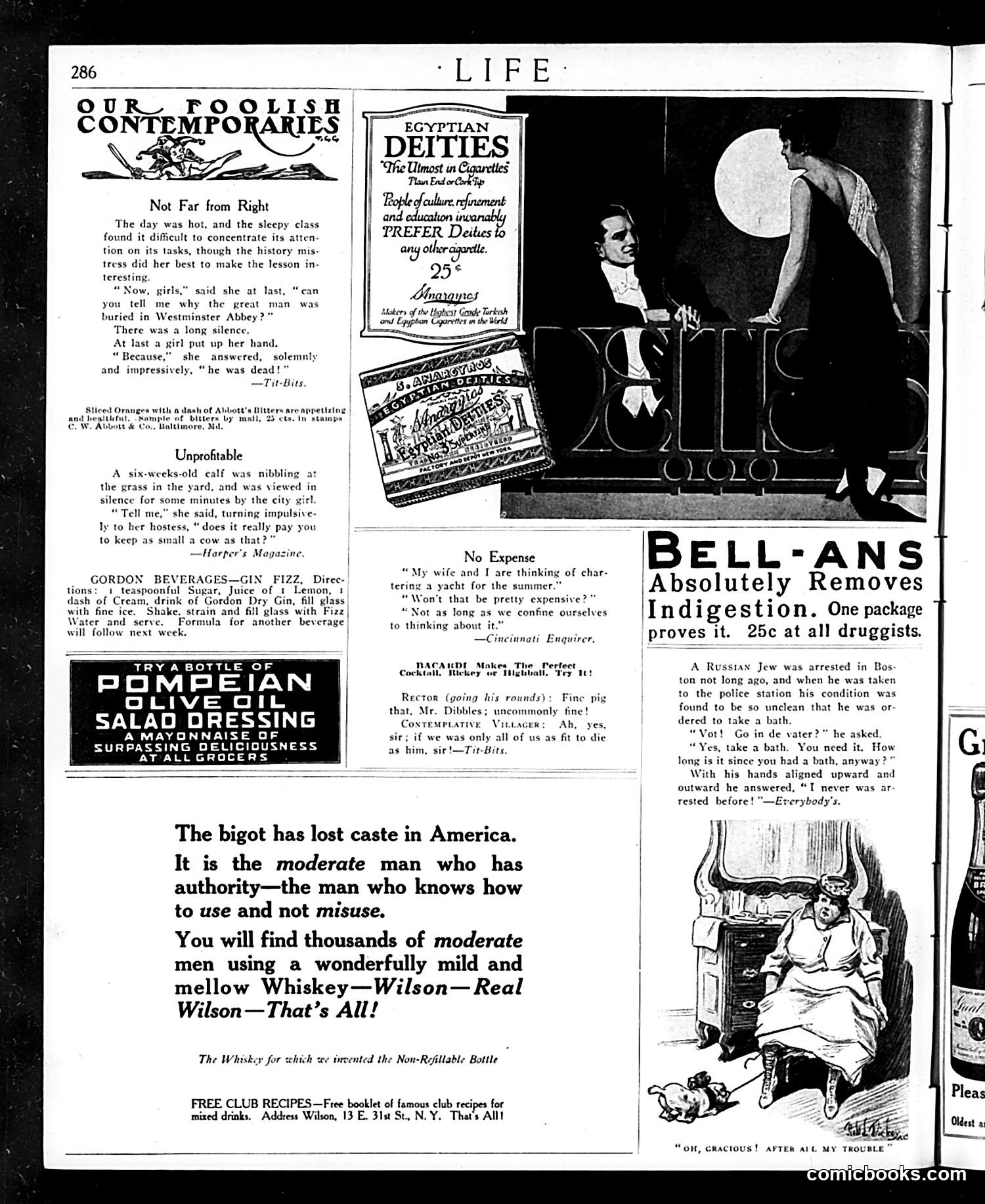
This page features several short humorous anecdotes typical of early 20th-century American satire magazines: **"Not Far from Right"** mocks schoolgirl logic—a history teacher asks why a great man was buried in Westminster Abbey; a student answers literally: "because he was dead." **"Unprofitable"** satirizes urban ignorance. A city visitor, seeing a small calf, naively asks a farmer if keeping such a small cow is profitable—missing the obvious point that calves grow into larger animals. The Russian immigrant anecdote at bottom ridicules both anti-immigrant prejudice (assumptions about Jewish cleanliness) and stereotyped dialect humor. When ordered to bathe, the character responds he's "never been arrested before"—implying police stations typically subject immigrants to such humiliating treatment. The page is primarily **advertising**—Egyptian Deities cigarettes, Wilson whiskey, Pompeian olive oil, Bell-ans antacid, and Gordon beverages dominate. The humor pieces serve as editorial filler between advertisements, typical of Life's format during this era.
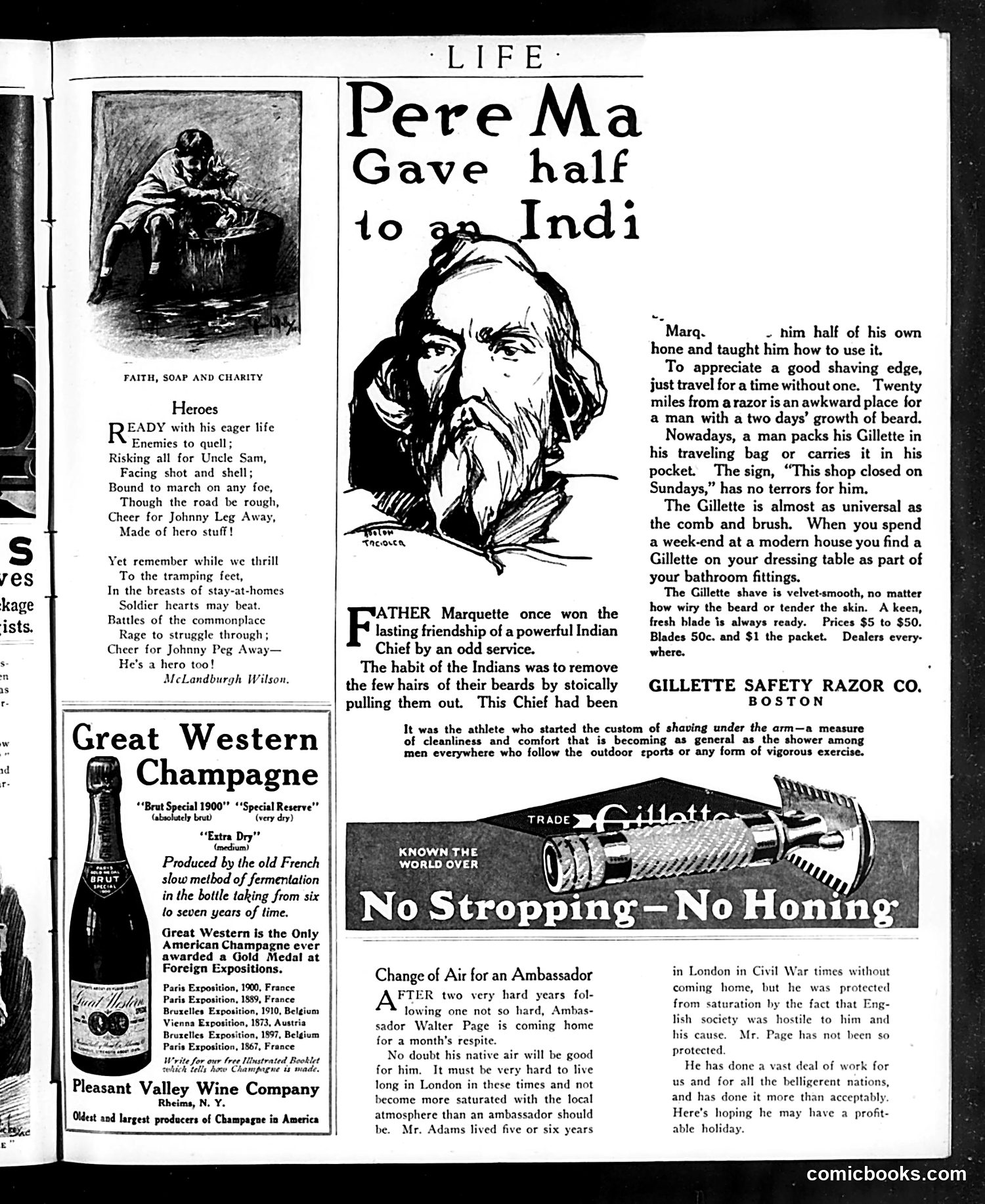
This page blends patriotic poetry, historical anecdote, and advertising. **The Poetry ("Heroes"):** McLandburgh Wilson's verse celebrates both soldiers fighting for "Uncle Sam" and civilian "heroes" performing everyday duties—a wartime morale-boosting message emphasizing that heroism exists on the home front too. **The Historical Anecdote ("Pere Ma Gave half to an Indi"):** The Father Marquette story illustrates how sharing practical knowledge (shaving) builds cross-cultural friendship. It's a colonial-era tale of ingenuity and generosity. **The Gillette Advertisement:** This hijacks the Marquette anecdote to market safety razors. It argues that modern men carry Gillettes as standard equipment, just as Marquette's innovation impressed the Chief. The ad also references underarm shaving as an "athletic" hygiene trend spreading among active men. **The Ambassador Item:** Notes Walter Page's diplomatic service in London during WWI and his upcoming home leave—framed as deserved rest after difficult work. The page mixes edification, nostalgia, and commerce typical of *Life*'s approach.
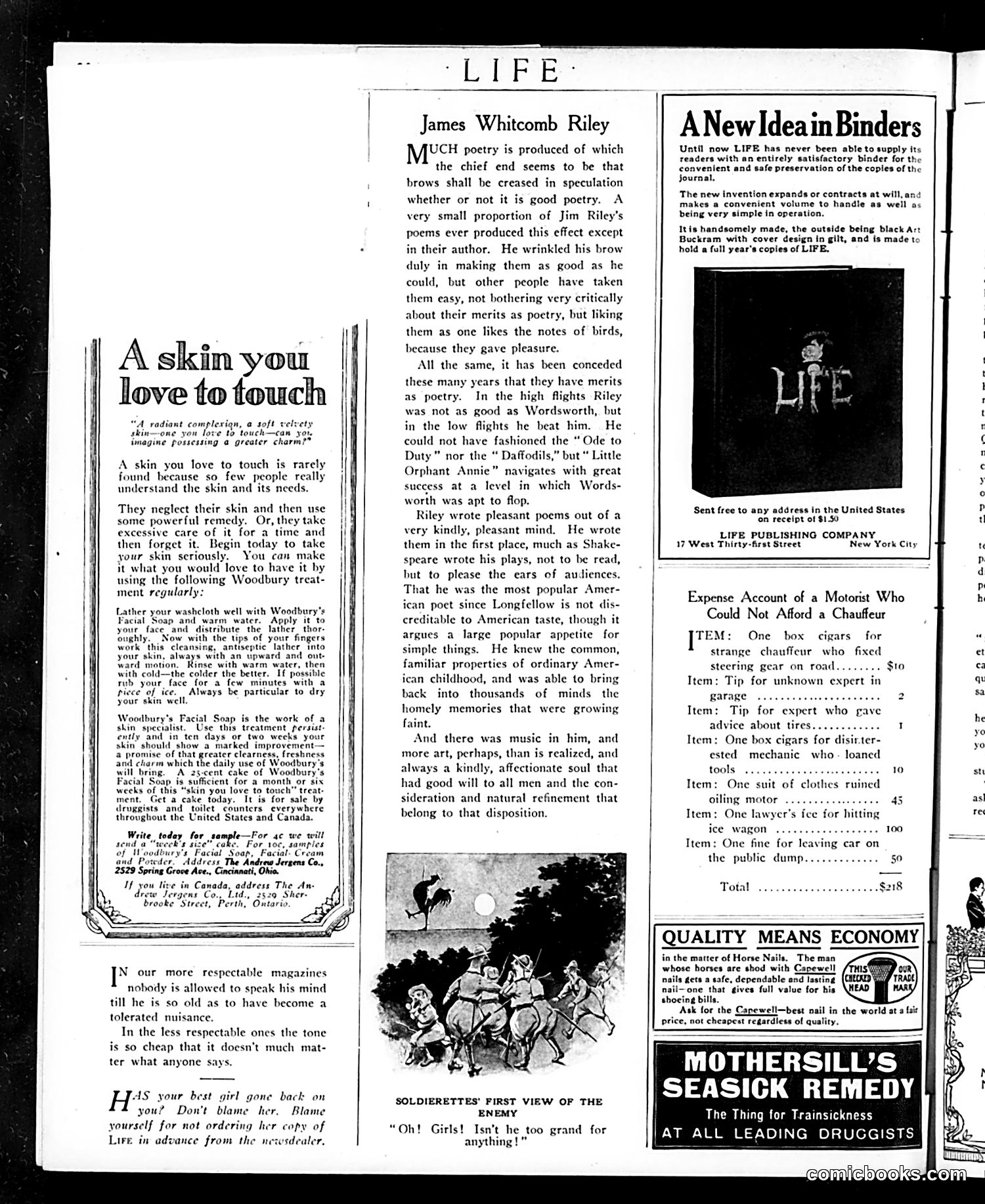
This page contains **primarily advertisements and editorial content**, not political satire in the traditional sense. The main cartoon depicts "**Soliderettes' First View of the Enemy**"—women in military uniforms observing armed soldiers, with one exclaiming "Oh! Girls! Isn't it too grand for anything!" This appears to satirize **women's romanticized or naive attitudes toward military combat**, mocking both the reality of warfare and contemporary attitudes about female military participation (likely WWI-era, given the context). The rest of the page features: - **Woodbury's Facial Soap advertisement** (left column) - An **obituary/tribute to poet James Whitcomb Riley** (center), praising his accessible, popular verse - Various other commercial advertisements for binders, horse nails, and seasickness remedy The page reflects **early 20th-century commercial and cultural values**: beauty standards, literary taste, and gender roles, rather than sharp political commentary.
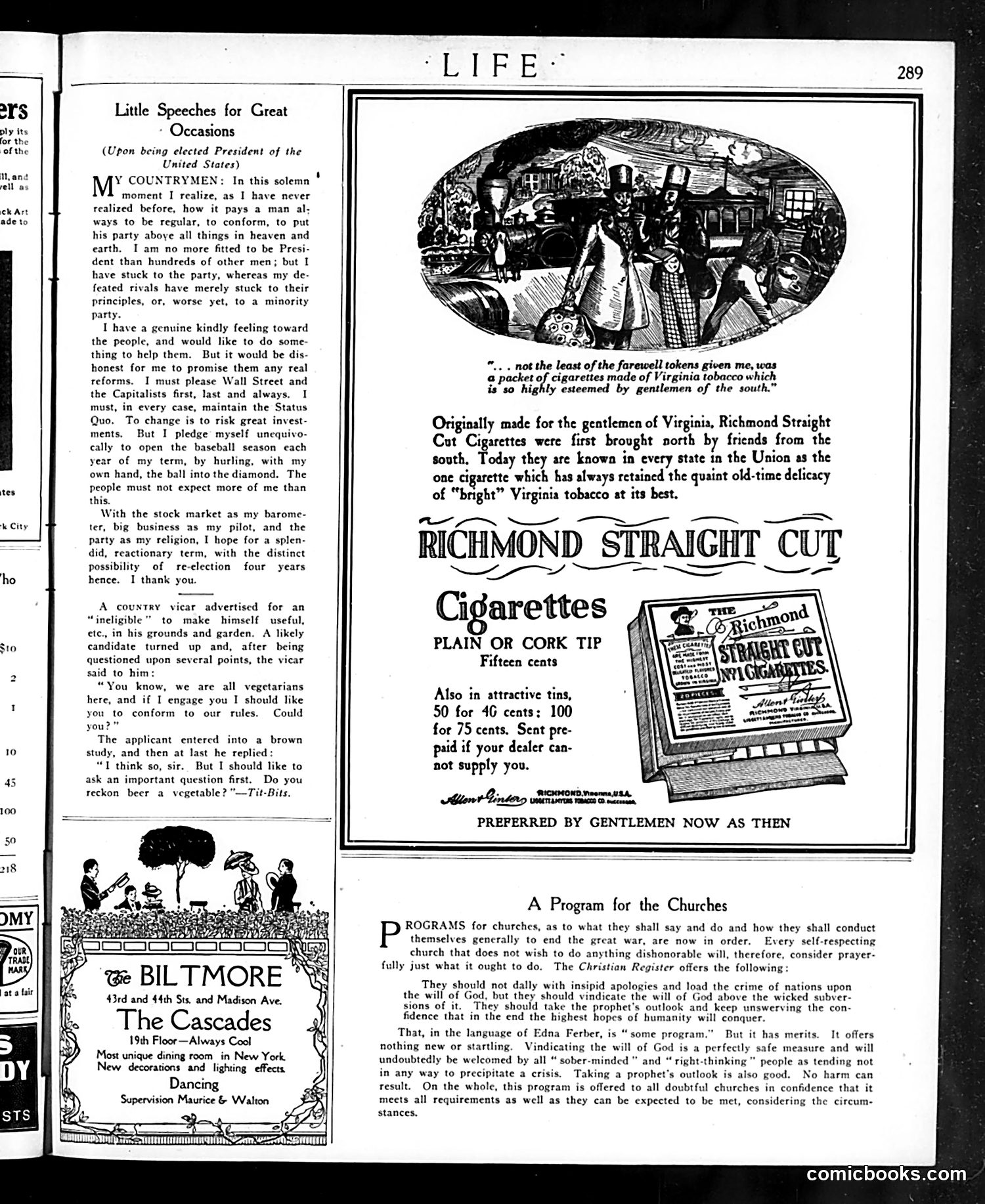
This page contains satirical commentary on American politics and capitalism, alongside period advertising. **"Little Speeches for Great Occasions"** mocks newly-elected presidents. The fictional inaugural address satirizes political compromise: the speaker admits being no more qualified than others but "stuck to the party" while rivals stuck to "principles." He pledges loyalty to Wall Street and the status quo over actual reform, promising only to open the baseball season annually. The satire targets how politicians prioritize party loyalty and capitalist interests over substantive change. A secondary joke about a vicar hiring a gardener plays on class assumptions—the applicant asks if beer counts as vegetable, suggesting working-class pragmatism versus upper-class pretension. **The bottom section** offers church guidance for WWI-era America, advising churches to vindicate God's will rather than making excuses—relatively conventional wartime rhetoric. The **Richmond Straight Cut cigarette advertisement** dominates the right side, claiming the product represents "old-time delicacy" and gentlemanly tradition.
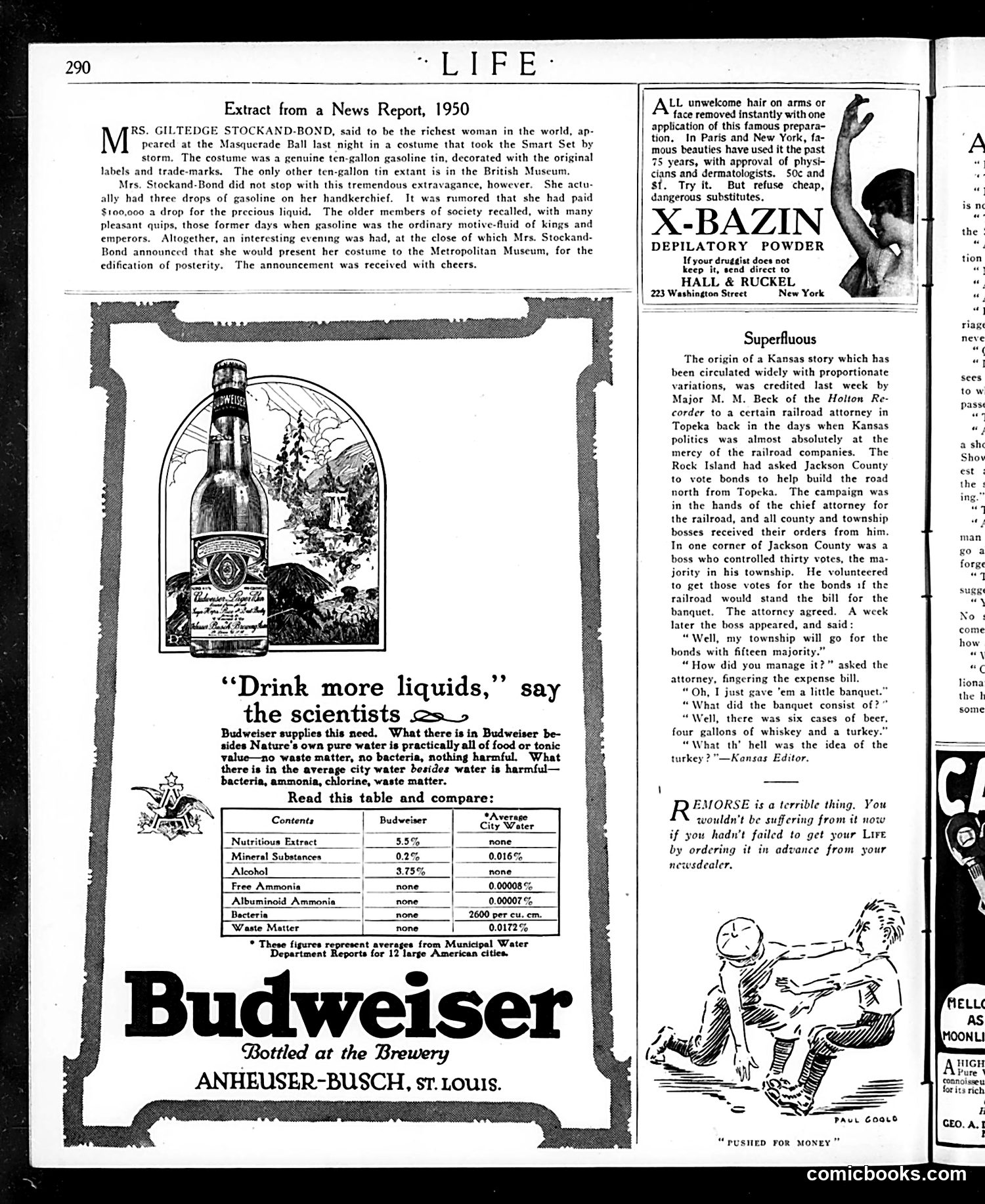
This page contains two distinct pieces of satire: **The Masquerade Ball Story** (top): A fictional news item mocking post-WWII wealth disparity and resource scarcity. It depicts an absurdly rich woman ("Mrs. Giltedge Stockand-Bond") wearing a gasoline can as a costume—a jab at fuel rationing that had recently ended. The joke hinges on gasoline having been precious during wartime/immediate postwar shortages; now wealthy elites can afford it as a frivolous fashion statement. References to "those former days when gasoline was the ordinary motive-fluid of kings and emperors" sarcastically note the shift from genuine scarcity to decadent excess. **The Kansas Political Story** (middle): A historical anecdote about railroad lobbyists bribing a township boss with a banquet to secure bond votes. The punchline—that the banquet featured "four gallons of whiskey and a turkey"—reveals how cheaply political influence could be purchased, satirizing rural political corruption. The **Budweiser advertisement** below uses a scientific comparison table to promote beer as healthier than tap water, a common but dubious advertising claim of the era.
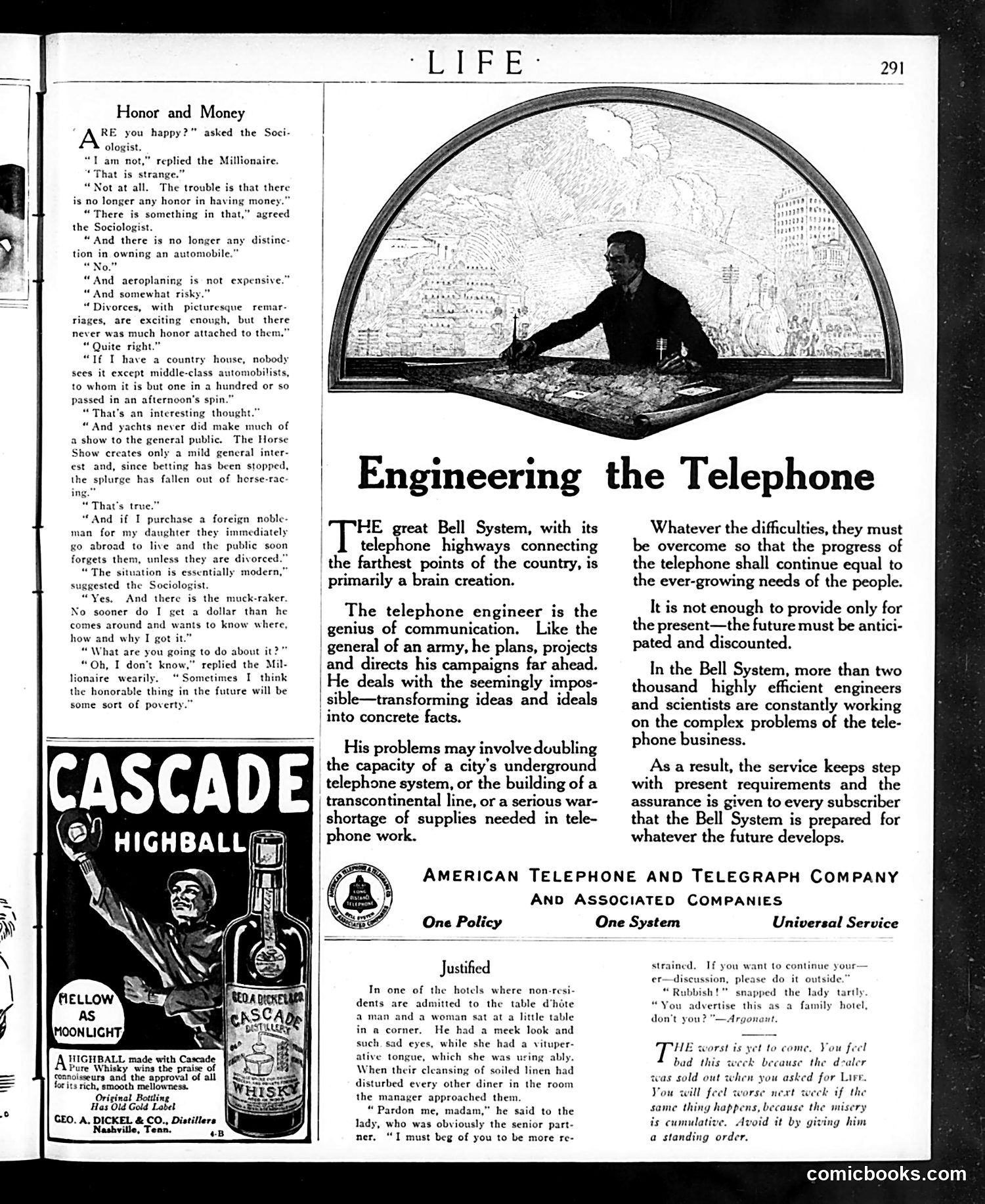
**"Honor and Money" Dialogue:** This satirical piece mocks wealthy industrialists' anxieties about status symbols losing prestige. A millionaire complains to a sociologist that money, automobiles, aeroplanes, divorces, country houses, and yachts no longer confer distinction—everyone has them now. The joke satirizes how mass consumption and democratization have stripped the ultra-wealthy of exclusive markers of superiority. The millionaire's final quip—that "the honorable thing in the future will be some sort of poverty"—is ironic commentary on how privilege loses meaning when widespread. **"Engineering the Telephone" Advertisement:** This is corporate propaganda for AT&T, celebrating telephone engineers as visionary "geniuses of communication" solving complex infrastructure problems. It emphasizes the Bell System's forward-thinking investment in future capacity, positioning AT&T as an essential public service constantly improving. **"Justified" Anecdote:** A brief humor piece about a hotel manager reproaching a loud, quarrelsome woman at dinner; she retorts that the hotel advertises table d'hote service (suggesting noise is implicit to shared dining). The page combines social satire with advertising and light humor typical of early 20th-century Life magazine.
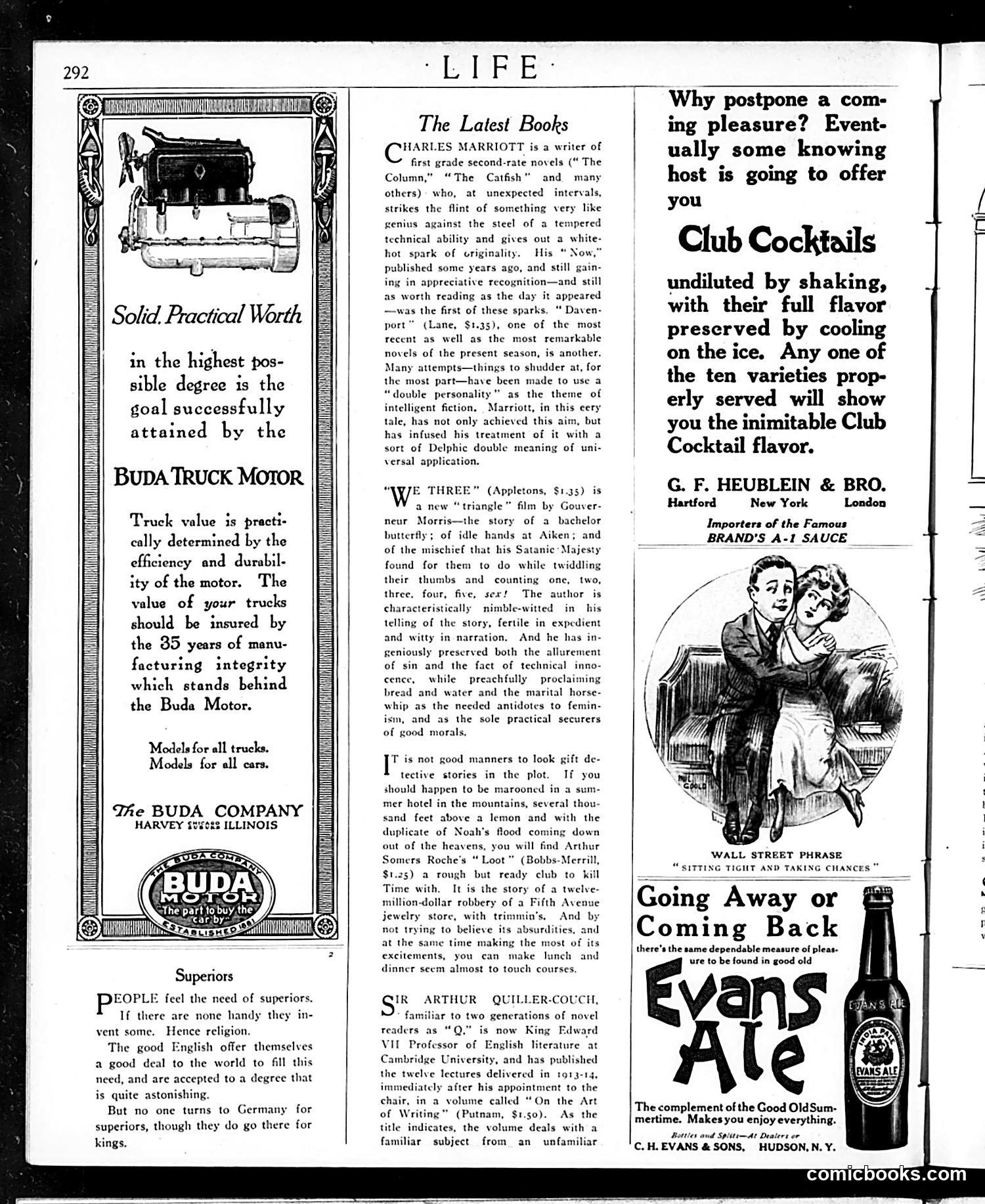
This page is primarily **advertising and book reviews**, not political satire or editorial cartooning. The only potentially satirical content is the brief "Superiors" section, which mocks English cultural pretension. It argues that people invented religion to fulfill a psychological need for authority figures, and that the English have successfully marketed themselves as natural "superiors" to the world—yet ironically, no one looks to Germany for superiority, "though they do go there for kings." This is light social commentary on class consciousness and national stereotypes, likely written during or shortly after WWI when German prestige was diminished. The rest of the page contains straightforward book advertisements and reviews of novels by Charles Marriott, Arthur Somers Roche, and Sir Arthur Quiller-Couch, alongside advertisements for Buda truck motors, Club Cocktails, Evans Ale, and Brand's A-1 Sauce.
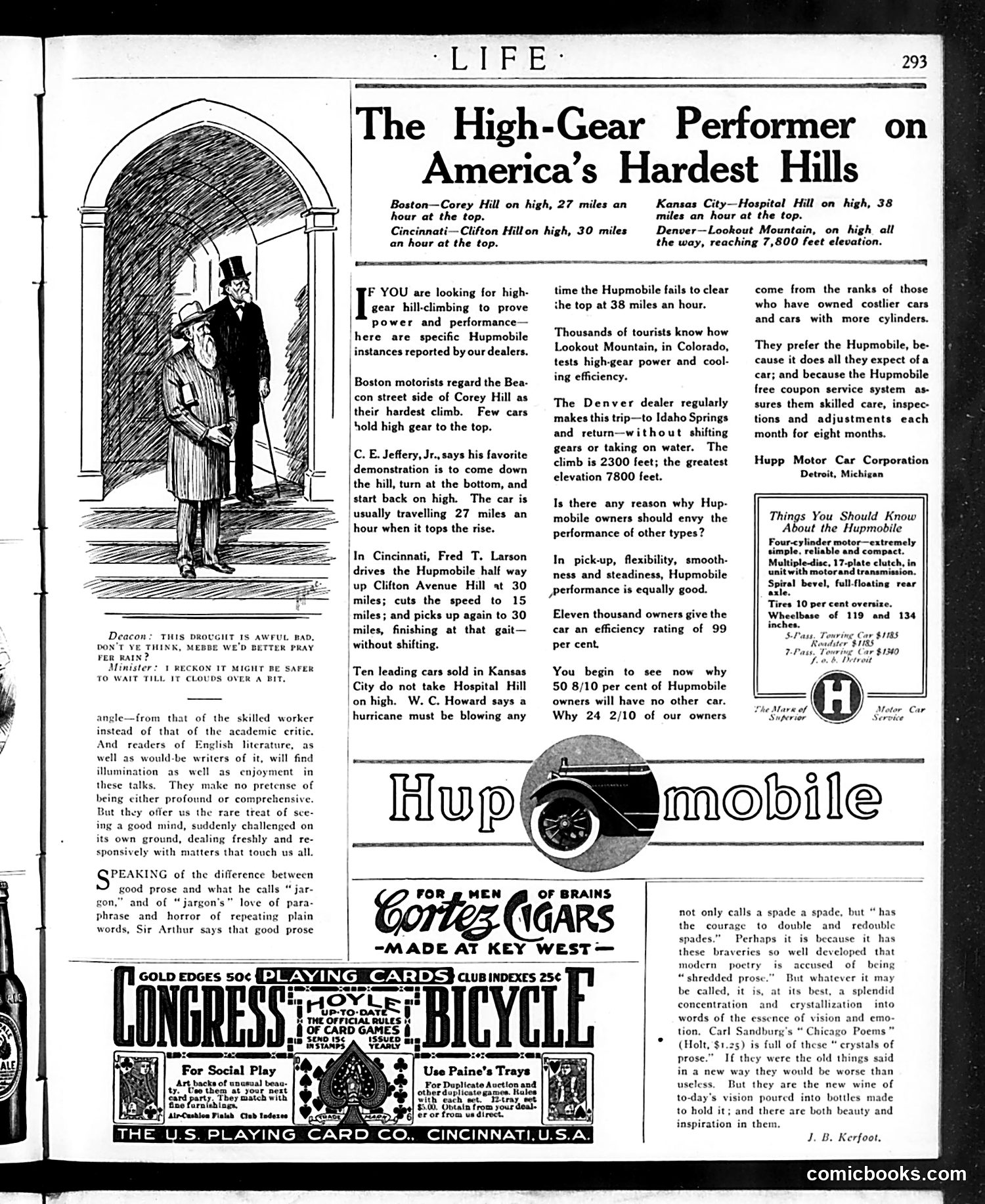
This page is primarily **advertising for Hupmobile automobiles**, not political satire. The main content demonstrates the car's hill-climbing power by listing specific American hills (Boston's Corey Hill, Cincinnati's Clifton Avenue Hill, Kansas City's Hospital Hill, Denver's Lookout Mountain) where Hupmobile dealers claim their vehicles successfully navigate at high gear. The small cartoon labeled "Deacon" is a mild joke: a clergyman tells another man it's safer to wait for rain clouds than to pray for relief from drought—a gentle religious humor playing on faith versus practical observation. The advertisement emphasizes the Hupmobile's performance advantages: eleven thousand owners rate it 99% efficient, and it outsells competitors. Supporting text argues why owners prefer it over costlier, multi-cylinder cars, highlighting reliability and company service. Additional advertisements for Cortez Cigars and Congress Playing Cards appear at page bottom.
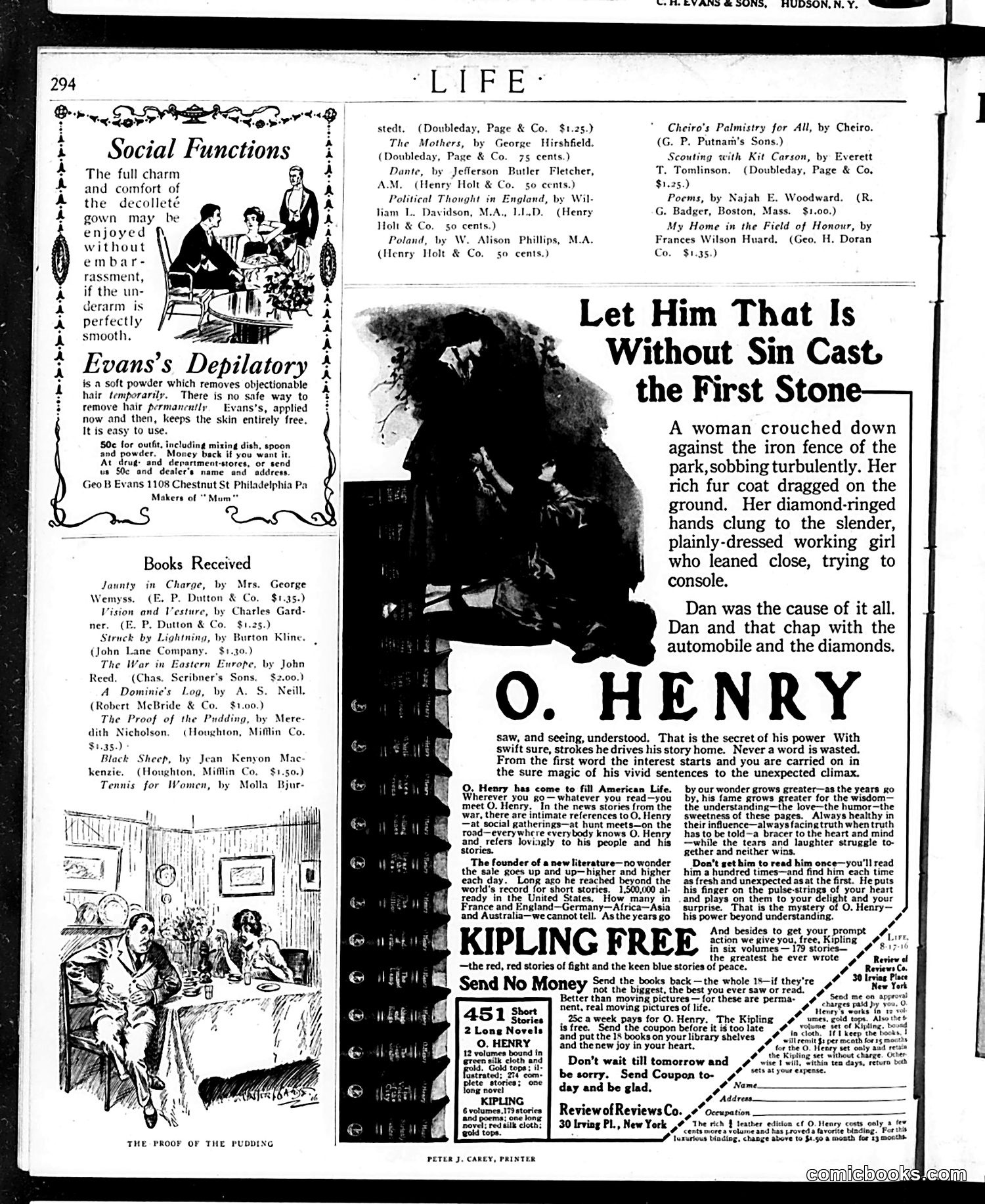
This page juxtaposes a satirical cartoon about social etiquette with a substantial advertisement for O. Henry's collected works. **The Cartoon:** "The Proof of the Pudding" (lower left) depicts a domestic scene where a woman serves pudding to a man at dinner. The accompanying text jokes that "the full charm and comfort of the decolleté gown may be enjoyed without embarrassment, if the underarm is perfectly smooth"—satirizing the vanity and social anxiety of fashionable women concerned with visible body hair when wearing low-cut dresses. This mocks both women's insecurity and the absurd beauty standards of the era. **The Advertisement:** The large O. Henry promotion features a dramatic photograph of a distressed wealthy woman consoling a working-class girl, illustrating a plot point from one of his stories. The ad emphasizes O. Henry's "understanding" and "love" of common people, positioning his short stories as America's most popular literature—having sold 1.5 million copies domestically with global reach. Together, the page reflects early 20th-century American consumer culture: one mocking frivolous social pretensions, the other celebrating populist fiction.